When discussing nuclear power plants, the image that often comes to mind—both among the general public and even among those within the nuclear community—is that of highly sophisticated nuclear reactors, massive concrete structures, and complex engineering systems that require extreme precision.
However, the experience of countries that have successfully developed nuclear power programs reveals another essential truth: the success of nuclear energy systems does not depend on technology alone. Rather, it depends fundamentally on the capability of the people who manage, operate, and regulate these systems so that they function safely and effectively.
From this perspective, a nuclear power program should not be understood merely as a power plant construction project. Instead, it should be recognized as a long-term national human resource development endeavor, one that requires sustained investment and institutional commitment over several decades.
For Thailand, therefore, the key question is not simply whether the technology is ready. The more important question is this: when the technology becomes available, will Thailand have a sufficiently prepared workforce capable of managing such a complex energy system over the long term?
Human Resources: The Most Critical Infrastructure
According to the framework of the International Atomic Energy Agency (IAEA), countries intending to develop nuclear power must establish readiness across 19 infrastructure issues, covering areas such as legal frameworks, regulatory systems, safety management, radioactive waste management, and public engagement.
Among these issues, human resource development is listed as Infrastructure Issue No. 10. In practice, however, it functions not merely as one item on the list but rather as the central pillar of the entire system.
The reason is straightforward. Every one of the remaining eighteen infrastructure areas ultimately depends on qualified professionals who possess not only technical expertise but also a deep understanding of safety culture—individuals capable of making responsible decisions, performing regulatory oversight, and operating complex technological systems.
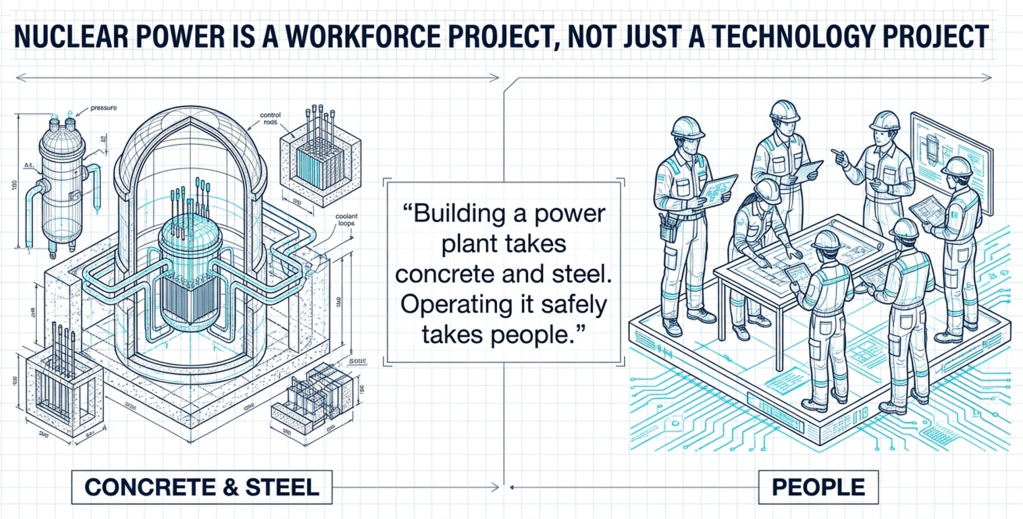
Without capable personnel, even the most advanced technology cannot guarantee safe and reliable operation. This principle is captured clearly in a well-known expression within the nuclear community: “Building a nuclear plant takes concrete. Operating it safely takes people.”
A Common Misconception: The Role of Technical Personnel
In public imagination, nuclear power plants are often associated primarily with highly specialized nuclear scientists and engineers. Yet the actual workforce structure of a nuclear power plant tells a different story.
The largest group of personnel is not researchers but technical and maintenance staff.
A typical nuclear power plant unit—such as a 1000 MW facility—may require approximately 700 personnel. Among these, the majority work in maintenance and technical operations, including welders, electricians, and instrumentation and control technicians.
These professionals constitute the backbone of plant operations, because even small technical errors can have significant implications for safety and public confidence.
In this regard, Thailand may possess an important structural advantage. The country maintains a large vocational education system that produces significant numbers of technically skilled graduates each year. Consequently, the challenge is not necessarily to create an entirely new workforce, but rather to upgrade existing technical training to meet the rigorous standards required by the global nuclear industry.
SMR Technology and New Challenges in Workforce Development
The emergence of Small Modular Reactor (SMR) technology is transforming the development model of nuclear power plants in many countries.
Traditional nuclear plants often require 7–8 years of construction, whereas SMR designs aim to reduce construction time to approximately 3–4 years. While this offers advantages in project implementation, it also creates new challenges for workforce development.
Shorter construction timelines may reduce opportunities for on-site training during the plant construction phase.
To address this challenge, many countries have begun integrating digital training tools, including full-scope plant simulators and virtual training platforms, enabling personnel to gain operational experience before the plant begins operation.
This development highlights an important lesson: technological innovation alone is not sufficient without parallel investment in training systems and workforce preparation.
Strategic Development: From Technology Import to National Capability
Another critical dimension of nuclear development concerns the procurement model for technology.
Many countries adopt a turnkey project approach, in which foreign vendors design, build, and deliver the entire nuclear facility. While this model can accelerate project implementation, excessive reliance on turnkey procurement may leave the host country in the position of technology user rather than technology developer.
An alternative approach increasingly discussed in policy circles is the Hybrid Model, which combines technology importation with deliberate domestic capability development.
Under such a model, agreements with technology providers include explicit provisions for technology transfer, workforce training, and knowledge development.
This approach allows nuclear investment to generate long-term national capability, rather than functioning merely as a procurement of imported equipment.
Thailand’s Opportunity in the ASEAN Regional Context
Thailand’s geographic position—situated near the center of mainland Southeast Asia—combined with its long-standing academic expertise in nuclear science, regulatory capacity, and research infrastructure, provides a potentially important opportunity.
With institutions such as the Thailand Institute of Nuclear Technology (TINT) operating a research reactor and several universities offering nuclear-related education, Thailand may have the potential to evolve into a regional training hub for nuclear technology within ASEAN.
At a time when many countries in the region are beginning to explore nuclear power and SMR technologies, Thailand could contribute by strengthening regional cooperation in training, knowledge exchange, and safety standards.
An Often Overlooked Dimension: Building a Nuclear Professional Community
In nuclear engineering and nuclear technology more broadly, one realization becomes increasingly clear: nuclear technology is not merely a technical system. It is a system of knowledge, responsibility, and safety culture that must be cultivated through education, training, and professional experience across multiple generations.
Nuclear development therefore involves more than infrastructure or machinery. It requires the creation of a strong professional community composed of scientists, engineers, technicians, and regulators who share a common commitment to safety and responsibility toward society.
Investment in human resources is therefore not simply about staffing a single project. It is about building a long-term national knowledge system.
Conclusion: The Challenge of Time
Ultimately, the greatest challenge of nuclear power development may not lie in nuclear physics or advanced engineering, but rather in time and policy continuity.
A nuclear power plant typically operates for 60–80 years, and when preparation, construction, operation, and eventual decommissioning are considered together, the lifecycle of a nuclear program may extend close to a century.
Public policy cycles, however, often operate on timelines of only a few years.
Without sustained commitment, the “seeds” of human resource development may be lost through the migration of trained personnel and the erosion of institutional capacity.
For this reason, the success of nuclear energy in Thailand should not be measured solely by the selection of technology. It should be measured by the country’s ability to cultivate a workforce that possesses knowledge, responsibility, and a strong safety culture capable of safeguarding the nation’s energy systems over the long term.
In the global transition toward clean energy, the most important question may therefore not be whether Thailand should adopt nuclear power, but rather:
Is Thailand ready to invest seriously in developing the people who will sustain its energy future?
 Around Radiation Detectors
ใส่ความเห็น