1. Introduction
Modern nuclear science and engineering rely on specialized facilities capable of producing intense radiation fields and energetic particle beams. Among the most important of these technologies are research reactors and particle accelerators.
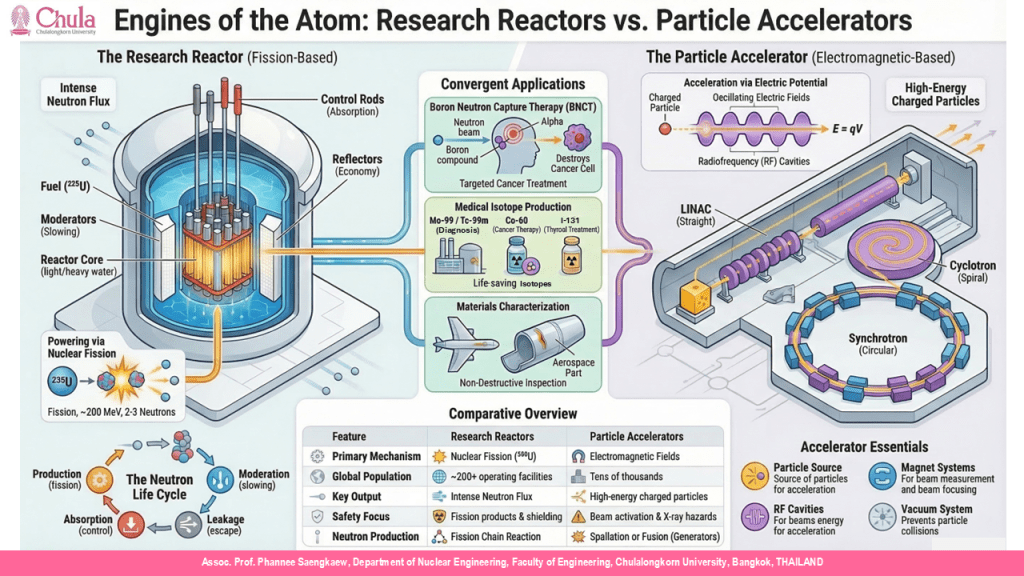
Research reactors generate large fluxes of neutrons through nuclear fission reactions, which can then be used for scientific research, radioisotope production, neutron beam experiments, and materials testing. Particle accelerators, in contrast, accelerate charged particles such as electrons, protons, or heavy ions to high energies using electromagnetic fields.
These technologies support a wide range of scientific and technological fields, including:
- nuclear engineering
- medical physics
- materials science
- radiation detection
- nuclear medicine
- security and inspection technologies
Because these systems provide the radiation sources used in many experiments and industrial applications, understanding their operating principles and applications is essential for nuclear engineers and scientists.
2. Nuclear Research Infrastructure
A variety of specialized facilities are used in nuclear science laboratories worldwide. The most important categories include the following.
- Research Reactors
Research reactors are nuclear reactors designed primarily for neutron production and experimental research rather than electricity generation. They are widely used in scientific research, isotope production, and nuclear engineering education.
- Particle Accelerators
Particle accelerators use electric and magnetic fields to accelerate charged particles to high energies. These machines are used in fundamental physics experiments, medical radiation therapy, and materials research.
- Neutron Generators
Neutron generators are compact devices that produce neutrons through fusion reactions between hydrogen isotopes. They are often used in field applications such as industrial inspection and detector calibration.
- Synchrotron Radiation Facilities
Synchrotron facilities are large accelerator-based laboratories that produce extremely intense X-ray beams used for advanced materials characterization.
According to the International Atomic Energy Agency (IAEA), more than 200 research reactors are currently operating worldwide. Particle accelerators are even more widespread, with tens of thousands of machines used globally in medicine, research, and industry.
Together, these technologies form the infrastructure supporting modern nuclear science.
3. Research Reactors
3.1 Purpose of Research Reactors
Research reactors are nuclear reactors designed primarily to generate neutrons for experimental and practical applications. Unlike nuclear power plants, which produce electricity, research reactors operate at relatively low power levels but can produce extremely high neutron flux.
Typical power levels range from:
- a few kilowatts
- up to several tens of megawatts
Despite their relatively low power output, research reactors are extremely valuable scientific tools because the neutron flux produced inside the reactor core can be very high. This allows researchers to perform experiments that require intense neutron radiation fields.
3.2 Nuclear Fission Reaction
The operation of most research reactors is based on the nuclear fission of uranium-235.

When a neutron is absorbed by a uranium-235 nucleus, the nucleus becomes unstable and splits into two smaller nuclei known as fission fragments. This reaction releases a large amount of energy as well as two or three additional neutrons.
These neutrons can initiate further fission reactions in nearby fuel nuclei, producing a self-sustaining chain reaction. Controlling this chain reaction is the fundamental principle of nuclear reactor operation.
3.3 Neutron Life Cycle
Neutrons produced in fission undergo several processes inside the reactor core:
- Production: Neutrons are generated through nuclear fission reactions.
- Moderation: Fast neutrons are slowed down through collisions with moderator materials.
- Absorption: Neutrons may be absorbed by fuel nuclei, control rods, or other materials.
- Leakage: Some neutrons escape from the reactor core.
Balancing these processes is essential for maintaining a stable and controlled chain reaction.
3.4 Reactor Core Components
A research reactor core typically contains several key components.
- Fuel
Fuel elements contain fissile materials such as uranium-235 or uranium-235 enriched uranium compounds.
- Moderator
The moderator slows neutrons to thermal energies. Common moderator materials include:
- light water
- heavy water
- graphite
- Control Rods
Control rods are made of neutron-absorbing materials such as boron, cadmium, or hafnium. By inserting or withdrawing control rods, operators regulate the reactor power level.
- Coolant
The coolant removes heat generated in the reactor core.
- Reflector
The reflector surrounds the core and reflects escaping neutrons back toward the fuel region, improving neutron economy.
- Biological Shielding
Shielding materials such as concrete or water protect personnel and the environment from radiation.
Table1: Reactor Core Components vs Typical Materials vs Required Properties
| Reactor Component | Typical Materials | Required Properties | Main Function |
| Fuel | Uranium dioxide (UO₂), uranium silicide (U₃Si₂), uranium–aluminum alloy (U–Al) | High fissile content, good thermal conductivity, radiation stability, chemical compatibility with coolant, high melting point | Produce neutrons and energy through nuclear fission |
| Fuel Cladding | Aluminum alloys (research reactors), zirconium alloys (power reactors) | Corrosion resistance, low neutron absorption, mechanical strength, good heat transfer | Contain the fuel and prevent release of radioactive fission products |
| Moderator | Light water (H₂O), heavy water (D₂O), graphite | Low neutron absorption cross section, high scattering cross section, radiation stability | Slow down fast neutrons to thermal energies |
| Control Rods | Boron carbide (B₄C), cadmium, hafnium, silver–indium–cadmium alloy | Very high neutron absorption cross section, high melting temperature, corrosion resistance, mechanical durability | Regulate reactor power and control the chain reaction |
| Coolant | Light water, heavy water, helium gas, liquid sodium (some reactors) | High heat capacity, good thermal conductivity, chemical stability, low neutron absorption | Remove heat generated in the reactor core |
| Reflector | Graphite, beryllium, heavy water | Low neutron absorption, high neutron scattering ability, radiation resistance | Reflect escaping neutrons back into the core to improve neutron economy |
| Biological Shielding | Concrete, water, lead, borated polyethylene | High density for gamma shielding, hydrogen content for neutron moderation, neutron absorption capability | Protect personnel and the environment from radiation |
| Structural Materials | Stainless steel, aluminum alloys | Mechanical strength, corrosion resistance, radiation tolerance, dimensional stability | Support the reactor core structure and internal components |
3.5 Neutron Flux
Neutron flux describes the number of neutrons passing through a unit area per unit time.
Research reactors typically produce neutron flux values between:

High neutron flux is essential for many experiments, including neutron activation analysis and radioisotope production.
4. Applications of Research Reactors
Research reactors support a wide range of scientific and technological activities.
4.1 Radioisotope Production
One of the most important applications of research reactors is the production of radioisotopes used in medicine.
Example reaction:

Molybdenum-99 decays into Technetium-99m, which is widely used in diagnostic imaging.
Other isotopes produced in research reactors include:
- Iodine-131
- Lutetium-177
- Cobalt-60
These isotopes play critical roles in medical diagnosis and cancer therapy.
4.2 Neutron Activation Analysis
Neutron activation analysis (NAA) is an analytical technique used to determine the elemental composition of materials.
Steps involved in NAA:
- The sample is irradiated with neutrons.
- Some nuclei become radioactive.
- The emitted gamma rays are measured.
Because each element produces a unique gamma-ray spectrum, the elemental composition of the sample can be determined with high sensitivity.
4.3 Neutron Scattering
Neutron scattering techniques allow scientists to study the atomic structure and dynamics of materials.
Neutrons interact with atomic nuclei and magnetic fields, making them particularly useful for investigating:
- crystal structures
- magnetic materials
- polymers
- biological molecules
Neutron scattering is widely used in condensed matter physics and materials science.
4.4 Neutron Imaging
Neutron imaging is similar to X-ray imaging but uses neutrons instead of photons.
Neutrons interact differently with matter than X-rays. For example, neutrons can penetrate heavy metals but are strongly absorbed by hydrogen-containing materials.
Applications include:
- inspection of aerospace components
- evaluation of nuclear fuel assemblies
- detection of water or moisture in materials
4.5 Materials Irradiation
Research reactors allow scientists to study how materials behave under intense neutron radiation.
These experiments help engineers design materials that can withstand the radiation environment in nuclear reactors and other high-energy systems.
4.6 Research Reactors for Nuclear Power Plant Safety
Research reactors also support nuclear power programs by providing experimental data needed for safety analysis.
They are used to:
- perform reactor physics experiments
- validate reactor simulation codes
- study fuel behavior
- test materials used in nuclear power plants
These experiments contribute to improving the safety and reliability of nuclear power systems.
5. Particle Accelerators
5.1 Principle of Particle Acceleration
Particle accelerators increase the kinetic energy of charged particles using electric fields.
The energy gained by a particle moving through an electric potential difference is given by:

where
E = particle energy
q = particle charge
V = electric potential difference
Repeated acceleration stages allow particles to reach extremely high energies.
5.2 Components of Particle Accelerators
Particle accelerators are complex systems designed to produce and control beams of high-energy charged particles. To achieve this, several subsystems operate together to generate particles, accelerate them to high energies, guide their trajectories, and maintain beam quality. The most important components are described below.
- Particle Source
The particle source is the starting point of the accelerator system. Its function is to generate the charged particles that will later be accelerated. The type of source depends on the particle species required for the experiment or application.
Common particle sources include:
- Electron guns, which produce electrons through thermionic emission from heated cathodes or through photoemission using lasers.
- Ion sources, which produce protons or heavier ions by ionizing gases such as hydrogen or helium.
Important performance characteristics of particle sources include:
- Beam current – the number of particles produced per unit time
- Beam stability – consistency of the particle output
- Beam emittance – the spread of particle positions and directions
A well-designed particle source ensures that the accelerator receives a stable and well-defined particle beam, which is essential for efficient acceleration.
- Accelerating Structures
Accelerating structures are responsible for increasing the kinetic energy of charged particles. This is typically achieved using radiofrequency (RF) cavities, which generate oscillating electric fields.
When a charged particle passes through an RF cavity at the correct phase of the oscillating electric field, it experiences an accelerating force that increases its velocity and energy.
The energy gain of a particle can be described by the relation

where


In modern accelerators, particles pass through many accelerating cavities in sequence, gradually increasing their energy.
Important design considerations for accelerating structures include:
- high electric field strength
- efficient power transfer from RF generators
- minimal energy losses due to resistive heating
- Magnet Systems
Magnetic fields play a crucial role in controlling particle beams. Since charged particles experience a force when moving through magnetic fields, magnets can be used to guide, bend, and focus particle trajectories.
Several types of magnets are commonly used:
Dipole magnets
- bend the particle beam along curved paths
- used to steer particles in circular accelerators
Quadrupole magnets
- focus particle beams
- prevent beam spreading during acceleration
Sextupole magnets
- correct beam distortions and chromatic aberrations
Precise control of magnetic fields is essential for maintaining beam stability and preventing particle losses within the accelerator.
- Vacuum System
Particle beams must travel through a highly evacuated environment to minimize interactions with air molecules. If particles collide with gas molecules, they can lose energy or scatter away from the intended beam path.
Therefore, accelerator beamlines operate under high vacuum conditions, typically between

Vacuum systems typically include:
- turbomolecular pumps
- ion pumps
- vacuum chambers and seals
Maintaining an ultra-high vacuum ensures efficient particle acceleration and prevents beam degradation.
5.3 Types of Particle Accelerators
Particle accelerators can be classified according to the geometry of the beam path and the method used to increase particle energy. Three major accelerator types are commonly encountered in nuclear science and engineering.
- Linear Accelerators (LINAC)
A linear accelerator accelerates particles along a straight path. The beam passes sequentially through a series of RF accelerating cavities, each increasing the particle energy.
Key characteristics of linear accelerators include:
- straight beamline geometry
- modular accelerating structures
- ability to produce high-energy particle beams
Because LINACs do not require strong bending magnets, they are particularly useful for accelerating electrons to very high energies.
Applications
Linear accelerators are widely used in:
- medical radiation therapy (electron and X-ray therapy machines)
- high-energy physics experiments
- injector systems for larger accelerators
- Cyclotrons
Cyclotrons are circular accelerators that use a constant magnetic field combined with an alternating electric field to accelerate charged particles.
Particles move in spiral trajectories between two semicircular electrodes known as “dees.” Each time the particle crosses the gap between the electrodes, it is accelerated by an oscillating electric field. As its energy increases, the radius of its path becomes larger, producing a spiral trajectory.
Key characteristics of cyclotrons include:
- compact circular design
- relatively high beam currents
- moderate particle energies
Applications
Cyclotrons are commonly used for:
- production of medical isotopes (e.g., fluorine-18 for PET imaging)
- nuclear physics experiments
- materials analysis
Because cyclotrons are compact and reliable, many hospitals operate cyclotrons for medical isotope production.
- Synchrotrons
Synchrotrons are circular accelerators designed to accelerate particles to extremely high energies. Unlike cyclotrons, the magnetic field strength and RF acceleration frequency are synchronized with the particle energy.
In synchrotrons:
- particles travel in a fixed circular orbit
- magnetic fields increase as particle energy increases
- particles can be accelerated to very high energies
Synchrotrons typically have large ring-shaped structures that can extend hundreds or even thousands of meters in circumference.
Applications
Synchrotrons are used in:
- high-energy particle physics research
- synchrotron radiation facilities for materials science
- structural biology and protein crystallography
The intense X-ray beams produced by synchrotron radiation are extremely useful for investigating the atomic structure of materials and biological molecules.
| Accelerator Type | Beam Path | Typical Size | Energy Range | Typical Uses |
| LINAC | Straight line | meters–kilometers | MeV–GeV | Medical therapy, injectors, FELs |
| Cyclotron | Spiral path | meters | MeV–hundreds MeV | Medical isotope production |
| Synchrotron | Circular ring | hundreds of meters–km | GeV–TeV | Particle physics, synchrotron radiation |
6. Accelerator-Based Neutron Sources
Particle accelerators can produce neutrons through nuclear reactions.
One important method is spallation, in which high-energy protons strike a heavy metal target such as tungsten or mercury. The collision ejects multiple neutrons from the nucleus.
Spallation neutron sources provide powerful neutron beams used for advanced materials research.
7. Boron Neutron Capture Therapy (BNCT)
BNCT is a cancer treatment method based on nuclear reactions involving boron-10.

The treatment process involves three steps:
- A drug containing boron-10 is introduced into tumor cells.
- The tumor region is irradiated with neutrons.
- Boron captures neutrons and produces alpha particles that destroy cancer cells.
BNCT can be performed using neutron beams from research reactors or accelerator-based neutron sources.
8. Portable Neutron Generators
Portable neutron generators produce neutrons through fusion reactions between hydrogen isotopes.
Common reactions include:
D-D reaction

D-T reaction

These devices are used in:
- oil and gas exploration
- security inspection
- neutron detector calibration
9. Neutron Radiation Safety
Neutron radiation presents several hazards because neutrons interact strongly with atomic nuclei and can produce secondary radiation.
Major concerns include:
- neutron radiation exposure
- secondary gamma radiation
- activation of materials
Radiation protection follows the principles of:
- time
- distance
- shielding
Hydrogen-rich materials such as water or polyethylene are effective neutron moderators, while boron-containing materials are commonly used for neutron absorption.
10. Summary
Research reactors and particle accelerators are essential tools in nuclear science and engineering.
Research reactors provide intense neutron sources used in scientific research, isotope production, materials testing, and nuclear power safety studies.
Particle accelerators generate high-energy particle beams used in physics research, medical treatment, and materials science.
Together, these technologies support a wide range of scientific, industrial, and medical applications.
Examples of Major Particle Accelerators Around the World
| Accelerator Type | Example Facility | Country | Typical Particle | Energy Range | Main Applications |
| Linear Accelerator (LINAC) | SLAC Linear Accelerator | USA | Electrons / Positrons | ~50 GeV | High-energy physics research |
| Linear Accelerator (Medical LINAC) | Varian / Elekta Clinical LINAC | Worldwide | Electrons | 4–25 MeV | Radiation therapy for cancer |
| Linear Accelerator | European XFEL LINAC | Germany | Electrons | ~17.5 GeV | Free-electron laser and photon science |
| Cyclotron | TRIUMF Cyclotron | Canada | Protons | ~500 MeV | Nuclear physics research |
| Cyclotron | IBA Cyclotron (medical isotope production) | Worldwide | Protons | ~30 MeV | PET isotope production |
| Cyclotron | RIKEN AVF Cyclotron | Japan | Protons / ions | ~90 MeV | Nuclear physics experiments |
| Synchrotron | Large Hadron Collider (LHC) | Switzerland (CERN) | Protons | 6.5 TeV per beam | Particle physics research |
| Synchrotron | Advanced Photon Source (APS) | USA | Electrons | 7 GeV | Materials science using synchrotron radiation |
| Synchrotron | SPring-8 | Japan | Electrons | 8 GeV | Structural biology and materials science |
| Synchrotron | Diamond Light Source | United Kingdom | Electrons | 3 GeV | Materials, chemistry, biology research |
 Around Radiation Detectors
ใส่ความเห็น