Introduction — Linking Source Physics to Measurement Systems
Nuclear and radiation technologies are uniquely characterized by their operation across an exceptionally wide range of physical conditions, spanning more than 15 orders of magnitude in radiation intensity. From trace environmental radioactivity to the extreme neutron flux within reactor cores, these applications rely fundamentally on the interaction of ionizing radiation with matter. Accordingly, the ability to detect and quantify radiation is not merely supportive but constitutes a central enabling function across all domains.
Rather than being universally applicable, radiation detection systems (ระบบตรวจวัดรังสี) must be carefully matched to the characteristics of the radiation source, including particle type, energy distribution, intensity, and interaction mechanisms. In particular, differences in linear energy transfer (LET), penetration depth, and dominant interaction processes (e.g., photoelectric absorption, Compton scattering, neutron capture) directly influence detector material selection and system architecture.
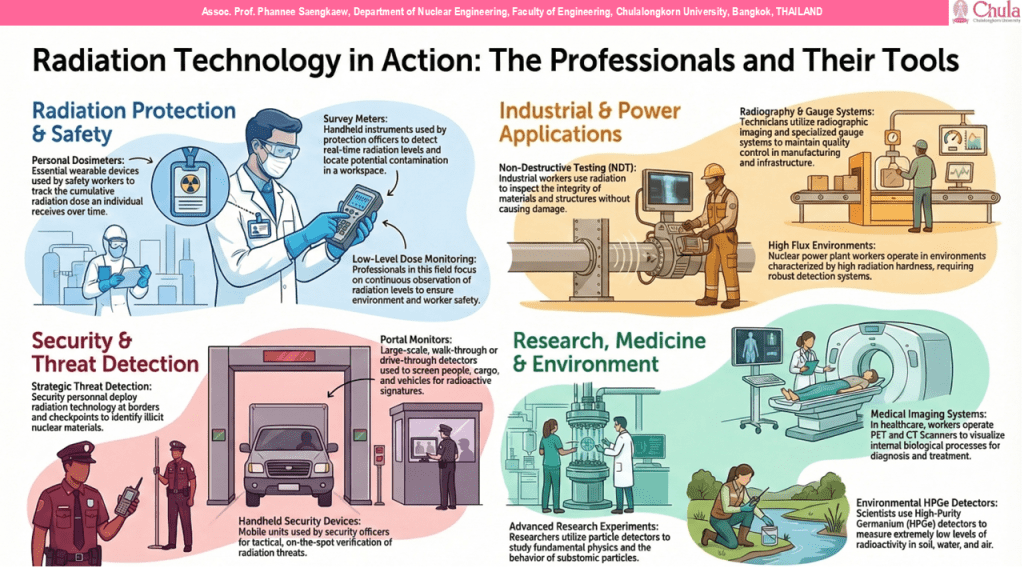
Thus, a unifying framework can be expressed as:
application → radiation source → interaction mechanism → detector response → system design
With this framework established, the following sections examine how this relationship manifests across major application domains.
1. Nuclear Power — High Flux, Wide Dynamic Range, and Radiation Hardness
In nuclear power systems, radiation fields are generated intrinsically through fission processes, producing both neutrons and gamma radiation with broad energy distributions. Initially, during reactor startup, neutron populations are extremely low and may be supported by sources such as Californium-252. As power increases, neutron flux rises exponentially, requiring detection systems that can seamlessly transition from pulse-counting to current mode operation.
Radiation Characteristics
- Mixed field: neutrons (thermal → fast) and gamma rays
- Neutron flux:
→
n·cm
·s
- High gamma dose rates (up to MGy·h
locally)

System Scale
- 400 reactors worldwide
- Each facility: hundreds–thousands of measurement channels
Detector Considerations
- Neutron detection via nuclear reactions (e.g.,
B(n,α),
He(n,p))
- Transition between pulse mode (low flux) and current mode (high flux)
- Radiation-induced degradation (damage, activation, leakage current)
Typical Systems
- Fission chambers (wide dynamic range)
- ³He / BF₃ proportional counters
- Ionization chambers for gamma monitoring
➡ Key Academic Insight:
Detector selection is governed by neutron interaction cross-sections and charge collection stability under high ionization density, rather than energy resolution.
2. Radiation Protection — Low-Level Detection and Dose Quantification
In radiation protection, the objective shifts from measuring high-intensity fields to accurately quantifying low-dose exposures relevant to biological risk. Therefore, detector response must be correlated with dose quantities such as absorbed dose and dose equivalent, rather than simply particle count.
Radiation Characteristics
- Low-intensity fields near background
- Mixed radiation types depending on environment
System Scale
- Millions of monitored workers globally
- Extensive deployment in hospitals, industry, and nuclear facilities
Detector Considerations
- Energy-dependent response (dose conversion)
- Sensitivity to low photon flux
- Angular dependence and field uniformity
Typical Systems
- GM counters (high sensitivity, limited energy discrimination)
- Scintillation detectors (improved efficiency and energy response)
- TLD / OSL dosimeters (integrated dose measurement)
➡ Key Academic Insight:
Detection systems must approximate tissue-equivalent response, linking physical measurement to biological effect.
3. Nuclear Medicine — Photon Detection and Image Reconstruction
In nuclear medicine, radiation detection is closely tied to imaging physics, where emitted photons carry spatial and functional information. Consequently, detector systems must not only detect radiation but also preserve information related to energy, timing, and position.
Radiation Characteristics
- Monoenergetic or discrete photon emissions
- Typical energy range: 100–511 keV
- Moderate activity levels (MBq–GBq)
System Scale
- 7,800 PET/CT systems worldwide
- Millions of diagnostic procedures annually
Detector Considerations
- High atomic number (Z) materials for efficient gamma interaction
- Fast scintillation decay for timing resolution
- Signal-to-noise ratio affecting image reconstruction
Typical Systems
- NaI(Tl) (high light yield, moderate resolution)
- LYSO (fast decay, high density for PET)
- CZT (direct conversion, high energy resolution)
➡ Key Academic Insight:
System performance is governed by photon interaction probability (photoelectric vs Compton) and statistical reconstruction of detected events.
4. Industrial Applications — Signal Stability and Penetration-Based Measurement
Industrial applications rely on radiation primarily for its ability to penetrate materials and provide indirect information about structure or composition. In this context, measurement systems prioritize stability and repeatability rather than detailed spectral analysis.
Radiation Characteristics
- High-intensity gamma or beta sources
- Strong attenuation dependence on material properties
System Scale
- Tens of thousands of devices globally
Detector Considerations
- Count-rate capability (avoid saturation)
- Long-term stability in harsh environments
- Minimal calibration drift
Typical Systems
- GM detectors (simple and robust)
- Scintillation detectors (higher efficiency)
- Ionization chambers (stable current output)
➡ Key Academic Insight:
Measurement is often based on exponential attenuation (Beer–Lambert law) rather than spectral discrimination.
5. Environmental Monitoring — Low Background and Spectral Identification
Environmental radiation monitoring requires the detection of very low activity levels, often near the limits of statistical uncertainty. Therefore, system design focuses on reducing background and improving spectral resolution.
Radiation Characteristics
- Natural radionuclides such as Potassium-40 and Uranium-238
- Low count rates and complex spectra
System Scale
- Thousands of monitoring stations worldwide
Detector Considerations
- High energy resolution (to distinguish radionuclides)
- Shielding to reduce background radiation
- Long acquisition times for statistical significance
Typical Systems
- HPGe detectors (excellent resolution)
- Alpha/beta counting systems
➡ Key Academic Insight:
Performance is limited by statistical counting uncertainty and background suppression, rather than detector sensitivity alone.
6. Nuclear Security — Detection Under Uncertainty
In nuclear security, radiation sources are not controlled and may be intentionally concealed. Thus, detection systems must operate effectively under uncertain and variable conditions.
Radiation Characteristics
- Weak or shielded gamma and neutron emissions
- Unknown source composition
System Scale
- Thousands of portal monitors and handheld devices
Detector Considerations
- Rapid signal processing
- Discrimination between background and threat
- Combined gamma–neutron detection capability
Typical Systems
- NaI / LaBr₃ scintillators (fast identification)
- CZT detectors (high-resolution spectroscopy)
- Neutron detectors
➡ Key Academic Insight:
Detection relies on pattern recognition and spectral fingerprinting, rather than precise quantitative measurement.
7. Research — Optimization of Source–Detector Coupling
In research applications, both radiation sources and detection systems are designed in tandem to maximize measurement precision. As a result, detector systems are often highly specialized and tailored to specific experiments.
Radiation Characteristics
- Controlled beams (neutron, charged particle, photon)
- Wide energy range (keV → GeV)
System Scale
- 220 research reactors and numerous accelerator facilities
Detector Considerations
- Energy, timing, and spatial resolution
- Multi-channel data acquisition
- Material-dependent response (bandgap, mobility, density)
Typical Systems
- Semiconductor detectors (Si, Ge, SiC)
- Scintillator arrays
- Hybrid detection systems
➡ Key Academic Insight:
Detector performance is determined by charge transport properties and signal formation mechanisms at the microscopic level.
Concluding Perspective — Source-Driven Detector Design
Across all application domains, radiation technologies exhibit extraordinary diversity in both scale and function. Nevertheless, a consistent principle emerges:
👉 The physical characteristics of the radiation source fundamentally determine detector selection, system architecture, and measurement strategy.
Therefore, advancing radiation detection technology requires not only improvements in materials and electronics but also a deep understanding of radiation–matter interaction and its implications for measurement.
In this context, detector development—such as emerging scintillator and semiconductor systems—represents a critical pathway toward enhancing performance across applications, from high-flux reactor monitoring to ultra-sensitive environmental detection.
| Application | Radiation Source | Typical Range | Interaction Mechanism | Detection Requirement | Typical Detectors |
| Nuclear Power | Fission neutrons, γ | (100–1014) n·cm-2·s-1 | Neutron capture, ionization | Wide dynamic range, radiation hardness | Fission chamber, ³He, IC |
| Radiation Protection | Cs-137, Co-60, background | µSv·h-1 range | Ionization, Compton | Dose accuracy, sensitivity | GM, scintillator, TLD |
| Nuclear Medicine | F-18, Tc-99m | 100–511 keV, MBq–GBq | Photoelectric, Compton | Energy + spatial resolution | NaI(Tl), LYSO, CZT |
| Industry | Ir-192, Sr-90 | MBq–TBq | Attenuation, scattering | Robustness, stability | GM, IC, scintillator |
| Environment | K-40, U-238 | mBq–Bq | Low-rate interactions | Low background, spectroscopy | HPGe |
| Security | U-235, Pu-239 | Weak / shielded | Mixed (γ + n) | Fast detection, ID capability | NaI, LaBr₃, neutron |
| Research | Beams (n, p, X-ray) | keV–GeV | All interaction modes | High precision, custom design | Si, Ge, arrays |
การประยุกต์ใช้เทคโนโลยีนิวเคลียร์และรังสี
จากแหล่งกำเนิดรังสีสู่การออกแบบระบบตรวจวัด
บทนำ — การเชื่อมโยงฟิสิกส์ของแหล่งกำเนิดกับระบบการวัด
เทคโนโลยีนิวเคลียร์และรังสีมีลักษณะเฉพาะที่โดดเด่น คือสามารถทำงานครอบคลุมช่วงสภาวะทางกายภาพที่กว้างมากเป็นพิเศษ โดยครอบคลุมมากกว่า 15 ลำดับขั้นของความเข้มรังสี ตั้งแต่กัมมันตภาพรังสีในสิ่งแวดล้อมระดับต่ำมาก ไปจนถึงฟลักซ์นิวตรอนที่สูงมากภายในแกนปฏิกรณ์นิวเคลียร์ การประยุกต์ใช้งานเหล่านี้ล้วนตั้งอยู่บนพื้นฐานของการทำอันตรกิริยาระหว่างรังสีก่อให้เกิดไอออนกับสสาร
ดังนั้น ความสามารถในการตรวจวัดและวัดปริมาณรังสีจึงไม่ได้เป็นเพียงองค์ประกอบสนับสนุน แต่ถือเป็นกลไกหลักที่ทำให้การประยุกต์ใช้งานเหล่านี้สามารถเกิดขึ้นได้จริงในทุกสาขา
ระบบตรวจวัดรังสีไม่สามารถออกแบบให้ใช้งานได้กับทุกกรณีอย่างครอบคลุม แต่จำเป็นต้องเลือกและออกแบบให้เหมาะสมกับลักษณะของแหล่งกำเนิดรังสี ซึ่งรวมถึงชนิดของอนุภาค การกระจายพลังงาน ความเข้ม และกลไกการทำอันตรกิริยา โดยเฉพาะอย่างยิ่ง ความแตกต่างของอัตราการถ่ายเทพลังงานเชิงเส้น (Linear Energy Transfer: LET) ความสามารถในการทะลุผ่านของรังสี และกระบวนการทำอันตรกิริยาหลัก เช่น การดูดกลืนแบบโฟโตอิเล็กทริก การกระเจิงแบบคอมป์ตัน และการจับนิวตรอน ล้วนมีผลโดยตรงต่อการเลือกวัสดุหัววัดและโครงสร้างของระบบตรวจวัด
ดังนั้น ความสัมพันธ์พื้นฐานสามารถสรุปได้ดังนี้
การประยุกต์ใช้งาน → แหล่งกำเนิดรังสี → กลไกการทำอันตรกิริยา → การตอบสนองของหัววัด → การออกแบบระบบ
จากกรอบแนวคิดนี้ ส่วนถัดไปจะอธิบายว่าความสัมพันธ์ดังกล่าวปรากฏในแต่ละสาขาการใช้งานอย่างไร
1. พลังงานนิวเคลียร์ — ฟลักซ์สูง ช่วงการวัดกว้าง และความทนทานต่อรังสี
ในระบบพลังงานนิวเคลียร์ สนามรังสีถูกสร้างขึ้นโดยตรงจากกระบวนการฟิชชัน ซึ่งก่อให้เกิดทั้งนิวตรอนและรังสีแกมมาที่มีการกระจายพลังงานกว้าง
ในช่วงเริ่มต้นของการเดินเครื่องปฏิกรณ์ ระดับนิวตรอนจะต่ำมาก และมักต้องอาศัยแหล่งกำเนิด เช่น Californium-252 เพื่อช่วยเริ่มต้นปฏิกิริยา เมื่อกำลังของปฏิกรณ์เพิ่มขึ้น ฟลักซ์นิวตรอนจะเพิ่มขึ้นแบบเอ็กซ์โปเนนเชียล ส่งผลให้ระบบตรวจวัดต้องสามารถเปลี่ยนโหมดการทำงานจากแบบนับพัลส์ไปเป็นแบบกระแสได้อย่างต่อเนื่อง
ลักษณะของรังสี
- สนามรังสีผสม: นิวตรอน (พลังงานต่ำถึงสูง) และรังสีแกมมา
- ฟลักซ์นิวตรอน:
ถึง
n·cm
·s
- อัตราปริมาณรังสีแกมมาสูงมาก (ระดับ MGy·h
)

ขนาดของระบบ
- มากกว่า 400 เครื่องปฏิกรณ์นิวเคลียร์ ทั่วโลก
- แต่ละโรงไฟฟ้ามีระบบตรวจวัดหลายร้อยถึงหลายพันจุด
ประเด็นด้านหัววัด
- การตรวจวัดนิวตรอนผ่านปฏิกิริยานิวเคลียร์ เช่น
B(n,α) และ
He(n,p)
- การทำงานได้ทั้งโหมดพัลส์และโหมดกระแส
- การเสื่อมสภาพจากรังสี (damage, activation, leakage current)
ระบบที่ใช้
- ห้องไอออไนเซชันแบบฟิชชัน (Fission chamber)
- หัววัดแบบทวีคูณเป็นสัดส่วน (³He, BF₃)
- ห้องไอออไนเซชันวัดรังสีแกมมา
➡ ประเด็นสำคัญ: การเลือกหัววัดขึ้นอยู่กับค่าภาคตัดขวางการทำอันตรกิริยากับนิวตรอน และเสถียรภาพของการเก็บประจุภายใต้สภาวะไอออไนซ์สูง มากกว่าความละเอียดพลังงาน
2. การป้องกันรังสี — การตรวจวัดระดับต่ำและการประเมินปริมาณรังสี
ในงานด้านการป้องกันรังสี เป้าหมายเปลี่ยนจากการวัดรังสีเข้มสูง มาเป็นการวัดปริมาณรังสีระดับต่ำที่มีผลต่อสุขภาพมนุษย์
ดังนั้น การตอบสนองของหัววัดต้องสัมพันธ์กับปริมาณรังสีเชิงชีวภาพ เช่น ปริมาณรังสีดูดกลืนและปริมาณรังสีสมมูล
ลักษณะของรังสี
- ระดับต่ำ ใกล้เคียงกับระดับปริมาณรังสีภูมิหลัง
- อาจเป็นสนามรังสีผสม
ขนาดของระบบ
- ผู้ปฏิบัติงานหลายล้านคนทั่วโลก
- ใช้งานทั่วไปและหลากหลาย ทั้งที่ในโรงพยาบาล อุตสาหกรรม และโรงไฟฟ้านิวเคลียร์
ประเด็นด้านหัววัด
- การตอบสนองขึ้นกับพลังงาน (energy dependence)
- ความไวต่อฟลักซ์ต่ำ
- การแปรเปลี่ยนตามทิศทางรังสีเข้าตกกระทบ (angular dependence)
ระบบที่ใช้
- เครื่องนับ GM
- หัววัดซินทิลเลชัน
- โดซิเมตรแบบ TLD / OSL
➡ ประเด็นสำคัญ: หัววัดต้องมีการตอบสนองใกล้เคียงเนื้อเยื่อมนุษย์ เพื่อเชื่อมโยงค่าทางฟิสิกส์กับผลกระทบทางชีวภาพ
3. เวชศาสตร์นิวเคลียร์ — การตรวจวัดโฟตอนและการสร้างภาพ
ในเวชศาสตร์นิวเคลียร์ การตรวจวัดรังสีเชื่อมโยงโดยตรงกับฟิสิกส์ของการสร้างภาพ ซึ่งโฟตอนที่ปล่อยออกมานำข้อมูลเชิงพื้นที่และหน้าที่การทำงานของอวัยวะร่างกาย
ลักษณะของรังสี
- โฟตอนพลังงานจำเพาะ
- ช่วงพลังงาน: 100–511 keV
- กัมมันตภาพระดับ MBq–GBq
ขนาดของระบบ
- เครื่อง PET/CT มากกว่า 7,800 เครื่องทั่วโลก
- การตรวจวินิจฉัยหลายล้านครั้งต่อปี
ประเด็นด้านหัววัด
- วัสดุเลขอะตอมสูงเพื่อเพิ่มประสิทธิภาพ
- เวลาการเรืองแสงสั้น มีอัตราการสลายตัวรวดเร็ว (fast decay)
- อัตราส่วนสัญญาณวัดต่อสัญญาณรบกวนสูง
ระบบที่ใช้
- NaI(Tl)
- LYSO
- CZT
➡ ประเด็นสำคัญ: ประสิทธิภาพระบบขึ้นอยู่กับความน่าจะเป็นของปฏิสัมพันธ์โฟตอนและการสร้างภาพเชิงสถิติ
4. งานอุตสาหกรรม — ความเสถียรของสัญญาณและการทะลุผ่าน
ในงานอุตสาหกรรม รังสีถูกใช้เพื่อทะลุผ่านวัสดุและให้ข้อมูลทางอ้อมเกี่ยวกับโครงสร้าง
ลักษณะของรังสี
- รังสีแกมมาหรือบีตาความเข้มสูง
- การลดทอนความเข้มรังสีขึ้นกับชนิดวัสดุ
ขนาดของระบบ
- อุปกรณ์หลายหมื่น/หลายแสนเครื่อง ทั่วโลก
ประเด็นด้านหัววัด
- รองรับอัตรานับสูง
- ความเสถียรระยะยาว
- ต้องการการสอบเทียบน้อย
ระบบที่ใช้
- GM
- Scintillator
- Ionization chamber
➡ ประเด็นสำคัญ: การวัดอาศัยกฎการลดทอนแบบเอ็กซ์โปเนนเชียล (Beer–Lambert)
5. การตรวจติดตามสิ่งแวดล้อม — รังสีภูมิหลังต่ำและการจำแนกสเปกตรัม
งานด้านสิ่งแวดล้อมต้องตรวจวัดระดับกัมมันตภาพรังสีที่ต่ำมาก
ลักษณะของรังสี
- K-40, U-238 เป็นต้น
- อัตรานับต่ำ
ขนาดของระบบ
- สถานีตรวจวัดหลายพันแห่ง
ประเด็นด้านหัววัด
- ความละเอียดหรือความจำแนกระดับพลังงานสูง
- อัตราระดับของรังสีภูมิหลังต่ำ (หรือมีระบบลดหรือคัดกรองหรือกำบังออก)
- เวลาวัดยาว
ระบบที่ใช้
- HPGe
- Alpha/Beta counter
➡ ประเด็นสำคัญ: ข้อจำกัดหลักคือความไม่แน่นอนเชิงสถิติและรังสีภูมิหลัง
6. ความมั่นคงทางนิวเคลียร์ — การตรวจวัดภายใต้ความไม่แน่นอน
ในด้านความมั่นคง แหล่งรังสีอาจถูกซ่อนหรือไม่ทราบชนิด
ลักษณะของรังสี
- สัญญาณอ่อน
- อาจถูกป้องกันปิดกั้นไว้
ขนาดของระบบ
- ระบบ portal หลายพันจุด
ประเด็นด้านหัววัด
- การประมวลผลรวดเร็ว
- แยกสัญญาณจากพื้นหลัง
- ตรวจทั้งแกมมาและนิวตรอน
➡ ประเด็นสำคัญ: อาศัยการจำแนกรูปแบบสเปกตรัมมากกว่าการวัดเชิงปริมาณ
7. งานวิจัย — การปรับให้เหมาะระหว่างแหล่งกำเนิดและหัววัด
ในงานวิจัย แหล่งกำเนิดและหัววัดถูกออกแบบร่วมกัน
ลักษณะของรังสี
- ลำรังสีควบคุมได้
- พลังงานกว้าง (keV–GeV)
ขนาดของระบบ
- เครื่องปฏิกรณ์วิจัยมากกว่า 220 เครื่อง
ประเด็นด้านหัววัด
- ความละเอียดหรือการจำแนกระดับพลังงานสูง
- ระบบหลายช่องสัญญาณ
- สมบัติวัสดุ
➡ ประเด็นสำคัญ: ขึ้นอยู่กับกลไกการเคลื่อนที่ของประจุในระดับจุลภาค
บทสรุป — การออกแบบหัววัดที่ขับเคลื่อนด้วยแหล่งกำเนิด
แม้ว่าการใช้งานจะหลากหลาย แต่หลักการสำคัญมีเพียงข้อเดียว
👉 ลักษณะของแหล่งกำเนิดรังสีกำหนดการออกแบบระบบตรวจวัด
ดังนั้น การพัฒนาเทคโนโลยีหัววัดจึงต้องอาศัยความเข้าใจเชิงลึกของการทำอันตรกิริยารังสีกับสสาร
ซึ่งจะนำไปสู่การพัฒนาเทคโนโลยีใหม่ เช่น วัสดุซินทิลเลเตอร์หรือวัสดุกึ่งตัวนำขั้นสูง ที่สามารถรองรับการใช้งานตั้งแต่ระดับรังสีต่ำมากไปจนถึงสภาวะรังสีเข้มสูงได้อย่างมีประสิทธิภาพ
ตาราง: ความสัมพันธ์ระหว่างการประยุกต์ใช้ แหล่งกำเนิดรังสี และความต้องการของระบบตรวจวัดรังสี
| การประยุกต์ใช้ | แหล่งกำเนิดรังสี | ช่วงค่าทั่วไป | กลไกการทำอันตรกิริยา | ความต้องการของการตรวจวัด | หัววัด/เครื่องตรวจวัดที่ใช้ |
| พลังงานนิวเคลียร์ | นิวตรอนจากฟิชชัน, แกมมา |  n·cm n·cm ·s ·s | การจับนิวตรอน, การไอออไนซ์ | ช่วงการวัดกว้าง, ทนทานต่อรังสี | ฟิชชันแชมเบอร์, ³He, ห้องไอออไนเซชัน |
| การป้องกันรังสี | Cs-137, Co-60, พื้นหลัง | ระดับ µSv·h | การไอออไนซ์, คอมป์ตัน | ความแม่นยำของปริมาณรังสี, ความไวสูง | GM, ซินทิลเลเตอร์, TLD |
| เวชศาสตร์นิวเคลียร์ | F-18, Tc-99m | 100–511 keV, MBq–GBq | โฟโตอิเล็กทริก, คอมป์ตัน | ความละเอียดพลังงานและเชิงพื้นที่ | NaI(Tl), LYSO, CZT |
| อุตสาหกรรม | Ir-192, Sr-90 | MBq–TBq | การลดทอน, การกระเจิง | ความทนทาน, ความเสถียร | GM, ห้องไอออไนเซชัน, ซินทิลเลเตอร์ |
| สิ่งแวดล้อม | K-40, U-238 | mBq–Bq | ปฏิสัมพันธ์อัตราต่ำ | พื้นหลังต่ำ, การวิเคราะห์สเปกตรัม | HPGe |
| ความมั่นคงนิวเคลียร์ | U-235, Pu-239 | อ่อน / ถูกกำบัง | สนามรังสีผสม (แกมมา + นิวตรอน) | ตรวจวัดรวดเร็ว, ระบุชนิดไอโซโทปได้ | NaI, LaBr₃, หัววัดนิวตรอน |
| งานวิจัย | ลำรังสี (นิวตรอน, โปรตอน, รังสีเอกซ์) | keV–GeV | ปฏิสัมพันธ์ได้ทุกแบบ | ความแม่นยำสูง, ออกแบบเฉพาะงาน | Si, Ge, อาเรย์ของหัววัด |
🔶 หมายเหตุ
- “กลไกการทำอันตรกิริยา” เป็นตัวกำหนดหลักในการเลือกวัสดุหัววัด
- “ความต้องการของการตรวจวัด” สะท้อนวัตถุประสงค์ของการใช้งาน เช่น ความแม่นยำ ความไว หรือความทนทาน
 Around Radiation Detectors
ใส่ความเห็น