Atomic Eyes: 4 Surprising Ways Nuclear Science is Unlocking the Secrets of Our Past
1. Introduction: The Silent Witnesses of History
When you stand before a glass case in a museum, you aren’t just looking at an object; you’re looking at a survivor. Whether it is a weathered bone from a prehistoric cave or the vibrant, haunting pigment of a Renaissance canvas, these artifacts are the silent witnesses of our shared human story. But for centuries, the most intimate details of their lives—their exact age, the hidden origins of their materials, or what lies inside their sealed chambers—remained locked away. To look inside often meant to destroy.
Today, we are entering a new era of “atomic eyes.” By harnessing the power of non-destructive analysis, nuclear science is allowing us to peer through the layers of time without leaving so much as a scratch. This is the intersection of the high-tech laboratory and the sacred halls of history, where researchers use subatomic particles to interrogate the past. Our mission is to explore how these nuclear tools provide profound insights into the age, composition, and internal structure of our cultural heritage, transforming the way we preserve the legacy of our ancestors.
2. The Atomic Clock That Starts at the Moment of Death
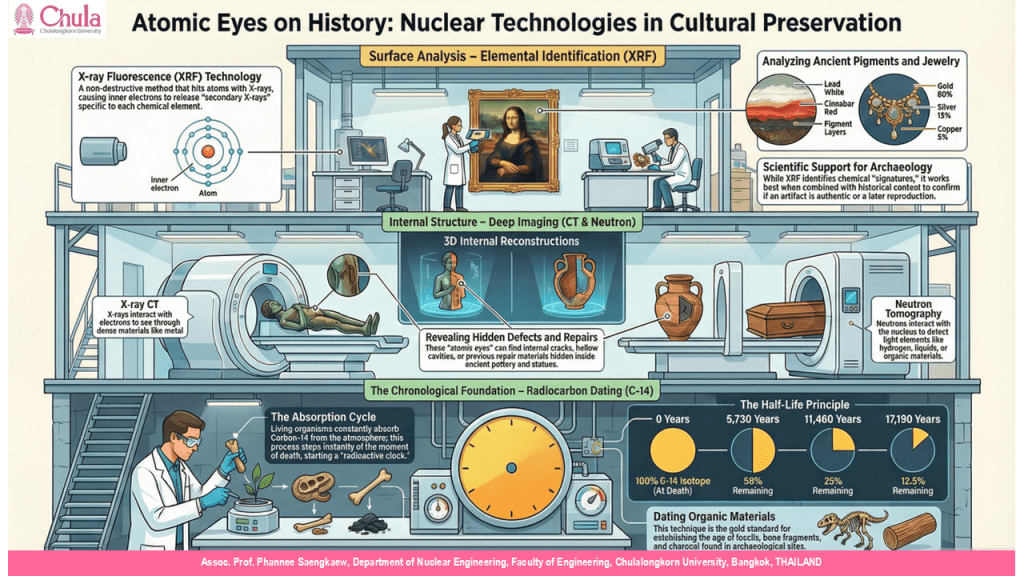
The most iconic of these tools is Radiocarbon Dating (C-14), a technique that essentially turns organic remains into biological clocks. Imagine a saber-toothed cat prowling the Pleistocene landscape. As it breathes and eats, it is a living participant in the carbon cycle.
As the source material suggests, this cycle is the heartbeat of the method:
“Carbon-14 is created naturally in the atmosphere and enters living organisms through the carbon cycle… While a plant or animal is alive, it constantly exchanges carbon with its environment.”
While alive, the cat maintains a steady ratio of Carbon-14—a radioactive isotope—within its body, balanced with the atmosphere. But the moment that cat breathes its last, the “clock” starts ticking. The intake of carbon stops, and the trapped C-14 begins to vanish through the steady rhythm of radioactive decay.
This decay follows the relentless Half-Life Principle. C-14 has a half-life of approximately 5,730 years. By measuring the “ghosts” of the remaining isotopes, scientists can step backward through time:
- 5,730 years: 50% of the C-14 remains.
- 11,460 years: 25% remains.
- 17,190 years: 12.5% remains.
By applying an exponential decay graph to these measurements, radiocarbon dating has become the gold standard for dating organic treasures up to 50,000 years old. It has turned fragments of charcoal, bone, and ancient fossils from mere rocks into precise chronometers of human evolution.
3. X-Ray Fluorescence: Reading the “Chemical Signature” of Art
If radiocarbon dating tells us when something lived, X-ray Fluorescence (XRF) unmasks the what. XRF provides a unique “chemical signature” for artifacts, allowing us to identify the elemental makeup of an object without even touching it.
To understand the mechanics of “Internal Excitation,” think of an X-ray as a cue ball hitting a rack of atomic billiard balls. When the beam strikes the inner electrons of an atom, it excites them, knocking them out of orbit. As the atom’s remaining electrons rearrange themselves to regain stability, they release “secondary X-rays.” Every element—gold, lead, copper, or mercury—has its own unique “pitch” or energy signature. By listening to these atomic echoes, scientists can identify exactly what minerals are present.
This technique is revolutionary for:
- Ancient Paintings: Unmasking the ghost of a 500-year-old brushstroke by identifying the specific minerals in the pigment.
- Antique Jewelry: Determining the metal makeup to trace whether a gold crown came from a local mine or a distant empire.
Beyond identification, this data is a lifeline for preservation. As the source context highlights:
“By understanding the exact chemical makeup, conservators can plan repairs that will not cause long-term damage.”
However, we must remember that while science provides the data, history provides the truth. XRF can identify the elements in a pigment, but it cannot determine “authenticity” in a vacuum. It requires the historical context of a curator to confirm if that specific chemical signature matches the period it claims to represent.
4. The “X-Ray Vision” Battle: X-Rays vs. Neutrons
When scientists need to see inside a sealed artifact, they engage in a high-stakes battle of perspectives: X-ray CT versus Neutron Tomography. Both create 3D internal maps, but they “see” the world through entirely different lenses.
- X-rays interact with the electrons surrounding an atom. They are the heavy hitters for high-density materials, making them perfect for scanning the thick metal shells of statues or heavy weaponry.
- Neutrons interact directly with the nucleus. This gives them a form of “impossible vision.” Because they ignore the dense electron clouds of heavy metals, they can sail through a bronze vessel to find light elements like hydrogen.
This leads to the most surprising revelation in modern heritage science: neutrons can see liquids—like water or oil—sloshing inside a sealed metal container that an X-ray would see only as a solid black void. In the world of archaeology, this means detecting internal cracks, hidden cavities, or ancient repairs in pottery that have been invisible for millennia. We can now peer inside a sealed Egyptian urn and know exactly what is inside without ever breaking the seal, preserving the mystery and the material simultaneously.
5. The Power of the Scientific “Confirmation”
In the modern lab, these technologies are rarely used as lone wolves. The real magic happens during synthesis. By layering the high-density data of X-rays with the light-element sensitivity of neutrons, researchers can create a “digital twin” of an artifact. This digital replica is often more complete than the physical object itself, as it reveals internal structures that the human eye will never see.
This multi-dimensional approach doesn’t replace the traditional archaeologist; it empowers them. Nuclear science acts as the ultimate “confirmation” tool, increasing our confidence in historical conclusions. When the chemical data from the lab aligns perfectly with the soil layers of a dig site, the story of our past moves from the realm of educated guesswork into the territory of scientific certainty.
6. Conclusion: Preserving the Future of the Past
Nuclear science has stepped into the role of a silent guardian for our cultural heritage. By providing these “atomic eyes,” we no longer have to choose between curiosity and conservation. We can determine the age of a bone, the chemistry of a masterpiece, and the contents of a sealed vessel while ensuring they remain pristine for the next thousand years.
As our ability to see every hidden crack and chemical bond continues to evolve, it raises a compelling question: as we strip away the physical layers of an ancient treasure with modern data, how do we protect the enduring mystery of our ancestors? Perhaps the true power of these nuclear tools isn’t just in the data they provide, but in the way they ensure our ancestors’ stories remain perfectly preserved for the generations yet to come.
***********************************************************************
การประยุกต์วิทยาศาสตร์นิวเคลียร์ในการเปิดเผยอดีตของมนุษยชาติ
1. บทนำ: วัตถุโบราณในฐานะพยานเงียบของประวัติศาสตร์
เมื่อพิจารณาวัตถุโบราณที่จัดแสดงในพิพิธภัณฑ์ ไม่ว่าจะเป็นกระดูกดึกดำบรรพ์หรือผลงานศิลปะจากยุคฟื้นฟูศิลปวิทยา วัตถุเหล่านี้มิได้เป็นเพียงสิ่งของ แต่เป็น “พยานเงียบ” ที่บันทึกเรื่องราวของมนุษยชาติไว้ภายใน อย่างไรก็ตาม ในอดีตการศึกษาข้อมูลเชิงลึก เช่น อายุ แหล่งกำเนิด หรือโครงสร้างภายในของวัตถุ มักต้องอาศัยวิธีการที่ก่อให้เกิดความเสียหายต่อชิ้นงาน
ความก้าวหน้าของวิทยาศาสตร์นิวเคลียร์ได้เปลี่ยนแปลงแนวทางดังกล่าว โดยอาศัยเทคนิคการวิเคราะห์แบบไม่ทำลาย (non-destructive analysis) ซึ่งใช้อนุภาคระดับอะตอมเป็นเครื่องมือในการตรวจสอบข้อมูลภายในวัตถุโดยไม่กระทบต่อสภาพดั้งเดิม วิธีการเหล่านี้จึงเปรียบเสมือน “ดวงตาเชิงอะตอม (Atomic Eyes)” ที่ช่วยให้สามารถศึกษาประวัติศาสตร์ได้อย่างแม่นยำและปลอดภัย
2. การหาอายุด้วยคาร์บอน-14: นาฬิกาทางชีววิทยาหลังความตาย
เทคนิคการหาอายุด้วยคาร์บอน-14 (Radiocarbon Dating) เป็นวิธีมาตรฐานสำหรับการกำหนดอายุของวัตถุอินทรีย์ โดยอาศัยหลักการสลายตัวของไอโซโทปกัมมันตรังสี
ในสิ่งมีชีวิต คาร์บอน-14 (C-14) จะเข้าสู่ร่างกายผ่านวัฏจักรคาร์บอน (carbon cycle) และคงอยู่ในอัตราส่วนสมดุลกับบรรยากาศตราบเท่าที่ยังมีชีวิต เมื่อสิ่งมีชีวิตตาย การแลกเปลี่ยนคาร์บอนจะหยุดลง และ C-14 จะเริ่มสลายตัวตามกฎการสลายตัวแบบครึ่งชีวิต (half-life decay) ซึ่งมีค่าครึ่งชีวิตประมาณ 5,730 ปี
การวัดปริมาณ C-14 ที่เหลืออยู่จึงสามารถย้อนกลับไปคำนวณอายุของตัวอย่างได้ โดยอาศัยแบบจำลองการสลายตัวแบบเอ็กซ์โพเนนเชียล (exponential decay) เทคนิคนี้สามารถใช้กำหนดอายุของตัวอย่างได้ถึงประมาณ 50,000 ปี และมีบทบาทสำคัญในการศึกษาวิวัฒนาการของมนุษย์และสิ่งมีชีวิตในอดีต
3. เอกซเรย์ฟลูออเรสเซนซ์: การระบุองค์ประกอบทางเคมีของวัตถุ
เทคนิคเอกซเรย์ฟลูออเรสเซนซ์ (X-ray Fluorescence: XRF) เป็นวิธีการวิเคราะห์องค์ประกอบธาตุของวัสดุโดยไม่ต้องสัมผัสหรือทำลายตัวอย่าง
หลักการทำงานคือ การฉายรังสีเอกซเรย์ไปกระตุ้นอิเล็กตรอนชั้นในของอะตอม เมื่ออิเล็กตรอนถูกกระตุ้นและหลุดออก อะตอมจะปรับสมดุลโดยให้อิเล็กตรอนจากระดับพลังงานที่สูงกว่าลงมาแทนที่ พร้อมปล่อยรังสีเอกซเรย์ทุติยภูมิ (secondary X-rays) ซึ่งมีพลังงานจำเพาะเฉพาะของแต่ละธาตุ
ด้วยเหตุนี้ XRF จึงสามารถใช้:
- วิเคราะห์องค์ประกอบของเม็ดสีในงานศิลปะ
- ตรวจสอบโลหะในเครื่องประดับโบราณ
- ระบุแหล่งกำเนิดของวัสดุ
นอกจากนี้ ข้อมูลองค์ประกอบทางเคมีดังกล่าวยังมีความสำคัญต่อการอนุรักษ์ (conservation) เนื่องจากช่วยให้สามารถเลือกวิธีซ่อมแซมที่ไม่ก่อให้เกิดความเสียหายในระยะยาว อย่างไรก็ตาม การตีความผลจำเป็นต้องอาศัยบริบททางประวัติศาสตร์ร่วมด้วย ไม่สามารถใช้ข้อมูลทางเคมีเพียงอย่างเดียวในการยืนยันความแท้จริงของวัตถุ
4. การสร้างภาพภายใน: การเปรียบเทียบระหว่างเอกซเรย์และนิวตรอน
การศึกษาภายในของวัตถุโบราณสามารถทำได้ด้วยเทคนิคการสร้างภาพสามมิติ เช่น เอกซเรย์คอมพิวเตอร์ (X-ray CT) และนิวตรอนโทโมกราฟี (Neutron Tomography) ซึ่งมีหลักการปฏิสัมพันธ์กับสสารที่แตกต่างกัน
- เอกซเรย์ (X-rays) ทำอันตรกิริยากับอิเล็กตรอน จึงเหมาะสำหรับวัสดุที่มีความหนาแน่นสูง เช่น โลหะ
- นิวตรอน (Neutrons) ทำอันตรกิริยากับนิวเคลียสของอะตอม ทำให้สามารถทะลุผ่านโลหะและตรวจวัดธาตุเบา เช่น ไฮโดรเจน ได้
คุณสมบัตินี้ทำให้เทคนิคด้วยนิวตรอนสามารถตรวจพบของเหลวหรือโครงสร้างภายในที่ซ่อนอยู่ในภาชนะโลหะ ซึ่งเอกซเรย์ไม่สามารถตรวจวัดได้ ตัวอย่างเช่น การตรวจสอบภาชนะโบราณที่ปิดผนึกโดยไม่ต้องเปิดหรือทำลายวัตถุ
เทคนิคทั้งสองจึงมีบทบาทเสริมกันในการวิเคราะห์โครงสร้างภายในของวัตถุทางโบราณคดี
5. การบูรณาการข้อมูล: การยืนยันทางวิทยาศาสตร์
ในการศึกษาสมัยใหม่ เทคนิคทางนิวเคลียร์มักถูกนำมาใช้ร่วมกันเพื่อเพิ่มความน่าเชื่อถือของผลการวิเคราะห์ การผสานข้อมูลจากหลายเทคนิค เช่น เอกซเรย์และนิวตรอน ช่วยให้สามารถสร้างแบบจำลองดิจิทัล (digital twin) ของวัตถุ ซึ่งให้ข้อมูลทั้งโครงสร้างภายในและองค์ประกอบทางเคมีอย่างครบถ้วน
แนวทางนี้ช่วยยกระดับการศึกษาทางโบราณคดีจากการตีความเชิงสมมติฐานไปสู่การยืนยันเชิงวิทยาศาสตร์ โดยเมื่อข้อมูลทางฟิสิกส์และเคมีสอดคล้องกับหลักฐานทางประวัติศาสตร์ จะทำให้ข้อสรุปมีความน่าเชื่อถือสูงขึ้น
6. บทสรุป: วิทยาศาสตร์นิวเคลียร์กับการอนุรักษ์อดีต
วิทยาศาสตร์นิวเคลียร์มีบทบาทสำคัญในการอนุรักษ์มรดกทางวัฒนธรรม โดยทำให้สามารถศึกษาอายุ องค์ประกอบ และโครงสร้างภายในของวัตถุได้โดยไม่ก่อให้เกิดความเสียหาย
เทคนิคเหล่านี้ไม่เพียงแต่เพิ่มความรู้ทางวิชาการ แต่ยังช่วยรักษาสภาพของวัตถุให้คงอยู่สำหรับอนุชนรุ่นต่อไป ในขณะเดียวกัน ก็สะท้อนให้เห็นถึงความสมดุลระหว่าง “ความต้องการรู้” และ “การอนุรักษ์” ซึ่งเป็นหัวใจสำคัญของการศึกษาทางวิทยาศาสตร์ในบริบทของมรดกมนุษยชาติ
 Around Radiation Detectors
ใส่ความเห็น