- 1. Introduction: From Invisible Processes to Engineered Systems
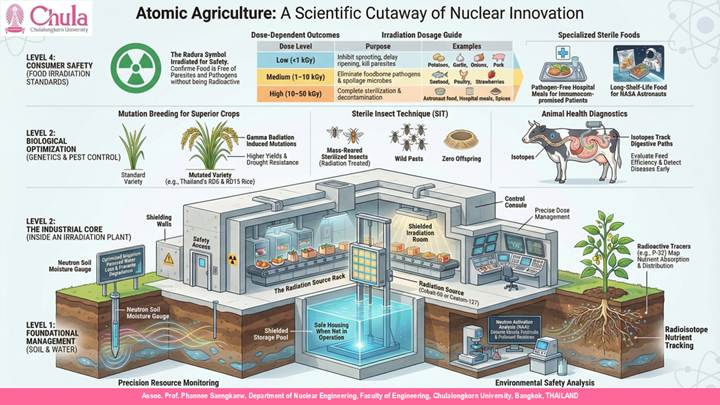
Nuclear agriculture represents not merely a collection of isolated techniques, but a multi-layered, integrated system that spans from fundamental resource management to advanced food safety applications. As illustrated in Figure 1, nuclear technologies operate across hierarchical levels—from soil and water monitoring to industrial irradiation systems and consumer-level safety assurance.
This systemic perspective highlights a key principle: nuclear science enables the transformation of invisible physical interactions into measurable, controllable, and optimizable processes across the entire food chain.
- 2. Level 1: Foundational Resource Management (Soil and Water)
At the most fundamental level, nuclear techniques support precision agriculture through quantitative monitoring of soil and environmental conditions.
- 2.1 Neutron Soil Moisture Gauge
The neutron soil moisture gauge, depicted in the figure, operates based on fast neutron scattering and thermalization. Fast neutrons emitted from a source collide with hydrogen nuclei (primarily from water molecules), losing energy and becoming thermal neutrons.
The detected count of thermal neutrons is directly proportional to volumetric soil moisture:

This enables:
- Deep soil moisture profiling
- Optimization of irrigation scheduling
- Reduction of water waste and soil degradation
- 2.2 Optimized Irrigation and Resource Efficiency
As indicated in the figure (“optimized irrigation prevents water loss & fracture degradation”), nuclear-based measurements allow data-driven irrigation, preventing:
- Overwatering (leading to nutrient leaching)
- Soil structural damage
- Inefficient fertilizer usage
- 3. Level 2: Industrial Core — Irradiation Facility Infrastructure
A key addition emphasized in your figure is the engineering architecture of irradiation plants, which was not fully detailed previously.
- 3.1 Irradiation Plant Design
The irradiation plant is designed as an integrated system that combines radiation protection, process control, and industrial efficiency. The overall layout incorporates thick shielding walls, typically constructed from high-density concrete, which serve as the primary barrier against ionizing radiation and ensure that radiation levels outside the facility remain within regulatory limits.
To further enhance safety, the facility is equipped with controlled access systems that regulate personnel entry into irradiation zones. These systems are interlocked with the radiation source operation, thereby ensuring compliance with radiation safety standards and preventing accidental exposure.
From an operational perspective, the plant commonly employs a conveyor-based processing system, which enables the continuous movement of products through the irradiation field. This configuration supports high-throughput industrial processing and ensures consistent exposure conditions for large volumes of materials.
At the core of system operation is the control console, which provides real-time monitoring of radiation dose, system status, and operational parameters. This centralized control allows operators to adjust processing conditions and maintain precise control over irradiation procedures.
A critical feature of the plant design is precise dose management, which ensures uniform irradiation of products. This is achieved through careful coordination of source geometry, conveyor speed, and exposure time, allowing the system to deliver accurate and reproducible doses required for applications such as sterilization, food preservation, and materials modification.
- 3.2 Radiation Source and Safety System
The radiation source and safety system comprises a set of integrated components designed to ensure reliable irradiation performance while maintaining a high level of operational safety. The primary radiation sources typically include Cobalt-60 and Cesium-137, both of which are widely utilized due to their appropriate gamma-ray energies and relatively long half-lives. In recent years, high-energy X-rays generated from electron accelerators have increasingly been adopted as an alternative radiation source, offering advantages such as on-demand operation and the elimination of long-term radioactive source management.
A key mechanical component of the system is the source rack mechanism, which is responsible for transferring the radiation sources from a shielded position into the irradiation zone during operation and retracting them afterward. This controlled movement enables precise regulation of exposure conditions and contributes significantly to system safety. When not in operation, the radiation sources are stored in a water pool, which serves as a secure “safe housing” system. Water provides an effective radiation shield due to its high hydrogen content, which is particularly efficient in attenuating ionizing radiation. This passive shielding approach ensures that radiation levels remain within safe limits, thereby protecting both personnel and the surrounding environment.
Overall, the integration of these components forms a robust engineering system that ensures operational safety, enables reproducible dose delivery, and supports industrial scalability. Such characteristics are essential for large-scale irradiation applications in fields such as medical sterilization, food processing, and materials modification.
- 4. Level 2: Biological Optimization — Genetics and Pest Control
- 4.1 Mutation Breeding
Mutation breeding is a well-established nuclear technique that enables the development of improved crop varieties through controlled genetic modification. As illustrated in the figure, a clear distinction is observed between standard and mutated crop varieties, emphasizing the role of radiation-induced mutations generated using gamma rays or neutrons. These forms of ionizing radiation interact with plant genetic material, inducing random but controlled mutations that expand the genetic diversity beyond what is typically achievable through conventional breeding methods.
Such induced variations can subsequently be screened and selected for desirable agronomic traits, including enhanced yield, improved drought resistance, and greater structural stability of the plant. This process represents a form of controlled genetic diversification, in which radiation acts as a tool to accelerate natural evolutionary mechanisms, thereby enabling targeted and efficient agricultural improvement in response to environmental and food security challenges.
- 4.2 Sterile Insect Technique (SIT)
The Sterile Insect Technique (SIT) is a biologically based pest control strategy that utilizes radiation to suppress insect populations in an environmentally sustainable manner. The diagram effectively illustrates the fundamental cycle underlying this approach, beginning with the mass rearing of target insect species under controlled conditions. These insects are then sterilized—typically using ionizing radiation—before being systematically released into wild populations.
Once released, the sterile insects compete with wild counterparts for mating opportunities. However, because they are reproductively inactive, these mating events result in no offspring. Over time, repeated releases lead to a progressive decline in the pest population, ultimately achieving effective suppression or even eradication in localized areas.
SIT is therefore recognized as a non-chemical pest control method that minimizes environmental contamination and avoids the development of pesticide resistance. Moreover, its species-specific nature allows for precise ecological intervention, targeting only the pest species of interest without adversely affecting non-target organisms or surrounding ecosystems.
- 5. Level 3: Food Safety — Irradiation Dosage and Consumer Protection
At Level 3 of nuclear applications in agriculture and food systems, the focus shifts toward ensuring food safety through the controlled application of irradiation.
- 5.1 Dose-Dependent Outcomes
The figure presents a structured, dose-dependent framework that clearly illustrates how varying levels of ionizing radiation produce distinct scientific effects and corresponding practical applications. At low doses (below 1 kGy), irradiation primarily inhibits enzymatic activity, which is particularly useful for delaying sprouting in crops such as potatoes and onions. At intermediate doses (1–10 kGy), the dominant effect is damage to microbial DNA, effectively reducing or eliminating pathogenic microorganisms and thereby enhancing food safety. At higher doses (10–50 kGy), irradiation achieves sterilization, which is applied in specialized contexts such as sterilized meals for immunocompromised patients or space food systems. This dose–effect relationship highlights the precision with which irradiation can be tailored to specific food preservation objectives.
| Dose Level | Range | Scientific Effect | Application |
| Low | <1 kGy | Enzyme inhibition | Sprouting delay |
| Medium | 1–10 kGy | DNA damage in microbes | Food safety |
| High | 10–50 kGy | Sterilization | Specialized food |
- 5.2 Radiation Chemistry Mechanism
From a mechanistic perspective, these effects arise from fundamental radiation chemistry processes. When ionizing radiation interacts with food materials—particularly water molecules—it generates reactive free radicals. These highly reactive species subsequently induce DNA strand breaks and disrupt critical cellular functions in microorganisms, leading to their inactivation or death. Importantly, these processes occur without significantly altering the macroscopic structure or nutritional value of the food when properly controlled, reinforcing the scientific basis for irradiation as a safe preservation method.
- 5.3 Radura Symbol (Consumer-Level Indicator)
In addition to the technical aspects, the figure appropriately incorporates the Radura symbol, a globally recognized indicator used at the consumer level. The presence of this symbol signifies that the food product has undergone irradiation in compliance with established safety standards. It communicates key assurances to consumers, including the reduction or elimination of parasites and pathogens, as well as the fact that the food itself does not become radioactive. This labeling mechanism plays a critical role in fostering public acceptance and ensuring regulatory transparency, both of which are essential for the broader adoption of irradiation technologies in modern food systems.
- 6. Specialized Applications: High-Reliability Food Systems
Beyond conventional food preservation and safety, irradiation technology plays a critical role in specialized, high-reliability food systems where the margin for error is effectively zero. The figure highlights two such applications—medical nutrition and space food systems—which, although less frequently discussed, represent some of the most demanding use cases for food irradiation technologies.
- 6.1 Medical Nutrition
In the context of medical nutrition, irradiation is employed to produce pathogen-free food specifically designed for immunocompromised patients, such as those undergoing chemotherapy, organ transplantation, or advanced clinical treatments. In these cases, even minimal microbial contamination can pose severe health risks. Therefore, food must meet an extremely stringent requirement of near-zero microbial presence. Irradiation provides a reliable method to achieve this level of safety without compromising the nutritional integrity of the food, making it an essential component of controlled clinical dietary systems.
- 6.2 Space Food Systems
Similarly, in space food systems, irradiation is utilized to ensure long shelf-life and microbiological stability under extreme and isolated conditions. Astronauts require food that remains safe and nutritionally stable over extended missions, often in environments where refrigeration, resupply, and conventional preservation methods are limited or unavailable. High-dose irradiation enables the production of shelf-stable, ready-to-eat meals that can withstand variations in temperature, radiation exposure, and storage duration.
Together, these applications exemplify high-reliability food systems, where conventional preservation techniques are insufficient to meet operational requirements. In such systems, irradiation is not merely an option but a necessity, providing a scientifically robust and dependable solution for ensuring both safety and performance under critical conditions.
- 7. Animal Health and Metabolic Diagnostics
A key addition from your figure is animal health diagnostics using isotopes, which expands the scope beyond plants.
- 7.1 Isotope Tracing in Livestock
An important extension of nuclear techniques in agricultural systems is their application in animal health and metabolic diagnostics, as highlighted in the figure. This perspective broadens the scope of nuclear technology beyond plant-based applications, emphasizing its role in advancing precision livestock management. Central to this approach is the use of radioisotopes as tracers, which enable detailed investigation of physiological and metabolic processes in living animals without significantly disturbing their normal biological functions.
In livestock systems, isotope tracing is employed to monitor digestive pathways, allowing researchers and practitioners to understand how nutrients are absorbed, distributed, and utilized within the body. This information is critical for evaluating feed efficiency, optimizing dietary formulations, and minimizing resource loss. Furthermore, radioisotopes can be used to identify deviations in normal metabolic behavior, enabling the early detection of disorders that may not yet present visible clinical symptoms.
Through these capabilities, isotope-based diagnostics support a transition toward precision livestock management, where feeding strategies and health interventions can be tailored to individual animals or specific herds. This leads to improved productivity, reduced feed waste, and enhanced animal welfare. Ultimately, such techniques contribute to more sustainable and efficient agricultural systems by integrating advanced nuclear science into routine veterinary and livestock practices.
- 8. Radiotracer Applications in Plants and Environment
- 8.1 Nutrient Mapping (e.g., P-32)
Radiotracer techniques represent a powerful extension of nuclear technology for investigating dynamic processes in both plant systems and the environment. As illustrated in the figure, these methods enable the direct visualization and quantification of material transport and elemental distribution, providing insights that are otherwise difficult to obtain through conventional analytical approaches.
In plant studies, the use of radioisotopes such as phosphorus-32 (P-32) allows for precise tracking of nutrient movement from the soil into plant roots and subsequently throughout the plant structure. This soil → root → plant pathway, clearly depicted in the diagram, reflects the real-time uptake and translocation processes that govern plant nutrition. By quantifying these pathways, researchers can optimize fertilizer application strategies, ensuring that nutrients are delivered efficiently to the plant while minimizing excess use. This not only improves agricultural productivity but also reduces nutrient loss to the environment, thereby limiting runoff and mitigating associated ecological impacts such as water pollution and eutrophication.
- 8.2 Environmental Safety Analysis (NAA)
In parallel, the figure highlights the application of Neutron Activation Analysis (NAA), a highly sensitive nuclear analytical technique used for environmental safety assessment. Through neutron irradiation and subsequent gamma-ray analysis, NAA enables the detection and quantification of trace elements and contaminants at very low concentrations. This capability is particularly important for identifying pesticide residues and other hazardous substances in agricultural products and environmental samples.
Together, these applications play a critical role in supporting food safety regulation and environmental monitoring. By providing accurate, quantitative, and non-destructive analysis, radiotracer techniques and NAA contribute to evidence-based decision-making in agriculture and environmental management, reinforcing the integration of nuclear science into sustainable development practices.
- 9. System Integration: A Multi-Level Nuclear Agriculture Framework
Building upon the figure, nuclear agriculture can be systematically conceptualized as a multi-level operational framework in which each level corresponds to a distinct functional role supported by specific nuclear technologies. At Level 1, the focus is on resource management, where techniques such as neutron moisture gauges are employed to quantify soil water content with high precision. This enables optimized irrigation strategies and efficient utilization of natural resources.
At Level 2, nuclear technologies are applied at the industrial processing stage, most notably through irradiation facilities that support large-scale food preservation and post-harvest treatment. In parallel, a biologically oriented extension of this level—referred to as Level 2 (Bio)—addresses genetic improvement and pest control. Here, mutation breeding and the Sterile Insect Technique (SIT) are utilized to enhance crop traits and suppress pest populations, respectively, reflecting the integration of nuclear science with biological systems.
Progressing to Level 3, the emphasis shifts to food safety, where irradiation is applied in a controlled and dose-dependent manner to eliminate pathogens and extend shelf life while maintaining food quality. Finally, at Level 4, the framework culminates in consumer assurance, represented by certification mechanisms such as the Radura symbol. This level ensures transparency, regulatory compliance, and public confidence in irradiated food products.
Together, these interconnected levels illustrate how nuclear technologies operate not in isolation, but as an integrated system spanning the entire agricultural and food supply chain—from resource management to end-user assurance.
| Level | Function | Technology |
| Level 1 | Resource Management | Neutron moisture gauge |
| Level 2 | Industrial Processing | Irradiation facility |
| Level 2 (Bio) | Genetic & Pest Control | Mutation breeding, SIT |
| Level 3 | Food Safety | Irradiation |
| Level 4 | Consumer Assurance | Radura certification |
- 10. Conclusion: From Tools to Infrastructure
When considered collectively, the elements presented in the figure reveal that nuclear agriculture should not be viewed merely as a collection of discrete techniques. Rather, it constitutes a coherent technological infrastructure that supports modern agricultural systems at multiple levels. Within this framework, nuclear methods enable the measurement of critical parameters such as soil moisture, nutrient dynamics, and environmental conditions. They also facilitate the modification of biological systems through genetic improvement and pest control, the preservation of food via irradiation-based safety processes, and the verification of product integrity through standardized certification mechanisms.
This integrated perspective underscores a central conceptual insight: nuclear science functions as a bridge between invisible physical interactions and practical, real-world applications. By converting microscopic radiation–matter interactions into measurable data and actionable interventions, nuclear technologies provide a foundation for informed decision-making across the agricultural value chain. Ultimately, this transformation from fundamental physics to applied systems plays a vital role in sustaining global food security, enhancing resource efficiency, and ensuring the safety and reliability of food supplies in an increasingly complex world.
**************************************************************************************************
เกษตรกรรมระดับอะตอม: วิทยาศาสตร์นิวเคลียร์ในฐานะระบบบูรณาการเพื่อความมั่นคงทางอาหาร
- 1.บทนำ: จากปรากฏการณ์ที่มองไม่เห็นสู่ระบบที่ออกแบบได้
เทคโนโลยีนิวเคลียร์ในภาคเกษตรกรรมมิได้เป็นเพียงเทคนิคเฉพาะทางที่แยกส่วน หากแต่เป็น ระบบเชิงบูรณาการหลายระดับ (multi-layered system) ที่ครอบคลุมตั้งแต่การจัดการทรัพยากรพื้นฐานไปจนถึงการควบคุมความปลอดภัยของอาหารในระดับผู้บริโภค ดังแสดงในรูปประกอบ เทคโนโลยีเหล่านี้ทำงานเป็นลำดับขั้น ตั้งแต่ระดับดินและน้ำ ไปจนถึงระดับอุตสาหกรรมและการรับรองคุณภาพอาหาร
แนวคิดสำคัญคือ วิทยาศาสตร์นิวเคลียร์ทำให้ปรากฏการณ์ที่มองไม่เห็นสามารถถูกตรวจวัด ควบคุม และเพิ่มประสิทธิภาพได้อย่างเป็นระบบตลอดห่วงโซ่อาหาร
- 2. ระดับที่ 1: การจัดการทรัพยากรพื้นฐาน (ดินและน้ำ)
- 2.1 เครื่องวัดความชื้นในดินด้วยนิวตรอน (Neutron Soil Moisture Gauge)
เครื่องมือนี้อาศัยหลักการ การกระเจิงของนิวตรอน (neutron scattering) โดยนิวตรอนพลังงานสูงจะชนกับนิวเคลียสของไฮโดรเจนในน้ำ ทำให้สูญเสียพลังงานและกลายเป็นนิวตรอนพลังงานต่ำ (thermal neutrons)
จำนวนของนิวตรอนที่ตรวจวัดได้มีความสัมพันธ์โดยตรงกับปริมาณน้ำในดิน:

ประโยชน์ทางวิชาการ:
- วัดความชื้นได้ลึกกว่าผิวดิน
- เพิ่มความแม่นยำในการให้น้ำ
- ลดการสูญเสียน้ำและการเสื่อมสภาพของดิน
- 2.2 การจัดการน้ำอย่างแม่นยำ (Precision Irrigation)
การจัดการน้ำในระบบเกษตรสมัยใหม่ไม่ได้อาศัยเพียงประสบการณ์หรือการสังเกตเชิงผิวเผินอีกต่อไป แต่ได้พัฒนาไปสู่แนวคิดของ “การจัดการน้ำอย่างแม่นยำ” (Precision Irrigation) ซึ่งตั้งอยู่บนพื้นฐานของข้อมูลเชิงปริมาณที่สามารถสะท้อนสภาพจริงของดินและพืชได้อย่างถูกต้อง หนึ่งในเทคโนโลยีสำคัญที่สนับสนุนแนวคิดนี้คือการวัดความชื้นในดินด้วยเทคนิคทางนิวเคลียร์ เช่น เครื่องวัดความชื้นนิวตรอน ซึ่งมีความสามารถในการตรวจวัดความชื้นได้ลึกลงไปใต้ผิวดิน แตกต่างจากวิธีทั่วไปที่มักจำกัดอยู่เพียงชั้นผิวดินเท่านั้น
ความสามารถในการวัดความชื้นในระดับความลึกนี้มีความสำคัญอย่างยิ่ง เนื่องจากระบบรากของพืชส่วนใหญ่แผ่กระจายอยู่ใต้ผิวดิน และเป็นบริเวณที่เกิดการดูดซึมน้ำจริง การมีข้อมูลความชื้นในระดับดังกล่าวจึงช่วยให้สามารถประเมินสถานะน้ำที่พืชเข้าถึงได้อย่างแท้จริง ส่งผลให้การตัดสินใจให้น้ำมีความแม่นยำมากขึ้น ลดทั้งการให้น้ำน้อยเกินไปซึ่งอาจกระทบต่อการเจริญเติบโต และการให้น้ำมากเกินไปซึ่งก่อให้เกิดการสูญเสียทรัพยากรโดยไม่จำเป็น
เมื่อเชื่อมโยงกับข้อมูลที่ปรากฏในภาพ เทคโนโลยีนี้มีบทบาทสำคัญในการป้องกันการให้น้ำเกิน (over-irrigation) ซึ่งเป็นปัญหาที่พบได้บ่อยในระบบเกษตรแบบดั้งเดิม การให้น้ำเกินไม่เพียงแต่ทำให้สิ้นเปลืองน้ำ แต่ยังส่งผลให้เกิดการชะล้างธาตุอาหาร (nutrient leaching) ลงสู่ชั้นดินลึก ทำให้พืชไม่สามารถนำธาตุอาหารไปใช้ได้อย่างเต็มที่ อีกทั้งยังอาจก่อให้เกิดปัญหาสิ่งแวดล้อม เช่น การปนเปื้อนในแหล่งน้ำใต้ดิน
นอกจากนี้ การควบคุมปริมาณน้ำอย่างเหมาะสมยังช่วยรักษาโครงสร้างของดิน (soil structure) ซึ่งเป็นปัจจัยสำคัญต่อการถ่ายเทอากาศ การซึมผ่านของน้ำ และการเจริญของรากพืช หากดินได้รับน้ำมากเกินไปอย่างต่อเนื่อง อาจเกิดการอัดแน่นหรือการเสื่อมสภาพของโครงสร้างดิน ส่งผลต่อประสิทธิภาพการเพาะปลูกในระยะยาว
ดังนั้น การบูรณาการเทคโนโลยีการวัดความชื้นเข้ากับระบบการให้น้ำแบบแม่นยำ จึงไม่เพียงแต่ช่วยเพิ่มประสิทธิภาพในการใช้น้ำเท่านั้น แต่ยังมีบทบาทในการลดการสูญเสียทรัพยากร ป้องกันการเสื่อมสภาพของดิน และสนับสนุนการเกษตรอย่างยั่งยืนในภาพรวม กล่าวได้ว่า เทคโนโลยีนี้เป็นตัวอย่างที่ชัดเจนของการนำหลักการทางวิทยาศาสตร์นิวเคลียร์มาประยุกต์ใช้เพื่อยกระดับการจัดการทรัพยากรในภาคเกษตรกรรมอย่างเป็นระบบและมีประสิทธิภาพสูงสุด
- 3. ระดับที่ 2: แกนกลางอุตสาหกรรม — ระบบโรงงานฉายรังสี
ในระดับที่ 2 เทคโนโลยีนิวเคลียร์ก้าวเข้าสู่บทบาทของ “แกนกลางอุตสาหกรรม” โดยเฉพาะในรูปแบบของโรงงานฉายรังสี ซึ่งเป็นโครงสร้างพื้นฐานที่เชื่อมโยงการผลิตทางการเกษตรกับการแปรรูปและการควบคุมคุณภาพในระดับอุตสาหกรรม ระบบนี้ถูกออกแบบเชิงวิศวกรรมอย่างเป็นระบบ เพื่อให้สามารถดำเนินงานได้อย่างปลอดภัย ต่อเนื่อง และมีความแม่นยำสูง
- 3.1 โครงสร้างของโรงงานฉายรังสี (Irradiation Facility)
จากภาพประกอบ โรงงานฉายรังสีประกอบด้วยองค์ประกอบสำคัญหลายส่วนที่ทำงานร่วมกันอย่างบูรณาการ
- ผนังป้องกันรังสี (shielding walls) ทำหน้าที่จำกัดการแพร่กระจายของรังสีสู่ภายนอก
- ระบบควบคุมการเข้า–ออก (safety access) ช่วยป้องกันการเข้าถึงพื้นที่อันตรายโดยไม่ได้รับอนุญาต ภายในระบบมีสายพานลำเลียง (conveyor system) สำหรับขนส่งผลิตภัณฑ์ผ่านบริเวณฉายรังสีอย่างต่อเนื่องเข้าสู่
- ห้องฉายรังสีที่เป็นผนังกำบังรังสี (shielded irradiation room) ซึ่งเป็นพื้นที่ที่ควบคุมสภาวะการฉายรังสีอย่างเข้มงวด
- ศูนย์กลางของการควบคุมอยู่ที่ระบบควบคุม (control console) ซึ่งใช้กำหนดและติดตามปริมาณรังสี (dose) ที่ผลิตภัณฑ์ได้รับในแต่ละรอบการฉาย
ด้วยการทำงานร่วมกันขององค์ประกอบทั้งหมดนี้ จึงสามารถบริหารจัดการปริมาณรังสีได้อย่างแม่นยำ (precise dose management) ซึ่งเป็นปัจจัยสำคัญต่อทั้งคุณภาพของผลิตภัณฑ์และความปลอดภัยของกระบวนการ
- 3.2 แหล่งกำเนิดรังสีและความปลอดภัย
ในด้านแหล่งกำเนิดรังสี โรงงานฉายรังสีแบบดั้งเดิมนิยมใช้ไอโซโทปกัมมันตรังสี เช่น โคบอลต์-60 (Co-60) และซีเซียม-137 (Cs-137) ซึ่งให้รังสีแกมมาที่มีพลังงานสูงและมีความสม่ำเสมอ อย่างไรก็ตาม ในปัจจุบันมีแนวโน้มเพิ่มขึ้นของการใช้รังสีเอกซ์พลังงานสูงที่ผลิตจากเครื่องเร่งอนุภาคอิเล็กตรอน ซึ่งสามารถควบคุมการเปิด–ปิดรังสีได้ทันที
เพื่อรองรับความปลอดภัย แหล่งกำเนิดรังสีจะถูกจัดเก็บไว้ในสระน้ำ (storage pool) เมื่อไม่ใช้งาน โดยน้ำทำหน้าที่เป็นตัวกำบังรังสีที่มีประสิทธิภาพสูง เนื่องจากมีไฮโดรเจนเป็นองค์ประกอบหลัก ขณะเดียวกัน ระบบยกแหล่งรังสี (source rack) จะทำหน้าที่นำแหล่งรังสีขึ้นสู่ตำแหน่งฉายเมื่อเริ่มกระบวนการ และลดลงสู่สระน้ำเมื่อหยุดใช้งาน
ด้วยการออกแบบเชิงวิศวกรรมดังกล่าว โรงงานฉายรังสีจึงสามารถดำเนินงานได้อย่างปลอดภัย มีความสม่ำเสมอของปริมาณรังสีในทุกผลิตภัณฑ์ และรองรับการผลิตในระดับอุตสาหกรรมได้อย่างมีประสิทธิภาพ กล่าวได้ว่า ระบบนี้เป็นหัวใจสำคัญที่ทำให้เทคโนโลยีนิวเคลียร์สามารถเปลี่ยนจากแนวคิดทางวิทยาศาสตร์ไปสู่การใช้งานจริงในระดับอุตสาหกรรมอาหารและเกษตรกรรมได้อย่างสมบูรณ์
- 4. ระดับที่ 2 (ชีวภาพ): การปรับปรุงพันธุกรรมและการควบคุมศัตรูพืช
ในระดับที่ 2 (ชีวภาพ) เทคโนโลยีนิวเคลียร์ถูกนำมาใช้เพื่อ “ปรับเปลี่ยน” ระบบชีวภาพโดยตรง ทั้งในพืชและแมลงศัตรูพืช เพื่อเพิ่มประสิทธิภาพการผลิตและลดผลกระทบต่อสิ่งแวดล้อมอย่างเป็นระบบ
- 4.1 การปรับปรุงพันธุ์พืชด้วยรังสี (Mutation Breeding)
การใช้รังสี เช่น รังสีแกมมาและนิวตรอน ทำให้เกิดการเปลี่ยนแปลงในระดับ DNA ของพืช ซึ่งเป็นจุดเริ่มต้นของความหลากหลายทางพันธุกรรมที่สามารถนำไปคัดเลือกต่อได้อย่างมีเป้าหมาย ผลลัพธ์ที่ได้จึงไม่ใช่การเปลี่ยนแปลงแบบสุ่มเพียงอย่างเดียว แต่เป็น “ความหลากหลายที่ถูกควบคุม” เพื่อให้ได้ลักษณะที่ต้องการ เช่น การเพิ่มผลผลิต ความสามารถในการทนแล้ง หรือโครงสร้างลำต้นที่แข็งแรงมากขึ้น กระบวนการนี้จึงทำหน้าที่เร่งกลไกของธรรมชาติให้เกิดขึ้นในระยะเวลาที่สั้นลง และตอบโจทย์การพัฒนาพันธุ์พืชในสภาพแวดล้อมที่เปลี่ยนแปลงอย่างรวดเร็ว
- 4.2 เทคนิคแมลงเป็นหมัน (Sterile Insect Technique: SIT)
ในขณะที่การปรับปรุงพันธุ์พืชมุ่งเน้นการ “เสริมสร้าง” คุณสมบัติที่ดี เทคนิค SIT มุ่งเน้นการ “ลดทอน” ศัตรูพืชอย่างจำเพาะเจาะจง โดยเริ่มจากการเพาะเลี้ยงแมลงเป้าหมายในปริมาณมาก จากนั้นฉายรังสีเพื่อทำให้เป็นหมัน แล้วปล่อยกลับสู่ธรรมชาติ เมื่อแมลงที่เป็นหมันไปผสมพันธุ์กับแมลงป่า จะไม่เกิดลูกหลาน ส่งผลให้จำนวนประชากรลดลงอย่างต่อเนื่องในระยะยาว
ข้อได้เปรียบสำคัญของเทคนิคนี้คือ ไม่ต้องใช้สารเคมี จึงไม่ก่อให้เกิดสารตกค้างในสิ่งแวดล้อม ไม่ทำลายสิ่งมีชีวิตอื่นในระบบนิเวศ และมีความจำเพาะต่อชนิดของแมลงเป้าหมายสูง ทำให้เป็นแนวทางการควบคุมศัตรูพืชที่สอดคล้องกับหลักการเกษตรยั่งยืน
โดยสรุป ระดับชีวภาพนี้สะท้อนให้เห็นบทบาทของเทคโนโลยีนิวเคลียร์ในการ “ออกแบบ” ระบบชีวภาพใหม่ ทั้งในมิติของการเพิ่มศักยภาพของพืชและการควบคุมความเสี่ยงจากศัตรูพืชอย่างแม่นยำและเป็นมิตรต่อสิ่งแวดล้อม
- 5. ระดับที่ 3: ความปลอดภัยอาหารและการฉายรังสี
ในระดับที่ 3 เทคโนโลยีนิวเคลียร์มีบทบาทสำคัญในการ “รักษา” คุณภาพและความปลอดภัยของอาหาร โดยอาศัยการฉายรังสีในระดับปริมาณที่เหมาะสม ซึ่งให้ผลลัพธ์แตกต่างกันอย่างเป็นระบบตามขนาดปริมาณรังสี
- 5.1 ระดับปริมาณรังสีและผลลัพธ์
การฉายรังสีในระดับต่ำ (<1 kGy) ส่งผลต่อการยับยั้งการทำงานของเอนไซม์ ช่วยชะลอการงอกของพืช เช่น มันฝรั่งและหัวหอม ขณะที่ระดับกลาง (1–10 kGy) สามารถทำลาย DNA ของจุลินทรีย์ จึงถูกใช้เพื่อฆ่าเชื้อและเพิ่มความปลอดภัยของอาหาร ส่วนในระดับสูง (10–50 kGy) จะทำให้เกิดการปลอดเชื้ออย่างสมบูรณ์ เหมาะสำหรับอาหารเฉพาะทาง เช่น อาหารทางการแพทย์
| ระดับ | ช่วงปริมาณ | ผลทางวิทยาศาสตร์ | การใช้งาน |
| ต่ำ | <1 kGy | ยับยั้งเอนไซม์ | ชะลอการงอก |
| กลาง | 1–10 kGy | ทำลาย DNA จุลินทรีย์ | ฆ่าเชื้อ |
| สูง | 10–50 kGy | ทำให้ปลอดเชื้อ | อาหารพิเศษ |
- 5.2 กลไกทางเคมีของรังสี (Radiation Chemistry)
ผลของการฉายรังสีเกิดจากปฏิกิริยาทางเคมีระดับจุลภาค เมื่อรังสีปฏิสัมพันธ์กับน้ำในอาหาร จะก่อให้เกิดอนุมูลอิสระ (free radicals) ซึ่งมีความไวต่อปฏิกิริยาสูง อนุมูลเหล่านี้จะไปทำลายโครงสร้างสำคัญของเซลล์ โดยเฉพาะการแตกสาย DNA ส่งผลให้จุลินทรีย์ไม่สามารถเจริญเติบโตหรือเพิ่มจำนวนได้ กระบวนการนี้จึงเป็นพื้นฐานทางวิทยาศาสตร์ของการยับยั้งเชื้อโรคโดยไม่ทำให้อาหารกลายเป็นกัมมันตรังสี
- 5.3 สัญลักษณ์ราดูรา (Radura Symbol)
เพื่อสร้างความเชื่อมั่นให้กับผู้บริโภค อาหารที่ผ่านการฉายรังสีจะมีสัญลักษณ์ “ราดูรา” กำกับ ซึ่งแสดงถึงการผ่านกระบวนการตามมาตรฐานความปลอดภัย ยืนยันว่าอาหารปลอดจากเชื้อโรคที่เป็นอันตราย และที่สำคัญคืออาหารนั้นไม่กลายเป็นสารกัมมันตรังสี สัญลักษณ์นี้จึงมีบทบาททั้งในด้านการสื่อสาร ความโปร่งใส และการยอมรับของสังคม
- 6. การประยุกต์เฉพาะทาง
นอกเหนือจากการใช้งานทั่วไป การฉายรังสียังถูกนำไปใช้ในระบบอาหารที่ต้องการ “ความน่าเชื่อถือสูง” ซึ่งวิธีการถนอมอาหารแบบดั้งเดิมไม่สามารถตอบโจทย์ได้
- 6.1 อาหารทางการแพทย์
ในผู้ป่วยที่มีภูมิคุ้มกันต่ำ เช่น ผู้ป่วยมะเร็งหรือผู้ปลูกถ่ายอวัยวะ อาหารต้องมีความปลอดเชื้อในระดับสูงมาก การฉายรังสีจึงถูกใช้เพื่อกำจัดจุลินทรีย์ทั้งหมด โดยยังคงคุณค่าทางโภชนาการไว้ได้ ทำให้สามารถลดความเสี่ยงจากการติดเชื้อผ่านอาหารได้อย่างมีประสิทธิภาพ
- 6.2 อาหารอวกาศ
สำหรับภารกิจอวกาศ อาหารต้องมีอายุการเก็บรักษาที่ยาวนานและมีความเสถียรภายใต้สภาวะสุดขั้ว เช่น อุณหภูมิที่เปลี่ยนแปลงและการขาดระบบเก็บรักษาแบบปกติ การฉายรังสีในระดับสูงจึงเป็นวิธีที่เหมาะสมในการผลิตอาหารที่ปลอดเชื้อ พร้อมบริโภค และสามารถเก็บรักษาได้เป็นเวลานาน
- 7. สุขภาพสัตว์และการวินิจฉัยด้วยไอโซโทป
ในภาคปศุสัตว์ เทคโนโลยีนิวเคลียร์มีบทบาทสำคัญในการ “ทำความเข้าใจ” ระบบชีวภาพของสัตว์ผ่านการใช้ไอโซโทปเป็นตัวติดตาม (tracer) ซึ่งช่วยให้สามารถศึกษากระบวนการภายในร่างกายได้อย่างแม่นยำ
การใช้ไอโซโทปช่วยติดตามเส้นทางการย่อยและการดูดซึมอาหาร ทำให้สามารถประเมินประสิทธิภาพของอาหารสัตว์ได้อย่างเป็นระบบ นอกจากนี้ ยังสามารถตรวจพบความผิดปกติของกระบวนการเมแทบอลิซึมในระยะเริ่มต้น ก่อนที่อาการทางคลินิกจะปรากฏอย่างชัดเจน
ข้อมูลเชิงลึกเหล่านี้นำไปสู่แนวทาง “การจัดการปศุสัตว์แบบแม่นยำ” (precision livestock management) ซึ่งช่วยเพิ่มประสิทธิภาพการผลิต ลดการสูญเสียทรัพยากร และยกระดับสุขภาพสัตว์ในระยะยาว ทั้งหมดนี้สะท้อนให้เห็นถึงบทบาทของเทคโนโลยีนิวเคลียร์ในการเชื่อมโยงวิทยาศาสตร์พื้นฐานเข้ากับการประยุกต์ใช้ในระบบเกษตรกรรมอย่างครบวงจร
- 8. การใช้ไอโซโทปติดตามธาตุอาหารและสิ่งแวดล้อม
การประยุกต์ใช้ไอโซโทปในระบบเกษตรและสิ่งแวดล้อมมีบทบาทสำคัญในการ “มองเห็น” กระบวนการที่เกิดขึ้นภายในระบบธรรมชาติอย่างเป็นเชิงปริมาณ โดยเฉพาะในด้านการเคลื่อนที่และการใช้ประโยชน์ของธาตุอาหาร
- 8.1 การติดตามธาตุอาหาร (เช่น P-32)
การใช้ไอโซโทปกัมมันตรังสี เช่น ฟอสฟอรัส-32 (P-32) เป็นตัวติดตาม (tracer) ช่วยให้สามารถวิเคราะห์เส้นทางการดูดซึมและการเคลื่อนที่ของธาตุอาหารจากดินเข้าสู่พืชได้อย่างชัดเจน ข้อมูลดังกล่าวมีความสำคัญต่อการออกแบบการใช้ปุ๋ยอย่างเหมาะสม ลดการใช้ปุ๋ยเกินความจำเป็น และเพิ่มประสิทธิภาพการใช้ธาตุอาหารของพืช ซึ่งส่งผลทั้งต่อผลผลิตและการลดผลกระทบต่อสิ่งแวดล้อม
- 8.2 การวิเคราะห์ด้วยนิวตรอน (Neutron Activation Analysis: NAA)
ในด้านการวิเคราะห์องค์ประกอบของสิ่งแวดล้อม เทคนิค Neutron Activation Analysis (NAA) เป็นเครื่องมือที่มีความไวสูง สามารถตรวจวัดธาตุในระดับปริมาณน้อยมาก (ppm–ppb) ได้อย่างแม่นยำ เทคนิคนี้ถูกนำมาใช้ในการตรวจสอบสารตกค้าง เช่น สารกำจัดศัตรูพืช หรือการวิเคราะห์ธาตุองค์ประกอบในดิน น้ำ และอาหาร ซึ่งมีความสำคัญต่อการควบคุมคุณภาพและความปลอดภัยในระบบเกษตรและสิ่งแวดล้อม
- 9. โครงสร้างเชิงระบบของเกษตรนิวเคลียร์
เมื่อพิจารณาในภาพรวม เทคโนโลยีนิวเคลียร์ในภาคเกษตรสามารถจัดเป็น “โครงสร้างเชิงระบบ” ที่เชื่อมโยงการทำงานในหลายระดับ ตั้งแต่ต้นน้ำจนถึงปลายน้ำของห่วงโซ่อาหาร โดยในระดับที่ 1 มุ่งเน้นการจัดการทรัพยากร เช่น การใช้เครื่องวัดความชื้นด้วยนิวตรอนเพื่อเพิ่มประสิทธิภาพการใช้น้ำ
ระดับที่ 2 ครอบคลุมกระบวนการอุตสาหกรรม เช่น โรงฉายรังสีสำหรับการแปรรูปและถนอมอาหาร ขณะที่ระดับ 2 (ชีวภาพ) เน้นการปรับปรุงพันธุกรรมพืชและการควบคุมศัตรูพืชผ่านเทคนิค Mutation Breeding และ SIT ซึ่งเป็นการแทรกแซงในระดับชีวภาพโดยตรง
ในระดับที่ 3 เทคโนโลยีการฉายรังสีถูกนำมาใช้เพื่อยกระดับความปลอดภัยของอาหาร ส่วนระดับที่ 4 เป็นขั้นของการรับรองและสร้างความเชื่อมั่นแก่ผู้บริโภคผ่านสัญลักษณ์ เช่น Radura ซึ่งสะท้อนถึงมาตรฐานและความโปร่งใสของกระบวนการผลิต
| ระดับ | หน้าที่ | เทคโนโลยี |
| ระดับ 1 | จัดการทรัพยากร | นิวตรอนวัดความชื้น |
| ระดับ 2 | อุตสาหกรรม | โรงฉายรังสี |
| ระดับ 2 (ชีวภาพ) | พันธุกรรม/ศัตรูพืช | Mutation, SIT |
| ระดับ 3 | ความปลอดภัยอาหาร | การฉายรังสี |
| ระดับ 4 | การรับรอง | Radura |
- 10. บทสรุป: จากเครื่องมือสู่โครงสร้างพื้นฐาน
เมื่อเชื่อมโยงทุกองค์ประกอบเข้าด้วยกัน จะเห็นได้ว่าเทคโนโลยีนิวเคลียร์ในเกษตรไม่ได้ทำหน้าที่เป็นเพียงเครื่องมือเฉพาะทาง แต่ได้พัฒนาเป็นโครงสร้างพื้นฐานที่รองรับการทำงานของระบบเกษตรสมัยใหม่อย่างครบวงจร กล่าวคือ ทำหน้าที่เป็นระบบการวัด (measurement system) ที่ให้ข้อมูลเชิงลึกเกี่ยวกับดิน น้ำ และสิ่งแวดล้อม เป็นระบบการควบคุม (control system) ที่ช่วยจัดการปัจจัยต่าง ๆ อย่างแม่นยำ และเป็นระบบการเพิ่มประสิทธิภาพ (optimization system) ที่ช่วยให้การใช้ทรัพยากรเกิดประโยชน์สูงสุด
โครงสร้างนี้เชื่อมโยงตั้งแต่ระดับดินและพืช ไปจนถึงระดับอุตสาหกรรมอาหารและผู้บริโภค ทำให้กระบวนการทั้งหมดมีความต่อเนื่องและตรวจสอบได้ในทุกขั้นตอน ที่สำคัญ วิทยาศาสตร์นิวเคลียร์ทำให้ปรากฏการณ์ที่มองไม่เห็นในระดับอะตอมและโมเลกุล สามารถแปลงเป็นข้อมูลที่ใช้ประกอบการตัดสินใจได้อย่างเป็นรูปธรรม ซึ่งเป็นรากฐานสำคัญในการขับเคลื่อนความมั่นคงทางอาหารอย่างยั่งยืนในระยะยาวAtomic Agriculture: Nuclear Science as an Integrated System for Food Security
- 1. Introduction: From Invisible Processes to Engineered Systems
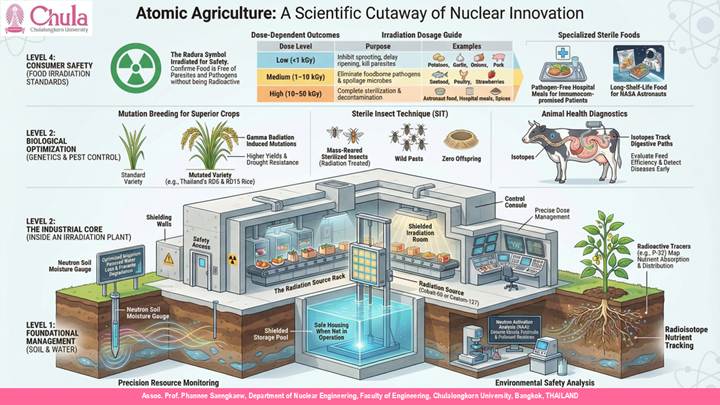
Nuclear agriculture represents not merely a collection of isolated techniques, but a multi-layered, integrated system that spans from fundamental resource management to advanced food safety applications. As illustrated in Figure 1, nuclear technologies operate across hierarchical levels—from soil and water monitoring to industrial irradiation systems and consumer-level safety assurance.
This systemic perspective highlights a key principle: nuclear science enables the transformation of invisible physical interactions into measurable, controllable, and optimizable processes across the entire food chain.
- 2. Level 1: Foundational Resource Management (Soil and Water)
At the most fundamental level, nuclear techniques support precision agriculture through quantitative monitoring of soil and environmental conditions.
- 2.1 Neutron Soil Moisture Gauge
The neutron soil moisture gauge, depicted in the figure, operates based on fast neutron scattering and thermalization. Fast neutrons emitted from a source collide with hydrogen nuclei (primarily from water molecules), losing energy and becoming thermal neutrons.
The detected count of thermal neutrons is directly proportional to volumetric soil moisture:

This enables:
- Deep soil moisture profiling
- Optimization of irrigation scheduling
- Reduction of water waste and soil degradation
- 2.2 Optimized Irrigation and Resource Efficiency
As indicated in the figure (“optimized irrigation prevents water loss & fracture degradation”), nuclear-based measurements allow data-driven irrigation, preventing:
- Overwatering (leading to nutrient leaching)
- Soil structural damage
- Inefficient fertilizer usage
- 3. Level 2: Industrial Core — Irradiation Facility Infrastructure
A key addition emphasized in your figure is the engineering architecture of irradiation plants, which was not fully detailed previously.
- 3.1 Irradiation Plant Design
The irradiation plant is designed as an integrated system that combines radiation protection, process control, and industrial efficiency. The overall layout incorporates thick shielding walls, typically constructed from high-density concrete, which serve as the primary barrier against ionizing radiation and ensure that radiation levels outside the facility remain within regulatory limits.
To further enhance safety, the facility is equipped with controlled access systems that regulate personnel entry into irradiation zones. These systems are interlocked with the radiation source operation, thereby ensuring compliance with radiation safety standards and preventing accidental exposure.
From an operational perspective, the plant commonly employs a conveyor-based processing system, which enables the continuous movement of products through the irradiation field. This configuration supports high-throughput industrial processing and ensures consistent exposure conditions for large volumes of materials.
At the core of system operation is the control console, which provides real-time monitoring of radiation dose, system status, and operational parameters. This centralized control allows operators to adjust processing conditions and maintain precise control over irradiation procedures.
A critical feature of the plant design is precise dose management, which ensures uniform irradiation of products. This is achieved through careful coordination of source geometry, conveyor speed, and exposure time, allowing the system to deliver accurate and reproducible doses required for applications such as sterilization, food preservation, and materials modification.
- 3.2 Radiation Source and Safety System
The radiation source and safety system comprises a set of integrated components designed to ensure reliable irradiation performance while maintaining a high level of operational safety. The primary radiation sources typically include Cobalt-60 and Cesium-137, both of which are widely utilized due to their appropriate gamma-ray energies and relatively long half-lives. In recent years, high-energy X-rays generated from electron accelerators have increasingly been adopted as an alternative radiation source, offering advantages such as on-demand operation and the elimination of long-term radioactive source management.
A key mechanical component of the system is the source rack mechanism, which is responsible for transferring the radiation sources from a shielded position into the irradiation zone during operation and retracting them afterward. This controlled movement enables precise regulation of exposure conditions and contributes significantly to system safety. When not in operation, the radiation sources are stored in a water pool, which serves as a secure “safe housing” system. Water provides an effective radiation shield due to its high hydrogen content, which is particularly efficient in attenuating ionizing radiation. This passive shielding approach ensures that radiation levels remain within safe limits, thereby protecting both personnel and the surrounding environment.
Overall, the integration of these components forms a robust engineering system that ensures operational safety, enables reproducible dose delivery, and supports industrial scalability. Such characteristics are essential for large-scale irradiation applications in fields such as medical sterilization, food processing, and materials modification.
- 4. Level 2: Biological Optimization — Genetics and Pest Control
- 4.1 Mutation Breeding
Mutation breeding is a well-established nuclear technique that enables the development of improved crop varieties through controlled genetic modification. As illustrated in the figure, a clear distinction is observed between standard and mutated crop varieties, emphasizing the role of radiation-induced mutations generated using gamma rays or neutrons. These forms of ionizing radiation interact with plant genetic material, inducing random but controlled mutations that expand the genetic diversity beyond what is typically achievable through conventional breeding methods.
Such induced variations can subsequently be screened and selected for desirable agronomic traits, including enhanced yield, improved drought resistance, and greater structural stability of the plant. This process represents a form of controlled genetic diversification, in which radiation acts as a tool to accelerate natural evolutionary mechanisms, thereby enabling targeted and efficient agricultural improvement in response to environmental and food security challenges.
- 4.2 Sterile Insect Technique (SIT)
The Sterile Insect Technique (SIT) is a biologically based pest control strategy that utilizes radiation to suppress insect populations in an environmentally sustainable manner. The diagram effectively illustrates the fundamental cycle underlying this approach, beginning with the mass rearing of target insect species under controlled conditions. These insects are then sterilized—typically using ionizing radiation—before being systematically released into wild populations.
Once released, the sterile insects compete with wild counterparts for mating opportunities. However, because they are reproductively inactive, these mating events result in no offspring. Over time, repeated releases lead to a progressive decline in the pest population, ultimately achieving effective suppression or even eradication in localized areas.
SIT is therefore recognized as a non-chemical pest control method that minimizes environmental contamination and avoids the development of pesticide resistance. Moreover, its species-specific nature allows for precise ecological intervention, targeting only the pest species of interest without adversely affecting non-target organisms or surrounding ecosystems.
- 5. Level 3: Food Safety — Irradiation Dosage and Consumer Protection
At Level 3 of nuclear applications in agriculture and food systems, the focus shifts toward ensuring food safety through the controlled application of irradiation.
- 5.1 Dose-Dependent Outcomes
The figure presents a structured, dose-dependent framework that clearly illustrates how varying levels of ionizing radiation produce distinct scientific effects and corresponding practical applications. At low doses (below 1 kGy), irradiation primarily inhibits enzymatic activity, which is particularly useful for delaying sprouting in crops such as potatoes and onions. At intermediate doses (1–10 kGy), the dominant effect is damage to microbial DNA, effectively reducing or eliminating pathogenic microorganisms and thereby enhancing food safety. At higher doses (10–50 kGy), irradiation achieves sterilization, which is applied in specialized contexts such as sterilized meals for immunocompromised patients or space food systems. This dose–effect relationship highlights the precision with which irradiation can be tailored to specific food preservation objectives.
| Dose Level | Range | Scientific Effect | Application |
| Low | <1 kGy | Enzyme inhibition | Sprouting delay |
| Medium | 1–10 kGy | DNA damage in microbes | Food safety |
| High | 10–50 kGy | Sterilization | Specialized food |
- 5.2 Radiation Chemistry Mechanism
From a mechanistic perspective, these effects arise from fundamental radiation chemistry processes. When ionizing radiation interacts with food materials—particularly water molecules—it generates reactive free radicals. These highly reactive species subsequently induce DNA strand breaks and disrupt critical cellular functions in microorganisms, leading to their inactivation or death. Importantly, these processes occur without significantly altering the macroscopic structure or nutritional value of the food when properly controlled, reinforcing the scientific basis for irradiation as a safe preservation method.
- 5.3 Radura Symbol (Consumer-Level Indicator)
In addition to the technical aspects, the figure appropriately incorporates the Radura symbol, a globally recognized indicator used at the consumer level. The presence of this symbol signifies that the food product has undergone irradiation in compliance with established safety standards. It communicates key assurances to consumers, including the reduction or elimination of parasites and pathogens, as well as the fact that the food itself does not become radioactive. This labeling mechanism plays a critical role in fostering public acceptance and ensuring regulatory transparency, both of which are essential for the broader adoption of irradiation technologies in modern food systems.
- 6. Specialized Applications: High-Reliability Food Systems
Beyond conventional food preservation and safety, irradiation technology plays a critical role in specialized, high-reliability food systems where the margin for error is effectively zero. The figure highlights two such applications—medical nutrition and space food systems—which, although less frequently discussed, represent some of the most demanding use cases for food irradiation technologies.
- 6.1 Medical Nutrition
In the context of medical nutrition, irradiation is employed to produce pathogen-free food specifically designed for immunocompromised patients, such as those undergoing chemotherapy, organ transplantation, or advanced clinical treatments. In these cases, even minimal microbial contamination can pose severe health risks. Therefore, food must meet an extremely stringent requirement of near-zero microbial presence. Irradiation provides a reliable method to achieve this level of safety without compromising the nutritional integrity of the food, making it an essential component of controlled clinical dietary systems.
- 6.2 Space Food Systems
Similarly, in space food systems, irradiation is utilized to ensure long shelf-life and microbiological stability under extreme and isolated conditions. Astronauts require food that remains safe and nutritionally stable over extended missions, often in environments where refrigeration, resupply, and conventional preservation methods are limited or unavailable. High-dose irradiation enables the production of shelf-stable, ready-to-eat meals that can withstand variations in temperature, radiation exposure, and storage duration.
Together, these applications exemplify high-reliability food systems, where conventional preservation techniques are insufficient to meet operational requirements. In such systems, irradiation is not merely an option but a necessity, providing a scientifically robust and dependable solution for ensuring both safety and performance under critical conditions.
- 7. Animal Health and Metabolic Diagnostics
A key addition from your figure is animal health diagnostics using isotopes, which expands the scope beyond plants.
- 7.1 Isotope Tracing in Livestock
An important extension of nuclear techniques in agricultural systems is their application in animal health and metabolic diagnostics, as highlighted in the figure. This perspective broadens the scope of nuclear technology beyond plant-based applications, emphasizing its role in advancing precision livestock management. Central to this approach is the use of radioisotopes as tracers, which enable detailed investigation of physiological and metabolic processes in living animals without significantly disturbing their normal biological functions.
In livestock systems, isotope tracing is employed to monitor digestive pathways, allowing researchers and practitioners to understand how nutrients are absorbed, distributed, and utilized within the body. This information is critical for evaluating feed efficiency, optimizing dietary formulations, and minimizing resource loss. Furthermore, radioisotopes can be used to identify deviations in normal metabolic behavior, enabling the early detection of disorders that may not yet present visible clinical symptoms.
Through these capabilities, isotope-based diagnostics support a transition toward precision livestock management, where feeding strategies and health interventions can be tailored to individual animals or specific herds. This leads to improved productivity, reduced feed waste, and enhanced animal welfare. Ultimately, such techniques contribute to more sustainable and efficient agricultural systems by integrating advanced nuclear science into routine veterinary and livestock practices.
- 8. Radiotracer Applications in Plants and Environment
- 8.1 Nutrient Mapping (e.g., P-32)
Radiotracer techniques represent a powerful extension of nuclear technology for investigating dynamic processes in both plant systems and the environment. As illustrated in the figure, these methods enable the direct visualization and quantification of material transport and elemental distribution, providing insights that are otherwise difficult to obtain through conventional analytical approaches.
In plant studies, the use of radioisotopes such as phosphorus-32 (P-32) allows for precise tracking of nutrient movement from the soil into plant roots and subsequently throughout the plant structure. This soil → root → plant pathway, clearly depicted in the diagram, reflects the real-time uptake and translocation processes that govern plant nutrition. By quantifying these pathways, researchers can optimize fertilizer application strategies, ensuring that nutrients are delivered efficiently to the plant while minimizing excess use. This not only improves agricultural productivity but also reduces nutrient loss to the environment, thereby limiting runoff and mitigating associated ecological impacts such as water pollution and eutrophication.
- 8.2 Environmental Safety Analysis (NAA)
In parallel, the figure highlights the application of Neutron Activation Analysis (NAA), a highly sensitive nuclear analytical technique used for environmental safety assessment. Through neutron irradiation and subsequent gamma-ray analysis, NAA enables the detection and quantification of trace elements and contaminants at very low concentrations. This capability is particularly important for identifying pesticide residues and other hazardous substances in agricultural products and environmental samples.
Together, these applications play a critical role in supporting food safety regulation and environmental monitoring. By providing accurate, quantitative, and non-destructive analysis, radiotracer techniques and NAA contribute to evidence-based decision-making in agriculture and environmental management, reinforcing the integration of nuclear science into sustainable development practices.
- 9. System Integration: A Multi-Level Nuclear Agriculture Framework
Building upon the figure, nuclear agriculture can be systematically conceptualized as a multi-level operational framework in which each level corresponds to a distinct functional role supported by specific nuclear technologies. At Level 1, the focus is on resource management, where techniques such as neutron moisture gauges are employed to quantify soil water content with high precision. This enables optimized irrigation strategies and efficient utilization of natural resources.
At Level 2, nuclear technologies are applied at the industrial processing stage, most notably through irradiation facilities that support large-scale food preservation and post-harvest treatment. In parallel, a biologically oriented extension of this level—referred to as Level 2 (Bio)—addresses genetic improvement and pest control. Here, mutation breeding and the Sterile Insect Technique (SIT) are utilized to enhance crop traits and suppress pest populations, respectively, reflecting the integration of nuclear science with biological systems.
Progressing to Level 3, the emphasis shifts to food safety, where irradiation is applied in a controlled and dose-dependent manner to eliminate pathogens and extend shelf life while maintaining food quality. Finally, at Level 4, the framework culminates in consumer assurance, represented by certification mechanisms such as the Radura symbol. This level ensures transparency, regulatory compliance, and public confidence in irradiated food products.
Together, these interconnected levels illustrate how nuclear technologies operate not in isolation, but as an integrated system spanning the entire agricultural and food supply chain—from resource management to end-user assurance.
| Level | Function | Technology |
| Level 1 | Resource Management | Neutron moisture gauge |
| Level 2 | Industrial Processing | Irradiation facility |
| Level 2 (Bio) | Genetic & Pest Control | Mutation breeding, SIT |
| Level 3 | Food Safety | Irradiation |
| Level 4 | Consumer Assurance | Radura certification |
- 10. Conclusion: From Tools to Infrastructure
When considered collectively, the elements presented in the figure reveal that nuclear agriculture should not be viewed merely as a collection of discrete techniques. Rather, it constitutes a coherent technological infrastructure that supports modern agricultural systems at multiple levels. Within this framework, nuclear methods enable the measurement of critical parameters such as soil moisture, nutrient dynamics, and environmental conditions. They also facilitate the modification of biological systems through genetic improvement and pest control, the preservation of food via irradiation-based safety processes, and the verification of product integrity through standardized certification mechanisms.
This integrated perspective underscores a central conceptual insight: nuclear science functions as a bridge between invisible physical interactions and practical, real-world applications. By converting microscopic radiation–matter interactions into measurable data and actionable interventions, nuclear technologies provide a foundation for informed decision-making across the agricultural value chain. Ultimately, this transformation from fundamental physics to applied systems plays a vital role in sustaining global food security, enhancing resource efficiency, and ensuring the safety and reliability of food supplies in an increasingly complex world.
******************************************************************************
เกษตรกรรมระดับอะตอม: วิทยาศาสตร์นิวเคลียร์ในฐานะระบบบูรณาการเพื่อความมั่นคงทางอาหาร
- 1.บทนำ: จากปรากฏการณ์ที่มองไม่เห็นสู่ระบบที่ออกแบบได้
เทคโนโลยีนิวเคลียร์ในภาคเกษตรกรรมมิได้เป็นเพียงเทคนิคเฉพาะทางที่แยกส่วน หากแต่เป็น ระบบเชิงบูรณาการหลายระดับ (multi-layered system) ที่ครอบคลุมตั้งแต่การจัดการทรัพยากรพื้นฐานไปจนถึงการควบคุมความปลอดภัยของอาหารในระดับผู้บริโภค ดังแสดงในรูปประกอบ เทคโนโลยีเหล่านี้ทำงานเป็นลำดับขั้น ตั้งแต่ระดับดินและน้ำ ไปจนถึงระดับอุตสาหกรรมและการรับรองคุณภาพอาหาร
แนวคิดสำคัญคือ วิทยาศาสตร์นิวเคลียร์ทำให้ปรากฏการณ์ที่มองไม่เห็นสามารถถูกตรวจวัด ควบคุม และเพิ่มประสิทธิภาพได้อย่างเป็นระบบตลอดห่วงโซ่อาหาร
- 2. ระดับที่ 1: การจัดการทรัพยากรพื้นฐาน (ดินและน้ำ)
- 2.1 เครื่องวัดความชื้นในดินด้วยนิวตรอน (Neutron Soil Moisture Gauge)
เครื่องมือนี้อาศัยหลักการ การกระเจิงของนิวตรอน (neutron scattering) โดยนิวตรอนพลังงานสูงจะชนกับนิวเคลียสของไฮโดรเจนในน้ำ ทำให้สูญเสียพลังงานและกลายเป็นนิวตรอนพลังงานต่ำ (thermal neutrons)
จำนวนของนิวตรอนที่ตรวจวัดได้มีความสัมพันธ์โดยตรงกับปริมาณน้ำในดิน:

ประโยชน์ทางวิชาการ:
- วัดความชื้นได้ลึกกว่าผิวดิน
- เพิ่มความแม่นยำในการให้น้ำ
- ลดการสูญเสียน้ำและการเสื่อมสภาพของดิน
- 2.2 การจัดการน้ำอย่างแม่นยำ (Precision Irrigation)
การจัดการน้ำในระบบเกษตรสมัยใหม่ไม่ได้อาศัยเพียงประสบการณ์หรือการสังเกตเชิงผิวเผินอีกต่อไป แต่ได้พัฒนาไปสู่แนวคิดของ “การจัดการน้ำอย่างแม่นยำ” (Precision Irrigation) ซึ่งตั้งอยู่บนพื้นฐานของข้อมูลเชิงปริมาณที่สามารถสะท้อนสภาพจริงของดินและพืชได้อย่างถูกต้อง หนึ่งในเทคโนโลยีสำคัญที่สนับสนุนแนวคิดนี้คือการวัดความชื้นในดินด้วยเทคนิคทางนิวเคลียร์ เช่น เครื่องวัดความชื้นนิวตรอน ซึ่งมีความสามารถในการตรวจวัดความชื้นได้ลึกลงไปใต้ผิวดิน แตกต่างจากวิธีทั่วไปที่มักจำกัดอยู่เพียงชั้นผิวดินเท่านั้น
ความสามารถในการวัดความชื้นในระดับความลึกนี้มีความสำคัญอย่างยิ่ง เนื่องจากระบบรากของพืชส่วนใหญ่แผ่กระจายอยู่ใต้ผิวดิน และเป็นบริเวณที่เกิดการดูดซึมน้ำจริง การมีข้อมูลความชื้นในระดับดังกล่าวจึงช่วยให้สามารถประเมินสถานะน้ำที่พืชเข้าถึงได้อย่างแท้จริง ส่งผลให้การตัดสินใจให้น้ำมีความแม่นยำมากขึ้น ลดทั้งการให้น้ำน้อยเกินไปซึ่งอาจกระทบต่อการเจริญเติบโต และการให้น้ำมากเกินไปซึ่งก่อให้เกิดการสูญเสียทรัพยากรโดยไม่จำเป็น
เมื่อเชื่อมโยงกับข้อมูลที่ปรากฏในภาพ เทคโนโลยีนี้มีบทบาทสำคัญในการป้องกันการให้น้ำเกิน (over-irrigation) ซึ่งเป็นปัญหาที่พบได้บ่อยในระบบเกษตรแบบดั้งเดิม การให้น้ำเกินไม่เพียงแต่ทำให้สิ้นเปลืองน้ำ แต่ยังส่งผลให้เกิดการชะล้างธาตุอาหาร (nutrient leaching) ลงสู่ชั้นดินลึก ทำให้พืชไม่สามารถนำธาตุอาหารไปใช้ได้อย่างเต็มที่ อีกทั้งยังอาจก่อให้เกิดปัญหาสิ่งแวดล้อม เช่น การปนเปื้อนในแหล่งน้ำใต้ดิน
นอกจากนี้ การควบคุมปริมาณน้ำอย่างเหมาะสมยังช่วยรักษาโครงสร้างของดิน (soil structure) ซึ่งเป็นปัจจัยสำคัญต่อการถ่ายเทอากาศ การซึมผ่านของน้ำ และการเจริญของรากพืช หากดินได้รับน้ำมากเกินไปอย่างต่อเนื่อง อาจเกิดการอัดแน่นหรือการเสื่อมสภาพของโครงสร้างดิน ส่งผลต่อประสิทธิภาพการเพาะปลูกในระยะยาว
ดังนั้น การบูรณาการเทคโนโลยีการวัดความชื้นเข้ากับระบบการให้น้ำแบบแม่นยำ จึงไม่เพียงแต่ช่วยเพิ่มประสิทธิภาพในการใช้น้ำเท่านั้น แต่ยังมีบทบาทในการลดการสูญเสียทรัพยากร ป้องกันการเสื่อมสภาพของดิน และสนับสนุนการเกษตรอย่างยั่งยืนในภาพรวม กล่าวได้ว่า เทคโนโลยีนี้เป็นตัวอย่างที่ชัดเจนของการนำหลักการทางวิทยาศาสตร์นิวเคลียร์มาประยุกต์ใช้เพื่อยกระดับการจัดการทรัพยากรในภาคเกษตรกรรมอย่างเป็นระบบและมีประสิทธิภาพสูงสุด
- 3. ระดับที่ 2: แกนกลางอุตสาหกรรม — ระบบโรงงานฉายรังสี
ในระดับที่ 2 เทคโนโลยีนิวเคลียร์ก้าวเข้าสู่บทบาทของ “แกนกลางอุตสาหกรรม” โดยเฉพาะในรูปแบบของโรงงานฉายรังสี ซึ่งเป็นโครงสร้างพื้นฐานที่เชื่อมโยงการผลิตทางการเกษตรกับการแปรรูปและการควบคุมคุณภาพในระดับอุตสาหกรรม ระบบนี้ถูกออกแบบเชิงวิศวกรรมอย่างเป็นระบบ เพื่อให้สามารถดำเนินงานได้อย่างปลอดภัย ต่อเนื่อง และมีความแม่นยำสูง
- 3.1 โครงสร้างของโรงงานฉายรังสี (Irradiation Facility)
จากภาพประกอบ โรงงานฉายรังสีประกอบด้วยองค์ประกอบสำคัญหลายส่วนที่ทำงานร่วมกันอย่างบูรณาการ
- ผนังป้องกันรังสี (shielding walls) ทำหน้าที่จำกัดการแพร่กระจายของรังสีสู่ภายนอก
- ระบบควบคุมการเข้า–ออก (safety access) ช่วยป้องกันการเข้าถึงพื้นที่อันตรายโดยไม่ได้รับอนุญาต ภายในระบบมีสายพานลำเลียง (conveyor system) สำหรับขนส่งผลิตภัณฑ์ผ่านบริเวณฉายรังสีอย่างต่อเนื่องเข้าสู่
- ห้องฉายรังสีที่เป็นผนังกำบังรังสี (shielded irradiation room) ซึ่งเป็นพื้นที่ที่ควบคุมสภาวะการฉายรังสีอย่างเข้มงวด
- ศูนย์กลางของการควบคุมอยู่ที่ระบบควบคุม (control console) ซึ่งใช้กำหนดและติดตามปริมาณรังสี (dose) ที่ผลิตภัณฑ์ได้รับในแต่ละรอบการฉาย
ด้วยการทำงานร่วมกันขององค์ประกอบทั้งหมดนี้ จึงสามารถบริหารจัดการปริมาณรังสีได้อย่างแม่นยำ (precise dose management) ซึ่งเป็นปัจจัยสำคัญต่อทั้งคุณภาพของผลิตภัณฑ์และความปลอดภัยของกระบวนการ
- 3.2 แหล่งกำเนิดรังสีและความปลอดภัย
ในด้านแหล่งกำเนิดรังสี โรงงานฉายรังสีแบบดั้งเดิมนิยมใช้ไอโซโทปกัมมันตรังสี เช่น โคบอลต์-60 (Co-60) และซีเซียม-137 (Cs-137) ซึ่งให้รังสีแกมมาที่มีพลังงานสูงและมีความสม่ำเสมอ อย่างไรก็ตาม ในปัจจุบันมีแนวโน้มเพิ่มขึ้นของการใช้รังสีเอกซ์พลังงานสูงที่ผลิตจากเครื่องเร่งอนุภาคอิเล็กตรอน ซึ่งสามารถควบคุมการเปิด–ปิดรังสีได้ทันที
เพื่อรองรับความปลอดภัย แหล่งกำเนิดรังสีจะถูกจัดเก็บไว้ในสระน้ำ (storage pool) เมื่อไม่ใช้งาน โดยน้ำทำหน้าที่เป็นตัวกำบังรังสีที่มีประสิทธิภาพสูง เนื่องจากมีไฮโดรเจนเป็นองค์ประกอบหลัก ขณะเดียวกัน ระบบยกแหล่งรังสี (source rack) จะทำหน้าที่นำแหล่งรังสีขึ้นสู่ตำแหน่งฉายเมื่อเริ่มกระบวนการ และลดลงสู่สระน้ำเมื่อหยุดใช้งาน
ด้วยการออกแบบเชิงวิศวกรรมดังกล่าว โรงงานฉายรังสีจึงสามารถดำเนินงานได้อย่างปลอดภัย มีความสม่ำเสมอของปริมาณรังสีในทุกผลิตภัณฑ์ และรองรับการผลิตในระดับอุตสาหกรรมได้อย่างมีประสิทธิภาพ กล่าวได้ว่า ระบบนี้เป็นหัวใจสำคัญที่ทำให้เทคโนโลยีนิวเคลียร์สามารถเปลี่ยนจากแนวคิดทางวิทยาศาสตร์ไปสู่การใช้งานจริงในระดับอุตสาหกรรมอาหารและเกษตรกรรมได้อย่างสมบูรณ์
- 4. ระดับที่ 2 (ชีวภาพ): การปรับปรุงพันธุกรรมและการควบคุมศัตรูพืช
ในระดับที่ 2 (ชีวภาพ) เทคโนโลยีนิวเคลียร์ถูกนำมาใช้เพื่อ “ปรับเปลี่ยน” ระบบชีวภาพโดยตรง ทั้งในพืชและแมลงศัตรูพืช เพื่อเพิ่มประสิทธิภาพการผลิตและลดผลกระทบต่อสิ่งแวดล้อมอย่างเป็นระบบ
- 4.1 การปรับปรุงพันธุ์พืชด้วยรังสี (Mutation Breeding)
การใช้รังสี เช่น รังสีแกมมาและนิวตรอน ทำให้เกิดการเปลี่ยนแปลงในระดับ DNA ของพืช ซึ่งเป็นจุดเริ่มต้นของความหลากหลายทางพันธุกรรมที่สามารถนำไปคัดเลือกต่อได้อย่างมีเป้าหมาย ผลลัพธ์ที่ได้จึงไม่ใช่การเปลี่ยนแปลงแบบสุ่มเพียงอย่างเดียว แต่เป็น “ความหลากหลายที่ถูกควบคุม” เพื่อให้ได้ลักษณะที่ต้องการ เช่น การเพิ่มผลผลิต ความสามารถในการทนแล้ง หรือโครงสร้างลำต้นที่แข็งแรงมากขึ้น กระบวนการนี้จึงทำหน้าที่เร่งกลไกของธรรมชาติให้เกิดขึ้นในระยะเวลาที่สั้นลง และตอบโจทย์การพัฒนาพันธุ์พืชในสภาพแวดล้อมที่เปลี่ยนแปลงอย่างรวดเร็ว
- 4.2 เทคนิคแมลงเป็นหมัน (Sterile Insect Technique: SIT)
ในขณะที่การปรับปรุงพันธุ์พืชมุ่งเน้นการ “เสริมสร้าง” คุณสมบัติที่ดี เทคนิค SIT มุ่งเน้นการ “ลดทอน” ศัตรูพืชอย่างจำเพาะเจาะจง โดยเริ่มจากการเพาะเลี้ยงแมลงเป้าหมายในปริมาณมาก จากนั้นฉายรังสีเพื่อทำให้เป็นหมัน แล้วปล่อยกลับสู่ธรรมชาติ เมื่อแมลงที่เป็นหมันไปผสมพันธุ์กับแมลงป่า จะไม่เกิดลูกหลาน ส่งผลให้จำนวนประชากรลดลงอย่างต่อเนื่องในระยะยาว
ข้อได้เปรียบสำคัญของเทคนิคนี้คือ ไม่ต้องใช้สารเคมี จึงไม่ก่อให้เกิดสารตกค้างในสิ่งแวดล้อม ไม่ทำลายสิ่งมีชีวิตอื่นในระบบนิเวศ และมีความจำเพาะต่อชนิดของแมลงเป้าหมายสูง ทำให้เป็นแนวทางการควบคุมศัตรูพืชที่สอดคล้องกับหลักการเกษตรยั่งยืน
โดยสรุป ระดับชีวภาพนี้สะท้อนให้เห็นบทบาทของเทคโนโลยีนิวเคลียร์ในการ “ออกแบบ” ระบบชีวภาพใหม่ ทั้งในมิติของการเพิ่มศักยภาพของพืชและการควบคุมความเสี่ยงจากศัตรูพืชอย่างแม่นยำและเป็นมิตรต่อสิ่งแวดล้อม
- 5. ระดับที่ 3: ความปลอดภัยอาหารและการฉายรังสี
ในระดับที่ 3 เทคโนโลยีนิวเคลียร์มีบทบาทสำคัญในการ “รักษา” คุณภาพและความปลอดภัยของอาหาร โดยอาศัยการฉายรังสีในระดับปริมาณที่เหมาะสม ซึ่งให้ผลลัพธ์แตกต่างกันอย่างเป็นระบบตามขนาดปริมาณรังสี
- 5.1 ระดับปริมาณรังสีและผลลัพธ์
การฉายรังสีในระดับต่ำ (<1 kGy) ส่งผลต่อการยับยั้งการทำงานของเอนไซม์ ช่วยชะลอการงอกของพืช เช่น มันฝรั่งและหัวหอม ขณะที่ระดับกลาง (1–10 kGy) สามารถทำลาย DNA ของจุลินทรีย์ จึงถูกใช้เพื่อฆ่าเชื้อและเพิ่มความปลอดภัยของอาหาร ส่วนในระดับสูง (10–50 kGy) จะทำให้เกิดการปลอดเชื้ออย่างสมบูรณ์ เหมาะสำหรับอาหารเฉพาะทาง เช่น อาหารทางการแพทย์
| ระดับ | ช่วงปริมาณ | ผลทางวิทยาศาสตร์ | การใช้งาน |
| ต่ำ | <1 kGy | ยับยั้งเอนไซม์ | ชะลอการงอก |
| กลาง | 1–10 kGy | ทำลาย DNA จุลินทรีย์ | ฆ่าเชื้อ |
| สูง | 10–50 kGy | ทำให้ปลอดเชื้อ | อาหารพิเศษ |
- 5.2 กลไกทางเคมีของรังสี (Radiation Chemistry)
ผลของการฉายรังสีเกิดจากปฏิกิริยาทางเคมีระดับจุลภาค เมื่อรังสีปฏิสัมพันธ์กับน้ำในอาหาร จะก่อให้เกิดอนุมูลอิสระ (free radicals) ซึ่งมีความไวต่อปฏิกิริยาสูง อนุมูลเหล่านี้จะไปทำลายโครงสร้างสำคัญของเซลล์ โดยเฉพาะการแตกสาย DNA ส่งผลให้จุลินทรีย์ไม่สามารถเจริญเติบโตหรือเพิ่มจำนวนได้ กระบวนการนี้จึงเป็นพื้นฐานทางวิทยาศาสตร์ของการยับยั้งเชื้อโรคโดยไม่ทำให้อาหารกลายเป็นกัมมันตรังสี
- 5.3 สัญลักษณ์ราดูรา (Radura Symbol)
เพื่อสร้างความเชื่อมั่นให้กับผู้บริโภค อาหารที่ผ่านการฉายรังสีจะมีสัญลักษณ์ “ราดูรา” กำกับ ซึ่งแสดงถึงการผ่านกระบวนการตามมาตรฐานความปลอดภัย ยืนยันว่าอาหารปลอดจากเชื้อโรคที่เป็นอันตราย และที่สำคัญคืออาหารนั้นไม่กลายเป็นสารกัมมันตรังสี สัญลักษณ์นี้จึงมีบทบาททั้งในด้านการสื่อสาร ความโปร่งใส และการยอมรับของสังคม
- 6. การประยุกต์เฉพาะทาง
นอกเหนือจากการใช้งานทั่วไป การฉายรังสียังถูกนำไปใช้ในระบบอาหารที่ต้องการ “ความน่าเชื่อถือสูง” ซึ่งวิธีการถนอมอาหารแบบดั้งเดิมไม่สามารถตอบโจทย์ได้
- 6.1 อาหารทางการแพทย์
ในผู้ป่วยที่มีภูมิคุ้มกันต่ำ เช่น ผู้ป่วยมะเร็งหรือผู้ปลูกถ่ายอวัยวะ อาหารต้องมีความปลอดเชื้อในระดับสูงมาก การฉายรังสีจึงถูกใช้เพื่อกำจัดจุลินทรีย์ทั้งหมด โดยยังคงคุณค่าทางโภชนาการไว้ได้ ทำให้สามารถลดความเสี่ยงจากการติดเชื้อผ่านอาหารได้อย่างมีประสิทธิภาพ
- 6.2 อาหารอวกาศ
สำหรับภารกิจอวกาศ อาหารต้องมีอายุการเก็บรักษาที่ยาวนานและมีความเสถียรภายใต้สภาวะสุดขั้ว เช่น อุณหภูมิที่เปลี่ยนแปลงและการขาดระบบเก็บรักษาแบบปกติ การฉายรังสีในระดับสูงจึงเป็นวิธีที่เหมาะสมในการผลิตอาหารที่ปลอดเชื้อ พร้อมบริโภค และสามารถเก็บรักษาได้เป็นเวลานาน
- 7. สุขภาพสัตว์และการวินิจฉัยด้วยไอโซโทป
ในภาคปศุสัตว์ เทคโนโลยีนิวเคลียร์มีบทบาทสำคัญในการ “ทำความเข้าใจ” ระบบชีวภาพของสัตว์ผ่านการใช้ไอโซโทปเป็นตัวติดตาม (tracer) ซึ่งช่วยให้สามารถศึกษากระบวนการภายในร่างกายได้อย่างแม่นยำ
การใช้ไอโซโทปช่วยติดตามเส้นทางการย่อยและการดูดซึมอาหาร ทำให้สามารถประเมินประสิทธิภาพของอาหารสัตว์ได้อย่างเป็นระบบ นอกจากนี้ ยังสามารถตรวจพบความผิดปกติของกระบวนการเมแทบอลิซึมในระยะเริ่มต้น ก่อนที่อาการทางคลินิกจะปรากฏอย่างชัดเจน
ข้อมูลเชิงลึกเหล่านี้นำไปสู่แนวทาง “การจัดการปศุสัตว์แบบแม่นยำ” (precision livestock management) ซึ่งช่วยเพิ่มประสิทธิภาพการผลิต ลดการสูญเสียทรัพยากร และยกระดับสุขภาพสัตว์ในระยะยาว ทั้งหมดนี้สะท้อนให้เห็นถึงบทบาทของเทคโนโลยีนิวเคลียร์ในการเชื่อมโยงวิทยาศาสตร์พื้นฐานเข้ากับการประยุกต์ใช้ในระบบเกษตรกรรมอย่างครบวงจร
- 8. การใช้ไอโซโทปติดตามธาตุอาหารและสิ่งแวดล้อม
การประยุกต์ใช้ไอโซโทปในระบบเกษตรและสิ่งแวดล้อมมีบทบาทสำคัญในการ “มองเห็น” กระบวนการที่เกิดขึ้นภายในระบบธรรมชาติอย่างเป็นเชิงปริมาณ โดยเฉพาะในด้านการเคลื่อนที่และการใช้ประโยชน์ของธาตุอาหาร
- 8.1 การติดตามธาตุอาหาร (เช่น P-32)
การใช้ไอโซโทปกัมมันตรังสี เช่น ฟอสฟอรัส-32 (P-32) เป็นตัวติดตาม (tracer) ช่วยให้สามารถวิเคราะห์เส้นทางการดูดซึมและการเคลื่อนที่ของธาตุอาหารจากดินเข้าสู่พืชได้อย่างชัดเจน ข้อมูลดังกล่าวมีความสำคัญต่อการออกแบบการใช้ปุ๋ยอย่างเหมาะสม ลดการใช้ปุ๋ยเกินความจำเป็น และเพิ่มประสิทธิภาพการใช้ธาตุอาหารของพืช ซึ่งส่งผลทั้งต่อผลผลิตและการลดผลกระทบต่อสิ่งแวดล้อม
- 8.2 การวิเคราะห์ด้วยนิวตรอน (Neutron Activation Analysis: NAA)
ในด้านการวิเคราะห์องค์ประกอบของสิ่งแวดล้อม เทคนิค Neutron Activation Analysis (NAA) เป็นเครื่องมือที่มีความไวสูง สามารถตรวจวัดธาตุในระดับปริมาณน้อยมาก (ppm–ppb) ได้อย่างแม่นยำ เทคนิคนี้ถูกนำมาใช้ในการตรวจสอบสารตกค้าง เช่น สารกำจัดศัตรูพืช หรือการวิเคราะห์ธาตุองค์ประกอบในดิน น้ำ และอาหาร ซึ่งมีความสำคัญต่อการควบคุมคุณภาพและความปลอดภัยในระบบเกษตรและสิ่งแวดล้อม
- 9. โครงสร้างเชิงระบบของเกษตรนิวเคลียร์
เมื่อพิจารณาในภาพรวม เทคโนโลยีนิวเคลียร์ในภาคเกษตรสามารถจัดเป็น “โครงสร้างเชิงระบบ” ที่เชื่อมโยงการทำงานในหลายระดับ ตั้งแต่ต้นน้ำจนถึงปลายน้ำของห่วงโซ่อาหาร โดยในระดับที่ 1 มุ่งเน้นการจัดการทรัพยากร เช่น การใช้เครื่องวัดความชื้นด้วยนิวตรอนเพื่อเพิ่มประสิทธิภาพการใช้น้ำ
ระดับที่ 2 ครอบคลุมกระบวนการอุตสาหกรรม เช่น โรงฉายรังสีสำหรับการแปรรูปและถนอมอาหาร ขณะที่ระดับ 2 (ชีวภาพ) เน้นการปรับปรุงพันธุกรรมพืชและการควบคุมศัตรูพืชผ่านเทคนิค Mutation Breeding และ SIT ซึ่งเป็นการแทรกแซงในระดับชีวภาพโดยตรง
ในระดับที่ 3 เทคโนโลยีการฉายรังสีถูกนำมาใช้เพื่อยกระดับความปลอดภัยของอาหาร ส่วนระดับที่ 4 เป็นขั้นของการรับรองและสร้างความเชื่อมั่นแก่ผู้บริโภคผ่านสัญลักษณ์ เช่น Radura ซึ่งสะท้อนถึงมาตรฐานและความโปร่งใสของกระบวนการผลิต
| ระดับ | หน้าที่ | เทคโนโลยี |
| ระดับ 1 | จัดการทรัพยากร | นิวตรอนวัดความชื้น |
| ระดับ 2 | อุตสาหกรรม | โรงฉายรังสี |
| ระดับ 2 (ชีวภาพ) | พันธุกรรม/ศัตรูพืช | Mutation, SIT |
| ระดับ 3 | ความปลอดภัยอาหาร | การฉายรังสี |
| ระดับ 4 | การรับรอง | Radura |
- 10. บทสรุป: จากเครื่องมือสู่โครงสร้างพื้นฐาน
เมื่อเชื่อมโยงทุกองค์ประกอบเข้าด้วยกัน จะเห็นได้ว่าเทคโนโลยีนิวเคลียร์ในเกษตรไม่ได้ทำหน้าที่เป็นเพียงเครื่องมือเฉพาะทาง แต่ได้พัฒนาเป็นโครงสร้างพื้นฐานที่รองรับการทำงานของระบบเกษตรสมัยใหม่อย่างครบวงจร กล่าวคือ ทำหน้าที่เป็นระบบการวัด (measurement system) ที่ให้ข้อมูลเชิงลึกเกี่ยวกับดิน น้ำ และสิ่งแวดล้อม เป็นระบบการควบคุม (control system) ที่ช่วยจัดการปัจจัยต่าง ๆ อย่างแม่นยำ และเป็นระบบการเพิ่มประสิทธิภาพ (optimization system) ที่ช่วยให้การใช้ทรัพยากรเกิดประโยชน์สูงสุด
โครงสร้างนี้เชื่อมโยงตั้งแต่ระดับดินและพืช ไปจนถึงระดับอุตสาหกรรมอาหารและผู้บริโภค ทำให้กระบวนการทั้งหมดมีความต่อเนื่องและตรวจสอบได้ในทุกขั้นตอน ที่สำคัญ วิทยาศาสตร์นิวเคลียร์ทำให้ปรากฏการณ์ที่มองไม่เห็นในระดับอะตอมและโมเลกุล สามารถแปลงเป็นข้อมูลที่ใช้ประกอบการตัดสินใจได้อย่างเป็นรูปธรรม ซึ่งเป็นรากฐานสำคัญในการขับเคลื่อนความมั่นคงทางอาหารอย่างยั่งยืนในระยะยาว
 Around Radiation Detectors
ใส่ความเห็น