Cyclotron Accelerator: An Integrated System
From Infrastructure and Workforce to Applications and Safety
1. Introduction: Cyclotron as an Integrated Scientific System
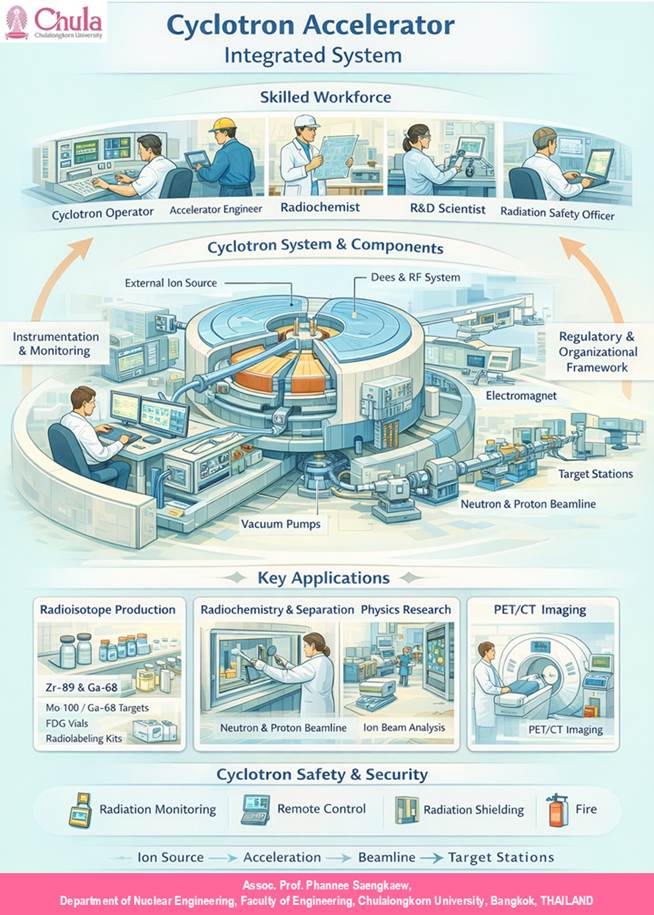
A cyclotron accelerator is not merely a device for accelerating charged particles; rather, it is a complex, integrated system that combines advanced engineering, human expertise, instrumentation, and regulatory oversight. Its purpose is to transform electrical energy into high-energy particle beams, which are then used to generate valuable outputs such as radioisotopes, analytical signals, and medical imaging tracers.
The system can be conceptually described as a transformation chain:
Ion Source → Acceleration → Beamline Transport → Target Interaction → Application
This framework highlights how fundamental physical processes are translated into real-world benefits across medicine, research, and industry.
2. Skilled Workforce: The Human Core of the System
At the top of the system lies the skilled workforce, emphasizing that successful cyclotron operation depends fundamentally on human expertise.
2.1 Cyclotron Operator
Responsible for routine operation, system control, and monitoring of beam parameters. Operators ensure stable performance and respond to operational deviations.
2.2 Accelerator Engineer
Maintains and optimizes core systems, including RF acceleration units, electromagnets, and vacuum systems. This role bridges physics and engineering implementation.
2.3 Radiochemist
Handles the processing, separation, and labeling of radioisotopes after irradiation. This role is critical for producing usable radiopharmaceuticals.
2.4 R&D Scientist
Conducts experimental studies using beamlines, including ion beam analysis and materials research, contributing to innovation and system advancement.
2.5 Radiation Safety Officer
Ensures compliance with radiation protection standards, monitors exposure, and enforces safety procedures across the facility.
Together, these roles illustrate that: “Building the system requires technology—but operating it safely requires people.”
3. Cyclotron System and Core Components
At the center of the figure is the cyclotron system itself, surrounded by supporting infrastructure.
3.1 External Ion Source
Provides charged particles (e.g., protons), which are injected into the cyclotron for acceleration.
3.2 Dees and RF Acceleration System
Alternating electric fields accelerate particles each time they cross the gap between the “Dee” electrodes, increasing their energy step by step.
3.3 Electromagnet
Generates a strong magnetic field that forces particles into circular trajectories, enabling repeated acceleration cycles.
3.4 Vacuum Pumps
Maintain a low-pressure environment to minimize collisions between particles and residual gas molecules, ensuring beam stability.
3.5 Beamline (Neutron & Proton Beamline)
Transports accelerated particles from the cyclotron to target stations using focusing and steering magnets.
3.6 Target Stations
Locations where particle beams interact with materials to produce radioisotopes or analytical signals.
4. Instrumentation and Monitoring Systems
The cyclotron system is supported by instrumentation and monitoring, which transform physical processes into measurable and controllable signals.
- Beam diagnostics (current, energy, position)
- Radiation monitoring systems (area and personal detectors)
- Control consoles and digital interfaces
These systems enable operators to:
Convert invisible particle behavior into real-time information → supporting decision-making and control
5. Regulatory and Organizational Framework
On the opposite side of the system lies the regulatory and organizational framework, ensuring that all operations are conducted safely, securely, and in compliance with national and international standards.
This includes oversight by organizations such as the Office of Atoms for Peace and the International Atomic Energy Agency.
Key functions include:
- Licensing and authorization
- Radiation protection regulations
- Material accountability and reporting
- Safety culture enforcement
Thus, governance forms an essential layer that connects technology with societal responsibility.
6. Key Applications of Cyclotron Systems
The lower section of the figure highlights the major application domains, demonstrating how the system produces tangible outputs.
6.1 Radioisotope Production
Cyclotrons produce medically important isotopes such as:
- Gallium-68 (Ga-68)
- Zirconium-89 (Zr-89)
- Fluorine-18 (FDG production)
These isotopes are used in diagnostic imaging and targeted therapy, requiring precise irradiation and rapid processing.
6.2 Radiochemistry and Separation
After irradiation, radioisotopes must be chemically separated and prepared for use.
Processes include:
- Target dissolution
- Chemical separation
- Radiolabeling into pharmaceutical compounds
This stage bridges physics and chemistry, transforming raw nuclear products into clinically usable forms.
6.3 Physics Research and Ion Beam Applications
Cyclotron beamlines support:
- Ion beam analysis (IBA)
- Materials characterization
- Nuclear reaction studies
These applications expand knowledge in materials science and nuclear physics.
6.4 PET/CT Imaging
One of the most impactful applications is in positron emission tomography (PET/CT), where cyclotron-produced isotopes enable:
- Functional imaging of metabolic processes
- Early disease detection (e.g., cancer diagnosis)
This demonstrates the direct translation of accelerator technology into healthcare.
7. Cyclotron Safety and Security Framework
The system incorporates a comprehensive safety and security structure.
7.1 Radiation Monitoring
Continuous monitoring of radiation levels ensures protection of personnel and environment.
7.2 Remote Control Systems
Allow operation of critical processes from safe distances, reducing radiation exposure.
7.3 Radiation Shielding
Thick shielding structures (e.g., concrete walls) attenuate radiation and protect surrounding areas.
7.4 Fire and Emergency Systems
Provide additional layers of safety in case of operational incidents.
Together, these elements form a multi-layered protection system, aligning with the broader concept of nuclear Safety, Security, and Safeguards (3S).
8. System Integration: A Holistic Perspective
The figure emphasizes that a cyclotron facility is a fully integrated ecosystem, where:
- Technology (hardware systems)
- Instrumentation (measurement and control)
- Human resources (skilled workforce)
- Governance (regulatory framework)
operate together in a coordinated manner.
This integration can be summarized as:
Physical System + Human System + Regulatory System = Operational Nuclear Infrastructure
9. Conceptual Synthesis
The entire system reflects a broader principle in nuclear engineering:
Invisible particles → Measurable signals → Controlled processes → Practical applications
Or in your framework: Measurement → Information → Decision → Application
10. Concluding Insight
A cyclotron accelerator is best understood not as a standalone machine, but as a knowledge-driven infrastructure, where physics, engineering, chemistry, and human expertise converge.
It is this integration that enables:
- Precision in radioisotope production
- Innovation in materials and research
- Life-saving applications in medicine
Ultimately, the cyclotron exemplifies how advanced scientific systems transform fundamental interactions into societal value, reinforcing its role as a cornerstone of modern nuclear science and technology.
**************************************
เครื่องเร่งอนุภาคแบบไซโคลตรอน: ระบบบูรณาการ
จากโครงสร้างพื้นฐานและทรัพยากรมนุษย์สู่การประยุกต์ใช้งานและความปลอดภัย
1. บทนำ: ไซโคลตรอนในฐานะระบบวิทยาศาสตร์แบบบูรณาการ
เครื่องเร่งอนุภาคแบบไซโคลตรอนไม่ได้เป็นเพียงอุปกรณ์สำหรับเร่งอนุภาคมีประจุเท่านั้น หากแต่เป็น ระบบทางวิทยาศาสตร์ที่มีความซับซ้อนและบูรณาการหลายมิติ ซึ่งผสานองค์ความรู้ด้านวิศวกรรมขั้นสูง ทรัพยากรมนุษย์ เครื่องมือวัดและควบคุม รวมถึงกรอบกำกับดูแลด้านกฎหมายและความปลอดภัยเข้าไว้ด้วยกันอย่างเป็นระบบ
หน้าที่หลักของระบบนี้คือการแปลงพลังงานไฟฟ้าให้เป็น ลำอนุภาคพลังงานสูง (high-energy particle beams) ซึ่งสามารถนำไปใช้สร้างผลผลิตที่มีมูลค่าสูง เช่น ไอโซโทปกัมมันตรังสี สัญญาณเชิงวิเคราะห์ และสารติดตามรังสีสำหรับการถ่ายภาพทางการแพทย์
ในเชิงแนวคิด ระบบไซโคลตรอนสามารถอธิบายได้ผ่านลำดับกระบวนการดังนี้
แหล่งกำเนิดไอออน → การเร่งอนุภาค → การลำเลียงลำอนุภาค → การเกิดอันตรกิริยาที่เป้าหมาย → การนำไปใช้ประโยชน์
กรอบแนวคิดนี้สะท้อนให้เห็นถึงการแปลงกระบวนการทางฟิสิกส์พื้นฐานไปสู่การใช้งานจริงในหลากหลายสาขา ทั้งด้านการแพทย์ การวิจัย และอุตสาหกรรม
2. ทรัพยากรมนุษย์: แกนกลางของการดำเนินระบบ
องค์ประกอบสำคัญที่ทำให้ระบบไซโคลตรอนสามารถดำเนินงานได้อย่างมีประสิทธิภาพ คือ บุคลากรผู้เชี่ยวชาญ (skilled workforce) ซึ่งมีบทบาทครอบคลุมตั้งแต่การควบคุมระบบ การบำรุงรักษา ไปจนถึงการประยุกต์ใช้งาน
ผู้ปฏิบัติงานเครื่องไซโคลตรอน (Cyclotron Operator) มีหน้าที่ควบคุมการทำงานของระบบ ตรวจสอบพารามิเตอร์ของลำอนุภาค และรักษาเสถียรภาพของการทำงาน ขณะที่วิศวกรเครื่องเร่งอนุภาค (Accelerator Engineer) รับผิดชอบในการออกแบบ ปรับแต่ง และบำรุงรักษาระบบสำคัญ เช่น ระบบ RF สนามแม่เหล็ก และระบบสุญญากาศ
ในส่วนของการประยุกต์ใช้งาน นักเคมีรังสี (Radiochemist) มีบทบาทสำคัญในการแยกและเตรียมไอโซโทปหลังการฉายรังสีให้สามารถนำไปใช้ได้จริง โดยเฉพาะในงานเวชศาสตร์นิวเคลียร์ นักวิจัยและนักวิทยาศาสตร์ (R&D Scientist) ใช้ลำอนุภาคในการศึกษาคุณสมบัติวัสดุและกระบวนการทางนิวเคลียร์ ขณะที่เจ้าหน้าที่ความปลอดภัยทางรังสี (Radiation Safety Officer) ทำหน้าที่กำกับดูแลให้การดำเนินงานเป็นไปตามมาตรฐานด้านความปลอดภัย
บทบาทของบุคลากรทั้งหมดนี้สะท้อนแนวคิดสำคัญว่า “การสร้างระบบอาจใช้เทคโนโลยี แต่การทำให้ระบบทำงานอย่างปลอดภัยต้องอาศัยมนุษย์”
3. ระบบไซโคลตรอนและองค์ประกอบหลัก
หัวใจของระบบคือ เครื่องไซโคลตรอน ซึ่งประกอบด้วยองค์ประกอบย่อยที่ทำงานประสานกันอย่างซับซ้อน
แหล่งกำเนิดไอออน (External Ion Source) ทำหน้าที่สร้างอนุภาคมีประจุ เช่น โปรตอน ซึ่งถูกฉีดเข้าสู่ระบบเร่งอนุภาค ภายในไซโคลตรอน อนุภาคจะถูกเร่งพลังงานโดยสนามไฟฟ้ากระแสสลับในระบบ RF ที่ติดตั้งอยู่ในโครงสร้าง “Dee” ขณะเดียวกัน สนามแม่เหล็กจากแม่เหล็กไฟฟ้า (Electromagnet) จะบังคับให้อณูเคลื่อนที่เป็นวงโคจร
ระบบสุญญากาศ (Vacuum System) มีบทบาทสำคัญในการลดการชนกับโมเลกุลของอากาศ ซึ่งช่วยรักษาพลังงานและความเสถียรของลำอนุภาค เมื่ออนุภาคมีพลังงานเพียงพอ จะถูกส่งออกผ่านระบบลำเลียง (Beamline) ไปยังสถานีเป้าหมาย (Target Stations) เพื่อให้เกิดอันตรกิริยากับวัสดุ
4. ระบบเครื่องมือวัดและการติดตามควบคุม
การทำงานของไซโคลตรอนต้องอาศัย ระบบเครื่องมือวัดและควบคุม (instrumentation and monitoring systems) เพื่อแปลงพฤติกรรมของอนุภาคที่มองไม่เห็นให้เป็นข้อมูลที่สามารถวิเคราะห์และควบคุมได้
ระบบเหล่านี้ประกอบด้วย
- การวัดลำอนุภาค (beam diagnostics) เช่น กระแส พลังงาน และตำแหน่ง
- ระบบตรวจวัดรังสี (ระบบตรวจวัดรังสี) ทั้งในพื้นที่และบุคคล
- ระบบควบคุมและแสดงผลแบบดิจิทัล
ข้อมูลจากระบบเหล่านี้ช่วยให้ผู้ปฏิบัติงานสามารถ
แปลงสิ่งที่มองไม่เห็น → เป็นข้อมูล → เพื่อนำไปสู่การตัดสินใจและควบคุมระบบ
5. กรอบกำกับดูแลและองค์กร
การดำเนินงานของไซโคลตรอนต้องอยู่ภายใต้ กรอบกำกับดูแล (regulatory framework) ที่เข้มงวด เพื่อให้มั่นใจในความปลอดภัย ความมั่นคง และความโปร่งใส
องค์กรกำกับดูแล เช่น สำนักงานปรมาณูเพื่อสันติ และทบวงการพลังงานปรมาณูระหว่างประเทศ (IAEA) มีบทบาทในการกำหนดมาตรฐานและตรวจสอบการดำเนินงาน
หน้าที่สำคัญ ได้แก่
- การออกใบอนุญาตและการกำกับดูแล
- การกำหนดมาตรฐานการป้องกันรังสี
- การควบคุมและติดตามวัสดุกัมมันตรังสี
- การส่งเสริมวัฒนธรรมความปลอดภัย
กรอบกำกับดูแลจึงทำหน้าที่เชื่อมโยงเทคโนโลยีกับความรับผิดชอบต่อสังคม
6. การประยุกต์ใช้งานของระบบไซโคลตรอน
เครื่องไซโคลตรอนเป็นแพลตฟอร์มที่สามารถสร้างผลผลิตที่มีคุณค่าในหลายสาขา โดยเฉพาะด้านการแพทย์และการวิจัย
ในด้านการผลิตไอโซโทปกัมมันตรังสี สามารถผลิตไอโซโทปสำคัญ เช่น Ga-68, Zr-89 และ F-18 ซึ่งใช้ในการวินิจฉัยและการรักษาโรค หลังการฉายรังสี ไอโซโทปจะถูกนำเข้าสู่กระบวนการเคมีรังสี (radiochemistry) เพื่อแยกและเตรียมเป็นสารเภสัชรังสี
ในด้านการวิจัย ลำอนุภาคถูกใช้ในเทคนิคต่าง ๆ เช่น การวิเคราะห์ด้วยลำไอออน (ion beam analysis) และการศึกษาปฏิกิริยานิวเคลียร์
นอกจากนี้ ไอโซโทปที่ผลิตยังถูกนำไปใช้ใน PET/CT imaging ซึ่งช่วยให้สามารถตรวจวินิจฉัยโรคได้ในระดับการทำงานของอวัยวะ (functional imaging)
7. ความปลอดภัยและความมั่นคงของระบบ
ระบบไซโคลตรอนต้องมีมาตรการด้านความปลอดภัยที่ครอบคลุมหลายระดับ
- การตรวจวัดรังสีอย่างต่อเนื่อง
- ระบบควบคุมระยะไกลเพื่อลดการได้รับรังสี
- โครงสร้างป้องกันรังสี เช่น ผนังคอนกรีตหนา
- ระบบป้องกันเหตุฉุกเฉิน เช่น อัคคีภัย
มาตรการเหล่านี้สอดคล้องกับแนวคิด Safety, Security, and Safeguards (3S) ซึ่งเป็นหลักการพื้นฐานของโครงสร้างพื้นฐานทางนิวเคลียร์
8. การบูรณาการเชิงระบบ
ระบบไซโคลตรอนเป็นตัวอย่างของ ระบบแบบบูรณาการ (integrated system) ที่ประกอบด้วย
- ระบบทางกายภาพ (hardware)
- ระบบการวัดและควบคุม
- ทรัพยากรมนุษย์
- กรอบกำกับดูแล
ซึ่งทำงานร่วมกันอย่างเป็นระบบ
สามารถสรุปได้ว่า ระบบกายภาพ + ระบบมนุษย์ + ระบบกำกับดูแล = โครงสร้างพื้นฐานนิวเคลียร์ที่ใช้งานได้จริง
9. การสังเคราะห์เชิงแนวคิด
ภาพรวมของระบบสะท้อนหลักการสำคัญของวิศวกรรมนิวเคลียร์
อนุภาคที่มองไม่เห็น → สัญญาณที่วัดได้ → กระบวนการที่ควบคุมได้ → การใช้งานจริง
หรือในอีกมุมหนึ่ง
การตรวจวัด → ข้อมูล → การตัดสินใจ → การนำไปใช้
10. ข้อสรุป
เครื่องไซโคลตรอนไม่ใช่เพียงเครื่องจักร แต่เป็น โครงสร้างพื้นฐานเชิงองค์ความรู้ (knowledge-driven infrastructure) ที่รวมเอาฟิสิกส์ วิศวกรรม เคมี และมนุษย์เข้าด้วยกัน
การบูรณาการนี้ทำให้สามารถ
- ผลิตไอโซโทปได้อย่างแม่นยำ
- พัฒนานวัตกรรมวัสดุ
- สนับสนุนการแพทย์สมัยใหม่
ดังนั้น ไซโคลตรอนจึงเป็นตัวอย่างที่ชัดเจนของระบบทางวิทยาศาสตร์ที่สามารถแปลงหลักการพื้นฐานไปสู่ คุณค่าทางสังคมอย่างเป็นรูปธรรม
 Around Radiation Detectors
ใส่ความเห็น