1. Introduction
Neutron Activation Analysis (NAA) is one of the most powerful nuclear analytical techniques for the qualitative and quantitative determination of elemental composition. The technique is based on the interaction between neutrons and atomic nuclei, whereby stable nuclei within a material capture incident neutrons and are transformed into radioactive isotopes. These activated nuclei subsequently emit characteristic gamma radiation during radioactive decay, allowing the elemental constituents of the sample to be identified and quantified through gamma spectrometric analysis. Because the emitted gamma-ray energies and intensities are directly related to the nuclear properties and abundance of the activated radionuclides, NAA provides an exceptionally reliable analytical pathway from nuclear interaction to elemental quantification.
Among nuclear analytical methods, NAA occupies a unique position due to its combination of high sensitivity, excellent multi-element capability, and minimal matrix dependence. In many cases, concentrations at the parts-per-million, parts-per-billion, or even lower levels can be determined without requiring chemical dissolution or destructive preparation of the sample. This non-destructive capability is particularly advantageous when analyzing precious, hazardous, radioactive, or irreplaceable materials such as archaeological artifacts, forensic evidence, semiconductor wafers, and nuclear materials.
Since its development in the mid-twentieth century, NAA has evolved into an established analytical platform across numerous scientific and industrial sectors. Its applications range from trace impurity analysis in advanced materials and environmental monitoring to nuclear forensics, archaeological provenance studies, and real-time industrial process monitoring. The continued development of compact neutron sources, digital gamma spectrometry, and automated analysis systems is further extending the applicability of NAA beyond conventional reactor laboratories toward distributed and industrial environments.
2. Fundamental Principles of Neutron Activation Analysis
The scientific basis of NAA lies in neutron-induced nuclear reactions, most commonly neutron capture reactions of the form:

where a target nucleus 

The analytical capability of NAA arises from the fact that each radionuclide produced possesses a unique decay scheme characterized by specific gamma-ray energies and half-lives. These nuclear signatures serve as elemental fingerprints, enabling the identity and quantity of constituent elements within the sample to be determined. In practical terms, NAA converts invisible neutron–matter interactions into measurable radiometric signatures that can be interpreted quantitatively.
The induced activity 

where 


Following irradiation, the induced radionuclides decay according to their characteristic half-lives, emitting delayed gamma rays whose energies identify the radionuclides and whose emission intensities provide quantitative information regarding elemental concentration. The combination of nuclear specificity, high-energy gamma-ray detection, and robust counting statistics underpins the exceptional sensitivity and reliability of NAA.
3. Instrumentation and System Components of NAA
The successful implementation of neutron activation analysis requires an integrated analytical system composed of neutron generation infrastructure, irradiation and sample handling mechanisms, gamma spectrometric instrumentation, and associated radiation protection and analytical support systems. The performance of an NAA facility depends not only on neutron flux but also on the optimization and integration of each subsystem throughout the analytical chain.
3.1 Neutron Source Systems
The neutron source is the foundational component of any NAA system because it determines the available neutron flux, energy spectrum, irradiation geometry, and ultimately the achievable analytical sensitivity.
Research Reactors
Research reactors remain the most widely utilized neutron sources for conventional NAA due to their exceptionally high and stable neutron flux, typically ranging from approximately 


In addition to high flux, research reactors provide well-characterized irradiation positions with tailored neutron spectra, including thermal, epithermal, and fast neutron fields, thereby allowing analytical optimization for specific target nuclides. Their highly stable operating conditions also improve reproducibility and support standardized analytical protocols. However, reactor-based NAA requires substantial nuclear infrastructure, regulatory oversight, radiation protection programs, and reactor access scheduling, which can limit routine availability.
Neutron Generators
Neutron generators provide a compact alternative to reactor-based neutron production, typically employing deuterium–deuterium (D–D) or deuterium–tritium (D–T) fusion reactions. Although neutron fluxes are substantially lower than those of research reactors, neutron generators offer advantages in portability, on-demand operation, and lower infrastructure requirements.
These systems are particularly attractive for Prompt Gamma Neutron Activation Analysis (PGNAA), field-deployable analytical systems, and industrial online process monitoring where immediate or continuous analysis is more important than ultra-trace sensitivity. Their compact design has enabled wider deployment of neutron-based analytical systems in industrial and non-reactor environments.
Accelerator-Based Neutron Sources
Accelerator-driven neutron sources generate neutrons through charged-particle-induced nuclear reactions such as 

Accelerator-based systems offer flexible neutron energy tuning, pulsed operation capability, and reduced nuclear regulatory burden compared with reactor facilities. They are increasingly being investigated for compact NAA platforms and specialized PGNAA systems, particularly where neutron energy tailoring or time-structured beams provide analytical advantages.
Radioisotopic Neutron Sources
In addition to research reactors, neutron generators, and accelerator-based neutron sources, radioisotopic neutron sources also represent a class of neutron-producing systems that have been historically and practically utilized in certain neutron activation and neutron interrogation applications.
These sources generate neutrons through nuclear reactions that occur intrinsically within radioactive materials, most commonly via 
- Americium–Beryllium (Am–Be) sources
- Plutonium–Beryllium (Pu–Be) sources
- Californium-252 (Cf-252) spontaneous fission sources
One of the principal advantages of radioisotopic neutron sources lies in their structural simplicity and operational independence from external power systems. Unlike neutron generators or accelerators, these sources do not require high-voltage systems, beam control, or complex infrastructure, and they provide a continuous neutron output without the need for active operation. This makes them particularly suitable for compact analytical systems, field applications, and certain types of in-situ measurements.
However, these advantages are accompanied by several important limitations. Most notably, radioisotopic neutron sources generally produce relatively low neutron fluxes compared to research reactors and even compact neutron generators. As a result, their analytical sensitivity is significantly lower, limiting their effectiveness for ultra-trace elemental analysis in conventional NAA applications.
In addition, because neutron emission is continuous and cannot be switched off, these sources present challenges in terms of radiation protection, shielding design, and operational control. Regulatory requirements for handling, transport, and storage of sealed radioactive neutron sources are also stringent, further constraining their widespread use.
Consequently, radioisotopic neutron sources are typically employed in specialized or niche applications, including calibration of neutron detectors, educational demonstrations, portable PGNAA systems, and certain industrial or field-deployable neutron interrogation techniques, rather than in high-sensitivity laboratory-based neutron activation analysis.
3.2 Irradiation and Sample Handling Systems
Efficient and reproducible irradiation of samples is critical to quantitative NAA. Sample irradiation systems must ensure controlled positioning within the neutron field, reproducible neutron exposure, and safe transfer of activated materials between irradiation and counting locations.
Many reactor-based NAA facilities employ pneumatic transfer systems, commonly known as rabbit systems, to transport samples rapidly between irradiation and counting stations. These systems are essential when analyzing radionuclides with short half-lives, as they minimize transfer delays and preserve measurable activity before significant decay occurs.
For larger analytical throughput, automated sample changers and robotic handling systems may be incorporated to improve repeatability, reduce operator dose, and enable batch processing. Shielded sample handling stations and decay storage areas are also required for activated materials management.
3.3 Gamma-Ray Detection and Spectrometry Systems
Following neutron activation, the emitted gamma radiation must be measured with sufficient energy resolution and counting precision to distinguish individual radionuclide signatures. This task is typically performed using high-resolution gamma-ray spectrometry systems centered around High-Purity Germanium (HPGe) detectors.
HPGe detectors are preferred because of their superior energy resolution, allowing separation of closely spaced gamma-ray peaks that would otherwise overlap in lower-resolution detectors. This capability is essential for accurate radionuclide identification in complex multi-element spectra.
The complete spectrometry chain generally includes:
- Detector preamplifier and shaping electronics
- Digital pulse processing system
- Multichannel analyzer (MCA)
- Spectral acquisition and analysis software
- Lead shielding and graded liners for background suppression
Detector efficiency calibration, dead-time correction, pile-up rejection, and energy calibration are all critical to ensuring accurate quantitative analysis.
3.4 Radiation Protection and Supporting Infrastructure
Because NAA inherently produces radioactive samples and involves neutron-generating systems, substantial supporting infrastructure is required for safe operation. This includes:
- Biological shielding around neutron sources
- Controlled radiation areas
- Contamination monitoring systems
- Radioactive waste handling and storage
- Personnel dosimetry programs
- Radiation safety interlock systems
Thus, NAA should be viewed not merely as an analytical instrument, but as an integrated nuclear analytical facility requiring coordinated infrastructure, instrumentation, and safety systems.
4. Major Analytical Modes of Neutron Activation Analysis
Although all forms of neutron activation analysis are based on neutron-induced nuclear reactions, the technique may be implemented through several operational modes depending on when the emitted gamma radiation is measured relative to neutron irradiation. The two principal analytical configurations are Conventional (Delayed) Neutron Activation Analysis and Prompt Gamma Neutron Activation Analysis, each possessing distinct analytical characteristics, infrastructure requirements, and application domains.
4.1 Conventional Neutron Activation Analysis (Delayed NAA / INAA)
In conventional neutron activation analysis—often referred to as Instrumental Neutron Activation Analysis (INAA) when no radiochemical separation is performed—the sample is first irradiated within a neutron field for a prescribed period to induce radioactivity. Following irradiation, the sample is removed from the neutron source and allowed to decay for an optimized cooling period before delayed gamma-ray measurement is conducted using high-resolution gamma spectrometry.
This delayed-counting approach exploits the radioactive decay of activation products after irradiation and is particularly suitable for radionuclides with half-lives ranging from seconds to weeks. By selecting appropriate irradiation, decay, and counting times, the analyst can optimize measurement conditions for specific radionuclides while reducing interference from undesired short-lived products.
Conventional NAA is generally regarded as the most sensitive implementation of the technique because the use of high-flux neutron irradiation combined with delayed counting allows the measurement of activation products under low-background conditions. Detection limits in the parts-per-billion or sub-parts-per-billion range may be achieved for favorable elements under optimized reactor-based conditions.
Because delayed NAA separates the irradiation and counting stages spatially and temporally, it is most commonly employed in laboratory-based analytical environments where the highest sensitivity and analytical precision are required. Typical applications include ultra-trace impurity analysis, reference material certification, forensic investigations, and high-accuracy environmental studies.
4.2 Prompt Gamma Neutron Activation Analysis (PGNAA)
Prompt Gamma Neutron Activation Analysis differs fundamentally from delayed NAA in that the emitted gamma radiation is measured during neutron irradiation, rather than after decay. Specifically, prompt gamma rays produced immediately following neutron capture are detected in real time while the sample remains within the neutron field.
This approach enables direct and continuous elemental analysis without waiting for radioactive decay, making PGNAA highly attractive for applications requiring rapid or real-time measurement. Since prompt gamma emission occurs within femtoseconds to nanoseconds of neutron capture, the analytical response is effectively instantaneous.
PGNAA is especially well suited for the analysis of bulk, heterogeneous, or continuously moving materials because measurement can be performed directly on process streams, conveyor belts, or large-volume samples. It is therefore widely used in industrial process monitoring applications such as cement manufacturing, mining, coal quality control, and bulk chemical processing.
However, prompt gamma measurement presents significant technical challenges due to the presence of intense neutron and gamma backgrounds during irradiation. As a result, PGNAA systems require carefully engineered shielding, collimation, detector placement, and background suppression strategies.
4.3 Comparative Characteristics of Delayed NAA and PGNAA
The choice between delayed NAA and PGNAA depends on the analytical objective, required sensitivity, sample geometry, and operational environment.
Delayed NAA generally provides:
- Higher analytical sensitivity
- Lower counting background
- Better suitability for ultra-trace laboratory analysis
PGNAA generally provides:
- Real-time or near-real-time analysis
- Non-contact online measurement capability
- Suitability for bulk and continuous industrial materials
Accordingly, delayed NAA is often favored in research and laboratory environments, whereas PGNAA dominates industrial and process-monitoring applications.
5. Analytical Workflow of Neutron Activation Analysis
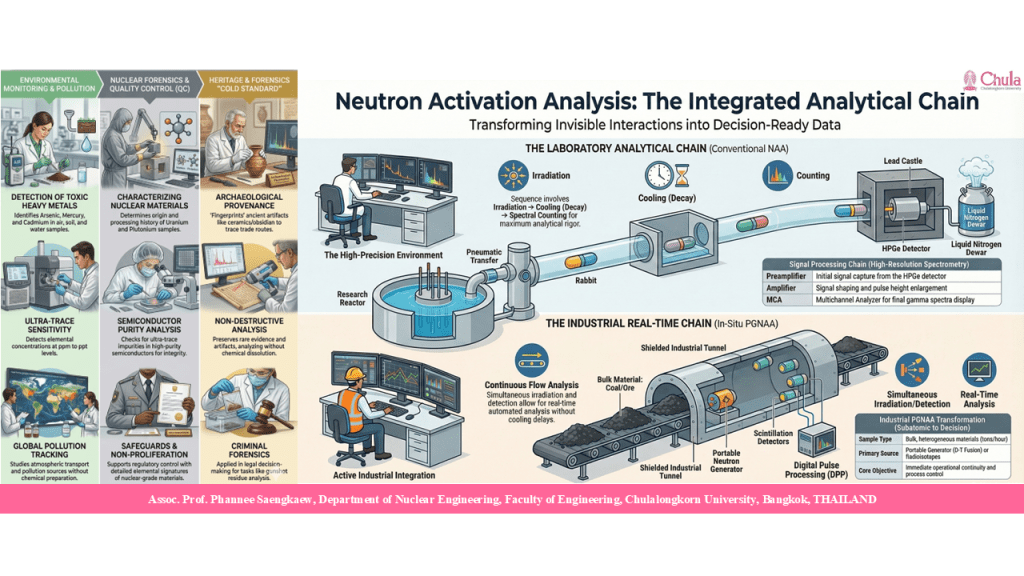
The NAA process may be conceptually understood as an integrated analytical chain transforming nuclear interactions into quantitative compositional information. This workflow comprises several interconnected stages, each of which contributes to the overall analytical accuracy and reliability of the method.
5.1 Sample Preparation and Characterization
Although NAA often requires minimal chemical preparation compared with conventional analytical methods, proper sample preparation remains essential to ensure representative and reproducible results. Samples are typically cleaned, dried, homogenized, weighed, and encapsulated in neutron-transparent containers such as polyethylene, quartz, or high-purity plastic vials.
For quantitative analysis, the physical dimensions, mass, and geometry of the sample must be carefully controlled because neutron self-shielding, gamma self-absorption, and geometric counting efficiency can influence measurement accuracy, particularly for large or dense samples.
5.2 Neutron Irradiation
Prepared samples are irradiated within the neutron field for durations ranging from seconds to many hours depending on the target radionuclides and desired sensitivity. The irradiation time is selected based on activation kinetics, radionuclide half-life, neutron flux, and analytical priorities.
At this stage, stable nuclei within the sample undergo neutron capture reactions, producing radioactive isotopes or prompt gamma emissions depending on the analytical mode employed.
5.3 Decay and Cooling (Delayed NAA)
For delayed NAA, samples may undergo a controlled cooling period after irradiation to permit decay of short-lived interfering radionuclides and optimize the signal-to-background ratio for radionuclides of interest. Cooling times can range from seconds to weeks depending on analytical requirements.
This temporal selectivity is a major strength of delayed NAA because it enables analytical discrimination based not only on gamma-ray energy but also on radionuclide half-life.
5.4 Gamma Spectral Acquisition
The activated sample is then positioned relative to the gamma-ray detector and counted for a predetermined acquisition period. The resulting gamma spectrum contains characteristic photopeaks corresponding to the decay of activation products present in the sample.
Spectral quality depends strongly on detector resolution, counting geometry, shielding effectiveness, dead-time management, and counting statistics.
5.5 Spectral Interpretation and Quantification
Quantitative interpretation of NAA spectra involves identifying gamma-ray peaks, assigning them to specific radionuclides, correcting for detector efficiency and decay timing, and calculating elemental concentrations based on calibration standards or comparator methods.
The final analytical result therefore emerges from the integrated transformation:
Neutron Interaction → Nuclear Activation → Gamma Emission → Spectral Analysis → Elemental Quantification
This analytical chain represents the core conceptual framework of NAA.
6. Major Application Areas of Neutron Activation Analysis
The combination of nuclear specificity, multi-element capability, and high analytical sensitivity has made NAA one of the most versatile elemental analysis techniques available. Its applications span scientific research, industrial processing, environmental monitoring, and national security.
6.1 Environmental Monitoring and Pollution Assessment
NAA has long been utilized for environmental trace element analysis because of its ability to determine multiple elements simultaneously at low concentrations with minimal matrix interference. Typical environmental applications include analysis of atmospheric particulate matter, soils, sediments, waters, and biological samples.
In air pollution studies, NAA is particularly valuable for source apportionment because it enables simultaneous determination of elemental tracers associated with industrial emissions, vehicular exhaust, crustal dust, marine aerosols, and combustion sources. The technique has therefore played a major role in atmospheric chemistry and environmental regulatory studies.
6.2 Semiconductor and Electronic Materials Analysis
Modern semiconductor manufacturing demands ultra-high material purity, often requiring detection of impurities at parts-per-billion or lower concentrations. NAA is highly suited to this role because it can quantify trace metallic and dopant impurities in semiconductor-grade silicon, gallium, germanium, and compound semiconductor materials without introducing contamination through wet chemistry.
Its high sensitivity and low blank contamination make NAA particularly valuable for quality assurance in electronic materials where even minute impurities can degrade device performance.
6.3 Archaeology and Cultural Heritage Science
Because NAA can often be performed non-destructively, it has become an important analytical tool in archaeology and heritage science. Applications include provenance determination of ceramics, obsidian, pigments, coins, metals, and archaeological artifacts.
By comparing elemental fingerprints among artifacts and raw material sources, researchers can reconstruct trade routes, manufacturing origins, and historical technological practices.
6.4 Nuclear Forensics and Safeguards
NAA plays an important role in nuclear security and safeguards because it enables precise elemental characterization of nuclear and radioactive materials. In nuclear forensic investigations, NAA can assist in determining the origin, processing history, and intended use of seized nuclear materials through trace elemental and impurity analysis.
The technique also supports safeguards verification, material accountancy, and characterization of unknown radiological materials.
6.5 Industrial Process Monitoring and Online Process Control
Prompt Gamma NAA has become a major industrial analytical tool for real-time monitoring of bulk material composition.
Cement Industry
In cement production, PGNAA systems installed above conveyor belts continuously measure the elemental composition of raw meal feedstock, particularly calcium, silicon, aluminum, and iron. This enables dynamic optimization of kiln feed chemistry and improves clinker quality consistency.
Mining and Mineral Processing
Mining operations employ PGNAA for online ore-grade analysis, allowing elemental characterization of conveyed ore prior to beneficiation. This supports real-time sorting, blending, and process optimization.
Coal and Fuel Quality Monitoring
PGNAA is widely used in coal-fired power and fuel processing industries for online determination of ash content, sulfur concentration, moisture-related elemental indicators, and calorific-value-related composition. These measurements improve combustion efficiency and emissions control.
Bulk Chemical and Fertilizer Processing
Industrial bulk feedstocks may be continuously monitored to ensure compositional uniformity, support blending control, and detect contamination or process drift.
7. Advantages of Neutron Activation Analysis
Neutron Activation Analysis possesses several analytical advantages that distinguish it from conventional elemental characterization techniques and underpin its continued relevance in modern scientific and industrial applications.
One of the most significant advantages of NAA is its exceptionally high analytical sensitivity. Because neutron-induced activation and gamma-ray detection are inherently nuclear processes, many elements can be detected at concentrations in the parts-per-million, parts-per-billion, or even sub-parts-per-billion range under optimized conditions. This sensitivity is particularly advantageous for ultra-trace impurity analysis, environmental monitoring, and forensic investigations.
A second major strength is its simultaneous multi-element capability. Unlike techniques that require sequential scanning or element-specific excitation conditions, NAA can determine multiple elemental constituents from a single irradiation and gamma-ray measurement because each activated radionuclide emits characteristic gamma-ray energies. This allows comprehensive compositional characterization in a single analytical workflow.
Another key advantage is the minimal matrix dependence of the technique. Since NAA is based on nuclear interactions rather than chemical bonding or electronic structure, analytical performance is generally less affected by sample matrix effects than many spectroscopic or chemical analytical methods. This contributes to the robustness and reliability of quantitative analysis across diverse sample types.
NAA also offers substantial non-destructive analytical capability. Because many implementations require little or no chemical dissolution, the original sample can often be preserved after analysis. This feature is especially valuable for irreplaceable, hazardous, radioactive, or legally sensitive materials such as cultural heritage artifacts, forensic evidence, and nuclear materials.
Furthermore, the technique benefits from high analytical accuracy and metrological reliability, making it a reference or benchmark method for certification of standard reference materials and interlaboratory comparison exercises.
8. Limitations and Challenges of Neutron Activation Analysis
Despite its powerful analytical capabilities, NAA is subject to several limitations that constrain its accessibility, practicality, and application scope.
The most fundamental limitation is the requirement for neutron source infrastructure. High-sensitivity NAA typically depends on access to research reactors or specialized neutron-producing systems, which are expensive to construct, maintain, and regulate. This infrastructure dependency significantly limits widespread deployment compared with conventional laboratory analytical techniques.
Another important limitation is that NAA inherently produces radioactive samples during analysis. Activated samples may require decay storage, radiological handling controls, contamination management, and waste disposal procedures. For certain materials or radionuclides, induced radioactivity may persist for extended periods, delaying sample return or disposal.
The technique may also involve long analytical turnaround times, particularly in delayed NAA where decay periods are required to optimize radionuclide measurement or reduce spectral interferences. This can limit throughput relative to faster analytical techniques in time-sensitive applications.
Spectral complexity represents another technical challenge. Because multi-element activation produces numerous radionuclides simultaneously, gamma spectra may contain overlapping peaks and complex backgrounds that require sophisticated spectral deconvolution and careful analytical interpretation.
In addition, not all elements are equally amenable to NAA. Analytical sensitivity depends strongly on neutron capture cross section, radionuclide half-life, gamma emission probability, and spectral interference conditions. Consequently, some elements are measured with excellent sensitivity whereas others are difficult or impractical to quantify.
Finally, regulatory and operational burdens associated with nuclear facilities, radiation protection, and radioactive materials management can impose substantial administrative and staffing requirements.
9. Infrastructure and Safety Requirements for NAA Facilities
Because neutron activation analysis involves neutron irradiation, induced radioactivity, and gamma-ray measurement, it requires a level of infrastructure substantially beyond that of conventional analytical laboratories. A functional NAA facility should therefore be considered an integrated nuclear analytical platform rather than a standalone instrument.
9.1 Nuclear Infrastructure Requirements
Implementation of NAA requires access to neutron-producing infrastructure, which may include:
- Research reactors
- Accelerator-driven neutron sources
- Neutron generators
- Associated irradiation ports and beamlines
The analytical performance of the facility is directly linked to the characteristics of the neutron source, including flux intensity, spectral distribution, irradiation geometry, and operational stability.
9.2 Radiation Protection Infrastructure
Radiation protection systems are essential to ensure safe operation and regulatory compliance. These typically include:
- Biological shielding around neutron and gamma sources
- Controlled radiation areas and access control systems
- Area radiation monitors and contamination monitoring devices
- Personnel dosimetry programs
- Interlock and emergency shutdown systems
- Radioactive waste storage and management facilities
Because neutron irradiation can activate structural materials and surrounding equipment in addition to the sample, facility design must also account for secondary activation and long-term radiation field management.
9.3 Human Resource Requirements
Operation of an NAA facility requires multidisciplinary expertise spanning:
- Nuclear engineering / reactor operations
- Radiation protection and health physics
- Nuclear instrumentation and electronics
- Gamma spectrometry and data analysis
- Analytical chemistry / materials characterization
- Quality assurance and metrology
Thus, effective NAA implementation depends not only on instrumentation but also on the availability of qualified technical personnel and supporting institutional infrastructure.
10. Emerging Trends and Future Developments
The future of neutron activation analysis is being shaped by technological developments aimed at expanding accessibility, automation, and analytical sophistication.
One major trend is the development of compact accelerator-based neutron sources, which may reduce dependence on research reactors and enable more distributed deployment of NAA systems. These systems offer the potential for laboratory-scale neutron activation platforms with lower regulatory and infrastructure burdens.
Another important development is the integration of advanced digital gamma spectrometry and AI-assisted spectral analysis. Machine learning and automated spectral deconvolution techniques are increasingly being investigated to improve radionuclide identification, resolve overlapping peaks, and accelerate analytical interpretation.
In industrial settings, PGNAA systems are becoming increasingly integrated into digital process control architectures, where real-time elemental analysis is linked directly to automated feedback systems for process optimization.
Emerging work also includes:
- Robotic sample handling systems for high-throughput NAA
- Hybrid analytical platforms combining NAA with complementary spectroscopic methods
- Time-structured neutron interrogation for improved background discrimination
- Portable and field-deployable PGNAA systems for specialized applications
These developments indicate that NAA is transitioning from a predominantly centralized reactor-laboratory technique toward a broader analytical ecosystem incorporating compact neutron technologies, digital analytics, and industrial automation.
11. Conclusion
Neutron Activation Analysis remains one of the most powerful and scientifically robust elemental characterization techniques available. By coupling neutron-induced nuclear reactions with gamma-ray spectrometry, the method transforms otherwise invisible atomic-scale nuclear interactions into precise and quantitative compositional information.
Its exceptional sensitivity, multi-element capability, non-destructive nature, and matrix-independent analytical performance have established NAA as an indispensable tool across environmental science, advanced materials characterization, industrial process control, archaeology, and nuclear security.
Although challenges related to neutron source availability, infrastructure cost, radioactive sample handling, and regulatory requirements continue to limit broader deployment, advances in compact neutron generation, digital spectrometry, and analytical automation are progressively expanding the reach of the technique.
Accordingly, NAA should be understood not merely as an analytical method, but as an integrated nuclear measurement platform that links neutron physics, radiation detection, and data analysis into actionable scientific and industrial decision-making.
******************************************************************************
การวิเคราะห์วัสดุโดยการกระตุ้นด้วยนิวตรอน
1. บทนำ
การวิเคราะห์โดยการกระตุ้นด้วยนิวตรอน (Neutron Activation Analysis: NAA) เป็นหนึ่งในเทคนิคการวิเคราะห์ธาตุเชิงนิวเคลียร์ที่ทรงประสิทธิภาพสูงสุดสำหรับการตรวจสอบองค์ประกอบเชิงคุณภาพและเชิงปริมาณของธาตุในวัสดุ เทคนิคนี้อาศัยปฏิกิริยานิวเคลียร์ระหว่างนิวตรอนกับนิวเคลียสของอะตอม โดยเมื่อนิวเคลียสเสถียรภายในตัวอย่างดูดกลืนนิวตรอนเข้าไป จะเกิดการเปลี่ยนสภาพเป็นไอโซโทปกัมมันตรังสี ซึ่งต่อมาจะสลายตัวพร้อมปลดปล่อยรังสีแกมมาที่มีพลังงานจำเพาะออกมา การตรวจวัดรังสีแกมมาเหล่านี้ด้วยระบบสเปกโตรเมตรีพลังงานสูงจึงสามารถนำมาใช้ระบุชนิดและปริมาณของธาตุที่มีอยู่ในตัวอย่างได้
ในบรรดาเทคนิคการวิเคราะห์ธาตุทั้งหมด เทคนิค NAA มีจุดเด่นเฉพาะตัวจากการผสมผสานระหว่างความไวในการตรวจวัดที่สูงมาก ความสามารถในการวิเคราะห์หลายธาตุพร้อมกัน และความไวต่อผลกระทบจากเมทริกซ์ของตัวอย่างที่ต่ำกว่าวิธีวิเคราะห์ทางเคมีหลายประเภท ภายใต้สภาวะที่เหมาะสม เทคนิคนี้สามารถตรวจวัดธาตุได้ในระดับส่วนในล้านส่วน (ppm) ส่วนในพันล้านส่วน (ppb) หรือแม้แต่ต่ำกว่านั้น โดยมักไม่จำเป็นต้องละลายหรือทำลายตัวอย่างก่อนการวิเคราะห์ คุณลักษณะดังกล่าวทำให้ เทคนิค NAA มีความเหมาะสมอย่างยิ่งต่อการวิเคราะห์วัสดุที่มีมูลค่าสูง ตัวอย่างที่มีอันตราย หรือวัสดุที่ไม่สามารถทำลายได้ เช่น โบราณวัตถุ วัตถุพยานทางนิติวิทยาศาสตร์ เวเฟอร์เซมิคอนดักเตอร์ และวัสดุนิวเคลียร์
นับตั้งแต่ได้รับการพัฒนาในช่วงกลางคริสต์ศตวรรษที่ 20 เป็นต้นมา เทคนิค NAA ได้กลายเป็นเทคนิคมาตรฐานในหลายสาขา ทั้งการวิเคราะห์สิ่งแวดล้อม การศึกษาวัสดุขั้นสูง นิติวิทยาศาสตร์นิวเคลียร์ การศึกษาทางโบราณคดี ตลอดจนการติดตามกระบวนการผลิตทางอุตสาหกรรมแบบเวลาจริง โดยความก้าวหน้าของแหล่งกำเนิดนิวตรอนขนาดกะทัดรัด ระบบสเปกโตรเมตรีดิจิทัล และระบบวิเคราะห์อัตโนมัติ กำลังช่วยขยายขอบเขตของเทคนิค NAA จากห้องปฏิบัติการที่ใช้เครื่องปฏิกรณ์วิจัยไปสู่สภาพแวดล้อมอุตสาหกรรมและภาคสนามมากขึ้น
2. หลักการพื้นฐานของการวิเคราะห์โดยการกระตุ้นด้วยนิวตรอน
พื้นฐานทางวิทยาศาสตร์ของเทคนิค NAA อยู่บนปฏิกิริยานิวเคลียร์ที่เกิดจากการจับนิวตรอน โดยปฏิกิริยาที่พบบ่อยที่สุดคือปฏิกิริยาการจับนิวตรอนพร้อมการปล่อยรังสีแกมมา ดังสมการ

โดยนิวเคลียสเป้าหมาย 

ศักยภาพเชิงวิเคราะห์ของเทคนิค NAA เกิดจากข้อเท็จจริงที่ว่า ไอโซโทปกัมมันตรังสีแต่ละชนิดมีแบบแผนการสลายตัวเฉพาะตัว โดยปลดปล่อยรังสีแกมมาที่มีพลังงานและความน่าจะเป็นในการปลดปล่อยจำเพาะต่อไอโซโทปนั้น ๆ รังสีแกมมาเหล่านี้จึงทำหน้าที่เป็น “ลายนิ้วมือทางนิวเคลียร์” สำหรับการระบุชนิดของธาตุ
กัมมันตภาพรังสีที่ถูกเหนี่ยวนำในตัวอย่างระหว่างการฉายรังสีสามารถประมาณได้จากสมการ

โดยที่


สมการดังกล่าวแสดงให้เห็นว่าความไวของการวิเคราะห์ขึ้นอยู่โดยตรงกับคุณสมบัติทางนิวเคลียร์ของธาตุเป้าหมาย ความเข้มของแหล่งนิวตรอน และเงื่อนไขการฉายรังสี
3. ระบบเครื่องมือและองค์ประกอบของระบบ NAA
การดำเนินการวิเคราะห์โดยการกระตุ้นด้วยนิวตรอนอย่างสมบูรณ์จำเป็นต้องอาศัยระบบวิเคราะห์แบบบูรณาการ ซึ่งประกอบด้วยแหล่งกำเนิดนิวตรอน ระบบฉายรังสีและจัดการตัวอย่าง ระบบตรวจวัดสเปกตรัมรังสีแกมมา และโครงสร้างพื้นฐานด้านความปลอดภัยทางรังสี โดยสมรรถนะของระบบ NAA ไม่ได้ขึ้นอยู่กับฟลักซ์นิวตรอนเพียงอย่างเดียว แต่ขึ้นอยู่กับการออกแบบและการบูรณาการของทุกองค์ประกอบในห่วงโซ่การวิเคราะห์ทั้งหมด
3.1 ระบบแหล่งกำเนิดนิวตรอน
แหล่งกำเนิดนิวตรอนถือเป็นองค์ประกอบพื้นฐานที่สุดของระบบ NAA เนื่องจากเป็นตัวกำหนดฟลักซ์นิวตรอน สเปกตรัมพลังงาน รูปแบบการฉายรังสี และท้ายที่สุดคือขีดความสามารถในการตรวจวัดของระบบ
เครื่องปฏิกรณ์นิวเคลียร์วิจัย
เครื่องปฏิกรณ์นิวเคลียร์วิจัยเป็นแหล่งกำเนิดนิวตรอนที่ใช้แพร่หลายที่สุดสำหรับเทคนิค NAA แบบดั้งเดิม เนื่องจากสามารถให้ฟลักซ์นิวตรอนสูงและมีเสถียรภาพมาก โดยทั่วไปอยู่ในช่วงประมาณ 

นอกจากนี้ เครื่องปฏิกรณ์วิจัยยังสามารถจัดเตรียมตำแหน่งฉายรังสีที่มีสเปกตรัมนิวตรอนแตกต่างกัน เช่น นิวตรอนความร้อน นิวตรอนกึ่งความร้อน และนิวตรอนเร็ว เพื่อให้เหมาะกับธาตุเป้าหมายแต่ละชนิด อย่างไรก็ตาม การใช้เครื่องปฏิกรณ์วิจัยต้องอาศัยโครงสร้างพื้นฐานทางนิวเคลียร์ขนาดใหญ่ การกำกับดูแลด้านกฎระเบียบ และบุคลากรเฉพาะทางจำนวนมาก
เครื่องกำเนิดนิวตรอน
เครื่องกำเนิดนิวตรอนเป็นทางเลือกขนาดกะทัดรัดที่ผลิตนิวตรอนจากปฏิกิริยาฟิวชัน เช่น D–D หรือ D–T แม้จะให้ฟลักซ์นิวตรอนต่ำกว่าเครื่องปฏิกรณ์มาก แต่มีข้อดีด้านขนาด ความคล่องตัว และการเปิด–ปิดใช้งานตามต้องการ จึงเหมาะสำหรับระบบ PGNAA หรือระบบวิเคราะห์ภาคสนาม
แหล่งกำเนิดนิวตรอนแบบเครื่องเร่งอนุภาค
ระบบประเภทนี้ผลิตนิวตรอนจากปฏิกิริยานิวเคลียร์ที่เกิดจากอนุภาคมีประจุ เช่น ปฏิกิริยา 

แหล่งกำเนิดนิวตรอนจากวัสดุกัมมันตรังสี (Radioisotopic Neutron Sources)
นอกจากเครื่องปฏิกรณ์นิวเคลียร์วิจัย เครื่องกำเนิดนิวตรอน และแหล่งกำเนิดนิวตรอนแบบเครื่องเร่งอนุภาคแล้ว ยังมีการใช้ แหล่งกำเนิดนิวตรอนจากวัสดุกัมมันตรังสี (radioisotopic neutron sources) เป็นแหล่งนิวตรอนสำหรับงานวิเคราะห์บางประเภท โดยเฉพาะในระบบขนาดเล็กหรือการใช้งานภาคสนาม
แหล่งกำเนิดประเภทนี้ผลิตนิวตรอนจากปฏิกิริยานิวเคลียร์ที่เกิดขึ้นตามธรรมชาติระหว่างสารกัมมันตรังสีกับวัสดุเป้าหมาย เช่น ปฏิกิริยา 
- แหล่ง อะเมริเซียม–เบริลเลียม (Am–Be)
- แหล่ง พลูโตเนียม–เบริลเลียม (Pu–Be)
- แหล่ง แคลิฟอร์เนียม-252 (Cf-252)
ข้อได้เปรียบของแหล่งกำเนิดประเภทนี้คือมีโครงสร้างเรียบง่าย ไม่ต้องใช้ระบบไฟฟ้ากำลังสูงหรือระบบเร่งอนุภาค และสามารถใช้งานได้ต่อเนื่องโดยไม่ต้องเปิด–ปิดการทำงานของระบบกำเนิดนิวตรอน จึงเหมาะกับการใช้งานในภาคสนามหรือระบบที่ต้องการความเรียบง่ายของอุปกรณ์
อย่างไรก็ตาม ข้อจำกัดสำคัญของแหล่งกำเนิดชนิดนี้คือ ฟลักซ์นิวตรอนค่อนข้างต่ำเมื่อเทียบกับแหล่งกำเนิดชนิดอื่น โดยทั่วไปต่ำกว่าเครื่องกำเนิดนิวตรอนและต่ำกว่าเครื่องปฏิกรณ์วิจัยหลายลำดับขนาด ส่งผลให้ความไวในการวิเคราะห์และขีดจำกัดการตรวจวัดต่ำกว่าระบบที่ใช้แหล่งนิวตรอนพลังงานสูงกว่าอย่างมีนัยสำคัญ นอกจากนี้ เนื่องจากเป็นแหล่งกัมมันตรังสีที่ปลดปล่อยนิวตรอนอย่างต่อเนื่อง จึงมีข้อจำกัดด้านการควบคุมการเปิด–ปิด การกำบังรังสี และการขนส่ง/กำกับดูแลทางกฎหมายที่เข้มงวด
ด้วยเหตุนี้ แหล่งกำเนิดนิวตรอนจากวัสดุกัมมันตรังสีจึงมักถูกใช้ในงานวิเคราะห์เฉพาะทาง การศึกษาระดับพื้นฐาน การสอบเทียบเครื่องมือ หรือระบบ PGNAA/การวิเคราะห์ภาคสนามบางประเภท มากกว่าจะใช้ในงาน NAA เชิงห้องปฏิบัติการที่ต้องการความไวสูง
3.2 ระบบฉายรังสีและการจัดการตัวอย่าง
การฉายรังสีตัวอย่างอย่างมีประสิทธิภาพและทำซ้ำได้เป็นปัจจัยสำคัญต่อความแม่นยำเชิงปริมาณของ NAA ระบบฉายรังสีจึงต้องสามารถควบคุมตำแหน่งตัวอย่างในสนามนิวตรอนได้อย่างแม่นยำ และทำให้ทุกตัวอย่างได้รับสภาวะฉายรังสีที่เทียบเท่ากัน
ในห้องปฏิบัติการ NAA ที่ใช้เครื่องปฏิกรณ์ มักใช้ระบบส่งตัวอย่างแบบนิวแมติกหรือ “rabbit system” เพื่อนำส่งตัวอย่างเข้า–ออกจากตำแหน่งฉายรังสีอย่างรวดเร็ว ซึ่งมีความสำคัญมากต่อการวิเคราะห์ไอโซโทปครึ่งชีวิตสั้น เพราะช่วยลดการสูญเสียสัญญาณจากการสลายตัวระหว่างการนำส่ง
ระบบอัตโนมัติ เช่น แขนกลเปลี่ยนตัวอย่างหรือระบบจัดการตัวอย่างแบบ robotic ยังถูกนำมาใช้เพื่อลดปริมาณรังสีที่ผู้ปฏิบัติงานได้รับ เพิ่มความสามารถในการทำซ้ำ และรองรับการวิเคราะห์ตัวอย่างจำนวนมาก
3.3 ระบบตรวจวัดและสเปกโตรเมตรีรังสีแกมมา
หลังการกระตุ้นด้วยนิวตรอน รังสีแกมมาที่ปลดปล่อยออกมาจะต้องถูกตรวจวัดด้วยระบบที่มีความสามารถในการจำแนกระดับพลังงานสูงพอที่จะแยกสัญญาณของไอโซโทปต่าง ๆ ออกจากกันได้อย่างแม่นยำ
หัววัดที่นิยมใช้มากที่สุดคือ หัววัดเจอร์เมเนียมบริสุทธิ์สูง (High-Purity Germanium: HPGe) เนื่องจากมีความสามารถในการจำแนกระดับพลังงานสูงมากเมื่อเทียบกับหัววัดชนิดอื่น จึงเหมาะสำหรับการวิเคราะห์สเปกตรัมที่มีหลายพีคและมีการทับซ้อนกัน
ระบบสเปกโตรเมตรีโดยทั่วไปประกอบด้วย
- หัววัดรังสีแกมมา
- วงจรอิเล็กทรอนิกส์สัญญาณส่วนหน้า
- ระบบประมวลผลสัญญาณดิจิทัล
- เครื่องวิเคราะห์หลายช่องสัญญาณ (Multichannel Analyzer: MCA)
- ซอฟต์แวร์วิเคราะห์สเปกตรัม
- ชุดกำบังรังสีพื้นหลัง
4. รูปแบบการวิเคราะห์หลักของเทคนิค NAA
แม้ว่าการวิเคราะห์โดยการกระตุ้นด้วยนิวตรอนทุกรูปแบบจะอาศัยหลักการพื้นฐานเดียวกัน คือการเกิดปฏิกิริยานิวเคลียร์จากการดูดกลืนนิวตรอนของนิวเคลียสเป้าหมาย แต่ในทางปฏิบัติ เทคนิคดังกล่าวสามารถแบ่งออกเป็นหลายรูปแบบตามช่วงเวลาที่ทำการตรวจวัดรังสีแกมมาเมื่อเทียบกับช่วงการฉายรังสี โดยสองรูปแบบหลักที่ใช้งานแพร่หลายที่สุด ได้แก่ การวิเคราะห์โดยการกระตุ้นด้วยนิวตรอนแบบหน่วงเวลา (Delayed NAA หรือ Conventional NAA) และ การวิเคราะห์โดยการกระตุ้นด้วยนิวตรอนแบบรังสีแกมมาฉับพลัน (Prompt Gamma Neutron Activation Analysis: PGNAA) ซึ่งแต่ละรูปแบบมีลักษณะทางเทคนิค ข้อจำกัด และบริบทการใช้งานที่แตกต่างกันอย่างมีนัยสำคัญ
- การวิเคราะห์โดยการกระตุ้นด้วยนิวตรอนแบบหน่วงเวลา (Delayed Neutron Activation Analysis / Instrumental NAA)
ในรูปแบบนี้ ตัวอย่างจะถูกฉายรังสีด้วยนิวตรอนเป็นระยะเวลาที่กำหนดก่อน จากนั้นจึงนำออกจากสนามนิวตรอนเพื่อปล่อยให้ไอโซโทปกัมมันตรังสีที่เกิดขึ้นสลายตัวตามระยะเวลาที่เหมาะสม ก่อนนำไปตรวจวัดรังสีแกมมาภายหลังด้วยระบบสเปกโตรเมตรีพลังงานสูง
แนวทางดังกล่าวทำให้สามารถเลือกช่วงเวลาการวัดที่เหมาะสมเพื่อหลีกเลี่ยงการรบกวนจากไอโซโทปครึ่งชีวิตสั้นหรือไอโซโทปที่ไม่ต้องการได้ จึงช่วยเพิ่มอัตราส่วนสัญญาณต่อรังสีภูมิหลังและเพิ่มความจำเพาะในการวิเคราะห์ โดยเฉพาะอย่างยิ่งเมื่อใช้ร่วมกับเครื่องปฏิกรณ์วิจัยที่มีฟลักซ์นิวตรอนสูงมาก เทคนิคนี้สามารถให้ขีดจำกัดการตรวจวัดในระดับต่ำมากถึง ppb หรือต่ำกว่าได้
เนื่องจากมีความไวสูงและมีรังสีภูมิหลังต่ำ การวิเคราะห์รูปแบบนี้จึงเหมาะสำหรับการวิเคราะห์เชิงห้องปฏิบัติการที่ต้องการความแม่นยำสูง เช่น การวิเคราะห์สิ่งเจือปนระดับต่ำมาก การรับรองวัสดุมาตรฐาน การวิเคราะห์นิติวิทยาศาสตร์ และการศึกษาสิ่งแวดล้อมเชิงลึก
4.2 การวิเคราะห์โดยการกระตุ้นด้วยนิวตรอนแบบรังสีแกมมาฉับพลัน (Prompt Gamma Neutron Activation Analysis: PGNAA)
เทคนิค PGNAA แตกต่างจากเทคนิค Delayed NAA โดยตรวจวัดรังสีแกมมาที่ถูกปลดปล่อยออกมา “ทันที” ขณะเกิดการจับนิวตรอน แทนที่จะรอการสลายตัวของไอโซโทปกัมมันตรังสีภายหลังการฉายรังสี กล่าวคือ การวัดเกิดขึ้นพร้อมกับการฉายรังสีในเวลาเดียวกัน
ข้อได้เปรียบสำคัญของแนวทางนี้คือสามารถวิเคราะห์ได้แบบเวลาจริงหรือใกล้เวลาจริง (real-time / near-real-time) จึงเหมาะอย่างยิ่งสำหรับการวิเคราะห์วัสดุปริมาณมาก วัสดุเคลื่อนที่ หรือกระบวนการผลิตต่อเนื่อง เช่น สายพานลำเลียงในโรงงานอุตสาหกรรม
อย่างไรก็ตาม เนื่องจากการตรวจวัดเกิดขึ้นในสภาวะที่ยังมีสนามนิวตรอนและรังสีภูมิหลังสูง ระบบ PGNAA จึงต้องมีการออกแบบด้านการกำบังรังสี การจัดแนวเรขาคณิตของหัววัด และการลดสัญญาณรังสีภูมิหลังอย่างรอบคอบมากกว่าระบบ Delayed NAA
5. ลำดับกระบวนการวิเคราะห์ของระบบ NAA
กระบวนการทำงานของเทคนิค NAA สามารถมองเป็นห่วงโซ่การแปลงข้อมูลจากอันตรกิริยาระดับนิวเคลียร์ไปสู่ข้อมูลเชิงวิเคราะห์เชิงปริมาณ โดยประกอบด้วยขั้นตอนหลักหลายส่วนที่เชื่อมโยงกันดังนี้
- การเตรียมตัวอย่าง
แม้ว่าเทคนิค NAA จะต้องการการเตรียมตัวอย่างน้อยกว่าวิธีวิเคราะห์ทางเคมีหลายประเภท แต่การเตรียมตัวอย่างอย่างเหมาะสมยังคงมีความสำคัญอย่างยิ่งต่อความแม่นยำของผลวิเคราะห์ ตัวอย่างมักถูกทำให้สะอาด ทำให้แห้ง ทำให้เป็นเนื้อเดียวกัน ชั่งน้ำหนัก และบรรจุในภาชนะที่โปร่งต่อนิวตรอน เช่น พอลิเอทิลีนหรือควอตซ์
นอกจากนี้ยังต้องควบคุมขนาด รูปร่าง และมวลของตัวอย่างให้เหมาะสม เพื่อลดผลของการบังนิวตรอนภายในตัวอย่าง (self-shielding) และการดูดกลืนรังสีแกมมาภายในตัวอย่างเอง (self-absorption)
5.2 การฉายรังสีด้วยนิวตรอน
ตัวอย่างจะถูกนำเข้าสู่สนามนิวตรอนเป็นระยะเวลาที่กำหนดตามชนิดของธาตุเป้าหมาย ครึ่งชีวิตของไอโซโทปที่ต้องการวิเคราะห์ และระดับความไวที่ต้องการ ในขั้นตอนนี้นิวเคลียสของธาตุเป้าหมายจะเกิดปฏิกิริยาจับนิวตรอนและเปลี่ยนเป็นไอโซโทปกัมมันตรังสีหรือปลดปล่อยรังสีแกมมาฉับพลัน
5.3 การพักรอการสลายตัว (สำหรับเทคนิค Delayed NAA)
สำหรับเทคนิค Delayed NAA ตัวอย่างจะถูกพักไว้เป็นระยะเวลาหนึ่งหลังการฉายรังสีเพื่อให้ไอโซโทปที่มีครึ่งชีวิตสั้นหรือเป็นตัวรบกวนสลายตัวลงก่อน วิธีนี้ช่วยเพิ่มความชัดเจนของสเปกตรัมและเพิ่มความจำเพาะในการวิเคราะห์
5.4 การตรวจวัดสเปกตรัมรังสีแกมมา
ตัวอย่างที่ผ่านการกระตุ้นแล้วจะถูกนำไปตรวจวัดด้วยหัววัดรังสีแกมมาเพื่อสร้างสเปกตรัมพลังงาน ซึ่งประกอบด้วยพีคพลังงานจำเพาะของไอโซโทปกัมมันตรังสีแต่ละชนิด
5.5 การวิเคราะห์เชิงปริมาณ
ข้อมูลสเปกตรัมจะถูกประมวลผลโดยการระบุพีคพลังงาน จับคู่กับไอโซโทปกัมมันตรังสีที่สอดคล้องกัน และคำนวณปริมาณธาตุจากพื้นที่ใต้พีคหลังผ่านการแก้ไขค่าประสิทธิภาพหัววัด การสลายตัว และปัจจัยเรขาคณิตต่าง ๆ
ดังนั้น กระบวนการทั้งหมดของเทคนิค NAA จึงสามารถสรุปเชิงแนวคิดได้ว่าเป็นการเปลี่ยนผ่านจาก
อันตรกิริยานิวตรอน → การกระตุ้นนิวเคลียร์ → การปลดปล่อยรังสีแกมมา → การวิเคราะห์สเปกตรัม → การหาปริมาณธาตุ
6. การประยุกต์ใช้งานหลักของ NAA
6.1 การวิเคราะห์ด้านสิ่งแวดล้อม
เทคนิค NAA ถูกนำมาใช้แพร่หลายในการวิเคราะห์ธาตุปริมาณน้อยในตัวอย่างสิ่งแวดล้อม เช่น ฝุ่นละอองในอากาศ ดิน ตะกอน น้ำ และตัวอย่างชีวภาพ เนื่องจากสามารถวิเคราะห์หลายธาตุพร้อมกันได้โดยไม่ต้องแยกตัวอย่างทางเคมี และมีผลกระทบจากเมทริกซ์ต่ำ
โดยเฉพาะในการศึกษามลพิษทางอากาศ เทคนิค NAA มีบทบาทสำคัญในการระบุแหล่งกำเนิดมลพิษผ่านการวิเคราะห์องค์ประกอบธาตุของฝุ่นละอองแขวนลอย
6.2 การวิเคราะห์วัสดุอิเล็กทรอนิกส์และเซมิคอนดักเตอร์
การผลิตวัสดุอิเล็กทรอนิกส์สมัยใหม่ต้องการความบริสุทธิ์สูงมาก โดยสิ่งเจือปนในระดับ ppb อาจส่งผลต่อสมบัติของอุปกรณ์ได้อย่างมีนัยสำคัญ เทคนิค NAA จึงถูกใช้ในการตรวจสอบความบริสุทธิ์ของซิลิคอน เวเฟอร์ วัสดุกึ่งตัวนำ และสารตั้งต้นสำหรับอุปกรณ์อิเล็กทรอนิกส์ขั้นสูง
6.3 โบราณคดีและมรดกทางวัฒนธรรม
เนื่องจากสามารถทำได้แบบไม่ทำลายตัวอย่าง เทคนิค NAA จึงเหมาะอย่างยิ่งต่อการศึกษาวัตถุโบราณและโบราณวัตถุ เช่น การระบุแหล่งกำเนิดของเครื่องปั้นดินเผา โลหะโบราณ หินออบซิเดียน และเม็ดสีโบราณ
6.4 นิติวิทยาศาสตร์นิวเคลียร์และการกำกับดูแลวัสดุนิวเคลียร์
เทคนิค NAA มีบทบาทสำคัญในการวิเคราะห์วัสดุนิวเคลียร์หรือวัสดุต้องสงสัย โดยใช้ข้อมูลองค์ประกอบธาตุและสิ่งเจือปนเพื่อช่วยระบุแหล่งที่มา ประวัติการผลิต และการใช้งานที่เป็นไปได้ของวัสดุนั้น
6.5 การติดตามกระบวนการอุตสาหกรรม
เทคนิค PGNAA ถูกนำมาใช้ในระบบติดตามกระบวนการผลิตแบบออนไลน์ในอุตสาหกรรมหลายประเภท เช่น
- อุตสาหกรรมปูนซีเมนต์ ใช้วิเคราะห์องค์ประกอบของวัตถุดิบบนสายพานลำเลียงแบบเวลาจริง เพื่อตรวจวัด Ca, Si, Al, Fe และควบคุมคุณภาพของ kiln feed
- อุตสาหกรรมเหมืองแร่ ใช้ตรวจสอบเกรดแร่บนสายพานลำเลียงเพื่อช่วยในการคัดแยกและเพิ่มประสิทธิภาพการแต่งแร่
- อุตสาหกรรมถ่านหินและพลังงาน ใช้วิเคราะห์ ash content, sulfur content และคุณภาพเชื้อเพลิงก่อนการเผาไหม้
- อุตสาหกรรมเคมีและปุ๋ย ใช้ติดตามองค์ประกอบของ feedstock หรือวัตถุดิบจำนวนมากในสายการผลิต
7. ข้อได้เปรียบของการวิเคราะห์โดยการกระตุ้นด้วยนิวตรอน
การวิเคราะห์โดยการกระตุ้นด้วยนิวตรอนถือเป็นหนึ่งในเทคนิคการวิเคราะห์องค์ประกอบธาตุที่มีสมรรถนะสูงที่สุดในบรรดาวิธีการวิเคราะห์เชิงธาตุทั้งหมด โดยมีข้อได้เปรียบเชิงเทคนิคหลายประการที่ทำให้เทคนิคนี้ยังคงได้รับการยอมรับอย่างกว้างขวาง แม้จะมีการพัฒนาเทคนิควิเคราะห์สมัยใหม่อื่น ๆ ขึ้นมาอย่างต่อเนื่อง
ข้อได้เปรียบประการแรกและสำคัญที่สุดคือ ความไวในการตรวจวัดที่สูงมาก (high analytical sensitivity) เนื่องจากการตรวจวัดอาศัยกระบวนการนิวเคลียร์ซึ่งมีความจำเพาะสูงต่อธาตุเป้าหมาย อีกทั้งยังสามารถใช้ประโยชน์จากฟลักซ์นิวตรอนสูงจากเครื่องปฏิกรณ์วิจัยเพื่อเหนี่ยวนำกัมมันตภาพในธาตุปริมาณน้อยมากได้อย่างมีประสิทธิภาพ ภายใต้สภาวะที่เหมาะสม เทคนิค NAA สามารถตรวจวัดธาตุบางชนิดได้ในระดับส่วนในพันล้านส่วนหรือแม้แต่ต่ำกว่านั้น จึงเหมาะอย่างยิ่งสำหรับงานวิเคราะห์สิ่งเจือปนระดับ ultra-trace และการศึกษาวัสดุความบริสุทธิ์สูง
ข้อได้เปรียบประการที่สองคือ ความสามารถในการวิเคราะห์หลายธาตุพร้อมกันจากการวัดเพียงครั้งเดียว (simultaneous multi-element capability) เนื่องจากนิวเคลียสของธาตุแต่ละชนิดที่ถูกกระตุ้นจะปลดปล่อยรังสีแกมมาที่มีพลังงานจำเพาะแตกต่างกัน ทำให้สามารถตรวจวัดและแยกแยะองค์ประกอบธาตุหลายชนิดได้จากสเปกตรัมเดียว คุณลักษณะนี้ช่วยเพิ่มประสิทธิภาพการวิเคราะห์อย่างมากเมื่อเปรียบเทียบกับเทคนิคที่ต้องวิเคราะห์ทีละธาตุหรืออาศัยการสแกนหลายรอบ
อีกประการหนึ่งคือ ผลกระทบจากเมทริกซ์ของตัวอย่างต่ำ (low matrix dependence) เนื่องจาก เทคนิคNAA อาศัยอันตรกิริยานิวเคลียร์แทนที่จะพึ่งพาสมบัติทางเคมีหรืออิเล็กทรอนิกส์ของวัสดุ จึงได้รับผลกระทบจากองค์ประกอบพื้นหลังของตัวอย่างน้อยกว่าวิธีวิเคราะห์หลายประเภท เช่น เทคนิคทางสเปกโทรสโกปีหรือการวิเคราะห์เชิงเคมีเปียก ส่งผลให้การสอบเทียบและการหาปริมาณมีความน่าเชื่อถือสูงในตัวอย่างหลากหลายชนิด
นอกจากนี้ เทคนิค NAA ยังมีข้อได้เปรียบด้าน การวิเคราะห์แบบไม่ทำลายตัวอย่าง (non-destructive analysis) ในหลายกรณี เนื่องจากไม่จำเป็นต้องละลายหรือเปลี่ยนสภาพตัวอย่างทางเคมี ทำให้สามารถคงสภาพตัวอย่างเดิมไว้ได้หลังการวิเคราะห์ คุณลักษณะนี้มีความสำคัญอย่างยิ่งต่อการวิเคราะห์วัตถุโบราณ หลักฐานทางนิติวิทยาศาสตร์ ตัวอย่างอ้างอิงมาตรฐาน และวัสดุที่มีมูลค่าสูงหรือมีจำนวนจำกัด
สุดท้าย เทคนิค NAA ยังเป็นวิธีที่มี ความแม่นยำและความน่าเชื่อถือเชิงมาตรวิทยาสูง (high metrological reliability) จนได้รับการยอมรับให้เป็นหนึ่งในเทคนิคอ้างอิงสำหรับการรับรองวัสดุมาตรฐานและการทดสอบเปรียบเทียบระหว่างห้องปฏิบัติการในระดับสากล
8. ข้อจำกัดและความท้าทายของการวิเคราะห์โดยการกระตุ้นด้วยนิวตรอน
แม้ เทคนิค NAA จะมีข้อได้เปรียบจำนวนมาก แต่การนำเทคนิคนี้ไปใช้งานจริงยังเผชิญข้อจำกัดและความท้าทายหลายประการ ซึ่งเป็นเหตุผลสำคัญที่ทำให้เทคนิคดังกล่าวยังไม่สามารถถูกใช้งานอย่างแพร่หลายเทียบเท่ากับเทคนิควิเคราะห์ทั่วไปบางประเภท
ข้อจำกัดสำคัญที่สุดคือ ความจำเป็นในการใช้แหล่งกำเนิดนิวตรอนเฉพาะทาง ซึ่งโดยมากหมายถึงเครื่องปฏิกรณ์นิวเคลียร์วิจัยหรือระบบกำเนิดนิวตรอนเฉพาะทางที่มีต้นทุนสูง การจัดหาและบำรุงรักษาแหล่งนิวตรอนดังกล่าวต้องอาศัยโครงสร้างพื้นฐานด้านนิวเคลียร์ขนาดใหญ่ ระบบกำกับดูแลทางกฎหมาย และบุคลากรเฉพาะทางจำนวนมาก ส่งผลให้การเข้าถึงเทคนิคนี้จำกัดอยู่เพียงสถาบันหรือหน่วยงานที่มีศักยภาพสูงเท่านั้น
ข้อจำกัดถัดมาคือ ตัวอย่างอาจกลายเป็นกัมมันตรังสีหลังการวิเคราะห์ ซึ่งเป็นผลโดยตรงจากกระบวนการ activation ตัวอย่างบางชนิดอาจต้องผ่านระยะเวลาการพักรอการสลายตัวเป็นเวลานานก่อนจึงจะสามารถนำออกจากพื้นที่ควบคุมได้ หรือในบางกรณีอาจกลายเป็นของเสียกัมมันตรังสีที่ต้องจัดการตามข้อกำหนดทางกฎหมาย ส่งผลให้เกิดข้อจำกัดทั้งในด้านการจัดการตัวอย่างและ logistics ของห้องปฏิบัติการ
อีกประเด็นหนึ่งคือ ระยะเวลาการวิเคราะห์ที่อาจยาวนาน โดยเฉพาะเทคนิค Delayed NAA ซึ่งต้องอาศัยช่วงเวลา cooling period เพื่อรอให้ไอโซโทปรบกวนสลายตัวก่อนการตรวจวัด กระบวนการทั้งหมดจึงอาจใช้เวลาตั้งแต่หลายชั่วโมงจนถึงหลายวัน ซึ่งไม่เหมาะกับงานวิเคราะห์ที่ต้องการผลลัพธ์รวดเร็ว
ในด้านเทคนิค การวิเคราะห์สเปกตรัมของเทคนิค NAA ยังมีความซับซ้อนสูง เนื่องจากการกระตุ้นตัวอย่างหลายธาตุพร้อมกันมักก่อให้เกิดสเปกตรัมแกมมาที่มีพีคจำนวนมากและมีการทับซ้อนกัน การวิเคราะห์ข้อมูลจึงต้องอาศัยความเชี่ยวชาญด้านสเปกโตรเมตรีและซอฟต์แวร์ประมวลผลขั้นสูง
สุดท้าย ความไวของเทคนิค NAA ไม่ได้สูงเท่ากันสำหรับทุกธาตุ เนื่องจากขึ้นอยู่กับค่าหน้าตัดการจับนิวตรอน ครึ่งชีวิตของไอโซโทปกัมมันตรังสี ความน่าจะเป็นในการปลดปล่อยรังสีแกมมา และระดับการรบกวนของสเปกตรัม ดังนั้นจึงมีธาตุบางชนิดที่เทคนิค NAA เหมาะสมอย่างยิ่ง ในขณะที่บางธาตุอาจวิเคราะห์ได้ยากหรือไม่มีประสิทธิภาพเพียงพอ
9. โครงสร้างพื้นฐานและข้อกำหนดด้านความปลอดภัยสำหรับห้องปฏิบัติการ NAA
การดำเนินงานวิเคราะห์โดยการกระตุ้นด้วยนิวตรอนไม่สามารถพิจารณาเป็นเพียงการใช้งาน “เครื่องมือวิเคราะห์” แบบทั่วไปได้ หากแต่ต้องมองเป็น ระบบวิเคราะห์เชิงนิวเคลียร์แบบบูรณาการ ที่ต้องอาศัยโครงสร้างพื้นฐานเฉพาะด้านทั้งทางเทคนิค วิศวกรรม และการกำกับดูแลด้านความปลอดภัย
หัวใจหลักของโครงสร้างพื้นฐานดังกล่าวคือ ระบบแหล่งกำเนิดนิวตรอน ซึ่งอาจเป็นเครื่องปฏิกรณ์วิจัย เครื่องกำเนิดนิวตรอน หรือระบบ accelerator-based neutron source โดยต้องมีการออกแบบพื้นที่ฉายรังสี ระบบจัดตำแหน่งตัวอย่าง และระบบขนส่งตัวอย่างให้เหมาะสมกับลักษณะการใช้งาน
เนื่องจากมีการสร้างสนามนิวตรอนและรังสีแกมมาความเข้มสูง ระบบ NAA จึงต้องมี โครงสร้างพื้นฐานด้านการป้องกันอันตรายจากรังสี อย่างครบถ้วน ได้แก่ ระบบกำบังรังสี พื้นที่ควบคุมรังสี ระบบตรวจวัดรังสีพื้นที่ ระบบเฝ้าระวังการปนเปื้อน ระบบ interlock และระบบตอบสนองเหตุฉุกเฉิน
นอกจากนี้ การที่ตัวอย่างและอุปกรณ์บางส่วนอาจเกิดการ activation ทำให้ต้องมี ระบบจัดเก็บและจัดการของเสียกัมมันตรังสี รวมถึงพื้นที่พักตัวอย่างเพื่อรอการสลายตัวก่อนนำออกจากพื้นที่ควบคุม
ในมิติด้านบุคลากร การดำเนินงาน NAA ต้องอาศัยทีมงานสหวิทยาการซึ่งรวมถึงผู้เชี่ยวชาญด้านวิศวกรรมนิวเคลียร์ นักฟิสิกส์รังสี นักวิเคราะห์สเปกตรัม ผู้เชี่ยวชาญด้านมาตรวิทยา และเจ้าหน้าที่ความปลอดภัยทางรังสี จึงสะท้อนให้เห็นว่า เทคนิค NAA เป็นระบบที่พึ่งพาทั้งเครื่องมือ โครงสร้างพื้นฐาน และทรัพยากรมนุษย์อย่างบูรณาการ
10. แนวโน้มและทิศทางการพัฒนาในอนาคตของ NAA
แม้ เทคนิค NAA จะเป็นเทคนิคที่มีประวัติการใช้งานยาวนาน แต่การพัฒนาเทคโนโลยีในปัจจุบันกำลังผลักดันให้เทคนิคนี้เข้าสู่ยุคใหม่ที่มีความยืดหยุ่น เข้าถึงง่าย และบูรณาการกับระบบดิจิทัลมากขึ้น
หนึ่งในแนวโน้มสำคัญคือการพัฒนา แหล่งกำเนิดนิวตรอนขนาดกะทัดรัดแบบ accelerator-based ซึ่งมีศักยภาพในการลดการพึ่งพาเครื่องปฏิกรณ์วิจัย และเปิดโอกาสให้เกิดระบบ NAA ขนาดห้องปฏิบัติการหรือกึ่งพกพาในอนาคต
อีกทิศทางหนึ่งคือการประยุกต์ใช้ ปัญญาประดิษฐ์และการเรียนรู้ของเครื่อง ในการวิเคราะห์สเปกตรัมแกมมา โดยเฉพาะการแยกพีคที่ทับซ้อนกัน การจำแนกสัญญาณรบกวน และการวิเคราะห์เชิงอัตโนมัติ ซึ่งจะช่วยเพิ่มความเร็วและลดการพึ่งพาผู้เชี่ยวชาญเฉพาะทาง
ในภาคอุตสาหกรรม ระบบ PGNAA กำลังถูกบูรณาการเข้ากับ digital process control และ Industry 4.0 มากขึ้น โดยข้อมูลการวิเคราะห์องค์ประกอบธาตุแบบเวลาจริงถูกนำไปใช้ควบคุมกระบวนการผลิตโดยตรงผ่านระบบ feedback automation
นอกจากนี้ยังมีแนวโน้มการพัฒนาในด้านระบบหุ่นยนต์จัดการตัวอย่าง การรวมเทคนิค NAA กับเทคนิควิเคราะห์อื่นแบบ hybrid platform และการออกแบบระบบภาคสนามสำหรับงานวิเคราะห์เฉพาะทาง เช่น ความมั่นคงและนิติวิทยาศาสตร์นิวเคลียร์
11. บทสรุป
การวิเคราะห์โดยการกระตุ้นด้วยนิวตรอนเป็นหนึ่งในเทคนิคการวิเคราะห์ธาตุที่มีความสามารถสูงที่สุดในด้านความไว ความแม่นยำ และความน่าเชื่อถือ โดยอาศัยการผสานระหว่างปฏิกิริยานิวเคลียร์ การตรวจวัดรังสี และการประมวลผลข้อมูลเชิงสเปกตรัม เพื่อเปลี่ยนอันตรกิริยาระดับอะตอมที่มองไม่เห็นให้กลายเป็นข้อมูลเชิงองค์ประกอบที่สามารถนำไปใช้ในการตัดสินใจทางวิทยาศาสตร์ วิศวกรรม และอุตสาหกรรมได้อย่างเป็นรูปธรรม
ด้วยความสามารถในการวิเคราะห์หลายธาตุพร้อมกัน การตรวจวัดในระดับ trace/ultra-trace และการวิเคราะห์แบบไม่ทำลายตัวอย่าง เทคนิค NAA จึงยังคงมีบทบาทสำคัญในงานวิเคราะห์ขั้นสูงหลากหลายสาขา ตั้งแต่วิทยาศาสตร์สิ่งแวดล้อม วัสดุศาสตร์ อุตสาหกรรม การแพทย์ นิติวิทยาศาสตร์ ไปจนถึงความมั่นคงทางนิวเคลียร์
แม้ว่าข้อจำกัดด้านโครงสร้างพื้นฐานและข้อกำกับด้านความปลอดภัยจะยังเป็นอุปสรรคสำคัญต่อการขยายการใช้งาน แต่แนวโน้มการพัฒนาแหล่งกำเนิดนิวตรอนรุ่นใหม่ ระบบวิเคราะห์ดิจิทัล และเทคโนโลยีอัตโนมัติ กำลังช่วยขยายขอบเขตของเทคนิคนี้อย่างต่อเนื่อง
ดังนั้น เทคนิค NAA จึงไม่ควรถูกมองเพียงเป็นเทคนิควิเคราะห์องค์ประกอบธาตุชนิดหนึ่งเท่านั้น แต่ควรถูกมองว่าเป็น แพลตฟอร์มการวิเคราะห์เชิงนิวเคลียร์แบบบูรณาการ ที่เชื่อมโยงฟิสิกส์นิวเคลียร์ การตรวจวัดรังสี และวิทยาการข้อมูลเข้าด้วยกัน เพื่อสร้างข้อมูลเชิงวิเคราะห์ระดับสูงสำหรับการตัดสินใจในระบบวิทยาศาสตร์และอุตสาหกรรมสมัยใหม่
References
- Molnár, G. L. (2004). Handbook of Prompt Gamma Activation Analysis with Neutron Beams. Springer.
- Knoll, G. F. (2010). Radiation Detection and Measurement (4th ed.). Wiley.
- INeutron Activation Analysis
1. Introduction
Neutron Activation Analysis (NAA) is one of the most powerful nuclear analytical techniques for the qualitative and quantitative determination of elemental composition. The technique is based on the interaction between neutrons and atomic nuclei, whereby stable nuclei within a material capture incident neutrons and are transformed into radioactive isotopes. These activated nuclei subsequently emit characteristic gamma radiation during radioactive decay, allowing the elemental constituents of the sample to be identified and quantified through gamma spectrometric analysis. Because the emitted gamma-ray energies and intensities are directly related to the nuclear properties and abundance of the activated radionuclides, NAA provides an exceptionally reliable analytical pathway from nuclear interaction to elemental quantification.
Among nuclear analytical methods, NAA occupies a unique position due to its combination of high sensitivity, excellent multi-element capability, and minimal matrix dependence. In many cases, concentrations at the parts-per-million, parts-per-billion, or even lower levels can be determined without requiring chemical dissolution or destructive preparation of the sample. This non-destructive capability is particularly advantageous when analyzing precious, hazardous, radioactive, or irreplaceable materials such as archaeological artifacts, forensic evidence, semiconductor wafers, and nuclear materials.
Since its development in the mid-twentieth century, NAA has evolved into an established analytical platform across numerous scientific and industrial sectors. Its applications range from trace impurity analysis in advanced materials and environmental monitoring to nuclear forensics, archaeological provenance studies, and real-time industrial process monitoring. The continued development of compact neutron sources, digital gamma spectrometry, and automated analysis systems is further extending the applicability of NAA beyond conventional reactor laboratories toward distributed and industrial environments.
2. Fundamental Principles of Neutron Activation Analysis
The scientific basis of NAA lies in neutron-induced nuclear reactions, most commonly neutron capture reactions of the form:
where a target nucleusabsorbs an incident neutron and forms an excited compound nucleus
. The excited nucleus promptly de-excites through the emission of prompt gamma radiation and may subsequently form a radioactive isotope that undergoes delayed radioactive decay.
The analytical capability of NAA arises from the fact that each radionuclide produced possesses a unique decay scheme characterized by specific gamma-ray energies and half-lives. These nuclear signatures serve as elemental fingerprints, enabling the identity and quantity of constituent elements within the sample to be determined. In practical terms, NAA converts invisible neutron–matter interactions into measurable radiometric signatures that can be interpreted quantitatively.
The induced activitygenerated in a sample during irradiation may be approximated by:
whereis the number of target atoms,
is the neutron capture cross section,
is the neutron flux,
is the decay constant of the product radionuclide, and
is the irradiation time. This relationship illustrates that analytical sensitivity depends strongly on nuclear properties of the target isotope, neutron source intensity, and irradiation conditions.
Following irradiation, the induced radionuclides decay according to their characteristic half-lives, emitting delayed gamma rays whose energies identify the radionuclides and whose emission intensities provide quantitative information regarding elemental concentration. The combination of nuclear specificity, high-energy gamma-ray detection, and robust counting statistics underpins the exceptional sensitivity and reliability of NAA.
3. Instrumentation and System Components of NAA
The successful implementation of neutron activation analysis requires an integrated analytical system composed of neutron generation infrastructure, irradiation and sample handling mechanisms, gamma spectrometric instrumentation, and associated radiation protection and analytical support systems. The performance of an NAA facility depends not only on neutron flux but also on the optimization and integration of each subsystem throughout the analytical chain.
3.1 Neutron Source Systems
The neutron source is the foundational component of any NAA system because it determines the available neutron flux, energy spectrum, irradiation geometry, and ultimately the achievable analytical sensitivity.
Research Reactors
Research reactors remain the most widely utilized neutron sources for conventional NAA due to their exceptionally high and stable neutron flux, typically ranging from approximatelyto
neutrons·
·
. Such flux levels permit activation of trace and ultra-trace elemental constituents, enabling extremely low detection limits that are often unattainable by alternative neutron sources.
In addition to high flux, research reactors provide well-characterized irradiation positions with tailored neutron spectra, including thermal, epithermal, and fast neutron fields, thereby allowing analytical optimization for specific target nuclides. Their highly stable operating conditions also improve reproducibility and support standardized analytical protocols. However, reactor-based NAA requires substantial nuclear infrastructure, regulatory oversight, radiation protection programs, and reactor access scheduling, which can limit routine availability.
Neutron Generators
Neutron generators provide a compact alternative to reactor-based neutron production, typically employing deuterium–deuterium (D–D) or deuterium–tritium (D–T) fusion reactions. Although neutron fluxes are substantially lower than those of research reactors, neutron generators offer advantages in portability, on-demand operation, and lower infrastructure requirements.
These systems are particularly attractive for Prompt Gamma Neutron Activation Analysis (PGNAA), field-deployable analytical systems, and industrial online process monitoring where immediate or continuous analysis is more important than ultra-trace sensitivity. Their compact design has enabled wider deployment of neutron-based analytical systems in industrial and non-reactor environments.
Accelerator-Based Neutron Sources
Accelerator-driven neutron sources generate neutrons through charged-particle-induced nuclear reactions such as,
, or spallation processes. Advances in compact accelerator technology have increased interest in these systems as alternatives to reactors for analytical neutron production.
Accelerator-based systems offer flexible neutron energy tuning, pulsed operation capability, and reduced nuclear regulatory burden compared with reactor facilities. They are increasingly being investigated for compact NAA platforms and specialized PGNAA systems, particularly where neutron energy tailoring or time-structured beams provide analytical advantages.
Radioisotopic Neutron Sources
In addition to research reactors, neutron generators, and accelerator-based neutron sources, radioisotopic neutron sources also represent a class of neutron-producing systems that have been historically and practically utilized in certain neutron activation and neutron interrogation applications.
These sources generate neutrons through nuclear reactions that occur intrinsically within radioactive materials, most commonly viareactions or spontaneous fission processes. Typical examples include:
Americium–Beryllium (Am–Be) sources
Plutonium–Beryllium (Pu–Be) sources
Californium-252 (Cf-252) spontaneous fission sources
One of the principal advantages of radioisotopic neutron sources lies in their structural simplicity and operational independence from external power systems. Unlike neutron generators or accelerators, these sources do not require high-voltage systems, beam control, or complex infrastructure, and they provide a continuous neutron output without the need for active operation. This makes them particularly suitable for compact analytical systems, field applications, and certain types of in-situ measurements.
However, these advantages are accompanied by several important limitations. Most notably, radioisotopic neutron sources generally produce relatively low neutron fluxes compared to research reactors and even compact neutron generators. As a result, their analytical sensitivity is significantly lower, limiting their effectiveness for ultra-trace elemental analysis in conventional NAA applications.
In addition, because neutron emission is continuous and cannot be switched off, these sources present challenges in terms of radiation protection, shielding design, and operational control. Regulatory requirements for handling, transport, and storage of sealed radioactive neutron sources are also stringent, further constraining their widespread use.
Consequently, radioisotopic neutron sources are typically employed in specialized or niche applications, including calibration of neutron detectors, educational demonstrations, portable PGNAA systems, and certain industrial or field-deployable neutron interrogation techniques, rather than in high-sensitivity laboratory-based neutron activation analysis.
3.2 Irradiation and Sample Handling Systems
Efficient and reproducible irradiation of samples is critical to quantitative NAA. Sample irradiation systems must ensure controlled positioning within the neutron field, reproducible neutron exposure, and safe transfer of activated materials between irradiation and counting locations.
Many reactor-based NAA facilities employ pneumatic transfer systems, commonly known as rabbit systems, to transport samples rapidly between irradiation and counting stations. These systems are essential when analyzing radionuclides with short half-lives, as they minimize transfer delays and preserve measurable activity before significant decay occurs.
For larger analytical throughput, automated sample changers and robotic handling systems may be incorporated to improve repeatability, reduce operator dose, and enable batch processing. Shielded sample handling stations and decay storage areas are also required for activated materials management.
3.3 Gamma-Ray Detection and Spectrometry Systems
Following neutron activation, the emitted gamma radiation must be measured with sufficient energy resolution and counting precision to distinguish individual radionuclide signatures. This task is typically performed using high-resolution gamma-ray spectrometry systems centered around High-Purity Germanium (HPGe) detectors.
HPGe detectors are preferred because of their superior energy resolution, allowing separation of closely spaced gamma-ray peaks that would otherwise overlap in lower-resolution detectors. This capability is essential for accurate radionuclide identification in complex multi-element spectra.
The complete spectrometry chain generally includes:
Detector preamplifier and shaping electronics
Digital pulse processing system
Multichannel analyzer (MCA)
Spectral acquisition and analysis software
Lead shielding and graded liners for background suppression
Detector efficiency calibration, dead-time correction, pile-up rejection, and energy calibration are all critical to ensuring accurate quantitative analysis.
3.4 Radiation Protection and Supporting Infrastructure
Because NAA inherently produces radioactive samples and involves neutron-generating systems, substantial supporting infrastructure is required for safe operation. This includes:
Biological shielding around neutron sources
Controlled radiation areas
Contamination monitoring systems
Radioactive waste handling and storage
Personnel dosimetry programs
Radiation safety interlock systems
Thus, NAA should be viewed not merely as an analytical instrument, but as an integrated nuclear analytical facility requiring coordinated infrastructure, instrumentation, and safety systems.
4. Major Analytical Modes of Neutron Activation Analysis
Although all forms of neutron activation analysis are based on neutron-induced nuclear reactions, the technique may be implemented through several operational modes depending on when the emitted gamma radiation is measured relative to neutron irradiation. The two principal analytical configurations are Conventional (Delayed) Neutron Activation Analysis and Prompt Gamma Neutron Activation Analysis, each possessing distinct analytical characteristics, infrastructure requirements, and application domains.
4.1 Conventional Neutron Activation Analysis (Delayed NAA / INAA)
In conventional neutron activation analysis—often referred to as Instrumental Neutron Activation Analysis (INAA) when no radiochemical separation is performed—the sample is first irradiated within a neutron field for a prescribed period to induce radioactivity. Following irradiation, the sample is removed from the neutron source and allowed to decay for an optimized cooling period before delayed gamma-ray measurement is conducted using high-resolution gamma spectrometry.
This delayed-counting approach exploits the radioactive decay of activation products after irradiation and is particularly suitable for radionuclides with half-lives ranging from seconds to weeks. By selecting appropriate irradiation, decay, and counting times, the analyst can optimize measurement conditions for specific radionuclides while reducing interference from undesired short-lived products.
Conventional NAA is generally regarded as the most sensitive implementation of the technique because the use of high-flux neutron irradiation combined with delayed counting allows the measurement of activation products under low-background conditions. Detection limits in the parts-per-billion or sub-parts-per-billion range may be achieved for favorable elements under optimized reactor-based conditions.
Because delayed NAA separates the irradiation and counting stages spatially and temporally, it is most commonly employed in laboratory-based analytical environments where the highest sensitivity and analytical precision are required. Typical applications include ultra-trace impurity analysis, reference material certification, forensic investigations, and high-accuracy environmental studies.
4.2 Prompt Gamma Neutron Activation Analysis (PGNAA)
Prompt Gamma Neutron Activation Analysis differs fundamentally from delayed NAA in that the emitted gamma radiation is measured during neutron irradiation, rather than after decay. Specifically, prompt gamma rays produced immediately following neutron capture are detected in real time while the sample remains within the neutron field.
This approach enables direct and continuous elemental analysis without waiting for radioactive decay, making PGNAA highly attractive for applications requiring rapid or real-time measurement. Since prompt gamma emission occurs within femtoseconds to nanoseconds of neutron capture, the analytical response is effectively instantaneous.
PGNAA is especially well suited for the analysis of bulk, heterogeneous, or continuously moving materials because measurement can be performed directly on process streams, conveyor belts, or large-volume samples. It is therefore widely used in industrial process monitoring applications such as cement manufacturing, mining, coal quality control, and bulk chemical processing.
However, prompt gamma measurement presents significant technical challenges due to the presence of intense neutron and gamma backgrounds during irradiation. As a result, PGNAA systems require carefully engineered shielding, collimation, detector placement, and background suppression strategies.
4.3 Comparative Characteristics of Delayed NAA and PGNAA
The choice between delayed NAA and PGNAA depends on the analytical objective, required sensitivity, sample geometry, and operational environment.
Delayed NAA generally provides:
Higher analytical sensitivity
Lower counting background
Better suitability for ultra-trace laboratory analysis
PGNAA generally provides:
Real-time or near-real-time analysis
Non-contact online measurement capability
Suitability for bulk and continuous industrial materials
Accordingly, delayed NAA is often favored in research and laboratory environments, whereas PGNAA dominates industrial and process-monitoring applications.
5. Analytical Workflow of Neutron Activation Analysis
The NAA process may be conceptually understood as an integrated analytical chain transforming nuclear interactions into quantitative compositional information. This workflow comprises several interconnected stages, each of which contributes to the overall analytical accuracy and reliability of the method.
5.1 Sample Preparation and Characterization
Although NAA often requires minimal chemical preparation compared with conventional analytical methods, proper sample preparation remains essential to ensure representative and reproducible results. Samples are typically cleaned, dried, homogenized, weighed, and encapsulated in neutron-transparent containers such as polyethylene, quartz, or high-purity plastic vials.
For quantitative analysis, the physical dimensions, mass, and geometry of the sample must be carefully controlled because neutron self-shielding, gamma self-absorption, and geometric counting efficiency can influence measurement accuracy, particularly for large or dense samples.
5.2 Neutron Irradiation
Prepared samples are irradiated within the neutron field for durations ranging from seconds to many hours depending on the target radionuclides and desired sensitivity. The irradiation time is selected based on activation kinetics, radionuclide half-life, neutron flux, and analytical priorities.
At this stage, stable nuclei within the sample undergo neutron capture reactions, producing radioactive isotopes or prompt gamma emissions depending on the analytical mode employed.
5.3 Decay and Cooling (Delayed NAA)
For delayed NAA, samples may undergo a controlled cooling period after irradiation to permit decay of short-lived interfering radionuclides and optimize the signal-to-background ratio for radionuclides of interest. Cooling times can range from seconds to weeks depending on analytical requirements.
This temporal selectivity is a major strength of delayed NAA because it enables analytical discrimination based not only on gamma-ray energy but also on radionuclide half-life.
5.4 Gamma Spectral Acquisition
The activated sample is then positioned relative to the gamma-ray detector and counted for a predetermined acquisition period. The resulting gamma spectrum contains characteristic photopeaks corresponding to the decay of activation products present in the sample.
Spectral quality depends strongly on detector resolution, counting geometry, shielding effectiveness, dead-time management, and counting statistics.
5.5 Spectral Interpretation and Quantification
Quantitative interpretation of NAA spectra involves identifying gamma-ray peaks, assigning them to specific radionuclides, correcting for detector efficiency and decay timing, and calculating elemental concentrations based on calibration standards or comparator methods.
The final analytical result therefore emerges from the integrated transformation:
Neutron Interaction → Nuclear Activation → Gamma Emission → Spectral Analysis → Elemental Quantification
This analytical chain represents the core conceptual framework of NAA.
6. Major Application Areas of Neutron Activation Analysis
The combination of nuclear specificity, multi-element capability, and high analytical sensitivity has made NAA one of the most versatile elemental analysis techniques available. Its applications span scientific research, industrial processing, environmental monitoring, and national security.
6.1 Environmental Monitoring and Pollution Assessment
NAA has long been utilized for environmental trace element analysis because of its ability to determine multiple elements simultaneously at low concentrations with minimal matrix interference. Typical environmental applications include analysis of atmospheric particulate matter, soils, sediments, waters, and biological samples.
In air pollution studies, NAA is particularly valuable for source apportionment because it enables simultaneous determination of elemental tracers associated with industrial emissions, vehicular exhaust, crustal dust, marine aerosols, and combustion sources. The technique has therefore played a major role in atmospheric chemistry and environmental regulatory studies.
6.2 Semiconductor and Electronic Materials Analysis
Modern semiconductor manufacturing demands ultra-high material purity, often requiring detection of impurities at parts-per-billion or lower concentrations. NAA is highly suited to this role because it can quantify trace metallic and dopant impurities in semiconductor-grade silicon, gallium, germanium, and compound semiconductor materials without introducing contamination through wet chemistry.
Its high sensitivity and low blank contamination make NAA particularly valuable for quality assurance in electronic materials where even minute impurities can degrade device performance.
6.3 Archaeology and Cultural Heritage Science
Because NAA can often be performed non-destructively, it has become an important analytical tool in archaeology and heritage science. Applications include provenance determination of ceramics, obsidian, pigments, coins, metals, and archaeological artifacts.
By comparing elemental fingerprints among artifacts and raw material sources, researchers can reconstruct trade routes, manufacturing origins, and historical technological practices.
6.4 Nuclear Forensics and Safeguards
NAA plays an important role in nuclear security and safeguards because it enables precise elemental characterization of nuclear and radioactive materials. In nuclear forensic investigations, NAA can assist in determining the origin, processing history, and intended use of seized nuclear materials through trace elemental and impurity analysis.
The technique also supports safeguards verification, material accountancy, and characterization of unknown radiological materials.
6.5 Industrial Process Monitoring and Online Process Control
Prompt Gamma NAA has become a major industrial analytical tool for real-time monitoring of bulk material composition.
Cement Industry
In cement production, PGNAA systems installed above conveyor belts continuously measure the elemental composition of raw meal feedstock, particularly calcium, silicon, aluminum, and iron. This enables dynamic optimization of kiln feed chemistry and improves clinker quality consistency.
Mining and Mineral Processing
Mining operations employ PGNAA for online ore-grade analysis, allowing elemental characterization of conveyed ore prior to beneficiation. This supports real-time sorting, blending, and process optimization.
Coal and Fuel Quality Monitoring
PGNAA is widely used in coal-fired power and fuel processing industries for online determination of ash content, sulfur concentration, moisture-related elemental indicators, and calorific-value-related composition. These measurements improve combustion efficiency and emissions control.
Bulk Chemical and Fertilizer Processing
Industrial bulk feedstocks may be continuously monitored to ensure compositional uniformity, support blending control, and detect contamination or process drift.
7. Advantages of Neutron Activation Analysis
Neutron Activation Analysis possesses several analytical advantages that distinguish it from conventional elemental characterization techniques and underpin its continued relevance in modern scientific and industrial applications.
One of the most significant advantages of NAA is its exceptionally high analytical sensitivity. Because neutron-induced activation and gamma-ray detection are inherently nuclear processes, many elements can be detected at concentrations in the parts-per-million, parts-per-billion, or even sub-parts-per-billion range under optimized conditions. This sensitivity is particularly advantageous for ultra-trace impurity analysis, environmental monitoring, and forensic investigations.
A second major strength is its simultaneous multi-element capability. Unlike techniques that require sequential scanning or element-specific excitation conditions, NAA can determine multiple elemental constituents from a single irradiation and gamma-ray measurement because each activated radionuclide emits characteristic gamma-ray energies. This allows comprehensive compositional characterization in a single analytical workflow.
Another key advantage is the minimal matrix dependence of the technique. Since NAA is based on nuclear interactions rather than chemical bonding or electronic structure, analytical performance is generally less affected by sample matrix effects than many spectroscopic or chemical analytical methods. This contributes to the robustness and reliability of quantitative analysis across diverse sample types.
NAA also offers substantial non-destructive analytical capability. Because many implementations require little or no chemical dissolution, the original sample can often be preserved after analysis. This feature is especially valuable for irreplaceable, hazardous, radioactive, or legally sensitive materials such as cultural heritage artifacts, forensic evidence, and nuclear materials.
Furthermore, the technique benefits from high analytical accuracy and metrological reliability, making it a reference or benchmark method for certification of standard reference materials and interlaboratory comparison exercises.
8. Limitations and Challenges of Neutron Activation Analysis
Despite its powerful analytical capabilities, NAA is subject to several limitations that constrain its accessibility, practicality, and application scope.
The most fundamental limitation is the requirement for neutron source infrastructure. High-sensitivity NAA typically depends on access to research reactors or specialized neutron-producing systems, which are expensive to construct, maintain, and regulate. This infrastructure dependency significantly limits widespread deployment compared with conventional laboratory analytical techniques.
Another important limitation is that NAA inherently produces radioactive samples during analysis. Activated samples may require decay storage, radiological handling controls, contamination management, and waste disposal procedures. For certain materials or radionuclides, induced radioactivity may persist for extended periods, delaying sample return or disposal.
The technique may also involve long analytical turnaround times, particularly in delayed NAA where decay periods are required to optimize radionuclide measurement or reduce spectral interferences. This can limit throughput relative to faster analytical techniques in time-sensitive applications.
Spectral complexity represents another technical challenge. Because multi-element activation produces numerous radionuclides simultaneously, gamma spectra may contain overlapping peaks and complex backgrounds that require sophisticated spectral deconvolution and careful analytical interpretation.
In addition, not all elements are equally amenable to NAA. Analytical sensitivity depends strongly on neutron capture cross section, radionuclide half-life, gamma emission probability, and spectral interference conditions. Consequently, some elements are measured with excellent sensitivity whereas others are difficult or impractical to quantify.
Finally, regulatory and operational burdens associated with nuclear facilities, radiation protection, and radioactive materials management can impose substantial administrative and staffing requirements.
9. Infrastructure and Safety Requirements for NAA Facilities
Because neutron activation analysis involves neutron irradiation, induced radioactivity, and gamma-ray measurement, it requires a level of infrastructure substantially beyond that of conventional analytical laboratories. A functional NAA facility should therefore be considered an integrated nuclear analytical platform rather than a standalone instrument.
9.1 Nuclear Infrastructure Requirements
Implementation of NAA requires access to neutron-producing infrastructure, which may include:
Research reactors
Accelerator-driven neutron sources
Neutron generators
Associated irradiation ports and beamlines
The analytical performance of the facility is directly linked to the characteristics of the neutron source, including flux intensity, spectral distribution, irradiation geometry, and operational stability.
9.2 Radiation Protection Infrastructure
Radiation protection systems are essential to ensure safe operation and regulatory compliance. These typically include:
Biological shielding around neutron and gamma sources
Controlled radiation areas and access control systems
Area radiation monitors and contamination monitoring devices
Personnel dosimetry programs
Interlock and emergency shutdown systems
Radioactive waste storage and management facilities
Because neutron irradiation can activate structural materials and surrounding equipment in addition to the sample, facility design must also account for secondary activation and long-term radiation field management.
9.3 Human Resource Requirements
Operation of an NAA facility requires multidisciplinary expertise spanning:
Nuclear engineering / reactor operations
Radiation protection and health physics
Nuclear instrumentation and electronics
Gamma spectrometry and data analysis
Analytical chemistry / materials characterization
Quality assurance and metrology
Thus, effective NAA implementation depends not only on instrumentation but also on the availability of qualified technical personnel and supporting institutional infrastructure.
10. Emerging Trends and Future Developments
The future of neutron activation analysis is being shaped by technological developments aimed at expanding accessibility, automation, and analytical sophistication.
One major trend is the development of compact accelerator-based neutron sources, which may reduce dependence on research reactors and enable more distributed deployment of NAA systems. These systems offer the potential for laboratory-scale neutron activation platforms with lower regulatory and infrastructure burdens.
Another important development is the integration of advanced digital gamma spectrometry and AI-assisted spectral analysis. Machine learning and automated spectral deconvolution techniques are increasingly being investigated to improve radionuclide identification, resolve overlapping peaks, and accelerate analytical interpretation.
In industrial settings, PGNAA systems are becoming increasingly integrated into digital process control architectures, where real-time elemental analysis is linked directly to automated feedback systems for process optimization.
Emerging work also includes:
Robotic sample handling systems for high-throughput NAA
Hybrid analytical platforms combining NAA with complementary spectroscopic methods
Time-structured neutron interrogation for improved background discrimination
Portable and field-deployable PGNAA systems for specialized applications
These developments indicate that NAA is transitioning from a predominantly centralized reactor-laboratory technique toward a broader analytical ecosystem incorporating compact neutron technologies, digital analytics, and industrial automation.
11. Conclusion
Neutron Activation Analysis remains one of the most powerful and scientifically robust elemental characterization techniques available. By coupling neutron-induced nuclear reactions with gamma-ray spectrometry, the method transforms otherwise invisible atomic-scale nuclear interactions into precise and quantitative compositional information.
Its exceptional sensitivity, multi-element capability, non-destructive nature, and matrix-independent analytical performance have established NAA as an indispensable tool across environmental science, advanced materials characterization, industrial process control, archaeology, and nuclear security.
Although challenges related to neutron source availability, infrastructure cost, radioactive sample handling, and regulatory requirements continue to limit broader deployment, advances in compact neutron generation, digital spectrometry, and analytical automation are progressively expanding the reach of the technique.
Accordingly, NAA should be understood not merely as an analytical method, but as an integrated nuclear measurement platform that links neutron physics, radiation detection, and data analysis into actionable scientific and industrial decision-making.
****************************************************************************************************************
การวิเคราะห์วัสดุโดยการกระตุ้นด้วยนิวตรอน
1. บทนำ
การวิเคราะห์โดยการกระตุ้นด้วยนิวตรอน (Neutron Activation Analysis: NAA) เป็นหนึ่งในเทคนิคการวิเคราะห์ธาตุเชิงนิวเคลียร์ที่ทรงประสิทธิภาพสูงสุดสำหรับการตรวจสอบองค์ประกอบเชิงคุณภาพและเชิงปริมาณของธาตุในวัสดุ เทคนิคนี้อาศัยปฏิกิริยานิวเคลียร์ระหว่างนิวตรอนกับนิวเคลียสของอะตอม โดยเมื่อนิวเคลียสเสถียรภายในตัวอย่างดูดกลืนนิวตรอนเข้าไป จะเกิดการเปลี่ยนสภาพเป็นไอโซโทปกัมมันตรังสี ซึ่งต่อมาจะสลายตัวพร้อมปลดปล่อยรังสีแกมมาที่มีพลังงานจำเพาะออกมา การตรวจวัดรังสีแกมมาเหล่านี้ด้วยระบบสเปกโตรเมตรีพลังงานสูงจึงสามารถนำมาใช้ระบุชนิดและปริมาณของธาตุที่มีอยู่ในตัวอย่างได้
ในบรรดาเทคนิคการวิเคราะห์ธาตุทั้งหมด เทคนิค NAA มีจุดเด่นเฉพาะตัวจากการผสมผสานระหว่างความไวในการตรวจวัดที่สูงมาก ความสามารถในการวิเคราะห์หลายธาตุพร้อมกัน และความไวต่อผลกระทบจากเมทริกซ์ของตัวอย่างที่ต่ำกว่าวิธีวิเคราะห์ทางเคมีหลายประเภท ภายใต้สภาวะที่เหมาะสม เทคนิคนี้สามารถตรวจวัดธาตุได้ในระดับส่วนในล้านส่วน (ppm) ส่วนในพันล้านส่วน (ppb) หรือแม้แต่ต่ำกว่านั้น โดยมักไม่จำเป็นต้องละลายหรือทำลายตัวอย่างก่อนการวิเคราะห์ คุณลักษณะดังกล่าวทำให้ เทคนิค NAA มีความเหมาะสมอย่างยิ่งต่อการวิเคราะห์วัสดุที่มีมูลค่าสูง ตัวอย่างที่มีอันตราย หรือวัสดุที่ไม่สามารถทำลายได้ เช่น โบราณวัตถุ วัตถุพยานทางนิติวิทยาศาสตร์ เวเฟอร์เซมิคอนดักเตอร์ และวัสดุนิวเคลียร์
นับตั้งแต่ได้รับการพัฒนาในช่วงกลางคริสต์ศตวรรษที่ 20 เป็นต้นมา เทคนิค NAA ได้กลายเป็นเทคนิคมาตรฐานในหลายสาขา ทั้งการวิเคราะห์สิ่งแวดล้อม การศึกษาวัสดุขั้นสูง นิติวิทยาศาสตร์นิวเคลียร์ การศึกษาทางโบราณคดี ตลอดจนการติดตามกระบวนการผลิตทางอุตสาหกรรมแบบเวลาจริง โดยความก้าวหน้าของแหล่งกำเนิดนิวตรอนขนาดกะทัดรัด ระบบสเปกโตรเมตรีดิจิทัล และระบบวิเคราะห์อัตโนมัติ กำลังช่วยขยายขอบเขตของเทคนิค NAA จากห้องปฏิบัติการที่ใช้เครื่องปฏิกรณ์วิจัยไปสู่สภาพแวดล้อมอุตสาหกรรมและภาคสนามมากขึ้น
2. หลักการพื้นฐานของการวิเคราะห์โดยการกระตุ้นด้วยนิวตรอน
พื้นฐานทางวิทยาศาสตร์ของเทคนิค NAA อยู่บนปฏิกิริยานิวเคลียร์ที่เกิดจากการจับนิวตรอน โดยปฏิกิริยาที่พบบ่อยที่สุดคือปฏิกิริยาการจับนิวตรอนพร้อมการปล่อยรังสีแกมมา ดังสมการ
โดยนิวเคลียสเป้าหมายดูดกลืนนิวตรอนและเปลี่ยนเป็นนิวเคลียสประกอบในสถานะกระตุ้น
จากนั้นนิวเคลียสดังกล่าวจะคลายพลังงานลงผ่านการปลดปล่อยรังสีแกมมา และอาจกลายเป็นไอโซโทปกัมมันตรังสีที่สลายตัวต่อไปในภายหลัง
ศักยภาพเชิงวิเคราะห์ของเทคนิค NAA เกิดจากข้อเท็จจริงที่ว่า ไอโซโทปกัมมันตรังสีแต่ละชนิดมีแบบแผนการสลายตัวเฉพาะตัว โดยปลดปล่อยรังสีแกมมาที่มีพลังงานและความน่าจะเป็นในการปลดปล่อยจำเพาะต่อไอโซโทปนั้น ๆ รังสีแกมมาเหล่านี้จึงทำหน้าที่เป็น “ลายนิ้วมือทางนิวเคลียร์” สำหรับการระบุชนิดของธาตุ
กัมมันตภาพรังสีที่ถูกเหนี่ยวนำในตัวอย่างระหว่างการฉายรังสีสามารถประมาณได้จากสมการ
โดยที่คือ จำนวนอะตอมของธาตุเป้าหมาย
คือ ค่าหน้าตัดการจับนิวตรอน
คือ ฟลักซ์นิวตรอน
คือ ค่าคงที่การสลายตัว
คือ เวลาฉายรังสี
สมการดังกล่าวแสดงให้เห็นว่าความไวของการวิเคราะห์ขึ้นอยู่โดยตรงกับคุณสมบัติทางนิวเคลียร์ของธาตุเป้าหมาย ความเข้มของแหล่งนิวตรอน และเงื่อนไขการฉายรังสี
3. ระบบเครื่องมือและองค์ประกอบของระบบ NAA
การดำเนินการวิเคราะห์โดยการกระตุ้นด้วยนิวตรอนอย่างสมบูรณ์จำเป็นต้องอาศัยระบบวิเคราะห์แบบบูรณาการ ซึ่งประกอบด้วยแหล่งกำเนิดนิวตรอน ระบบฉายรังสีและจัดการตัวอย่าง ระบบตรวจวัดสเปกตรัมรังสีแกมมา และโครงสร้างพื้นฐานด้านความปลอดภัยทางรังสี โดยสมรรถนะของระบบ NAA ไม่ได้ขึ้นอยู่กับฟลักซ์นิวตรอนเพียงอย่างเดียว แต่ขึ้นอยู่กับการออกแบบและการบูรณาการของทุกองค์ประกอบในห่วงโซ่การวิเคราะห์ทั้งหมด
3.1 ระบบแหล่งกำเนิดนิวตรอน
แหล่งกำเนิดนิวตรอนถือเป็นองค์ประกอบพื้นฐานที่สุดของระบบ NAA เนื่องจากเป็นตัวกำหนดฟลักซ์นิวตรอน สเปกตรัมพลังงาน รูปแบบการฉายรังสี และท้ายที่สุดคือขีดความสามารถในการตรวจวัดของระบบ
เครื่องปฏิกรณ์นิวเคลียร์วิจัย
เครื่องปฏิกรณ์นิวเคลียร์วิจัยเป็นแหล่งกำเนิดนิวตรอนที่ใช้แพร่หลายที่สุดสำหรับเทคนิค NAA แบบดั้งเดิม เนื่องจากสามารถให้ฟลักซ์นิวตรอนสูงและมีเสถียรภาพมาก โดยทั่วไปอยู่ในช่วงประมาณถึง
นิวตรอนต่อตารางเซนติเมตรต่อวินาที ฟลักซ์ระดับนี้ทำให้สามารถเหนี่ยวนำกัมมันตภาพในธาตุปริมาณน้อยมากได้ จึงเหมาะสำหรับการวิเคราะห์ระดับ trace และ ultra-trace
นอกจากนี้ เครื่องปฏิกรณ์วิจัยยังสามารถจัดเตรียมตำแหน่งฉายรังสีที่มีสเปกตรัมนิวตรอนแตกต่างกัน เช่น นิวตรอนความร้อน นิวตรอนกึ่งความร้อน และนิวตรอนเร็ว เพื่อให้เหมาะกับธาตุเป้าหมายแต่ละชนิด อย่างไรก็ตาม การใช้เครื่องปฏิกรณ์วิจัยต้องอาศัยโครงสร้างพื้นฐานทางนิวเคลียร์ขนาดใหญ่ การกำกับดูแลด้านกฎระเบียบ และบุคลากรเฉพาะทางจำนวนมาก
เครื่องกำเนิดนิวตรอน
เครื่องกำเนิดนิวตรอนเป็นทางเลือกขนาดกะทัดรัดที่ผลิตนิวตรอนจากปฏิกิริยาฟิวชัน เช่น D–D หรือ D–T แม้จะให้ฟลักซ์นิวตรอนต่ำกว่าเครื่องปฏิกรณ์มาก แต่มีข้อดีด้านขนาด ความคล่องตัว และการเปิด–ปิดใช้งานตามต้องการ จึงเหมาะสำหรับระบบ PGNAA หรือระบบวิเคราะห์ภาคสนาม
แหล่งกำเนิดนิวตรอนแบบเครื่องเร่งอนุภาค
ระบบประเภทนี้ผลิตนิวตรอนจากปฏิกิริยานิวเคลียร์ที่เกิดจากอนุภาคมีประจุ เช่น ปฏิกิริยาหรือ
ความก้าวหน้าของเทคโนโลยีเครื่องเร่งอนุภาคขนาดกะทัดรัดทำให้ระบบชนิดนี้เริ่มได้รับความสนใจมากขึ้นในฐานะแหล่งนิวตรอนสำหรับเทคนิค NAA รุ่นใหม่
แหล่งกำเนิดนิวตรอนจากวัสดุกัมมันตรังสี (Radioisotopic Neutron Sources)
นอกจากเครื่องปฏิกรณ์นิวเคลียร์วิจัย เครื่องกำเนิดนิวตรอน และแหล่งกำเนิดนิวตรอนแบบเครื่องเร่งอนุภาคแล้ว ยังมีการใช้ แหล่งกำเนิดนิวตรอนจากวัสดุกัมมันตรังสี (radioisotopic neutron sources) เป็นแหล่งนิวตรอนสำหรับงานวิเคราะห์บางประเภท โดยเฉพาะในระบบขนาดเล็กหรือการใช้งานภาคสนาม
แหล่งกำเนิดประเภทนี้ผลิตนิวตรอนจากปฏิกิริยานิวเคลียร์ที่เกิดขึ้นตามธรรมชาติระหว่างสารกัมมันตรังสีกับวัสดุเป้าหมาย เช่น ปฏิกิริยาหรือการฟิชชันเอง (spontaneous fission) ตัวอย่างที่ใช้แพร่หลาย ได้แก่
แหล่ง อะเมริเซียม–เบริลเลียม (Am–Be)
แหล่ง พลูโตเนียม–เบริลเลียม (Pu–Be)
แหล่ง แคลิฟอร์เนียม-252 (Cf-252)
ข้อได้เปรียบของแหล่งกำเนิดประเภทนี้คือมีโครงสร้างเรียบง่าย ไม่ต้องใช้ระบบไฟฟ้ากำลังสูงหรือระบบเร่งอนุภาค และสามารถใช้งานได้ต่อเนื่องโดยไม่ต้องเปิด–ปิดการทำงานของระบบกำเนิดนิวตรอน จึงเหมาะกับการใช้งานในภาคสนามหรือระบบที่ต้องการความเรียบง่ายของอุปกรณ์
อย่างไรก็ตาม ข้อจำกัดสำคัญของแหล่งกำเนิดชนิดนี้คือ ฟลักซ์นิวตรอนค่อนข้างต่ำเมื่อเทียบกับแหล่งกำเนิดชนิดอื่น โดยทั่วไปต่ำกว่าเครื่องกำเนิดนิวตรอนและต่ำกว่าเครื่องปฏิกรณ์วิจัยหลายลำดับขนาด ส่งผลให้ความไวในการวิเคราะห์และขีดจำกัดการตรวจวัดต่ำกว่าระบบที่ใช้แหล่งนิวตรอนพลังงานสูงกว่าอย่างมีนัยสำคัญ นอกจากนี้ เนื่องจากเป็นแหล่งกัมมันตรังสีที่ปลดปล่อยนิวตรอนอย่างต่อเนื่อง จึงมีข้อจำกัดด้านการควบคุมการเปิด–ปิด การกำบังรังสี และการขนส่ง/กำกับดูแลทางกฎหมายที่เข้มงวด
ด้วยเหตุนี้ แหล่งกำเนิดนิวตรอนจากวัสดุกัมมันตรังสีจึงมักถูกใช้ในงานวิเคราะห์เฉพาะทาง การศึกษาระดับพื้นฐาน การสอบเทียบเครื่องมือ หรือระบบ PGNAA/การวิเคราะห์ภาคสนามบางประเภท มากกว่าจะใช้ในงาน NAA เชิงห้องปฏิบัติการที่ต้องการความไวสูง
3.2 ระบบฉายรังสีและการจัดการตัวอย่าง
การฉายรังสีตัวอย่างอย่างมีประสิทธิภาพและทำซ้ำได้เป็นปัจจัยสำคัญต่อความแม่นยำเชิงปริมาณของ NAA ระบบฉายรังสีจึงต้องสามารถควบคุมตำแหน่งตัวอย่างในสนามนิวตรอนได้อย่างแม่นยำ และทำให้ทุกตัวอย่างได้รับสภาวะฉายรังสีที่เทียบเท่ากัน
ในห้องปฏิบัติการ NAA ที่ใช้เครื่องปฏิกรณ์ มักใช้ระบบส่งตัวอย่างแบบนิวแมติกหรือ “rabbit system” เพื่อนำส่งตัวอย่างเข้า–ออกจากตำแหน่งฉายรังสีอย่างรวดเร็ว ซึ่งมีความสำคัญมากต่อการวิเคราะห์ไอโซโทปครึ่งชีวิตสั้น เพราะช่วยลดการสูญเสียสัญญาณจากการสลายตัวระหว่างการนำส่ง
ระบบอัตโนมัติ เช่น แขนกลเปลี่ยนตัวอย่างหรือระบบจัดการตัวอย่างแบบ robotic ยังถูกนำมาใช้เพื่อลดปริมาณรังสีที่ผู้ปฏิบัติงานได้รับ เพิ่มความสามารถในการทำซ้ำ และรองรับการวิเคราะห์ตัวอย่างจำนวนมาก
3.3 ระบบตรวจวัดและสเปกโตรเมตรีรังสีแกมมา
หลังการกระตุ้นด้วยนิวตรอน รังสีแกมมาที่ปลดปล่อยออกมาจะต้องถูกตรวจวัดด้วยระบบที่มีความสามารถในการจำแนกระดับพลังงานสูงพอที่จะแยกสัญญาณของไอโซโทปต่าง ๆ ออกจากกันได้อย่างแม่นยำ
หัววัดที่นิยมใช้มากที่สุดคือ หัววัดเจอร์เมเนียมบริสุทธิ์สูง (High-Purity Germanium: HPGe) เนื่องจากมีความสามารถในการจำแนกระดับพลังงานสูงมากเมื่อเทียบกับหัววัดชนิดอื่น จึงเหมาะสำหรับการวิเคราะห์สเปกตรัมที่มีหลายพีคและมีการทับซ้อนกัน
ระบบสเปกโตรเมตรีโดยทั่วไปประกอบด้วย
หัววัดรังสีแกมมา
วงจรอิเล็กทรอนิกส์สัญญาณส่วนหน้า
ระบบประมวลผลสัญญาณดิจิทัล
เครื่องวิเคราะห์หลายช่องสัญญาณ (Multichannel Analyzer: MCA)
ซอฟต์แวร์วิเคราะห์สเปกตรัม
ชุดกำบังรังสีพื้นหลัง
4. รูปแบบการวิเคราะห์หลักของเทคนิค NAA
แม้ว่าการวิเคราะห์โดยการกระตุ้นด้วยนิวตรอนทุกรูปแบบจะอาศัยหลักการพื้นฐานเดียวกัน คือการเกิดปฏิกิริยานิวเคลียร์จากการดูดกลืนนิวตรอนของนิวเคลียสเป้าหมาย แต่ในทางปฏิบัติ เทคนิคดังกล่าวสามารถแบ่งออกเป็นหลายรูปแบบตามช่วงเวลาที่ทำการตรวจวัดรังสีแกมมาเมื่อเทียบกับช่วงการฉายรังสี โดยสองรูปแบบหลักที่ใช้งานแพร่หลายที่สุด ได้แก่ การวิเคราะห์โดยการกระตุ้นด้วยนิวตรอนแบบหน่วงเวลา (Delayed NAA หรือ Conventional NAA) และ การวิเคราะห์โดยการกระตุ้นด้วยนิวตรอนแบบรังสีแกมมาฉับพลัน (Prompt Gamma Neutron Activation Analysis: PGNAA) ซึ่งแต่ละรูปแบบมีลักษณะทางเทคนิค ข้อจำกัด และบริบทการใช้งานที่แตกต่างกันอย่างมีนัยสำคัญ
การวิเคราะห์โดยการกระตุ้นด้วยนิวตรอนแบบหน่วงเวลา (Delayed Neutron Activation Analysis / Instrumental NAA)
ในรูปแบบนี้ ตัวอย่างจะถูกฉายรังสีด้วยนิวตรอนเป็นระยะเวลาที่กำหนดก่อน จากนั้นจึงนำออกจากสนามนิวตรอนเพื่อปล่อยให้ไอโซโทปกัมมันตรังสีที่เกิดขึ้นสลายตัวตามระยะเวลาที่เหมาะสม ก่อนนำไปตรวจวัดรังสีแกมมาภายหลังด้วยระบบสเปกโตรเมตรีพลังงานสูง
แนวทางดังกล่าวทำให้สามารถเลือกช่วงเวลาการวัดที่เหมาะสมเพื่อหลีกเลี่ยงการรบกวนจากไอโซโทปครึ่งชีวิตสั้นหรือไอโซโทปที่ไม่ต้องการได้ จึงช่วยเพิ่มอัตราส่วนสัญญาณต่อรังสีภูมิหลังและเพิ่มความจำเพาะในการวิเคราะห์ โดยเฉพาะอย่างยิ่งเมื่อใช้ร่วมกับเครื่องปฏิกรณ์วิจัยที่มีฟลักซ์นิวตรอนสูงมาก เทคนิคนี้สามารถให้ขีดจำกัดการตรวจวัดในระดับต่ำมากถึง ppb หรือต่ำกว่าได้
เนื่องจากมีความไวสูงและมีรังสีภูมิหลังต่ำ การวิเคราะห์รูปแบบนี้จึงเหมาะสำหรับการวิเคราะห์เชิงห้องปฏิบัติการที่ต้องการความแม่นยำสูง เช่น การวิเคราะห์สิ่งเจือปนระดับต่ำมาก การรับรองวัสดุมาตรฐาน การวิเคราะห์นิติวิทยาศาสตร์ และการศึกษาสิ่งแวดล้อมเชิงลึก
4.2 การวิเคราะห์โดยการกระตุ้นด้วยนิวตรอนแบบรังสีแกมมาฉับพลัน (Prompt Gamma Neutron Activation Analysis: PGNAA)
เทคนิค PGNAA แตกต่างจากเทคนิค Delayed NAA โดยตรวจวัดรังสีแกมมาที่ถูกปลดปล่อยออกมา “ทันที” ขณะเกิดการจับนิวตรอน แทนที่จะรอการสลายตัวของไอโซโทปกัมมันตรังสีภายหลังการฉายรังสี กล่าวคือ การวัดเกิดขึ้นพร้อมกับการฉายรังสีในเวลาเดียวกัน
ข้อได้เปรียบสำคัญของแนวทางนี้คือสามารถวิเคราะห์ได้แบบเวลาจริงหรือใกล้เวลาจริง (real-time / near-real-time) จึงเหมาะอย่างยิ่งสำหรับการวิเคราะห์วัสดุปริมาณมาก วัสดุเคลื่อนที่ หรือกระบวนการผลิตต่อเนื่อง เช่น สายพานลำเลียงในโรงงานอุตสาหกรรม
อย่างไรก็ตาม เนื่องจากการตรวจวัดเกิดขึ้นในสภาวะที่ยังมีสนามนิวตรอนและรังสีภูมิหลังสูง ระบบ PGNAA จึงต้องมีการออกแบบด้านการกำบังรังสี การจัดแนวเรขาคณิตของหัววัด และการลดสัญญาณรังสีภูมิหลังอย่างรอบคอบมากกว่าระบบ Delayed NAA
5. ลำดับกระบวนการวิเคราะห์ของระบบ NAA
กระบวนการทำงานของเทคนิค NAA สามารถมองเป็นห่วงโซ่การแปลงข้อมูลจากอันตรกิริยาระดับนิวเคลียร์ไปสู่ข้อมูลเชิงวิเคราะห์เชิงปริมาณ โดยประกอบด้วยขั้นตอนหลักหลายส่วนที่เชื่อมโยงกันดังนี้
การเตรียมตัวอย่าง
แม้ว่าเทคนิค NAA จะต้องการการเตรียมตัวอย่างน้อยกว่าวิธีวิเคราะห์ทางเคมีหลายประเภท แต่การเตรียมตัวอย่างอย่างเหมาะสมยังคงมีความสำคัญอย่างยิ่งต่อความแม่นยำของผลวิเคราะห์ ตัวอย่างมักถูกทำให้สะอาด ทำให้แห้ง ทำให้เป็นเนื้อเดียวกัน ชั่งน้ำหนัก และบรรจุในภาชนะที่โปร่งต่อนิวตรอน เช่น พอลิเอทิลีนหรือควอตซ์
นอกจากนี้ยังต้องควบคุมขนาด รูปร่าง และมวลของตัวอย่างให้เหมาะสม เพื่อลดผลของการบังนิวตรอนภายในตัวอย่าง (self-shielding) และการดูดกลืนรังสีแกมมาภายในตัวอย่างเอง (self-absorption)
5.2 การฉายรังสีด้วยนิวตรอน
ตัวอย่างจะถูกนำเข้าสู่สนามนิวตรอนเป็นระยะเวลาที่กำหนดตามชนิดของธาตุเป้าหมาย ครึ่งชีวิตของไอโซโทปที่ต้องการวิเคราะห์ และระดับความไวที่ต้องการ ในขั้นตอนนี้นิวเคลียสของธาตุเป้าหมายจะเกิดปฏิกิริยาจับนิวตรอนและเปลี่ยนเป็นไอโซโทปกัมมันตรังสีหรือปลดปล่อยรังสีแกมมาฉับพลัน
5.3 การพักรอการสลายตัว (สำหรับเทคนิค Delayed NAA)
สำหรับเทคนิค Delayed NAA ตัวอย่างจะถูกพักไว้เป็นระยะเวลาหนึ่งหลังการฉายรังสีเพื่อให้ไอโซโทปที่มีครึ่งชีวิตสั้นหรือเป็นตัวรบกวนสลายตัวลงก่อน วิธีนี้ช่วยเพิ่มความชัดเจนของสเปกตรัมและเพิ่มความจำเพาะในการวิเคราะห์
5.4 การตรวจวัดสเปกตรัมรังสีแกมมา
ตัวอย่างที่ผ่านการกระตุ้นแล้วจะถูกนำไปตรวจวัดด้วยหัววัดรังสีแกมมาเพื่อสร้างสเปกตรัมพลังงาน ซึ่งประกอบด้วยพีคพลังงานจำเพาะของไอโซโทปกัมมันตรังสีแต่ละชนิด
5.5 การวิเคราะห์เชิงปริมาณ
ข้อมูลสเปกตรัมจะถูกประมวลผลโดยการระบุพีคพลังงาน จับคู่กับไอโซโทปกัมมันตรังสีที่สอดคล้องกัน และคำนวณปริมาณธาตุจากพื้นที่ใต้พีคหลังผ่านการแก้ไขค่าประสิทธิภาพหัววัด การสลายตัว และปัจจัยเรขาคณิตต่าง ๆ
ดังนั้น กระบวนการทั้งหมดของเทคนิค NAA จึงสามารถสรุปเชิงแนวคิดได้ว่าเป็นการเปลี่ยนผ่านจาก
อันตรกิริยานิวตรอน → การกระตุ้นนิวเคลียร์ → การปลดปล่อยรังสีแกมมา → การวิเคราะห์สเปกตรัม → การหาปริมาณธาตุ
6. การประยุกต์ใช้งานหลักของ NAA
6.1 การวิเคราะห์ด้านสิ่งแวดล้อม
เทคนิค NAA ถูกนำมาใช้แพร่หลายในการวิเคราะห์ธาตุปริมาณน้อยในตัวอย่างสิ่งแวดล้อม เช่น ฝุ่นละอองในอากาศ ดิน ตะกอน น้ำ และตัวอย่างชีวภาพ เนื่องจากสามารถวิเคราะห์หลายธาตุพร้อมกันได้โดยไม่ต้องแยกตัวอย่างทางเคมี และมีผลกระทบจากเมทริกซ์ต่ำ
โดยเฉพาะในการศึกษามลพิษทางอากาศ เทคนิค NAA มีบทบาทสำคัญในการระบุแหล่งกำเนิดมลพิษผ่านการวิเคราะห์องค์ประกอบธาตุของฝุ่นละอองแขวนลอย
6.2 การวิเคราะห์วัสดุอิเล็กทรอนิกส์และเซมิคอนดักเตอร์
การผลิตวัสดุอิเล็กทรอนิกส์สมัยใหม่ต้องการความบริสุทธิ์สูงมาก โดยสิ่งเจือปนในระดับ ppb อาจส่งผลต่อสมบัติของอุปกรณ์ได้อย่างมีนัยสำคัญ เทคนิค NAA จึงถูกใช้ในการตรวจสอบความบริสุทธิ์ของซิลิคอน เวเฟอร์ วัสดุกึ่งตัวนำ และสารตั้งต้นสำหรับอุปกรณ์อิเล็กทรอนิกส์ขั้นสูง
6.3 โบราณคดีและมรดกทางวัฒนธรรม
เนื่องจากสามารถทำได้แบบไม่ทำลายตัวอย่าง เทคนิค NAA จึงเหมาะอย่างยิ่งต่อการศึกษาวัตถุโบราณและโบราณวัตถุ เช่น การระบุแหล่งกำเนิดของเครื่องปั้นดินเผา โลหะโบราณ หินออบซิเดียน และเม็ดสีโบราณ
6.4 นิติวิทยาศาสตร์นิวเคลียร์และการกำกับดูแลวัสดุนิวเคลียร์
เทคนิค NAA มีบทบาทสำคัญในการวิเคราะห์วัสดุนิวเคลียร์หรือวัสดุต้องสงสัย โดยใช้ข้อมูลองค์ประกอบธาตุและสิ่งเจือปนเพื่อช่วยระบุแหล่งที่มา ประวัติการผลิต และการใช้งานที่เป็นไปได้ของวัสดุนั้น
6.5 การติดตามกระบวนการอุตสาหกรรม
เทคนิค PGNAA ถูกนำมาใช้ในระบบติดตามกระบวนการผลิตแบบออนไลน์ในอุตสาหกรรมหลายประเภท เช่น
อุตสาหกรรมปูนซีเมนต์ ใช้วิเคราะห์องค์ประกอบของวัตถุดิบบนสายพานลำเลียงแบบเวลาจริง เพื่อตรวจวัด Ca, Si, Al, Fe และควบคุมคุณภาพของ kiln feed
อุตสาหกรรมเหมืองแร่ ใช้ตรวจสอบเกรดแร่บนสายพานลำเลียงเพื่อช่วยในการคัดแยกและเพิ่มประสิทธิภาพการแต่งแร่
อุตสาหกรรมถ่านหินและพลังงาน ใช้วิเคราะห์ ash content, sulfur content และคุณภาพเชื้อเพลิงก่อนการเผาไหม้
อุตสาหกรรมเคมีและปุ๋ย ใช้ติดตามองค์ประกอบของ feedstock หรือวัตถุดิบจำนวนมากในสายการผลิต
7. ข้อได้เปรียบของการวิเคราะห์โดยการกระตุ้นด้วยนิวตรอน
การวิเคราะห์โดยการกระตุ้นด้วยนิวตรอนถือเป็นหนึ่งในเทคนิคการวิเคราะห์องค์ประกอบธาตุที่มีสมรรถนะสูงที่สุดในบรรดาวิธีการวิเคราะห์เชิงธาตุทั้งหมด โดยมีข้อได้เปรียบเชิงเทคนิคหลายประการที่ทำให้เทคนิคนี้ยังคงได้รับการยอมรับอย่างกว้างขวาง แม้จะมีการพัฒนาเทคนิควิเคราะห์สมัยใหม่อื่น ๆ ขึ้นมาอย่างต่อเนื่อง
ข้อได้เปรียบประการแรกและสำคัญที่สุดคือ ความไวในการตรวจวัดที่สูงมาก (high analytical sensitivity) เนื่องจากการตรวจวัดอาศัยกระบวนการนิวเคลียร์ซึ่งมีความจำเพาะสูงต่อธาตุเป้าหมาย อีกทั้งยังสามารถใช้ประโยชน์จากฟลักซ์นิวตรอนสูงจากเครื่องปฏิกรณ์วิจัยเพื่อเหนี่ยวนำกัมมันตภาพในธาตุปริมาณน้อยมากได้อย่างมีประสิทธิภาพ ภายใต้สภาวะที่เหมาะสม เทคนิค NAA สามารถตรวจวัดธาตุบางชนิดได้ในระดับส่วนในพันล้านส่วนหรือแม้แต่ต่ำกว่านั้น จึงเหมาะอย่างยิ่งสำหรับงานวิเคราะห์สิ่งเจือปนระดับ ultra-trace และการศึกษาวัสดุความบริสุทธิ์สูง
ข้อได้เปรียบประการที่สองคือ ความสามารถในการวิเคราะห์หลายธาตุพร้อมกันจากการวัดเพียงครั้งเดียว (simultaneous multi-element capability) เนื่องจากนิวเคลียสของธาตุแต่ละชนิดที่ถูกกระตุ้นจะปลดปล่อยรังสีแกมมาที่มีพลังงานจำเพาะแตกต่างกัน ทำให้สามารถตรวจวัดและแยกแยะองค์ประกอบธาตุหลายชนิดได้จากสเปกตรัมเดียว คุณลักษณะนี้ช่วยเพิ่มประสิทธิภาพการวิเคราะห์อย่างมากเมื่อเปรียบเทียบกับเทคนิคที่ต้องวิเคราะห์ทีละธาตุหรืออาศัยการสแกนหลายรอบ
อีกประการหนึ่งคือ ผลกระทบจากเมทริกซ์ของตัวอย่างต่ำ (low matrix dependence) เนื่องจาก เทคนิคNAA อาศัยอันตรกิริยานิวเคลียร์แทนที่จะพึ่งพาสมบัติทางเคมีหรืออิเล็กทรอนิกส์ของวัสดุ จึงได้รับผลกระทบจากองค์ประกอบพื้นหลังของตัวอย่างน้อยกว่าวิธีวิเคราะห์หลายประเภท เช่น เทคนิคทางสเปกโทรสโกปีหรือการวิเคราะห์เชิงเคมีเปียก ส่งผลให้การสอบเทียบและการหาปริมาณมีความน่าเชื่อถือสูงในตัวอย่างหลากหลายชนิด
นอกจากนี้ เทคนิค NAA ยังมีข้อได้เปรียบด้าน การวิเคราะห์แบบไม่ทำลายตัวอย่าง (non-destructive analysis) ในหลายกรณี เนื่องจากไม่จำเป็นต้องละลายหรือเปลี่ยนสภาพตัวอย่างทางเคมี ทำให้สามารถคงสภาพตัวอย่างเดิมไว้ได้หลังการวิเคราะห์ คุณลักษณะนี้มีความสำคัญอย่างยิ่งต่อการวิเคราะห์วัตถุโบราณ หลักฐานทางนิติวิทยาศาสตร์ ตัวอย่างอ้างอิงมาตรฐาน และวัสดุที่มีมูลค่าสูงหรือมีจำนวนจำกัด
สุดท้าย เทคนิค NAA ยังเป็นวิธีที่มี ความแม่นยำและความน่าเชื่อถือเชิงมาตรวิทยาสูง (high metrological reliability) จนได้รับการยอมรับให้เป็นหนึ่งในเทคนิคอ้างอิงสำหรับการรับรองวัสดุมาตรฐานและการทดสอบเปรียบเทียบระหว่างห้องปฏิบัติการในระดับสากล
8. ข้อจำกัดและความท้าทายของการวิเคราะห์โดยการกระตุ้นด้วยนิวตรอน
แม้ เทคนิค NAA จะมีข้อได้เปรียบจำนวนมาก แต่การนำเทคนิคนี้ไปใช้งานจริงยังเผชิญข้อจำกัดและความท้าทายหลายประการ ซึ่งเป็นเหตุผลสำคัญที่ทำให้เทคนิคดังกล่าวยังไม่สามารถถูกใช้งานอย่างแพร่หลายเทียบเท่ากับเทคนิควิเคราะห์ทั่วไปบางประเภท
ข้อจำกัดสำคัญที่สุดคือ ความจำเป็นในการใช้แหล่งกำเนิดนิวตรอนเฉพาะทาง ซึ่งโดยมากหมายถึงเครื่องปฏิกรณ์นิวเคลียร์วิจัยหรือระบบกำเนิดนิวตรอนเฉพาะทางที่มีต้นทุนสูง การจัดหาและบำรุงรักษาแหล่งนิวตรอนดังกล่าวต้องอาศัยโครงสร้างพื้นฐานด้านนิวเคลียร์ขนาดใหญ่ ระบบกำกับดูแลทางกฎหมาย และบุคลากรเฉพาะทางจำนวนมาก ส่งผลให้การเข้าถึงเทคนิคนี้จำกัดอยู่เพียงสถาบันหรือหน่วยงานที่มีศักยภาพสูงเท่านั้น
ข้อจำกัดถัดมาคือ ตัวอย่างอาจกลายเป็นกัมมันตรังสีหลังการวิเคราะห์ ซึ่งเป็นผลโดยตรงจากกระบวนการ activation ตัวอย่างบางชนิดอาจต้องผ่านระยะเวลาการพักรอการสลายตัวเป็นเวลานานก่อนจึงจะสามารถนำออกจากพื้นที่ควบคุมได้ หรือในบางกรณีอาจกลายเป็นของเสียกัมมันตรังสีที่ต้องจัดการตามข้อกำหนดทางกฎหมาย ส่งผลให้เกิดข้อจำกัดทั้งในด้านการจัดการตัวอย่างและ logistics ของห้องปฏิบัติการ
อีกประเด็นหนึ่งคือ ระยะเวลาการวิเคราะห์ที่อาจยาวนาน โดยเฉพาะเทคนิค Delayed NAA ซึ่งต้องอาศัยช่วงเวลา cooling period เพื่อรอให้ไอโซโทปรบกวนสลายตัวก่อนการตรวจวัด กระบวนการทั้งหมดจึงอาจใช้เวลาตั้งแต่หลายชั่วโมงจนถึงหลายวัน ซึ่งไม่เหมาะกับงานวิเคราะห์ที่ต้องการผลลัพธ์รวดเร็ว
ในด้านเทคนิค การวิเคราะห์สเปกตรัมของเทคนิค NAA ยังมีความซับซ้อนสูง เนื่องจากการกระตุ้นตัวอย่างหลายธาตุพร้อมกันมักก่อให้เกิดสเปกตรัมแกมมาที่มีพีคจำนวนมากและมีการทับซ้อนกัน การวิเคราะห์ข้อมูลจึงต้องอาศัยความเชี่ยวชาญด้านสเปกโตรเมตรีและซอฟต์แวร์ประมวลผลขั้นสูง
สุดท้าย ความไวของเทคนิค NAA ไม่ได้สูงเท่ากันสำหรับทุกธาตุ เนื่องจากขึ้นอยู่กับค่าหน้าตัดการจับนิวตรอน ครึ่งชีวิตของไอโซโทปกัมมันตรังสี ความน่าจะเป็นในการปลดปล่อยรังสีแกมมา และระดับการรบกวนของสเปกตรัม ดังนั้นจึงมีธาตุบางชนิดที่เทคนิค NAA เหมาะสมอย่างยิ่ง ในขณะที่บางธาตุอาจวิเคราะห์ได้ยากหรือไม่มีประสิทธิภาพเพียงพอ
9. โครงสร้างพื้นฐานและข้อกำหนดด้านความปลอดภัยสำหรับห้องปฏิบัติการ NAA
การดำเนินงานวิเคราะห์โดยการกระตุ้นด้วยนิวตรอนไม่สามารถพิจารณาเป็นเพียงการใช้งาน “เครื่องมือวิเคราะห์” แบบทั่วไปได้ หากแต่ต้องมองเป็น ระบบวิเคราะห์เชิงนิวเคลียร์แบบบูรณาการ ที่ต้องอาศัยโครงสร้างพื้นฐานเฉพาะด้านทั้งทางเทคนิค วิศวกรรม และการกำกับดูแลด้านความปลอดภัย
หัวใจหลักของโครงสร้างพื้นฐานดังกล่าวคือ ระบบแหล่งกำเนิดนิวตรอน ซึ่งอาจเป็นเครื่องปฏิกรณ์วิจัย เครื่องกำเนิดนิวตรอน หรือระบบ accelerator-based neutron source โดยต้องมีการออกแบบพื้นที่ฉายรังสี ระบบจัดตำแหน่งตัวอย่าง และระบบขนส่งตัวอย่างให้เหมาะสมกับลักษณะการใช้งาน
เนื่องจากมีการสร้างสนามนิวตรอนและรังสีแกมมาความเข้มสูง ระบบ NAA จึงต้องมี โครงสร้างพื้นฐานด้านการป้องกันอันตรายจากรังสี อย่างครบถ้วน ได้แก่ ระบบกำบังรังสี พื้นที่ควบคุมรังสี ระบบตรวจวัดรังสีพื้นที่ ระบบเฝ้าระวังการปนเปื้อน ระบบ interlock และระบบตอบสนองเหตุฉุกเฉิน
นอกจากนี้ การที่ตัวอย่างและอุปกรณ์บางส่วนอาจเกิดการ activation ทำให้ต้องมี ระบบจัดเก็บและจัดการของเสียกัมมันตรังสี รวมถึงพื้นที่พักตัวอย่างเพื่อรอการสลายตัวก่อนนำออกจากพื้นที่ควบคุม
ในมิติด้านบุคลากร การดำเนินงาน NAA ต้องอาศัยทีมงานสหวิทยาการซึ่งรวมถึงผู้เชี่ยวชาญด้านวิศวกรรมนิวเคลียร์ นักฟิสิกส์รังสี นักวิเคราะห์สเปกตรัม ผู้เชี่ยวชาญด้านมาตรวิทยา และเจ้าหน้าที่ความปลอดภัยทางรังสี จึงสะท้อนให้เห็นว่า เทคนิค NAA เป็นระบบที่พึ่งพาทั้งเครื่องมือ โครงสร้างพื้นฐาน และทรัพยากรมนุษย์อย่างบูรณาการ
10. แนวโน้มและทิศทางการพัฒนาในอนาคตของ NAA
แม้ เทคนิค NAA จะเป็นเทคนิคที่มีประวัติการใช้งานยาวนาน แต่การพัฒนาเทคโนโลยีในปัจจุบันกำลังผลักดันให้เทคนิคนี้เข้าสู่ยุคใหม่ที่มีความยืดหยุ่น เข้าถึงง่าย และบูรณาการกับระบบดิจิทัลมากขึ้น
หนึ่งในแนวโน้มสำคัญคือการพัฒนา แหล่งกำเนิดนิวตรอนขนาดกะทัดรัดแบบ accelerator-based ซึ่งมีศักยภาพในการลดการพึ่งพาเครื่องปฏิกรณ์วิจัย และเปิดโอกาสให้เกิดระบบ NAA ขนาดห้องปฏิบัติการหรือกึ่งพกพาในอนาคต
อีกทิศทางหนึ่งคือการประยุกต์ใช้ ปัญญาประดิษฐ์และการเรียนรู้ของเครื่อง ในการวิเคราะห์สเปกตรัมแกมมา โดยเฉพาะการแยกพีคที่ทับซ้อนกัน การจำแนกสัญญาณรบกวน และการวิเคราะห์เชิงอัตโนมัติ ซึ่งจะช่วยเพิ่มความเร็วและลดการพึ่งพาผู้เชี่ยวชาญเฉพาะทาง
ในภาคอุตสาหกรรม ระบบ PGNAA กำลังถูกบูรณาการเข้ากับ digital process control และ Industry 4.0 มากขึ้น โดยข้อมูลการวิเคราะห์องค์ประกอบธาตุแบบเวลาจริงถูกนำไปใช้ควบคุมกระบวนการผลิตโดยตรงผ่านระบบ feedback automation
นอกจากนี้ยังมีแนวโน้มการพัฒนาในด้านระบบหุ่นยนต์จัดการตัวอย่าง การรวมเทคนิค NAA กับเทคนิควิเคราะห์อื่นแบบ hybrid platform และการออกแบบระบบภาคสนามสำหรับงานวิเคราะห์เฉพาะทาง เช่น ความมั่นคงและนิติวิทยาศาสตร์นิวเคลียร์
11. บทสรุป
การวิเคราะห์โดยการกระตุ้นด้วยนิวตรอนเป็นหนึ่งในเทคนิคการวิเคราะห์ธาตุที่มีความสามารถสูงที่สุดในด้านความไว ความแม่นยำ และความน่าเชื่อถือ โดยอาศัยการผสานระหว่างปฏิกิริยานิวเคลียร์ การตรวจวัดรังสี และการประมวลผลข้อมูลเชิงสเปกตรัม เพื่อเปลี่ยนอันตรกิริยาระดับอะตอมที่มองไม่เห็นให้กลายเป็นข้อมูลเชิงองค์ประกอบที่สามารถนำไปใช้ในการตัดสินใจทางวิทยาศาสตร์ วิศวกรรม และอุตสาหกรรมได้อย่างเป็นรูปธรรม
ด้วยความสามารถในการวิเคราะห์หลายธาตุพร้อมกัน การตรวจวัดในระดับ trace/ultra-trace และการวิเคราะห์แบบไม่ทำลายตัวอย่าง เทคนิค NAA จึงยังคงมีบทบาทสำคัญในงานวิเคราะห์ขั้นสูงหลากหลายสาขา ตั้งแต่วิทยาศาสตร์สิ่งแวดล้อม วัสดุศาสตร์ อุตสาหกรรม การแพทย์ นิติวิทยาศาสตร์ ไปจนถึงความมั่นคงทางนิวเคลียร์
แม้ว่าข้อจำกัดด้านโครงสร้างพื้นฐานและข้อกำกับด้านความปลอดภัยจะยังเป็นอุปสรรคสำคัญต่อการขยายการใช้งาน แต่แนวโน้มการพัฒนาแหล่งกำเนิดนิวตรอนรุ่นใหม่ ระบบวิเคราะห์ดิจิทัล และเทคโนโลยีอัตโนมัติ กำลังช่วยขยายขอบเขตของเทคนิคนี้อย่างต่อเนื่อง
ดังนั้น เทคนิค NAA จึงไม่ควรถูกมองเพียงเป็นเทคนิควิเคราะห์องค์ประกอบธาตุชนิดหนึ่งเท่านั้น แต่ควรถูกมองว่าเป็น แพลตฟอร์มการวิเคราะห์เชิงนิวเคลียร์แบบบูรณาการ ที่เชื่อมโยงฟิสิกส์นิวเคลียร์ การตรวจวัดรังสี และวิทยาการข้อมูลเข้าด้วยกัน เพื่อสร้างข้อมูลเชิงวิเคราะห์ระดับสูงสำหรับการตัดสินใจในระบบวิทยาศาสตร์และอุตสาหกรรมสมัยใหม่
References
Molnár, G. L. (2004). Handbook of Prompt Gamma Activation Analysis with Neutron Beams. Springer.
Knoll, G. F. (2010). Radiation Detection and Measurement (4th ed.). Wiley.
IAEA. (2007). Practical Aspects of Operating a Neutron Activation Analysis Laboratory. IAEA-TECDOC-564.
IAEA. (2008). Neutron Generators for Analytical Purposes. Vienna: International Atomic Energy Agency.
Fan, J., Xu, J., & Wang, C. (2020). Overview of Industrial Materials Detection Based on Prompt Gamma Neutron Activation Analysis Technology. World Journal of Engineering and Technology, 8(3), 389–404.
De Soete, D., Gijbels, R., & Hoste, J. (1972). Neutron Activation Analysis. Wiley.
AEA. (2007). Practical Aspects of Operating a Neutron Activation Analysis Laboratory. IAEA-TECDOC-564. - IAEA. (2008). Neutron Generators for Analytical Purposes. Vienna: International Atomic Energy Agency.
- Fan, J., Xu, J., & Wang, C. (2020). Overview of Industrial Materials Detection Based on Prompt Gamma Neutron Activation Analysis Technology. World Journal of Engineering and Technology, 8(3), 389–404.
- De Soete, D., Gijbels, R., & Hoste, J. (1972). Neutron Activation Analysis. Wiley.
 Around Radiation Detectors
ใส่ความเห็น