Radiation Protection Planning for External and Internal Exposure: Principles, Measures, and Operational Implementation
1. Introduction
Radiation protection programs are established to ensure that occupational and public exposures to ionizing radiation are maintained within regulatory limits and reduced to levels that are as low as reasonably achievable (ALARA), taking into account economic and societal factors. Effective radiation protection planning requires recognition that external exposure and internal exposure arise through fundamentally different mechanisms and therefore demand distinct control strategies.
External exposure occurs when radiation emitted from a source outside the body irradiates tissues externally, whereas internal exposure occurs when radioactive material enters the body through inhalation, ingestion, dermal absorption, or wounds and subsequently irradiates tissues internally over time. Because the pathways, dosimetric consequences, and mitigation approaches differ substantially, radiation protection plans must separately evaluate and control these two hazard classes.
2. Conceptual Basis of Radiation Protection Planning
A comprehensive radiation protection plan should be based on the following hierarchical framework:
- Hazard Identification
- Exposure Pathway Analysis
- Engineering Controls
- Administrative Controls
- Personal Protective Measures
- Monitoring and Verification
- Emergency Preparedness
Within this framework, protection strategies differ according to whether the dominant hazard is external irradiation or radionuclide intake.
3. Radiation Protection Plan for External Exposure
3.1 Nature of External Exposure Hazard
External exposure arises when ionizing radiation emitted from a source outside the body penetrates tissue and deposits energy. This is most significant for:
- Gamma emitters
- X-ray generators
- High-energy beta emitters
- Neutron sources
The magnitude of dose depends primarily on:
- Source activity or radiation output
- Radiation energy
- Exposure duration
- Distance from source
- Shielding conditions
3.2 Core Protection Strategy: Time, Distance, and Shielding
The classical radiation protection approach for external exposure is based on the optimization of time, distance, and shielding.
3.2.1 Time Minimization
Because dose is proportional to exposure duration:

Reducing the time spent in radiation fields directly lowers accumulated dose.
Implementation Measures:
- Detailed pre-job planning
- Worker training and rehearsal/mock-up exercises
- Pre-assembly of tools/materials before entry
- Remote operational procedures
- Rotational work scheduling where appropriate
3.2.2 Distance Maximization
For point-like radiation sources, dose rate decreases approximately according to the inverse square law:

where 
Implementation Measures:
- Remote manipulators/tongs
- Extended-handle tools
- Robotic handling systems
- Physical barriers/exclusion zones
- Optimized workstation geometry
3.2.3 Shielding
Shielding attenuates radiation intensity through absorption and scattering.
Typical Shielding Materials:
| Radiation Type | Common Shielding Material |
| Gamma/X-ray | Lead, Tungsten, Concrete |
| Beta | Acrylic, Plastic, Glass |
| Neutron | Water, Polyethylene, Borated Materials |
Implementation Measures:
- Fixed shielding walls
- Portable shielding barriers
- Shielded containers/casks
- Hot cells
- Shielded transport systems
3.3 Administrative Controls for External Exposure
Administrative measures supplement engineering controls.
Examples:
- Radiation Work Permits (RWPs)
- Dose budgeting and stay-time calculations
- Controlled area designation
- Access restrictions
- Worker authorization systems
- ALARA review committees for high-dose jobs
3.4 Monitoring Requirements
Continuous verification of external radiation hazards is essential.
Monitoring Tools:
- Personal dosimeters (TLD, OSL, EPD)
- Area gamma/neutron monitors
- Portable survey meters
- Electronic alarming dosimeters
4. Radiation Protection Plan for Internal Exposure
4.1 Nature of Internal Exposure Hazard
Internal exposure occurs when radioactive material enters the body and irradiates tissues from within until excreted or decayed.
Primary Intake Pathways:
- Inhalation
- Ingestion
- Percutaneous absorption
- Contaminated wounds/injections
Internal exposure is particularly important for:
- Alpha emitters
- Beta emitters with high tissue uptake
- Volatile radionuclides
- Aerosol/particulate radionuclides
4.2 Core Protection Strategy: Prevent Intake and Spread
Unlike external exposure, internal protection focuses on preventing radionuclide entry into the body.
4.2.1 Containment of Radioactive Material
Containment is the first line of defense.
Engineering Measures:
- Glove boxes
- Fume hoods
- Hot cells
- Sealed transfer systems
- Enclosed processing equipment
4.2.2 Ventilation and Airborne Contamination Control
Prevent airborne radionuclide inhalation.
Measures:
- Negative-pressure ventilation
- HEPA filtration systems
- Local exhaust ventilation
- Airflow directional control
- Continuous airborne monitors
4.2.3 Surface Contamination Control
Prevent contamination spread and secondary intake.
Measures:
- Segregated contamination zones
- Step-off pads
- Surface contamination surveys
- Routine decontamination procedures
- Controlled waste handling systems
4.2.4 Personnel Protective Equipment
Where engineering controls are insufficient:
Typical PPE:
| Hazard Type | PPE |
| Surface contamination | Gloves, Lab Coat, Shoe Covers |
| Airborne particulate | Respirator, Half/Full Face Mask |
| High airborne hazard | Powered Air-Purifying Respirator / SCBA |
4.2.5 Hygiene and Behavioral Controls
Critical for preventing ingestion/transfer.
Measures:
- No food/drink in controlled areas
- Mandatory hand washing
- Controlled donning/doffing procedures
- Prohibition of mouth pipetting
- Personnel frisking before exit
4.3 Internal Dosimetry and Bioassay
Because internal contamination cannot be assessed solely by external dosimeters, dedicated internal monitoring is required.
Methods:
- Whole-body counting
- Thyroid counting
- Urinalysis
- Fecal bioassay
- Nasal swabs following airborne incidents
5. Integrated Protection for Mixed Hazards
Many nuclear and radiological operations involve simultaneous external and internal hazards.
| Application | External Hazard | Internal Hazard |
| Radiopharmaceutical Preparation | High | Moderate–High |
| Nuclear Fuel Fabrication | Moderate | High |
| Reactor Maintenance | Moderate–High | Moderate |
| Sealed Source Industrial Radiography | High | Low |
| Radioiodine Therapy Handling | Moderate | High |
Thus, integrated radiation protection plans must evaluate both pathways concurrently.
6. Comparative Summary of Protection Philosophy
| Parameter | External Exposure | Internal Exposure |
| Hazard Source | Radiation Field | Radioactive Material |
| Primary Goal | Reduce Incident Radiation | Prevent Intake |
| Main Engineering Controls | Shielding, Remote Handling | Containment, Ventilation |
| Main Administrative Controls | Stay-time Limits, Access Control | Contamination Control, Hygiene |
| Monitoring Method | Personal Dosimeter, Survey Meter | Bioassay, Air Monitoring, Contamination Survey |
7. Conclusion
Radiation protection planning must recognize the fundamental distinction between external and internal exposure pathways. External exposure protection is governed primarily by the management of radiation fields through time, distance, and shielding, whereas internal exposure protection depends on preventing radionuclide intake through containment, contamination control, and respiratory/hygienic barriers.
In modern radiation workplaces, these hazards frequently coexist; therefore, robust radiation protection programs require integrated hazard assessment and layered defense strategies combining engineering, administrative, and personal protective controls. A well-designed radiation protection plan not only ensures regulatory compliance but also forms the operational basis for sustainable radiological safety culture.
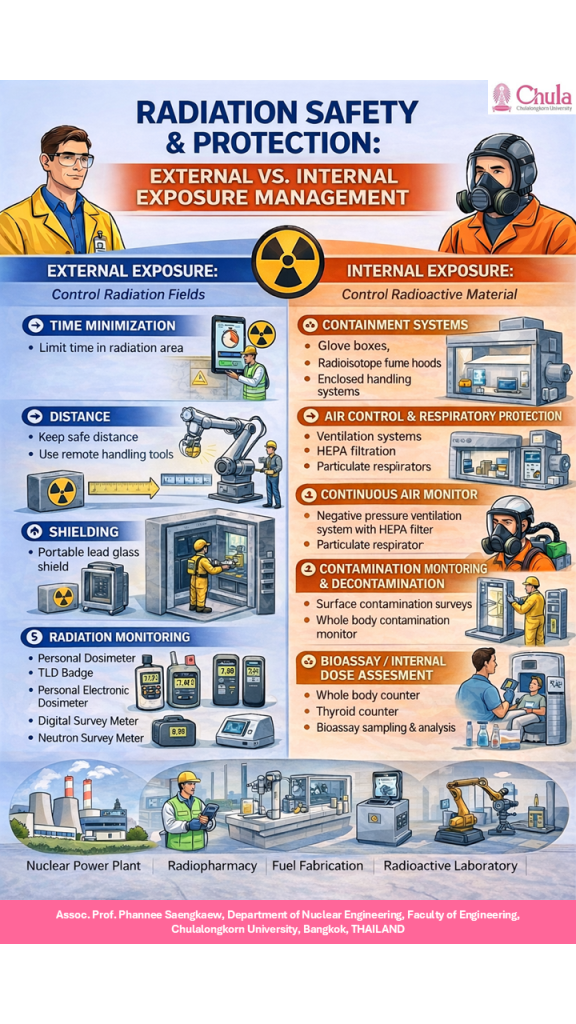
อุปกรณ์และเครื่องมือสำหรับสนับสนุนแผนการป้องกันรังสีจากการรับรังสีภายนอกและการรับรังสีภายใน
1. บทนำ
การดำเนินงานด้านการป้องกันรังสีให้เกิดผลอย่างมีประสิทธิภาพมิได้อาศัยเพียงหลักการทางทฤษฎีหรือข้อกำหนดด้านความปลอดภัยเท่านั้น หากแต่ต้องมีการจัดเตรียมอุปกรณ์ เครื่องมือ และระบบสนับสนุนที่เหมาะสม เพื่อให้สามารถนำมาตรการป้องกันรังสีไปใช้ได้จริงในทางปฏิบัติ โดยอุปกรณ์ที่ใช้สำหรับควบคุมการรับรังสีจากภายนอกร่างกายและการรับสารกัมมันตรังสีเข้าสู่ร่างกายนั้นมีความแตกต่างกันตามลักษณะของอันตรายที่ต้องควบคุม
ในกรณีของการรับรังสีภายนอก เป้าหมายหลักของการป้องกันคือการลดความเข้มของสนามรังสีที่ตกกระทบต่อร่างกายของผู้ปฏิบัติงาน ส่วนในกรณีของการรับรังสีภายใน เป้าหมายหลักคือการป้องกันไม่ให้สารกัมมันตรังสีเข้าสู่ร่างกายผ่านการหายใจ การกลืนกิน การดูดซึมผ่านผิวหนัง หรือบาดแผล ดังนั้น การเลือกใช้อุปกรณ์ป้องกันจึงต้องสอดคล้องกับกลไกของอันตรายทางรังสีในแต่ละกรณี
2. อุปกรณ์สำหรับการป้องกันการรับรังสีภายนอก
2.1 อุปกรณ์สำหรับเพิ่มระยะห่างระหว่างผู้ปฏิบัติงานกับแหล่งกำเนิดรังสี
เนื่องจากความเข้มของรังสีจะลดลงเมื่อระยะห่างจากแหล่งกำเนิดเพิ่มขึ้น การเพิ่มระยะห่างจึงเป็นวิธีพื้นฐานในการลดการรับรังสีภายนอก
อุปกรณ์ที่ใช้ ได้แก่
- คีมจับด้ามยาว
- เครื่องมือหยิบจับระยะไกล
- แขนกลควบคุมจากระยะไกล
- ระบบหุ่นยนต์สำหรับงานรังสี
- ระบบควบคุมการปฏิบัติงานจากระยะไกลผ่านกล้องและแผงควบคุม
อุปกรณ์เหล่านี้ช่วยลดความจำเป็นที่ผู้ปฏิบัติงานต้องเข้าใกล้แหล่งกำเนิดรังสีโดยตรง และมีความสำคัญอย่างยิ่งในงานที่มีอัตราปริมาณรังสีสูง
2.2 อุปกรณ์กำบังรังสี
อุปกรณ์กำบังรังสีมีหน้าที่ลดความเข้มของรังสีก่อนถึงตัวผู้ปฏิบัติงาน โดยเลือกวัสดุตามชนิดและพลังงานของรังสี
ตัวอย่างอุปกรณ์กำบังรังสี
- ฉากกำบังรังสีแบบเคลื่อนย้ายได้
- กล่องกำบังตะกั่ว
- ผนังกำบังรังสีประจำที่
- ตู้ปฏิบัติงานกำบังรังสี
- ภาชนะขนส่งวัสดุกัมมันตรังสีแบบกำบัง
วัสดุที่ใช้ทั่วไป
- ตะกั่ว สำหรับรังสีแกมมาและรังสีเอกซ์
- พลาสติกหรืออะคริลิก สำหรับรังสีบีตา
- น้ำหรือวัสดุที่มีธาตุโบรอน สำหรับรังสีนิวตรอน
2.3 เครื่องตรวจวัดระดับรังสีในพื้นที่
ใช้สำหรับประเมินระดับรังสีในบริเวณปฏิบัติงานก่อนและระหว่างการทำงาน
เครื่องมือสำคัญ
- เครื่องสำรวจรังสีแบบเคลื่อนที่
- เครื่องวัดอัตราปริมาณรังสีประจำพื้นที่
- เครื่องตรวจวัดรังสีนิวตรอน
- ระบบเฝ้าระวังรังสีประจำสถานที่
เครื่องมือเหล่านี้ช่วยให้สามารถประเมินสภาพรังสีก่อนเข้าปฏิบัติงาน กำหนดเขตควบคุม และติดตามความผิดปกติของระดับรังสีได้อย่างต่อเนื่อง
2.4 เครื่องวัดปริมาณรังสีประจำบุคคล
ใช้ติดตามปริมาณรังสีสะสมที่ผู้ปฏิบัติงานได้รับ
ตัวอย่าง
- แผ่นวัดปริมาณรังสีฟิล์ม
- เครื่องวัดปริมาณรังสีเรืองแสงเมื่อให้ความร้อน (TLD)
- เครื่องวัดปริมาณรังสีเรืองแสงด้วยแสงกระตุ้น (OSL)
- เครื่องวัดปริมาณรังสีอิเล็กทรอนิกส์ส่วนบุคคล (EPD)
3. อุปกรณ์สำหรับการป้องกันการรับรังสีภายใน
3.1 ระบบกักกันสารกัมมันตรังสี
อุปกรณ์กลุ่มนี้มีหน้าที่ป้องกันไม่ให้สารกัมมันตรังสีแพร่กระจายออกสู่สภาพแวดล้อมการทำงาน
ตัวอย่างอุปกรณ์
- ตู้ปฏิบัติการปิดผนึกพร้อมถุงมือสอด
- ตู้ดูดควันสำหรับงานสารกัมมันตรังสี
- ห้องปฏิบัติการปิดผนึกกำบังรังสี
- ระบบลำเลียงสารในท่อหรือภาชนะปิด
3.2 ระบบควบคุมและกรองอากาศ
ใช้ควบคุมการแพร่กระจายของสารกัมมันตรังสีในอากาศ และลดโอกาสการสูดดมเข้าสู่ร่างกาย
องค์ประกอบสำคัญ
- ระบบระบายอากาศความดันต่ำ
- ระบบกรองอนุภาคประสิทธิภาพสูง
- ระบบดูดอากาศเฉพาะจุด
- เครื่องตรวจวัดสารกัมมันตรังสีในอากาศอย่างต่อเนื่อง
3.3 อุปกรณ์ป้องกันทางเดินหายใจ
ใช้เมื่อมาตรการควบคุมทางวิศวกรรมเพียงอย่างเดียวไม่เพียงพอ
ตัวอย่าง
- หน้ากากกรองอนุภาค
- หน้ากากกรองไอและอนุภาค
- ชุดช่วยหายใจแบบใช้พัดลม
- เครื่องช่วยหายใจพร้อมถังอากาศอิสระ
3.4 อุปกรณ์ป้องกันการปนเปื้อนส่วนบุคคล
ใช้ป้องกันไม่ให้สารกัมมันตรังสีสัมผัสผิวหนังหรือเสื้อผ้าของผู้ปฏิบัติงาน
ตัวอย่าง
- ถุงมือป้องกันการปนเปื้อน
- เสื้อคลุมปฏิบัติงาน
- ชุดคลุมป้องกันแบบใช้ครั้งเดียว
- ปลอกคลุมรองเท้า
- แว่นหรือกระบังป้องกันใบหน้า
3.5 เครื่องตรวจวัดการปนเปื้อน
ใช้ตรวจสอบการปนเปื้อนของสารกัมมันตรังสีบนพื้นผิว วัสดุ และบุคลากร
ตัวอย่าง
- เครื่องตรวจวัดการปนเปื้อนพื้นผิว
- เครื่องตรวจการปนเปื้อนมือ เท้า และเสื้อผ้า
- เครื่องตรวจวัดอนุภาคแอลฟา/บีตาบนพื้นผิว
3.6 ระบบเฝ้าระวังการรับสารกัมมันตรังสีเข้าสู่ร่างกาย
ใช้ประเมินปริมาณรังสีภายในหลังสงสัยว่ามีการรับสารเข้าสู่ร่างกาย
เครื่องมือที่ใช้
- เครื่องตรวจวัดกัมมันตภาพภายในร่างกาย
- เครื่องตรวจวัดกัมมันตภาพบริเวณต่อมไทรอยด์
- ระบบวิเคราะห์ตัวอย่างปัสสาวะหรือสารคัดหลั่ง
- ห้องปฏิบัติการวิเคราะห์การปนเปื้อนภายใน
4. หลักการเลือกใช้อุปกรณ์ตามลักษณะอันตราย
การเลือกใช้อุปกรณ์ต้องพิจารณาจากลักษณะของอันตรายทางรังสีเป็นสำคัญ ดังนี้
| ลักษณะอันตราย | อุปกรณ์หลักที่ควรใช้ |
| สนามรังสีภายนอกระดับสูง | อุปกรณ์กำบัง + เครื่องสำรวจรังสี + เครื่องวัดประจำบุคคล |
| แหล่งกำเนิดรังสีเปิดผนึก | ระบบกักกัน + เครื่องตรวจการปนเปื้อน |
| สารกัมมันตรังสีฟุ้งกระจายในอากาศ | ระบบกรองอากาศ + หน้ากากป้องกันทางเดินหายใจ |
| การทำงานกับสารปล่อยอนุภาคแอลฟา | ระบบปิดผนึก + เครื่องตรวจการปนเปื้อน + การเฝ้าระวังภายใน |
| พื้นที่มีอันตรายผสม | ระบบป้องกันแบบบูรณาการทั้งภายนอกและภายใน |
5. สรุป
อุปกรณ์และเครื่องมือด้านการป้องกันรังสีเป็นองค์ประกอบสำคัญที่ทำให้มาตรการควบคุมอันตรายทางรังสีสามารถนำไปปฏิบัติได้จริงในระดับหน้างาน โดยอุปกรณ์สำหรับการป้องกันการรับรังสีภายนอกมีเป้าหมายหลักในการลดสนามรังสีที่กระทบต่อร่างกาย ขณะที่อุปกรณ์สำหรับการป้องกันการรับรังสีภายในมีเป้าหมายในการป้องกันไม่ให้สารกัมมันตรังสีเข้าสู่ร่างกาย
ดังนั้น การออกแบบระบบป้องกันรังสีที่มีประสิทธิภาพจึงต้องพิจารณาเลือกใช้อุปกรณ์ให้สอดคล้องกับลักษณะของอันตรายทางรังสี ประเภทของแหล่งกำเนิดรังสี และรูปแบบการปฏิบัติงาน เพื่อให้สามารถควบคุมการรับรังสีได้อย่างเหมาะสมและเกิดความปลอดภัยสูงสุดแก่ผู้ปฏิบัติงาน
References
- International Atomic Energy Agency. Radiation Protection and Safety of Radiation Sources: International Basic Safety Standards, GSR Part 3. Vienna: IAEA, 2014.
- International Atomic Energy Agency. Occupational Radiation Protection, GSG-7. Vienna: IAEA, 2018.
- International Commission on Radiological Protection. The 2007 Recommendations of the International Commission on Radiological Protection, ICRP Publication 103.
- Knoll, G. F. Radiation Detection and Measurement, 4th Edition. Wiley, 2010.
- Turner, J. E. Atoms, Radiation, and Radiation Protection, 3rd Edition. Wiley-VCH, 2007.
 Around Radiation Detectors
ใส่ความเห็น