Determination of Radiation Area Acceptability for Routine Work and Worker Readiness Prior to Entry According to Source Type
1. Introduction
The safe performance of work in radiation areas requires systematic determination that workplace radiological conditions are acceptable for the intended task and that workers are adequately prepared prior to entry. Radiation protection in occupational settings is achieved not merely by monitoring dose during work, but through structured pre-job radiological assessment, verification of engineered and administrative controls, and confirmation of worker readiness.
Importantly, the acceptability of a radiation area for routine work cannot be judged solely by the presence or magnitude of radiation fields. Rather, it must be determined according to the dominant hazard pathway associated with the radioactive source involved, since different source forms present fundamentally different exposure mechanisms.
Sealed radioactive sources generally present hazards dominated by external exposure, whereas unsealed radioactive materials introduce additional risks of surface contamination, airborne contamination, and internal exposure. Accordingly, radiation area acceptability assessments shall be conducted using a source-specific and hazard-based framework.
2. Fundamental Principles of Radiation Area Acceptability
A radiation area may be considered acceptable for routine work only when all of the following conditions are satisfied:
- Radiological conditions are verified to be within approved operational limits for the planned task;
- Required engineering controls are functional and verified operable;
- Appropriate administrative controls and work authorizations are in place;
- Necessary radiological monitoring instrumentation is available and operational;
- Workers are adequately trained, equipped, and briefed for the specific hazards present.
Area acceptability is therefore a task-dependent and condition-dependent determination, not a fixed characteristic of the workplace.
3. Hazard Pathway Dependence on Source Type
The source form fundamentally determines the dominant radiological hazard pathway and thus the criteria for work readiness.
3.1 Sealed Radioactive Sources
Sealed sources consist of radioactive material encapsulated in a manner intended to prevent dispersion under normal operating conditions. Routine work involving sealed sources is therefore characterized primarily by:
- External radiation exposure hazard
- Potential high dose-rate localized fields
- Minimal contamination/internal hazard under intact conditions
3.2 Unsealed Radioactive Materials
Unsealed radioactive materials may disperse into the workplace environment during handling, processing, or transfer. Consequently, routine work may involve combined hazards of:
- External radiation exposure
- Surface contamination
- Airborne radioactivity
- Internal exposure via inhalation, ingestion, or absorption
4. Radiation Area Acceptability Criteria for Sealed-Source Work
4.1 External Radiation Field Assessment
Prior to work commencement, external radiation levels shall be measured and confirmed acceptable using:
- Installed area radiation monitors
- Portable survey meters
- Electronic personal dosimeters (EPDs), where applicable
Measured dose rates shall be evaluated against:
- Facility administrative dose-rate limits
- Task occupancy assumptions
- ALARA planning targets
- Work permit constraints
4.2 Verification of Source Integrity and Shielding
The following conditions shall be confirmed:
- Source housing/encapsulation intact
- Shielding barriers correctly positioned
- Beam shutters or source retraction mechanisms functional
- No evidence of mechanical damage or source leakage
4.3 Verification of Safety and Access Controls
Operational status of safety systems shall be verified:
- Interlocks
- Warning lights and alarms
- Access barriers and signage
- Emergency source retraction/shutdown systems
5. Radiation Area Acceptability Criteria for Unsealed-Source Work
5.1 External Radiation Field Assessment
External dose-rate verification shall be performed as for sealed-source work.
5.2 Surface Contamination Assessment
Contamination conditions shall be verified through:
- Portable contamination survey instruments
- Smear/wipe testing
- Fixed contamination monitoring systems where installed
Measured contamination levels shall remain below facility contamination action limits.
5.3 Airborne Radioactivity Assessment
Airborne activity shall be assessed using:
- Continuous air monitors (CAMs)
- Workplace air samplers
- Exhaust/ventilation monitors
Measured airborne concentrations shall be below investigation/action levels unless respiratory protection and special controls are implemented.
5.4 Verification of Containment and Ventilation Systems
The following engineering controls shall be verified operable:
- Fume hoods
- Glove boxes
- Hot cells
- Negative-pressure ventilation systems
- HEPA filtration / exhaust systems
6. Worker Readiness Verification Prior to Entry
Worker readiness shall be verified separately from area acceptability.
6.1 Personal Monitoring and Protective Equipment
Workers shall be equipped as appropriate with:
- Passive personal dosimeter
- Electronic alarming dosimeter (if required)
- Contamination-control PPE
- Respiratory protection (where applicable)
6.2 Administrative and Procedural Readiness
Workers shall:
- Review applicable work permit / radiological work permit
- Complete pre-job briefing
- Understand anticipated hazards and controls
- Demonstrate familiarity with emergency procedures
- Confirm stop-work criteria
7. ALARA-Based Pre-Job Radiological Review
Determination of area acceptability constitutes a practical implementation of ALARA planning.
Pre-job radiological review shall evaluate:
- Expected dose and dose rate
- Anticipated contamination/airborne hazards
- Task duration and occupancy
- Worker positioning and source geometry
- Available shielding/containment
- Opportunities for dose optimization
8. Dynamic Nature of Radiation Area Acceptability
Radiation area acceptability is not static.
Acceptability determinations remain valid only for the assessed work scope and prevailing radiological conditions. Reassessment is required when:
- Source position changes
- Shielding configuration changes
- Material form changes
- Ventilation/containment performance changes
- Task scope changes
- Unexpected radiological conditions arise
9. Continuous Monitoring and Stop-Work Criteria
Radiological conditions shall be continuously monitored during work.
Workers shall:
- Observe EPD readings continuously
- Watch for monitor alarms
- Periodically re-survey work areas
- Track cumulative dose against pre-job estimates
- Stop work if radiological conditions exceed approved limits
10. Comparative Summary of Source-Type Dependent Requirements
| Parameter | Sealed Source Work | Unsealed Source Work |
| Dominant Hazard | External Exposure | External + Internal Exposure |
| Primary Monitoring | Dose Rate | Dose Rate + Contamination + Air |
| Main Engineering Controls | Shielding / Interlocks | Containment / Ventilation / Shielding |
| PPE Requirements | Minimal / Standard | Contamination PPE / Respiratory |
| Main Emergency Concern | Source Exposure / Stuck Source | Spill / Intake / Contamination Spread |
11. Conclusion
Determination of radiation area acceptability for routine work must be performed through structured radiological assessment and hazard-specific worker preparation. Because sealed and unsealed radioactive sources present fundamentally different hazard pathways, the criteria for area acceptability and worker readiness must be adapted accordingly.
Radiation protection is therefore not merely the passive monitoring of dose during work, but a proactive decision-making process that verifies radiological readiness before work begins. Through systematic, source-specific, and ALARA-based assessment, radiation work can be performed safely while maintaining occupational exposures within justified, optimized, and controlled limits.
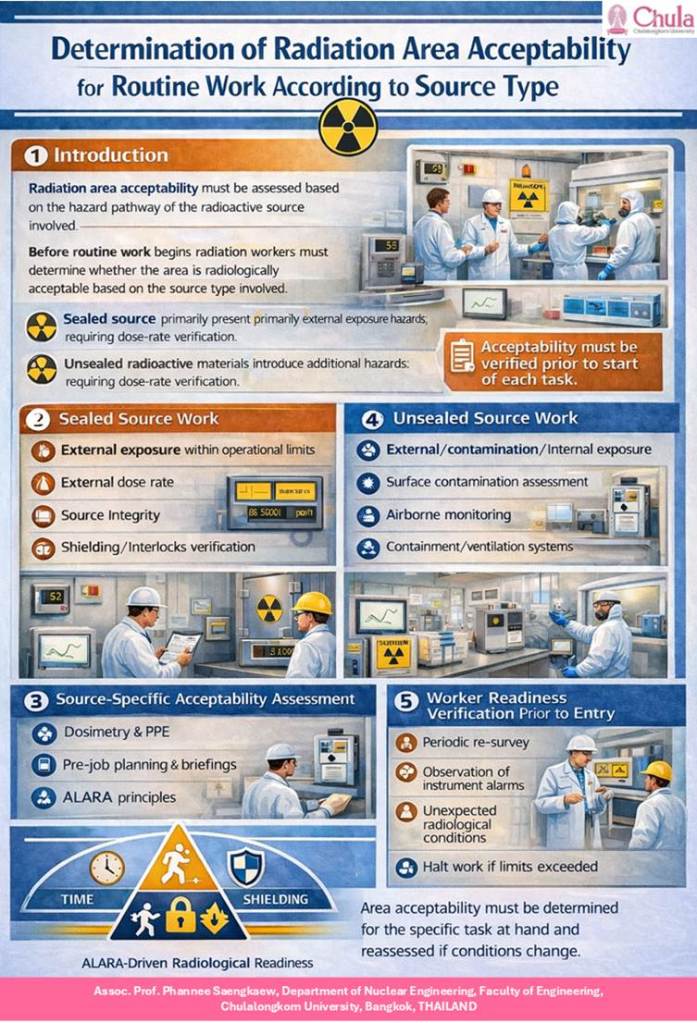
**********************************************************
การประเมินความพร้อมของพื้นที่รังสีก่อนปฏิบัติงานประจำตามประเภทของแหล่งกำเนิดกัมมันตรังสี
1. บทนำ
การปฏิบัติงานในพื้นที่รังสีอย่างปลอดภัยจำเป็นต้องมีการประเมินอย่างเป็นระบบว่า สภาพทางรังสีของพื้นที่มีความเหมาะสมต่อการปฏิบัติงานตามภารกิจที่กำหนด และผู้ปฏิบัติงานมีความพร้อมเพียงพอก่อนเข้าสู่พื้นที่ดังกล่าว การป้องกันรังสีในการปฏิบัติงานมิได้อาศัยเพียงการติดตามปริมาณรังสีระหว่างการทำงานเท่านั้น แต่ต้องอาศัยกระบวนการประเมินสภาพทางรังสีก่อนเริ่มงาน การตรวจสอบความพร้อมของระบบควบคุมทางวิศวกรรมและมาตรการทางการบริหาร ตลอดจนการเตรียมความพร้อมของบุคลากรให้เหมาะสมกับลักษณะอันตรายของงานนั้น
ทั้งนี้ การพิจารณาว่าพื้นที่รังสี “เหมาะสมต่อการทำงาน” หรือไม่นั้น ไม่อาจพิจารณาจากเพียงการมีอยู่ของรังสีหรือค่าระดับรังสีเพียงอย่างเดียว แต่ต้องพิจารณาตาม เส้นทางความเสี่ยงของอันตราย (hazard pathway) ที่สัมพันธ์กับลักษณะของแหล่งกำเนิดกัมมันตรังสี เนื่องจากแหล่งกำเนิดแต่ละประเภทก่อให้เกิดกลไกการได้รับรังสีและความเสี่ยงที่แตกต่างกันอย่างมีนัยสำคัญ
โดยทั่วไป แหล่งกำเนิดกัมมันตรังสีชนิดปิดผนึกมักก่อให้เกิดความเสี่ยงหลักจาก การได้รับรังสีภายนอก ขณะที่วัสดุกัมมันตรังสีชนิดไม่ปิดผนึกอาจก่อให้เกิดความเสี่ยงเพิ่มเติมจาก การปนเปื้อนทางกัมมันตรังสี การแพร่กระจายในอากาศ และการได้รับเข้าสู่ภายในร่างกาย ดังนั้น การประเมินความพร้อมของพื้นที่จึงต้องดำเนินการโดยอาศัยหลักการประเมินเชิงเฉพาะตามประเภทของแหล่งกำเนิด
2. หลักการพื้นฐานของการประเมินความพร้อมของพื้นที่รังสี
พื้นที่รังสีจะถือว่าเหมาะสมสำหรับการปฏิบัติงานประจำได้ก็ต่อเมื่อเป็นไปตามเงื่อนไขดังต่อไปนี้ครบถ้วน
- สภาพทางรังสีอยู่ภายในขีดจำกัดการปฏิบัติงานที่กำหนดสำหรับภารกิจนั้น
- ระบบควบคุมทางวิศวกรรมทำงานได้อย่างถูกต้องและพร้อมใช้งาน
- มาตรการควบคุมทางบริหารและใบอนุญาต/ใบอนุมัติงานที่เกี่ยวข้องได้รับการจัดเตรียมครบถ้วน
- เครื่องมือเฝ้าระวังและตรวจวัดรังสีที่จำเป็นพร้อมใช้งาน
- ผู้ปฏิบัติงานได้รับการฝึกอบรม สวมใส่อุปกรณ์ป้องกัน และรับทราบข้อมูลอันตรายอย่างเหมาะสม
ดังนั้น ความพร้อมของพื้นที่รังสีจึงเป็น การตัดสินเชิงเงื่อนไข (conditional determination) ที่ขึ้นอยู่กับลักษณะงานและสภาพแวดล้อม ณ เวลานั้น มิใช่คุณสมบัติคงที่ของพื้นที่
3. ความสัมพันธ์ระหว่างประเภทของแหล่งกำเนิดกับเส้นทางความเสี่ยง
3.1 วัสดุกัมมันตรังสีชนิดปิดผนึก (Sealed Radioactive Sources)
วัสดุกัมมันตรังสีชนิดปิดผนึกหมายถึงวัสดุกัมมันตรังสีที่ถูกบรรจุหรือห่อหุ้มในโครงสร้างป้องกันซึ่งออกแบบให้ป้องกันการแพร่กระจายของสารกัมมันตรังสีภายใต้สภาวะการใช้งานปกติ
ดังนั้น อันตรายหลักในการปฏิบัติงานจึงได้แก่
- การได้รับรังสีภายนอกจากสนามรังสีโดยตรง
- การได้รับรังสีเฉพาะจุดจากแหล่งกำเนิดความเข้มสูง
- ความเสี่ยงจากการปนเปื้อนมีน้อยมาก หากแหล่งกำเนิดยังคงสมบูรณ์
3.2 วัสดุกัมมันตรังสีชนิดไม่ปิดผนึก (Unsealed Radioactive Materials)
วัสดุกัมมันตรังสีชนิดไม่ปิดผนึกสามารถแพร่กระจายออกสู่สิ่งแวดล้อมระหว่างการใช้งาน การถ่ายเท หรือการประมวลผลได้
ดังนั้น อันตรายที่เกี่ยวข้องอาจประกอบด้วย
- การได้รับรังสีภายนอก
- การปนเปื้อนบนพื้นผิว
- การปนเปื้อนในอากาศ
- การได้รับเข้าสู่ภายในร่างกาย จากการสูดดม กลืนกิน หรือดูดซึมผ่านผิวหนัง
4. เกณฑ์การประเมินความพร้อมของพื้นที่สำหรับงานกับแหล่งกำเนิดชนิดปิดผนึก
4.1 การประเมินสนามรังสีภายนอก
ต้องทำการตรวจวัดระดับรังสีภายนอกก่อนเริ่มงานโดยใช้เครื่องมือที่เหมาะสม เช่น
- ระบบตรวจวัดรังสีพื้นที่แบบติดตั้งประจำที่ (Area monitor)
- เครื่องสำรวจรังสีแบบพกพา (Surveymeter)
- เครื่องวัดรังสีส่วนบุคคลแบบอิเล็กทรอนิกส์ (EPD)
ผลการวัดต้องได้รับการประเมินเทียบกับ
- ค่าขีดจำกัดทางปฏิบัติของหน่วยงาน
- ระยะเวลาการปฏิบัติงานที่คาดการณ์
- ค่าเป้าหมายตามหลัก ALARA
- ข้อกำหนดในใบอนุญาต/ใบอนุมัติงาน
4.2 การตรวจสอบความสมบูรณ์ของแหล่งกำเนิดและเครื่องกำบังรังสี
ต้องตรวจสอบว่า
- ตัวห่อหุ้มแหล่งกำเนิดรังสีอยู่ในสภาพสมบูรณ์
- เครื่องกำบังรังสีอยู่ในตำแหน่งถูกต้อง
- ระบบ shutter / source retraction ทำงานได้ปกติ
- ไม่มีร่องรอยความเสียหายทางกลหรือการรั่วไหล
4.3 การตรวจสอบระบบความปลอดภัยและควบคุมการเข้าถึง
ต้องยืนยันการทำงานของ
- ระบบอินเตอร์ล็อก
- สัญญาณไฟและสัญญาณเตือน
- ป้ายเตือนและเครื่องกั้นพื้นที่
- ระบบหยุดฉุกเฉิน / ดึงแหล่งกำเนิดกลับ
5. เกณฑ์การประเมินความพร้อมของพื้นที่สำหรับงานกับวัสดุไม่ปิดผนึก
5.1 การประเมินสนามรังสีภายนอก
ดำเนินการเช่นเดียวกับกรณีแหล่งกำเนิดปิดผนึก
5.2 การประเมินการปนเปื้อนบนพื้นผิว
ต้องตรวจสอบการปนเปื้อนโดยใช้
- เครื่องตรวจวัดการปนเปื้อนทางรังสีแบบพกพา
- การทดสอบเช็ดคราบ (smear/wipe test)
- ระบบตรวจวัดการปนเปื้อนแบบติดตั้งประจำ
ค่าการปนเปื้อนต้องต่ำกว่าระดับปฏิบัติการ/ระดับดำเนินการที่กำหนด
5.3 การประเมินการปนเปื้อนในอากาศ
ต้องตรวจสอบโดยใช้
- เครื่องตรวจวัดกัมมันตภาพรังสีในอากาศแบบต่อเนื่อง (CAM)
- เครื่องเก็บตัวอย่างอากาศ
- ระบบตรวจวัดทางระบายอากาศ/ปล่องระบาย
5.4 การตรวจสอบระบบกักกันและระบายอากาศ
ต้องตรวจสอบความพร้อมของ
- ตู้ดูดควัน
- กล่องถุงมือ
- Hot Cell
- ระบบระบายอากาศความดันลบ
- ระบบกรองแบบ HEPA
6. การตรวจสอบความพร้อมของผู้ปฏิบัติงานก่อนเข้าสู่พื้นที่
การประเมินความพร้อมของผู้ปฏิบัติงานต้องแยกจากการประเมินพื้นที่
6.1 อุปกรณ์ป้องกันและเฝ้าระวังส่วนบุคคล
ผู้ปฏิบัติงานต้องได้รับการจัดเตรียมอย่างเหมาะสม เช่น
- เครื่องวัดปริมาณรังสีประจำตัวบุคคล
- เครื่องวัดรังสีเตือนภัยแบบอิเล็กทรอนิกส์
- PPE สำหรับควบคุมการปนเปื้อน
- อุปกรณ์ป้องกันระบบทางเดินหายใจ (หากจำเป็น)
6.2 ความพร้อมเชิงบริหารและขั้นตอนปฏิบัติ
ผู้ปฏิบัติงานต้อง
- ทบทวนใบอนุญาต/ใบอนุมัติงาน
- เข้าร่วม pre-job briefing
- รับทราบอันตรายและมาตรการควบคุม
- เข้าใจขั้นตอนฉุกเฉิน
- ทราบเกณฑ์หยุด/ยกเลิก การปฏิบัติงาน
7. การทบทวนเชิง ALARA ก่อนเริ่มงาน
การประเมินความพร้อมของพื้นที่ถือเป็นส่วนหนึ่งของการดำเนินการตามหลัก ALARA
โดยต้องพิจารณา
- ปริมาณรังสีและอัตราปริมาณรังสีที่คาดการณ์
- ความเสี่ยงการปนเปื้อน/การได้รับรังสี แหล่งภายใน
- ระยะเวลาการทำงาน
- ตำแหน่งของผู้ปฏิบัติงานและเรขาคณิตของแหล่งกำเนิด
- เครื่องกำบังและระบบกักกันที่มีอยู่
- แนวทางลดการได้รับรังสีให้ต่ำที่สุดอย่างสมเหตุสมผล
8. ลักษณะพลวัตของความพร้อมของพื้นที่รังสี
ความพร้อมของพื้นที่รังสีมิใช่สถานะคงที่ แต่สามารถเปลี่ยนแปลงได้ตลอดเวลา
ต้องประเมินใหม่เมื่อมีการเปลี่ยนแปลง เช่น
- ตำแหน่งแหล่งกำเนิดเปลี่ยน
- การจัดวางเครื่องกำบังเปลี่ยน
- รูปแบบของวัสดุกัมมันตรังสีเปลี่ยน
- ระบบระบายอากาศ/กักกันผิดปกติ
- ขอบเขตงานเปลี่ยน
- พบสภาพรังสีผิดปกติ
9. การเฝ้าระวังระหว่างปฏิบัติงานและเกณฑ์หยุดงาน
ระหว่างปฏิบัติงานต้องมีการเฝ้าระวังอย่างต่อเนื่อง โดยผู้ปฏิบัติงานต้อง
- ตรวจสอบค่า EPD อย่างสม่ำเสมอ
- เฝ้าระวังสัญญาณเตือนจากเครื่องมือ
- สำรวจพื้นที่ซ้ำเมื่อจำเป็น
- ติดตาม cumulative dose เทียบกับแผนงาน
- หยุดงานทันทีเมื่อระดับปริมาณรังสีเกินเกณฑ์กำหนด
10. สรุป
การประเมินความพร้อมของพื้นที่รังสีก่อนปฏิบัติงานต้องดำเนินการผ่านกระบวนการประเมินเชิงระบบที่สอดคล้องกับเส้นทางความเสี่ยงของแหล่งกำเนิดกัมมันตรังสีแต่ละประเภท เนื่องจากวัสดุกัมมันตรังสีชนิดปิดผนึกและไม่ปิดผนึกก่อให้เกิดอันตรายผ่านกลไกที่แตกต่างกันอย่างมีนัยสำคัญ
ดังนั้น การพิจารณาความพร้อมของพื้นที่และความพร้อมของผู้ปฏิบัติงานจึงต้องปรับให้เหมาะสมกับลักษณะของอันตรายนั้น โดยอาศัยหลักการประเมินเชิงรังสี การควบคุมทางวิศวกรรม มาตรการทางบริหาร และแนวคิด ALARA อย่างบูรณาการ เพื่อให้การปฏิบัติงานทางรังสีสามารถดำเนินได้อย่างปลอดภัย มีประสิทธิภาพ และอยู่ภายใต้การควบคุมที่เหมาะสม
Suggested References
- International Atomic Energy Agency. Radiation Protection and Safety of Radiation Sources: International Basic Safety Standards, GSR Part 3, Vienna, 2014.
- International Atomic Energy Agency. Occupational Radiation Protection, GSG-7, Vienna, 2018.
- International Commission on Radiological Protection. ICRP Publication 103: The 2007 Recommendations of the ICRP, 2007.
 Around Radiation Detectors
ใส่ความเห็น