☢️ The IAEA 19 Infrastructure Issues for Nuclear Power Programme Development
1. Introduction
The development of a nuclear power programme is a highly complex national undertaking that extends far beyond the deployment of reactor technology. It requires the establishment of a comprehensive infrastructure encompassing policy, legal systems, regulatory oversight, safety frameworks, technical capabilities, and human resources in an integrated manner. The unique characteristics of nuclear energy—particularly its safety implications, long operational lifetime, and international obligations—necessitate a structured and rigorous approach to programme development.
The International Atomic Energy Agency has developed the Milestones Approach to guide countries embarking on nuclear power development. This framework defines three progressive phases: pre-decision, preparatory, and implementation phases. Central to this approach are the 19 Infrastructure Issues, which represent the essential domains of national readiness.
These issues should not be viewed as isolated elements but rather as an integrated system, where progress in each domain both supports and constrains the others.
2. Purpose
This document aims to:
- Explain the importance of each infrastructure issue
- Identify their key institutional and technical components
- Describe their progression across the Milestones phases
- Highlight the systemic interconnections among all 19 issues
☢️ 3. Analysis of the 19 Infrastructure Issues
1. National Position
Importance: Establishes the strategic direction and national commitment to nuclear power, aligning it with energy security, economic development, and environmental policy. Without a clear national position, progress in other areas lacks direction and continuity.
Key Components: Includes national energy policy, government decision-making mechanisms, and inter-institutional coordination to ensure coherent programme implementation.
Progression: Begins with feasibility studies and policy dialogue, advances to formal governmental decision-making, and evolves into sustained long-term policy support.
Milestones:
Phase 1: Studies and consultations
Phase 2: Government decision
Phase 3: Sustained policy commitment
Additional Explanation: Serves as the “foundation of the entire system,” defining the direction of all infrastructure development.
2. Nuclear Safety
Importance: Represents the highest priority, ensuring protection of people and the environment through all phases of nuclear activities.
Key Components: Includes safety standards, defence-in-depth principles, safety assessment processes, and the establishment of a strong safety culture.
Progression: Starts with adoption of international standards, progresses to integration into design and licensing, and culminates in operational safety supported by a mature safety culture.
Milestones:
Phase 1: Establish safety framework
Phase 2: Integration into systems
Phase 3: Sustained safe operation
Additional Explanation: Nuclear safety is both a technical system and an organizational culture that must be developed simultaneously.
3. Management
Importance: Ensures effective coordination and control of complex programme activities involving multiple stakeholders and long timelines.
Key Components: Includes organizational structures, quality management systems, decision-making processes, and risk management mechanisms.
Progression: Begins with the establishment of a programme organization (e.g., NEPIO), followed by implementation of project management systems, and evolves into mature organizational capability.
Milestones:
Phase 1: Organizational establishment
Phase 2: Operational management systems
Phase 3: Mature management capability
Additional Explanation: Acts as the “integrating mechanism” that enables all infrastructure issues to function cohesively.
4. Funding and Financing
Importance: Determines the feasibility and long-term sustainability of the nuclear power programme, given its high capital cost and long lifecycle.
Key Components: Includes cost analysis, financing models, and financial risk allocation among stakeholders.
Progression: Begins with economic feasibility assessment, followed by securing financing, and develops into sustainable long-term financial management.
Milestones:
Phase 1: Feasibility analysis
Phase 2: Financing secured
Phase 3: Financial sustainability
Additional Explanation: Must address the entire lifecycle, including construction, operation, and decommissioning.
5. Legislative Framework
Importance: Provides the legal foundation for governance, regulation, and enforcement of nuclear activities.
Key Components: Includes nuclear law, liability provisions, international conventions, and legal mandates for regulatory bodies.
Progression: Starts with drafting legislation, proceeds to enactment, and advances to effective enforcement.
Milestones:
Phase 1: Draft legislation
Phase 2: Enactment
Phase 3: Enforcement
Additional Explanation: Forms the legal backbone of the entire nuclear programme.
6. Safeguards
Importance: Ensures compliance with international non-proliferation obligations and builds global confidence in the peaceful use of nuclear energy.
Key Components: Includes nuclear material accounting systems, reporting mechanisms, verification processes, and institutional frameworks.
Progression: Begins with international agreements, followed by national system development, and culminates in full operational implementation.
Milestones:
Phase 1: Commitment to safeguards
Phase 2: Institutional system established
Phase 3: Fully operational system
Additional Explanation: Directly linked to international trust and credibility.
7. Regulatory Framework
Importance: Ensures independent oversight, licensing, inspection, and enforcement of nuclear safety and compliance.
Key Components: Includes regulatory authority, licensing systems, inspection mechanisms, and technical competence.
Progression: Begins with defining regulatory structure, progresses to operational regulatory activities, and evolves into a fully independent and competent authority.
Milestones:
Phase 1: Regulatory strategy defined
Phase 2: Regulatory body operational
Phase 3: Fully independent regulator
Additional Explanation: A clear separation between regulator and operator is essential.
8. Radiation Protection
Importance: Protects workers, the public, and the environment from radiation exposure.
Key Components: Includes dose limits, monitoring systems, and ALARA implementation.
Progression: Begins with establishing regulatory frameworks, followed by implementation of monitoring systems, and advances toward optimization.
Milestones:
Phase 1: Framework established
Phase 2: Systems implemented
Phase 3: Optimization
Additional Explanation: Radiation protection serves as the operational interface between regulatory requirements and real-world practices, ensuring that abstract dose limits are translated into measurable and controllable conditions in the workplace and environment. It integrates monitoring, procedural control, and optimization principles to maintain exposures as low as reasonably achievable. Beyond compliance, it also provides the evidential basis for demonstrating safety performance and building public confidence.
9. Electrical Grid
Importance: Ensures compatibility between nuclear power generation and the national electricity system.
Key Components: Includes grid capacity, system stability, and load management.
Progression: Begins with system assessment, followed by upgrades, and culminates in full integration with nuclear operation.
Milestones:
Phase 1: Assessment
Phase 2: Upgrades
Phase 3: Integration
Additional Explanation: The electrical grid represents a critical enabling infrastructure that determines whether nuclear-generated electricity can be delivered reliably to the national system. Nuclear power plants require a stable and resilient grid not only for power export but also for maintaining internal safety systems under both normal and transient conditions. Therefore, grid readiness is directly linked to both operational efficiency and nuclear safety, making it a key prerequisite rather than a supporting component.
10. Human Resource Development (HRD)
Importance: Represents the central enabling factor for all infrastructure elements.
Key Components: Includes education and training systems, workforce planning, and competency development.
Progression: Begins with needs assessment, followed by establishment of training systems, and results in a fully qualified workforce.
Milestones:
Phase 1: HRD strategy
Phase 2: Training systems
Phase 3: Workforce readiness
Additional Explanation: Human resource development functions as the central integrating element across all infrastructure issues, as every technical, regulatory, and operational system ultimately depends on competent personnel. It ensures not only the availability of qualified individuals, but also the continuity of knowledge, institutional memory, and safety culture over the long lifecycle of nuclear programmes. Without sustained HRD, even well-established systems cannot be effectively implemented or maintained.
11. Stakeholder Involvement
Importance: Plays a critical role in building public trust and acceptance of the nuclear power programme. Given the sensitivity of nuclear issues related to safety, environment, and transparency, effective stakeholder engagement is essential to ensure social legitimacy and reduce potential conflicts.
Key Components: Includes communication strategies, identification and analysis of stakeholders, public engagement activities, and mechanisms to ensure transparency in decision-making processes.
Progression: Begins with stakeholder identification and awareness-building, advances to structured engagement programmes, and evolves into sustained public confidence and trust.
Milestones:
Phase 1: Stakeholder identification
Phase 2: Engagement programmes implemented
Phase 3: Sustained public confidence
Additional Explanation: Acts as a “bridge between the programme and society,” directly influencing policy support and implementation success.
12. Site and Supporting Facilities
Importance: Determines the physical safety and long-term viability of the nuclear power plant. The selection of an appropriate site is critical for ensuring safety under both normal and extreme conditions.
Key Components: Includes site selection processes, site characterization (geology, hydrology, seismic conditions), infrastructure development (transportation, cooling water, utilities), and overall site suitability assessment.
Progression: Begins with preliminary site screening, followed by detailed evaluation and characterization, and culminates in site readiness for construction and operation.
Milestones:
Phase 1: Site screening
Phase 2: Detailed site evaluation
Phase 3: Site ready for construction
Additional Explanation: Represents one of the most critical engineering and safety decisions, influencing plant design and long-term operation.
13. Environmental Protection
Importance: Ensures that nuclear power development is environmentally sustainable by minimizing impacts on ecosystems and natural resources throughout the project lifecycle.
Key Components: Includes environmental impact assessment (EIA), baseline environmental data collection, environmental monitoring systems, and compliance with regulatory requirements.
Progression: Begins with baseline studies and impact assessments, followed by regulatory approval processes, and advances toward continuous monitoring and environmental management.
Milestones:
Phase 1: Baseline environmental studies
Phase 2: EIA approval
Phase 3: Continuous monitoring
Additional Explanation: Serves as a key condition for sustainability, linking technical performance with regulatory compliance and public acceptance.
14. Emergency Planning
Importance: Ensures preparedness for nuclear or radiological emergencies, minimizing consequences for people, property, and the environment.
Key Components: Includes emergency response plans at facility and national levels, coordination mechanisms among relevant agencies, warning and communication systems, evacuation planning, and regular training and exercises.
Progression: Begins with the development of emergency frameworks, progresses through system implementation and training, and culminates in full operational readiness.
Milestones:
Phase 1: Emergency framework established
Phase 2: Systems and training implemented
Phase 3: Full readiness demonstrated
Additional Explanation: Functions as a risk mitigation system, ensuring resilience in abnormal or accident conditions.
15. Security and Physical Protection
Importance: Protects nuclear facilities and materials against malicious acts such as sabotage, theft, or unauthorized access, which could have severe safety and security consequences.
Key Components: Includes physical protection systems, threat assessment, access control, surveillance systems, and response measures.
Progression: Begins with policy and threat definition, followed by system installation and implementation, and advances toward integrated and tested security systems.
Milestones:
Phase 1: Security policy defined
Phase 2: Systems installed
Phase 3: Integrated and tested
Additional Explanation: Acts as a defensive layer against external threats, complementing nuclear safety systems.
16. Nuclear Fuel Cycle
Importance: Ensures the continuity of nuclear power generation through reliable fuel supply and effective management of spent fuel.
Key Components: Includes fuel procurement strategies, fuel utilization during reactor operation, and spent fuel management, as well as front-end and back-end policy considerations.
Progression: Begins with national strategy development, followed by supply agreements and system establishment, and evolves into fully operational fuel cycle management.
Milestones:
Phase 1: Strategy defined
Phase 2: Supply agreements established
Phase 3: Operational system
Additional Explanation: Represents a core resource infrastructure, linking energy security, technical operation, and waste management.
17. Radioactive Waste Management
Importance: Ensures long-term protection of people and the environment through safe management of radioactive waste.
Key Components: Includes waste classification, storage, transport, disposal systems, and national policies and regulatory frameworks.
Progression: Begins with policy and strategy development, followed by planning and infrastructure development, and advances to full operational waste management systems.
Milestones:
Phase 1: Strategy developed
Phase 2: Facilities planned
Phase 3: Operational system
Additional Explanation: Represents a long-term responsibility, essential for sustainability and public acceptance.
18. Industrial Involvement
Importance: Supports economic development and enhances programme sustainability by building domestic industrial capacity and reducing reliance on foreign suppliers.
Key Components: Includes development of local supply chains, industry capability enhancement, technology transfer, and quality assurance systems.
Progression: Begins with assessment of national industrial capacity, followed by capability development, and culminates in active participation in the nuclear programme.
Milestones:
Phase 1: Industry assessment
Phase 2: Capacity building
Phase 3: Active participation
Additional Explanation: Acts as a link between the nuclear programme and national economy.
19. Procurement
Importance: Determines project success in terms of quality, cost, and schedule through effective selection of technology, vendors, and contractual arrangements.
Key Components: Includes procurement strategy, contract models, vendor qualification, and quality and contract management systems.
Progression: Begins with procurement planning, followed by vendor selection and contracting, and advances to contract implementation and oversight.
Milestones:
Phase 1: Procurement planning
Phase 2: Vendor selection and contracting
Phase 3: Implementation and oversight
Additional Explanation: Represents the interface between planning and execution, directly affecting project delivery.
4. Conclusion
The development of a nuclear power programme should not be understood as the implementation of isolated components, but rather as the establishment of an integrated infrastructure system in which all 19 issues are interdependent.
At a systemic level:
- Policy and Law provide authority and legitimacy
- Regulation and Safety ensure control and reliability
- Technical Infrastructure enables operational capability
- Human Resources connect and sustain all components
Therefore, a nuclear power programme becomes viable not when all 19 issues exist individually, but when they are developed coherently and function together as a unified system.
A nuclear power programme is “ready”, not when all 19 issues are present, but when all 19 function together as one integrated national system.
References
Core IAEA Framework
International Atomic Energy Agency
- International Atomic Energy Agency. (2024).
Milestones in the Development of a National Infrastructure for Nuclear Power (Rev. 2).
IAEA Nuclear Energy Series No. NG-G-3.1.
Vienna: IAEA.
https://www.iaea.org/publications/15225/milestones-in-the-development-of-a-national-infrastructure-for-nuclear-power
Infrastructure & Programme Development
- International Atomic Energy Agency. (2022).
Evaluation of the Status of National Nuclear Infrastructure Development.
IAEA Nuclear Energy Series No. NG-T-3.2. - International Atomic Energy Agency. (2021).
Nuclear Power Human Resources Model (NPHR).
IAEA Training Course Series No. 73.
Safety, Regulatory & Organization
- International Atomic Energy Agency. (2022).
Recruitment, Qualification and Training of Personnel for Nuclear Power Plants.
IAEA Safety Standards Series No. SSG-75. - International Atomic Energy Agency. (2022).
Leadership and Management for Safety.
IAEA Safety Standards Series No. GSR Part 2. - International Atomic Energy Agency. (2020).
Establishing the Safety Infrastructure for a Nuclear Power Programme (Rev. 1).
IAEA Safety Standards Series No. SSG-16.
Additional Supporting References
- World Nuclear Association. (2023).
Nuclear Power in the World Today.
https://world-nuclear.org - International Energy Agency (IEA). (2022).
Nuclear Power and Secure Energy Transitions.
Paris: IEA.
**************************************************************
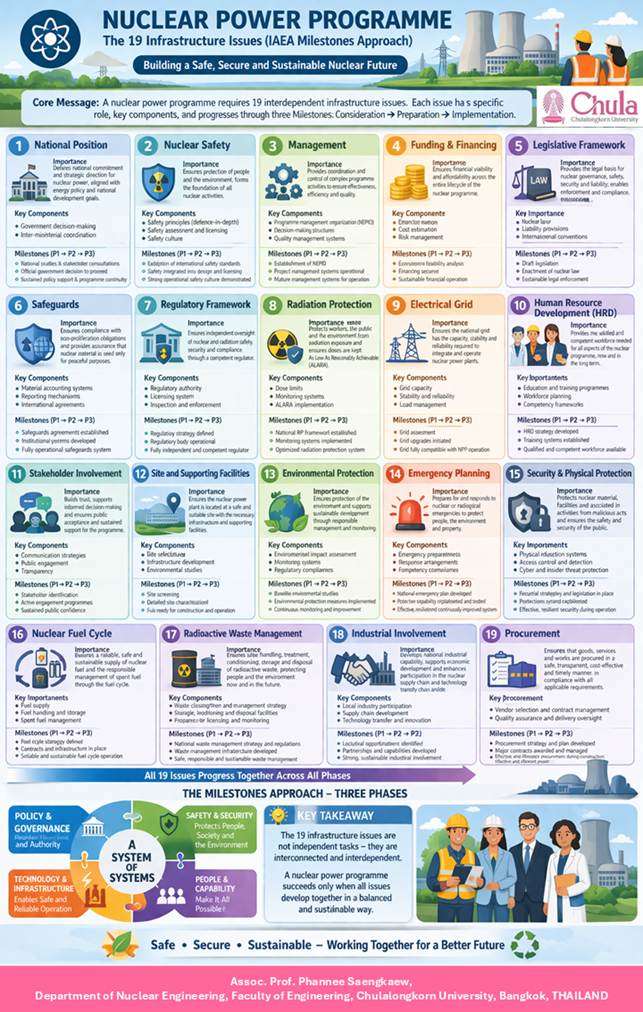
☢️ โครงสร้างพื้นฐาน 19 ด้าน ตามกรอบของ IAEA สำหรับการพัฒนาโครงการพลังงานนิวเคลียร์
1. บทนำ (Introduction)
การพัฒนาโครงการพลังงานนิวเคลียร์เป็นกระบวนการระดับชาติที่มีความซับซ้อนสูง ซึ่งไม่ได้จำกัดอยู่เพียงการติดตั้งเทคโนโลยีเครื่องปฏิกรณ์นิวเคลียร์ แต่ต้องอาศัยการจัดตั้งโครงสร้างพื้นฐานที่ครอบคลุมทั้งด้านนโยบาย กฎหมาย การกำกับดูแล ความปลอดภัย ระบบเทคนิค และทรัพยากรมนุษย์อย่างบูรณาการ ลักษณะเฉพาะของพลังงานนิวเคลียร์ ซึ่งเกี่ยวข้องกับความเสี่ยงด้านรังสี อายุการใช้งานระยะยาว และพันธกรณีระหว่างประเทศ ทำให้การพัฒนาโครงการต้องอาศัยกรอบแนวทางที่เป็นระบบและมีความเข้มงวด
International Atomic Energy Agency ได้กำหนดกรอบ Milestones Approach เพื่อใช้เป็นแนวทางสำหรับประเทศที่เริ่มพัฒนาโครงการพลังงานนิวเคลียร์ โดยแบ่งออกเป็น 3 ระยะ ได้แก่ ระยะพิจารณาก่อนตัดสินใจ ระยะเตรียมความพร้อม และระยะดำเนินการก่อสร้างและเดินเครื่อง ภายใต้กรอบนี้ ได้ระบุ โครงสร้างพื้นฐาน 19 ด้าน ซึ่งเป็นองค์ประกอบสำคัญของความพร้อมระดับชาติ
ทั้ง 19 ประเด็นนี้ มิได้เป็นรายการตรวจสอบแบบแยกส่วน แต่เป็น ระบบที่เชื่อมโยงกัน (integrated system) ซึ่งความก้าวหน้าในแต่ละประเด็นส่งผลต่อกันและกันอย่างมีนัยสำคัญ
2. วัตถุประสงค์ (Purpose)
บทความนี้มีวัตถุประสงค์เพื่อ:
- อธิบายความสำคัญของแต่ละประเด็นโครงสร้างพื้นฐาน
- วิเคราะห์องค์ประกอบหลักในเชิงสถาบันและเทคนิค
- อธิบายระดับความก้าวหน้าตามกรอบ Milestones
- แสดงความเชื่อมโยงเชิงระบบของทั้ง 19 ประเด็น
☢️ 3. การวิเคราะห์ประเด็นโครงสร้างพื้นฐาน
1. จุดยืนของประเทศ (National Position)
ความสำคัญ:เป็นกรอบเชิงยุทธศาสตร์ที่กำหนดบทบาทของพลังงานนิวเคลียร์ในระบบพลังงานของประเทศ และเชื่อมโยงกับความมั่นคงพลังงานและการพัฒนาเศรษฐกิจ หากไม่มีจุดยืนที่ชัดเจน การพัฒนาในประเด็นอื่นจะขาดทิศทางและความต่อเนื่อง
องค์ประกอบ:ประกอบด้วยนโยบายพลังงานระดับชาติ กลไกการตัดสินใจของรัฐบาล และระบบการประสานงานระหว่างหน่วยงาน เพื่อให้การดำเนินงานเป็นไปในทิศทางเดียวกัน
ระดับความก้าวหน้า:เริ่มจากการศึกษาความเป็นไปได้และการหารือเชิงนโยบาย นำไปสู่การตัดสินใจระดับรัฐบาล และพัฒนาเป็นการดำเนินนโยบายอย่างต่อเนื่องในระยะยาว
Milestones:
Phase 1: วิเคราะห์และปรึกษาหารือ
Phase 2: ตัดสินใจเชิงนโยบาย
Phase 3: ดำเนินนโยบายต่อเนื่อง
คำอธิบายเสริม:เป็น “จุดตั้งต้นของทั้งระบบ” ที่กำหนดทิศทางของโครงสร้างพื้นฐานทั้งหมด
2. ความปลอดภัยทางนิวเคลียร์ (Nuclear Safety)
ความสำคัญ:เป็นหลักการพื้นฐานสูงสุดในการปกป้องประชาชนและสิ่งแวดล้อม โดยครอบคลุมทั้งการออกแบบ ระบบกำกับดูแล และการปฏิบัติงานจริง
องค์ประกอบ:ประกอบด้วยมาตรฐานความปลอดภัย หลักการป้องกันเชิงลึก (defence-in-depth) กระบวนการประเมินความปลอดภัย และวัฒนธรรมความปลอดภัยในองค์กร
ระดับความก้าวหน้า:เริ่มจากการนำมาตรฐานสากลมาใช้ ต่อมาบูรณาการในกระบวนการออกแบบและอนุญาต และพัฒนาเป็นการดำเนินงานภายใต้วัฒนธรรมความปลอดภัย
Milestones:
Phase 1: กำหนดกรอบความปลอดภัย
Phase 2: บูรณาการในระบบ
Phase 3: ใช้งานจริงอย่างยั่งยืน
คำอธิบายเสริม:ความปลอดภัยเป็นทั้ง “ระบบเทคนิค” และ “วัฒนธรรมองค์กร” ที่ต้องพัฒนาไปพร้อมกัน
3. การบริหารจัดการ (Management)
ความสำคัญ: ทำให้โครงการที่มีความซับซ้อนสูงสามารถดำเนินได้อย่างเป็นระบบ โดยลดความซ้ำซ้อนและความเสี่ยงจากการประสานงานหลายหน่วยงาน
องค์ประกอบ: ประกอบด้วยโครงสร้างองค์กร ระบบบริหารคุณภาพ กลไกการตัดสินใจ และการบริหารความเสี่ยง
ระดับความก้าวหน้า:เริ่มจากการจัดตั้งองค์กรหลัก (เช่น NEPIO) ต่อมาพัฒนาระบบบริหารโครงการ และยกระดับสู่การบริหารองค์กรเต็มรูปแบบ
Milestones:
Phase 1: จัดตั้งองค์กร
Phase 2: ดำเนินระบบบริหาร
Phase 3: องค์กรมีความสมบูรณ์
คำอธิบายเสริม: เป็น “ตัวเชื่อมระบบ” ที่ทำให้ทุกประเด็นทำงานร่วมกันได้อย่างมีประสิทธิภาพ
4. การเงินและการลงทุน (Funding & Financing)
ความสำคัญ: เป็นปัจจัยกำหนดความเป็นไปได้และความยั่งยืนของโครงการ เนื่องจากต้องใช้เงินลงทุนสูงและมีวงจรชีวิตยาว
องค์ประกอบ: ประกอบด้วยการวิเคราะห์ต้นทุน รูปแบบการจัดหาเงินทุน และการจัดสรรความเสี่ยงทางการเงิน
ระดับความก้าวหน้า: เริ่มจากการศึกษาความคุ้มค่า ต่อมาจัดหาแหล่งเงินทุน และพัฒนาไปสู่การบริหารทางการเงินระยะยาว
Milestones:
Phase 1: วิเคราะห์ความเป็นไปได้
Phase 2: จัดหาเงินทุน
Phase 3: บริหารการเงิน
คำอธิบายเสริม: ต้องครอบคลุมทั้ง “การสร้าง การเดินเครื่อง และการปลดระวาง”
5. กรอบกฎหมาย (Legislative Framework)
ความสำคัญ: เป็นพื้นฐานทางกฎหมายที่รองรับการพัฒนาและการกำกับดูแลกิจกรรมทางนิวเคลียร์ทั้งหมด โดยกำหนดอำนาจ หน้าที่ และความรับผิดของหน่วยงานที่เกี่ยวข้อง รวมถึงสร้างความชอบธรรมในการบังคับใช้ข้อกำหนดด้านความปลอดภัยและความมั่นคง
องค์ประกอบ: ประกอบด้วยกฎหมายพลังงานนิวเคลียร์หลัก กฎหมายว่าด้วยความรับผิดทางแพ่งและการประกันภัย ความตกลงและอนุสัญญาระหว่างประเทศ ตลอดจนบทบัญญัติที่กำหนดอำนาจของหน่วยงานกำกับดูแล
ระดับความก้าวหน้า: เริ่มจากการร่างกฎหมายและปรับให้สอดคล้องกับมาตรฐานสากล ต่อมามีการประกาศใช้และจัดตั้งกลไกบังคับใช้ และพัฒนาไปสู่การบังคับใช้ที่มีประสิทธิภาพและทันสมัย
Milestones:
Phase 1: จัดทำร่างกฎหมาย
Phase 2: ประกาศใช้กฎหมาย
Phase 3: บังคับใช้อย่างมีประสิทธิผล
คำอธิบายเสริม: กรอบกฎหมายเป็น “รากฐานของการกำกับดูแล” หากไม่ชัดเจน ระบบอื่นจะไม่สามารถดำเนินการได้อย่างถูกต้องตามกฎหมาย
6. การพิทักษ์วัสดุนิวเคลียร์ (Safeguards)
ความสำคัญ: มีบทบาทในการป้องกันการนำวัสดุนิวเคลียร์ไปใช้ในทางที่ไม่เป็นไปตามวัตถุประสงค์โดยสันติ และสร้างความเชื่อมั่นในระดับระหว่างประเทศว่าประเทศปฏิบัติตามพันธกรณีด้านการไม่แพร่ขยายอาวุธนิวเคลียร์
องค์ประกอบ: ประกอบด้วยระบบบัญชีและควบคุมวัสดุนิวเคลียร์ ระบบรายงานข้อมูลต่อหน่วยงานระหว่างประเทศ และกระบวนการตรวจสอบยืนยัน (verification) รวมถึงโครงสร้างสถาบันที่รองรับการดำเนินงานด้านนี้
ระดับความก้าวหน้า: เริ่มจากการเข้าร่วมข้อตกลงระหว่างประเทศ ต่อมาพัฒนาระบบและกลไกภายในประเทศ และก้าวสู่การดำเนินงานอย่างครบถ้วนและต่อเนื่อง
Milestones:
Phase 1: เข้าร่วมและยอมรับพันธกรณี
Phase 2: จัดตั้งระบบภายในประเทศ
Phase 3: ดำเนินงานอย่างเต็มรูปแบบ
คำอธิบายเสริม: เป็นประเด็นที่เชื่อมโยงโดยตรงกับ “ความเชื่อถือในระดับนานาชาติ” ของโครงการนิวเคลียร์
7. กรอบการกำกับดูแล (Regulatory Framework)
ความสำคัญ: ทำหน้าที่ควบคุม ตรวจสอบ และบังคับใช้ข้อกำหนดด้านความปลอดภัย ความมั่นคง และการป้องกันอันตรายจากรังสี โดยต้องมีความเป็นอิสระจากหน่วยงานผู้ดำเนินการเพื่อให้การกำกับดูแลมีความน่าเชื่อถือ
องค์ประกอบ: ประกอบด้วยหน่วยงานกำกับดูแลที่มีอำนาจตามกฎหมาย ระบบการออกใบอนุญาต กระบวนการตรวจสอบและบังคับใช้ รวมถึงขีดความสามารถทางเทคนิคของบุคลากรในหน่วยงาน
ระดับความก้าวหน้า: เริ่มจากการกำหนดโครงสร้างและบทบาทของหน่วยงาน ต่อมาดำเนินการออกใบอนุญาตและตรวจสอบ และพัฒนาไปสู่การเป็นองค์กรที่มีความเป็นอิสระและมีสมรรถนะสูง
Milestones:
Phase 1: กำหนดยุทธศาสตร์และโครงสร้าง
Phase 2: เริ่มดำเนินงานกำกับดูแล
Phase 3: เป็นองค์กรอิสระที่มีสมรรถนะครบถ้วน
คำอธิบายเสริม: “Regulator” เป็นกลไกสำคัญในการสร้างความเชื่อมั่นว่าการดำเนินโครงการเป็นไปตามมาตรฐานความปลอดภัยอย่างแท้จริง
8. การป้องกันอันตรายจากรังสี (Radiation Protection)
ความสำคัญ: เป็นกลไกหลักในการปกป้องผู้ปฏิบัติงาน ประชาชน และสิ่งแวดล้อมจากการได้รับรังสีเกินระดับที่ยอมรับได้ โดยครอบคลุมทั้งสถานการณ์ปกติและสถานการณ์ผิดปกติ จึงเป็นองค์ประกอบพื้นฐานของความปลอดภัยในการใช้พลังงานนิวเคลียร์
องค์ประกอบ: ประกอบด้วยการกำหนดค่าขีดจำกัดการได้รับรังสี ระบบตรวจวัดและเฝ้าระวังรังสี การประยุกต์หลักการ ALARA (การลดการได้รับรังสีให้อยู่ในระดับต่ำที่สุดเท่าที่เหมาะสม) รวมถึงมาตรการควบคุมและป้องกันในสถานที่ปฏิบัติงาน
ระดับความก้าวหน้า: เริ่มจากการจัดตั้งกรอบข้อกำหนดด้านการป้องกันอันตรายจากรังสี ต่อมาพัฒนาระบบตรวจวัดและการควบคุมในทางปฏิบัติ และก้าวสู่การเพิ่มประสิทธิภาพของระบบโดยอาศัยข้อมูลจากการใช้งานจริง
Milestones:
Phase 1: กำหนดกรอบและข้อกำหนด
Phase 2: นำระบบตรวจวัดและควบคุมมาใช้
Phase 3: ปรับปรุงและเพิ่มประสิทธิภาพ
คำอธิบายเสริม: การป้องกันอันตรายจากรังสีเป็นตัวเชื่อมระหว่าง “ข้อกำหนดเชิงกฎหมาย” กับ “การปฏิบัติจริงในพื้นที่ทำงาน”
9. โครงข่ายไฟฟ้า (Electrical Grid)
ความสำคัญ: มีบทบาทในการรองรับและถ่ายเทพลังงานไฟฟ้าที่ผลิตจากโรงไฟฟ้านิวเคลียร์ ซึ่งมีขนาดกำลังผลิตสูงและต้องการความเสถียรของระบบ หากโครงข่ายไฟฟ้าไม่มีความพร้อม อาจส่งผลกระทบต่อทั้งความมั่นคงของระบบไฟฟ้าและความปลอดภัยของโรงไฟฟ้า
องค์ประกอบ: ประกอบด้วยความสามารถของโครงข่ายในการรองรับกำลังผลิต (capacity) ความเสถียรและความเชื่อถือได้ของระบบ (stability and reliability) ระบบควบคุมโหลด และโครงสร้างพื้นฐานด้านสายส่งและสถานีไฟฟ้า
ระดับความก้าวหน้า: เริ่มจากการประเมินความสามารถของโครงข่าย ต่อมาดำเนินการปรับปรุงและขยายระบบ และพัฒนาไปสู่การเชื่อมต่อและใช้งานร่วมกับโรงไฟฟ้านิวเคลียร์อย่างมีเสถียรภาพ
Milestones:
Phase 1: ประเมินระบบโครงข่าย
Phase 2: ปรับปรุงและขยายระบบ
Phase 3: เชื่อมต่อและใช้งานจริง
คำอธิบายเสริม: โครงข่ายไฟฟ้าเป็น “โครงสร้างพื้นฐานรองรับ” ที่กำหนดว่าพลังงานที่ผลิตได้สามารถนำไปใช้ประโยชน์ได้อย่างมีประสิทธิภาพหรือไม่
10. การพัฒนาทรัพยากรมนุษย์ (Human Resource Development: HRD)
ความสำคัญ: เป็นปัจจัยเชิงระบบที่สำคัญที่สุด เนื่องจากทุกองค์ประกอบของโครงการพลังงานนิวเคลียร์ต้องอาศัยบุคลากรที่มีความรู้ ความสามารถ และประสบการณ์ในการดำเนินงาน หากขาดทรัพยากรมนุษย์ที่เหมาะสม ระบบอื่นจะไม่สามารถทำงานได้อย่างมีประสิทธิภาพ
องค์ประกอบ: ประกอบด้วยระบบการศึกษาและฝึกอบรม การวางแผนกำลังคนในระยะสั้นและระยะยาว การพัฒนาสมรรถนะของบุคลากรในทุกภาคส่วน (ผู้ดำเนินการ หน่วยงานกำกับดูแล และอุตสาหกรรม) รวมถึงระบบการรับรองคุณสมบัติและการพัฒนาวิชาชีพ
ระดับความก้าวหน้า: เริ่มจากการวิเคราะห์ช่องว่างของกำลังคน ต่อมาพัฒนาหลักสูตรและระบบฝึกอบรม และก้าวสู่การมีบุคลากรที่พร้อมปฏิบัติงานในทุกระดับของโครงการ
Milestones:
Phase 1: วิเคราะห์ความต้องการกำลังคน
Phase 2: จัดตั้งระบบการศึกษาและฝึกอบรม
Phase 3: มีบุคลากรพร้อมใช้งานจริง
คำอธิบายเสริม: HRD เป็น “แกนกลางของระบบ” ที่เชื่อมโยงและขับเคลื่อนทุกประเด็นโครงสร้างพื้นฐานให้เกิดผลในทางปฏิบัติ
11. การมีส่วนร่วมของผู้มีส่วนได้ส่วนเสีย (Stakeholder Involvement)
ความสำคัญ: เป็นกลไกสำคัญในการสร้างความเชื่อมั่นและการยอมรับของสังคมต่อโครงการพลังงานนิวเคลียร์ เนื่องจากโครงการมีความอ่อนไหวต่อประเด็นด้านความปลอดภัย สิ่งแวดล้อม และความโปร่งใส การมีส่วนร่วมอย่างเหมาะสมจึงช่วยลดความขัดแย้งและเพิ่มความชอบธรรมของโครงการ
องค์ประกอบ: ประกอบด้วยการกำหนดกลยุทธ์การสื่อสารที่ชัดเจน การระบุและวิเคราะห์ผู้มีส่วนได้ส่วนเสีย การดำเนินกิจกรรมการมีส่วนร่วมของสาธารณะ และการสร้างความโปร่งใสในการให้ข้อมูลและการตัดสินใจ
ระดับความก้าวหน้า: เริ่มจากการระบุผู้มีส่วนได้ส่วนเสียและการสร้างการรับรู้ ต่อมาพัฒนาเป็นการมีส่วนร่วมอย่างเป็นระบบ และก้าวสู่การสร้างความเชื่อมั่นและความไว้วางใจในระยะยาว
Milestones:
Phase 1: ระบุผู้มีส่วนได้ส่วนเสีย
Phase 2: ดำเนินกิจกรรมการมีส่วนร่วม
Phase 3: สร้างความเชื่อมั่นอย่างต่อเนื่อง
คำอธิบายเสริม: ประเด็นนี้เป็น “สะพานเชื่อมระหว่างโครงการกับสังคม” ซึ่งมีผลโดยตรงต่อความสำเร็จในเชิงนโยบายและการดำเนินงาน
12. สถานที่ตั้งและสิ่งอำนวยความสะดวก/สนับสนุน (Site and Supporting Facilities)
ความสำคัญ: มีบทบาทในการกำหนดความปลอดภัยเชิงกายภาพของโรงไฟฟ้านิวเคลียร์ โดยต้องเลือกพื้นที่ที่เหมาะสมทั้งด้านธรณีวิทยา สิ่งแวดล้อม และโครงสร้างพื้นฐาน เพื่อรองรับการก่อสร้างและการดำเนินงานในระยะยาว
องค์ประกอบ: ประกอบด้วยกระบวนการคัดเลือกสถานที่ตั้ง การศึกษาลักษณะพื้นที่ (เช่น ธรณีวิทยา อุทกวิทยา และแผ่นดินไหว) การพัฒนาโครงสร้างพื้นฐานสนับสนุน เช่น ระบบขนส่ง น้ำหล่อเย็น และสาธารณูปโภค รวมถึงการประเมินความเหมาะสมในภาพรวม
ระดับความก้าวหน้า: เริ่มจากการคัดกรองพื้นที่เบื้องต้น ต่อมาศึกษาเชิงลึกและประเมินความเหมาะสม และพัฒนาไปสู่การเตรียมความพร้อมของพื้นที่สำหรับการก่อสร้างและดำเนินงาน
Milestones:
Phase 1: คัดเลือกและคัดกรองพื้นที่
Phase 2: ศึกษาและประเมินเชิงลึก
Phase 3: พื้นที่พร้อมสำหรับการใช้งาน
คำอธิบายเสริม: การเลือกสถานที่ตั้งเป็น “การตัดสินใจเชิงวิศวกรรมและความปลอดภัยที่สำคัญที่สุด” ซึ่งมีผลต่อทั้งการออกแบบและการดำเนินงานของโรงไฟฟ้า
13. การคุ้มครองสิ่งแวดล้อม (Environmental Protection)
ความสำคัญ: รับรองว่าการพัฒนาและการดำเนินโครงการพลังงานนิวเคลียร์เป็นไปอย่างยั่งยืน โดยลดผลกระทบต่อสิ่งแวดล้อมและระบบนิเวศทั้งในระยะสั้นและระยะยาว
องค์ประกอบ: ประกอบด้วยการจัดทำการประเมินผลกระทบสิ่งแวดล้อม (EIA) การเก็บข้อมูลพื้นฐานด้านสิ่งแวดล้อมก่อนโครงการ ระบบเฝ้าระวังและติดตามผลกระทบ รวมถึงการปฏิบัติตามข้อกำหนดด้านสิ่งแวดล้อมของหน่วยงานกำกับดูแล
ระดับความก้าวหน้า: เริ่มจากการเก็บข้อมูลพื้นฐานและการประเมินผลกระทบ ต่อมาผ่านกระบวนการอนุมัติและกำกับดูแล และพัฒนาไปสู่การติดตามและควบคุมผลกระทบอย่างต่อเนื่องในระยะยาว
Milestones:
Phase 1: ศึกษาสภาพแวดล้อมพื้นฐาน
Phase 2: ได้รับอนุมัติ EIA
Phase 3: ดำเนินการติดตามและควบคุม
คำอธิบายเสริม: การคุ้มครองสิ่งแวดล้อมเป็น “เงื่อนไขของความยั่งยืน” ที่เชื่อมโยงทั้งด้านเทคนิค กฎหมาย และการยอมรับของสังคม
14. การวางแผนฉุกเฉิน (Emergency Planning)
ความสำคัญ: เป็นองค์ประกอบสำคัญในการเตรียมความพร้อมรับมือเหตุการณ์ฉุกเฉินทางนิวเคลียร์หรือรังสี เพื่อลดผลกระทบต่อชีวิต ทรัพย์สิน และสิ่งแวดล้อม การมีแผนที่ชัดเจนและสามารถปฏิบัติได้จริงช่วยเพิ่มความเชื่อมั่นของสาธารณะและความพร้อมของหน่วยงานที่เกี่ยวข้อง
องค์ประกอบ: ประกอบด้วยแผนตอบสนองเหตุฉุกเฉินระดับสถานประกอบการและระดับชาติ ระบบประสานงานระหว่างหน่วยงาน (เช่น หน่วยงานฉุกเฉิน สาธารณสุข และท้องถิ่น) ระบบแจ้งเตือน การอพยพ และการสื่อสารความเสี่ยง รวมถึงการฝึกซ้อมอย่างสม่ำเสมอ
ระดับความก้าวหน้า: เริ่มจากการกำหนดกรอบและแผนเบื้องต้น ต่อมาพัฒนาระบบและการฝึกอบรม และก้าวสู่ความพร้อมใช้งานจริงผ่านการทดสอบและการฝึกซ้อม
Milestones:
Phase 1: จัดทำกรอบและแผนฉุกเฉิน
Phase 2: พัฒนาระบบและฝึกอบรม
Phase 3: ความพร้อมใช้งานเต็มรูปแบบ
คำอธิบายเสริม: ประเด็นนี้เป็น “กลไกรองรับความเสี่ยง” ที่ทำให้ระบบโดยรวมยังคงสามารถควบคุมสถานการณ์ได้แม้เกิดเหตุไม่คาดคิด
15. ความมั่นคงปลอดภัยและการป้องกันทางกายภาพ (Security and Physical Protection)
ความสำคัญ: มีบทบาทในการป้องกันภัยคุกคามจากการกระทำโดยเจตนา เช่น การก่อวินาศกรรม การโจรกรรมวัสดุนิวเคลียร์ หรือการเข้าถึงพื้นที่โดยไม่ได้รับอนุญาต ซึ่งอาจส่งผลกระทบอย่างรุนแรงต่อความปลอดภัยและความเชื่อมั่นของสาธารณะ
องค์ประกอบ: ประกอบด้วยระบบป้องกันทางกายภาพ (physical protection systems) การประเมินภัยคุกคาม (threat assessment) ระบบควบคุมการเข้าถึง (access control) การเฝ้าระวัง และมาตรการตอบสนองต่อเหตุการณ์ด้านความมั่นคง
ระดับความก้าวหน้า: เริ่มจากการกำหนดนโยบายและกรอบด้านความมั่นคง ต่อมาดำเนินการติดตั้งระบบและมาตรการควบคุม และพัฒนาไปสู่การบูรณาการและทดสอบระบบอย่างครบถ้วน
Milestones:
Phase 1: กำหนดนโยบายและกรอบความมั่นคง
Phase 2: ติดตั้งและดำเนินระบบ
Phase 3: ระบบบูรณาการและผ่านการทดสอบ
คำอธิบายเสริม: เป็น “เกราะป้องกันจากภัยคุกคามภายนอก” ที่ต้องทำงานควบคู่กับระบบความปลอดภัย (safety) อย่างใกล้ชิด
16. วงจรเชื้อเพลิงนิวเคลียร์ (Nuclear Fuel Cycle)
ความสำคัญ: มีบทบาทในการรับรองความต่อเนื่องของการผลิตพลังงาน โดยครอบคลุมตั้งแต่การจัดหาเชื้อเพลิง การใช้งานในเครื่องปฏิกรณ์ ไปจนถึงการจัดการเชื้อเพลิงใช้แล้ว ซึ่งเป็นประเด็นสำคัญทั้งด้านความมั่นคงพลังงานและความปลอดภัยระยะยาว
องค์ประกอบ: ประกอบด้วยกลยุทธ์การจัดหาเชื้อเพลิง (fuel procurement) การบริหารจัดการเชื้อเพลิงระหว่างการใช้งาน (fuel utilization) และการจัดการเชื้อเพลิงใช้แล้ว (spent fuel management) รวมถึงการกำหนดนโยบายส่วนต้นและส่วนปลายของวงจรเชื้อเพลิง
ระดับความก้าวหน้า: เริ่มจากการกำหนดกลยุทธ์ระดับชาติ ต่อมาจัดทำข้อตกลงและระบบการจัดหา และพัฒนาไปสู่การดำเนินงานจริงอย่างต่อเนื่อง
Milestones:
Phase 1: กำหนดกลยุทธ์วงจรเชื้อเพลิง
Phase 2: จัดทำข้อตกลงและระบบจัดหา
Phase 3: ดำเนินงานระบบเชื้อเพลิง
คำอธิบายเสริม: ประเด็นนี้เป็น “โครงสร้างพื้นฐานด้านทรัพยากรหลัก” ที่เชื่อมโยงทั้งด้านเทคนิค ความมั่นคง และการจัดการของเสีย
17. การจัดการกากกัมมันตรังสี (Radioactive Waste Management)
ความสำคัญ: เป็นองค์ประกอบสำคัญของความปลอดภัยระยะยาว เนื่องจากกากกัมมันตรังสีต้องได้รับการจัดการอย่างเหมาะสมเพื่อป้องกันผลกระทบต่อมนุษย์และสิ่งแวดล้อมทั้งในปัจจุบันและอนาคต
องค์ประกอบ: ประกอบด้วยการจำแนกประเภทกาก (waste classification) ระบบการจัดเก็บ การขนส่ง และการกำจัดขั้นสุดท้าย (disposal) รวมถึงการกำหนดนโยบายระดับชาติและกรอบการกำกับดูแลที่เกี่ยวข้อง
ระดับความก้าวหน้า: เริ่มจากการกำหนดนโยบายและกลยุทธ์ ต่อมาวางแผนและพัฒนาสิ่งอำนวยความสะดวก และก้าวสู่การดำเนินงานระบบจัดการกากอย่างครบถ้วน
Milestones:
Phase 1: กำหนดนโยบายและกลยุทธ์
Phase 2: วางแผนและพัฒนาโครงสร้างพื้นฐาน
Phase 3: ดำเนินงานระบบจัดการกาก
คำอธิบายเสริม: เป็น “เงื่อนไขของความรับผิดชอบระยะยาว” ที่มีผลโดยตรงต่อความยั่งยืนและการยอมรับของสังคม
18. การมีส่วนร่วมของภาคอุตสาหกรรม (Industrial Involvement)
ความสำคัญ: ช่วยเสริมสร้างความยั่งยืนของโครงการและสนับสนุนการพัฒนาเศรษฐกิจภายในประเทศ โดยลดการพึ่งพาต่างประเทศและเพิ่มศักยภาพของอุตสาหกรรมท้องถิ่น
องค์ประกอบ: ประกอบด้วยการพัฒนาห่วงโซ่อุปทานภายในประเทศ (local supply chain) การยกระดับศักยภาพของผู้ประกอบการ การถ่ายทอดเทคโนโลยี และการสร้างมาตรฐานคุณภาพในภาคอุตสาหกรรม
ระดับความก้าวหน้า: เริ่มจากการประเมินศักยภาพของอุตสาหกรรมภายในประเทศ ต่อมาพัฒนาและยกระดับขีดความสามารถ และก้าวสู่การมีส่วนร่วมอย่างแท้จริงในโครงการ
Milestones:
Phase 1: ประเมินศักยภาพอุตสาหกรรม
Phase 2: พัฒนาและเสริมสร้างขีดความสามารถ
Phase 3: การมีส่วนร่วมในโครงการ
คำอธิบายเสริม: เป็น “กลไกเชื่อมโยงโครงการกับเศรษฐกิจ” ที่ช่วยสร้างผลประโยชน์ในระดับประเทศ
19. การจัดซื้อจัดจ้าง (Procurement)
ความสำคัญ: เป็นปัจจัยกำหนดความสำเร็จของโครงการในด้านคุณภาพ ต้นทุน และระยะเวลา โดยครอบคลุมการคัดเลือกเทคโนโลยี ผู้ขาย และรูปแบบสัญญา
องค์ประกอบ: ประกอบด้วยกลยุทธ์การจัดซื้อจัดจ้าง รูปแบบสัญญา (contract models) กระบวนการคัดเลือกผู้ขาย (vendor selection) และระบบควบคุมคุณภาพและการปฏิบัติตามสัญญา
ระดับความก้าวหน้า: เริ่มจากการวางแผนกลยุทธ์ ต่อมาดำเนินการคัดเลือกและทำสัญญา และพัฒนาไปสู่การบริหารสัญญาและควบคุมการดำเนินงาน
Milestones:
Phase 1: วางแผนการจัดซื้อจัดจ้าง
Phase 2: คัดเลือกผู้ขายและทำสัญญา
Phase 3: ดำเนินการและกำกับติดตาม
คำอธิบายเสริม: เป็น “จุดเชื่อมระหว่างแผนกับการก่อสร้างจริง” ที่มีผลโดยตรงต่อความสำเร็จของโครงการทั้งหมด
4. บทสรุป (Conclusion)
การพัฒนาโครงการพลังงานนิวเคลียร์ไม่สามารถพิจารณาเป็นเพียงการจัดเตรียมองค์ประกอบรายประเด็น แต่ต้องมองในลักษณะของ ระบบโครงสร้างพื้นฐานแบบบูรณาการ (integrated infrastructure system) ซึ่งทั้ง 19 ด้าน มีความเชื่อมโยงและพึ่งพาอาศัยกันอย่างมีนัยสำคัญ
ในภาพรวม สามารถสังเคราะห์บทบาทของแต่ละกลุ่มองค์ประกอบได้ดังนี้:
- นโยบายและกฎหมาย (Policy & Law) → สร้างกรอบอำนาจและความชอบธรรม
- การกำกับดูแลและความปลอดภัย (Regulation & Safety) → รับรองการควบคุมและความเชื่อมั่น
- โครงสร้างพื้นฐานทางเทคนิค (Technical Infrastructure) → ทำให้ระบบสามารถดำเนินงานได้จริง
- ทรัพยากรมนุษย์ (Human Resources) → เชื่อมโยงและขับเคลื่อนทุกองค์ประกอบ
ดังนั้น ความพร้อมของโครงการพลังงานนิวเคลียร์มิได้ขึ้นอยู่กับการมีองค์ประกอบครบถ้วนในแต่ละด้านเท่านั้น แต่ขึ้นอยู่กับ ความสามารถในการบูรณาการองค์ประกอบทั้งหมดให้ทำงานร่วมกันได้อย่างมีประสิทธิภาพ
โครงการพลังงานนิวเคลียร์จะ “พร้อมใช้งานจริง” ไม่ใช่เพียงแค่เมื่อมีครบทั้ง 19 ด้าน แต่ต้องเมื่อทั้ง 19 ด้าน สามารถ “ทำงานร่วมกันเป็นระบบเดียวกันอย่างมีประสิทธิภาพ”
 Around Radiation Detectors
ใส่ความเห็น