Issue 1 : National Position in Nuclear Power Infrastructure Development:
Foundational Policy, Strategic Alignment, and Institutional Implications
1. Introduction
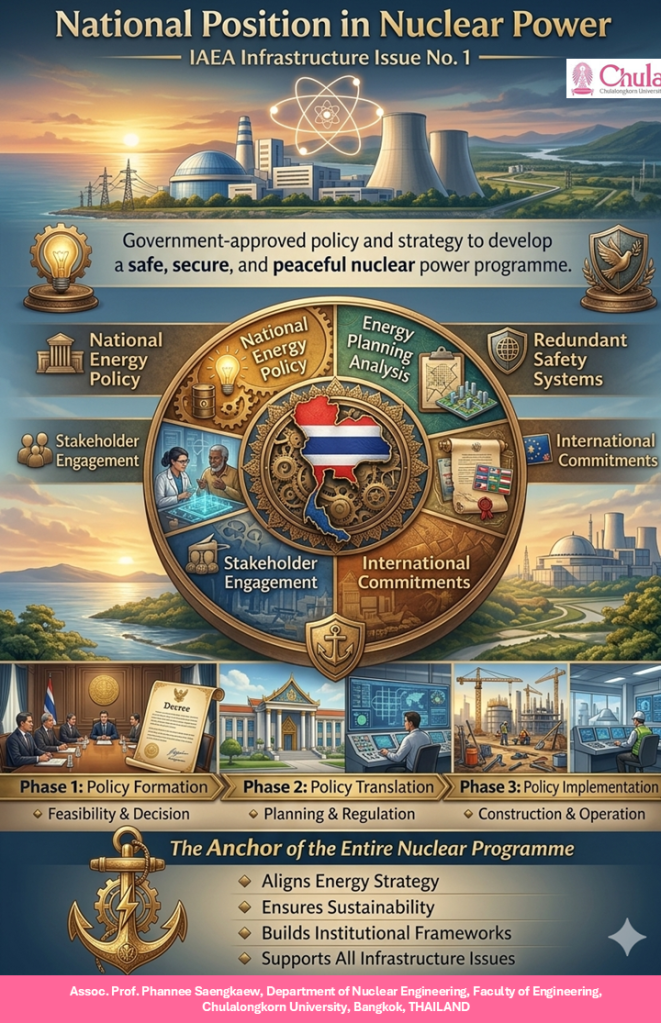
The establishment of a national position represents the first and most critical step in the development of a nuclear power programme. Within the framework defined by the International Atomic Energy Agency, it is categorized as Infrastructure Issue No. 1 among the 19 infrastructure issues required for a comprehensive nuclear infrastructure.
Unlike technical components such as reactor technology or regulatory systems, the national position is inherently strategic and political, serving as the anchor that aligns national policy, institutional arrangements, and long-term commitments. It provides the basis upon which all subsequent infrastructure elements are developed.
A nuclear programme without a clearly defined national position risks fragmentation, inefficiency, and lack of sustainability, particularly given the long lifecycle and high institutional complexity of nuclear power systems.
2. Conceptual Definition and Scope
The International Atomic Energy Agency defines the national position as:
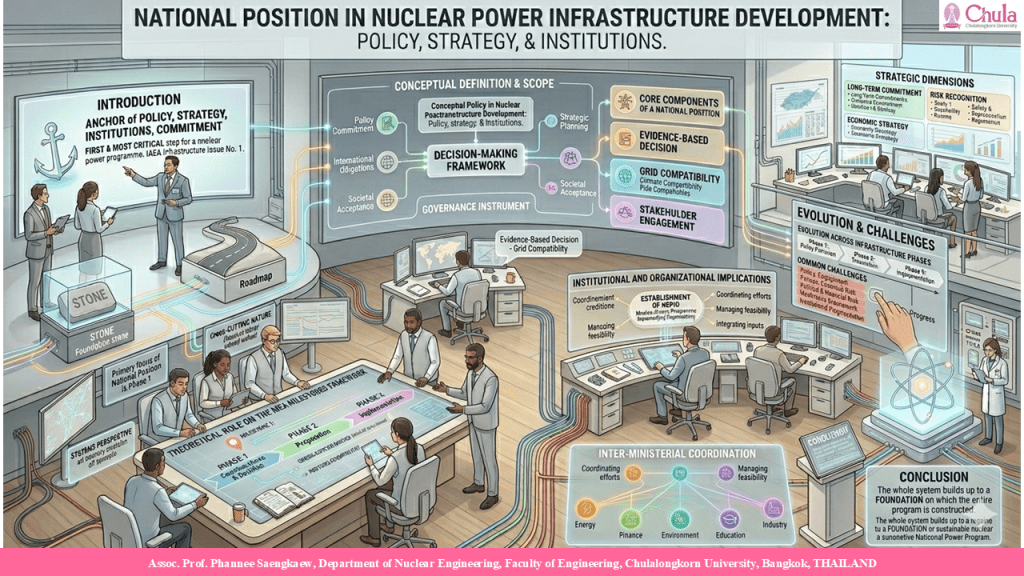
A formal governmental commitment and policy framework that establishes the rationale, objectives, and conditions under which a country decides to pursue nuclear power.
This definition highlights that the national position is not merely a declaration but a multi-dimensional construct, encompassing:
- Policy commitment
- Strategic planning
- Institutional alignment
- International obligations
- Societal acceptance
Thus, it functions as both a decision-making framework and a governance instrument.
3. Theoretical Role within the IAEA Milestones Framework
The International Atomic Energy Agency Milestones Approach divides nuclear infrastructure development into three phases:
- Phase 1: Considerations before a decision to launch a programme
- Phase 2: Preparations for construction
- Phase 3: Activities to implement and operate the plant
Within this structure, the national position is primarily developed during Phase 1, culminating in Milestone 1: “Ready to make a knowledgeable commitment.”
3.1 Cross-Cutting Nature
Although categorized as Issue No. 1, the national position is not isolated. It is inherently linked to all other infrastructure issues, including:
- Legal and regulatory framework
- Human resource development (HRD)
- Safety and security
- Financial planning
- Grid infrastructure
3.2 Systems Perspective
From a systems engineering viewpoint, the national position functions as:
The boundary condition that constrains and guides the evolution of all infrastructure subsystems.
4. Core Components of a National Position
A robust national position consists of four interdependent components:
4.1 National Energy Policy Integration
The nuclear programme must be embedded within a broader national energy strategy, addressing:
- Energy security and diversification
- Long-term demand projections
- Climate commitments (e.g., decarbonization pathways)
- Comparative assessment with alternative technologies
This ensures that nuclear power is not pursued in isolation but as part of a coherent national development strategy.
4.2 Evidence-Based Decision Making
A credible national position requires rigorous analytical justification, including:
- Techno-economic analysis
- Grid compatibility studies
- Site screening (preliminary level)
- Environmental and social impact considerations
This analytical foundation transforms the national position from a political statement into a knowledge-based decision.
4.3 Stakeholder Engagement and Public Communication
Given the societal sensitivity of nuclear energy, stakeholder engagement is a structural requirement, not an optional activity.
Key elements include:
- Transparent communication strategies
- Public consultations
- Engagement with academia, industry, and local communities
This component ensures social legitimacy, which is essential for long-term programme sustainability.
4.4 International Commitments and Governance Alignment
A national position must explicitly recognize and commit to international frameworks, including:
- Nuclear safety standards
- Nuclear security principles
- Safeguards and non-proliferation agreements
Alignment with International Atomic Energy Agency standards ensures that the programme operates within the global nuclear governance regime.
5. Institutional and Organizational Implications
The adoption of a national position triggers the development of institutional structures, most notably:
5.1 Establishment of NEPIO
The Nuclear Energy Programme Implementing Organization (NEPIO) is responsible for:
- Coordinating national efforts
- Managing feasibility studies
- Integrating inputs across ministries and agencies
5.2 Inter-Ministerial Coordination
Nuclear programmes require coordination across:
- Energy
- Finance
- Environment
- Education
- Industry
The national position provides the policy mandate for such coordination.
6. Strategic Dimensions of the National Position
6.1 Long-Term Commitment
Nuclear power programmes span several decades, requiring:
- Policy stability
- Institutional continuity
- Sustainable financing
The national position must therefore be resilient to political changes.
6.2 Risk Recognition and Governance
A mature national position explicitly acknowledges:
- The non-zero probability of nuclear accidents
- The need for strong safety culture
- The importance of regulatory independence
This reflects a realistic and responsible approach to nuclear development.
6.3 Economic and Financing Strategy
Financial considerations include:
- Capital investment models (e.g., BOO, BOOT, PPP)
- Cost recovery mechanisms
- Long-term operational economics
Without a credible financial strategy, the national position remains non-implementable.
( BOO (Build–Own–Operate): Private entity builds, owns, and operates the project permanently.
BOOT (Build–Own–Operate–Transfer): Private entity builds and operates the project, then transfers ownership to the government after a defined period.
PPP (Public–Private Partnership): Government and private sector share investment, risks, and responsibilities in a project.)
7. Evolution Across Infrastructure Phases
Phase 1: Policy Formation
- Development of national position
- Feasibility studies
- Stakeholder engagement
Phase 2: Policy Translation
- Legal and regulatory development
- Institutional establishment
- Detailed planning
Phase 3: Policy Implementation
- Construction and commissioning
- Operational readiness
- Continuous policy reinforcement
8. Interrelationship with Other Infrastructure Issues
The national position directly influences:
- Issue 2 (Nuclear Safety): Sets safety commitment
- Issue 10 (HRD): Defines workforce strategy
- Issue 17 (Financing): Establishes economic feasibility
- Issue 9 (Grid): Determines technical compatibility
Thus, it acts as a central coordinating mechanism across the entire infrastructure system.
9. Common Challenges in Developing National Position
Based on International Atomic Energy Agency experience:
- Ambiguous or inconsistent policy statements
- Insufficient analytical basis
- Weak stakeholder engagement
- Lack of financial clarity
- Institutional fragmentation
These challenges often delay progress toward Milestone 1.
10. Discussion: National Position as Enabling Infrastructure
From a conceptual standpoint, the national position can be interpreted as:
“Enabling infrastructure for infrastructure development.”
It transforms:
- Political intent → Institutional action
- Strategic vision → Operational roadmap
- Public concern → Managed engagement
This aligns with the broader principle:
Policy defines direction; infrastructure enables execution.
11. Conclusion
The national position is not merely the first step in nuclear infrastructure development—it is the foundation upon which the entire programme is constructed.
It integrates:
- Policy
- Strategy
- Institutions
- Society
- International obligations
A well-defined national position ensures that nuclear development is:
- Technically feasible
- Economically viable
- Socially acceptable
- Institutionally sustainable
12. References
- International Atomic Energy Agency (2024). Milestones in the Development of a National Infrastructure for Nuclear Power (NG-G-3.1 Rev. 2).
- International Atomic Energy Agency (2020). Establishing the Safety Infrastructure for a Nuclear Power Programme (SSG-16 Rev.1).
- International Atomic Energy Agency (2022). Operating Organization for Nuclear Power Plants (SSG-72).
- International Atomic Energy Agency (2021). Nuclear Power Human Resources Model (TCS-73).
ประเด็นที่ 1 จุดยืนระดับชาติในการพัฒนาโครงสร้างพื้นฐานด้านพลังงานนิวเคลียร์:
รากฐานเชิงนโยบาย การจัดวางเชิงยุทธศาสตร์ และผลกระทบเชิงสถาบัน
1. บทนำ
การกำหนด จุดยืนระดับชาติ (National Position) ถือเป็นจุดเริ่มต้นที่มีความสำคัญสูงสุดของการพัฒนาโครงการพลังงานนิวเคลียร์ โดยภายใต้กรอบของ International Atomic Energy Agency ได้จัดให้เป็นประเด็นโครงสร้างพื้นฐานลำดับที่ 1 จากทั้งหมด 19 ด้าน ซึ่งสะท้อนให้เห็นถึงบทบาทเชิงรากฐานของประเด็นนี้ในภาพรวมของระบบโครงสร้างพื้นฐานทั้งหมด
แตกต่างจากองค์ประกอบทางเทคนิค เช่น เทคโนโลยีเครื่องปฏิกรณ์ หรือระบบกำกับดูแล จุดยืนระดับชาติมีลักษณะเป็นเชิงนโยบายและเชิงยุทธศาสตร์ โดยทำหน้าที่เป็น “แกนกลาง” ที่เชื่อมโยงการตัดสินใจระดับชาติ การจัดวางเชิงสถาบัน และความมุ่งมั่นระยะยาวเข้าด้วยกัน กล่าวได้ว่า หากขาดจุดยืนระดับชาติที่ชัดเจน โครงการนิวเคลียร์ย่อมมีแนวโน้มเผชิญกับความไม่ต่อเนื่อง ความไม่เป็นเอกภาพ และความไม่ยั่งยืนในระยะยาว
2. นิยามและขอบเขตเชิงแนวคิด
International Atomic Energy Agency ให้นิยามของจุดยืนระดับชาติว่าเป็นความมุ่งมั่นและกรอบนโยบายของรัฐบาลที่กำหนดเหตุผล วัตถุประสงค์ และเงื่อนไขในการตัดสินใจพัฒนาโครงการพลังงานนิวเคลียร์ อย่างไรก็ตาม ในเชิงวิชาการ นิยามดังกล่าวควรถูกตีความในลักษณะของ “โครงสร้างเชิงระบบหลายมิติ” มากกว่าการเป็นเพียงถ้อยแถลงเชิงนโยบาย
กล่าวคือ จุดยืนระดับชาติครอบคลุมทั้งมิติของความมุ่งมั่นเชิงนโยบาย การวางแผนเชิงยุทธศาสตร์ การจัดวางสถาบัน พันธกรณีระหว่างประเทศ และการยอมรับของสังคม องค์ประกอบเหล่านี้ทำให้จุดยืนระดับชาติทำหน้าที่ได้ทั้งในฐานะกรอบการตัดสินใจ (decision-making framework) และเครื่องมือเชิงธรรมาภิบาล (governance instrument) ที่กำหนดทิศทางของโครงการในระยะยาว
3. บทบาทภายใต้กรอบ Milestones
ในกรอบ Milestones ของ International Atomic Energy Agency การพัฒนาโครงสร้างพื้นฐานถูกแบ่งออกเป็นสามระยะ ได้แก่ ระยะการพิจารณาก่อนตัดสินใจ ระยะการเตรียมความพร้อม และระยะการดำเนินโครงการ โดยจุดยืนระดับชาติจะถูกพัฒนาในระยะที่ 1 และเป็นปัจจัยสำคัญที่นำไปสู่ Milestone 1 หรือ “ความพร้อมในการตัดสินใจอย่างมีข้อมูลรองรับ”
แม้จะถูกจัดเป็นเพียงหนึ่งใน 19 ประเด็น แต่ในความเป็นจริง จุดยืนระดับชาติมีลักษณะเป็นประเด็นเชื่อมโยง (cross-cutting issue) ที่มีอิทธิพลต่อทุกองค์ประกอบอื่น ไม่ว่าจะเป็นด้านกฎหมาย ระบบกำกับดูแล การพัฒนาทรัพยากรมนุษย์ ความปลอดภัย การเงิน หรือแม้แต่โครงข่ายไฟฟ้า
ในมุมมองเชิงวิศวกรรมระบบ จุดยืนระดับชาติสามารถอธิบายได้ว่าเป็น “เงื่อนไขขอบเขต” (boundary condition) ที่กำหนดทิศทาง ข้อจำกัด และขอบเขตของการพัฒนาในทุกระบบย่อยของโครงสร้างพื้นฐานนิวเคลียร์
4. องค์ประกอบหลักของจุดยืนระดับชาติ
จุดยืนระดับชาติที่มีความสมบูรณ์ไม่ได้เกิดขึ้นจากองค์ประกอบเพียงด้านเดียว แต่เป็นผลจากการบูรณาการหลายมิติที่เชื่อมโยงกันอย่างเป็นระบบ
ประการแรก โครงการนิวเคลียร์จำเป็นต้องถูกบูรณาการเข้ากับนโยบายพลังงานของประเทศ โดยต้องตอบคำถามเชิงยุทธศาสตร์ว่า พลังงานนิวเคลียร์มีบทบาทอย่างไรในบริบทของความมั่นคงทางพลังงาน ความต้องการพลังงานระยะยาว และเป้าหมายด้านการลดการปล่อยก๊าซเรือนกระจก การพิจารณาในลักษณะนี้ช่วยให้การตัดสินใจไม่เกิดขึ้นแบบแยกส่วน แต่เป็นส่วนหนึ่งของภาพรวมการพัฒนาประเทศ
ต่อมา การกำหนดจุดยืนระดับชาติจำเป็นต้องตั้งอยู่บนฐานของข้อมูลเชิงประจักษ์และการวิเคราะห์อย่างเป็นระบบ ไม่ว่าจะเป็นการวิเคราะห์เชิงเทคนิคและเศรษฐศาสตร์ การประเมินความพร้อมของโครงข่ายไฟฟ้า การคัดเลือกพื้นที่ในระดับเบื้องต้น ตลอดจนการประเมินผลกระทบต่อสิ่งแวดล้อมและสังคม การมีข้อมูลรองรับเหล่านี้ช่วยเปลี่ยน “การตัดสินใจเชิงนโยบาย” ให้กลายเป็น “การตัดสินใจเชิงวิชาการ”
ในขณะเดียวกัน การมีส่วนร่วมของผู้มีส่วนได้ส่วนเสียเป็นอีกองค์ประกอบที่ไม่สามารถละเลยได้ เนื่องจากพลังงานนิวเคลียร์เป็นประเด็นที่มีความอ่อนไหวในสังคม การสื่อสารอย่างโปร่งใส การรับฟังความคิดเห็น และการมีส่วนร่วมของภาคส่วนต่าง ๆ เช่น ภาควิชาการ อุตสาหกรรม และชุมชน จึงเป็นเงื่อนไขสำคัญของการสร้างความยอมรับและความยั่งยืนของโครงการ
สุดท้าย จุดยืนระดับชาติต้องสอดคล้องกับพันธกรณีระหว่างประเทศ ทั้งในด้านความปลอดภัย ความมั่นคงปลอดภัย และการไม่แพร่ขยายอาวุธนิวเคลียร์ ซึ่งเป็นกรอบที่กำหนดให้โครงการนิวเคลียร์ของประเทศต้องดำเนินไปภายใต้ระบบธรรมาภิบาลระดับสากล
5. ผลกระทบเชิงสถาบันและองค์กร
เมื่อมีการกำหนดจุดยืนระดับชาติอย่างชัดเจน ผลที่ตามมาคือการปรับโครงสร้างเชิงสถาบันเพื่อรองรับการดำเนินโครงการ โดยหนึ่งในกลไกสำคัญคือการจัดตั้งองค์กรดำเนินโครงการพลังงานนิวเคลียร์ (NEPIO) ซึ่งทำหน้าที่เป็นศูนย์กลางในการประสานงานระดับชาติ รวมถึงการจัดทำการศึกษาความเป็นไปได้และการบูรณาการข้อมูลจากหน่วยงานต่าง ๆ
นอกจากนี้ โครงการนิวเคลียร์ยังต้องอาศัยการประสานงานระหว่างหลายหน่วยงาน เช่น หน่วยงานด้านพลังงาน การคลัง สิ่งแวดล้อม และการศึกษา ซึ่งจุดยืนระดับชาติจะทำหน้าที่เป็น “กรอบนโยบายร่วม” ที่ทำให้การดำเนินงานของแต่ละหน่วยงานมีทิศทางสอดคล้องกัน
6. มิติทางยุทธศาสตร์
ในเชิงยุทธศาสตร์ จุดยืนระดับชาติต้องสะท้อนถึงความมุ่งมั่นระยะยาว เนื่องจากโครงการนิวเคลียร์มีอายุการดำเนินงานหลายทศวรรษ การรักษาความต่อเนื่องของนโยบาย เสถียรภาพของสถาบัน และความมั่นคงทางการเงินจึงเป็นปัจจัยสำคัญ
ขณะเดียวกัน จุดยืนระดับชาติที่มีความสมบูรณ์ต้องยอมรับความเป็นจริงเกี่ยวกับความเสี่ยงของเทคโนโลยีนิวเคลียร์ ไม่ว่าจะเป็นความเป็นไปได้ของอุบัติเหตุ หรือความจำเป็นในการสร้างวัฒนธรรมความปลอดภัยและระบบกำกับดูแลที่เป็นอิสระ การยอมรับความเสี่ยงดังกล่าวไม่ได้เป็นจุดอ่อน แต่เป็นพื้นฐานของการบริหารจัดการความเสี่ยงอย่างมีประสิทธิภาพ
ในด้านเศรษฐศาสตร์ การกำหนดกลยุทธ์ด้านการเงิน เช่น รูปแบบการลงทุน กลไกการคืนทุน และความยั่งยืนทางเศรษฐกิจในระยะยาว เป็นอีกองค์ประกอบที่ทำให้จุดยืนระดับชาติสามารถนำไปสู่การปฏิบัติได้จริง
7. การพัฒนาในแต่ละระยะ
การพัฒนาจุดยืนระดับชาติเริ่มต้นในระยะที่ 1 ซึ่งเน้นการกำหนดนโยบายและการศึกษาความเป็นไปได้ จากนั้นในระยะที่ 2 จุดยืนดังกล่าวจะถูกแปลงไปสู่การจัดทำกฎหมาย การจัดตั้งองค์กร และการวางแผนเชิงปฏิบัติ สุดท้าย ในระยะที่ 3 นโยบายจะถูกนำไปสู่การดำเนินการจริงผ่านการก่อสร้างและการเดินเครื่องโรงไฟฟ้า
8. ความสัมพันธ์กับประเด็นโครงสร้างพื้นฐานอื่น
จุดยืนระดับชาติไม่ได้ดำรงอยู่โดยลำพัง แต่มีอิทธิพลโดยตรงต่อประเด็นอื่น ๆ เช่น ความปลอดภัย การพัฒนาทรัพยากรมนุษย์ การเงิน และโครงข่ายไฟฟ้า จึงสามารถมองได้ว่าเป็น “กลไกกลาง” ที่เชื่อมโยงทุกองค์ประกอบของโครงสร้างพื้นฐานเข้าด้วยกัน
9. ความท้าทายในการพัฒนา
จากประสบการณ์ของ International Atomic Energy Agency ประเทศที่เริ่มต้นโครงการนิวเคลียร์มักเผชิญกับความท้าทาย เช่น ความไม่ชัดเจนของนโยบาย การขาดข้อมูลสนับสนุน การมีส่วนร่วมของสังคมที่จำกัด และโครงสร้างสถาบันที่ไม่บูรณาการ ซึ่งปัจจัยเหล่านี้สามารถส่งผลให้การพัฒนาโครงการล่าช้าได้
10. การอภิปรายเชิงแนวคิด
ในเชิงแนวคิด จุดยืนระดับชาติสามารถถูกตีความได้ว่าเป็น “โครงสร้างพื้นฐานที่เอื้อให้เกิดโครงสร้างพื้นฐานอื่น” เนื่องจากเป็นกลไกที่แปลงเจตจำนงทางการเมืองให้กลายเป็นการดำเนินการเชิงสถาบัน และแปลงวิสัยทัศน์เชิงยุทธศาสตร์ให้เป็นแผนปฏิบัติที่เป็นรูปธรรม
11. สรุป
โดยสรุป จุดยืนระดับชาติเป็นองค์ประกอบพื้นฐานที่กำหนดทิศทางของโครงการพลังงานนิวเคลียร์ทั้งหมด โดยทำหน้าที่เชื่อมโยงนโยบาย ยุทธศาสตร์ สถาบัน และสังคมเข้าด้วยกันอย่างเป็นระบบ การมีจุดยืนระดับชาติที่ชัดเจนและมีความสมบูรณ์จึงเป็นเงื่อนไขสำคัญที่ทำให้โครงการสามารถดำเนินไปได้อย่างมีประสิทธิภาพและยั่งยืนในระยะยาว
สรุปแนวคิด : จุดยืนระดับชาติ = นโยบาย + ยุทธศาสตร์ + ความมุ่งมั่น + การยอมรับของสังคม
 Around Radiation Detectors
ใส่ความเห็น