Issue 2: Nuclear Safety in National Nuclear Infrastructure Development:
Principles, Institutional Frameworks, and System Integration
1. Introduction
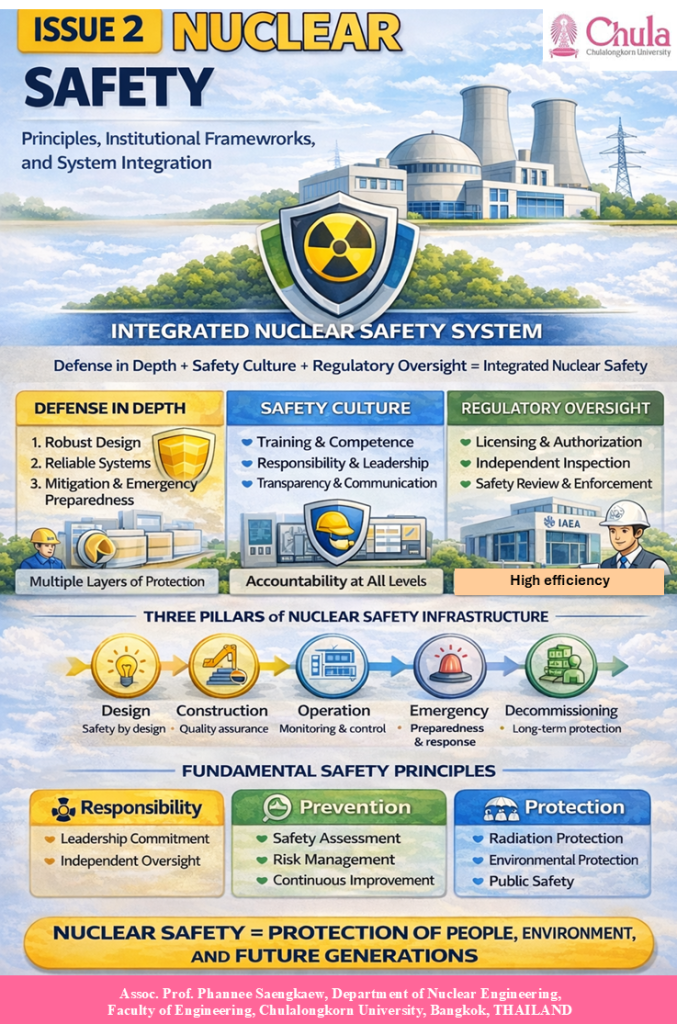
Within the framework of the International Atomic Energy Agency (IAEA) 19 Infrastructure Issues, Nuclear Safety (Issue No. 2) represents a core foundational pillar that ensures the protection of people and the environment from harmful effects of ionizing radiation. While the National Position (Issue No. 1) defines the strategic direction, nuclear safety provides the operational and ethical boundary conditions within which that strategy must be implemented.
In this sense, nuclear safety is not merely a technical requirement; rather, it is a system-level commitment that permeates all aspects of a nuclear power programme, from policy formulation to plant operation and eventual decommissioning. Without a robust safety framework, the legitimacy, sustainability, and international acceptability of a nuclear programme cannot be ensured.
2. Conceptual Definition and Scope
The ทบวงการพลังงานปรมาณูระหว่างประเทศ defines nuclear safety as:
The achievement of proper operating conditions, prevention of accidents, and mitigation of accident consequences, resulting in protection of workers, the public, and the environment.
This definition highlights that nuclear safety operates across three interconnected layers:
First, it requires the establishment of safe operating conditions, ensuring that systems function within designed limits.
Second, it emphasizes the prevention of accidents through design, engineering, and procedural controls.
Third, it addresses the mitigation of consequences, recognizing that residual risk must be managed even under unlikely scenarios.
Thus, nuclear safety is inherently preventive, protective, and mitigative, forming a comprehensive risk management framework.
3. Fundamental Safety Principles
The conceptual foundation of nuclear safety is derived from the ทบวงการพลังงานปรมาณูระหว่างประเทศ Fundamental Safety Principles (SF-1), which establish globally accepted norms.
At the highest level, the principle of responsibility for safety places ultimate accountability on the operator, while simultaneously requiring strong governmental oversight. This is complemented by the principle of leadership and management for safety, which emphasizes the role of organizational culture and decision-making.
Equally important is the principle of defence in depth, which introduces multiple independent and redundant layers of protection. These layers are designed such that failure in one does not lead directly to catastrophic outcomes.
In addition, the principle of justification and optimization of protection ensures that radiation risks are both necessary and minimized, while the principle of protection of present and future generations extends safety considerations beyond immediate operational timelines.
Together, these principles form the ethical and technical backbone of nuclear safety.
4. Core Elements of Nuclear Safety Infrastructure
A comprehensive nuclear safety framework emerges from the integration of several interdependent elements, each reinforcing the others.
4.1 Governmental, Legal, and Regulatory Framework
At the national level, nuclear safety begins with the establishment of a robust legal and regulatory system. This includes the development of nuclear laws, regulatory bodies, and licensing processes that are aligned with international standards.
Crucially, the regulatory authority must be effectively independent from organizations responsible for the promotion or operation of nuclear power. This independence ensures that safety decisions are made based on objective technical criteria rather than political or economic pressures.
4.2 Regulatory Body and Oversight Mechanisms
Building upon the legal framework, the regulatory body is responsible for authorization, inspection, and enforcement. Through licensing processes, it ensures that facilities meet safety requirements before operation. Through inspections, it verifies ongoing compliance. Through enforcement actions, it addresses deviations and ensures corrective measures.
Thus, the regulatory body serves as the guardian of safety compliance within the national system.
4.3 Safety Assessment and Licensing
Safety must be demonstrated through systematic safety assessment processes, including deterministic and probabilistic analyses. These assessments evaluate plant behavior under normal operation, anticipated operational occurrences, and accident conditions.
The licensing process integrates these assessments into a structured decision-making framework, ensuring that safety is demonstrated, documented, and verified before authorization is granted.
4.4 Design Safety and Defence in Depth
A central concept in nuclear safety is defence in depth, which is implemented through design features such as:
- Multiple physical barriers (fuel matrix, cladding, reactor vessel, containment)
- Redundant and diverse safety systems
- Passive safety features (especially in advanced and SMR designs)
These design elements ensure that even in the presence of failures, safety functions are preserved.
4.5 Operational Safety and Safety Culture
Beyond design, safety must be maintained during operation through strict adherence to procedures, continuous monitoring, and organizational discipline.
In this context, safety culture plays a critical role. It encompasses attitudes, values, and behaviors that prioritize safety above all other considerations. A strong safety culture ensures that potential issues are identified early and addressed proactively.
4.6 Emergency Preparedness and Response
Recognizing that no system is entirely risk-free, nuclear safety includes comprehensive emergency preparedness and response (EPR) arrangements. These involve:
- Emergency planning zones
- Communication systems
- Coordination with national and local authorities
- Public protection measures
Such systems ensure that, in the event of an accident, consequences are effectively managed.
4.7 Radiation Protection and Environmental Safety
Nuclear safety is closely linked with radiation protection, ensuring that exposures to workers and the public remain within prescribed limits and are optimized according to the ALARA principle.
In parallel, environmental monitoring systems are established to track releases and assess long-term impacts, thereby ensuring protection of ecosystems and future generations.
5. Evolution Across the Three Phases
The development of nuclear safety infrastructure evolves progressively across the three phases of the Milestones framework.
During Phase 1, the focus is on establishing the legal framework, understanding safety principles, and building initial regulatory capacity. In Phase 2, this foundation is expanded into detailed regulations, licensing processes, and institutional strengthening. Finally, in Phase 3, safety systems are fully implemented, with continuous oversight, operational feedback, and periodic safety reviews.
This phased approach ensures that safety is built progressively rather than retrofitted.
6. Interrelationship with Other Infrastructure Issues
Nuclear safety is deeply interconnected with other infrastructure issues. For instance, it depends on HRD (Issue 10) for competent personnel, on the legal framework (Issue 3) for enforceable regulations, and on emergency planning (Issue 11) for response capability.
At the same time, nuclear safety also influences financial decisions, public acceptance, and technology selection. Therefore, it operates both as a dependent and a driving factor within the infrastructure system.
7. Common Challenges in Nuclear Safety Development
Despite its critical importance, the establishment of nuclear safety infrastructure often encounters challenges. These may include insufficient regulatory independence, limited technical capacity, inadequate safety culture, and gaps in emergency preparedness.
Furthermore, in newcomer countries, the rapid development of infrastructure may outpace the development of safety systems, leading to imbalances that must be carefully managed.
8. Discussion: Nuclear Safety as a System Property
From a conceptual perspective, nuclear safety should not be viewed as a single component but rather as an emergent property of the entire system. It arises from the interaction of technology, institutions, human performance, and regulatory oversight.
Thus, safety cannot be “added” to a system after design; it must be embedded from the outset and reinforced continuously throughout the lifecycle.
9. Conclusion
In conclusion, nuclear safety constitutes the central operational foundation of a nuclear power programme. While national policy defines the direction, nuclear safety defines the limits within which that direction can be pursued responsibly.
By integrating legal frameworks, regulatory oversight, engineering design, operational discipline, and societal protection measures, nuclear safety ensures that nuclear power can be developed in a manner that is secure, sustainable, and publicly acceptable.
Nuclear Safety = Principles + Regulation + Design + Culture + Continuous Oversight → Protection of People and Environment
References
- International Atomic Energy Agency (2024). Milestones in the Development of a National Infrastructure for Nuclear Power (NG-G-3.1 Rev.2)
- International Atomic Energy Agency (2006). Fundamental Safety Principles (SF-1)
- International Atomic Energy Agency (2020). Establishing the Safety Infrastructure for a Nuclear Power Programme (SSG-16 Rev.1)
ความปลอดภัยทางนิวเคลียร์ในการพัฒนาโครงสร้างพื้นฐานพลังงานนิวเคลียร์
1. บทนำ
ภายใต้กรอบ 19 ประเด็นโครงสร้างพื้นฐานของ ทบวงการพลังงานปรมาณูระหว่างประเทศ ความปลอดภัยทางนิวเคลียร์ (Nuclear Safety: Issue No. 2) ถือเป็น เสาหลักพื้นฐาน (core foundational pillar) ที่มีบทบาทสำคัญในการคุ้มครองมนุษย์และสิ่งแวดล้อมจากผลกระทบของรังสีก่อให้เกิดไอออน
ในขณะที่ จุดยืนระดับชาติ (Issue No. 1) ทำหน้าที่กำหนดทิศทางเชิงยุทธศาสตร์ ความปลอดภัยทางนิวเคลียร์ทำหน้าที่กำหนด ขอบเขตเชิงปฏิบัติและจริยธรรม (operational and ethical boundary conditions) ที่การดำเนินโครงการต้องอยู่ภายใต้ข้อจำกัดดังกล่าว
ดังนั้น ความปลอดภัยทางนิวเคลียร์จึงมิได้เป็นเพียงข้อกำหนดทางเทคนิค แต่เป็น ความมุ่งมั่นในระดับระบบ (system-level commitment) ที่แทรกซึมอยู่ในทุกช่วงของโครงการ ตั้งแต่การกำหนดนโยบาย การออกแบบ การก่อสร้าง การดำเนินงาน จนถึงการปลดระวาง (decommissioning) หากขาดระบบความปลอดภัยที่เข้มแข็ง โครงการย่อมไม่สามารถสร้างความน่าเชื่อถือ ความยั่งยืน และการยอมรับในระดับสากลได้
2. นิยามและขอบเขตเชิงแนวคิด
ทบวงการพลังงานปรมาณูระหว่างประเทศ (International Atomic Energy Agency) ให้นิยามของความปลอดภัยทางนิวเคลียร์ว่า: การบรรลุสภาวะการดำเนินงานที่เหมาะสม การป้องกันอุบัติเหตุ และการลดผลกระทบของอุบัติเหตุ เพื่อคุ้มครองผู้ปฏิบัติงาน ประชาชน และสิ่งแวดล้อม
นิยามดังกล่าวสะท้อนให้เห็นว่าความปลอดภัยทางนิวเคลียร์ครอบคลุม สามมิติที่เชื่อมโยงกันอย่างเป็นระบบ ได้แก่
ประการแรก คือ การสร้างและรักษา สภาวะการดำเนินงานที่ปลอดภัย (safe operating conditions) โดยให้ระบบทั้งหมดทำงานภายในขีดจำกัดที่ออกแบบไว้
ประการที่สอง คือ การ ป้องกันอุบัติเหตุ (accident prevention) ผ่านการออกแบบ วิศวกรรม และกระบวนการควบคุม
และประการสุดท้าย คือ การ บรรเทาผลกระทบ (consequence mitigation) ซึ่งยอมรับว่าความเสี่ยงบางส่วนยังคงมีอยู่และต้องได้รับการจัดการอย่างมีระบบ
ด้วยเหตุนี้ ความปลอดภัยทางนิวเคลียร์จึงมีลักษณะเป็นทั้ง เชิงป้องกัน เชิงปกป้อง และเชิงบรรเทา ในเวลาเดียวกัน
3. หลักการพื้นฐานของความปลอดภัยทางนิวเคลียร์
รากฐานทางแนวคิดของความปลอดภัยทางนิวเคลียร์มาจากเอกสาร Fundamental Safety Principles (SF-1) ของทบวงการพลังงานปรมาณูระหว่างประเทศ ซึ่งกำหนดหลักการสากลที่ต้องยึดถือ
หลักการสำคัญประการแรกคือ ความรับผิดชอบต่อความปลอดภัย (responsibility for safety) ซึ่งกำหนดให้ผู้ดำเนินการเป็นผู้รับผิดชอบหลัก ขณะเดียวกันรัฐต้องมีบทบาทกำกับดูแลอย่างเข้มแข็ง
ถัดมาคือหลักการด้าน ภาวะผู้นำและการบริหารจัดการเพื่อความปลอดภัย (leadership and management for safety) ซึ่งเน้นบทบาทของวัฒนธรรมองค์กรและการตัดสินใจ
นอกจากนี้ หลักการ การป้องกันเชิงลึก (defence in depth) ถือเป็นหัวใจสำคัญ โดยกำหนดให้มีหลายชั้นของการป้องกันที่เป็นอิสระและซ้ำซ้อน เพื่อไม่ให้ความล้มเหลวเพียงจุดเดียวก่อให้เกิดผลกระทบร้ายแรง
ควบคู่กันนั้น หลักการ การวิเคราะห์เทียบอย่างมีเหตุผลและการเลือกวิธีที่เหมาะที่สุด (justification and optimization) รวมถึงหลักการ การคุ้มครองคนรุ่นปัจจุบันและอนาคต ช่วยขยายขอบเขตของความปลอดภัยให้ครอบคลุมมิติระยะยาว
4. องค์ประกอบหลักของโครงสร้างพื้นฐานด้านความปลอดภัย
โครงสร้างพื้นฐานด้านความปลอดภัยทางนิวเคลียร์เกิดจากการบูรณาการขององค์ประกอบหลายด้านที่เสริมกันอย่างเป็นระบบ
4.1 กรอบกฎหมายและการกำกับดูแล
ความปลอดภัยเริ่มต้นจากการมี กฎหมายและระบบกำกับดูแลที่เข้มแข็ง ซึ่งครอบคลุมการออกกฎหมาย การจัดตั้งหน่วยงานกำกับดูแล และกระบวนการออกใบอนุญาต ที่สำคัญ หน่วยงานกำกับดูแลต้องมี ความเป็นอิสระอย่างแท้จริง จากหน่วยงานที่มีหน้าที่ส่งเสริมหรือดำเนินโครงการ เพื่อให้การตัดสินใจด้านความปลอดภัยเป็นไปตามหลักวิชาการ
4.2 หน่วยงานกำกับดูแลและการตรวจสอบ
หน่วยงานกำกับดูแลมีบทบาทในการ อนุญาต ตรวจสอบ และบังคับใช้กฎหมาย โดยผ่านกระบวนการออกใบอนุญาต การตรวจสอบหน้างาน และการดำเนินมาตรการบังคับใช้เมื่อพบความไม่สอดคล้อง ดังนั้น หน่วยงานกำกับดูแลจึงทำหน้าที่เป็น ผู้พิทักษ์ความปลอดภัยของระบบ
4.3 การประเมินความปลอดภัยและการอนุญาต
ความปลอดภัยต้องได้รับการพิสูจน์ผ่าน การประเมินความปลอดภัยอย่างเป็นระบบ ทั้งเชิงกำหนด (deterministic) และเชิงความน่าจะเป็น (probabilistic) กระบวนการอนุญาตจะนำผลการประเมินเหล่านี้มาใช้ในการตัดสินใจ เพื่อให้มั่นใจว่าความปลอดภัยได้รับการพิสูจน์และตรวจสอบแล้ว
4.4 การออกแบบและการป้องกันเชิงลึก (defence in depth)
แนวคิด การป้องกันเชิงลึก (defence in depth) ถูกนำไปใช้ในการออกแบบผ่านองค์ประกอบต่าง ๆ เช่น
- ชั้นระบบป้องกันทางกายภาพหลายระดับ
- ระบบความปลอดภัยที่ซ้ำซ้อนและหลากหลาย
- ระบบความปลอดภัยแบบพาสซีฟที่ทำงานได้เองอัตโนมัติ
ซึ่งช่วยให้ระบบยังคงปลอดภัยแม้เกิดความล้มเหลวบางส่วน
4.5 ความปลอดภัยในการดำเนินงานและวัฒนธรรมความปลอดภัย
นอกเหนือจากการออกแบบ ความปลอดภัยต้องถูกดำรงรักษาผ่านการดำเนินงานที่มีวินัยและการควบคุมอย่างเข้มงวด ในบริบทนี้ วัฒนธรรมความปลอดภัย (safety culture) มีบทบาทสำคัญในการกำหนดพฤติกรรมและทัศนคติของบุคลากรให้ให้ความสำคัญกับความปลอดภัยเป็นอันดับแรก
4.6 การเตรียมความพร้อมและตอบโต้เหตุฉุกเฉิน
เนื่องจากไม่มีระบบใดปราศจากความเสี่ยงโดยสิ้นเชิง จึงต้องมีระบบ การเตรียมความพร้อมและตอบโต้เหตุฉุกเฉิน ที่ครอบคลุม
- แผนฉุกเฉิน
- การสื่อสาร
- การประสานงาน
- มาตรการปกป้องประชาชน
4.7 การป้องกันรังสีและสิ่งแวดล้อม
ความปลอดภัยยังรวมถึง การป้องกันรังสี โดยควบคุมปริมาณรังสีให้อยู่ในเกณฑ์และตามหลัก ALARA พร้อมกันนั้นต้องมี ระบบติดตามสิ่งแวดล้อม เพื่อประเมินผลกระทบระยะยาว
5. การพัฒนาในแต่ละระยะ (Phased Development of Nuclear Safety Infrastructure)
ในระยะที่ 1 เน้นการสร้างกรอบกฎหมายและความเข้าใจด้านความปลอดภัย
ในระยะที่ 2 เน้นการพัฒนาระบบกำกับดูแลและกระบวนการอนุญาต
ในระยะที่ 3 เน้นการดำเนินงานและการกำกับดูแลอย่างต่อเนื่อง
การพัฒนาความปลอดภัยทางนิวเคลียร์เป็นกระบวนการเชิงลำดับขั้น (phased approach) ที่ต้องดำเนินไปอย่างเป็นระบบ โดยแต่ละระยะมี วัตถุประสงค์ โครงสร้าง และผลลัพธ์ที่แตกต่างกัน แต่เชื่อมโยงต่อเนื่องกัน
- ระยะที่ 1: การเตรียมความพร้อม (Phase 1: Considerations Before a Decision)
เป้าหมายหลัก: สร้าง “รากฐานเชิงนโยบายและความเข้าใจด้านความปลอดภัย”
ลักษณะสำคัญ
ในระยะนี้ ความปลอดภัยยังไม่อยู่ในรูปของระบบปฏิบัติการเต็มรูปแบบ แต่เป็นการ:
- สร้าง ความเข้าใจพื้นฐานด้านความปลอดภัย (safety awareness) ในระดับประเทศ
- กำหนด นโยบายระดับชาติ (national policy) ที่ให้ความสำคัญกับความปลอดภัยเป็นอันดับแรก
- เริ่มพัฒนา กรอบกฎหมายเบื้องต้น (legal framework)
องค์ประกอบสำคัญ
- การศึกษาและอ้างอิง IAEA Safety Standards
- การกำหนดบทบาทของ:
- รัฐบาล
- หน่วยงานกำกับดูแล (regulatory body – ระยะเริ่มต้น)
- การสร้างขีดความสามารถด้านทรัพยากรมนุษย์ (human capacity) ในระยะเริ่มต้น (การฝึกอบรม การศึกษา และการสร้างความตระหนักรู้)
ประเด็นเชิงระบบ
- ความปลอดภัยถูกกำหนดเป็น “หลักการ” มากกว่า “ระบบ”
- เป็นช่วงของการ alignment ระหว่างนโยบาย วิสัยทัศน์ และมาตรฐานสากล
ผลลัพธ์ที่คาดหวัง
- มีจุดยืนระดับชาติที่ชัดเจนด้านความปลอดภัย
- มีร่างหรือโครงสร้างของ กฎหมายและหน่วยงานกำกับดูแล
- มีความเข้าใจร่วมว่า “ความปลอดภัยเป็นเงื่อนไขพื้นฐานที่ต้องมี ไม่ใช่เป็นทางเลือก safety is a prerequisite, not an option”
- ระยะที่ 2: การเตรียมการก่อสร้าง (Phase 2: Preparatory Work for Construction)
เป้าหมายหลัก: พัฒนา “ระบบกำกับดูแลและกลไกการควบคุมความปลอดภัย”
ลักษณะสำคัญ
- ความปลอดภัยเริ่มเปลี่ยนจากแนวคิด → ไปสู่ ระบบที่สามารถบังคับใช้ได้ (enforceable system)
- จัดตั้ง หน่วยงานกำกับดูแลอย่างเป็นทางการ
- พัฒนา กระบวนการออกใบอนุญาต (licensing process)
องค์ประกอบสำคัญ
- การออก กฎหมายและข้อบังคับ (regulations) ที่มีผลบังคับใช้
- การจัดทำ:
- กรอบการประเมินความปลอดภัย
- กระบวนการทบทวนและประเมินผล
- การพัฒนาเครื่องมือสำคัญ เช่น:
- การวิเคราะห์ความปลอดภัยเชิงกำหนด (Deterministic Safety Analysis)
- การประเมินความปลอดภัยเชิงความน่าจะเป็น (Probabilistic Safety Assessment: PSA)
บทบาทของหน่วยงานกำกับ
- ตรวจสอบการออกแบบ (design review)
- ประเมินรายงานความปลอดภัย (safety analysis report: SAR)
- ออกใบอนุญาตในแต่ละขั้นตอน (site, construction)
ประเด็นสำคัญเชิงคุณภาพ
- ความเป็นอิสระของหน่วยงานกำกับดูแลต้อง “เกิดขึ้นจริง”
- บุคลากรต้องมีความเชี่ยวชาญเชิงลึกทางเทคนิค (technical depth) เพียงพอสำหรับการทบทวนและประเมิน
ผลลัพธ์ที่คาดหวัง
- ระบบกำกับดูแลมีความสมบูรณ์และสามารถปฏิบัติได้จริง
- มีกระบวนการอนุญาตที่ชัดเจน โปร่งใส และตรวจสอบได้
- ความปลอดภัยเริ่มถูก “ฝัง” อยู่ในกระบวนการออกแบบและก่อสร้าง
- ระยะที่ 3: การดำเนินงาน (Phase 3: Activities to Implement the First Nuclear Power Plant)
เป้าหมายหลัก: การดำเนินงานอย่างปลอดภัยและการกำกับดูแลอย่างต่อเนื่อง (sustained safety operation)
ลักษณะสำคัญ
- ความปลอดภัยเข้าสู่ระยะสภาพการดำเนินงานจริง (operational reality)
- ไม่ใช่เพียงการออกแบบหรือการอนุญาต แต่เป็น:
- การควบคุม
- การติดตาม
- การปรับปรุงอย่างต่อเนื่อง
องค์ประกอบสำคัญ
การดำเนินงานภายใต้:
- ขีดจำกัดและเงื่อนไขการเดินเครื่อง (operational limits and conditions (OLCs)
- ข้อกำหนดทางเทคนิค (technical specifications)
ระบบตรวจวัด:
- ระบบการตรวจวัดรังสี (radiation monitoring)
- การติดตามสมรรถนะของระบบความปลอดภัย (safety system performance)
การจัดการ:
- การรายงานอุบัติการณ์ (incident reporting)
- การวิเคราะห์เหตุการณ์ (event analysis)
- การดำเนินมาตรการแก้ไข (corrective actions)
บทบาทของหน่วยงานกำกับ
- การตรวจสอบ (inspection) อย่างสม่ำเสมอ
- การบังคับใช้ (enforcement) เมื่อพบข้อบกพร่อง
- การประเมินความปลอดภัยเชิงต่อเนื่อง (periodic safety review: PSR)
มิติที่สำคัญเพิ่มเติม
- การเสริมสร้างวัฒนธรรมความปลอดภัยระดับองค์กร
- การบูรณาการ:
การเตรียมความพร้อมและตอบโต้เหตุฉุกเฉิน (emergency preparedness)
การสื่อสารกับสาธารณะ (public communication)
- การเรียนรู้จาก:
ประสบการณ์การเดินเครื่อง (operating experience : OPEX)
ข้อมูลย้อนกลับ/ข้อคิดเห็นจากนานาชาติ (international feedback (IAEA, WANO)
ผลลัพธ์ที่คาดหวัง
- ระบบมีสมรรถนะด้านความปลอดภัยในการดำเนินงาน (operational safety performance) ที่มั่นคง
- มีการปรับปรุงอย่างต่อเนื่อง (continuous improvement)
- ความปลอดภัยกลายเป็น “ส่วนหนึ่งของวัฒนธรรมองค์กร”
สรุปเชิงบูรณาการ (Integrated Perspective)
การพัฒนาความปลอดภัยทั้ง 3 ระยะสามารถมองเป็นการเปลี่ยนผ่านดังนี้:
| ระยะ | ลักษณะ/ระดับ | บทบาทของความปลอดภัย |
| Phase 1 | เชิงแนวคิด (Conceptual) | หลักการและนโยบาย |
| Phase 2 | เชิงสถาบัน (Institutional) | ระบบและกฎระเบียบ |
| Phase 3 | เชิงการดำเนินงาน(Operational) | การปฏิบัติและการควบคุมจริง |
สาระสำคัญ: ความปลอดภัยไม่ได้ “เกิดขึ้นทันที” แต่เป็นสิ่งที่ถูก “สร้างขึ้นทีละระยะ”
จาก แนวคิด → สู่ระบบ → สู่การปฏิบัติจริง
6. ความเชื่อมโยงกับประเด็นโครงสร้างพื้นฐานอื่น (Interlinkages with Other Infrastructure Issues)
ความปลอดภัยทางนิวเคลียร์ไม่ได้ดำรงอยู่อย่างโดดเดี่ยว แต่เป็น แกนกลางที่เชื่อมโยง (cross-cutting function) กับประเด็นโครงสร้างพื้นฐานอื่นเกือบทั้งหมดใน 19 ประเด็นของ IAEA โดยเฉพาะอย่างยิ่ง:
- ทรัพยากรมนุษย์ (Human Resource Development: HRD)
ความปลอดภัยขึ้นอยู่กับ “คน” ในทุกระดับ ตั้งแต่ผู้ปฏิบัติงาน วิศวกร นักวิเคราะห์ ไปจนถึงผู้กำกับดูแล
- บุคลากรต้องมี การฝึกอบรมตามสมรรถนะ (competency-based training) และการรับรองคุณสมบัติ (qualification & certification)
- การพัฒนาวัฒนธรรมความปลอดภัยเริ่มต้นจากระบบการศึกษาและการฝึกอบรม
- ความล้มเหลวด้านบุคลากรมักเป็น “จุดอ่อนที่สุดของระบบ” ซึ่งสามารถส่งผลกระทบต่อประสิทธิภาพของระบบความปลอดภัยโดยรวมได้อย่างมีนัยสำคัญ
- ประเด็นดังกล่าวมีความสอดคล้องกับ IAEA Issue 10: การพัฒนาทรัพยากรมนุษย์ (HRD) ซึ่งทำหน้าที่เป็น กลไกสนับสนุนหลัก (enabler) ต่อการดำเนินการด้านความปลอดภัยใน IAEA Issue 2: ความปลอดภัยทางนิวเคลียร์
- กรอบกฎหมายและกฎระเบียบ (Legal & Regulatory Framework)
ความปลอดภัยต้องถูก “ทำให้เป็นทางการ” ผ่านกฎหมาย
- กำหนด มาตรฐานความปลอดภัย (safety standards)
- ระบุบทบาทและอำนาจของหน่วยงานกำกับดูแล
- สร้างกลไกการบังคับใช้ (enforcement) และการปฏิบัติตามข้อกำหนด (compliance)
หากไม่มีกรอบกฎหมายที่ชัดเจน ความปลอดภัยจะกลายเป็นเพียง “แนวปฏิบัติที่ไม่ผูกพัน”
- การเตรียมพร้อมและตอบโต้เหตุฉุกเฉิน (Emergency Preparedness & Response)
แม้จะมีการป้องกันหลายชั้น แต่ระบบต้องยอมรับว่า เหตุการณ์รุนแรงยังคงมีความเป็นไปได้ (low probability, high consequence)
- ต้องมีพื้นที่เขตตามแผนภาวะฉุกเฉิน (emergency planning zones: EPZs)
- ระบบเตือนภัย การอพยพ และการสื่อสารสาธารณะ
- การฝึกซ้อม (drills & exercises) อย่างสม่ำเสมอ
ความปลอดภัยจึงไม่ได้จบที่การป้องกัน แต่รวมถึง “ความสามารถในการฟื้นตัว (resilience)”
- การเงินและความยั่งยืน (Financing & Economic Structure)
ความปลอดภัยต้องการการลงทุนระยะยาว
ระบบความปลอดภัย เช่น ความซ้ำซ้อนของระบบ (redundancy), การกักกันไว้ (containment), และการตรวจวัด (monitoring) มีต้นทุนสูง
จึงต้องมีการจัดสรรทางการเงินรองรับสำหรับ:
- การดำเนินงานด้านความปลอดภัย
- การจัดการกากกัมมันตรังสี
- การรื้อถอน (decommissioning)
หากโครงสร้างการเงินไม่มั่นคง อาจนำไปสู่ “การลดทอนขอบเขตความปลอดภัย (erosion of safety margins)”
7. ความท้าทายในการดำเนินการ (Key Challenges)
แม้ว่าหลักการความปลอดภัยจะชัดเจน แต่การนำไปปฏิบัติจริงเผชิญกับความท้าทายหลายประการ:
- ความเป็นอิสระของหน่วยงานกำกับดูแล
ต้องแยกจากหน่วยงานผู้ดำเนินการอย่างชัดเจน
ปัญหาที่พบบ่อย:
- การแทรกแซงทางการเมือง (political interference)
- การครอบงำหน่วยงานกำกับดูแล ( regulatory capture)
ความเป็นอิสระเป็น “เงื่อนไขพื้นฐานของความน่าเชื่อถือ (credibility)”
- ขีดความสามารถทางเทคนิค (Technical Capacity)
ต้องมีผู้เชี่ยวชาญด้าน:
- ฟิสิกส์เครื่องปฏิกรณ์ (reactor physics)
- การวิเคราะห์ความปลอดภัย (safety analysis)
- การประเมินความเสี่ยงเชิงความน่าจะเป็น (probabilistic risk assessment (PRA)
ประเทศที่เริ่มต้นใหม่มักเผชิญกับ “ช่องว่างด้านขีดความสามารถ” ซึ่งส่งผลโดยตรงต่อคุณภาพของการทบทวนความปลอดภัยและการตัดสินใจ
- วัฒนธรรมความปลอดภัย (Safety Culture)
ไม่ใช่เพียงนโยบาย แต่เป็น “พฤติกรรมองค์กร”
ความท้าทาย:
- ความเคยชินหรือความประมาท (complacency)
- แรงกดดันด้านการผลิตเทียบกับความปลอดภัย (production pressure vs safety)
อุบัติเหตุสำคัญในอดีตมักเชื่อมโยงกับวัฒนธรรมความปลอดภัยที่ไม่เข้มแข็ง
- ความพร้อมด้านเหตุฉุกเฉิน (Emergency Preparedness)
ต้องบูรณาการหลายหน่วยงาน:
- รัฐ
- ท้องถิ่น
- สาธารณสุข
ความท้าทาย:
- ความซับซ้อนในการประสานงานระหว่างหน่วยงาน (coordination complexity)
- การสื่อสารกับสาธารณะ (public communication)
การตอบสนองที่ล่าช้าหรือไม่ชัดเจนอาจขยายผลกระทบอย่างมีนัยสำคัญ
8. การอภิปรายเชิงแนวคิด (Conceptual Discussion)
ประเด็นสำคัญเชิงทฤษฎีคือ: ความปลอดภัยทางนิวเคลียร์เป็น “คุณสมบัติที่เกิดขึ้นจากระบบโดยรวม (emergent property)” กล่าวคือ ความปลอดภัย:
❌ ไม่ได้เกิดจากอุปกรณ์ใดอุปกรณ์หนึ่ง
❌ ไม่ได้ขึ้นกับมาตรการเดียว
❌ ไม่ได้จำกัดอยู่ที่หน่วยงานเดียว
แต่เกิดจาก:
- การออกแบบ (design)
- การดำเนินงาน (operation)
- บุคลากร (people)
- กฎระเบียบ (regulation)
- วัฒนธรรมองค์กร (culture)
ที่ทำงานร่วมกันอย่างเป็นระบบ (system integration)
มุมมองเชิงระบบ (Systems Perspective) ความปลอดภัยสามารถมองเป็น:
- ระบบการป้องกันหลายชั้น (multi-layered defense system: defense in depth)
- ระบบสังคม–เทคโนโลยี (socio-technical system) (คนและเทคโนโลยี)
- กระบวนการพลวัตที่เปลี่ยนแปลงตามเวลา (dynamic process)
ดังนั้น การประเมินความปลอดภัยต้อง:
- ใช้ทั้งวิธีการแบบเชิงกำหนดและแบบเชิงความน่าจะเป็น (deterministic & probabilistic approaches)
- พิจารณาปัจจัยด้านมนุษย์อย่างเป็นระบบ
- รวมถึงพฤติกรรมขององค์กรและบริบทการดำเนินงาน
- มีการทบทวนและปรับปรุงอย่างต่อเนื่อง
9. สรุป
โดยสรุปแล้ว ความปลอดภัยทางนิวเคลียร์เป็นมากกว่า “ข้อกำหนดทางเทคนิค” แต่เป็น:
- รากฐานเชิงปฏิบัติ (operational foundation)
– รองรับการออกแบบ การก่อสร้าง และการเดินเครื่อง
– เป็นเงื่อนไขของการอนุญาตดำเนินการ (licensing basis)
- กลไกสร้างความเชื่อมั่น (public trust mechanism)
– สังคมยอมรับโครงการได้เมื่อเชื่อมั่นในความปลอดภัย
– ความโปร่งใสและการกำกับดูแลเป็นหัวใจสำคัญ
- เงื่อนไขของความยั่งยืน (condition for sustainability)
หากไม่มีความปลอดภัย:
– โครงการไม่สามารถดำเนินต่อได้
– ไม่สามารถขยายหรือพัฒนาในระยะยาว
ข้อคิดสำคัญ: ความปลอดภัยทางนิวเคลียร์ไม่ใช่ “ส่วนหนึ่ง” ของโครงการ แต่เป็น “เงื่อนไขที่ทำให้โครงการสามารถดำรงอยู่ได้”


ใส่ความเห็น