Within the Framework of the 19 Infrastructure Issues of the International Atomic Energy Agency
6.1 Introduction
Nuclear safeguards constitute an international verification system designed to provide credible assurance that nuclear material and nuclear-related activities within a State are used exclusively for peaceful purposes and are not diverted to nuclear weapons or other non-peaceful uses.
In this context, safeguards must be clearly distinguished from nuclear safety and nuclear security. Nuclear safety focuses on the prevention of accidents and protection against radiation hazards, whereas nuclear security addresses protection against theft, sabotage, and unauthorized access. In contrast, safeguards function as a verification system aimed at preventing the proliferation of nuclear weapons through the detection and deterrence of diversion.
6.2 Legal Framework and International Obligations
The implementation of safeguards is grounded in international legal obligations, particularly under the Treaty on the Non-Proliferation of Nuclear Weapons, which requires non-nuclear-weapon States to accept verification by the International Atomic Energy Agency.
States conclude Comprehensive Safeguards Agreements (CSA), which require the declaration of all nuclear material. The Additional Protocol (AP) further strengthens the safeguards system by expanding access to information and locations, thereby enhancing the ability to detect undeclared nuclear activities.
States are therefore obligated to declare nuclear materials, accept inspections, and provide relevant information in a transparent and timely manner.
6.3 Objectives of Nuclear Safeguards
The safeguards system is structured around two fundamental objectives: correctness and completeness.
Correctness refers to the verification that declared information is accurate and consistent with actual conditions. Completeness refers to the verification that no undeclared nuclear material or activities exist. The latter represents the more complex and challenging objective, as it requires the detection of hidden or undisclosed activities.
6.4 State System of Accounting and Control (SSAC)
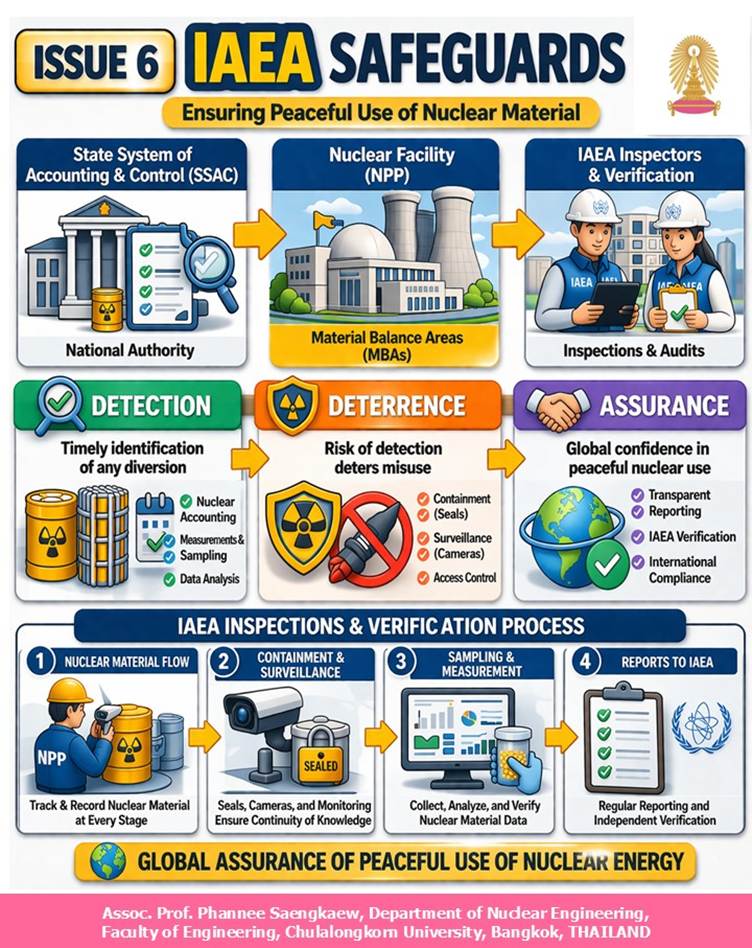
Each State is required to establish a State System of Accounting and Control of Nuclear Material (SSAC) to manage nuclear material at the national level.
The SSAC is responsible for maintaining accurate records, tracking nuclear material movements, preparing reports, and supporting safeguards inspections. It serves as the essential interface between national control systems and the international safeguards regime.
6.5 Nuclear Material Accounting and Material Balance
Nuclear material accounting is based on the principle of material balance. The quantity of nuclear material at a given time is determined by the initial inventory, plus inputs, minus outputs, and minus measured losses.
Any discrepancy in this balance is referred to as Material Unaccounted For (MUF). Such discrepancies must be carefully evaluated, as they may result from measurement uncertainties or may indicate potential diversion.
6.6 Material Balance Areas (MBA)
Nuclear facilities are divided into Material Balance Areas (MBAs) to improve the accuracy and resolution of material accounting.
By segmenting facilities into smaller accounting units, it becomes possible to detect discrepancies more effectively and localize potential anomalies.
6.7 Measurement Techniques and Uncertainty
Safeguards verification relies on both non-destructive assay (NDA) and destructive analysis (DA) techniques to determine the quantity and composition of nuclear materials.
All measurements are subject to uncertainty; therefore, statistical methods are applied to evaluate measurement results. Safeguards thus operate as a decision-making system under uncertainty, requiring careful differentiation between normal measurement variation and significant anomalies.
6.8 Containment and Surveillance
Containment and surveillance (C/S) measures are used to maintain continuity of knowledge between inspections. These include tamper-indicating seals, surveillance cameras, and remote monitoring systems.
In addition, the risk of detection plays a critical behavioral role, as it acts as a deterrent against potential diversion or misuse of nuclear material.
6.9 Detection and Deterrence
The safeguards system is designed to achieve timely detection of diversion with a high probability. The concept of timeliness refers to the ability to detect diversion within a time frame that would prevent the misuse of nuclear material for weapons purposes.
Effective detection capability inherently creates a deterrent effect, discouraging actors from attempting diversion due to the high likelihood of being detected.
6.10 Assurance
The ultimate outcome of safeguards implementation is the provision of international assurance that nuclear energy is being used for peaceful purposes.
This assurance is achieved through:
- Transparent reporting
- Independent verification by the IAEA
- Compliance with international obligations
6.11 State-Level Approach (SLA)
Modern safeguards are implemented through a State-Level Approach (SLA), which integrates multiple sources of information to form a comprehensive evaluation of a State.
These sources include:
- State declarations
- Inspection results
- Environmental sampling
- Satellite imagery
- Open-source information
The integration of these data streams enhances the ability to detect undeclared nuclear activities.
6.12 IAEA Safeguards Implementation Process
The safeguards implementation process consists of six major stages:
- Planning of inspection activities
- On-site inspection and verification
- Measurement and sampling
- Data analysis
- Evaluation of findings
- Reporting and safeguards conclusion
At the final stage, the International Atomic Energy Agency issues a safeguards conclusion regarding the absence or presence of undeclared nuclear material and activities.
6.13 Core Principles of Safeguards
The effective implementation of safeguards is based on several fundamental principles:
- Accuracy
- Transparency
- Independence
- Technical competence
- Confidentiality
- International cooperation
These principles ensure both the credibility and integrity of the safeguards system.
6.14 Relationship with Safety and Security
Safeguards must be clearly distinguished from, yet coordinated with, nuclear safety and nuclear security.
Safety focuses on preventing accidents and protecting people and the environment, while security focuses on preventing malicious acts. Safeguards, in contrast, ensure that nuclear material is not diverted for non-peaceful purposes. Together, these three systems form an integrated framework for nuclear governance.
6.15 Challenges
The implementation of safeguards faces several challenges, including:
- Measurement uncertainties and technical complexity
- Detection of undeclared nuclear activities
- Balancing national sovereignty with international transparency
- Emerging technologies, such as small modular reactors (SMRs)
These challenges require continuous development of safeguards methodologies and technologies.
6.16 Systems Perspective
From a systems perspective, safeguards transform physical measurements into international confidence through a structured process:
Measurement → Information → Verification → Decision → Trust
This conceptual chain reflects the role of safeguards as a bridge between technical data and international assurance.
6.17 Progression of Nuclear Safeguards Across the IAEA Milestones Phases
The implementation of nuclear safeguards progresses systematically across the three phases of the Milestones framework of the International Atomic Energy Agency, reflecting the level of readiness of a nuclear power programme from policy formulation to full operational verification. Each phase is associated with a “Milestone,” which serves as an indicator of the State’s readiness to advance to the next stage and plays a critical role in the structured development of the safeguards system.
Phase 1: Considerations Before a Decision to Launch
During Phase 1, safeguards activities focus on developing understanding and establishing the necessary legal and institutional foundations. The State must recognize its international obligations under the Treaty on the Non-Proliferation of Nuclear Weapons and initiate engagement with the International Atomic Energy Agency.
At this stage, the State assesses gaps in its legal framework and infrastructure, while considering the establishment of a State System of Accounting and Control of Nuclear Material (SSAC) at a conceptual level. In parallel, awareness-building and capacity development for relevant personnel are initiated.
The achievement of Milestone 1, defined as readiness to make a knowledgeable commitment to a nuclear power programme, indicates that the State has a sufficient understanding of safeguards obligations and is prepared to establish the necessary systems in subsequent phases.
Phase 2: Preparatory Work for Construction
In Phase 2, safeguards evolve into structured implementation. The State formally establishes the SSAC and develops procedures for nuclear material accounting, reporting, and verification in accordance with the requirements of the International Atomic Energy Agency.
The legal and regulatory framework is strengthened to support compliance with the Comprehensive Safeguards Agreement and, where applicable, the Additional Protocol. At the same time, technical capabilities are enhanced through training, development of measurement techniques such as non-destructive assay (NDA) and destructive analysis (DA), and preparation for safeguards inspections. The concept of “safeguards-by-design” is also incorporated into facility design.
The achievement of Milestone 2, defined as readiness to invite bids for the first nuclear power plant, demonstrates that the State possesses the legal, institutional, and technical capabilities required to support safeguards implementation during construction and pre-operational phases.
Phase 3: Activities to Implement the First Nuclear Power Plant
In Phase 3, safeguards are fully implemented and operational. The State operates a mature SSAC capable of maintaining accurate records, tracking nuclear material movements, and supporting continuous reporting.
Nuclear facilities are subject to systematic safeguards inspections by the International Atomic Energy Agency, utilizing measurement systems, containment and surveillance technologies, and integrated data analysis processes. The State-Level Approach (SLA) is applied to evaluate the overall safeguards status of the State through the integration of multiple information sources.
The achievement of Milestone 3, defined as readiness to commission and operate the first nuclear power plant, indicates that the State is capable of sustaining comprehensive safeguards implementation, maintaining compliance with international obligations, and effectively supporting international verification activities.
Conceptual Interpretation of the Progression
The progression of safeguards across the three phases can be understood as a systematic transition from: Understanding → Establishment → Full Verification
This reflects a stepwise development from policy-level commitment to technical capability and ultimately to operational assurance under international oversight.
Integrated Perspective : The development of safeguards is closely linked to other infrastructure issues, including the legislative framework (Issue 5), the regulatory framework (Issue 7), and human resource development (Issue 10). Therefore, the effectiveness of safeguards implementation depends on the coordinated and integrated advancement of the entire nuclear infrastructure system.
6.18 Conclusion
Nuclear safeguards represent a sophisticated integration of measurement science, engineering, legal frameworks, and international cooperation. They provide the essential mechanism through which the global community can trust that nuclear energy is used exclusively for peaceful purposes.
Within the framework of the 19 infrastructure issues, safeguards function as the verification layer that ensures transparency, compliance, and international confidence.
ประเด็นด้านที่ 6 การพิทักษ์ความปลอดภัยทางนิวเคลียร์ (Nuclear Safeguards)
ภายใต้กรอบโครงสร้างพื้นฐาน 19 ด้านของทบวงการพลังงานปรมาณูระหว่างประเทศ (International Atomic Energy Agency: IAEA)
6.1 บทนำ
การพิทักษ์ความปลอดภัยทางนิวเคลียร์ (Nuclear Safeguards) เป็นระบบการตรวจสอบระหว่างประเทศที่ถูกออกแบบขึ้นเพื่อให้ความเชื่อมั่นอย่างมีหลักฐานเชิงประจักษ์ว่า วัสดุนิวเคลียร์และกิจกรรมที่เกี่ยวข้องกับนิวเคลียร์ภายในรัฐถูกใช้เพื่อวัตถุประสงค์โดยสันติเท่านั้น และมิได้ถูกเบี่ยงเบนไปสู่การผลิตอาวุธนิวเคลียร์หรือการใช้งานในลักษณะที่มิใช่เพื่อสันติ
ในบริบทนี้ การพิทักษ์ความปลอดภัยทางนิวเคลียร์ต้องถูกแยกออกจากความปลอดภัยทางนิวเคลียร์ (Safety) และความมั่นคงปลอดภัยทางนิวเคลียร์ (Security) อย่างชัดเจน โดยความปลอดภัยนิวเคลียร์มุ่งเน้นการป้องกันอุบัติเหตุและการปกป้องจากอันตรายทางรังสี ในขณะที่ความมั่นคงปลอดภัยนิวเคลียร์มุ่งเน้นการป้องกันการโจรกรรม การก่อวินาศกรรม และการเข้าถึงโดยไม่ได้รับอนุญาต ในทางตรงกันข้าม การพิทักษ์ความปลอดภัยทางนิวเคลียร์ทำหน้าที่เป็น “ระบบการตรวจสอบและยืนยัน (verification system)” ที่มุ่งป้องกันการแพร่ขยายอาวุธนิวเคลียร์ผ่านการตรวจจับและการยับยั้งการเบี่ยงเบนวัสดุนิวเคลียร์
6.2 กรอบกฎหมายและพันธกรณีระหว่างประเทศ
การดำเนินการด้านการพิทักษ์ความปลอดภัยทางนิวเคลียร์ตั้งอยู่บนพื้นฐานของพันธกรณีทางกฎหมายระหว่างประเทศ โดยเฉพาะอย่างยิ่งภายใต้ Treaty on the Non-Proliferation of Nuclear Weapons ซึ่งกำหนดให้รัฐที่ไม่มีอาวุธนิวเคลียร์ต้องยอมรับการตรวจสอบโดย International Atomic Energy Agency
รัฐจะต้องจัดทำข้อตกลง Comprehensive Safeguards Agreement (CSA) ซึ่งกำหนดให้มีการประกาศวัสดุนิวเคลียร์ทั้งหมด ในขณะที่ Additional Protocol (AP) ทำหน้าที่เสริมความเข้มแข็งของระบบการพิทักษ์ความปลอดภัยทางนิวเคลียร์โดยการขยายขอบเขตการเข้าถึงข้อมูลและสถานที่ ซึ่งช่วยเพิ่มความสามารถในการตรวจจับกิจกรรมที่ไม่ได้มีการประกาศ
ดังนั้น รัฐจึงมีพันธกรณีในการประกาศวัสดุนิวเคลียร์ ยอมรับการตรวจสอบ และให้ข้อมูลที่เกี่ยวข้องอย่างโปร่งใสและทันท่วงที
6.3 วัตถุประสงค์ของการพิทักษ์ความปลอดภัยทางนิวเคลียร์
ระบบการพิทักษ์ความปลอดภัยทางนิวเคลียร์ถูกออกแบบขึ้นโดยมีวัตถุประสงค์พื้นฐานสองประการ ได้แก่ “ความถูกต้อง (correctness)” และ “ความครบถ้วน (completeness)”
ความถูกต้องหมายถึงการตรวจสอบว่าข้อมูลที่รัฐได้ประกาศนั้นมีความถูกต้องและสอดคล้องกับสภาพความเป็นจริง ในขณะที่ความครบถ้วนหมายถึงการตรวจสอบว่าไม่มีวัสดุนิวเคลียร์หรือกิจกรรมใดที่ไม่ได้ถูกประกาศ ซึ่งวัตถุประสงค์ด้านความครบถ้วนถือเป็นประเด็นที่มีความซับซ้อนและท้าทายมากกว่า เนื่องจากต้องอาศัยการตรวจวัดกัมมันตภาพรังสีที่ถูกซ่อนหรือไม่ได้เปิดเผย
6.4 ระบบบัญชีและควบคุมวัสดุนิวเคลียร์แห่งชาติ (SSAC)
รัฐแต่ละประเทศจำเป็นต้องจัดตั้งระบบที่เรียกว่า State System of Accounting and Control of Nuclear Material (SSAC) เพื่อบริหารจัดการวัสดุนิวเคลียร์ในระดับประเทศ
SSAC มีหน้าที่ในการบันทึกข้อมูลอย่างถูกต้อง ติดตามการเคลื่อนย้ายของวัสดุนิวเคลียร์ จัดทำรายงาน และสนับสนุนการตรวจสอบของการพิทักษ์ความปลอดภัยทางนิวเคลียร์ โดยทำหน้าที่เป็นจุดเชื่อมต่อที่สำคัญระหว่างระบบการควบคุมภายในประเทศกับระบบการตรวจสอบระหว่างประเทศ
6.5 การบัญชีวัสดุนิวเคลียร์และสมดุลวัสดุ
การบัญชีวัสดุนิวเคลียร์อาศัยหลักการของสมดุลวัสดุ ซึ่งระบุว่าปริมาณวัสดุนิวเคลียร์ ณ ช่วงเวลาหนึ่งสามารถคำนวณได้จากปริมาณเริ่มต้น บวกด้วยวัสดุที่รับเข้า ลบด้วยวัสดุที่ส่งออก และลบด้วยความสูญเสียที่วัดได้
ความคลาดเคลื่อนที่เกิดขึ้นในสมดุลดังกล่าวเรียกว่า Material Unaccounted For (MUF) ซึ่งต้องได้รับการประเมินอย่างรอบคอบ เนื่องจากอาจเป็นผลจากความไม่แน่นอนของการวัด หรืออาจเป็นสัญญาณของการเบี่ยงเบนวัสดุนิวเคลียร์
6.6 พื้นที่สมดุลวัสดุ (Material Balance Areas: MBA)
สถานประกอบการนิวเคลียร์จะถูกแบ่งออกเป็นพื้นที่สมดุลวัสดุ หรือ Material Balance Areas (MBAs) เพื่อเพิ่มความแม่นยำของระบบการบัญชีวัสดุ
การแบ่งพื้นที่ดังกล่าวช่วยให้สามารถตรวจวัดความคลาดเคลื่อนได้อย่างมีประสิทธิภาพมากขึ้น และสามารถระบุแหล่งที่มาของความผิดปกติได้ในระดับย่อย
6.7 เทคนิคการตรวจวัดและความไม่แน่นอน
การตรวจสอบในระบบการพิทักษ์ความปลอดภัยทางนิวเคลียร์ อาศัยเทคนิคการตรวจวัดทั้งแบบไม่ทำลายตัวอย่าง (Non-Destructive Assay: NDA) และแบบทำลายตัวอย่าง (Destructive Analysis: DA) เพื่อกำหนดปริมาณและองค์ประกอบของวัสดุนิวเคลียร์
เนื่องจากการตรวจวัดทั้งหมดมีความไม่แน่นอน จึงต้องใช้วิธีการทางสถิติในการประเมินผลลัพธ์ของการตรวจวัด ระบบการพิทักษ์ความปลอดภัยทางนิวเคลียร์ จึงสามารถมองได้ว่าเป็นระบบการตัดสินใจภายใต้ความไม่แน่นอน ซึ่งต้องอาศัยการแยกแยะระหว่างความแปรผันตามธรรมชาติของการวัดกับความผิดปกติที่มีนัยสำคัญ
6.8 การกักกันและการเฝ้าระวัง
การกักกันและการเฝ้าระวัง (Containment and Surveillance) ถูกนำมาใช้เพื่อรักษาความต่อเนื่องของข้อมูลระหว่างช่วงเวลาการตรวจสอบ โดยใช้เครื่องมือ เช่น ซีล (seals) กล้องวงจรปิด (เฝ้าระวัง) (surveillance cameras) และระบบตรวจสอบระยะไกล
นอกจากนี้ แนวคิดเรื่อง “ความเสี่ยงในการถูกตรวจพบ (risk of detection)” ยังมีบทบาทสำคัญในเชิงพฤติกรรม เนื่องจากช่วยสร้างแรงยับยั้ง (deterrence) ต่อการกระทำที่อาจนำไปสู่การเบี่ยงเบนวัสดุนิวเคลียร์
6.9 การตรวจจับและการยับยั้ง
ระบบการพิทักษ์ความปลอดภัยทางนิวเคลียร์ ถูกออกแบบให้สามารถตรวจวัดการเบี่ยงเบนวัสดุนิวเคลียร์ได้อย่างทันท่วงที (timely detection) และด้วยความน่าจะเป็นที่สูง (high probability of detection) แนวคิดเรื่อง “ความทันเวลา (timeliness)” หมายถึงความสามารถในการตรวจวัดการเบี่ยงเบนภายในระยะเวลาที่เพียงพอในการป้องกันการนำวัสดุนิวเคลียร์ไปใช้ในการผลิตอาวุธ
ความสามารถในการตรวจวัดที่มีประสิทธิภาพย่อมก่อให้เกิดผลในเชิงการยับยั้งได้ เนื่องจากผู้กระทำมีแนวโน้มที่จะหลีกเลี่ยงการกระทำผิดเมื่อมีความเสี่ยงสูงที่จะถูกตรวจพบ
6.10 การสร้างความเชื่อมั่น
ผลลัพธ์สูงสุดของระบบการพิทักษ์ความปลอดภัยทางนิวเคลียร์ คือการสร้างความเชื่อมั่นในระดับสากลว่าการใช้พลังงานนิวเคลียร์เป็นไปเพื่อสันติ ความเชื่อมั่นนี้เกิดขึ้นผ่านการรายงานอย่างโปร่งใส การตรวจสอบโดยองค์กรอิสระอย่าง International Atomic Energy Agency และการปฏิบัติตามพันธกรณีระหว่างประเทศ
6.11 แนวทางการตรวจสอบระดับรัฐ (State-Level Approach)
ระบบการพิทักษ์ความปลอดภัยทางนิวเคลียร์ สมัยใหม่ดำเนินการภายใต้แนวทาง State-Level Approach ซึ่งเป็นการบูรณาการข้อมูลจากหลายแหล่งเพื่อประเมินสถานะของรัฐในภาพรวม แหล่งข้อมูลดังกล่าวประกอบด้วยข้อมูลที่รัฐประกาศ ผลการตรวจสอบ การเก็บตัวอย่างสิ่งแวดล้อม ภาพถ่ายดาวเทียม และข้อมูลจากแหล่งเปิด ซึ่งช่วยเพิ่มความสามารถในการตรวจวัดรังสีของที่ไม่ได้ประกาศแจ้ง
6.12 กระบวนการดำเนินงานของ การพิทักษ์ความปลอดภัยทางนิวเคลียร์
กระบวนการดำเนินงานของการพิทักษ์ความปลอดภัยทางนิวเคลียร์ ประกอบด้วย 6 ขั้นตอนหลัก ได้แก่ การวางแผน การตรวจสอบในสถานที่ การวัดและการเก็บตัวอย่าง การวิเคราะห์ข้อมูล การประเมินผล และการรายงานผล
ในขั้นตอนสุดท้าย International Atomic Energy Agency จะจัดทำข้อสรุปเกี่ยวกับการมีหรือไม่มีวัสดุนิวเคลียร์หรือกัมมันตภาพรังสีที่ไม่ได้ประกาศแจ้ง
6.13 หลักการพื้นฐานของ การพิทักษ์ความปลอดภัยทางนิวเคลียร์
การดำเนินการพิทักษ์ความปลอดภัยทางนิวเคลียร์อย่างมีประสิทธิภาพตั้งอยู่บนหลักการพื้นฐานหลายประการ ได้แก่ ความถูกต้อง ความโปร่งใส ความเป็นอิสระ ความสามารถทางเทคนิค การรักษาความลับ และความร่วมมือระหว่างประเทศ หลักการเหล่านี้ช่วยสร้างความน่าเชื่อถือและความไว้วางใจในระบบการพิทักษ์ความปลอดภัยทางนิวเคลียร์
6.14 ความสัมพันธ์กับความปลอดภัยและความมั่นคงปลอดภัย
การพิทักษ์ความปลอดภัยทางนิวเคลียร์ ต้องถูกแยกออกจากแต่ต้องทำงานร่วมกับความปลอดภัยนิวเคลียร์ (Safety) และความมั่นคงปลอดภัยนิวเคลียร์(Security) โดยทั้งสามระบบมีบทบาทที่แตกต่างกันแต่เสริมกันในการกำกับดูแลพลังงานนิวเคลียร์
6.15 ความท้าทาย
การดำเนินการพิทักษ์ความปลอดภัยทางนิวเคลียร์ ต้องเผชิญกับความท้าทายหลายประการ เช่น ความไม่แน่นอนของการตรวจวัด ความยากในการตรวจวัดรังสีที่ไม่ได้ประกาศแจ้ง ความจำเป็นในการรักษาสมดุลระหว่างอธิปไตยของรัฐและความโปร่งใส และความท้าทายจากเทคโนโลยีใหม่ เช่น เครื่องปฏิกรณ์ขนาดเล็กแบบโมดูล (SMRs)
6.16 มุมมองเชิงระบบ
ในเชิงระบบการพิทักษ์ความปลอดภัยทางนิวเคลียร์ สามารถอธิบายได้ว่าเป็นกระบวนการที่เปลี่ยนข้อมูลเชิงกายภาพให้กลายเป็นความเชื่อมั่นในระดับนานาชาติ ผ่านลำดับของการวัด การวิเคราะห์ การตรวจสอบ และการตัดสินใจ
การวัด → ข้อมูล → การตรวจสอบ → การตัดสินใจ → ความเชื่อมั่น
6.17 พัฒนาการของการพิทักษ์ความปลอดภัยทางนิวเคลียร์ตามระยะของ IAEA Milestones
การดำเนินการด้านการพิทักษ์ความปลอดภัยทางนิวเคลียร์มีพัฒนาการอย่างเป็นลำดับตามสามระยะของกรอบ Milestones ของ IAEA ซึ่งสะท้อนระดับความพร้อมของโครงการพลังงานนิวเคลียร์ ตั้งแต่การกำหนดนโยบายไปจนถึงการดำเนินการตรวจสอบอย่างเต็มรูปแบบ โดยแต่ละระยะมี “จุดหมุดหมาย (Milestone)” เป็นตัวชี้วัดความพร้อมของรัฐในการก้าวสู่ขั้นถัดไป และมีบทบาทสำคัญต่อการพัฒนาระบบ Safeguards อย่างเป็นระบบ
ระยะที่ 1: การพิจารณาก่อนการตัดสินใจเริ่มโครงการ (Phase 1)
ในระยะที่ 1 การดำเนินการด้านการพิทักษ์ความปลอดภัยทางนิวเคลียร์ มุ่งเน้นการสร้างความเข้าใจและวางรากฐานทางกฎหมายและสถาบัน โดยรัฐต้องตระหนักถึงพันธกรณีภายใต้ Treaty on the Non-Proliferation of Nuclear Weapons และเริ่มประสานงานกับ IAEA
รัฐจะประเมินช่องว่างของกฎหมายและโครงสร้างพื้นฐาน พร้อมทั้งพิจารณาการจัดตั้งระบบบัญชีและควบคุมวัสดุนิวเคลียร์ระดับรัฐ (SSAC) ในระดับแนวคิด ควบคู่กับการพัฒนาความตระหนักรู้และศักยภาพของบุคลากร
การบรรลุ จุดหมุดหมายที่ 1 (Milestone 1) ซึ่งหมายถึงความพร้อมในการตัดสินใจเชิงนโยบาย (ready to make a knowledgeable commitment) สะท้อนว่ารัฐมีความเข้าใจเพียงพอเกี่ยวกับพันธกรณีด้านการพิทักษ์ความปลอดภัยทางนิวเคลียร์ และพร้อมวางรากฐานสำหรับการพัฒนาในระยะถัดไป
ระยะที่ 2: การเตรียมความพร้อมก่อนการก่อสร้าง (Phase 2)
ในระยะที่ 2 การพิทักษ์ความปลอดภัยทางนิวเคลียร์จะพัฒนาไปสู่การดำเนินการอย่างเป็นรูปธรรม โดยรัฐจะจัดตั้งระบบ SSAC อย่างเป็นทางการ และพัฒนากระบวนการบัญชีวัสดุนิวเคลียร์ การรายงาน และการตรวจสอบให้สอดคล้องกับข้อกำหนดของ IAEA
กรอบกฎหมายและกฎระเบียบจะได้รับการเสริมสร้างเพื่อรองรับ Comprehensive Safeguards Agreement และ Additional Protocol (หากมี) ขณะเดียวกัน จะมีการพัฒนาศักยภาพด้านเทคนิค เช่น NDA/DA และการเตรียมความพร้อมสำหรับการตรวจสอบ รวมถึงการนำแนวคิด “Safeguards-by-design” มาใช้ในการออกแบบสถานประกอบการ
การบรรลุ จุดหมุดหมายที่ 2 (Milestone 2) ซึ่งหมายถึงความพร้อมในการเชิญผู้จำหน่ายเทคโนโลยี (ready to invite bids) แสดงว่ารัฐมีทั้งระบบกฎหมาย ระบบ SSAC และขีดความสามารถด้านเทคนิคที่เพียงพอสำหรับระยะการก่อสร้างและเตรียมเดินเครื่อง
ระยะที่ 3: การดำเนินโครงการโรงไฟฟ้านิวเคลียร์เครื่องแรก (Phase 3)
ในระยะที่ 3 ระบบการพิทักษ์ความปลอดภัยทางนิวเคลียร์จะถูกนำไปใช้และดำเนินการอย่างเต็มรูปแบบ โดยรัฐมีระบบ SSAC ที่สามารถบันทึก ติดตาม และรายงานวัสดุนิวเคลียร์ได้อย่างมีประสิทธิภาพ
สถานประกอบการจะอยู่ภายใต้การตรวจสอบอย่างเป็นระบบโดย IAEA ผ่านการตรวจวัด การกักกันและเฝ้าระวัง และการวิเคราะห์ข้อมูลแบบบูรณาการ โดยแนวทาง State-Level Approach จะถูกนำมาใช้ในการประเมินภาพรวมของรัฐ
การบรรลุ จุดหมุดหมายที่ 3 (Milestone 3) ซึ่งหมายถึงความพร้อมในการเดินเครื่องและดำเนินงาน (ready to commission and operate) สะท้อนว่ารัฐสามารถดำเนินการการพิทักษ์ความปลอดภัยทางนิวเคลียร์ ได้อย่างครบถ้วนและต่อเนื่อง พร้อมทั้งสนับสนุนการตรวจสอบในระดับสากล
พัฒนาการของการพิทักษ์ความปลอดภัยทางนิวเคลียร์ สามารถอธิบายได้ในลักษณะของการเปลี่ยนผ่านจาก
ความเข้าใจ → การจัดตั้ง → การตรวจสอบอย่างสมบูรณ์ ซึ่งสะท้อนการพัฒนาอย่างเป็นขั้นตอนจากระดับนโยบายไปสู่การดำเนินงานจริงภายใต้การตรวจสอบระหว่างประเทศ
การพัฒนาการพิทักษ์ความปลอดภัยทางนิวเคลียร์ มีความเชื่อมโยงกับโครงสร้างพื้นฐานด้านอื่น ได้แก่ กรอบกฎหมาย (Issue 5) ระบบกำกับดูแล (Issue 7) และการพัฒนาทรัพยากรมนุษย์ (Issue 10) ดังนั้น ประสิทธิผลของระบบ การพิทักษ์ความปลอดภัยทางนิวเคลียร์ จึงขึ้นอยู่กับการพัฒนาแบบบูรณาการของทั้งระบบ
6.18 บทสรุป
การพิทักษ์ความปลอดภัยทางนิวเคลียร์เป็นระบบที่ผสมผสานวิทยาศาสตร์การวัด วิศวกรรม กฎหมาย และความร่วมมือระหว่างประเทศเข้าไว้ด้วยกัน เพื่อสร้างความเชื่อมั่นว่าพลังงานนิวเคลียร์ถูกใช้เพื่อสันติ ภายใต้กรอบโครงสร้างพื้นฐาน 19 ด้าน ซึ่งการพิทักษ์ความปลอดภัยทางนิวเคลียร์ทำหน้าที่เป็น “ชั้นการตรวจสอบ (verification layer)” ที่รับรองความโปร่งใส การปฏิบัติตามข้อกำหนด และความเชื่อมั่นในระดับสากล
References
- International Atomic Energy Agency (2022). IAEA Safeguards Glossary: 2022 Edition. Vienna: IAEA.
- International Atomic Energy Agency (2018). The Structure and Content of Agreements between the Agency and States Required in Connection with the Treaty on the Non-Proliferation of Nuclear Weapons (INFCIRC/153 (Corrected)). Vienna: IAEA.
- International Atomic Energy Agency (1997). Model Protocol Additional to the Agreement(s) between State(s) and the IAEA for the Application of Safeguards (INFCIRC/540 (Corrected)). Vienna: IAEA.
- International Atomic Energy Agency (2019). Safeguards Techniques and Equipment: 2011 Edition (Rev. 2). Vienna: IAEA.
- International Atomic Energy Agency (2020). State-Level Concept and the Evolution of Safeguards Implementation. Vienna: IAEA.
- International Atomic Energy Agency (Annual). IAEA Safeguards Implementation Report (SIR). Vienna: IAEA.
- Treaty on the Non-Proliferation of Nuclear Weapons (1968). Treaty on the Non-Proliferation of Nuclear Weapons. United Nations.
- United Nations (1995). Review and Extension Conference of the Parties to the NPT. New York: UN.
- International Atomic Energy Agency (1980). Safeguards Technical Manual: Nuclear Material Accounting. Vienna: IAEA.
- International Atomic Energy Agency (2007). Establishing a State System of Accounting for and Control of Nuclear Material (SSAC). Vienna: IAEA.


ใส่ความเห็น