Issue 3: Management
1. Conceptual Foundation
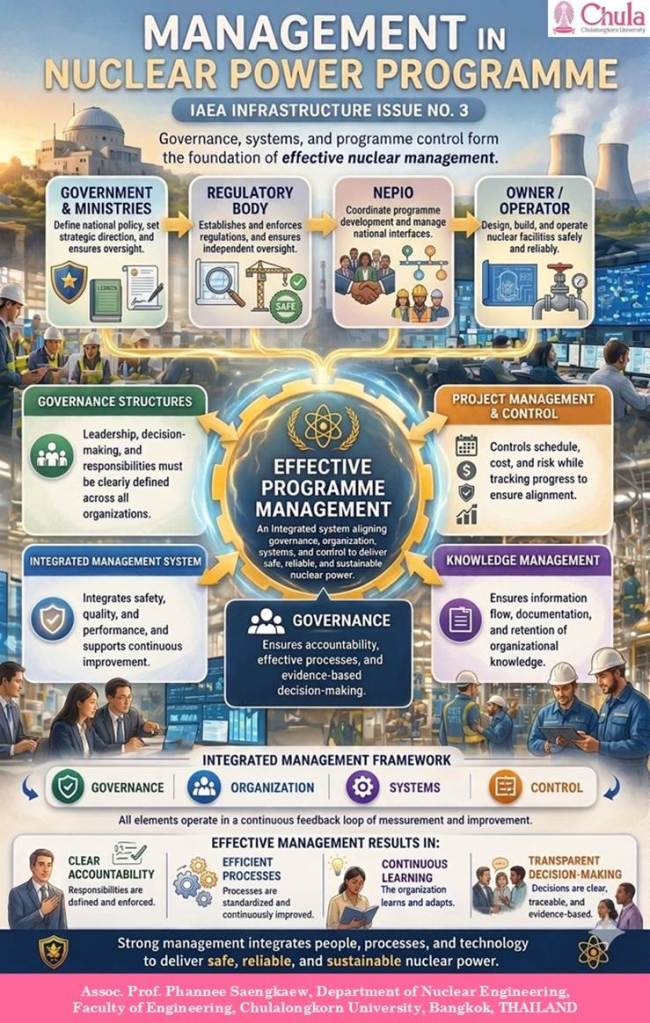
Within the framework of the International Atomic Energy Agency 19 Infrastructure Issues, Issue 3: Management refers to the establishment of an integrated management system that governs the planning, execution, control, and continuous improvement of all organizations involved in a nuclear power programme. In this context, management should not be interpreted merely as an administrative function. Rather, it represents the “system architecture” that integrates governance, organizational structures, technical systems, and programme control into a coherent and verifiable operational framework.
Management therefore functions as the mechanism through which national policy is translated into controlled, assessable, and continuously improvable actions.
2. Definition and Scope
According to the International Atomic Energy Agency (GSR Part 2), a management system is defined as a set of interrelated elements that establish policies and objectives and enable those objectives to be achieved in a safe, efficient, and consistent manner. Such a system must integrate multiple dimensions, including safety, quality, security, environmental protection, and economic performance. Safety remains the highest priority and must not be compromised by pressures related to schedule or cost.
3. Core Components of Management
3.1 Integrated Management System (IMS)
The Integrated Management System (IMS) constitutes the core operational framework of the programme. It integrates technical processes, organizational structures, and human performance into a unified system. This system ensures that all activities are carried out consistently through defined processes, supported by documentation and traceability, and continuously improved over time. It also ensures that safety is maintained even under constraints related to time and budget.
3.2 Organizational Structure and Governance
A nuclear power programme involves multiple institutions, including government authorities, regulatory bodies, the Nuclear Energy Programme Implementing Organization (NEPIO), and the owner/operator.
Effective management requires clearly defined roles, responsibilities, and decision-making authority. Governance structures must ensure transparency, accountability, and traceability in decision-making processes. Without such clarity, coordination failures may occur, leading to delays and increased safety risks.
3.3 Leadership and Safety Culture
Leadership plays a critical role in establishing and sustaining a strong safety culture. Management must ensure that safety is consistently prioritized over production or economic objectives.
Personnel must be able to report concerns openly, and decisions must be made based on conservative principles, particularly in situations involving uncertainty. Lessons from the nuclear disaster demonstrate that failures in organizational culture can undermine even advanced technical systems.
3.4 Process Management and Project Control
All programme activities must be conducted under clearly defined processes, covering design, procurement, construction, and operation. In addition, management must ensure effective project control in terms of schedule, cost, and risk, while systematically tracking progress to maintain alignment with planning objectives.
3.5 Resource Management
Management must ensure the proper allocation of resources, including qualified personnel, financial support, infrastructure, and technological tools. Insufficient resources can compromise both system performance and safety, even when the management framework is well designed.
3.6 Communication, Interface, and Knowledge Management
Effective communication and interface management are essential due to the complexity of nuclear programmes. Clear communication channels must be established between all stakeholders.
Knowledge management must be implemented as a structured function, ensuring effective information flow, proper documentation, and retention of organizational knowledge. This is essential for long-term sustainability and continuity.
3.7 Performance Monitoring and Feedback Loop
The management system must include mechanisms for performance monitoring, such as key performance indicators, audits, and evaluations.
These elements form a feedback loop:
Measurement → Evaluation → Improvement → Enhanced Safety
This loop enables continuous learning and adaptation over time.
4. Progression of Management Systems Across IAEA Milestones Phases
The development of management systems follows the three phases of the Milestones framework of the International Atomic Energy Agency, reflecting the level of programme readiness.
In Phase 1, the management framework and governance structures are established. This includes the formation of NEPIO and the definition of organizational roles, with emphasis on policy coordination and strategic planning. The achievement of Milestone 1 indicates readiness to make a knowledgeable commitment to a nuclear power programme.
In Phase 2, the IMS and project control systems are developed in a structured manner. This includes the establishment of procedures, documentation, and training, as well as the implementation of project management practices. The achievement of Milestone 2 reflects readiness to invite bids for the first nuclear power plant.
In Phase 3, the management system becomes fully operational, supporting plant commissioning and operation. Continuous monitoring, evaluation, and decision-making processes are implemented. The achievement of Milestone 3 indicates readiness to commission and operate the first nuclear power plant in a safe and sustainable manner.
Conceptually, this progression can be understood as a transition from
framework establishment → system development → full operation
5. Key Challenges
Newcomer countries often face limitations in experience and human resources. Additional challenges include balancing safety with cost and schedule pressures, managing complex organizational interfaces, and addressing differences in organizational culture.
6. Integrated Perspective
Management is closely linked to other infrastructure issues, including the legal framework, regulatory system, human resource development, and financing. It functions as the mechanism that enables all components to operate coherently.
7. Systems Perspective
From a systems perspective, management acts as a control layer that connects policy to execution:
Policy → Organization → Systems → Control → Safe Outcomes
8. Concluding Perspective
Management is a fundamental element that enables a nuclear power programme to operate safely, efficiently, and sustainably. It ensures clear accountability, effective processes, continuous learning, and transparent decision-making across all organizational levels.
ประเด็นด้านที่ 3: การบริหารจัดการ
1. แนวคิดพื้นฐาน
ภายใต้กรอบการพัฒนาโครงสร้างพื้นฐาน 19 ด้าน ของทบวงการพลังงานปรมาณูระหว่างประเทศ (International Atomic Energy Agency: IAEA) ประเด็นด้านที่ 3 การบริหารจัดการ หมายถึงการจัดตั้งระบบการบริหารจัดการแบบบูรณาการที่กำกับการวางแผน การดำเนินงาน การควบคุม และการปรับปรุงอย่างต่อเนื่องของทุกองค์กรที่เกี่ยวข้องกับโครงการพลังงานนิวเคลียร์ ในบริบทนี้ การบริหารจัดการมิใช่เพียงหน้าที่เชิงธุรการ แต่เป็น “สถาปัตยกรรมของระบบ” ที่ทำหน้าที่เชื่อมโยงธรรมาภิบาล โครงสร้างองค์กร ระบบทางเทคนิค และการควบคุมโครงการ ให้ทำงานร่วมกันอย่างสอดคล้องและตรวจสอบได้ การบริหารจัดการจึงเป็นกลไกที่แปลงนโยบายระดับชาติให้กลายเป็นการดำเนินงานที่สามารถควบคุม ประเมิน และปรับปรุงได้อย่างต่อเนื่อง
2. นิยามและขอบเขต
ตามแนวทางเอกสารแนะนำ International Atomic Energy Agency (GSR Part 2) ระบบการบริหารจัดการหมายถึงชุดขององค์ประกอบที่เชื่อมโยงกัน ซึ่งกำหนดนโยบาย วัตถุประสงค์ และทำให้บรรลุผลอย่างปลอดภัย มีประสิทธิภาพ และสม่ำเสมอ ระบบดังกล่าวต้องบูรณาการหลายมิติ ได้แก่ ความปลอดภัย คุณภาพ ความมั่นคงปลอดภัย สิ่งแวดล้อม และประสิทธิภาพทางเศรษฐกิจ โดยความปลอดภัยต้องได้รับความสำคัญสูงสุด และไม่ควรถูกลดทอนจากแรงกดดันด้านเวลาและต้นทุน
3. องค์ประกอบหลักของการบริหารจัดการ
3.1 ระบบการบริหารจัดการแบบบูรณาการ (Integrated Management System: IMS)
ระบบ IMS เป็นแกนกลางของการดำเนินโครงการ โดยรวมองค์ประกอบด้านเทคนิค โครงสร้างองค์กร และการปฏิบัติงานของบุคลากรเข้าไว้ในระบบเดียว ระบบนี้ทำให้กิจกรรมทั้งหมดดำเนินไปอย่างสอดคล้องภายใต้กระบวนการที่กำหนด มีเอกสารรองรับ และสามารถตรวจสอบย้อนกลับได้ พร้อมทั้งสนับสนุนการปรับปรุงอย่างต่อเนื่อง และรักษาความปลอดภัยแม้ภายใต้ข้อจำกัดด้านเวลาและงบประมาณ
3.2 โครงสร้างองค์กรและธรรมาภิบาล
โครงการพลังงานนิวเคลียร์เกี่ยวข้องกับหลายหน่วยงาน ได้แก่ หน่วยงานภาครัฐ หน่วยงานกำกับดูแล องค์กรดำเนินโครงการ (NEPIO = Nuclear Energy Programme Implementing Organization) และผู้ดำเนินการโรงไฟฟ้า ซึ่งการบริหารจัดการต้องกำหนดบทบาท หน้าที่ และอำนาจการตัดสินใจอย่างชัดเจน พร้อมทั้งสร้างโครงสร้างธรรมาภิบาลที่โปร่งใส มีความรับผิดชอบ และสามารถตรวจสอบได้ เพื่อป้องกันความซ้ำซ้อน ช่องว่าง และความล้มเหลวในการประสานงาน
3.3 ภาวะผู้นำและวัฒนธรรมความปลอดภัย
ภาวะผู้นำมีบทบาทสำคัญในการสร้างและรักษาวัฒนธรรมความปลอดภัย โดยต้องให้ความสำคัญกับความปลอดภัยเหนือเป้าหมายด้านการผลิตหรือผลตอบแทน บุคลากรต้องสามารถรายงานข้อกังวลได้อย่างเปิดเผย และการตัดสินใจต้องตั้งอยู่บนหลักความระมัดระวัง โดยมีบทเรียนจากอุบัติเหตุทางนิวเคลียร์ที่ผ่านมามีที่แสดงให้เห็นว่า ความล้มเหลวด้านวัฒนธรรมองค์กรสามารถส่งผลกระทบร้ายแรงได้
3.4 การจัดการกระบวนการและการควบคุมโครงการ
กิจกรรมทั้งหมดของโครงการต้องดำเนินภายใต้กระบวนการที่กำหนดไว้อย่างชัดเจน ครอบคลุมการออกแบบ การจัดซื้อ การก่อสร้าง และการดำเนินงาน นอกจากนี้ การบริหารจัดการต้องควบคุมโครงการในด้านเวลา ต้นทุน และความเสี่ยง พร้อมทั้งติดตามความก้าวหน้าอย่างเป็นระบบ เพื่อให้การดำเนินงานสอดคล้องกับแผนที่กำหนด
3.5 การจัดการทรัพยากร
ต้องมีการจัดสรรทรัพยากรอย่างเหมาะสม ทั้งบุคลากร งบประมาณ และโครงสร้างพื้นฐาน หากทรัพยากรไม่เพียงพอ จะส่งผลต่อประสิทธิภาพและความปลอดภัยของระบบ
3.6 การสื่อสาร การจัดการจุดเชื่อมต่อ และการจัดการความรู้
การสื่อสารที่มีประสิทธิภาพและการจัดการจุดเชื่อมต่อระหว่างหน่วยงานเป็นปัจจัยสำคัญในการลดความผิดพลาดและเพิ่มประสิทธิภาพ การจัดการความรู้ต้องครอบคลุมการไหลของข้อมูล การจัดเก็บเอกสาร และการรักษาความรู้ขององค์กร เพื่อให้โครงการสามารถดำเนินได้อย่างต่อเนื่องในระยะยาว
3.7 การติดตามผลและวงจรป้อนกลับ (Feedback Loop)
ระบบการบริหารจัดการต้องมีการติดตามผลผ่านตัวชี้วัด การตรวจประเมิน และการวิเคราะห์ผลการดำเนินงาน
องค์ประกอบเหล่านี้ก่อให้เกิดวงจรป้อนกลับ:
การวัด → การประเมิน → การปรับปรุง → ความปลอดภัยที่ดีขึ้น
ซึ่งช่วยให้ระบบสามารถเรียนรู้และพัฒนาได้อย่างต่อเนื่อง
4. พัฒนาการของระบบการบริหารจัดการตามระยะ Milestones
การพัฒนาระบบการบริหารจัดการดำเนินไปตามสามระยะของกรอบหมุดหมาย (Milestones) ของ IAEA ซึ่งสะท้อนระดับความพร้อมของโครงการ
ใน ระยะที่ 1 จะมีการวางกรอบการบริหารและโครงสร้างธรรมาภิบาล รวมถึงการจัดตั้ง NEPIO และกำหนดบทบาทขององค์กร โดยเน้นการวางแผนและการประสานงานเชิงนโยบาย การบรรลุ Milestone 1 แสดงถึงความพร้อมในการตัดสินใจเชิงนโยบายอย่างมีข้อมูล
ใน ระยะที่ 2 ระบบ IMS และระบบควบคุมโครงการจะถูกพัฒนาอย่างเป็นรูปธรรม มีการกำหนดกระบวนการ เอกสาร และการฝึกอบรม รวมถึงการนำระบบบริหารโครงการมาใช้ การบรรลุ Milestone 2 แสดงถึงความพร้อมในการดำเนินโครงการและเข้าสู่กระบวนการจัดหา
ใน ระยะที่ 3 ระบบบริหารจัดการจะดำเนินงานอย่างเต็มรูปแบบ สนับสนุนการเดินเครื่องโรงไฟฟ้า มีการติดตามผล การประเมิน และการตัดสินใจอย่างต่อเนื่อง การบรรลุ Milestone 3 แสดงถึงความพร้อมในการดำเนินงานอย่างปลอดภัยและยั่งยืน
ในเชิงแนวคิด พัฒนาการนี้สามารถอธิบายได้ว่าเป็นการเปลี่ยนผ่านจาก
การวางกรอบ → การพัฒนา → การดำเนินงานจริง
5. ความท้าทายสำคัญ
ประเทศที่เริ่มต้นมักเผชิญกับข้อจำกัดด้านบุคลากรและประสบการณ์ รวมถึงความท้าทายในการสมดุลระหว่างความปลอดภัยกับต้นทุนและเวลา นอกจากนี้ ความซับซ้อนของโครงการและความแตกต่างด้านวัฒนธรรมองค์กรอาจส่งผลต่อประสิทธิภาพของการบริหารจัดการ
6. มุมมองเชิงบูรณาการ
การบริหารจัดการมีความเชื่อมโยงกับโครงสร้างพื้นฐานด้านอื่น ได้แก่ กฎหมาย การกำกับดูแล ทรัพยากรมนุษย์ และการเงิน โดยทำหน้าที่เป็นกลไกที่ทำให้ทุกองค์ประกอบสามารถดำเนินงานได้อย่างสอดคล้อง
7. มุมมองเชิงระบบ
ในเชิงระบบ การบริหารจัดการทำหน้าที่เป็นชั้นควบคุมที่เชื่อมโยงนโยบายกับการปฏิบัติ
นโยบาย → องค์กร → ระบบ → การควบคุม → ผลลัพธ์ที่ปลอดภัย
8. บทสรุป
การบริหารจัดการเป็นองค์ประกอบหลักที่ทำให้โครงการพลังงานนิวเคลียร์สามารถดำเนินไปได้อย่างปลอดภัย มีประสิทธิภาพ และยั่งยืน โดยสร้างความรับผิดชอบที่ชัดเจน กระบวนการที่มีประสิทธิผล การเรียนรู้อย่างต่อเนื่อง และการตัดสินใจที่โปร่งใส
References
- International Atomic Energy Agency (2022). Milestones in the Development of a National Infrastructure for Nuclear Power (NG-G-3.1 Rev. 2). Vienna: IAEA.
- International Atomic Energy Agency (2016). Leadership and Management for Safety (GSR Part 2). Vienna: IAEA.
- International Atomic Energy Agency (2020). The Operating Organization for Nuclear Power Plants (SSG-72). Vienna: IAEA.
- International Atomic Energy Agency (2022). Recruitment, Qualification and Training of Personnel for Nuclear Power Plants (SSG-75). Vienna: IAEA.
- International Atomic Energy Agency (2022). Guide to Knowledge Management Strategies in Nuclear Energy Organizations (NG-G-6.1). Vienna: IAEA.
- International Atomic Energy Agency (2015). Managing the First Nuclear Power Plant Project (NP-T-2.1). Vienna: IAEA.
- International Atomic Energy Agency (2012). Evaluation of the Status of National Nuclear Infrastructure Development (NG-T-3.2). Vienna: IAEA.
 Around Radiation Detectors
ใส่ความเห็น