Issue 5: Legislative Framework
1. Introduction and Strategic Context
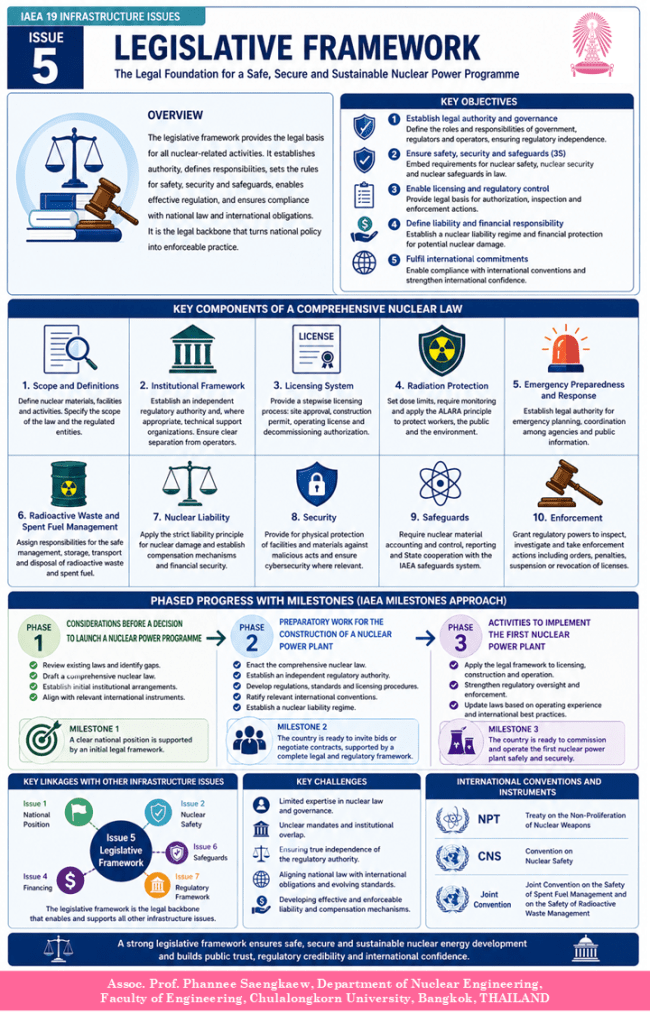
Within the framework established by the International Atomic Energy Agency (IAEA), the Legislative Framework represents a fundamental prerequisite for the development of a nuclear power programme. It is not merely a collection of legal instruments, but rather a coherent and enforceable system of governance that enables all nuclear activities to be conducted safely, securely, and in compliance with national and international obligations.
A nuclear power programme involves complex interactions among technical systems, institutions, and human actors over several decades. Consequently, these activities cannot rely solely on policy intentions or technical capacity; they must be underpinned by a clear legal mandate that defines authority, assigns responsibility, and ensures accountability. The legislative framework therefore serves as the legal backbone that translates national policy into enforceable regulatory practice.
2. Purpose and Functions of the Legislative Framework
The primary purpose of the legislative framework is to establish a legally binding structure that governs all aspects of nuclear activities within a State. In this context, the framework performs several interrelated functions.
First, it defines the roles and responsibilities of all relevant stakeholders, including the government, the regulatory body, and the operating organization. Through this legal definition, institutional clarity is achieved, and the risk of overlap or conflict of authority is minimized.
Second, the framework provides the legal basis for ensuring nuclear safety, nuclear security, and nuclear safeguards (3S). It mandates compliance with safety principles such as defence-in-depth, establishes requirements for physical protection against malicious acts, and enables the implementation of safeguards obligations under international agreements such as the Treaty on the Non-Proliferation of Nuclear Weapons.
Third, it enables the establishment of a licensing and regulatory control system, through which nuclear installations and activities are authorized, inspected, and, if necessary, sanctioned. This includes the legal authority to issue licenses, conduct inspections, and enforce compliance through penalties or corrective actions.
Fourth, the legislative framework defines the liability regime for nuclear damage, ensuring that operators bear responsibility for potential incidents and that mechanisms for compensation are clearly established.
Finally, it ensures that the State can adhere to international conventions and obligations, such as the Convention on Nuclear Safety and the Joint Convention on the Safety of Spent Fuel Management and on the Safety of Radioactive Waste Management, thereby reinforcing international confidence and cooperation.
3. Essential Elements of a National Nuclear Law
A comprehensive nuclear law typically encompasses several essential elements, each of which contributes to the overall effectiveness of the legislative framework.
The law begins by clearly defining its scope and terminology, including nuclear materials, facilities, and regulated activities. Such definitions are critical for ensuring legal clarity and avoiding ambiguity in interpretation.
It then establishes the institutional framework, including the creation of an independent regulatory body. The principle of regulatory independence is particularly important, as it ensures that safety oversight is conducted free from undue influence by political or commercial interests.
The law further provides for a stepwise authorization process, whereby nuclear facilities must obtain approval at each stage of their lifecycle, including site selection, construction, operation, and decommissioning. This staged approach ensures that safety is systematically evaluated and verified.
In addition, the legislative framework includes provisions for radiation protection, requiring adherence to dose limits, monitoring systems, and optimization principles such as ALARA (As Low As Reasonably Achievable).
Provisions for emergency preparedness and response are also incorporated, ensuring that legal authority exists for coordinated action in the event of a nuclear or radiological emergency.
Furthermore, the law addresses the management of radioactive waste and spent fuel, assigning responsibility for their safe handling, storage, transport, and disposal.
Finally, it includes requirements related to nuclear security and safeguards, including physical protection measures, nuclear material accounting, and control systems.
4. Phased Development of the Legislative Framework According to the IAEA Milestones Approach
The development of the legislative framework follows a structured progression aligned with the phases defined in the IAEA Milestones in the Development of a National Infrastructure for Nuclear Power. Each phase reflects an increasing level of legal and institutional maturity.
4.1 Phase 1: Considerations Before a Decision to Launch a Nuclear Power Programme
During Phase 1, the State focuses on establishing the initial legal foundation necessary to support informed decision-making regarding the adoption of nuclear power.
At this stage, existing national legislation, such as environmental law, energy law, and radiation protection regulations, is systematically reviewed to identify gaps and inconsistencies. Based on this analysis, the State begins drafting a comprehensive nuclear law that will eventually govern all nuclear activities.
In parallel, efforts are made to align national legislation with relevant international legal instruments, although full ratification may not yet be completed.
By the end of Phase 1, the State achieves Milestone 1, which signifies that a clear national position has been established and is supported by an initial legal and institutional framework.
4.2 Phase 2: Preparatory Work for the Construction of a Nuclear Power Plant
In Phase 2, the legislative framework evolves into a fully developed and operational system capable of supporting the implementation of a nuclear power programme.
During this phase, the comprehensive nuclear law is formally enacted, and an independent regulatory authority is established with clearly defined legal powers. Detailed regulations, licensing procedures, and safety standards are developed and implemented.
The State also proceeds with the ratification of international conventions, including those related to safety, liability, and non-proliferation. At the same time, a legally binding nuclear liability regime is established.
By the completion of this phase, the State reaches Milestone 2, indicating that it is ready to invite bids or enter into contractual negotiations for the construction of a nuclear power plant, supported by a complete and functional legal framework.
4.3 Phase 3: Activities to Implement the First Nuclear Power Plant
Phase 3 focuses on the effective implementation and continuous improvement of the legislative framework as nuclear facilities are constructed and prepared for operation.
During this phase, the legal system is actively applied in the licensing of nuclear installations, the oversight of construction activities, and the authorization of operation. The regulatory body exercises its authority through inspections, enforcement actions, and performance monitoring.
At the same time, the legislative framework is continuously updated to reflect operational experience, technological advancements, and evolving international standards.
The achievement of Milestone 3 signifies that the State is ready to commission and operate its first nuclear power plant, with a legislative and regulatory system that is fully functional, effective, and internationally aligned.
5. Integration with the Overall Nuclear Infrastructure
The legislative framework does not operate in isolation; rather, it is deeply interconnected with other infrastructure issues. It provides the legal basis for the regulatory framework (Issue 7), enables the enforcement of nuclear safety (Issue 2), and supports compliance with safeguards (Issue 6) and financing mechanisms (Issue 4).
In this sense, Issue 5 functions as a cross-cutting enabler, ensuring that all components of the nuclear infrastructure are coherently aligned within a legally enforceable system.
6. Challenges and Considerations
States embarking on a nuclear power programme often encounter several challenges in developing their legislative framework. These include limited expertise in nuclear law, institutional fragmentation, and difficulties in ensuring true regulatory independence.
Moreover, aligning national legislation with international conventions and establishing effective liability mechanisms require both technical knowledge and political commitment. Addressing these challenges typically involves international cooperation, capacity building, and sustained institutional development.
7. Conclusion
In conclusion, the legislative framework is an essential component of nuclear infrastructure that transforms policy intentions into binding legal obligations and operational reality. Its development must follow a structured, phased approach to ensure that it evolves in parallel with the overall maturity of the nuclear programme.
A well-designed legislative framework not only enables safe and secure nuclear operations but also fosters public trust, regulatory credibility, and international confidence, all of which are indispensable for the long-term sustainability of nuclear energy programmes.
References
- International Atomic Energy Agency. (2024). Milestones in the Development of a National Infrastructure for Nuclear Power (NG-G-3.1 Rev. 2).
- International Atomic Energy Agency. (2010). Handbook on Nuclear Law.
- International Atomic Energy Agency. (2003). Legislative Assistance for Nuclear Law.
- Treaty on the Non-Proliferation of Nuclear Weapons.
- Convention on Nuclear Safety.
- Joint Convention on the Safety of Spent Fuel Management and on the Safety of Radioactive Waste Management.
ประเด็นด้านที่ 5: กรอบกฎหมาย (Legislative Framework)
1. บทนำและบริบทเชิงยุทธศาสตร์
ภายใต้กรอบการพัฒนาโครงสร้างพื้นฐานสำหรับโครงการพลังงานนิวเคลียร์ของ International Atomic Energy Agency (IAEA) นั้น กรอบกฎหมาย (Legislative Framework) จัดเป็นองค์ประกอบพื้นฐานที่มีความสำคัญอย่างยิ่ง เนื่องจากเป็นกลไกที่ทำให้การดำเนินกิจกรรมทางนิวเคลียร์ทั้งหมดสามารถดำเนินไปได้อย่างถูกต้องตามกฎหมาย (legally compliant) ปลอดภัย (safe) มั่นคงปลอดภัย (secure) และสอดคล้องกับพันธกรณีระหว่างประเทศ (international obligations)
การพัฒนาโครงการพลังงานนิวเคลียร์มิได้เป็นเพียงกระบวนการทางวิศวกรรมหรือเทคโนโลยีเท่านั้น หากแต่เป็นระบบเชิงสังคม–เทคนิค (socio-technical system) ที่มีความซับซ้อนและดำเนินต่อเนื่องในระยะยาวหลายทศวรรษ ดังนั้น การมีเพียงนโยบายหรือศักยภาพทางเทคนิคจึงไม่เพียงพอ หากปราศจาก ฐานทางกฎหมายที่ชัดเจนและมีผลบังคับใช้ ซึ่งกำหนดอำนาจหน้าที่ ความรับผิดชอบ และกลไกการกำกับดูแลอย่างเป็นระบบ
ด้วยเหตุนี้ กรอบกฎหมายจึงทำหน้าที่เป็น “แกนหลักเชิงโครงสร้าง (structural backbone)” ที่เชื่อมโยงนโยบายระดับชาติไปสู่การปฏิบัติจริงในระดับองค์กรและระดับปฏิบัติการ
2. วัตถุประสงค์และหน้าที่ของกรอบกฎหมาย
กรอบกฎหมายมีบทบาทสำคัญในการสร้างระบบกำกับดูแลที่มีผลผูกพันทางกฎหมาย โดยสามารถอธิบายหน้าที่หลักได้ดังต่อไปนี้
ประการแรก กรอบกฎหมายทำหน้าที่กำหนด บทบาทและความรับผิดชอบ (roles and responsibilities) ของหน่วยงานที่เกี่ยวข้องทั้งหมดอย่างชัดเจน ไม่ว่าจะเป็นภาครัฐ หน่วยงานกำกับดูแล (regulatory body) และผู้ดำเนินการ (operating organization) ซึ่งช่วยลดความซ้ำซ้อนและความคลุมเครือของอำนาจหน้าที่
ประการที่สอง กรอบกฎหมายเป็นเครื่องมือสำคัญในการประกันให้เกิดการดำเนินงานด้าน ความปลอดภัยทางนิวเคลียร์ (nuclear safety) ความมั่นคงปลอดภัยทางนิวเคลียร์ (nuclear security) และการพิทักษ์ความปลอดภัยทางนิวเคลียร์ (nuclear safeguards) หรือที่เรียกรวมว่า “3S” โดยกำหนดข้อบังคับและมาตรการที่ต้องปฏิบัติอย่างเคร่งครัด
ประการที่สาม กรอบกฎหมายรองรับการจัดตั้งระบบ การอนุญาต (authorization) และการออกใบอนุญาต (licensing) ซึ่งเป็นกลไกหลักในการควบคุมกิจกรรมทางนิวเคลียร์ ตั้งแต่การออกใบอนุญาต การตรวจสอบ (inspection) ไปจนถึงการบังคับใช้กฎหมาย (enforcement)
ประการที่สี่ กรอบกฎหมายกำหนดระบบ ความรับผิดทางแพ่งสำหรับความเสียหายจากนิวเคลียร์ (nuclear liability) โดยกำหนดให้ผู้ดำเนินการต้องรับผิดชอบต่อความเสียหายที่อาจเกิดขึ้น พร้อมทั้งจัดให้มีกลไกการชดเชยที่เหมาะสม
ประการสุดท้าย กรอบกฎหมายช่วยให้รัฐสามารถปฏิบัติตามพันธกรณีระหว่างประเทศได้อย่างมีประสิทธิภาพ เช่น ภายใต้ Treaty on the Non-Proliferation of Nuclear Weapons Convention on Nuclear Safety และ Joint Convention on the Safety of Spent Fuel Management and on the Safety of Radioactive Waste Management
3. องค์ประกอบสำคัญของกฎหมายพลังงานนิวเคลียร์
กฎหมายพลังงานนิวเคลียร์ที่สมบูรณ์ควรครอบคลุมองค์ประกอบสำคัญหลายประการ โดยแต่ละองค์ประกอบมีบทบาทสนับสนุนซึ่งกันและกันอย่างเป็นระบบ
ในส่วนแรก กฎหมายต้องกำหนด ขอบเขตและนิยาม (scope and definitions) อย่างชัดเจน เพื่อให้ครอบคลุมวัสดุนิวเคลียร์ สถานประกอบการ และกิจกรรมที่อยู่ภายใต้การกำกับดูแล
ถัดมา กฎหมายต้องจัดตั้ง โครงสร้างสถาบัน (institutional framework) โดยเฉพาะการจัดตั้งหน่วยงานกำกับดูแลที่มีความเป็นอิสระ (independent regulatory body) เพื่อให้สามารถปฏิบัติหน้าที่ได้อย่างปราศจากอิทธิพลจากฝ่ายการเมืองหรือเชิงพาณิชย์
กฎหมายยังต้องกำหนด กระบวนการอนุญาตแบบเป็นขั้นตอน (stepwise licensing process) ซึ่งครอบคลุมตั้งแต่การเลือกสถานที่ การก่อสร้าง การเดินเครื่อง และการรื้อถอน เพื่อให้มั่นใจว่าทุกขั้นตอนผ่านการประเมินด้านความปลอดภัยอย่างเหมาะสม
นอกจากนี้ กฎหมายต้องครอบคลุมถึง การป้องกันรังสี (radiation protection) โดยกำหนดขีดจำกัดปริมาณรังสี ระบบการตรวจวัด และหลักการ ALARA
ในด้านความพร้อมรับเหตุฉุกเฉิน กฎหมายต้องกำหนด ระบบการเตรียมความพร้อมและตอบสนองเหตุฉุกเฉิน (emergency preparedness and response) อย่างเป็นทางการ
ในส่วนของวัฏจักรเชื้อเพลิง กฎหมายต้องกำหนดแนวทางการจัดการ กากกัมมันตรังสีและเชื้อเพลิงใช้แล้ว (radioactive waste and spent fuel management) อย่างปลอดภัย
สุดท้าย กฎหมายต้องรองรับ ความมั่นคงปลอดภัยและการพิทักษ์ (security and safeguards) รวมถึงระบบบัญชีและควบคุมวัสดุนิวเคลียร์
4. การพัฒนากรอบกฎหมายตามแนวทาง Milestones ของ IAEA
การพัฒนากรอบกฎหมายมิได้เกิดขึ้นในคราวเดียว หากแต่เป็นกระบวนการที่พัฒนาอย่างเป็นลำดับขั้นตามแนวทางในเอกสาร IAEA Milestones in the Development of a National Infrastructure for Nuclear Power
4.1 ระยะที่ 1: การพิจารณาก่อนตัดสินใจดำเนินโครงการ (Phase 1)
ในระยะนี้ รัฐมุ่งเน้นการวางรากฐานทางกฎหมายเบื้องต้นเพื่อสนับสนุนการตัดสินใจเชิงนโยบายเกี่ยวกับการพัฒนาโครงการพลังงานนิวเคลียร์
กิจกรรมสำคัญประกอบด้วยการทบทวนกฎหมายที่มีอยู่ เช่น กฎหมายพลังงาน กฎหมายสิ่งแวดล้อม และกฎหมายการป้องกันรังสี เพื่อวิเคราะห์ช่องว่างและข้อจำกัด จากนั้นจึงเริ่มดำเนินการร่างกฎหมายพลังงานนิวเคลียร์ฉบับใหม่
ในขณะเดียวกัน รัฐเริ่มดำเนินการให้สอดคล้องกับกรอบกฎหมายระหว่างประเทศ แม้ว่ายังไม่จำเป็นต้องให้สัตยาบันครบถ้วนในระยะนี้
เมื่อสิ้นสุดระยะนี้ จะบรรลุ Milestone 1 ซึ่งหมายถึงการที่ประเทศมี จุดยืนระดับชาติ (national position) ที่ชัดเจน และมีกรอบกฎหมายเบื้องต้นรองรับ
4.2 ระยะที่ 2: การเตรียมความพร้อมสำหรับการก่อสร้างโรงไฟฟ้านิวเคลียร์ (Phase 2)
ในระยะที่ 2 กรอบกฎหมายจะได้รับการพัฒนาให้มีความสมบูรณ์และสามารถใช้งานได้จริง
รัฐจะดำเนินการประกาศใช้กฎหมายพลังงานนิวเคลียร์อย่างเป็นทางการ และจัดตั้งหน่วยงานกำกับดูแลที่มีความเป็นอิสระ พร้อมทั้งกำหนดระเบียบ ข้อบังคับ และมาตรฐานด้านความปลอดภัยอย่างครบถ้วน
นอกจากนี้ รัฐจะดำเนินการให้สัตยาบันต่ออนุสัญญาระหว่างประเทศที่เกี่ยวข้อง และจัดตั้งระบบความรับผิดทางนิวเคลียร์อย่างเป็นรูปธรรม
เมื่อสิ้นสุดระยะนี้ จะบรรลุ Milestone 2 ซึ่งสะท้อนถึงความพร้อมของประเทศในการ เชิญชวนผู้ลงทุนหรือผู้รับเหมา (invite bids / contract negotiation) สำหรับโครงการโรงไฟฟ้านิวเคลียร์
4.3 ระยะที่ 3: การดำเนินการก่อสร้างและเตรียมการเดินเครื่อง (Phase 3)
ในระยะสุดท้าย กรอบกฎหมายจะถูกนำไปใช้ในการดำเนินงานจริง และมีการปรับปรุงอย่างต่อเนื่อง
หน่วยงานกำกับดูแลจะใช้กฎหมายเป็นเครื่องมือในการออกใบอนุญาต ตรวจสอบ และบังคับใช้กฎหมายในทุกขั้นตอนของการก่อสร้างและการเตรียมเดินเครื่อง
ในขณะเดียวกัน กรอบกฎหมายจะได้รับการปรับปรุงให้สอดคล้องกับประสบการณ์การดำเนินงาน เทคโนโลยีใหม่ และมาตรฐานสากลที่พัฒนาอย่างต่อเนื่อง
การบรรลุ Milestone 3 แสดงให้เห็นว่าประเทศมีความพร้อมในการ เดินเครื่องโรงไฟฟ้านิวเคลียร์แห่งแรกได้อย่างปลอดภัยและมั่นคง
5. ความเชื่อมโยงกับประเด็นโครงสร้างพื้นฐานอื่น
กรอบกฎหมายมีความเชื่อมโยงอย่างใกล้ชิดกับประเด็นอื่นในทั้ง 19 ประเด็น โดยเฉพาะอย่างยิ่ง
- การกำหนดจุดยืนระดับชาติ (Issue 1)
- ความปลอดภัยทางนิวเคลียร์ (Issue 2)
- กรอบการกำกับดูแล (Issue 7)
- การพิทักษ์ความปลอดภัย (Issue 6)
- การเงินและการลงทุน (Issue 4)
ดังนั้น กรอบกฎหมายจึงทำหน้าที่เป็น กลไกบูรณาการ (integrative mechanism) ที่เชื่อมโยงทุกองค์ประกอบให้ทำงานร่วมกันอย่างสอดคล้อง
6. ความท้าทายในการพัฒนา
ประเทศที่เริ่มต้นโครงการพลังงานนิวเคลียร์มักเผชิญความท้าทายหลายประการ เช่น การขาดผู้เชี่ยวชาญด้านกฎหมายนิวเคลียร์ ความไม่ชัดเจนของโครงสร้างสถาบัน และข้อจำกัดในการสร้างความเป็นอิสระของหน่วยงานกำกับดูแล
นอกจากนี้ การปรับกฎหมายให้สอดคล้องกับมาตรฐานสากลและการกำหนดระบบความรับผิดทางนิวเคลียร์ที่มีประสิทธิภาพยังเป็นประเด็นที่ต้องอาศัยทั้งความรู้ทางเทคนิคและการตัดสินใจเชิงนโยบาย
7. บทสรุป
โดยสรุป กรอบกฎหมายเป็นองค์ประกอบที่มีบทบาทสำคัญในการแปลงนโยบายระดับชาติไปสู่การปฏิบัติที่มีผลผูกพันทางกฎหมายและสามารถตรวจสอบได้จริง การพัฒนากรอบกฎหมายจำเป็นต้องดำเนินไปอย่างเป็นลำดับขั้นตามระดับความพร้อมของประเทศ
กรอบกฎหมายที่มีประสิทธิภาพไม่เพียงแต่ช่วยให้การดำเนินโครงการพลังงานนิวเคลียร์เป็นไปอย่างปลอดภัยและมั่นคงเท่านั้น แต่ยังเป็นปัจจัยสำคัญในการสร้าง ความเชื่อมั่นของสาธารณะ (public trust) ความน่าเชื่อถือของหน่วยงานกำกับดูแล (regulatory credibility) และความไว้วางใจในระดับนานาชาติ (international confidence) ซึ่งล้วนเป็นเงื่อนไขสำคัญของความยั่งยืนในระยะยาว
เอกสารอ้างอิง
- International Atomic Energy Agency. (2024). Milestones in the Development of a National Infrastructure for Nuclear Power (NG-G-3.1 Rev. 2).
- International Atomic Energy Agency. (2010). Handbook on Nuclear Law.
- International Atomic Energy Agency. (2003). Legislative Assistance for Nuclear Law.
- Treaty on the Non-Proliferation of Nuclear Weapons.
- Convention on Nuclear Safety.
- Joint Convention on the Safety of Spent Fuel Management and on the Safety of Radioactive Waste Management.


ใส่ความเห็น