Issue 8: Radiation Protection
1. Introduction
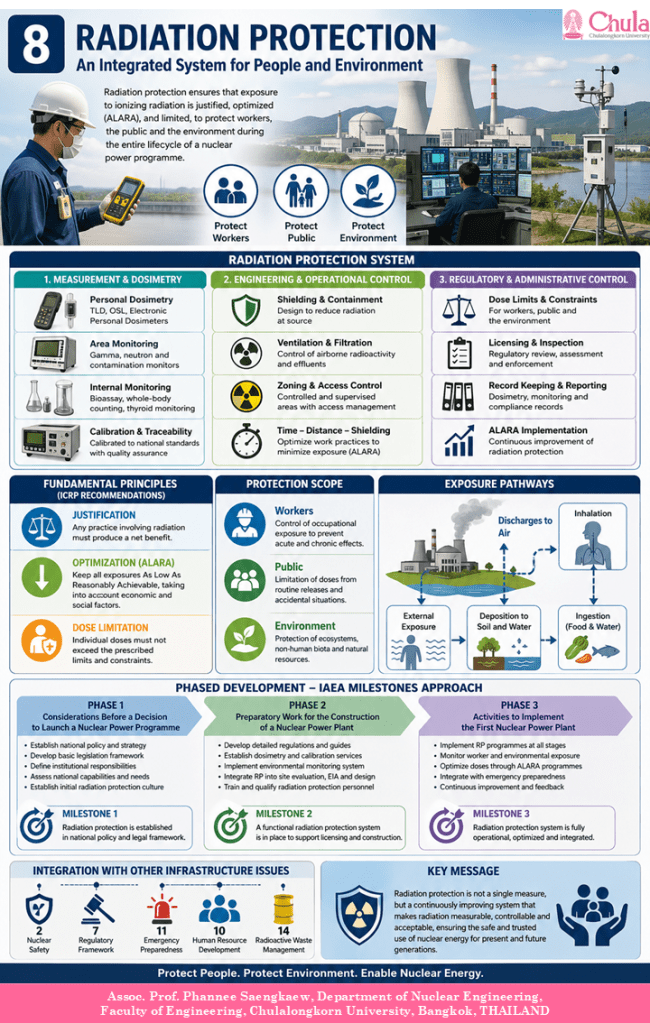
Radiation Protection (Issue 8) constitutes a fundamental pillar within the International Atomic Energy Agency (IAEA) framework for the development of nuclear power infrastructure. It ensures that all exposures to ionizing radiation—whether occupational, public, or environmental—are controlled, justified, and optimized in accordance with internationally accepted safety standards.
Within the context of a nuclear power programme, radiation protection is not a standalone technical discipline but an integrated regulatory–operational–technical system. It transforms the abstract concept of radiological risk into measurable, controllable, and auditable parameters that support decision-making across all phases of the nuclear lifecycle.
The implementation of radiation protection is guided primarily by the International Commission on Radiological Protection (ICRP) principles and codified in the IAEA Safety Standards, particularly the IAEA GSR Part 3 (BSS).
2. Fundamental Principles of Radiation Protection
The radiation protection system is built upon three internationally recognized principles:
2.1 Justification
Any decision that alters radiation exposure must result in a net benefit. No practice involving radiation should be adopted unless it produces more good than harm.
2.2 Optimization (ALARA)
Radiation doses must be kept As Low As Reasonably Achievable (ALARA), taking into account economic and social factors. This principle drives engineering design, operational procedures, and safety culture.
2.3 Dose Limitation
Individual doses must not exceed prescribed limits. These include:
- Occupational dose limits (workers)
- Public dose limits
- Constraints and reference levels for specific situations
3. Scope of Radiation Protection in Nuclear Infrastructure
Radiation protection within Issue 8 encompasses:
3.1 Occupational Radiation Protection
- Worker classification and zoning (controlled/supervised areas)
- Personal dosimetry systems (e.g., TLD, OSL, electronic dosimeters)
- Work planning and exposure control
- Internal exposure monitoring (bioassay, air sampling)
3.2 Public Radiation Protection
- Dose assessment for surrounding populations
- Control of radioactive discharges (liquid/gaseous effluents)
- Environmental impact assessment (EIA)
- Establishment of exclusion zones and emergency planning zones (EPZs)
3.3 Environmental Radiation Protection
- Environmental monitoring programmes (air, water, soil, biota)
- Long-term surveillance of radionuclide dispersion
- Protection of non-human biota (emerging framework)
3.4 Medical and Emergency Exposure
- Protection during emergency response
- Dose management in accidental exposure scenarios
- Integration with emergency preparedness (Issue 14)
4. Institutional and Regulatory Framework
Radiation protection requires a clearly defined institutional structure:
- Regulatory Body (linked to Issue 7)
Establishes regulations, dose limits, licensing requirements, and compliance enforcement
- Operating Organization
Implements radiation protection programmes at nuclear facilities
- Technical Support Organizations (TSOs)
Provide expertise in dosimetry, environmental monitoring, and risk assessment
- National Laboratories and Calibration Facilities
Ensure traceability of measurements (metrology infrastructure)
5. Phased Development and Milestones
The development of radiation protection infrastructure follows the phased approach defined in the IAEA Milestones Approach.
Phase 1: Considerations Before a Decision to Launch a Nuclear Power Programme
Objective: Establish the foundational legal, regulatory, and strategic framework for radiation protection.
Key Actions:
- Adoption of national radiation protection policy aligned with IAEA BSS
- Identification of competent authority and regulatory responsibilities
- Initial development of radiation protection legislation
- Awareness-building and stakeholder engagement
- Preliminary assessment of national capabilities (human resources, laboratories)
Milestone 1: A national framework for radiation protection is established as part of the overall nuclear policy.
Phase 2: Preparatory Work for the Construction of a Nuclear Power Plant
Objective: Develop and implement the operational and regulatory systems required for radiation protection.
Key Actions:
- Establishment of detailed regulations, guides, and licensing requirements
- Development of national dosimetry services and calibration laboratories
- Implementation of environmental monitoring systems
- Development of occupational radiation protection programmes
- Integration with site selection, EIA, and safety analysis
- Training and qualification of radiation protection personnel
Milestone 2: Radiation protection systems and regulatory infrastructure are in place to support licensing and construction.
Phase 3: Activities to Implement the First Nuclear Power Plant
Objective: Achieve full operational capability and optimization of radiation protection systems.
Key Actions:
- Full implementation of radiation protection programmes at the plant
- Routine monitoring of occupational and environmental exposures
- Optimization of doses during commissioning and operation
- Integration with emergency preparedness and response systems
- Continuous improvement through operational experience and feedback
Milestone 3: Radiation protection systems are fully operational, optimized, and integrated into plant operation and national oversight.
6. Integration with Other Infrastructure Issues
Radiation protection is inherently interconnected with multiple infrastructure elements:
- Issue 2: Nuclear Safety → Dose control is a direct indicator of safety performance
- Issue 7: Regulatory Framework → Enforcement of radiation protection requirements
- Issue 14: Emergency Preparedness → Protection during radiological emergencies
- Issue 10: Human Resource Development → Competence of radiation protection personnel
- Issue 17: Radioactive Waste Management → Control of exposure from waste streams
Thus, radiation protection functions as a cross-cutting system that links technical operation, regulatory oversight, and societal protection.
7. Key Challenges for Newcomer Countries
Countries embarking on nuclear power programmes typically face:
- Limited expertise in radiation dosimetry and protection
- Insufficient monitoring and calibration infrastructure
- Gaps in regulatory enforcement capability
- Public perception and communication challenges
- Integration of radiation protection into broader safety culture
Addressing these challenges requires early investment in capacity building, education, and international cooperation, particularly through IAEA technical assistance programmes.
8. Conclusion
Radiation Protection (Issue 8) is not merely a compliance requirement but a foundational system for enabling safe and sustainable nuclear energy deployment. It ensures that radiation—an inherently invisible hazard—is systematically measured, controlled, and minimized. From policy formulation to operational optimization, radiation protection underpins the credibility of the nuclear programme, supports regulatory confidence, and safeguards public trust. In essence, it transforms radiation from a potential risk into a managed, quantifiable, and acceptable component of modern energy systems.
References
- International Atomic Energy Agency. (2024). Milestones in the Development of a National Infrastructure for Nuclear Power (NG-G-3.1 Rev.2).
- International Atomic Energy Agency. (2014). Radiation Protection and Safety of Radiation Sources: International Basic Safety Standards (GSR Part 3).
- International Commission on Radiological Protection. (2007). ICRP Publication 103: The 2007 Recommendations.
- International Atomic Energy Agency. (2018). Occupational Radiation Protection (GSG-7).
ประเด็นที่ 8: การป้องกันอันตรายจากรังสี (Issue 8: Radiation Protection)
1. บทนำ
การป้องกันอันตรายจากรังสี ซึ่งกำหนดไว้ภายใต้กรอบของ International Atomic Energy Agency (IAEA) ถือเป็นองค์ประกอบพื้นฐานที่มีความสำคัญยิ่งของโครงสร้างพื้นฐานที่จำเป็นสำหรับการพัฒนาโครงการพลังงานนิวเคลียร์อย่างปลอดภัยและยั่งยืน โดยมีวัตถุประสงค์เพื่อให้มั่นใจว่าการได้รับรังสีไอออไนซ์ของผู้ปฏิบัติงาน ประชาชน และสิ่งแวดล้อม จะถูกควบคุม ลดทอน และคงอยู่ภายในขีดจำกัดที่เป็นที่ยอมรับในระดับสากล ในบริบทนี้ การป้องกันอันตรายจากรังสีไม่ควรถูกมองเพียงในฐานะข้อกำหนดทางเทคนิคเท่านั้น หากแต่เป็น “ระบบแบบบูรณาการ” ที่เชื่อมโยงระหว่างการวัดทางฟิสิกส์ การกำกับดูแลเชิงกฎระเบียบ การดำเนินงานเชิงปฏิบัติ และการสร้างความเชื่อมั่นต่อสังคม
รากฐานที่มาเริ่มต้นแนวคิดของการป้องกันอันตรายจากรังสียึดถือมาจากข้อเสนอแนะของ International Commission on Radiological Protection (ICRP) โดยเฉพาะใน ICRP Publication 103 และถูกนำไปปฏิบัติจริงผ่านมาตรฐานสากล เช่น IAEA GSR Part 3 ซึ่งร่วมกันสร้างระบบที่มีความสอดคล้องในระดับนานาชาติ
2. หลักการพื้นฐานของการป้องกันอันตรายจากรังสี
ระบบการป้องกันอันตรายจากรังสีถูกสร้างขึ้นบนหลักการสำคัญสามประการ ซึ่งต้องนำมาใช้ร่วมกันอย่างสอดคล้องและสมดุล
หลักการแรก คือ “การวิเคราะห์ตัดสินอย่างมีเหตุผล (Justification)” ซึ่งกำหนดว่า การตัดสินใจใด ๆ ที่เกี่ยวข้องกับการได้รับรังสีต้องก่อให้เกิดประโยชน์สุทธิ โดยจะต้องไม่มีการดำเนินกิจกรรมที่เกี่ยวข้องกับรังสี หากไม่ก่อให้เกิดประโยชน์มากกว่าความเสี่ยงที่จะได้รับ
หลักการที่สอง คือ “การพิจารณาเลือกที่เหมาะสมที่สุด (Optimization)” ซึ่งกำหนดให้การได้รับรังสีต้องอยู่ในระดับต่ำที่สุดเท่าที่สามารถทำได้อย่างสมเหตุสมผล (ALARA: As Low As Reasonably Achievable) โดยคำนึงถึงปัจจัยทางเศรษฐกิจและสังคม หลักการนี้มีลักษณะเป็นกระบวนการต่อเนื่อง มิใช่ค่าเป้าหมายคงที่
หลักการที่สาม คือ “การจำกัดปริมาณรังสี (Dose Limitation)” ซึ่งกำหนดขีดจำกัดสูงสุดของการได้รับรังสีรายบุคคล เพื่อป้องกันไม่ให้เกิดความเสี่ยงที่ไม่สามารถยอมรับได้
หลักการทั้งสามนี้ทำงานร่วมกันเป็นกรอบในการตัดสินใจ ทั้งในระดับการออกแบบระบบและการดำเนินงานจริง โดยมีเป้าหมายเพื่อแปลงความเสี่ยงทางรังสีให้อยู่ในรูปของค่าที่สามารถวัด ควบคุม และกำกับดูแลได้
3. โครงสร้างของระบบการป้องกันอันตรายจากรังสี
ระบบการป้องกันอันตรายจากรังสีในโครงการพลังงานนิวเคลียร์มีลักษณะเป็นระบบหลายชั้น (multi-layered system) ซึ่งประกอบด้วยองค์ประกอบหลัก ได้แก่ การวัดและการวัดปริมาณรังสี การควบคุมเชิงวิศวกรรมและการปฏิบัติการ และกรอบการกำกับดูแล
องค์ประกอบแรก คือ ระบบการวัดและการวัดปริมาณรังสี ซึ่งเป็นฐานเชิงปริมาณของการป้องกันอันตรายจากรังสี ระบบนี้ประกอบด้วยเครื่องวัดปริมาณรังสีส่วนบุคคล ระบบตรวจวัดพื้นที่ เครื่องตรวจวัดการปนเปื้อนในอากาศ และระบบประเมินการได้รับรังสีภายในร่างกาย ความถูกต้องของข้อมูลขึ้นอยู่กับการสอบเทียบที่สามารถสอบกลับได้ (traceability) ไปยังมาตรฐานระดับชาติหรือสากล รวมถึงการควบคุมคุณภาพอย่างเข้มงวด
องค์ประกอบที่สอง คือ การควบคุมเชิงวิศวกรรมและการดำเนินงาน ซึ่งถูกออกแบบเพื่อลดการได้รับรังสีตั้งแต่ต้นทาง โดยรวมถึงโครงสร้างกำบัง ระบบกักกัน ระบบระบายอากาศ การแบ่งเขตพื้นที่ควบคุม และมาตรการควบคุมการเข้าถึง รวมถึงการกำหนดขั้นตอนการทำงานที่คำนึงถึงหลักเวลา ระยะทาง และการกำบัง
องค์ประกอบที่สาม คือ ระบบการบริหารจัดการและการกำกับดูแล ซึ่งครอบคลุมกฎหมาย ระเบียบ ข้อกำหนดด้านการอนุญาต การตรวจสอบ และการบังคับใช้ เพื่อให้มั่นใจว่าระบบการป้องกันอันตรายจากรังสีได้รับการดำเนินการอย่างถูกต้อง มีการบันทึก ตรวจสอบ และปรับปรุงอย่างต่อเนื่อง
4. พื้นฐานเชิงปริมาณและกรอบการวัดปริมาณรังสี
ประสิทธิผลของการป้องกันอันตรายจากรังสีขึ้นอยู่กับความสามารถในการวัดและประเมินปริมาณรังสีในลักษณะที่สะท้อนความเสี่ยงทางชีวภาพได้อย่างเหมาะสม
ในระดับพื้นฐาน ปริมาณรังสีดูดกลืน (absorbed dose) แสดงถึงพลังงานที่สะสมต่อหน่วยมวล ซึ่งจะถูกแปลงเป็นปริมาณที่เกี่ยวข้องกับการป้องกัน ได้แก่ ปริมาณรังสีสมมูล (equivalent dose) และปริมาณรังสียังผล (effective dose) ซึ่งคำนึงถึงชนิดของรังสีและความไวของอวัยวะต่าง ๆ
ในทางปฏิบัติ จะใช้ปริมาณเชิงปฏิบัติการ (operational quantities) เช่น ปริมาณรังสีสมมูลสภาพแวดล้อม (ambient dose equivalent) และ ปริมาณรังสีสมมูลรายบุคคล (personal dose equivalent) เพื่อใช้ในการตรวจวัดและควบคุมการได้รับรังสีแบบเรียลไทม์ ทำให้สามารถเปรียบเทียบกับเกณฑ์มาตรฐานและข้อกำหนดได้โดยตรง
5. การพัฒนาแบบเป็นระยะและหลักหมุดหมาย (Milestones)
การพัฒนาระบบการป้องกันอันตรายจากรังสีเป็นไปตามแนวทางของ IAEA Milestones Approach ซึ่งกำหนดเส้นทางการพัฒนาเป็นระยะอย่างชัดเจน
ในระยะที่ 1 (Phase 1) ซึ่งเป็นช่วงก่อนการตัดสินใจเริ่มโครงการ เป้าหมายหลักคือการวางรากฐานเชิงนโยบายและกฎหมาย โดยรวมถึงการกำหนดนโยบายระดับชาติ การจัดตั้งกรอบกฎหมาย และการระบุบทบาทของหน่วยงานที่เกี่ยวข้อง ตลอดจนการประเมินศักยภาพของประเทศในด้านบุคลากรและโครงสร้างพื้นฐาน เมื่อสิ้นสุดระยะนี้ จะบรรลุ Milestone 1 ซึ่งหมายถึงการที่การป้องกันอันตรายจากรังสีได้รับการบูรณาการเข้าเป็นส่วนหนึ่งของนโยบายระดับชาติ
ในระยะที่ 2 (Phase 2) ซึ่งเป็นช่วงเตรียมความพร้อมสำหรับการก่อสร้างโรงไฟฟ้านิวเคลียร์ จะมุ่งเน้นการพัฒนาระบบให้สามารถใช้งานได้จริง โดยรวมถึงการจัดทำกฎระเบียบอย่างละเอียด การจัดตั้งระบบการวัดปริมาณรังสี ห้องปฏิบัติการสอบเทียบ และระบบติดตามสิ่งแวดล้อม รวมถึงการบูรณาการเข้ากับกระบวนการออกใบอนุญาตและการประเมินผลกระทบสิ่งแวดล้อม เมื่อสิ้นสุดระยะนี้ จะบรรลุ Milestone 2 ซึ่งแสดงถึงความพร้อมของระบบในการสนับสนุนการก่อสร้างและการอนุญาต
ในระยะที่ 3 (Phase 3) ซึ่งเป็นช่วงดำเนินการและใช้งานโรงไฟฟ้า ระบบการป้องกันอันตรายจากรังสีจะต้องมีความสมบูรณ์และมีประสิทธิภาพสูง โดยรวมถึงการตรวจวัดอย่างต่อเนื่อง การเพิ่มประสิทธิภาพตามหลัก ALARA และการบูรณาการเข้ากับระบบเตรียมความพร้อมฉุกเฉิน เมื่อสิ้นสุดระยะนี้ จะบรรลุ Milestone 3 ซึ่งหมายถึงระบบการป้องกันอันตรายจากรังสีที่ทำงานได้อย่างสมบูรณ์ มีการปรับปรุงอย่างต่อเนื่อง และสนับสนุนการดำเนินงานอย่างปลอดภัย
6. การบูรณาการกับการปกป้องสิ่งแวดล้อมและประชาชน
การป้องกันอันตรายจากรังสีไม่ได้จำกัดอยู่เพียงภายในโรงไฟฟ้า หากแต่ครอบคลุมถึงการปกป้องสิ่งแวดล้อมและประชาชนโดยรอบด้วย
การดำเนินการดังกล่าวต้องอาศัยระบบตรวจวัดสิ่งแวดล้อมที่ครอบคลุมทั้งอากาศ น้ำ ดิน และสิ่งมีชีวิต รวมถึงแบบจำลองการแพร่กระจายของสารกัมมันตรังสี ซึ่งช่วยในการประเมินเส้นทางการได้รับรังสี เช่น การหายใจ การบริโภค และการได้รับรังสีจากภายนอก
นอกจากนี้ ยังต้องมีมาตรการรองรับกรณีอุบัติเหตุ เพื่อปกป้องประชาชนผ่านการกำหนดเขตวางแผนฉุกเฉิน การประเมินปริมาณรังสีแบบเรียลไทม์ และการดำเนินมาตรการป้องกัน เช่น การหลบในที่กำบังหรือการอพยพ
7. ทรัพยากรมนุษย์และศักยภาพเชิงสถาบัน
การป้องกันอันตรายจากรังสีต้องอาศัยบุคลากรที่มีความเชี่ยวชาญเฉพาะทางในหลายสาขา เช่น ฟิสิกส์สุขภาพ (health physics) การวัดปริมาณรังสี วิทยาศาสตร์สิ่งแวดล้อม และเครื่องมือวัดรังสี การพัฒนาศักยภาพบุคลากรจึงเป็นองค์ประกอบสำคัญของโครงสร้างพื้นฐาน และต้องได้รับการสนับสนุนผ่านระบบการศึกษา การฝึกอบรม และการพัฒนาวิชาชีพอย่างต่อเนื่อง โดยอ้างอิงแนวทางจากเอกสาร เช่น IAEA SSG-75 (Recruitment, Qualification and Training of Personnel for Nuclear Power Plants) และ IAEA SRS-79 (Hazards Associated with Human Induced External Events in Site Evaluation for Nuclear Installations)
8. ความท้าทายและประเด็นเชิงกลยุทธ์
ประเทศที่เพิ่งเริ่มต้นพัฒนาโครงการพลังงานนิวเคลียร์มักเผชิญกับความท้าทายหลายประการ เช่น การขาดแคลนบุคลากรที่มีความเชี่ยวชาญ โครงสร้างพื้นฐานด้านการวัดที่ยังไม่เพียงพอ และความจำเป็นในการพัฒนาระบบกำกับดูแลให้มีประสิทธิภาพ นอกจากนี้ การรับรู้ของสาธารณชนเกี่ยวกับความเสี่ยงจากรังสียังมีบทบาทสำคัญต่อการยอมรับโครงการ ในเชิงกลยุทธ์ การป้องกันอันตรายจากรังสีควรถูกมองว่าเป็น “โครงสร้างพื้นฐานที่เอื้อให้เกิดความปลอดภัย” ซึ่งสนับสนุนความน่าเชื่อถือของโครงการ การอนุญาตตามกฎระเบียบ และความยั่งยืนในระยะยาว
9. บทสรุป
การป้องกันอันตรายจากรังสีภายใต้ประเด็นที่ 8 ของกรอบโครงสร้างพื้นฐาน IAEA เป็นระบบที่ครอบคลุมและมีพลวัต ซึ่งบูรณาการหลักการทางวิทยาศาสตร์ การควบคุมเชิงวิศวกรรม กลไกทางกฎระเบียบ และปัจจัยด้านมนุษย์เข้าด้วยกัน เพื่อให้สามารถจัดการความเสี่ยงจากรังสีก่อให้เกิดไอออนได้อย่างมีประสิทธิภาพตลอดวัฏจักรของโครงการพลังงานนิวเคลียร์ ระบบนี้มีบทบาทสำคัญในการเปลี่ยนรังสีจากสิ่งที่ไม่สามารถมองเห็นได้ ให้กลายเป็นสิ่งที่สามารถวัด ควบคุม และนำไปใช้ในการตัดสินใจได้อย่างมีเหตุผล อีกทั้งยังช่วยสร้างความเชื่อมั่นต่อหน่วยงานกำกับดูแลและสาธารณชน
ดังนั้น การป้องกันอันตรายจากรังสีจึงมิใช่เพียงองค์ประกอบสนับสนุน แต่เป็น “รากฐานสำคัญ” ของระบบพลังงานนิวเคลียร์ที่มีความน่าเชื่อถือและยั่งยืนในระยะยาว


ใส่ความเห็น