Issue 15: Nuclear Security and Physical Protection in the IAEA 19 Infrastructure Issues
1. Introduction
Issue 15 of the IAEA’s 19 infrastructure issues is Nuclear Security, which includes the security and physical protection arrangements required for a national nuclear power programme. In earlier descriptions of the Milestones framework, this issue is often expressed as security and physical protection, because physical protection of nuclear material and nuclear facilities is one of the core operational components of nuclear security.
Nuclear security is concerned with the prevention and detection of, and response to, theft, sabotage, unauthorized access, illegal transfer, and other malicious acts involving nuclear material, other radioactive material, associated facilities, and associated activities. The IAEA Nuclear Security Series defines nuclear security broadly in terms of preventing, detecting, and responding to nuclear security events, and it is intended to support States in establishing national nuclear security regimes consistent with relevant international legal instruments. These include the amended Convention on the Physical Protection of Nuclear Material, the International Convention for the Suppression of Acts of Nuclear Terrorism, and other international obligations and counter-terrorism instruments, including relevant United Nations Security Council resolutions such as 1373 and 1540.
Within a nuclear power programme, nuclear security should not be treated as an isolated guard-force activity. It is a national infrastructure function that connects law, regulation, intelligence, border control, facility design, cyber protection, personnel trustworthiness, emergency response, transport security, and international cooperation. Its purpose is to ensure that nuclear and radioactive materials remain under effective control and that nuclear facilities are protected against acts that could lead to unacceptable radiological consequences.
2. Conceptual Scope of Nuclear Security and Physical Protection
Nuclear security differs from nuclear safety, although the two areas must be coordinated. Nuclear safety focuses primarily on preventing accidents and protecting people and the environment from unintended failures. Nuclear security focuses on preventing, detecting, delaying, and responding to intentional malicious acts. In practice, the two domains overlap because a malicious act may produce a safety consequence. For example, sabotage of cooling, power supply, instrumentation and control, or access-control systems could compromise safety functions. For this reason, the IAEA Milestones document emphasizes that security organizations should maintain interfaces with authorities responsible for nuclear safety and safeguards so that activities are coordinated and mutually reinforcing.
Physical protection is a major sub-component of nuclear security. It includes engineered barriers, access controls, detection systems, delay systems, response arrangements, armed or non-armed guard forces depending on national law, and contingency plans. It is not limited to the reactor site perimeter. It also includes protection of nuclear material during storage, use, and transport; protection of vital areas; protection against insider threats; and protection against sabotage. The IAEA publication Nuclear Security Recommendations on Physical Protection of Nuclear Material and Nuclear Facilities (INFCIRC/225/Revision 5) states that it provides guidance for States and competent authorities on developing, implementing, and maintaining a physical protection regime for nuclear material and nuclear facilities.
A mature nuclear security system therefore consists of several interdependent layers. The first layer is the State-level nuclear security regime, which establishes national policy, legal authority, competent institutions, and international obligations. The second layer is the regulatory and authorization system, through which requirements are imposed and verified. The third layer is the operator-level physical protection system, which translates national requirements into site-specific protection measures. The fourth layer is the response system, involving the operator, law enforcement, intelligence, emergency response organizations, and other competent authorities.
3. Security Threats Addressed by Issue 15
A nuclear security infrastructure must be based on credible threat assessment. The IAEA guidance emphasizes that a State’s nuclear security measures should be based on the State’s current evaluation of threat, commonly expressed through a national threat assessment and, for high-consequence facilities such as nuclear power plants, a design basis threat.
The principal threat categories include unauthorized removal of nuclear material, sabotage of nuclear facilities or nuclear material, malicious use of radioactive material, cyber compromise of digital systems, insider actions, and coordinated attacks involving both physical and cyber pathways. The IAEA Milestones document explicitly notes that because digital equipment is increasingly used in the nuclear industry, legal and regulatory frameworks should also consider computer security so that compromise of digital systems does not contribute to a nuclear safety or security event.
The design basis threat (DBT) is especially important because it provides a structured description of the adversary characteristics and capabilities against which protection systems must be designed. The IAEA Nuclear Security Series No. 19 states that the legal and regulatory framework should include requirements for a national threat assessment and a DBT for a nuclear power plant. The DBT may consider external adversaries, insiders, collusion between insiders and outsiders, use of weapons or tools, cyber capabilities, transport-related threats, and possible sabotage pathways. It is not a static document; it must be reviewed and updated when threat conditions change.
4. State Responsibility and Institutional Arrangements
A central principle of Issue 15 is that nuclear security is a State responsibility. The operator has direct responsibility for implementing security measures at the facility, but the State must establish the national framework within which those measures are designed, authorized, inspected, tested, and enforced. The IAEA guidance on establishing nuclear security infrastructure states that an effective national nuclear security infrastructure is essential for a State embarking on a nuclear power programme and is vital to ensure that nuclear and other radioactive material does not fall into the hands of parties who could use it for criminal or terrorist acts.
The institutional framework normally involves several authorities. These may include the nuclear regulatory body, national security and intelligence agencies, police, military or specialized response forces, customs and border control, transport authorities, emergency management agencies, prosecution authorities, and licensed operators. The IAEA Milestones document notes that organizations assigned nuclear security responsibilities may include national security and intelligence authorities, the nuclear regulatory body, customs and border protection, and licensed facility operators.
A key challenge for newcomer countries is that nuclear security cannot be built only inside the nuclear regulator. It requires inter-agency coordination, legal clarity, information-sharing procedures, and defined command relationships. For example, the regulator may approve and inspect the operator’s security plan, but police or national security agencies may be responsible for armed response. Customs may control radioactive material at borders, while intelligence agencies may provide threat information. Without a clear allocation of authority, security measures may become fragmented or ineffective.
5. Legal and Regulatory Framework for Nuclear Security
The legal framework for nuclear security should establish the authority to regulate, authorize, inspect, enforce, prosecute, and cooperate internationally. It should define offences related to unauthorized possession, sabotage, trafficking, theft, attempted theft, insider assistance, and malicious use of nuclear or radioactive material. It should also provide authority for protecting sensitive information, controlling access to nuclear facilities, screening personnel, and regulating transport security.
The IAEA Milestones document states that the State’s nuclear security policy and strategy should identify international obligations, implement a comprehensive nuclear security infrastructure, assign institutional responsibilities, and identify measures for response to nuclear security events based on the national threat assessment or DBT. It also notes that Phase 1 should identify relevant international instruments and the necessary elements of domestic legal and regulatory frameworks for nuclear security.
The regulatory framework should require operators to submit security plans, physical protection designs, contingency plans, cyber security arrangements, transport security plans, and personnel trustworthiness arrangements. It should also authorize inspections, performance testing, corrective actions, enforcement actions, and periodic reassessments. The regulatory body must have sufficient technical competence to evaluate whether protection measures are credible against the DBT and whether the operator can detect, delay, and respond to attempted malicious acts.
6. Physical Protection System: Core Functions
A physical protection system is normally evaluated through three fundamental functions: detection, delay, and response. Detection refers to the timely discovery of unauthorized access, intrusion, attempted removal, sabotage activity, or abnormal behavior. Delay refers to physical and procedural barriers that slow adversary progress and provide time for response forces to act. Response refers to actions taken by facility security forces, law enforcement, or other designated responders to interrupt and neutralize the threat.
For nuclear facilities, these functions are applied through a graded approach. Areas and materials with higher security significance require stronger protection. For example, vital areas, control rooms, spent fuel areas, nuclear material storage areas, and systems needed to prevent radiological release may require stronger access control, intrusion detection, surveillance, barriers, and response planning than lower-consequence areas.
The physical protection system should be designed from the early stages of facility planning. Security-by-design is preferable to retrofitting security after the plant layout is finalized. In new nuclear power projects, early integration allows the design to include protected area boundaries, vehicle barriers, protected access routes, central alarm stations, hardened communication links, security lighting, search areas, guard posts, and cyber-secure architectures for digital systems. If these issues are considered late, the cost, complexity, and operational burden of security can increase significantly.
7. Cyber Security and Information Security
Modern nuclear power plants rely heavily on digital instrumentation and control systems, plant computer networks, security systems, communication systems, access-control systems, and data management platforms. Consequently, cyber security is now an integral part of nuclear security. The IAEA Milestones document explicitly states that legal and regulatory frameworks should consider computer security because compromise of digital systems could contribute to a nuclear safety or security event.
Cyber security in the nuclear context should protect both safety-related and security-related digital assets. This includes preventing unauthorized access, malware infection, manipulation of data, disruption of monitoring systems, compromise of access-control systems, and interference with emergency or security communications. The security programme should also protect sensitive nuclear information, including facility layouts, security plans, DBT information, alarm system details, cyber architecture, transport schedules, and vulnerability assessments.
Information security is closely linked with personnel reliability. Access to sensitive nuclear security information should be limited to individuals with a legitimate need to know. Procedures should cover classification, storage, transmission, retention, destruction, and incident reporting. This is particularly important during vendor engagement, construction, commissioning, and international technical cooperation, when many external organizations may require controlled access to project information.
8. Nuclear Security Culture and Human Reliability
Technology alone cannot ensure nuclear security. A strong nuclear security culture is required across government organizations, regulatory bodies, operators, contractors, and support organizations. Security culture means that individuals understand the importance of nuclear security, respect procedures, report concerns, protect information, and remain alert to insider and external threats.
The IAEA Milestones document emphasizes that all organizations assigned nuclear security responsibilities need to be aware of the importance of nuclear security and ensure the development of nuclear security culture. This is particularly important because security failures often arise not only from equipment weaknesses but also from complacency, poor communication, weak supervision, inadequate training, or normalization of deviance.
Personnel trustworthiness programmes are also essential. These programmes may include background checks, identity verification, access authorization, psychological or behavioral observation where allowed by law, drug and alcohol policies, continuous evaluation, and procedures for removing access when risk indicators arise. For nuclear facilities, the insider threat is especially important because insiders may understand plant layout, security procedures, access systems, and operational vulnerabilities.
9. Interface with Safety, Safeguards, and Emergency Preparedness
Issue 15 must be implemented in coordination with several other infrastructure issues. Its most direct interfaces are with Issue 2 Nuclear Safety, Issue 5 Legal Framework, Issue 6 Safeguards, Issue 7 Regulatory Framework, Issue 10 Human Resource Development, Issue 14 Emergency Planning, and Issue 19 Procurement.
The safety-security interface is important because some security measures may affect safety, and some safety measures may affect security. For example, emergency exits must support evacuation but should not create uncontrolled access pathways. Digital safety systems must be protected against cyber compromise, but cyber controls should not prevent authorized safety actions during an emergency. Security barriers should delay adversaries but should not obstruct emergency response or firefighting.
The safeguards-security interface is also important because nuclear material accountancy and control can support detection of unauthorized removal. Safeguards focus on non-proliferation verification, while nuclear security focuses on malicious acts by non-State actors and other threats. Although their objectives differ, both depend on accurate material control, reliable records, access control, and institutional accountability.
The emergency preparedness-security interface is critical because a nuclear security event may require both security response and radiological emergency response. The IAEA Milestones document states that roles and responsibilities should be assigned for preparing for, detecting, and responding to nuclear security events during Phase 2. During Phase 3, security arrangements must progressively come into place to secure the NPP site during construction and fuel arrival.
10. Phase-Wise Development According to the IAEA Milestones Approach
The IAEA Milestones approach divides nuclear power infrastructure development into three phases: Phase 1 covers considerations before a decision to launch a nuclear power programme; Phase 2 covers preparatory work for contracting and construction after a policy decision; and Phase 3 covers activities to implement the first nuclear power plant. The corresponding milestones are readiness to make a knowledgeable commitment, readiness to invite bids or negotiate a contract, and readiness to operate the first NPP.
Phase 1: Before a Decision to Launch a Nuclear Power Programme
During Phase 1, nuclear security should be addressed at the strategic level. The Nuclear Energy Programme Implementing Organization, or equivalent national coordinating body, should evaluate whether the country has the legal, institutional, human resource, and technical capacity to establish a national nuclear security regime. The Phase 1 report should include recommendations on national policy and strategy for nuclear security, roles and responsibilities of government agencies, and preliminary conclusions based on the national threat environment.
The IAEA Milestones document states that the Phase 1 report should identify relevant international instruments, identify the necessary elements of a domestic legal and regulatory framework, and evaluate human resource needs and expertise required to establish the framework. This phase is therefore not about designing a complete plant security system; it is about ensuring that the State understands the obligations, institutions, competencies, and long-term commitments required for nuclear security.
By the end of Phase 1, the country should be able to demonstrate that nuclear security has been incorporated into the national position and that a credible plan exists for developing the legal and regulatory infrastructure. It should also recognize that security must be funded and sustained over the entire nuclear lifecycle, including construction, operation, fuel transport, spent fuel management, and decommissioning.
Phase 2: Preparatory Work for Contracting and Construction
Phase 2 is the period in which the State must move from conceptual planning to institutional implementation. The legislative and regulatory frameworks should be put in place. Competent authorities should be assigned and resourced. Nuclear security requirements for physical protection of nuclear material and nuclear facilities should be defined through the development of DBT or equivalent threat-based approaches.
During this phase, the State should establish programmes for sensitive information management, nuclear security culture, and personnel trustworthiness. It should also assign roles for preparing for, detecting, and responding to nuclear security events. Importantly, the regulator or competent authority must begin developing the competence to approve security plans and inspect facilities to verify effectiveness.
Phase 2 is also the appropriate time to integrate security requirements into procurement and contracting. Vendor bids should be evaluated not only for reactor technology, cost, and schedule but also for their ability to support security-by-design, cyber security, access control, physical protection system design, training, sensitive information management, and localization of security-related capabilities. Security requirements should be embedded in project specifications before major design decisions become difficult to change.
Phase 3: Activities to Implement the First Nuclear Power Plant
During Phase 3, nuclear security arrangements must become operational. Competent authorities should implement and fulfil their responsibilities under the legal and regulatory framework. The operator should develop, submit, test, and implement site-specific security plans, contingency plans, cyber security arrangements, transport security arrangements, and procedures for protection of nuclear material and vital areas.
Security arrangements must be introduced progressively during construction, because a nuclear power plant site becomes security-sensitive before fuel arrives. Construction involves large workforces, contractors, imported equipment, temporary access routes, and complex supply chains. These conditions create vulnerabilities related to insider access, counterfeit or compromised equipment, sensitive information exposure, and unauthorized photography or mapping. As fuel arrival approaches, physical protection requirements become more stringent.
Before operation, the security system should be tested through drills, exercises, inspections, performance testing, and integrated exercises involving the operator, regulator, law enforcement, emergency responders, and other competent authorities. The objective is not merely to show that equipment has been installed, but to demonstrate that the entire security system can function under realistic conditions.
11. Key Performance Elements for Issue 15
A credible nuclear security infrastructure should demonstrate several performance elements. First, the State should have a clear legal basis for nuclear security, including offences, enforcement powers, regulatory authority, and international cooperation mechanisms. Second, competent authorities should have defined responsibilities and sufficient resources. Third, threat assessment and DBT processes should be established, protected, periodically reviewed, and linked to facility-level requirements.
Fourth, the operator should be capable of implementing physical protection, cyber security, information security, personnel trustworthiness, and contingency planning. Fifth, the regulatory body should be capable of reviewing, authorizing, inspecting, and enforcing nuclear security requirements. Sixth, response arrangements should be tested through exercises involving all relevant organizations. Seventh, nuclear security culture should be actively developed and sustained.
These elements should not be treated as paperwork. They must be translated into real institutional capability, trained personnel, secure facilities, tested systems, and continuous improvement mechanisms. Nuclear security is not achieved simply by installing fences, cameras, and guards. It is achieved through an integrated national system that links threat knowledge, regulation, facility design, operational discipline, human reliability, and response capability.
12. Special Considerations for Newcomer Countries and SMR Deployment
For newcomer countries, Issue 15 presents special challenges because nuclear security requires capabilities that may not yet exist in the national system. These include nuclear-specific regulatory expertise, DBT development, security inspection capability, cyber security competence for nuclear systems, protection of sensitive nuclear information, and coordination between nuclear institutions and national security organizations.
SMR deployment may introduce additional considerations. Smaller reactor units, modular construction, factory fabrication, transport of modules, remote or distributed siting, and potentially different staffing models may change the security analysis. The physical footprint may be smaller, but the security requirements do not disappear. For some deployment models, transport security, cyber security, remote monitoring, supply chain security, and multi-unit protection may become more prominent. The security framework should therefore be technology-informed but not weakened by assumptions that smaller size automatically means lower security significance.
13. Academic Summary
Issue 15, Nuclear Security, is a foundational component of a credible nuclear power infrastructure. It ensures that nuclear material, radioactive material, nuclear facilities, associated activities, and sensitive information are protected against malicious acts. Its scope includes physical protection, cyber security, information security, threat assessment, DBT development, personnel trustworthiness, detection and response arrangements, transport security, security culture, and international cooperation.
In the IAEA Milestones framework, nuclear security develops progressively. Phase 1 establishes policy awareness, legal planning, institutional mapping, and preliminary threat-informed thinking. Phase 2 establishes the legal and regulatory framework, competent authorities, DBT or threat assessment processes, and security requirements before contracting and construction. Phase 3 implements and tests the security system for the first nuclear power plant, including protection during construction, fuel arrival, commissioning, and readiness for operation.
From an infrastructure perspective, nuclear security should be understood as a national system of prevention, detection, delay, response, and recovery, rather than as a narrow facility-level guard function. It must be integrated with safety, safeguards, emergency preparedness, human resource development, procurement, and long-term governance. A country that develops Issue 15 effectively strengthens not only the protection of its first nuclear power plant, but also public confidence, international trust, and the long-term sustainability of its nuclear power programme.
References
International Atomic Energy Agency. (2011). Nuclear Security Recommendations on Physical Protection of Nuclear Material and Nuclear Facilities (INFCIRC/225/Revision 5). IAEA Nuclear Security Series No. 13. Vienna: IAEA. https://doi.org/10.61092/iaea.ko2c-dc4q
International Atomic Energy Agency. (2013). Establishing the Nuclear Security Infrastructure for a Nuclear Power Programme. IAEA Nuclear Security Series No. 19. Vienna: IAEA.
International Atomic Energy Agency. (2013). Objective and Essential Elements of a State’s Nuclear Security Regime. IAEA Nuclear Security Series No. 20. Vienna: IAEA.
International Atomic Energy Agency. (2024). Milestones in the Development of a National Infrastructure for Nuclear Power. IAEA Nuclear Energy Series No. NG-G-3.1, Rev. 2. Vienna: IAEA.
International Atomic Energy Agency. (2024). Nuclear Infrastructure Bibliography. Vienna: IAEA.
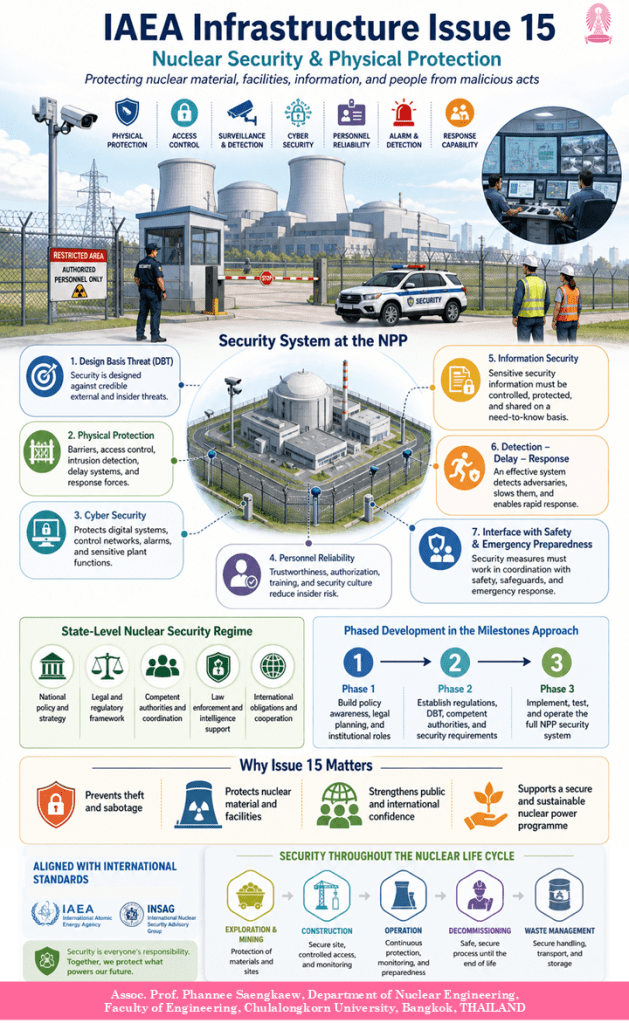
ประเด็นด้านที่ 15: ความมั่นคงปลอดภัยทางนิวเคลียร์และการป้องกันทางกายภาพในโครงสร้างพื้นฐาน 19 ด้านของ IAEA
1. บทนำ
ประเด็นด้านที่ 15 ของโครงสร้างพื้นฐาน 19 ด้าน ตามแนวทางของทบวงการพลังงานปรมาณูระหว่างประเทศ หรือ IAEA คือ ความมั่นคงปลอดภัยทางนิวเคลียร์ (Nuclear Security) ซึ่งครอบคลุมการจัดเตรียมด้านความมั่นคงปลอดภัยและการป้องกันทางกายภาพที่จำเป็นสำหรับโครงการพลังงานนิวเคลียร์ของประเทศ ซึ่งการป้องกันทางกายภาพของวัสดุนิวเคลียร์และสถานประกอบการทางนิวเคลียร์เป็นหนึ่งในองค์ประกอบเชิงปฏิบัติการที่สำคัญที่สุดของความมั่นคงปลอดภัยทางนิวเคลียร์
เอกสาร IAEA Nuclear Security Series อธิบายความมั่นคงปลอดภัยทางนิวเคลียร์ในกรอบกว้างของการป้องกัน การตรวจพบ และการตอบสนองต่อเหตุการณ์ด้านความมั่นคงปลอดภัยทางนิวเคลียร์ โดยสนับสนุนให้รัฐจัดตั้งระบอบความมั่นคงปลอดภัยทางนิวเคลียร์ระดับชาติที่สอดคล้องกับเครื่องมือระหว่างประเทศที่เกี่ยวข้อง เช่น อนุสัญญาว่าด้วยการป้องกันทางกายภาพของวัสดุนิวเคลียร์ อนุสัญญาระหว่างประเทศว่าด้วยการปราบปรามการกระทำการก่อการร้ายทางนิวเคลียร์ และมติคณะมนตรีความมั่นคงแห่งสหประชาชาติที่เกี่ยวข้อง เช่น มติที่ 1373 และ 1540
ความมั่นคงปลอดภัยทางนิวเคลียร์เกี่ยวข้องกับ การป้องกัน การตรวจพบ และการตอบสนอง ต่อการโจรกรรม การก่อวินาศกรรม การเข้าถึงโดยไม่ได้รับอนุญาต การถ่ายโอนอย่างผิดกฎหมาย และการกระทำโดยเจตนาร้ายอื่น ๆ ที่เกี่ยวข้องกับวัสดุนิวเคลียร์ วัสดุกัมมันตรังสีอื่น ๆ สถานประกอบการที่เกี่ยวข้อง และกิจกรรมงานที่เกี่ยวข้อง แนวคิดนี้มิได้จำกัดเฉพาะการป้องกันโรงไฟฟ้านิวเคลียร์เท่านั้น แต่ยังรวมถึงการควบคุมวัสดุนิวเคลียร์และวัสดุกัมมันตรังสีตลอดวัฏจักรการใช้งาน การขนส่ง การจัดเก็บ การใช้งานในอุตสาหกรรม การแพทย์ การวิจัย และการดำเนินกิจกรรมอื่น ๆ ที่อาจก่อให้เกิดความเสี่ยงหากถูกนำไปใช้ในทางที่ผิด
ภายในบริบทของโครงการพลังงานนิวเคลียร์ ความมั่นคงปลอดภัยทางนิวเคลียร์ไม่ควรถูกมองว่าเป็นเพียงกิจกรรมของเจ้าหน้าที่รักษาความปลอดภัยหรือการติดตั้งรั้ว กล้องวงจรปิด และระบบควบคุมทางเข้าเท่านั้น หากแต่เป็นหน้าที่เชิงโครงสร้างพื้นฐานระดับชาติที่เชื่อมโยงกฎหมาย กฎระเบียบ หน่วยข่าวกรอง การควบคุมชายแดน การออกแบบสถานประกอบการ การป้องกันภัยคุกคามทางไซเบอร์ ความน่าเชื่อถือของบุคลากร การตอบสนองต่อเหตุการณ์ และความร่วมมือระหว่างประเทศเข้าด้วยกัน จุดมุ่งหมายสำคัญของประเด็นนี้คือการทำให้มั่นใจว่าวัสดุนิวเคลียร์และวัสดุกัมมันตรังสีอยู่ภายใต้การควบคุมที่มีประสิทธิภาพ และสถานประกอบการทางนิวเคลียร์ได้รับการคุ้มครองจากการกระทำโดยเจตนาร้ายที่อาจนำไปสู่ผลกระทบทางรังสีที่ไม่อาจยอมรับได้
2. ขอบเขตเชิงแนวคิดของความมั่นคงปลอดภัยทางนิวเคลียร์และการป้องกันทางกายภาพ
ความมั่นคงปลอดภัยทางนิวเคลียร์มีความแตกต่างจากความปลอดภัยทางนิวเคลียร์ แม้ว่าทั้งสองด้านจำเป็นต้องมีการประสานงานกันอย่างใกล้ชิดก็ตาม ความปลอดภัยทางนิวเคลียร์ (nuclear safety) มุ่งเน้นการป้องกันอุบัติเหตุและการคุ้มครองประชาชนและสิ่งแวดล้อมจากความล้มเหลวที่ไม่ได้เกิดจากเจตนา ในขณะที่ ความมั่นคงปลอดภัยทางนิวเคลียร์ (nuclear security) มุ่งเน้นการป้องกัน การตรวจพบ การหน่วงเวลา และการตอบสนองต่อการกระทำโดยเจตนาร้าย อย่างไรก็ตาม ในทางปฏิบัติ ทั้งสองด้านมีความเชื่อมโยงกันอย่างมาก เนื่องจากการกระทำโดยเจตนาร้ายอาจก่อให้เกิดผลกระทบด้านความปลอดภัยได้ ตัวอย่างเช่น การก่อวินาศกรรมต่อระบบหล่อเย็น ระบบจ่ายไฟ ระบบเครื่องมือวัดและควบคุม หรือระบบควบคุมการเข้าถึง อาจส่งผลกระทบโดยตรงต่อหน้าที่ด้านความปลอดภัยของโรงไฟฟ้านิวเคลียร์ ด้วยเหตุนี้ เอกสาร Milestones ของ IAEA จึงเน้นว่าหน่วยงานที่มีหน้าที่ด้านความมั่นคงปลอดภัยควรมีการประสานงานกับหน่วยงานที่รับผิดชอบด้านความปลอดภัยทางนิวเคลียร์และพิทักษ์ความปลอดภัยทางนิวเคลียร์ เพื่อให้กิจกรรมต่าง ๆ มีความสอดคล้องและเสริมแรงซึ่งกันและกัน
การป้องกันทางกายภาพเป็นองค์ประกอบหลักของความมั่นคงปลอดภัยทางนิวเคลียร์ โดยประกอบด้วยสิ่งกีดขวางทางวิศวกรรม การควบคุมการเข้าถึง ระบบตรวจจับ ระบบหน่วงเวลา การจัดเตรียมกำลังตอบสนอง กำลังรักษาความปลอดภัยที่อาจมีอาวุธหรือไม่มีอาวุธขึ้นอยู่กับกฎหมายของประเทศ และแผนเผชิญเหตุ การป้องกันทางกายภาพมิได้จำกัดอยู่เฉพาะแนวรั้วรอบโรงไฟฟ้านิวเคลียร์เท่านั้น แต่ยังครอบคลุมการป้องกันวัสดุนิวเคลียร์ระหว่างการจัดเก็บ การใช้งาน และการขนส่ง การป้องกันพื้นที่สำคัญของสถานประกอบการ การป้องกันภัยคุกคามจากบุคคลภายใน และการป้องกันการก่อวินาศกรรมต่อระบบหรือโครงสร้างที่มีความสำคัญต่อความปลอดภัยของสถานประกอบการ
ระบบความมั่นคงปลอดภัยทางนิวเคลียร์ที่ครบถ้วน จึงประกอบด้วยหลายชั้นที่พึ่งพาอาศัยกัน ชั้นแรกคือ ระบอบความมั่นคงปลอดภัยทางนิวเคลียร์ระดับรัฐ (State-level nuclear security regime) ซึ่งกำหนดนโยบายระดับชาติ อำนาจตามกฎหมาย สถาบันที่มีหน้าที่รับผิดชอบ และพันธกรณีระหว่างประเทศ ชั้นที่สองคือ ระบบกำกับดูแลและการอนุญาต (regulatory and authorization system) ซึ่งเป็นกลไกที่ใช้กำหนดข้อกำหนดด้านความมั่นคงปลอดภัยและตรวจสอบการปฏิบัติตาม ชั้นที่สามคือ ระบบป้องกันทางกายภาพระดับผู้ดำเนินการ (operator-level physical protection system) ซึ่งแปลงข้อกำหนดของรัฐให้เป็นมาตรการเฉพาะสำหรับสถานประกอบการ และชั้นที่สี่คือ ระบบตอบสนอง (response system) ซึ่งเกี่ยวข้องกับผู้ดำเนินการ หน่วยบังคับใช้กฎหมาย หน่วยข่าวกรอง หน่วยตอบสนองต่อเหตุฉุกเฉิน และหน่วยงานผู้มีอำนาจอื่น ๆ
3. ภัยคุกคามด้านความมั่นคงปลอดภัยที่ประเด็นด้านที่ 15 ต้องรองรับ
โครงสร้างพื้นฐานด้านความมั่นคงปลอดภัยทางนิวเคลียร์ต้องตั้งอยู่บนพื้นฐานของการประเมินภัยคุกคามที่น่าเชื่อถือ แนวทางของ IAEA เน้นว่ามาตรการด้านความมั่นคงปลอดภัยทางนิวเคลียร์ของรัฐควรตั้งอยู่บนการประเมินภัยคุกคามในปัจจุบันของรัฐนั้น ๆ ซึ่งมักแสดงออกในรูปของการประเมินภัยคุกคามระดับชาติ (national threat assessment) และสำหรับสถานประกอบการที่อาจมีผลกระทบสูง เช่น โรงไฟฟ้านิวเคลียร์ อาจต้องกำหนดภัยคุกคามตามฐานการออกแบบ (design basis threat, DBT)
ประเภทภัยคุกคามหลักประกอบด้วย การนำวัสดุนิวเคลียร์ออกไปโดยไม่ได้รับอนุญาต การก่อวินาศกรรมต่อสถานประกอบการทางนิวเคลียร์หรือวัสดุนิวเคลียร์ การใช้วัสดุกัมมันตรังสีโดยเจตนาร้าย การโจมตีหรือแทรกแซงระบบดิจิทัล การกระทำของบุคคลภายใน และการโจมตีแบบประสานงานที่ใช้ทั้งช่องทางทางกายภาพและช่องทางทางไซเบอร์ร่วมกัน เอกสาร Milestones ของ IAEA ระบุอย่างชัดเจนว่า เนื่องจากอุปกรณ์ดิจิทัลถูกใช้อย่างแพร่หลายมากขึ้นในอุตสาหกรรมนิวเคลียร์ กรอบกฎหมายและกฎระเบียบจึงควรคำนึงถึงความมั่นคงปลอดภัยทางคอมพิวเตอร์ เพื่อป้องกันไม่ให้การถูกโจมตีหรือการถูกแทรกแซงของระบบดิจิทัลกลายเป็นปัจจัยที่นำไปสู่เหตุการณ์ด้านความปลอดภัยหรือความมั่นคงปลอดภัยทางนิวเคลียร์
ภัยคุกคามตามฐานการออกแบบ (DBT) มีความสำคัญอย่างยิ่ง เพราะเป็นเครื่องมือที่ใช้กำหนดลักษณะและขีดความสามารถของฝ่ายตรงข้ามหรือผู้ก่อการที่ระบบป้องกันต้องสามารถรับมือได้ ภัยคุกคามแบบDBT อาจพิจารณาถึงฝ่ายตรงข้ามจากภายนอก บุคคลภายใน การสมรู้ร่วมคิดระหว่างบุคคลภายในและบุคคลภายนอก การใช้อาวุธหรือเครื่องมือเฉพาะ ความสามารถทางไซเบอร์ ภัยคุกคามที่เกี่ยวข้องกับการขนส่ง และเส้นทางที่เป็นไปได้ของการก่อวินาศกรรม ภัยคุกคามแบบ DBT ไม่ใช่เอกสารที่จัดทำครั้งเดียวแล้วใช้ตลอดไป แต่ต้องได้รับการทบทวนและปรับปรุงเมื่อสภาพแวดล้อมด้านภัยคุกคามเปลี่ยนแปลง
4. ความรับผิดชอบของรัฐและการจัดวางสถาบัน
หลักการสำคัญของประเด็นด้านที่ 15 คือ ความมั่นคงปลอดภัยทางนิวเคลียร์เป็นความรับผิดชอบของรัฐ (State responsibility) ผู้ดำเนินการโรงไฟฟ้าหรือสถานประกอบการมีความรับผิดชอบโดยตรงในการดำเนินมาตรการด้านความมั่นคงปลอดภัย ณ สถานประกอบการ แต่รัฐต้องเป็นผู้จัดตั้งกรอบระดับชาติที่ใช้ในการออกแบบ อนุญาต ตรวจสอบ ทดสอบ และบังคับใช้มาตรการเหล่านั้น แนวทางของ IAEA เกี่ยวกับการจัดตั้งโครงสร้างพื้นฐานด้านความมั่นคงปลอดภัยทางนิวเคลียร์ระบุว่า โครงสร้างพื้นฐานระดับชาติที่มีประสิทธิภาพเป็นสิ่งจำเป็นสำหรับรัฐที่กำลังเริ่มต้นโครงการพลังงานนิวเคลียร์ และมีความสำคัญอย่างยิ่งต่อการทำให้มั่นใจว่าวัสดุนิวเคลียร์และวัสดุกัมมันตรังสีอื่น ๆ จะไม่ตกไปอยู่ในมือของบุคคลหรือกลุ่มบุคคลที่อาจนำไปใช้ในการกระทำผิดทางอาญาหรือการก่อการร้าย
กรอบสถาบันโดยทั่วไปเกี่ยวข้องกับหน่วยงานหลายประเภท ได้แก่ หน่วยงานกำกับดูแลนิวเคลียร์ หน่วยงานความมั่นคงและข่าวกรองของชาติ ตำรวจ ทหารหรือหน่วยตอบสนองเฉพาะทาง ศุลกากรและหน่วยควบคุมชายแดน หน่วยงานด้านการขนส่ง หน่วยงานจัดการเหตุฉุกเฉิน หน่วยงานอัยการ และผู้รับใบอนุญาตหรือผู้ดำเนินการสถานประกอบการ เอกสาร Milestones ของ IAEA ระบุว่าหน่วยงานที่ได้รับมอบหมายหน้าที่ด้านความมั่นคงปลอดภัยทางนิวเคลียร์อาจรวมถึงหน่วยงานความมั่นคงและข่าวกรอง หน่วยงานกำกับดูแลนิวเคลียร์ ศุลกากรและการป้องกันชายแดน รวมถึงผู้ดำเนินการสถานประกอบการที่ได้รับใบอนุญาต
ความท้าทายสำคัญสำหรับประเทศที่เริ่มต้นโครงการนิวเคลียร์ใหม่คือ ความมั่นคงปลอดภัยทางนิวเคลียร์ไม่สามารถสร้างขึ้นได้เฉพาะภายในหน่วยงานกำกับดูแลนิวเคลียร์เพียงหน่วยงานเดียว แต่ต้องอาศัยการประสานงานระหว่างหน่วยงาน ความชัดเจนทางกฎหมาย ขั้นตอนการแลกเปลี่ยนข้อมูล และความชัดเจนของสายการบังคับบัญชา ตัวอย่างเช่น หน่วยงานกำกับดูแลอาจมีหน้าที่อนุมัติและตรวจสอบแผนรักษาความมั่นคงปลอดภัยของผู้ดำเนินการ แต่ตำรวจหรือหน่วยงานความมั่นคงอาจมีหน้าที่รับผิดชอบการตอบสนองด้วยกำลัง ศุลกากรอาจมีหน้าที่ควบคุมวัสดุกัมมันตรังสีที่ชายแดน ขณะที่หน่วยข่าวกรองอาจเป็นผู้ให้ข้อมูลด้านภัยคุกคาม หากไม่มีการจัดสรรอำนาจหน้าที่อย่างชัดเจน มาตรการด้านความมั่นคงปลอดภัยอาจกระจัดกระจาย ซ้ำซ้อน หรือไม่มีประสิทธิภาพเพียงพอ
5. กรอบกฎหมายและกฎระเบียบสำหรับความมั่นคงปลอดภัยทางนิวเคลียร์
กรอบกฎหมายด้านความมั่นคงปลอดภัยทางนิวเคลียร์ควรกำหนดอำนาจในการกำกับดูแล การอนุญาต การตรวจสอบ การบังคับใช้กฎหมาย การดำเนินคดี และความร่วมมือระหว่างประเทศ กฎหมายควรกำหนดความผิดที่เกี่ยวข้องกับการครอบครองโดยไม่ได้รับอนุญาต การก่อวินาศกรรม การลักลอบขน การโจรกรรม การพยายามโจรกรรม การให้ความช่วยเหลือจากบุคคลภายใน และการใช้วัสดุนิวเคลียร์หรือวัสดุกัมมันตรังสีโดยเจตนาร้าย นอกจากนี้ กฎหมายควรให้อำนาจในการคุ้มครองข้อมูลที่มีความอ่อนไหว การควบคุมการเข้าถึงสถานประกอบการทางนิวเคลียร์ การตรวจสอบความน่าเชื่อถือของบุคลากร และการกำกับดูแลความมั่นคงปลอดภัยระหว่างการขนส่ง
เอกสาร Milestones ของ IAEA ระบุว่านโยบายและยุทธศาสตร์ด้านความมั่นคงปลอดภัยทางนิวเคลียร์ของรัฐควรระบุพันธกรณีระหว่างประเทศ จัดให้มีโครงสร้างพื้นฐานด้านความมั่นคงปลอดภัยทางนิวเคลียร์ที่ครอบคลุม มอบหมายความรับผิดชอบเชิงสถาบัน และระบุมาตรการตอบสนองต่อเหตุการณ์ด้านความมั่นคงปลอดภัยทางนิวเคลียร์บนพื้นฐานของการประเมินภัยคุกคามระดับชาติหรือ DBT เอกสารดังกล่าวยังระบุด้วยว่า ในระยะที่ 1 ควรมีการระบุเครื่องมือระหว่างประเทศที่เกี่ยวข้อง และองค์ประกอบที่จำเป็นของกรอบกฎหมายและกฎระเบียบภายในประเทศสำหรับความมั่นคงปลอดภัยทางนิวเคลียร์
กรอบกฎระเบียบควรกำหนดให้ผู้ดำเนินการต้องจัดทำและเสนอแผนความมั่นคงปลอดภัย การออกแบบระบบป้องกันทางกายภาพ แผนเผชิญเหตุ การจัดการความมั่นคงปลอดภัยทางไซเบอร์ แผนความมั่นคงปลอดภัยในการขนส่ง และมาตรการด้านความน่าเชื่อถือของบุคลากร นอกจากนี้ ควรให้อำนาจแก่หน่วยงานกำกับดูแลในการตรวจสอบ การทดสอบสมรรถนะ การกำหนดมาตรการแก้ไข การบังคับใช้ และการประเมินซ้ำเป็นระยะ หน่วยงานกำกับดูแลต้องมีความสามารถทางเทคนิคเพียงพอในการประเมินว่ามาตรการป้องกันมีความน่าเชื่อถือเพียงพอต่อภัยคุกคามตามฐานการออกแบบหรือไม่ และผู้ดำเนินการมีความสามารถในการตรวจพบ หน่วงเวลา และตอบสนองต่อความพยายามกระทำโดยเจตนาร้ายได้จริงหรือไม่
6. ระบบป้องกันทางกายภาพ: หน้าที่หลัก
ระบบป้องกันทางกายภาพโดยทั่วไปได้รับการประเมินผ่านหน้าที่พื้นฐานสามประการ ได้แก่ การตรวจพบ (detection) การหน่วงเวลา (delay) และ การตอบสนอง (response) การตรวจพบหมายถึงการค้นพบการเข้าถึงโดยไม่ได้รับอนุญาต การบุกรุก ความพยายามนำวัสดุออกไปโดยไม่ได้รับอนุญาต กิจกรรมก่อวินาศกรรม หรือพฤติกรรมผิดปกติได้อย่างทันท่วงที การหน่วงเวลาหมายถึงสิ่งกีดขวางทางกายภาพและขั้นตอนปฏิบัติที่ทำให้ฝ่ายตรงข้ามเคลื่อนที่หรือดำเนินการได้ช้าลง เพื่อให้มีเวลาเพียงพอสำหรับกำลังตอบสนอง ส่วนการตอบสนองหมายถึงการกระทำของเจ้าหน้าที่รักษาความปลอดภัยของสถานประกอบการ หน่วยบังคับใช้กฎหมาย หรือผู้ตอบสนองที่ได้รับมอบหมาย เพื่อขัดขวางและยุติภัยคุกคาม
สำหรับสถานประกอบการทางนิวเคลียร์ หน้าที่เหล่านี้ต้องนำไปใช้ตามแนวทางแบบลำดับชั้นตามระดับความเสี่ยง หรือ graded approach พื้นที่และวัสดุที่มีความสำคัญด้านความมั่นคงปลอดภัยสูงย่อมต้องการการป้องกันที่เข้มแข็งกว่า ตัวอย่างเช่น พื้นที่สำคัญต่อความปลอดภัย ห้องควบคุม พื้นที่เก็บเชื้อเพลิงใช้แล้ว พื้นที่เก็บวัสดุนิวเคลียร์ และระบบที่จำเป็นต่อการป้องกันการปลดปล่อยรังสี อาจต้องมีการควบคุมการเข้าถึง ระบบตรวจจับการบุกรุก ระบบเฝ้าระวัง สิ่งกีดขวาง และการวางแผนตอบสนองที่เข้มงวดกว่าพื้นที่ที่มีผลกระทบต่ำกว่า
ระบบป้องกันทางกายภาพควรได้รับการออกแบบตั้งแต่ระยะเริ่มต้นของการวางแผนสถานประกอบการ แนวคิด security-by-design หรือการผนวกความมั่นคงปลอดภัยเข้าไปตั้งแต่ขั้นตอนการออกแบบ เป็นแนวทางที่ดีกว่าการติดตั้งระบบความมั่นคงปลอดภัยเพิ่มเติมภายหลังจากที่ผังสถานประกอบการถูกกำหนดเรียบร้อยแล้ว สำหรับโครงการโรงไฟฟ้านิวเคลียร์ใหม่ การบูรณาการตั้งแต่ต้นช่วยให้การออกแบบสามารถรวมเขตพื้นที่คุ้มครอง แนวกั้นยานพาหนะ เส้นทางเข้าออกที่ควบคุมได้ ศูนย์รับสัญญาณเตือนกลาง ช่องทางสื่อสารที่มีการป้องกัน แสงสว่างเพื่อการรักษาความปลอดภัย พื้นที่ตรวจค้น ป้อมยาม และโครงสร้างระบบดิจิทัลที่มีความมั่นคงปลอดภัยทางไซเบอร์เข้าไว้ด้วยกัน หากประเด็นเหล่านี้ถูกพิจารณาล่าช้า ต้นทุน ความซับซ้อน และภาระเชิงปฏิบัติการของระบบความมั่นคงปลอดภัยอาจเพิ่มขึ้นอย่างมีนัยสำคัญ
7. ความมั่นคงปลอดภัยทางไซเบอร์และความมั่นคงปลอดภัยของข้อมูล
โรงไฟฟ้านิวเคลียร์สมัยใหม่พึ่งพาระบบดิจิทัลอย่างมาก ไม่ว่าจะเป็นระบบเครื่องมือวัดและควบคุม ระบบคอมพิวเตอร์ของโรงไฟฟ้า เครือข่ายสื่อสาร ระบบรักษาความปลอดภัย ระบบควบคุมการเข้าถึง และแพลตฟอร์มการจัดการข้อมูล ด้วยเหตุนี้ ความมั่นคงปลอดภัยทางไซเบอร์ (Cyber security) จึงกลายเป็นส่วนหนึ่งของความมั่นคงปลอดภัยทางนิวเคลียร์อย่างหลีกเลี่ยงไม่ได้ เอกสาร Milestones ของ IAEA ระบุอย่างชัดเจนว่ากรอบกฎหมายและกฎระเบียบควรคำนึงถึงความมั่นคงปลอดภัยทางคอมพิวเตอร์ เนื่องจากการถูกแทรกแซงหรือทำลายระบบดิจิทัลอาจนำไปสู่เหตุการณ์ด้านความปลอดภัยหรือความมั่นคงปลอดภัยทางนิวเคลียร์ได้ ในบริบทนิวเคลียร์ ความมั่นคงปลอดภัยทางไซเบอร์ควรคุ้มครองทั้งสินทรัพย์ดิจิทัลที่เกี่ยวข้องกับความปลอดภัยและสินทรัพย์ดิจิทัลที่เกี่ยวข้องกับความมั่นคงปลอดภัย ซึ่งรวมถึงการป้องกันการเข้าถึงโดยไม่ได้รับอนุญาต การติดมัลแวร์ การแก้ไขข้อมูลโดยมิชอบ การรบกวนระบบตรวจติดตาม การแทรกแซงระบบควบคุมการเข้าถึง และการขัดขวางการสื่อสารด้านเหตุฉุกเฉินหรือด้านความมั่นคงปลอดภัย โครงการด้านความมั่นคงปลอดภัยยังต้องคุ้มครองข้อมูลนิวเคลียร์ที่มีความอ่อนไหว เช่น ผังสถานประกอบการ แผนความมั่นคงปลอดภัย ข้อมูล DBT รายละเอียดระบบสัญญาณเตือน โครงสร้างเครือข่ายไซเบอร์ ตารางการขนส่งวัสดุ และผลการประเมินจุดอ่อนหรือความเปราะบางของระบบ
ความมั่นคงปลอดภัยของข้อมูลเชื่อมโยงอย่างใกล้ชิดกับความน่าเชื่อถือของบุคลากร การเข้าถึงข้อมูลด้านความมั่นคงปลอดภัยทางนิวเคลียร์ที่มีความอ่อนไหวควรถูกจำกัดไว้เฉพาะบุคคลที่มีความจำเป็นต้องรู้ตามหน้าที่เท่านั้น ขั้นตอนปฏิบัติควรครอบคลุมการจัดชั้นความลับ การจัดเก็บ การส่งต่อ การเก็บรักษา การทำลาย และการรายงานเหตุการณ์ผิดปกติ ประเด็นนี้มีความสำคัญเป็นพิเศษในระหว่างการมีส่วนร่วมของผู้ขายเทคโนโลยี การก่อสร้าง การทดสอบเดินระบบ และความร่วมมือทางเทคนิคระหว่างประเทศ เนื่องจากองค์กรภายนอกจำนวนมากอาจจำเป็นต้องเข้าถึงข้อมูลของโครงการในระดับที่ต้องมีการควบคุมอย่างรัดกุม
8. วัฒนธรรมความมั่นคงปลอดภัยทางนิวเคลียร์และความน่าเชื่อถือของมนุษย์
เทคโนโลยีเพียงอย่างเดียวไม่สามารถรับประกันความมั่นคงปลอดภัยทางนิวเคลียร์ได้ จำเป็นต้องมี วัฒนธรรมความมั่นคงปลอดภัยทางนิวเคลียร์ (nuclear security culture) ที่เข้มแข็งในทุกระดับ ตั้งแต่หน่วยงานของรัฐ หน่วยงานกำกับดูแล ผู้ดำเนินการ ผู้รับเหมา และองค์กรสนับสนุน วัฒนธรรมความมั่นคงปลอดภัยหมายถึงการที่บุคลากรเข้าใจความสำคัญของความมั่นคงปลอดภัยทางนิวเคลียร์ เคารพขั้นตอนปฏิบัติ รายงานข้อกังวล ปกป้องข้อมูล และรักษาความตื่นตัวต่อภัยคุกคามจากทั้งบุคคลภายในและภายนอก
เอกสาร Milestones ของ IAEA เน้นว่าองค์กรทั้งหมดที่ได้รับมอบหมายหน้าที่ด้านความมั่นคงปลอดภัยทางนิวเคลียร์จำเป็นต้องตระหนักถึงความสำคัญของความมั่นคงปลอดภัยทางนิวเคลียร์ และต้องสนับสนุนการพัฒนาวัฒนธรรมความมั่นคงปลอดภัยทางนิวเคลียร์อย่างจริงจัง ประเด็นนี้มีความสำคัญอย่างยิ่ง เนื่องจากความล้มเหลวด้านความมั่นคงปลอดภัยมักไม่ได้เกิดจากความบกพร่องของอุปกรณ์เพียงอย่างเดียว แต่ยังเกิดจากความประมาท ความเคยชิน การสื่อสารที่ไม่ดี การกำกับดูแลที่อ่อนแอ การฝึกอบรมไม่เพียงพอ หรือการยอมรับพฤติกรรมเบี่ยงเบนจนกลายเป็นเรื่องปกติ
โปรแกรมความน่าเชื่อถือของบุคลากรเป็นองค์ประกอบที่จำเป็นเช่นกัน โปรแกรมเหล่านี้อาจรวมถึงการตรวจสอบประวัติ การยืนยันตัวตน การอนุญาตให้เข้าถึงพื้นที่ การสังเกตพฤติกรรมหรือสภาพจิตใจภายใต้กรอบที่กฎหมายอนุญาต นโยบายเกี่ยวกับสารเสพติดและแอลกอฮอล์ การประเมินอย่างต่อเนื่อง และขั้นตอนการยกเลิกสิทธิการเข้าถึงเมื่อมีสัญญาณความเสี่ยง สำหรับสถานประกอบการทางนิวเคลียร์ ภัยคุกคามจากบุคคลภายในมีความสำคัญเป็นพิเศษ เนื่องจากบุคคลภายในอาจมีความรู้เกี่ยวกับผังสถานประกอบการ ขั้นตอนรักษาความปลอดภัย ระบบการเข้าถึง และจุดเปราะบางเชิงปฏิบัติการของโรงไฟฟ้า
9. การบูรณาการกับความปลอดภัย พิทักษ์ความปลอดภัยนิวเคลียร์ และการเตรียมพร้อมรับเหตุฉุกเฉิน
ประเด็นที่ 15 ต้องดำเนินการโดยประสานกับโครงสร้างพื้นฐานประเด็นอื่น ๆ หลายประเด็น การบูรณาการที่สำคัญที่สุด ได้แก่ ประเด็นที่ 2 ความปลอดภัยทางนิวเคลียร์ ประเด็นที่ 5 กรอบกฎหมาย ประเด็นที่ 6 พิทักษ์ความปลอดภัยนิวเคลียร์ ประเด็นที่ 7 กรอบการกำกับดูแล ประเด็นที่ 10 การพัฒนาทรัพยากรมนุษย์ ประเด็นที่ 14 การเตรียมพร้อมและการตอบสนองต่อเหตุฉุกเฉิน และ ประเด็นที่ 19 การจัดซื้อจัดจ้าง
การบูรณาการระหว่างความปลอดภัยและความมั่นคงปลอดภัยมีความสำคัญ เนื่องจากมาตรการด้านความมั่นคงปลอดภัยบางประการอาจมีผลต่อความปลอดภัย และมาตรการด้านความปลอดภัยบางประการอาจมีผลต่อความมั่นคงปลอดภัย ตัวอย่างเช่น ทางออกฉุกเฉินต้องเอื้อต่อการอพยพ แต่ไม่ควรกลายเป็นช่องทางการเข้าถึงที่ไม่มีการควบคุม ระบบดิจิทัลที่เกี่ยวข้องกับความปลอดภัยต้องได้รับการป้องกันจากการโจมตีทางไซเบอร์ แต่ในขณะเดียวกันมาตรการควบคุมทางไซเบอร์ไม่ควรขัดขวางการดำเนินการด้านความปลอดภัยที่ได้รับอนุญาตในสถานการณ์ฉุกเฉิน สิ่งกีดขวางด้านความมั่นคงปลอดภัยควรหน่วงเวลาฝ่ายตรงข้าม แต่ไม่ควรกีดขวางการตอบสนองต่อเหตุฉุกเฉินหรือการดับเพลิง
การบูรณาการระหว่างพิทักษ์ความปลอดภัยนิวเคลียร์และความมั่นคงปลอดภัยก็มีความสำคัญเช่นกัน เนื่องจากระบบบัญชีและการควบคุมวัสดุนิวเคลียร์สามารถสนับสนุนการตรวจพบการนำวัสดุออกไปโดยไม่ได้รับอนุญาตได้ พิทักษ์ความปลอดภัยนิวเคลียร์มีวัตถุประสงค์หลักด้านการตรวจพิสูจน์เพื่อการไม่แพร่ขยายอาวุธนิวเคลียร์ ขณะที่ความมั่นคงปลอดภัยทางนิวเคลียร์มุ่งเน้นการป้องกันการกระทำโดยเจตนาร้ายจากผู้กระทำที่ไม่ใช่รัฐหรือภัยคุกคามอื่น ๆ แม้ว่าวัตถุประสงค์จะแตกต่างกัน แต่ทั้งสองด้านอาศัยระบบควบคุมวัสดุที่แม่นยำ บันทึกข้อมูลที่เชื่อถือได้ การควบคุมการเข้าถึง และความรับผิดชอบเชิงสถาบัน
การบูรณาการระหว่างการเตรียมพร้อมรับเหตุฉุกเฉินและความมั่นคงปลอดภัยมีความสำคัญอย่างยิ่ง เนื่องจากเหตุการณ์ด้านความมั่นคงปลอดภัยทางนิวเคลียร์อาจต้องอาศัยทั้งการตอบสนองด้านความมั่นคงปลอดภัยและการตอบสนองต่อเหตุฉุกเฉินทางรังสี เอกสาร Milestones ของ IAEA ระบุว่า ในระยะที่ 2 ควรมีการมอบหมายบทบาทและความรับผิดชอบสำหรับการเตรียมการ การตรวจพบ และการตอบสนองต่อเหตุการณ์ด้านความมั่นคงปลอดภัยทางนิวเคลียร์ ส่วนในระยะที่ 3 มาตรการด้านความมั่นคงปลอดภัยต้องถูกนำมาใช้เพิ่มขึ้นอย่างต่อเนื่อง เพื่อรักษาความมั่นคงปลอดภัยของพื้นที่โรงไฟฟ้านิวเคลียร์ระหว่างการก่อสร้างและก่อนการมาถึงของเชื้อเพลิงนิวเคลียร์
10. การพัฒนาเป็นระยะตามแนวทาง IAEA Milestones
แนวทาง IAEA Milestones แบ่งการพัฒนาโครงสร้างพื้นฐานพลังงานนิวเคลียร์ออกเป็นสามระยะ ได้แก่ ระยะที่ 1 ซึ่งเป็นการพิจารณาก่อนการตัดสินใจเริ่มโครงการพลังงานนิวเคลียร์ ระยะที่ 2 ซึ่งเป็นการเตรียมงานสำหรับการทำสัญญาและการก่อสร้างหลังจากมีการตัดสินใจเชิงนโยบาย และระยะที่ 3 ซึ่งเป็นกิจกรรมเพื่อดำเนินการโรงไฟฟ้านิวเคลียร์แห่งแรก จุดหมุดหมายที่สอดคล้องกับแต่ละระยะคือ ความพร้อมในการให้คำมั่นอย่างมีความรู้ ความพร้อมในการเชิญชวนให้ยื่นข้อเสนอหรือเจรจาสัญญา และความพร้อมในการเดินเครื่องโรงไฟฟ้านิวเคลียร์แห่งแรก
ระยะที่ 1: ก่อนการตัดสินใจเริ่มโครงการพลังงานนิวเคลียร์
ในระยะที่ 1 ความมั่นคงปลอดภัยทางนิวเคลียร์ควรถูกพิจารณาในระดับยุทธศาสตร์ องค์กรดำเนินการโครงการพลังงานนิวเคลียร์ หรือองค์กรประสานงานระดับชาติที่ทำหน้าที่เทียบเท่า ควรประเมินว่าประเทศมีความสามารถทางกฎหมาย สถาบัน ทรัพยากรมนุษย์ และเทคนิคเพียงพอหรือไม่ในการจัดตั้งระบอบความมั่นคงปลอดภัยทางนิวเคลียร์ระดับชาติ รายงานระยะที่ 1 ควรมีข้อเสนอแนะเกี่ยวกับนโยบายและยุทธศาสตร์ด้านความมั่นคงปลอดภัยทางนิวเคลียร์ระดับชาติ บทบาทและความรับผิดชอบของหน่วยงานรัฐ และข้อสรุปเบื้องต้นจากการพิจารณาสภาพแวดล้อมด้านภัยคุกคามของประเทศ
เอกสาร Milestones ของ IAEA ระบุว่า รายงานระยะที่ 1 ควรระบุเครื่องมือระหว่างประเทศที่เกี่ยวข้อง ระบุองค์ประกอบที่จำเป็นของกรอบกฎหมายและกฎระเบียบภายในประเทศ และประเมินความต้องการด้านทรัพยากรมนุษย์และความเชี่ยวชาญที่จำเป็นต่อการจัดตั้งกรอบดังกล่าว ดังนั้น ระยะนี้มิใช่ระยะของการออกแบบระบบรักษาความมั่นคงปลอดภัยของโรงไฟฟ้าอย่างสมบูรณ์ แต่เป็นระยะที่ทำให้มั่นใจว่ารัฐเข้าใจพันธกรณี สถาบัน สมรรถนะ และภาระผูกพันระยะยาวที่จำเป็นสำหรับความมั่นคงปลอดภัยทางนิวเคลียร์
เมื่อสิ้นสุดระยะที่ 1 ประเทศควรสามารถแสดงให้เห็นได้ว่าความมั่นคงปลอดภัยทางนิวเคลียร์ได้รับการบูรณาการเข้าไปในจุดยืนแห่งชาติ และมีแผนที่น่าเชื่อถือสำหรับการพัฒนาโครงสร้างพื้นฐานทางกฎหมายและกฎระเบียบ นอกจากนี้ ประเทศควรตระหนักว่าความมั่นคงปลอดภัยต้องได้รับการสนับสนุนด้านงบประมาณและรักษาไว้อย่างต่อเนื่องตลอดวัฏจักรนิวเคลียร์ ตั้งแต่การก่อสร้าง การเดินเครื่อง การขนส่งเชื้อเพลิง การจัดการเชื้อเพลิงใช้แล้ว ไปจนถึงการรื้อถอน
ระยะที่ 2: การเตรียมงานสำหรับการทำสัญญาและการก่อสร้าง
ระยะที่ 2 เป็นช่วงเวลาที่รัฐต้องเปลี่ยนจากการวางแผนเชิงแนวคิดไปสู่การดำเนินการเชิงสถาบัน กรอบกฎหมายและกฎระเบียบควรถูกจัดตั้งขึ้น หน่วยงานผู้มีอำนาจควรได้รับการมอบหมายหน้าที่และได้รับทรัพยากรที่จำเป็น ข้อกำหนดด้านความมั่นคงปลอดภัยทางนิวเคลียร์สำหรับการป้องกันทางกายภาพของวัสดุนิวเคลียร์และสถานประกอบการทางนิวเคลียร์ควรถูกกำหนดผ่านการพัฒนา DBT หรือแนวทางอื่นที่ตั้งอยู่บนพื้นฐานของภัยคุกคาม
ในระยะนี้ รัฐควรจัดตั้งโปรแกรมสำหรับการจัดการข้อมูลที่มีความอ่อนไหว การพัฒนาวัฒนธรรมความมั่นคงปลอดภัยทางนิวเคลียร์ และความน่าเชื่อถือของบุคลากร นอกจากนี้ ควรมอบหมายบทบาทสำหรับการเตรียมการ การตรวจพบ และการตอบสนองต่อเหตุการณ์ด้านความมั่นคงปลอดภัยทางนิวเคลียร์ สิ่งสำคัญคือ หน่วยงานกำกับดูแลหรือหน่วยงานผู้มีอำนาจต้องเริ่มพัฒนาสมรรถนะในการอนุมัติแผนความมั่นคงปลอดภัยและตรวจสอบสถานประกอบการเพื่อยืนยันประสิทธิผลของมาตรการที่นำมาใช้
ระยะที่ 2 ยังเป็นช่วงเวลาที่เหมาะสมสำหรับการบูรณาการข้อกำหนดด้านความมั่นคงปลอดภัยเข้าไปในกระบวนการจัดซื้อจัดจ้างและการทำสัญญา การประเมินข้อเสนอจากผู้ขายเทคโนโลยีไม่ควรพิจารณาเฉพาะเทคโนโลยีเครื่องปฏิกรณ์ ต้นทุน และกำหนดเวลาเท่านั้น แต่ควรพิจารณาด้วยว่าผู้ขายสามารถสนับสนุน security-by-design ความมั่นคงปลอดภัยทางไซเบอร์ ระบบควบคุมการเข้าถึง การออกแบบระบบป้องกันทางกายภาพ การฝึกอบรม การจัดการข้อมูลที่มีความอ่อนไหว และการพัฒนาขีดความสามารถด้านความมั่นคงปลอดภัยภายในประเทศได้มากน้อยเพียงใด ข้อกำหนดด้านความมั่นคงปลอดภัยควรถูกฝังอยู่ในข้อกำหนดของโครงการก่อนที่การตัดสินใจด้านการออกแบบหลักจะเปลี่ยนแปลงได้ยาก
ระยะที่ 3: กิจกรรมเพื่อดำเนินการโรงไฟฟ้านิวเคลียร์แห่งแรก
ในระยะที่ 3 การจัดเตรียมด้านความมั่นคงปลอดภัยทางนิวเคลียร์ต้องกลายเป็นระบบปฏิบัติการจริง หน่วยงานผู้มีอำนาจควรดำเนินการและปฏิบัติหน้าที่ตามกรอบกฎหมายและกฎระเบียบ ผู้ดำเนินการควรพัฒนา เสนอ ทดสอบ และดำเนินการตามแผนความมั่นคงปลอดภัยเฉพาะสถานประกอบการ แผนเผชิญเหตุ มาตรการความมั่นคงปลอดภัยทางไซเบอร์ มาตรการความมั่นคงปลอดภัยในการขนส่ง และขั้นตอนการป้องกันวัสดุนิวเคลียร์และพื้นที่สำคัญ
มาตรการด้านความมั่นคงปลอดภัยต้องถูกนำมาใช้เพิ่มขึ้นอย่างเป็นลำดับระหว่างการก่อสร้าง เนื่องจากพื้นที่โรงไฟฟ้านิวเคลียร์กลายเป็นพื้นที่ที่มีความอ่อนไหวด้านความมั่นคงปลอดภัยก่อนที่เชื้อเพลิงนิวเคลียร์จะมาถึง การก่อสร้างเกี่ยวข้องกับแรงงานจำนวนมาก ผู้รับเหมา อุปกรณ์นำเข้า เส้นทางเข้าออกชั่วคราว และห่วงโซ่อุปทานที่ซับซ้อน เงื่อนไขเหล่านี้สร้างความเปราะบางที่เกี่ยวข้องกับการเข้าถึงของบุคคลภายใน อุปกรณ์ปลอมหรืออุปกรณ์ที่ถูกแทรกแซง การเปิดเผยข้อมูลที่มีความอ่อนไหว และการถ่ายภาพหรือทำแผนที่โดยไม่ได้รับอนุญาต เมื่อใกล้ถึงช่วงการมาถึงของเชื้อเพลิง ข้อกำหนดด้านการป้องกันทางกายภาพจะยิ่งเข้มงวดมากขึ้น
ก่อนการเดินเครื่อง ระบบความมั่นคงปลอดภัยควรได้รับการทดสอบผ่านการฝึกซ้อม การตรวจสอบ การทดสอบสมรรถนะ และการฝึกซ้อมแบบบูรณาการที่เกี่ยวข้องกับผู้ดำเนินการ หน่วยงานกำกับดูแล หน่วยบังคับใช้กฎหมาย หน่วยตอบสนองต่อเหตุฉุกเฉิน และหน่วยงานผู้มีอำนาจอื่น ๆ วัตถุประสงค์มิใช่เพียงเพื่อแสดงให้เห็นว่าอุปกรณ์ได้รับการติดตั้งแล้วเท่านั้น แต่ต้องแสดงให้เห็นว่าระบบความมั่นคงปลอดภัยทั้งระบบสามารถทำงานได้ภายใต้เงื่อนไขที่สมจริง
11. องค์ประกอบสมรรถนะสำคัญของประเด็นที่ 15
โครงสร้างพื้นฐานด้านความมั่นคงปลอดภัยทางนิวเคลียร์ที่น่าเชื่อถือควรแสดงให้เห็นถึงองค์ประกอบสมรรถนะหลายประการ
ประการแรก รัฐควรมีฐานทางกฎหมายที่ชัดเจนสำหรับความมั่นคงปลอดภัยทางนิวเคลียร์ รวมถึงการกำหนดความผิด อำนาจบังคับใช้ อำนาจกำกับดูแล และกลไกความร่วมมือระหว่างประเทศ
ประการที่สอง หน่วยงานผู้มีอำนาจควรมีหน้าที่รับผิดชอบที่กำหนดไว้อย่างชัดเจนและมีทรัพยากรเพียงพอ ประการที่สาม กระบวนการประเมินภัยคุกคามและการจัดทำ DBT ควรถูกจัดตั้ง ได้รับการคุ้มครอง ทบทวนเป็นระยะ และเชื่อมโยงกับข้อกำหนดระดับสถานประกอบการ
ประการที่สี่ ผู้ดำเนินการควรมีขีดความสามารถในการดำเนินการด้านการป้องกันทางกายภาพ ความมั่นคงปลอดภัยทางไซเบอร์ ความมั่นคงปลอดภัยของข้อมูล ความน่าเชื่อถือของบุคลากร และการวางแผนเผชิญเหตุ ประการที่ห้า หน่วยงานกำกับดูแลควรมีขีดความสามารถในการทบทวน อนุญาต ตรวจสอบ และบังคับใช้ข้อกำหนดด้านความมั่นคงปลอดภัยทางนิวเคลียร์
ประการที่หก การจัดเตรียมการตอบสนองควรได้รับการทดสอบผ่านการฝึกซ้อมที่เกี่ยวข้องกับทุกองค์กรที่เกี่ยวข้อง
ประการที่เจ็ด วัฒนธรรมความมั่นคงปลอดภัยทางนิวเคลียร์ควรถูกพัฒนาและรักษาไว้อย่างต่อเนื่อง
องค์ประกอบเหล่านี้ไม่ควรถูกมองว่าเป็นเพียงเอกสารหรือภาระเชิงธุรการเท่านั้น แต่ต้องถูกแปลงให้เป็นขีดความสามารถเชิงสถาบันที่แท้จริง บุคลากรที่ผ่านการฝึกอบรม สถานประกอบการที่มีการป้องกัน ระบบที่ได้รับการทดสอบ และกลไกการปรับปรุงอย่างต่อเนื่อง ความมั่นคงปลอดภัยทางนิวเคลียร์ไม่สามารถเกิดขึ้นได้เพียงจากการติดตั้งรั้ว กล้อง และเจ้าหน้าที่รักษาความปลอดภัย แต่เกิดจากระบบระดับชาติที่บูรณาการความรู้ด้านภัยคุกคาม การกำกับดูแล การออกแบบสถานประกอบการ วินัยเชิงปฏิบัติการ ความน่าเชื่อถือของมนุษย์ และขีดความสามารถในการตอบสนองเข้าด้วยกัน
12. ข้อพิจารณาเฉพาะสำหรับประเทศเริ่มต้นใหม่และการใช้ SMR
สำหรับประเทศที่เพิ่งเริ่มโครงการนิวเคลียร์ใหม่ ประเด็นด้านที่ 15 มีความท้าทายเฉพาะ เนื่องจากความมั่นคงปลอดภัยทางนิวเคลียร์ต้องการขีดความสามารถที่อาจยังไม่มีอยู่ในระบบของประเทศ ขีดความสามารถเหล่านี้รวมถึงความเชี่ยวชาญด้านการกำกับดูแลเฉพาะทางนิวเคลียร์ การพัฒนา DBT สมรรถนะในการตรวจสอบด้านความมั่นคงปลอดภัย ความเชี่ยวชาญด้านความมั่นคงปลอดภัยทางไซเบอร์สำหรับระบบนิวเคลียร์ การคุ้มครองข้อมูลนิวเคลียร์ที่มีความอ่อนไหว และการประสานงานระหว่างสถาบันนิวเคลียร์กับหน่วยงานความมั่นคงของชาติ
การใช้เครื่องปฏิกรณ์โมดูลาร์ขนาดเล็ก หรือ SMR (Small Modular Reactor) อาจนำมาซึ่งข้อพิจารณาเพิ่มเติม ขนาดหน่วยเครื่องปฏิกรณ์ที่เล็กลง การก่อสร้างแบบโมดูล การผลิตจากโรงงาน การขนส่งโมดูล การตั้งอยู่ในพื้นที่ห่างไกลหรือกระจายตัว และรูปแบบการจัดกำลังคนที่อาจแตกต่างจากโรงไฟฟ้านิวเคลียร์ขนาดใหญ่ ล้วนสามารถเปลี่ยนแปลงลักษณะการวิเคราะห์ด้านความมั่นคงปลอดภัยได้ แม้พื้นที่ทางกายภาพของสถานประกอบการอาจมีขนาดเล็กลง แต่ข้อกำหนดด้านความมั่นคงปลอดภัยไม่ได้หายไป สำหรับบางรูปแบบการใช้ SMR ความมั่นคงปลอดภัยในการขนส่ง ความมั่นคงปลอดภัยทางไซเบอร์ การตรวจติดตามระยะไกล ความมั่นคงปลอดภัยของห่วงโซ่อุปทาน และการป้องกันหลายหน่วยเครื่องปฏิกรณ์ในพื้นที่เดียวกันหรือหลายพื้นที่ อาจมีความสำคัญมากขึ้น ดังนั้น กรอบความมั่นคงปลอดภัยควรมีความเข้าใจต่อเทคโนโลยี แต่ไม่ควรถูกลดทอนด้วยสมมติฐานว่าขนาดที่เล็กลงย่อมหมายถึงความสำคัญด้านความมั่นคงปลอดภัยที่ต่ำลงโดยอัตโนมัติ
13. สรุปเชิงวิชาการ
ประเด็นด้านที่ 15 หรือความมั่นคงปลอดภัยทางนิวเคลียร์ เป็นองค์ประกอบพื้นฐานของโครงสร้างพื้นฐานพลังงานนิวเคลียร์ที่มีความน่าเชื่อถือ ประเด็นนี้ทำให้มั่นใจว่าวัสดุนิวเคลียร์ วัสดุกัมมันตรังสี สถานประกอบการทางนิวเคลียร์ กิจกรรมที่เกี่ยวข้อง และข้อมูลที่มีความอ่อนไหวได้รับการคุ้มครองจากการกระทำโดยเจตนาร้าย ขอบเขตของประเด็นนี้ครอบคลุมการป้องกันทางกายภาพ ความมั่นคงปลอดภัยทางไซเบอร์ ความมั่นคงปลอดภัยของข้อมูล การประเมินภัยคุกคาม การพัฒนา DBT ความน่าเชื่อถือของบุคลากร การจัดเตรียมการตรวจพบและตอบสนอง ความมั่นคงปลอดภัยในการขนส่ง วัฒนธรรมความมั่นคงปลอดภัย และความร่วมมือระหว่างประเทศ
ภายใต้กรอบ IAEA Milestones ความมั่นคงปลอดภัยทางนิวเคลียร์พัฒนาอย่างเป็นลำดับ ระยะที่ 1 สร้างความตระหนักเชิงนโยบาย การวางแผนทางกฎหมาย การจัดทำแผนที่เชื่อมโยงระดับสถาบัน และการคิดเชิงยุทธศาสตร์ที่ตั้งอยู่บนพื้นฐานของภัยคุกคาม ระยะที่ 2 จัดตั้งกรอบกฎหมายและกฎระเบียบ หน่วยงานผู้มีอำนาจ กระบวนการ DBT หรือการประเมินภัยคุกคาม และข้อกำหนดด้านความมั่นคงปลอดภัยก่อนการทำสัญญาและการก่อสร้าง ระยะที่ 3 ดำเนินการและทดสอบระบบความมั่นคงปลอดภัยสำหรับโรงไฟฟ้านิวเคลียร์แห่งแรก รวมถึงการคุ้มครองระหว่างการก่อสร้าง การมาถึงของเชื้อเพลิง การทดสอบเดินระบบ และความพร้อมสำหรับการเดินเครื่อง
จากมุมมองเชิงโครงสร้างพื้นฐาน ความมั่นคงปลอดภัยทางนิวเคลียร์ควรถูกเข้าใจว่าเป็น ระบบระดับชาติของการป้องกัน การตรวจพบ การหน่วงเวลา การตอบสนอง และการฟื้นฟู มิใช่เพียงหน้าที่ของเจ้าหน้าที่รักษาความปลอดภัยระดับสถานประกอบการเท่านั้น ระบบนี้ต้องบูรณาการกับความปลอดภัย พิทักษ์ความปลอดภัยนิวเคลียร์ การเตรียมพร้อมรับเหตุฉุกเฉิน การพัฒนาทรัพยากรมนุษย์ การจัดซื้อจัดจ้าง และธรรมาภิบาลระยะยาว ประเทศที่สามารถพัฒนาประเด็นด้านที่ 15 ได้อย่างมีประสิทธิภาพจะไม่เพียงแต่เสริมสร้างการคุ้มครองโรงไฟฟ้านิวเคลียร์แห่งแรกเท่านั้น แต่ยังเสริมสร้างความเชื่อมั่นของสาธารณะ ความไว้วางใจจากนานาชาติ และความยั่งยืนระยะยาวของโครงการพลังงานนิวเคลียร์ของประเทศด้วย
เอกสารอ้างอิง
International Atomic Energy Agency. (2011). Nuclear Security Recommendations on Physical Protection of Nuclear Material and Nuclear Facilities (INFCIRC/225/Revision 5). IAEA Nuclear Security Series No. 13. Vienna: IAEA. https://doi.org/10.61092/iaea.ko2c-dc4q
International Atomic Energy Agency. (2013). Establishing the Nuclear Security Infrastructure for a Nuclear Power Programme. IAEA Nuclear Security Series No. 19. Vienna: IAEA.
International Atomic Energy Agency. (2013). Objective and Essential Elements of a State’s Nuclear Security Regime. IAEA Nuclear Security Series No. 20. Vienna: IAEA.
International Atomic Energy Agency. (2024). Milestones in the Development of a National Infrastructure for Nuclear Power. IAEA Nuclear Energy Series No. NG-G-3.1, Rev. 2. Vienna: IAEA.
International Atomic Energy Agency. (2024). Nuclear Infrastructure Bibliography. Vienna: IAEA.
 Around Radiation Detectors
ใส่ความเห็น