Issue 9: Electric Grid in the IAEA 19 Nuclear Infrastructure Issues
1. Introduction
Within the IAEA Milestones Approach, Issue 9: Electric Grid refers to the national capability to connect, operate, support, and protect a nuclear power plant through a sufficiently reliable and stable electrical power system. The IAEA Milestones Approach identifies 19 infrastructure issues that must be developed across three phases before a country can make an informed nuclear power decision, prepare for contracting and construction, and finally commission and operate the first nuclear power plant. The IAEA emphasizes that these 19 issues require attention throughout the three phases, and that successful completion of each phase corresponds to achieving the associated milestone.
Issue 9 is sometimes misunderstood as a conventional electricity transmission topic. In reality, for a nuclear power programme, the electric grid is a safety-relevant infrastructure interface. A nuclear power plant is not only a generator that supplies electricity to the grid; it is also a facility that depends on reliable off-site electrical power for safe start-up, normal operation, shutdown, cooling, and post-shutdown safety functions. The IAEA publication Electric Grid Reliability and Interface with Nuclear Power Plants explains that nuclear power plants are connected to the grid both to export generated electricity and to receive electrical power needed for safe start-up, operation, and shutdown.
Therefore, Issue 9 should be treated as a core element of national nuclear infrastructure. It connects energy planning, grid engineering, nuclear safety, emergency preparedness, cyber security, regulatory oversight, and long-term plant operation. For a country introducing nuclear power for the first time, electric grid readiness must be assessed early, because weaknesses in grid capacity, stability, frequency control, voltage control, transmission redundancy, protection coordination, or system operation can directly affect the feasibility and safety of nuclear power deployment.
2. Conceptual Meaning of Issue 9: Electric Grid
Issue 9 concerns the technical and institutional preparedness of the national electric power system to accommodate a nuclear power plant. This includes the ability of the grid to absorb the power output of a nuclear unit, maintain stable voltage and frequency, provide reliable off-site power to the plant, withstand credible disturbances, and coordinate effectively between the nuclear plant operator, transmission system operator, grid regulator, and energy planning authorities.
From a nuclear infrastructure perspective, the grid must perform four major functions.
First, the grid must provide a power evacuation function. This means that the transmission system must be able to receive the electrical output from the nuclear power plant and deliver it to load centres without overloading lines, transformers, substations, protection systems, or interconnections.
Second, the grid must provide a safety-support function. Nuclear power plants require reliable electrical power for cooling systems, control systems, instrumentation, safety systems, and post-shutdown heat removal. Even after a reactor is shut down, decay heat must be removed, and this requires electrical systems unless alternative passive or non-electric systems are specifically designed and qualified.
Third, the grid must provide a stability function. The grid must be able to maintain frequency and voltage within acceptable limits during normal operation and after disturbances such as line trips, generator trips, load rejection, transformer failure, lightning events, or loss of major generation.
Fourth, the grid must provide a system resilience function. This includes physical robustness, redundancy, cyber security, restoration capability, black-start coordination, and emergency operating procedures. The IAEA notes that grid reliability and the interface between the nuclear power plant and the grid require careful attention because grid disturbances can challenge nuclear plant safety.
3. Why the Electric Grid is a Nuclear Infrastructure Issue
A nuclear power plant differs from many other generation technologies because it is a large, complex, safety-regulated facility with strict requirements for electrical reliability. The electric grid is therefore not merely an external commercial system; it becomes part of the wider safety and operational environment of the nuclear facility.
The IAEA highlights that particular attention is needed in small power systems, especially where one nuclear unit represents a large fraction of total generation capacity. In such systems, a reactor trip can create a major grid disturbance, while a grid disturbance can also challenge the nuclear plant.
This two-way relationship is central to Issue 9. The nuclear power plant affects the grid because it may introduce a large generating unit, new transmission flows, system inertia changes, reactive power requirements, protection coordination issues, and new operational constraints. At the same time, the grid affects the nuclear power plant because unstable frequency, degraded voltage, loss of off-site power, delayed fault clearing, or inadequate transmission reliability can affect plant operation and safety systems.
The issue is especially important for newcomer countries because their grids may have been developed for smaller generation units, fossil fuel plants, hydropower plants, or distributed generation, but not for a large baseload nuclear unit with stringent reliability and safety interface requirements. In some cases, significant grid reinforcement may be required before nuclear power can be introduced.
4. Main Technical Dimensions of Issue 9
4.1 Grid Capacity and Unit Size Compatibility
One of the first questions in Issue 9 is whether the existing grid is large enough and strong enough to accommodate the selected nuclear power plant. A large nuclear unit connected to a relatively small grid can create operational and safety challenges. If the unit trips, the sudden loss of generation may cause a sharp frequency decline. If the grid is weak, voltage instability or cascading outages may occur.
For this reason, the relationship between unit size and total grid capacity is a critical planning parameter. Countries with smaller grids may need to consider smaller nuclear units, multi-unit deployment strategies, regional interconnections, grid reinforcement, or Small Modular Reactors. The IAEA publication on grid reliability specifically discusses the issue of a large nuclear unit connected to a small system.
In practical terms, grid planners must evaluate whether the grid can tolerate the sudden loss of the largest generating unit, whether reserve margins are adequate, whether frequency response is sufficient, and whether interconnections can support system stability.
4.2 Transmission Infrastructure and Power Evacuation
A nuclear power plant requires strong transmission connections from the plant site to the national grid. Transmission planning must consider line capacity, substation design, transformer capacity, redundancy, right-of-way availability, grid congestion, protection schemes, and system expansion.
The transmission system must be able to evacuate the plant’s full power output under normal conditions and credible contingency conditions. This normally requires N-1 reliability analysis, meaning the grid should remain secure after the loss of one major component such as a transmission line, transformer, or generator. In some cases, nuclear safety considerations may require more conservative planning assumptions.
Transmission reinforcement may include new high-voltage lines, new substations, additional transformers, reactive power compensation, grid automation systems, communication systems, and upgraded protection schemes. These investments must be planned early because transmission infrastructure may require long lead times for design, permitting, environmental review, land acquisition, and construction.
4.3 Off-Site Power Supply and Nuclear Safety
The electric grid is an important source of off-site power for a nuclear power plant. Off-site power is needed for normal operation, start-up, shutdown, and safety-related functions. Although nuclear plants have on-site emergency power systems, such as diesel generators or batteries, the grid remains a preferred and important power source.
The IAEA Safety Guide Design of Electrical Power Systems for Nuclear Power Plants provides recommendations on the characteristics of electrical power systems for nuclear power plants and the processes for developing them to meet safety requirements, including those related to emergency power supply.
The loss of off-site power is a major safety-relevant event. If off-site power is lost, the plant must rely on on-site emergency power systems and other backup arrangements. Therefore, Issue 9 must be coordinated with plant electrical design, emergency power systems, grid protection, and emergency operating procedures.
The importance of off-site power has been repeatedly demonstrated in international operating experience. For example, recent events at Zaporizhzhia Nuclear Power Plant have shown that repeated loss of external power lines can create serious nuclear safety concerns, even when the reactors are not producing electricity, because cooling and safety support functions still require power.
4.4 Voltage and Frequency Stability
Nuclear power plants require stable voltage and frequency conditions. Severe frequency deviations can affect turbine-generator operation, reactor protection systems, electrical equipment, pumps, motors, and auxiliary systems. Voltage instability or degraded voltage conditions can affect safety-related equipment and may lead to plant trips or safety system challenges.
Therefore, the grid must have adequate frequency control, spinning reserve, automatic generation control, voltage regulation, reactive power support, and disturbance recovery capability. Grid studies must evaluate transient stability, dynamic stability, voltage stability, short-circuit levels, load-flow behaviour, and protection coordination.
For a newcomer country, these studies are not optional technical exercises; they are part of nuclear infrastructure readiness. The transmission system operator must be capable of performing advanced grid analysis, maintaining reliable operation, and coordinating with the nuclear plant operator under both normal and abnormal grid conditions.
4.5 Protection Systems and Fault Clearing
Grid protection systems must be coordinated with the nuclear power plant’s electrical systems. Faults on transmission lines, substations, transformers, or busbars must be detected and cleared rapidly. Delayed or incorrect fault clearing may cause voltage collapse, generator instability, or unnecessary disconnection of the plant.
Protection coordination involves distance relays, differential protection, breaker failure protection, under-frequency protection, over-voltage and under-voltage protection, generator protection, transformer protection, and grid islanding schemes. The design must avoid situations where a grid disturbance unnecessarily trips the nuclear plant, or where the plant remains connected under unsafe grid conditions.
This area requires strong coordination between the nuclear plant designer, plant operator, transmission system operator, grid code authority, regulator, and equipment suppliers.
4.6 Grid Code Requirements
A nuclear power plant must comply with the national grid code, but the grid code itself may need to be reviewed or upgraded before nuclear power is introduced. Grid codes normally define technical requirements for generator connection, voltage control, frequency response, reactive power capability, fault ride-through, protection settings, communication protocols, dispatch requirements, and operational coordination.
For nuclear power, the grid code should clearly define the interface between the plant and the grid. It should specify requirements for connection studies, commissioning tests, operational communication, emergency coordination, planned outages, unplanned trips, frequency and voltage limits, and restoration procedures.
If the existing grid code was designed mainly for conventional fossil, hydro, or renewable generation, it may not fully address nuclear-specific requirements. Therefore, Issue 9 requires institutional review of grid regulations and technical standards.
4.7 Grid Resilience, Cyber Security, and Physical Protection
Modern power grids rely heavily on digital control systems, communication networks, supervisory control and data acquisition systems, energy management systems, protection relays, and automated substations. This creates new vulnerabilities. The IAEA publication on electric grid reliability notes that cyber security for the grid system near the nuclear power plant is an important topic.
Grid cyber security is relevant because a cyberattack on substations, dispatch systems, communication systems, or grid control systems could affect the availability or quality of off-site power to the nuclear plant. Therefore, Issue 9 must be linked with Issue 15 on nuclear security and physical protection.
Physical protection is also important. Transmission lines, switchyards, substations, control centres, and communication links may be vulnerable to natural hazards, intentional acts, sabotage, extreme weather, or geopolitical disruption. For nuclear infrastructure planning, critical grid assets connected to the nuclear plant should be treated as part of the broader national energy security and nuclear safety framework.
5. Institutional Responsibilities
Issue 9 requires clear institutional responsibilities. The electric grid interface cannot be managed by the nuclear plant operator alone. It involves multiple organizations.
The government and energy ministry are responsible for national energy planning, power development planning, policy direction, and coordination among institutions.
The transmission system operator is responsible for grid planning, dispatch, system operation, reliability assessment, grid expansion, protection coordination, and emergency restoration.
The nuclear plant owner/operator is responsible for defining plant electrical requirements, coordinating with the grid operator, ensuring plant-grid interface design, and maintaining safe operation under grid disturbances.
The nuclear regulatory body is responsible for reviewing the safety implications of off-site power, plant electrical systems, emergency power systems, and grid-related assumptions in the safety case.
The electricity regulator or grid code authority is responsible for grid rules, connection requirements, reliability standards, market rules, and operational obligations.
The emergency preparedness authorities must understand how grid failure, loss of off-site power, blackouts, or regional grid collapse may affect nuclear emergency response.
Because these responsibilities are distributed, Issue 9 requires strong coordination mechanisms. A newcomer country should avoid treating grid readiness as a separate utility issue; it should be integrated into national nuclear infrastructure planning.
6. Phased Development of Issue 9 under the IAEA Milestones Approach
6.1 Phase 1: Considerations Before a Decision to Launch a Nuclear Power Programme
In Phase 1, the country evaluates whether nuclear power is a suitable option and whether the national infrastructure can support it. For Issue 9, the main task is to conduct a preliminary assessment of the electric grid and identify whether the grid can accommodate a nuclear power plant within the expected deployment timeframe.
At this stage, the country should examine total installed capacity, peak demand, minimum demand, reserve margin, transmission topology, interconnection strength, frequency stability, voltage stability, existing grid reliability, blackout history, and future electricity demand growth. It should also evaluate whether the anticipated nuclear unit size is compatible with the national grid.
The key output of Phase 1 should be a preliminary grid feasibility assessment. This assessment should identify major gaps, estimate the scale of grid reinforcement, evaluate candidate nuclear sites from a grid perspective, and determine whether nuclear power is realistic without major grid expansion.
For a newcomer country, this phase should also identify institutional gaps. For example, the transmission system operator may need new analytical tools, training in nuclear-grid interface requirements, and experience in large-unit stability analysis.
By the end of Phase 1, the country should understand whether the electric grid represents a manageable infrastructure challenge or a major constraint on nuclear power deployment.
6.2 Phase 2: Preparatory Work for Contracting and Construction
In Phase 2, the country prepares the technical, legal, regulatory, and institutional framework needed before inviting bids or negotiating contracts. For Issue 9, this phase requires more detailed grid studies and stronger coordination between the nuclear project organization and the transmission system operator.
The country should perform detailed load-flow studies, transient stability studies, voltage stability studies, short-circuit studies, protection coordination studies, reliability studies, and system restoration studies. These studies should be based on realistic nuclear plant design options, candidate sites, transmission reinforcement plans, and projected demand growth.
During this phase, the grid code may need to be revised to include nuclear-specific connection and operational requirements. Agreements between the plant owner and grid operator should define responsibilities for connection assets, switchyards, communications, dispatch, outage planning, emergency response, and restoration after grid disturbances.
Grid reinforcement projects should also be planned, financed, permitted, and scheduled. This is important because grid infrastructure must be ready before plant commissioning. If grid reinforcement is delayed, the nuclear project may face commissioning constraints, reduced power operation, or safety case complications.
By the end of Phase 2, the country should have a credible and implementable grid development plan that is aligned with the nuclear project schedule.
6.3 Phase 3: Activities to Construct, Commission, and Operate the First Nuclear Power Plant
In Phase 3, grid infrastructure must be constructed, tested, commissioned, and integrated with the nuclear power plant. This includes transmission lines, substations, switchyards, protection systems, communication systems, dispatch systems, and operational procedures.
The nuclear plant and grid operator must perform integrated testing. This may include energization tests, generator synchronization tests, load rejection tests, protection testing, communication testing, emergency response drills, and restoration exercises.
Operational coordination becomes especially important during commissioning because the plant may undergo staged power ascension testing, turbine-generator testing, planned trips, and electrical system tests. The grid must be prepared to manage these events without compromising system reliability.
After commercial operation begins, the plant operator and grid operator must maintain continuous coordination. This includes planned outage coordination, grid disturbance response, plant trip analysis, post-event review, maintenance of protection settings, periodic safety review, and updating of grid studies as the power system evolves.
By the end of Phase 3, the country should have demonstrated that the grid can support safe and reliable nuclear plant operation under normal, abnormal, and emergency conditions.
7. Issue 9 and Small Modular Reactors
Small Modular Reactors may reduce some grid integration challenges because each module may have a lower electrical output than a large conventional nuclear unit. This can be attractive for countries with smaller grids, island systems, weak interconnections, or regional grids.
However, SMRs do not eliminate the need for grid readiness. Multiple SMR modules at one site may still represent a large generating station. In addition, SMRs may introduce new operational questions related to modular dispatch, shared electrical systems, passive safety systems, battery systems, alternate AC power, renewable integration, and hybrid energy systems.
The IAEA has recognized the need to update discussions on grid reliability and nuclear plant interfaces in light of SMRs and renewable energy sources. A 2024 IAEA technical meeting was organized to share operating experience and design considerations on electric grid reliability and the interface with SMRs and renewable energy sources, and to collect feedback for revising the relevant IAEA Nuclear Energy Series publication.
For newcomer countries, SMRs may provide more flexible options, but careful grid studies remain necessary. The country must still determine whether the grid can support start-up, shutdown, off-site power supply, emergency response, power evacuation, and operational stability.
8. Relationship with Other IAEA Infrastructure Issues
Issue 9 is strongly connected with several other IAEA infrastructure issues.
It is connected with Issue 1: National Position, because the decision to pursue nuclear power must be based on realistic assumptions about electricity demand, grid expansion, and national energy strategy.
It is connected with Issue 2: Nuclear Safety, because off-site power reliability, grid stability, and loss-of-power scenarios are part of the safety basis of the nuclear power plant.
It is connected with Issue 3: Management, because the plant-grid interface requires clear organizational responsibilities, management systems, coordination procedures, and decision-making authority.
It is connected with Issue 4: Funding and Financing, because grid reinforcement may require major capital investment separate from the nuclear plant itself.
It is connected with Issue 7: Regulatory Framework, because the nuclear regulator must review safety-related assumptions about off-site power, while the electricity regulator must ensure grid reliability and connection rules.
It is connected with Issue 10: Human Resource Development, because the transmission system operator, plant operator, regulator, and emergency organizations need specialized competence in nuclear-grid interface issues.
It is connected with Issue 13: Site and Supporting Facilities, because the suitability of a nuclear site depends partly on its access to strong transmission infrastructure and reliable off-site power.
It is connected with Issue 15: Nuclear Security, because cyber and physical protection of grid assets near the nuclear plant can affect nuclear safety and national energy security.
Thus, Issue 9 should be understood as a cross-cutting infrastructure issue rather than an isolated engineering topic.
9. Key Challenges for Newcomer Countries
Newcomer countries may face several common challenges in developing Issue 9.
One major challenge is grid size limitation. If the national grid is small, a large nuclear unit may exceed the system’s ability to absorb sudden generation loss. This can require larger spinning reserves, stronger interconnections, or smaller nuclear units.
A second challenge is transmission weakness. Candidate nuclear sites may be far from load centres or may lack high-voltage transmission corridors. New lines and substations may be politically, environmentally, and financially difficult to develop.
A third challenge is limited technical experience. Grid operators may have experience with conventional power plants but limited experience with nuclear plant requirements, loss-of-off-site-power analysis, nuclear-grade safety interfaces, and large baseload unit integration.
A fourth challenge is institutional separation. In many modern electricity systems, the nuclear plant owner, transmission operator, market operator, regulator, and energy ministry are separate entities. This separation can create coordination gaps unless responsibilities are clearly defined.
A fifth challenge is renewable integration. High penetration of variable renewable energy can change frequency stability, inertia, reserve requirements, and dispatch patterns. Nuclear power integration must therefore be assessed within the future grid, not only the current grid.
A sixth challenge is cyber and physical vulnerability. Digitalized grid systems and critical substations must be protected because attacks or failures affecting the grid may also affect nuclear safety support functions.
10. Recommended Elements of a National Grid Readiness Programme
A strong national approach to Issue 9 should include the following elements.
First, the country should conduct a national grid adequacy assessment for nuclear power. This should examine whether the grid can support the proposed unit size, site, commissioning schedule, and operational requirements.
Second, it should prepare a nuclear-grid interface plan that defines the technical and institutional interface between the nuclear plant and the transmission system operator.
Third, it should conduct detailed grid studies, including load-flow analysis, transient stability analysis, voltage stability analysis, short-circuit analysis, frequency response analysis, protection coordination, and loss-of-off-site-power scenarios.
Fourth, it should develop a grid reinforcement programme with clear financing, scheduling, land-use planning, environmental assessment, and project management arrangements.
Fifth, it should update the grid code and connection requirements to reflect nuclear-specific needs.
Sixth, it should establish operational coordination procedures between the plant operator and transmission system operator, including dispatch, outage management, emergency communication, system restoration, and event reporting.
Seventh, it should integrate cyber security and physical protection into grid planning, especially for substations, control centres, communication systems, and transmission corridors connected to the nuclear plant.
Eighth, it should develop human resources and training for grid engineers, plant electrical engineers, regulators, emergency planners, and system operators.
Ninth, it should perform regular reassessment because grid conditions change over time due to demand growth, renewable integration, new interconnections, market reform, and technology changes.
11. Conclusion
Issue 9: Electric Grid is a fundamental component of nuclear power infrastructure. It determines whether the national power system can safely and reliably accommodate a nuclear power plant, whether the plant can export electricity to the grid, and whether the grid can provide the off-site power needed for safe operation and shutdown.
From an academic and infrastructure-development perspective, Issue 9 should be interpreted as a plant-grid safety and reliability interface. It requires technical studies, institutional coordination, regulatory review, grid investment, cyber security, human resource development, and long-term operational planning.
For newcomer countries, the electric grid must be assessed early in Phase 1, developed in detail during Phase 2, and fully implemented and tested during Phase 3. If grid readiness is underestimated, it can become a major constraint on nuclear power deployment. Conversely, if Issue 9 is properly addressed, the electric grid becomes not only a transmission pathway but a critical enabling infrastructure for safe, reliable, and sustainable nuclear power operation.
References
International Atomic Energy Agency. (2012). Electric Grid Reliability and Interface with Nuclear Power Plants. IAEA Nuclear Energy Series No. NG-T-3.8. IAEA, Vienna.
International Atomic Energy Agency. (2016). Design of Electrical Power Systems for Nuclear Power Plants. IAEA Safety Standards Series No. SSG-34. IAEA, Vienna.
International Atomic Energy Agency. (2024). Milestones in the Development of a National Infrastructure for Nuclear Power. IAEA Nuclear Energy Series No. NG-G-3.1, Rev. 2. IAEA, Vienna.
International Atomic Energy Agency. (n.d.). Milestones Approach. IAEA.
International Atomic Energy Agency. (2024). Technical Meeting on Electric Grid Reliability and Interface with Nuclear Power Plants: Information Sheet. IAEA.
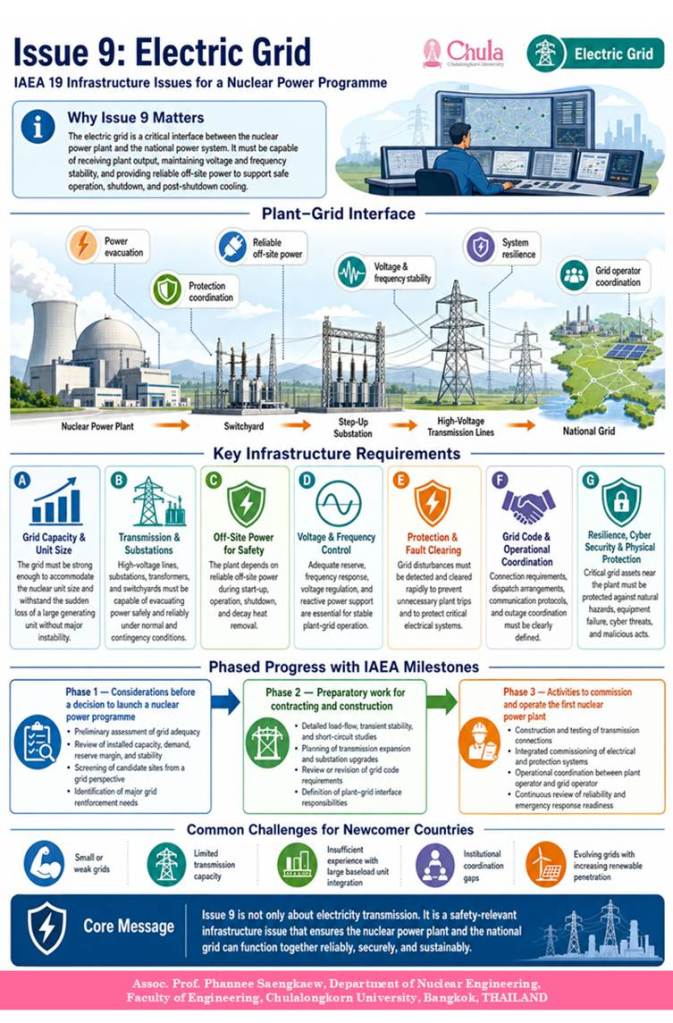
ประเด็นด้านที่ 9: โครงข่ายไฟฟ้า
ในการพัฒนาโครงสร้างพื้นฐาน 19 ด้านของ IAEA สำหรับโครงการพลังงานนิวเคลียร์
1. บทนำ
ภายใต้แนวทางตามหมุดหมายของทบวงการพลังงานปรมาณูระหว่างประเทศ หรือ IAEA Milestones Approach ประเด็นด้านที่ 9: โครงข่ายไฟฟ้า (Electric Grid) หมายถึง ขีดความสามารถของประเทศในการเชื่อมต่อ เดินระบบ สนับสนุน และปกป้องโรงไฟฟ้านิวเคลียร์ผ่านระบบไฟฟ้ากำลังที่มีความเชื่อถือได้ มีเสถียรภาพ และมีความพร้อมเพียงพอ แนวทางตามหมุดหมายของ IAEA ระบุว่า การพัฒนาโครงการพลังงานนิวเคลียร์ต้องพิจารณาโครงสร้างพื้นฐาน 19 ด้าน อย่างเป็นระบบ ครอบคลุมตั้งแต่ระยะที่ประเทศยังอยู่ในขั้นพิจารณาก่อนตัดสินใจดำเนินโครงการ ระยะการเตรียมความพร้อมก่อนการทำสัญญาและก่อนการก่อสร้าง ไปจนถึงระยะการก่อสร้าง การทดสอบระบบ การเดินเครื่อง และการดำเนินงานโรงไฟฟ้านิวเคลียร์แห่งแรกของประเทศ
ประเด็นด้านที่ 9 มักถูกเข้าใจอย่างจำกัดว่า เป็นเพียงเรื่องของระบบส่งไฟฟ้าหรือการเชื่อมต่อโรงไฟฟ้าเข้ากับระบบสายส่งไฟฟ้าแรงสูง แต่ในบริบทของโครงการพลังงานนิวเคลียร์ โครงข่ายไฟฟ้ามีความหมายกว้างและลึกกว่านั้นมาก เนื่องจากโครงข่ายไฟฟ้าเป็นโครงสร้างพื้นฐานเชิงรอยต่อที่มีนัยสำคัญต่อความปลอดภัย (safety-relevant infrastructure interface) ระหว่างโรงไฟฟ้านิวเคลียร์กับระบบไฟฟ้ากำลังของประเทศ โรงไฟฟ้านิวเคลียร์มิได้เป็นเพียงแหล่งผลิตไฟฟ้าที่จ่ายกำลังไฟฟ้าเข้าสู่โครงข่ายเท่านั้น แต่ยังเป็นสถานประกอบการอุตสาหกรรมนิวเคลียร์ที่ต้องพึ่งพาแหล่งจ่ายไฟฟ้าภายนอก หรือ off-site power เพื่อสนับสนุนการเริ่มเดินเครื่อง การเดินเครื่องปกติ การหยุดเดินเครื่อง การระบายความร้อน การควบคุมระบบ และการคงไว้ซึ่งฟังก์ชันความปลอดภัยหลังการหยุดปฏิกรณ์
ดังนั้นโครงสร้างด้านที่ 9 จึงควรถูกพิจารณาในฐานะองค์ประกอบสำคัญของโครงสร้างพื้นฐานนิวเคลียร์ระดับชาติ มิใช่เพียงประเด็นทางวิศวกรรมไฟฟ้ากำลังทั่วไป ประเด็นนี้เชื่อมโยงกับการวางแผนพลังงาน การออกแบบระบบส่งไฟฟ้า ความเชื่อถือได้ของระบบไฟฟ้า เสถียรภาพแรงดันและความถี่ ความปลอดภัยทางนิวเคลียร์ การกำกับดูแล ความมั่นคงทางกายภาพ ความมั่นคงปลอดภัยทางไซเบอร์ การเตรียมพร้อมฉุกเฉิน และการดำเนินงานระยะยาวของโรงไฟฟ้านิวเคลียร์
สำหรับประเทศเพิ่งเริ่มโครงการใหม่ โครงข่ายไฟฟ้าต้องได้รับการประเมินตั้งแต่ระยะเริ่มต้นของการพัฒนาโครงการพลังงานนิวเคลียร์ เพราะข้อจำกัดของระบบไฟฟ้า เช่น กำลังรองรับของระบบไม่เพียงพอ เสถียรภาพความถี่ต่ำ ความสามารถในการควบคุมแรงดันไม่เพียงพอ ระบบส่งไฟฟ้าไม่มีความซ้ำซ้อน ระบบป้องกันไฟฟ้ายังไม่ประสานกัน หรือความสามารถของผู้ปฏิบัติการโครงข่ายยังไม่รองรับโรงไฟฟ้าขนาดใหญ่ อาจกลายเป็นข้อจำกัดสำคัญต่อความเป็นไปได้ ความปลอดภัย และความน่าเชื่อถือของโครงการพลังงานนิวเคลียร์ทั้งระบบ
2. ความหมายเชิงแนวคิดของประเด็นด้านที่ 9: โครงข่ายไฟฟ้า
ประเด็นด้านที่ 9 เกี่ยวข้องกับความพร้อมทางเทคนิคและสถาบันของระบบไฟฟ้ากำลังแห่งชาติ สำหรับการรองรับโรงไฟฟ้านิวเคลียร์ ความพร้อมดังกล่าวครอบคลุมความสามารถของโครงข่ายในการรับกำลังไฟฟ้าที่ผลิตจากโรงไฟฟ้านิวเคลียร์ รักษาเสถียรภาพของแรงดันและความถี่ จ่ายไฟฟ้าจากภายนอกกลับเข้าสู่โรงไฟฟ้าเพื่อสนับสนุนฟังก์ชันความปลอดภัย ทนต่อเหตุขัดข้องที่สามารถคาดการณ์ได้ และจัดให้มีการประสานงานอย่างมีประสิทธิภาพระหว่างผู้ดำเนินการโรงไฟฟ้านิวเคลียร์ ผู้ดำเนินการระบบส่งไฟฟ้า หน่วยงานกำกับดูแลด้านไฟฟ้า หน่วยงานกำกับดูแลด้านนิวเคลียร์ และหน่วยงานด้านนโยบายพลังงาน
จากมุมมองของโครงสร้างพื้นฐานนิวเคลียร์ โครงข่ายไฟฟ้ามีหน้าที่สำคัญอย่างน้อย 4 ประการ คือ
ประการแรก โครงข่ายไฟฟ้าต้องทำหน้าที่เป็นระบบระบายกำลังไฟฟ้าออกจากโรงไฟฟ้า (power evacuation function) กล่าวคือ ระบบส่งไฟฟ้าต้องสามารถรับกำลังไฟฟ้าที่ผลิตจากโรงไฟฟ้านิวเคลียร์และส่งต่อไปยังศูนย์โหลดหรือพื้นที่ใช้ไฟฟ้าได้โดยไม่ทำให้สายส่ง หม้อแปลง สถานีไฟฟ้าย่อย อุปกรณ์ป้องกัน หรือจุดเชื่อมต่อระหว่างระบบเกิดการใช้งานเกินพิกัด
ประการที่สอง โครงข่ายไฟฟ้าต้องทำหน้าที่เป็นระบบสนับสนุนความปลอดภัย (safety-support function) โรงไฟฟ้านิวเคลียร์ต้องใช้ไฟฟ้าเพื่อเดินระบบระบายความร้อน ระบบควบคุม ระบบเครื่องมือวัด ระบบความปลอดภัย ระบบปั๊ม ระบบวาล์ว ระบบระบายความร้อนหลังการหยุดปฏิกรณ์ และระบบสนับสนุนอื่น ๆ แม้ปฏิกรณ์จะหยุดเดินเครื่องแล้ว ความร้อนหลังสลายตัว หรือ decay heat ยังคงเกิดขึ้นจากผลิตภัณฑ์ฟิชชัน และจำเป็นต้องถูกระบายออกอย่างต่อเนื่อง การคงไว้ซึ่งแหล่งจ่ายไฟฟ้าที่เชื่อถือได้จึงเป็นองค์ประกอบสำคัญของความปลอดภัยทางนิวเคลียร์
ประการที่สาม โครงข่ายไฟฟ้าต้องทำหน้าที่เป็นระบบรักษาเสถียรภาพของระบบไฟฟ้า (stability function) ระบบไฟฟ้าต้องสามารถรักษาความถี่และแรงดันให้อยู่ในช่วงที่ยอมรับได้ ทั้งในภาวะเดินระบบปกติและภายหลังเหตุรบกวน เช่น การตัดสายส่ง การตัดเครื่องกำเนิดไฟฟ้า การสูญเสียโหลดขนาดใหญ่ ความขัดข้องของหม้อแปลง เหตุฟ้าผ่า การลัดวงจร หรือการสูญเสียกำลังผลิตขนาดใหญ่
ประการที่สี่ โครงข่ายไฟฟ้าต้องทำหน้าที่เป็นระบบเสริมสร้างความยืดหยุ่นและความทนทานของระบบพลังงาน (system resilience function) ซึ่งรวมถึงความแข็งแรงทางกายภาพของโครงสร้างพื้นฐาน ความซ้ำซ้อนของระบบ ความมั่นคงปลอดภัยทางไซเบอร์ ความสามารถในการกู้คืนระบบหลังไฟดับเป็นบริเวณกว้าง การประสานงานเริ่มเดินระบบหลังไฟฟ้าดับ (black-start) การสื่อสารฉุกเฉิน และขั้นตอนการเดินระบบในภาวะผิดปกติหรือภาวะวิกฤต
ด้วยเหตุนี้ โครงข่ายไฟฟ้าจึงมิใช่เพียงเส้นทางส่งพลังงานไฟฟ้าออกจากโรงไฟฟ้า แต่เป็นโครงสร้างพื้นฐานเชิงระบบที่ส่งผลต่อความปลอดภัย ความมั่นคง ความน่าเชื่อถือ และความยั่งยืนของโครงการพลังงานนิวเคลียร์โดยตรง
3. เหตุผลที่โครงข่ายไฟฟ้าเป็นประเด็นโครงสร้างพื้นฐานนิวเคลียร์
โรงไฟฟ้านิวเคลียร์มีลักษณะแตกต่างจากโรงไฟฟ้าหลายประเภท เนื่องจากเป็นสถานประกอบการอุตสาหกรรมขนาดใหญ่ที่มีความซับซ้อนสูงและอยู่ภายใต้ข้อกำหนดด้านความปลอดภัยที่เข้มงวด โรงไฟฟ้านิวเคลียร์ต้องมีระบบไฟฟ้าภายในโรงไฟฟ้า ระบบไฟฟ้าฉุกเฉิน ระบบไฟฟ้าสำรอง และแหล่งจ่ายไฟฟ้าภายนอกที่มีความเชื่อถือได้ เพื่อให้สามารถคงไว้ซึ่งฟังก์ชันด้านความปลอดภัยในทุกสภาวะที่ออกแบบไว้
ด้วยเหตุนี้ โครงข่ายไฟฟ้าจึงไม่สามารถถูกมองว่าเป็นระบบภายนอกเชิงพาณิชย์เพียงอย่างเดียว แต่ต้องถูกพิจารณาเป็นส่วนหนึ่งของสภาพแวดล้อมการดำเนินงานและความปลอดภัยของโรงไฟฟ้านิวเคลียร์ โครงข่ายไฟฟ้ามีความสัมพันธ์แบบสองทิศทางกับโรงไฟฟ้านิวเคลียร์ กล่าวคือ โรงไฟฟ้านิวเคลียร์ส่งผลกระทบต่อโครงข่ายไฟฟ้า และโครงข่ายไฟฟ้าก็ส่งผลกระทบต่อโรงไฟฟ้านิวเคลียร์เช่นกัน
ในด้านหนึ่ง โรงไฟฟ้านิวเคลียร์ส่งผลต่อโครงข่ายไฟฟ้า เพราะเป็นแหล่งผลิตไฟฟ้าขนาดใหญ่ที่อาจทำให้เกิดการเปลี่ยนแปลงของการไหลของกำลังไฟฟ้าในระบบ ความต้องการกำลังรีแอกทีฟ ข้อกำหนดด้านเสถียรภาพของระบบ การประสานงานของระบบป้องกัน และเงื่อนไขการเดินระบบของโครงข่าย หากโรงไฟฟ้านิวเคลียร์หยุดเดินเครื่องกะทันหัน ระบบไฟฟ้าต้องสามารถรองรับการสูญเสียกำลังผลิตขนาดใหญ่โดยไม่ทำให้ความถี่ลดลงอย่างรวดเร็วหรือเกิดไฟดับเป็นบริเวณกว้าง
ในอีกด้านหนึ่ง โครงข่ายไฟฟ้าก็ส่งผลต่อโรงไฟฟ้านิวเคลียร์ เพราะความไม่เสถียรของความถี่ แรงดันตกเป็นเวลานาน การสูญเสียแหล่งจ่ายไฟฟ้าภายนอก การตัดความผิดพร่องที่ล่าช้า หรือความเชื่อถือได้ของระบบส่งไฟฟ้าที่ไม่เพียงพอ อาจกระทบต่อการเดินระบบของโรงไฟฟ้าและระบบสนับสนุนความปลอดภัย
ความสัมพันธ์สองทิศทางนี้เป็นหัวใจของโครงสร้างด้านที่ 9 นี้ โดยเฉพาะอย่างยิ่งสำหรับประเทศที่เพิ่งเริ่มโครงการใหม่ ซึ่งระบบไฟฟ้าอาจถูกพัฒนามาเพื่อรองรับโรงไฟฟ้าขนาดเล็กกว่า โรงไฟฟ้าฟอสซิลหรือโรงไฟฟ้าที่ใช้ถ่านหิน น้ำมัน หรือก๊าซธรรมชาติ โรงไฟฟ้าพลังน้ำ โรงไฟฟ้าพลังงานหมุนเวียนแบบกระจายตัว แต่ว่ายังไม่เคยรองรับโรงไฟฟ้านิวเคลียร์ขนาดใหญ่ที่มีข้อกำหนดด้านความเชื่อถือได้และความปลอดภัยในระดับสูง ในกรณีเช่นนี้ การเสริมความแข็งแรงของโครงข่ายไฟฟ้าอาจเป็นเงื่อนไขจำเป็นก่อนการตัดสินใจดำเนินโครงการพลังงานนิวเคลียร์
4. มิติทางเทคนิคหลักของประเด็นด้านที่ 9
4.1 กำลังรองรับของโครงข่ายและความเหมาะสมของขนาดหน่วยผลิต
คำถามพื้นฐานประการแรกของประเด็นด้านที่ 9 คือ โครงข่ายไฟฟ้าที่มีอยู่มีขนาดใหญ่ แข็งแรง และเสถียรเพียงพอที่จะรองรับโรงไฟฟ้านิวเคลียร์ที่เสนอหรือไม่ โรงไฟฟ้านิวเคลียร์ขนาดใหญ่ที่เชื่อมต่อเข้ากับโครงข่ายไฟฟ้าขนาดเล็กอาจก่อให้เกิดความท้าทายทั้งด้านการเดินระบบและความปลอดภัย หากหน่วยผลิตไฟฟ้าขนาดใหญ่ดังกล่าวหยุดเดินเครื่องกะทันหัน ระบบไฟฟ้าอาจสูญเสียกำลังผลิตจำนวนมากในทันที ทำให้ความถี่ลดลงอย่างรวดเร็ว หากระบบไม่มีความเฉื่อยของระบบไฟฟ้า กำลังสำรอง หรือระบบควบคุมความถี่ที่เพียงพอ เหตุการณ์ดังกล่าวอาจนำไปสู่ความไม่เสถียรของระบบ หรือแม้กระทั่งไฟดับเป็นบริเวณกว้าง
ดังนั้น ความสัมพันธ์ระหว่าง ขนาดหน่วยผลิตของโรงไฟฟ้านิวเคลียร์กับขนาดรวมของระบบไฟฟ้า จึงเป็นตัวแปรสำคัญในการวางแผน ประเทศที่มีโครงข่ายไฟฟ้าขนาดเล็กอาจจำเป็นต้องพิจารณาทางเลือก เช่น การเลือกหน่วยผลิตที่มีขนาดเล็กลง การพัฒนาโรงไฟฟ้านิวเคลียร์แบบหลายหน่วย การเสริมกำลังระบบส่งไฟฟ้า การเพิ่มความเชื่อมโยงกับระบบไฟฟ้าของประเทศเพื่อนบ้าน หรือการพิจารณาเครื่องปฏิกรณ์นิวเคลียร์แบบโมดูลาร์ขนาดเล็ก หรือ Small Modular Reactors
ในทางปฏิบัติ ผู้วางแผนระบบไฟฟ้าต้องประเมินว่าระบบสามารถทนต่อการสูญเสียหน่วยผลิตขนาดใหญ่ที่สุดได้หรือไม่ ระบบมีกำลังสำรองเพียงพอหรือไม่ ระบบมีความสามารถในการตอบสนองต่อความถี่เพียงพอหรือไม่ และระบบเชื่อมโยงระหว่างพื้นที่หรือระหว่างประเทศสามารถช่วยรองรับเหตุรบกวนได้มากน้อยเพียงใด
4.2 โครงสร้างพื้นฐานระบบส่งไฟฟ้าและการระบายกำลังไฟฟ้า
โรงไฟฟ้านิวเคลียร์จำเป็นต้องมีการเชื่อมต่อระบบส่งไฟฟ้าที่แข็งแรงจากพื้นที่ตั้งโรงไฟฟ้าไปยังโครงข่ายไฟฟ้าแห่งชาติ การวางแผนระบบส่งต้องพิจารณาความสามารถในการรับกระแสของสายส่ง การออกแบบสถานีไฟฟ้าย่อย ความสามารถของหม้อแปลง ความซ้ำซ้อนของระบบ พื้นที่แนวสายส่ง การอิ่มตัวของโครงข่าย ระบบป้องกัน และแผนการขยายระบบในอนาคต
ระบบส่งไฟฟ้าต้องสามารถระบายกำลังไฟฟ้าเต็มกำลังของโรงไฟฟ้าได้ทั้งในภาวะปกติและภายใต้เงื่อนไขความขัดข้องที่สามารถคาดการณ์ได้ โดยทั่วไป การวิเคราะห์ความเชื่อถือได้ของระบบส่งมักใช้แนวคิด N-1 reliability ซึ่งหมายถึงระบบต้องยังคงสามารถเดินระบบได้อย่างปลอดภัยหลังจากสูญเสียองค์ประกอบหลักหนึ่งรายการ เช่น สายส่งหนึ่งเส้น หม้อแปลงหนึ่งตัว หรือเครื่องกำเนิดไฟฟ้าหนึ่งหน่วย ในบริบทของโรงไฟฟ้านิวเคลียร์ การพิจารณาดังกล่าวอาจต้องใช้สมมติฐานที่ระมัดระวังมากขึ้น เนื่องจากมีนัยต่อความปลอดภัยของสถานประกอบการนิวเคลียร์
การเสริมความแข็งแรงของระบบส่งอาจประกอบด้วยการก่อสร้างสายส่งแรงสูงใหม่ การสร้างสถานีไฟฟ้าย่อยใหม่ การเพิ่มหม้อแปลง การติดตั้งอุปกรณ์ชดเชยกำลังรีแอกทีฟ การปรับปรุงระบบอัตโนมัติของโครงข่าย ระบบสื่อสาร ระบบป้องกัน และระบบควบคุมการเดินระบบ งานเหล่านี้ต้องเริ่มวางแผนตั้งแต่ระยะเริ่มต้น เพราะโครงสร้างพื้นฐานระบบส่งมักต้องใช้เวลานานในการออกแบบ ขออนุญาต ประเมินผลกระทบสิ่งแวดล้อม จัดหาที่ดิน และก่อสร้าง
4.3 แหล่งจ่ายไฟฟ้าภายนอกและความปลอดภัยนิวเคลียร์
โครงข่ายไฟฟ้าเป็นแหล่งสำคัญของ ไฟฟ้าภายนอกโรงไฟฟ้า (off-site power) สำหรับโรงไฟฟ้านิวเคลียร์ ไฟฟ้าภายนอกจำเป็นต่อการเริ่มเดินเครื่อง การเดินเครื่องปกติ การหยุดเดินเครื่อง และการสนับสนุนระบบที่เกี่ยวข้องกับความปลอดภัย แม้โรงไฟฟ้านิวเคลียร์จะมีระบบจ่ายไฟฟ้าฉุกเฉินภายในพื้นที่ เช่น เครื่องกำเนิดไฟฟ้าดีเซล แบตเตอรี่ หรือแหล่งจ่ายไฟฟ้าสำรองอื่น ๆ แต่โครงข่ายไฟฟ้าภายนอกยังคงเป็นแหล่งจ่ายไฟฟ้าที่สำคัญและควรถูกออกแบบให้มีความเชื่อถือได้สูง
การสูญเสียแหล่งจ่ายไฟฟ้าภายนอก หรือ Loss of Off-Site Power เป็นเหตุการณ์ที่มีความสำคัญด้านความปลอดภัย หากไฟฟ้าภายนอกสูญเสีย โรงไฟฟ้าต้องพึ่งพาระบบไฟฟ้าฉุกเฉินภายในพื้นที่และระบบสำรองอื่น ๆ เพื่อคงไว้ซึ่งการระบายความร้อนและฟังก์ชันความปลอดภัย ดังนั้น ประเด็นด้านที่ 9 ต้องประสานกับการออกแบบระบบไฟฟ้าของโรงไฟฟ้า ระบบไฟฟ้าฉุกเฉิน ระบบป้องกันไฟฟ้า ขั้นตอนปฏิบัติฉุกเฉิน และการวิเคราะห์ความปลอดภัย
ความสำคัญของไฟฟ้าภายนอกได้รับการยืนยันจากประสบการณ์การเดินระบบในระดับสากลหลายครั้ง แม้ในกรณีที่ปฏิกรณ์ไม่ได้ผลิตไฟฟ้าแล้ว โรงไฟฟ้านิวเคลียร์ยังคงต้องใช้ไฟฟ้าเพื่อสนับสนุนระบบระบายความร้อน ระบบควบคุม และระบบเฝ้าระวัง ความสูญเสียหรือความไม่เสถียรของแหล่งจ่ายไฟฟ้าภายนอกจึงสามารถสร้างความกังวลด้านความปลอดภัยนิวเคลียร์ได้โดยตรง
4.4 เสถียรภาพแรงดันและความถี่
โรงไฟฟ้านิวเคลียร์ต้องการสภาวะไฟฟ้าที่มีแรงดันและความถี่คงที่ในช่วงที่ยอมรับได้ ความเบี่ยงเบนของความถี่อย่างรุนแรงอาจส่งผลต่อการทำงานของเครื่องกำเนิดไฟฟ้า กังหัน ระบบป้องกันปฏิกรณ์ ปั๊ม มอเตอร์ อุปกรณ์ไฟฟ้า และระบบช่วยเดินเครื่อง ส่วนแรงดันตก แรงดันเกิน หรือแรงดันไม่เสถียรอาจส่งผลต่อความสามารถของอุปกรณ์ที่เกี่ยวข้องกับความปลอดภัยในการทำงานตามหน้าที่ที่ออกแบบไว้
ดังนั้น โครงข่ายไฟฟ้าต้องมีขีดความสามารถเพียงพอในการควบคุมความถี่ การจัดให้มีกำลังสำรองหมุน การควบคุมกำลังผลิตอัตโนมัติ การควบคุมแรงดัน การสนับสนุนกำลังรีแอกทีฟ และการฟื้นตัวของระบบหลังเหตุรบกวน การศึกษาระบบไฟฟ้าต้องครอบคลุมการวิเคราะห์การไหลของกำลังไฟฟ้า (load flow analysis) การวิเคราะห์เสถียรภาพชั่วครู่ (transient stability analysis) การวิเคราะห์เสถียรภาพเชิงพลวัต (dynamic stability analysis) การวิเคราะห์เสถียรภาพแรงดัน (voltage stability analysis) การวิเคราะห์ระดับกระแสลัดวงจร (short-circuit level analysis) การประสานงานระบบป้องกัน (protection coordination) และการประเมินการตอบสนองของระบบต่อเหตุขัดข้องต่าง ๆ (system response assessment under disturbances)
สำหรับประเทศที่เพิ่งเริ่มโครงการใหม่ การศึกษาดังกล่าวมิใช่งานวิเคราะห์ทางเทคนิคทั่วไปที่สามารถทำภายหลังได้ แต่เป็นส่วนหนึ่งของการประเมินความพร้อมของโครงสร้างพื้นฐานนิวเคลียร์ ผู้ดำเนินการระบบส่งไฟฟ้าต้องมีความสามารถในการใช้เครื่องมือวิเคราะห์ระบบไฟฟ้าขั้นสูง เข้าใจข้อกำหนดของโรงไฟฟ้านิวเคลียร์ และประสานงานกับผู้ดำเนินการโรงไฟฟ้าในสภาวะปกติและผิดปกติ
4.5 ระบบป้องกันไฟฟ้าและการตัดความผิดพร่อง
ระบบป้องกันของโครงข่ายไฟฟ้าต้องประสานกับระบบไฟฟ้าของโรงไฟฟ้านิวเคลียร์อย่างเหมาะสม ความผิดพร่องบนสายส่ง สถานีไฟฟ้าย่อย หม้อแปลง หรือบัสบาร์ ต้องถูกตรวจพบและตัดออกจากระบบอย่างรวดเร็วและถูกต้อง การตัดความผิดพร่องที่ล่าช้าหรือไม่ถูกต้องอาจก่อให้เกิดแรงดันตก การสูญเสียเสถียรภาพของเครื่องกำเนิดไฟฟ้า การตัดโรงไฟฟ้าออกจากระบบโดยไม่จำเป็น หรือความเสียหายต่ออุปกรณ์ไฟฟ้าที่สำคัญ
การประสานระบบป้องกันเกี่ยวข้องกับอุปกรณ์หลายประเภท เช่น รีเลย์ระยะทาง ระบบป้องกันแบบดิฟเฟอเรนเชียล ระบบป้องกันความล้มเหลวของเบรกเกอร์ ระบบป้องกันความถี่ต่ำ ระบบป้องกันแรงดันต่ำและแรงดันเกิน ระบบป้องกันเครื่องกำเนิดไฟฟ้า ระบบป้องกันหม้อแปลง และระบบป้องกันการแยกระบบไฟฟ้า หรือ islanding scheme
การออกแบบระบบป้องกันต้องหลีกเลี่ยงทั้งสองสถานการณ์ที่ไม่พึงประสงค์ กล่าวคือ หนึ่ง ต้องหลีกเลี่ยงการที่เหตุรบกวนในโครงข่ายทำให้โรงไฟฟ้านิวเคลียร์หยุดเดินเครื่องโดยไม่จำเป็น และสอง ต้องหลีกเลี่ยงการที่โรงไฟฟ้ายังคงเชื่อมต่ออยู่กับโครงข่ายในสภาวะที่ไม่ปลอดภัยหรือไม่เสถียร
ด้านนี้ต้องอาศัยการประสานงานอย่างใกล้ชิดระหว่างผู้ออกแบบโรงไฟฟ้านิวเคลียร์ ผู้ดำเนินการโรงไฟฟ้า ผู้ดำเนินการระบบส่งไฟฟ้า หน่วยงานกำหนด grid code หน่วยงานกำกับดูแล และผู้ผลิตอุปกรณ์ไฟฟ้า
4.6 ข้อกำหนดโครงข่ายไฟฟ้า (Grid Code)
โรงไฟฟ้านิวเคลียร์ต้องปฏิบัติตามข้อกำหนดโครงข่ายไฟฟ้าหรือกริดโค้ด (grid code) ของประเทศ แต่ในหลายกรณีข้อกำหนดโครงข่ายไฟฟ้าเดิมอาจจำเป็นต้องได้รับการทบทวนหรือปรับปรุงก่อนการนำพลังงานนิวเคลียร์เข้ามาใช้ ข้อกำหนดโครงข่ายไฟฟ้าโดยทั่วไปกำหนดข้อกำหนดทางเทคนิคสำหรับการเชื่อมต่อเครื่องกำเนิดไฟฟ้าเข้ากับระบบ เช่น การควบคุมแรงดัน การตอบสนองต่อความถี่ ความสามารถในการผลิตหรือดูดซับกำลังรีแอกทีฟ ความสามารถในการทนต่อความผิดพร่อง การตั้งค่าระบบป้องกัน พิธีสารการสื่อสาร เงื่อนไขการสั่งจ่ายกำลังไฟฟ้า และการประสานงานการเดินระบบ
สำหรับโรงไฟฟ้านิวเคลียร์ ข้อกำหนดโครงข่ายไฟฟ้าควรกำหนดรอยต่อระหว่างโรงไฟฟ้าและโครงข่ายอย่างชัดเจน ซึ่งควรระบุรายละเอียดของข้อกำหนดเกี่ยวกับ การศึกษาการเชื่อมต่อระบบ การทดสอบระบบก่อนเดินเครื่อง การสื่อสารระหว่างการเดินระบบ การประสานงานในภาวะฉุกเฉิน การวางแผนหยุดเดินเครื่อง การหยุดเดินเครื่องโดยไม่ตั้งใจ ขีดจำกัดด้านความถี่และแรงดัน และขั้นตอนการกู้คืนระบบหลังเหตุรบกวน
หากว่าข้อกำหนดโครงข่ายไฟฟ้าที่มีอยู่ถูกออกแบบมาโดยเน้นโรงไฟฟ้าฟอสซิล พลังน้ำ หรือพลังงานหมุนเวียนเป็นหลัก อาจยังไม่ครอบคลุมข้อกำหนดเฉพาะของโรงไฟฟ้านิวเคลียร์ ดังนั้น โครงสร้างพื้นฐานด้านที่ 9 จึงต้องรวมถึงการทบทวนเชิงสถาบันของกฎระเบียบด้านโครงข่ายไฟฟ้า มาตรฐานทางเทคนิค และข้อตกลงการเชื่อมต่อระบบไฟฟ้า
4.7 ความยืดหยุ่นของโครงข่าย ความมั่นคงปลอดภัยทางไซเบอร์ และการป้องกันทางกายภาพ
โครงข่ายไฟฟ้าสมัยใหม่พึ่งพาระบบดิจิทัลอย่างมาก ทั้งระบบควบคุม ระบบสื่อสาร ระบบควบคุมกำกับดูแลและเก็บรวบรวมข้อมูล (Supervisory Control and Data Acquisition, SCADA) ระบบจัดการพลังงาน รีเลย์ป้องกันแบบดิจิทัล สถานีไฟฟ้าย่อยอัตโนมัติ และระบบวิเคราะห์ข้อมูลแบบเวลาจริง การพึ่งพาระบบดิจิทัลช่วยเพิ่มประสิทธิภาพและความสามารถในการควบคุมระบบ แต่ก็สร้างความเปราะบางใหม่ด้านความมั่นคงปลอดภัยทางไซเบอร์
ความมั่นคงปลอดภัยทางไซเบอร์ของโครงข่ายไฟฟ้ามีความเกี่ยวข้องกับโครงการพลังงานนิวเคลียร์โดยตรง เพราะการโจมตีทางไซเบอร์ต่อสถานีไฟฟ้าย่อย ศูนย์การสั่งจ่ายกำลังไฟฟ้า ระบบสื่อสาร ระบบป้องกัน หรือระบบควบคุมโครงข่าย อาจกระทบต่อความพร้อมหรือคุณภาพของไฟฟ้าภายนอกที่จ่ายให้โรงไฟฟ้านิวเคลียร์ ดังนั้นโครงสร้างด้านที่ 9 ต้องเชื่อมโยงกับโครงสร้างด้านที่ 15 ว่าด้วยความมั่นคงนิวเคลียร์และการป้องกันทางกายภาพ
นอกจากทางไซเบอร์แล้ว การป้องกันทางกายภาพก็มีความสำคัญเช่นกัน สายส่ง สถานีไฟฟ้าย่อย switchyard ศูนย์ควบคุมระบบ และระบบสื่อสารอาจเผชิญความเสี่ยงจากภัยธรรมชาติ การกระทำโดยเจตนา การก่อวินาศกรรม สภาพอากาศสุดขั้ว ความขัดข้องของอุปกรณ์ หรือสถานการณ์ด้านความมั่นคงระดับประเทศ ในการวางแผนโครงสร้างพื้นฐานนิวเคลียร์ สินทรัพย์โครงข่ายที่สำคัญซึ่งเชื่อมต่อกับโรงไฟฟ้านิวเคลียร์จึงควรถูกพิจารณาเป็นส่วนหนึ่งของกรอบความมั่นคงทางพลังงานและความปลอดภัยนิวเคลียร์ของประเทศ
5. ความรับผิดชอบเชิงสถาบัน
โครงสร้างด้านที่ 9 ต้องอาศัยการกำหนดความรับผิดชอบเชิงสถาบันอย่างชัดเจน รอยต่อระหว่างโรงไฟฟ้านิวเคลียร์กับโครงข่ายไฟฟ้าไม่สามารถจัดการได้โดยผู้ดำเนินการโรงไฟฟ้าเพียงหน่วยงานเดียว แต่เกี่ยวข้องกับองค์กรหลายฝ่ายที่มีบทบาทแตกต่างกัน
- รัฐบาลและกระทรวงพลังงาน มีหน้าที่กำหนดนโยบายพลังงาน แผนพัฒนากำลังผลิตไฟฟ้า ทิศทางการลงทุนด้านโครงสร้างพื้นฐาน และการประสานงานระหว่างหน่วยงานระดับชาติ
- ผู้ดำเนินการระบบส่งไฟฟ้า (transmission system operator) มีหน้าที่วางแผนโครงข่าย ดำเนินการ การสั่งจ่ายกำลังไฟฟ้า ประเมินความเชื่อถือได้ของระบบ ขยายระบบส่ง ประสานระบบป้องกัน และวางแผนการกู้คืนระบบหลังเหตุขัดข้อง
- เจ้าของหรือผู้ดำเนินการโรงไฟฟ้านิวเคลียร์ มีหน้าที่กำหนดความต้องการทางไฟฟ้าของโรงไฟฟ้า ประสานกับผู้ดำเนินการระบบส่ง ออกแบบรอยต่อระหว่างโรงไฟฟ้าและโครงข่าย และคงไว้ซึ่งการดำเนินงานอย่างปลอดภัยภายใต้เหตุรบกวนของโครงข่าย
- หน่วยงานกำกับดูแลด้านนิวเคลียร์ มีหน้าที่ทบทวนผลกระทบด้านความปลอดภัยที่เกี่ยวข้องกับไฟฟ้าภายนอก ระบบไฟฟ้าของโรงไฟฟ้า ระบบไฟฟ้าฉุกเฉิน และสมมติฐานเกี่ยวกับโครงข่ายที่ถูกใช้ใน safety case
- หน่วยงานกำกับดูแลด้านไฟฟ้าหรือหน่วยงานกำหนดข้อกำหนดโครงข่ายไฟฟ้า มีหน้าที่กำหนดกฎระเบียบของระบบไฟฟ้า ข้อกำหนดการเชื่อมต่อระบบไฟฟ้า มาตรฐานความเชื่อถือได้ กฎตลาดไฟฟ้า และพันธะการเดินระบบ
- หน่วยงานด้านการเตรียมพร้อมฉุกเฉิน ต้องเข้าใจว่าเหตุไฟฟ้าดับ การสูญเสียไฟฟ้าภายนอก หรือการล่มของระบบไฟฟ้าระดับภูมิภาคอาจส่งผลต่อการตอบสนองต่อเหตุฉุกเฉินนิวเคลียร์อย่างไร
เนื่องจากความรับผิดชอบเหล่านี้กระจายอยู่ในหลายองค์กร โครงสร้างด้านที่ 9 จึงต้องมีระบบประสานงานที่เข้มแข็ง ประเทศที่เพิ่งเริ่มโครงการใหม่ไม่ควรมองความพร้อมของโครงข่ายไฟฟ้าเป็นเพียงภารกิจของสาธารณูปโภคด้านไฟฟ้าเท่านั้น แต่ควรบูรณาการประเด็นนี้เข้ากับการวางแผนโครงสร้างพื้นฐานนิวเคลียร์ระดับชาติ
6. การพัฒนาโครงสร้างพื้นฐานด้านที่ 9 ตามระยะของ IAEA Milestones Approach
6.1 ระยะที่ 1: การพิจารณาก่อนการตัดสินใจดำเนินโครงการพลังงานนิวเคลียร์
ในระยะที่ 1 ประเทศอยู่ในขั้นประเมินว่าพลังงานนิวเคลียร์เป็นทางเลือกที่เหมาะสมหรือไม่ และโครงสร้างพื้นฐานของประเทศสามารถรองรับได้หรือไม่ สำหรับโครงสร้างด้านที่ 9 ภารกิจหลักคือการประเมินเบื้องต้นว่าโครงข่ายไฟฟ้ามีความสามารถเพียงพอในการรองรับโรงไฟฟ้านิวเคลียร์ภายในกรอบเวลาที่คาดว่าจะพัฒนาโครงการหรือไม่
ในระยะนี้ ประเทศควรประเมินกำลังผลิตติดตั้งรวม ความต้องการไฟฟ้าสูงสุด ความต้องการไฟฟ้าต่ำสุด กำลังสำรอง โครงสร้างของระบบส่ง ความแข็งแรงของจุดเชื่อมต่อระหว่างระบบ ความเสถียรของความถี่ เสถียรภาพของแรงดัน ความเชื่อถือได้ของระบบไฟฟ้า ประวัติไฟฟ้าดับ ความต้องการไฟฟ้าในอนาคต และความเป็นไปได้ของตำแหน่งที่ตั้งโรงไฟฟ้านิวเคลียร์จากมุมมองของโครงข่าย
ประเทศควรประเมินด้วยว่า ขนาดหน่วยผลิตของโรงไฟฟ้านิวเคลียร์ที่กำลังพิจารณามีความเหมาะสมกับขนาดและความแข็งแรงของโครงข่ายไฟฟ้าหรือไม่ หากหน่วยผลิตมีขนาดใหญ่เกินไปเมื่อเทียบกับระบบไฟฟ้า อาจจำเป็นต้องพิจารณาทางเลือกอื่น เช่น หน่วยผลิตขนาดเล็กลง การเสริมระบบส่งไฟฟ้า การเพิ่มการเชื่อมโยงระบบไฟฟ้าระหว่างพื้นที่ หรือการเลือกใช้เทคโนโลยี SMR
ผลลัพธ์สำคัญของระยะที่ 1 ควรเป็น รายงานประเมินความเป็นไปได้เบื้องต้นของโครงข่ายไฟฟ้าสำหรับพลังงานนิวเคลียร์ รายงานดังกล่าวควรระบุช่องว่างหลัก ประมาณการขนาดของการเสริมโครงข่าย ประเมินพื้นที่ตั้งโรงไฟฟ้าจากมุมมองของโครงข่าย และสรุปว่าโครงการพลังงานนิวเคลียร์มีความเป็นไปได้มากน้อยเพียงใดภายใต้ข้อจำกัดของระบบไฟฟ้า
นอกจากนี้ ระยะที่ 1 ควรระบุช่องว่างเชิงสถาบันด้วย เช่น ผู้ดำเนินการระบบส่งอาจต้องพัฒนาเครื่องมือวิเคราะห์ระบบไฟฟ้า ฝึกอบรมบุคลากรด้านการเชื่อมประสานระหว่างโรงไฟฟ้ากับโครงข่ายไฟฟ้า (plant-grid interface) และเสริมความเข้าใจเกี่ยวกับการวิเคราะห์เสถียรภาพของหน่วยผลิตขนาดใหญ่
เมื่อสิ้นสุดระยะที่ 1 ประเทศควรเข้าใจอย่างชัดเจนว่าโครงข่ายไฟฟ้าเป็นความท้าทายที่สามารถจัดการได้ หรือเป็นข้อจำกัดสำคัญที่อาจส่งผลต่อการตัดสินใจดำเนินโครงการพลังงานนิวเคลียร์
6.2 ระยะที่ 2: การเตรียมความพร้อมก่อนการทำสัญญาและการก่อสร้าง
ในระยะที่ 2 ประเทศต้องเตรียมกรอบด้านเทคนิค กฎหมาย กฎระเบียบ และสถาบันให้พร้อมก่อนการเชิญชวนผู้เสนอราคา การเจรจาสัญญา หรือการเริ่มก่อสร้าง สำหรับโครงสร้างด้านที่ 9 ระยะนี้ต้องมีการศึกษาระบบไฟฟ้าที่ละเอียดขึ้น และการประสานงานที่เข้มแข็งระหว่างองค์กรโครงการพลังงานนิวเคลียร์กับผู้ดำเนินการระบบส่งไฟฟ้า
ประเทศควรดำเนินการศึกษาทางวิศวกรรมระบบไฟฟ้าอย่างละเอียด ครอบคลุมการวิเคราะห์การไหลของกำลังไฟฟ้า การวิเคราะห์เสถียรภาพชั่วครู่ การวิเคราะห์เสถียรภาพแรงดัน การวิเคราะห์กระแสลัดวงจร การประสานงานระบบป้องกัน การประเมินความเชื่อถือได้ของระบบไฟฟ้า และการศึกษากระบวนการกู้คืนระบบหลังเหตุไฟฟ้าดับเป็นบริเวณกว้าง การศึกษาเหล่านี้ควรอ้างอิงข้อมูลจริงของทางเลือกการออกแบบโรงไฟฟ้า พื้นที่ตั้งที่เป็นไปได้ แผนเสริมระบบส่ง และการคาดการณ์ความต้องการไฟฟ้าในอนาคต
ในระยะนี้ ข้อกำหนดโครงข่ายอาจต้องได้รับการทบทวนหรือปรับปรุงเพื่อรวมข้อกำหนดเฉพาะสำหรับโรงไฟฟ้านิวเคลียร์ ข้อตกลงระหว่างเจ้าของโรงไฟฟ้าและผู้ดำเนินการโครงข่ายควรกำหนดหน้าที่ความรับผิดชอบเกี่ยวกับทรัพย์สินที่ใช้เชื่อมต่อ ระบบลานอุปกรณ์สวิตช์ไฟฟ้าแรงสูง (switchyard) ระบบสื่อสาร การ การสั่งจ่ายกำลังไฟฟ้า การวางแผนหยุดซ่อมบำรุง การประสานงานฉุกเฉิน และการกู้คืนระบบหลังเหตุรบกวน
โครงการเสริมโครงข่ายไฟฟ้าควรถูกวางแผน จัดหาเงินทุน ขออนุญาต และกำหนดตารางเวลาดำเนินงานให้ชัดเจน เนื่องจากโครงสร้างพื้นฐานด้านระบบส่งต้องพร้อมก่อนการทดสอบและการเดินเครื่องโรงไฟฟ้านิวเคลียร์ หากการเสริมโครงข่ายล่าช้า โครงการนิวเคลียร์อาจเผชิญข้อจำกัดในการทดสอบระบบก่อนเดินเครื่อง การเดินเครื่องที่กำลังผลิตเต็มพิกัด การอนุมัติกรณีความปลอดภัย (safety case)
เมื่อสิ้นสุดระยะที่ 2 ประเทศควรมี แผนพัฒนาโครงข่ายไฟฟ้าที่น่าเชื่อถือและสามารถดำเนินการได้จริง ซึ่งสอดคล้องกับตารางเวลาของโครงการโรงไฟฟ้านิวเคลียร์
6.3 ระยะที่ 3: การก่อสร้าง การทดสอบระบบ การเดินเครื่อง และการดำเนินงานโรงไฟฟ้านิวเคลียร์แห่งแรก
ในระยะที่ 3 โครงสร้างพื้นฐานของโครงข่ายไฟฟ้าต้องถูกก่อสร้าง ทดสอบระบบก่อนเดินเครื่อง และบูรณาการเข้ากับโรงไฟฟ้านิวเคลียร์อย่างสมบูรณ์ ซึ่งรวมถึงสายส่ง สถานีไฟฟ้าย่อย ลานอุปกรณ์สวิตช์ไฟฟ้าแรงสูง ระบบป้องกัน ระบบสื่อสาร ระบบการสั่งจ่ายกำลังไฟฟ้า และขั้นตอนการปฏิบัติงาน
โรงไฟฟ้านิวเคลียร์และผู้ดำเนินการโครงข่ายต้องดำเนินการทดสอบร่วมกัน เช่น การจ่ายไฟเข้าระบบ การทดสอบการเข้ากันได้ของเครื่องกำเนิดไฟฟ้ากับโครงข่าย การทดสอบการสูญเสียโหลดอย่างฉับพลัน การทดสอบระบบป้องกัน การทดสอบระบบสื่อสาร การฝึกซ้อมฉุกเฉิน และการฝึกซ้อมการกู้คืนระบบ
การประสานงานระหว่างโรงไฟฟ้าและโครงข่ายมีความสำคัญอย่างยิ่งในช่วงการทดสอบระบบก่อนเดินเครื่อง เพราะโรงไฟฟ้าอาจต้องผ่านการทดสอบเพิ่มกำลังทีละขั้น การทดสอบกังหันและเครื่องกำเนิดไฟฟ้า การทดสอบการหยุดเดินเครื่อง การทดสอบระบบไฟฟ้า และเหตุการณ์เปลี่ยนผ่านหลายรูปแบบ โครงข่ายต้องพร้อมรองรับเหตุการณ์เหล่านี้โดยไม่กระทบต่อความน่าเชื่อถือของระบบไฟฟ้าโดยรวม
หลังจากเริ่มดำเนินการเชิงพาณิชย์แล้ว ผู้ดำเนินการโรงไฟฟ้าและผู้ดำเนินการโครงข่ายต้องรักษาการประสานงานอย่างต่อเนื่อง ซึ่งรวมถึงการวางแผนหยุดซ่อมบำรุง การตอบสนองต่อเหตุรบกวนของโครงข่าย การวิเคราะห์เหตุโรงไฟฟ้าหยุดเดินเครื่องโดยไม่ตั้งใจ การทบทวนเหตุการณ์หลังเกิดเหตุ การบำรุงรักษาการตั้งค่าระบบป้องกัน การทบทวนความปลอดภัยเป็นระยะ และการปรับปรุงการศึกษาระบบไฟฟ้าตามการเปลี่ยนแปลงของโครงข่ายในอนาคต
เมื่อสิ้นสุดระยะที่ 3 ประเทศควรสามารถแสดงให้เห็นว่าโครงข่ายไฟฟ้าสามารถสนับสนุนการเดินระบบโรงไฟฟ้านิวเคลียร์ได้อย่างปลอดภัยและเชื่อถือได้ ทั้งในภาวะปกติ ภาวะผิดปกติ และภาวะฉุกเฉิน
7. โครงสร้างพื้นฐานด้านที่ 9 กับเครื่องปฏิกรณ์นิวเคลียร์แบบโมดูลาร์ขนาดเล็ก
เครื่องปฏิกรณ์นิวเคลียร์แบบโมดูลาร์ขนาดเล็ก หรือ SMR อาจช่วยลดความท้าทายบางประการด้านการเชื่อมต่อกับโครงข่ายไฟฟ้า เนื่องจากแต่ละโมดูลอาจมีกำลังผลิตไฟฟ้าต่ำกว่าโรงไฟฟ้านิวเคลียร์ขนาดใหญ่แบบดั้งเดิม จึงอาจเหมาะสมกับประเทศที่มีโครงข่ายไฟฟ้าขนาดเล็ก ระบบไฟฟ้าเกาะ ระบบไฟฟ้าที่มีการเชื่อมโยงระบบไฟฟ้าระหว่างพื้นที่จำกัด หรือพื้นที่ที่โครงข่ายยังไม่แข็งแรง
อย่างไรก็ตาม SMR ไม่ได้ทำให้ความจำเป็นในการเตรียมความพร้อมของโครงข่ายไฟฟ้าหมดไป หากมี SMR หลายโมดูลตั้งอยู่ในพื้นที่เดียวกัน โรงไฟฟ้านั้นอาจยังคงเป็นแหล่งผลิตไฟฟ้าขนาดใหญ่ในระดับระบบ นอกจากนี้ SMR ยังอาจนำมาซึ่งคำถามใหม่ด้านการเดินระบบ เช่น การสั่งจ่ายกำลังไฟฟ้า แบบแยกโมดูล ระบบไฟฟ้าร่วมระหว่างโมดูล ระบบความปลอดภัยแบบพาสซีฟ ระบบแบตเตอรี่ ระบบไฟฟ้ากระแสสลับสำรอง การบูรณาการกับพลังงานหมุนเวียน และระบบพลังงานแบบผสมผสาน
สำหรับประเทศที่เพิ่งเริ่มโครงการพลังงานนิวเคลียร์ใหม่ SMR อาจเป็นทางเลือกที่มีความยืดหยุ่นมากขึ้น แต่ยังต้องมีการศึกษาระบบไฟฟ้าอย่างรอบคอบ ประเทศต้องประเมินว่าโครงข่ายสามารถรองรับการเริ่มเดินเครื่อง การหยุดเดินเครื่อง การจ่ายไฟฟ้าภายนอก การตอบสนองฉุกเฉิน การระบายกำลังไฟฟ้า และเสถียรภาพการเดินระบบได้หรือไม่
ดังนั้น SMR อาจช่วยลดความไม่สมดุลระหว่างขนาดหน่วยผลิตกับขนาดระบบไฟฟ้า แต่ไม่ได้ลดความสำคัญของโครงสร้างด้านที่ 9 ในฐานะโครงสร้างพื้นฐานเชิงรอยต่อระหว่างโรงไฟฟ้านิวเคลียร์กับโครงข่ายไฟฟ้า
8. ความสัมพันธ์ของโครงสร้างด้านที่ 9 กับโครงสร้างพื้นฐานด้านอื่น ๆ
โครงสร้างด้านที่ 9 มีความสัมพันธ์อย่างแน่นแฟ้นกับโครงสร้างพื้นฐาน IAEA อีกหลายด้าน
ความเชื่อมโยงกับด้านที่ 1: จุดยืนระดับชาติ (National Position) เพราะการตัดสินใจดำเนินโครงการพลังงานนิวเคลียร์ต้องตั้งอยู่บนสมมติฐานที่สมจริงเกี่ยวกับความต้องการไฟฟ้า การขยายโครงข่ายไฟฟ้า และยุทธศาสตร์พลังงานของประเทศ
ความเชื่อมโยงกับด้านที่ 2: ความปลอดภัยนิวเคลียร์ (Nuclear Safety) เพราะความเชื่อถือได้ของไฟฟ้าภายนอก เสถียรภาพของโครงข่าย และเหตุการณ์สูญเสียไฟฟ้าเป็นส่วนหนึ่งของพื้นฐานด้านความปลอดภัยของโรงไฟฟ้านิวเคลียร์
ความเชื่อมโยงกับด้านที่ 3: การบริหารจัดการ (Management) เพราะรอยต่อระหว่างโรงไฟฟ้ากับโครงข่ายต้องมีการกำหนดความรับผิดชอบเชิงองค์กร ระบบบริหารจัดการ ขั้นตอนการประสานงาน และอำนาจตัดสินใจที่ชัดเจน
ความเชื่อมโยงกับด้านที่ 4: เงินทุนและการจัดหาเงินทุน (Funding and Financing) เพราะการเสริมโครงข่ายไฟฟ้าอาจต้องใช้เงินลงทุนจำนวนมากและอาจเป็นโครงการลงทุนแยกต่างหากจากตัวโรงไฟฟ้านิวเคลียร์
ความเชื่อมโยงกับด้านที่ 7: กรอบการกำกับดูแล (Regulatory Framework) เพราะหน่วยงานกำกับดูแลด้านนิวเคลียร์ต้องทบทวนสมมติฐานด้านความปลอดภัยเกี่ยวกับไฟฟ้าภายนอก ขณะที่หน่วยงานกำกับดูแลด้านไฟฟ้าต้องดูแลความเชื่อถือได้ของโครงข่ายและกฎการเชื่อมต่อ
ความเชื่อมโยงกับด้านที่ 10: การพัฒนาทรัพยากรมนุษย์ (Human Resource Development) เพราะผู้ดำเนินการระบบส่ง ผู้ดำเนินการโรงไฟฟ้า หน่วยงานกำกับดูแล และหน่วยงานฉุกเฉินต้องมีบุคลากรที่เข้าใจประเด็นเฉพาะของการเชื่อมประสานระหว่างโรงไฟฟ้ากับโครงข่าย
ความเชื่อมโยงกับด้านที่ 13: พื้นที่ตั้งและสิ่งอำนวยความสะดวกสนับสนุน (Site and Supporting Facilities) เพราะความเหมาะสมของพื้นที่ตั้งโรงไฟฟ้านิวเคลียร์ขึ้นกับการเข้าถึงระบบส่งไฟฟ้าแรงสูงและแหล่งจ่ายไฟฟ้าภายนอกที่เชื่อถือได้
ความเชื่อมโยงกับด้านที่ 15: ความมั่นคงนิวเคลียร์ (Nuclear Security) เพราะการป้องกันทางไซเบอร์และทางกายภาพของสินทรัพย์โครงข่ายที่อยู่ใกล้โรงไฟฟ้านิวเคลียร์อาจส่งผลต่อความปลอดภัยนิวเคลียร์และความมั่นคงทางพลังงานของประเทศ
ดังนั้น โครงสร้างด้านที่ 9 ควรถูกมองว่าเป็นโครงสร้างพื้นฐานแบบขวาง(แบบเชื่อมโยง) ไม่ใช่หัวข้อทางวิศวกรรมไฟฟ้าเฉพาะด้านที่แตกแขนงแยกออกจากระบบนิวเคลียร์
9. ความท้าทายสำคัญสำหรับประเทศที่เพิ่งเริ่มโครงการใหม่
ประเทศที่เพิ่งเริ่มโครงการใหม่อาจเผชิญความท้าทายหลายประการในการพัฒนาโครงสร้างด้านที่ 9
ความท้าทายประการแรกคือ ข้อจำกัดด้านขนาดและความแข็งแรงของโครงข่ายไฟฟ้า หากระบบไฟฟ้าแห่งชาติมีขนาดเล็ก โรงไฟฟ้านิวเคลียร์ขนาดใหญ่อาจมีสัดส่วนกำลังผลิตสูงเกินไปเมื่อเทียบกับกำลังผลิตรวมของระบบ การสูญเสียหน่วยผลิตดังกล่าวโดยฉับพลันอาจทำให้ระบบไฟฟ้าขาดเสถียรภาพ จำเป็นต้องมีกำลังสำรองมากขึ้น ระบบการเชื่อมต่อระหว่างพื้นที่ที่แข็งแรงขึ้น หรือหน่วยผลิตที่มีขนาดเหมาะสมกว่า
ความท้าทายประการที่สองคือ ความอ่อนแอของระบบส่งไฟฟ้า พื้นที่ตั้งโรงไฟฟ้านิวเคลียร์ที่เหมาะสมในด้านความปลอดภัย สิ่งแวดล้อม หรือทรัพยากรน้ำ อาจอยู่ห่างจากศูนย์โหลดหรืออยู่ในพื้นที่ที่ยังไม่มีระบบส่งแรงสูงเพียงพอ การก่อสร้างสายส่งและสถานีไฟฟ้าย่อยใหม่อาจเผชิญข้อจำกัดด้านสิ่งแวดล้อม การยอมรับของชุมชน การจัดหาที่ดิน และงบประมาณ
ความท้าทายประการที่สามคือ ประสบการณ์ทางเทคนิคที่จำกัด ผู้ดำเนินการระบบไฟฟ้าอาจมีประสบการณ์กับโรงไฟฟ้าทั่วไป แต่ยังไม่มีประสบการณ์กับข้อกำหนดของโรงไฟฟ้านิวเคลียร์ การวิเคราะห์เหตุการณ์สูญเสียแหล่งจ่ายไฟฟ้าภายนอก การประสานงานด้านความปลอดภัยบริเวณรอยต่อระหว่างโรงไฟฟ้านิวเคลียร์กับโครงข่ายไฟฟ้า และการบูรณาการหน่วยผลิตไฟฟ้าฐานขนาดใหญ่
ความท้าทายประการที่สี่คือ การแยกบทบาทเชิงสถาบัน ในระบบไฟฟ้าสมัยใหม่ เจ้าของโรงไฟฟ้า ผู้ดำเนินการระบบส่ง ผู้ดำเนินการตลาดไฟฟ้า หน่วยงานกำกับดูแล และกระทรวงพลังงาน อาจเป็นคนละองค์กรกัน การแยกบทบาทดังกล่าวอาจทำให้เกิดช่องว่างในการประสานงาน หากไม่มีการกำหนดความรับผิดชอบอย่างชัดเจน
ความท้าทายประการที่ห้าคือ การเพิ่มขึ้นของพลังงานหมุนเวียนแบบผันแปร การมีสัดส่วนพลังงานหมุนเวียนสูง เช่น พลังงานแสงอาทิตย์และพลังงานลม อาจเปลี่ยนลักษณะของความเฉื่อยของระบบไฟฟ้า ความต้องการกำลังสำรอง รูปแบบการสั่งจ่ายกำลังไฟฟ้า และเสถียรภาพความถี่ การบูรณาการโรงไฟฟ้านิวเคลียร์จึงต้องประเมินบนพื้นฐานของโครงข่ายไฟฟ้าในอนาคต ไม่ใช่เฉพาะโครงข่ายไฟฟ้าในปัจจุบัน
ความท้าทายประการที่หกคือ ความเปราะบางด้านไซเบอร์และกายภาพ ระบบโครงข่ายดิจิทัล สถานีไฟฟ้าย่อยที่สำคัญ ศูนย์ควบคุม และระบบสื่อสารต้องได้รับการปกป้อง เพราะความล้มเหลวหรือการโจมตีต่อโครงข่ายอาจส่งผลต่อแหล่งจ่ายไฟฟ้าภายนอกของโรงไฟฟ้านิวเคลียร์ และอาจขยายผลไปสู่ประเด็นความปลอดภัยและความมั่นคงระดับชาติ
10. องค์ประกอบที่ควรมีในโครงการเตรียมความพร้อมโครงข่ายไฟฟ้าระดับชาติ
แนวทางระดับชาติที่เข้มแข็งสำหรับโครงสร้างด้านที่ 9 ควรประกอบด้วยองค์ประกอบสำคัญหลายประการ
ประการแรก ประเทศควรจัดทำการประเมินความเพียงพอของโครงข่ายไฟฟ้าสำหรับพลังงานนิวเคลียร์ โดยประเมินว่าระบบไฟฟ้ามีความสามารถรองรับขนาดหน่วยผลิต พื้นที่ตั้ง กำหนดการการทดสอบก่อนเดินเครื่อง และข้อกำหนดการเดินระบบของโรงไฟฟ้านิวเคลียร์หรือไม่
ประการที่สอง ประเทศควรจัดทำแผนการเชื่อมประสานระหว่างโรงไฟฟ้านิวเคลียร์กับโครงข่ายไฟฟ้า เพื่อกำหนดการเชื่อมประสานทางเทคนิคและเชิงสถาบันระหว่างโรงไฟฟ้ากับผู้ดำเนินการระบบส่ง
ประการที่สาม ประเทศควรดำเนินการศึกษาระบบไฟฟ้าอย่างละเอียด ได้แก่ การวิเคราะห์การไหลของกำลังไฟฟ้า การวิเคราะห์เสถียรภาพชั่วครู่ การวิเคราะห์เสถียรภาพแรงดัน การวิเคราะห์กระแสลัดวงจร และ การวิเคราะห์การตอบสนองของความถี่ การประสานระบบป้องกัน และการวิเคราะห์เหตุสูญเสียไฟฟ้าภายนอก
ประการที่สี่ ประเทศควรพัฒนาแผนเสริมโครงข่ายไฟฟ้า ที่มีรายละเอียดชัดเจนเกี่ยวกับแหล่งเงินทุน ตารางกำหนดการ การใช้ที่ดิน การประเมินผลกระทบสิ่งแวดล้อม การบริหารโครงการ และความสอดคล้องกับแผนก่อสร้างโรงไฟฟ้านิวเคลียร์
ประการที่ห้า ประเทศควรปรับปรุงข้อกำหนดโครงข่ายและข้อกำหนดการเชื่อมต่อ ให้ครอบคลุมความต้องการเฉพาะของโรงไฟฟ้านิวเคลียร์
ประการที่หก ประเทศควรจัดทำขั้นตอนการประสานงานการเดินระบบ ระหว่างผู้ดำเนินการโรงไฟฟ้าและผู้ดำเนินการระบบส่งไฟฟ้า ครอบคลุมการสั่งจ่ายกำลังไฟฟ้า การจัดการการหยุดเดินเครื่องเพื่อซ่อมบำรุง การสื่อสารฉุกเฉิน การกู้คืนระบบ และการรายงานเหตุการณ์
ประการที่เจ็ด ประเทศควรบูรณาการความมั่นคงปลอดภัยทางไซเบอร์และการป้องกันทางกายภาพ เข้ากับการวางแผนโครงข่าย โดยเฉพาะสถานีไฟฟ้าย่อย ศูนย์ควบคุม ระบบสื่อสาร และแนวสายส่งที่เชื่อมต่อกับโรงไฟฟ้านิวเคลียร์
ประการที่แปด ประเทศควรพัฒนาทรัพยากรมนุษย์และการฝึกอบรม สำหรับวิศวกรระบบไฟฟ้า วิศวกรไฟฟ้าของโรงไฟฟ้านิวเคลียร์ ผู้กำกับดูแล ผู้วางแผนฉุกเฉิน และผู้ปฏิบัติการระบบไฟฟ้า
ประการที่เก้า ประเทศควรจัดให้มีการประเมินซ้ำอย่างสม่ำเสมอ เพราะโครงข่ายไฟฟ้าเปลี่ยนแปลงตลอดเวลา เนื่องจากความต้องการไฟฟ้าที่เพิ่มขึ้น การบูรณาการพลังงานหมุนเวียน การเพิ่มการเชื่อมต่อระหว่างพื้นที่ การปฏิรูปตลาดไฟฟ้า และการเปลี่ยนแปลงเทคโนโลยี
11. บทสรุป
โครงสร้างด้านที่ 9: โครงข่ายไฟฟ้า เป็นองค์ประกอบพื้นฐานของโครงสร้างพื้นฐานของโครงการพลังงานนิวเคลียร์ ด้านนี้เป็นตัวกำหนดว่าระบบไฟฟ้าของประเทศสามารถรองรับโรงไฟฟ้านิวเคลียร์ได้อย่างปลอดภัยและเชื่อถือได้หรือไม่ โรงไฟฟ้าสามารถจ่ายกำลังไฟฟ้าเข้าสู่โครงข่ายได้หรือไม่ และโครงข่ายสามารถจ่ายไฟฟ้าภายนอกกลับเข้าสู่โรงไฟฟ้าเพื่อสนับสนุนการเดินระบบและการหยุดเดินเครื่องได้อย่างปลอดภัยได้หรือไม่
ซึ่งการพัฒนาโครงสร้างพื้นฐานด้านที่ 9 ถือว่าเป็น การเชื่อมประสานด้านความปลอดภัยและความเชื่อถือได้ระหว่างโรงไฟฟ้านิวเคลียร์กับโครงข่ายไฟฟ้า ไม่ใช่เพียงเรื่องของระบบส่งไฟฟ้า โครงสร้างด้านนี้ต้องอาศัยการศึกษาทางเทคนิค การประสานงานเชิงสถาบัน การทบทวนด้านกฎระเบียบ การลงทุนด้านโครงข่าย ความมั่นคงปลอดภัยทางไซเบอร์ การพัฒนาทรัพยากรมนุษย์ และการวางแผนการเดินระบบระยะยาว
สำหรับประเทศที่เพิ่งเริ่มโครงการใหม่ โครงข่ายไฟฟ้าต้องได้รับการประเมินตั้งแต่ระยะที่ 1 พัฒนาอย่างละเอียดในระยะที่ 2 และดำเนินการก่อสร้าง ทดสอบ และบูรณาการอย่างเต็มรูปแบบในระยะที่ 3 หากประเมินความพร้อมของโครงข่ายต่ำเกินไป โครงสร้างด้านนี้อาจกลายเป็นข้อจำกัดสำคัญต่อการนำพลังงานนิวเคลียร์มาใช้ ในทางกลับกันถ้าหากว่าได้รับการพัฒนาอย่างถูกต้อง โครงข่ายไฟฟ้าจะไม่ใช่เพียงเส้นทางส่งพลังงาน แต่จะเป็นโครงสร้างพื้นฐานที่ช่วยให้โรงไฟฟ้านิวเคลียร์และระบบไฟฟ้าแห่งชาติสามารถทำงานร่วมกันได้อย่างเชื่อถือได้ ปลอดภัย มั่นคง และยั่งยืน
เอกสารอ้างอิง
- International Atomic Energy Agency. (2012). Electric Grid Reliability and Interface with Nuclear Power Plants. IAEA Nuclear Energy Series No. NG-T-3.8. IAEA, Vienna.
- International Atomic Energy Agency. (2016). Design of Electrical Power Systems for Nuclear Power Plants. IAEA Safety Standards Series No. SSG-34. IAEA, Vienna.
- International Atomic Energy Agency. (2024). Milestones in the Development of a National Infrastructure for Nuclear Power. IAEA Nuclear Energy Series No. NG-G-3.1, Rev. 2. IAEA, Vienna.
- International Atomic Energy Agency. (n.d.). Milestones Approach. IAEA.
- International Atomic Energy Agency. (2024). Technical Meeting on Electric Grid Reliability and Interface with Nuclear Power Plants: Information Sheet. IAEA.
 Around Radiation Detectors
ใส่ความเห็น