Issue 7: Regulatory Framework
One of the 19 IAEA Infrastructure Issues for a Nuclear Power Programme
1. Introduction
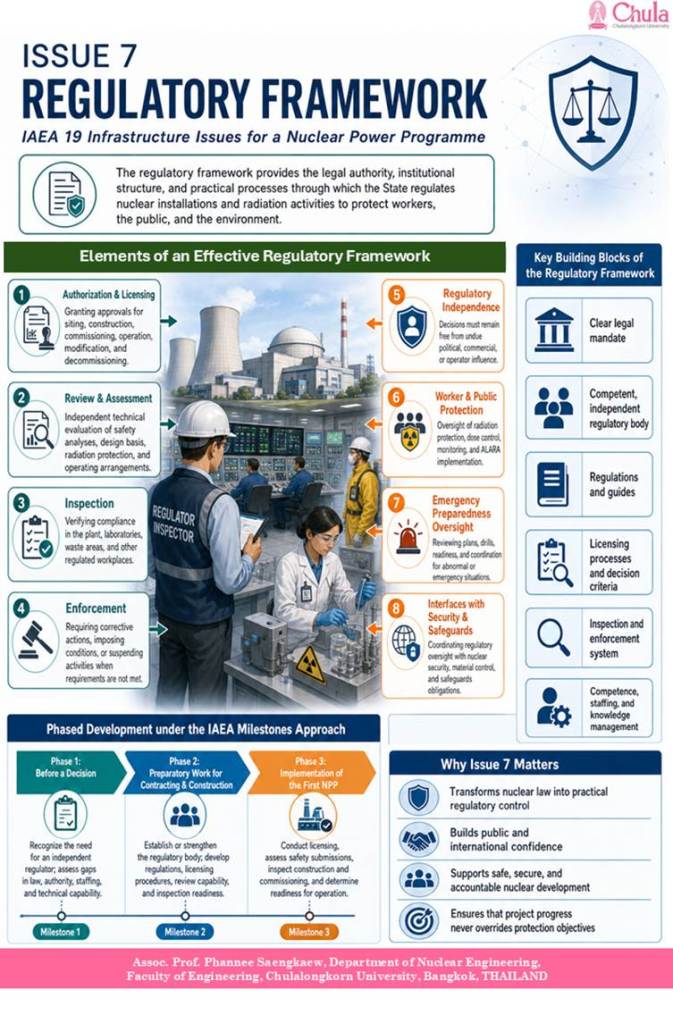
In the IAEA Milestones Approach, Issue 7: Regulatory Framework refers to the establishment of a competent, independent, legally empowered, and technically capable regulatory system for overseeing nuclear safety, radiation protection, nuclear security interfaces, safeguards-related requirements, emergency preparedness, environmental protection interfaces, and the licensing of nuclear facilities. Within the 19 infrastructure issues, the regulatory framework is one of the most critical institutional pillars because it transforms the national legal framework into enforceable regulatory control.
The IAEA Milestones Approach is a phased method for countries considering or planning their first nuclear power plant. It divides infrastructure development into three phases: Phase 1, before a national decision to launch a nuclear power programme; Phase 2, preparatory work for contracting and construction; and Phase 3, activities to implement the first nuclear power plant. The IAEA notes that the approach includes 19 infrastructure issues, all requiring appropriate attention, and that a competent, independent regulatory body is one of the three key organizations in a nuclear power programme.
Issue 7 should not be understood merely as the creation of an administrative agency. Rather, it involves the development of a complete regulatory system consisting of legislation, regulations, licensing processes, inspection and enforcement mechanisms, technical review capability, staffing, competence management, decision-making independence, transparency, quality management, and interfaces with other national and international organizations. The regulatory framework provides the formal mechanism through which the State assures that nuclear power is developed, constructed, commissioned, operated, and eventually decommissioned under conditions that protect people, society, and the environment.
The IAEA’s nuclear infrastructure bibliography identifies Regulatory Framework as Issue 7 and lists key and supporting references, including Establishing the Safety Infrastructure for a Nuclear Power Programme (SSG-16 Rev.1), Managing Regulatory Body Competence (Safety Reports Series No. 79), Governmental, Legal and Regulatory Framework for Safety (GSR Part 1 Rev.1), Organization, Management and Staffing of the Regulatory Body for Safety (GSG-12), Functions and Processes of the Regulatory Body for Safety (GSG-13), and Licensing Process for Nuclear Installations (SSG-12).
2. Conceptual Meaning of the Regulatory Framework
The regulatory framework is the institutional and procedural structure through which the State exercises control over activities and facilities involving nuclear energy and ionizing radiation. It is broader than the regulatory body alone. It includes the legal authority granted to the regulator, the national policies that define its mandate, the regulatory requirements issued under the law, and the practical processes used for authorization, review, assessment, inspection, enforcement, and public communication.
In a nuclear power programme, the regulatory framework has three main purposes. First, it ensures that safety, security, safeguards, radiation protection, environmental protection, and emergency preparedness are embedded into the project before construction begins. Second, it provides confidence that the owner/operator, suppliers, contractors, and technical organizations are subject to formal oversight. Third, it establishes a predictable licensing environment that supports sound decision-making without compromising regulatory independence.
A strong regulatory framework must therefore balance two functions. On one hand, it must enable the nuclear power programme to proceed through clear, timely, and well-defined authorization steps. On the other hand, it must preserve the regulator’s authority to require modifications, impose conditions, suspend activities, or reject applications when safety or legal requirements are not met. This balance is essential because nuclear regulation is not a service function for project delivery; it is a public-interest function for protection, assurance, and accountability.
3. Relationship between Issue 5 and Issue 7
Issue 7 is closely connected to Issue 5: Legal Framework, but the two are not identical. The legal framework provides the statutory foundation: nuclear law, regulatory authority, liability provisions, international obligations, inspection powers, enforcement powers, and institutional responsibilities. The regulatory framework operationalizes that legal foundation by creating the detailed regulations, licensing procedures, review criteria, inspection programmes, enforcement processes, and technical capacity needed for day-to-day regulatory control.
In this sense, Issue 5 answers the question: Does the State have a legal basis to regulate nuclear activities? Issue 7 answers a different question: Can the State actually regulate a nuclear power programme effectively, independently, and competently?
For this reason, a country may have a nuclear law but still lack a mature regulatory framework. The existence of legislation is only the first step. The regulatory body must also be staffed, trained, funded, organized, and equipped with procedures, technical support, decision-making systems, and inspection authority. It must be capable of reviewing safety analysis reports, evaluating site and design submissions, inspecting construction activities, assessing commissioning tests, and maintaining oversight during operation.
4. Core Elements of an Effective Regulatory Framework
4.1 Legal Authority and Mandate
The regulatory body must have a clear legal mandate. This mandate should define its authority to issue regulations, grant authorizations, conduct inspections, require information, impose enforcement actions, and communicate with the public. Without explicit legal authority, the regulator may be unable to act decisively when safety concerns arise.
The mandate should also clarify the scope of regulatory control. For a nuclear power programme, this scope normally includes site evaluation, design review, construction authorization, commissioning, operation, modification control, radioactive waste management interfaces, radiation protection, emergency preparedness, physical protection interfaces, transport of radioactive material, and eventual decommissioning. The regulatory body must also interact with safeguards authorities where nuclear material accounting and reporting are required.
4.2 Independence in Regulatory Decision-Making
Regulatory independence is a central principle. The regulatory body must be functionally separated from organizations responsible for promoting, owning, operating, financing, or constructing nuclear facilities. Independence does not mean isolation from government; rather, it means that regulatory decisions must be protected from undue political, commercial, or project-schedule pressure.
In practice, independence requires several conditions. The regulator must have a clear statutory basis, stable funding, qualified personnel, transparent decision-making procedures, conflict-of-interest controls, and the authority to make safety-based decisions even when those decisions affect project cost or schedule. If the regulator is administratively weak or dependent on the owner/operator for technical judgment, the credibility of the entire nuclear power programme is reduced.
4.3 Regulatory Requirements and Guidance
A nuclear power programme requires a hierarchy of regulatory documents. At the top are laws and governmental decrees. Below them are binding regulations issued by the regulatory body or government. Supporting these are regulatory guides, review procedures, inspection manuals, and technical criteria.
Regulatory requirements should be clear enough to guide applicants and licensees, but flexible enough to allow the use of modern engineering approaches and international standards. They should cover safety objectives, site evaluation, design safety, defense in depth, radiation protection, management systems, quality assurance, emergency preparedness, security interfaces, radioactive waste management, and decommissioning planning.
4.4 Licensing and Authorization Process
The licensing process is one of the most visible expressions of the regulatory framework. For a first nuclear power plant, the licensing process usually proceeds through a sequence of regulatory decisions, such as site approval, construction license, commissioning authorization, operating license, license amendments, and eventually decommissioning authorization.
Each licensing stage should require the applicant to submit evidence demonstrating that safety requirements are met. This evidence may include site evaluation reports, environmental impact assessments, preliminary and final safety analysis reports, probabilistic safety assessments, radiation protection programmes, emergency plans, quality assurance programmes, security arrangements, and commissioning test programmes.
A mature licensing process is not simply a checklist. It is a structured technical assessment process in which the regulator evaluates whether the applicant has demonstrated safety with adequate evidence. The regulatory body must be able to challenge assumptions, request additional information, impose license conditions, and require corrective actions.
4.5 Review and Assessment Capability
The regulatory body must be capable of performing independent technical review and assessment. This includes the ability to evaluate reactor design, safety analysis, deterministic and probabilistic assessments, severe accident considerations, site hazards, radiation protection, human factors, instrumentation and control, electrical systems, mechanical systems, civil structures, emergency preparedness, and operational limits and conditions.
For newcomer countries, this capability is often one of the most difficult areas to develop. The regulator may need to rely on technical and scientific support organizations, international consultants, or vendor-provided information. However, external support cannot replace regulatory responsibility. The regulatory body must remain an “intelligent customer” capable of understanding, questioning, integrating, and judging the technical advice it receives.
4.6 Inspection and Enforcement
Regulation does not end with document review. The regulatory body must inspect activities at the site, in fabrication facilities, during construction, during commissioning, and throughout operation. Inspections verify whether the licensee is implementing approved programmes and whether actual activities conform to regulatory requirements.
Enforcement mechanisms must also be available. These may include written notices, corrective action requirements, licence conditions, penalties, suspension of work, or revocation of authorization. Enforcement should be graded according to safety significance, but it must be credible. A regulator that cannot enforce requirements cannot maintain effective control.
4.7 Competence, Staffing, and Knowledge Management
The regulatory body must have qualified staff across multiple disciplines. These include nuclear engineering, reactor physics, thermal hydraulics, mechanical engineering, electrical engineering, civil engineering, instrumentation and control, radiation protection, environmental assessment, emergency preparedness, nuclear security interfaces, safeguards interfaces, human factors, quality assurance, legal affairs, and communication.
Competence management is not only a human resources function. It is a safety function. The regulator must identify required competencies, recruit and train staff, manage knowledge transfer, preserve institutional memory, and develop career pathways. For a first nuclear power programme, staffing must begin early enough to allow the regulator to participate meaningfully before major project decisions are made.
4.8 Interface with Other Infrastructure Issues
Issue 7 interacts strongly with other IAEA infrastructure issues. It depends on Issue 5 because legal authority must exist before effective regulation can be implemented. It supports Issue 2 because nuclear safety cannot be assured without an effective regulator. It overlaps with Issue 8 because radiation protection requirements must be regulated and enforced. It contributes to Issue 14 because emergency preparedness requires regulatory review and oversight. It also interfaces with Issue 15 because physical protection and nuclear security arrangements require coordinated regulatory control.
Therefore, the regulatory framework should be designed as a system of institutional interfaces rather than as a stand-alone agency. The regulator must coordinate with ministries, environmental authorities, emergency organizations, security agencies, safeguards authorities, technical support organizations, and local stakeholders while maintaining decision-making independence.
5. Phase-by-Phase Development under the IAEA Milestones Approach
Phase 1: Considerations before a Decision to Launch a Nuclear Power Programme
In Phase 1, the country has not yet made a final decision to launch a nuclear power programme. The main objective is to understand the implications, responsibilities, and institutional requirements associated with nuclear power. For Issue 7, this phase focuses on recognizing the need for an independent regulatory body and identifying the future regulatory functions that will be required.
During this phase, the government and the Nuclear Energy Programme Implementing Organization should assess the existing regulatory arrangements for radiation sources, research reactors, radioactive waste, and other nuclear or radiological activities. This assessment helps determine whether the existing regulator can be expanded to cover nuclear power or whether a new regulatory body must be established.
A key Phase 1 task is to identify gaps. These gaps may include insufficient legal authority, lack of nuclear power licensing experience, inadequate staffing, weak inspection powers, limited technical review capability, insufficient independence, or fragmented institutional responsibilities. The country should also examine international obligations and conventions relevant to nuclear safety, security, safeguards, and liability.
By the end of Phase 1, the country should understand that a nuclear power programme requires a regulatory body that is independent, competent, adequately resourced, and legally empowered. The regulatory framework does not need to be fully mature at this stage, but the government should have a realistic plan for establishing it during Phase 2.
Expected Phase 1 outcome: The State has recognized the need for a competent and independent regulatory body and has identified the major legal, institutional, and technical actions required to establish the regulatory framework.
Phase 2: Preparatory Work for Contracting and Construction
Phase 2 begins after the country has made a knowledgeable commitment to nuclear power. In this phase, the regulatory framework must move from conceptual planning to practical establishment. This is the phase in which the regulatory body should be formally established or significantly strengthened, because the country is preparing to invite bids, negotiate contracts, and make technology-related decisions.
The IAEA describes Phase 2 as the stage in which key organizations and the legal and regulatory frameworks are established. For Issue 7, this means that the regulatory body must become operational before major licensing and procurement decisions are finalized.
During Phase 2, the regulatory body should develop its organizational structure, staffing plan, competence development programme, regulatory document hierarchy, licensing process, inspection strategy, and technical review procedures. It should also prepare regulations and guides for site evaluation, design safety, construction authorization, radiation protection, emergency preparedness, quality assurance, environmental protection interfaces, and security interfaces.
This phase is particularly important because the selected reactor technology and contractual model can significantly affect regulatory work. If a country enters a vendor agreement before the regulatory framework is ready, it may create regulatory dependency, schedule pressure, or difficulty modifying contractual arrangements to meet national requirements. Therefore, the regulator must be sufficiently prepared to review bid specifications, understand reference plant information, define licensing expectations, and communicate regulatory requirements clearly to the owner/operator.
The regulatory body should also establish access to technical support. This may include national universities, research institutes, international consultants, experienced foreign regulators, or technical and scientific support organizations. However, the regulator must retain ownership of regulatory decisions. Technical support can inform decisions, but it should not make decisions on behalf of the regulatory body.
Expected Phase 2 outcome: The regulatory body is established, legally empowered, staffed at an initial functional level, and capable of defining licensing requirements for site selection, technology selection, and preparation for construction authorization.
Phase 3: Activities to Implement the First Nuclear Power Plant
Phase 3 begins when the country moves toward implementation of the first nuclear power plant. In this phase, the regulatory framework must function in practice. The regulatory body must review licence applications, assess safety submissions, inspect construction activities, evaluate commissioning tests, and determine whether the plant is ready for operation.
The IAEA Milestones Approach identifies Phase 3 as the stage involving activities to implement the first nuclear power plant, leading to Milestone 3: readiness to operate the first nuclear power plant. For Issue 7, this means the regulator must demonstrate that it can exercise independent control over the project from construction through commissioning and into operation.
During construction, the regulator must inspect safety-related structures, systems, and components; verify quality assurance implementation; monitor non-conformances; and review design changes. During commissioning, it must evaluate test results, operational limits and conditions, emergency arrangements, operator training, radiation protection arrangements, security interfaces, and readiness of the operating organization.
Before authorizing operation, the regulator must be satisfied that the plant has been constructed according to approved requirements, that safety analysis remains valid, that the operating organization is competent, that emergency arrangements are functional, and that regulatory conditions have been met. The operating license should define the conditions under which the plant may operate and the requirements for continued regulatory oversight.
Expected Phase 3 outcome: The regulatory body is capable of licensing, inspecting, enforcing, and overseeing the first nuclear power plant through construction, commissioning, and transition to operation.
6. Key Challenges for Newcomer Countries
Newcomer countries often face several challenges in developing Issue 7. The first challenge is regulatory independence. In countries where nuclear power is closely linked to national energy policy or strategic industrial development, the regulator may face pressure to support project timelines. Institutional design must therefore protect the regulator from undue influence.
The second challenge is competence. Nuclear power regulation requires expertise that may not exist domestically at the beginning of the programme. Building competence takes time, and it cannot be achieved only through short training courses. It requires long-term staffing, mentoring, technical review experience, inspection experience, and knowledge transfer.
The third challenge is licensing a first-of-a-kind national project. Even if the reactor design is proven elsewhere, it is new to the country. The regulator must understand how international reference designs are adapted to national site conditions, legal requirements, emergency arrangements, grid conditions, environmental constraints, and local industrial practices.
The fourth challenge is overreliance on foreign support. International consultants and experienced regulators can provide valuable assistance, but the national regulator must avoid becoming dependent on external judgment. The State retains responsibility for safety, and regulatory decisions cannot be subcontracted. The IAEA emphasizes that even when extensive foreign assistance is obtained, responsibility for implementing a nuclear power programme rests with the country and cannot be subcontracted.
The fifth challenge is timing. If the regulatory body is created too late, it may not be ready to review site and design decisions. If it is understaffed during procurement, it may be forced to react to decisions already made by the owner/operator or vendor. Effective regulatory development must therefore begin early, preferably during Phase 1 planning and certainly during Phase 2 implementation.
7. Importance of Regulatory Culture
A regulatory framework is not defined only by laws and procedures. It is also shaped by regulatory culture. Regulatory culture refers to the values, habits, and professional expectations that guide regulatory staff in their work. A strong regulatory culture emphasizes independence, technical rigor, transparency, accountability, conservatism in safety judgment, openness to questioning, and respect for evidence.
Regulatory culture differs from operator safety culture, although the two are related. The operator is responsible for safe operation, while the regulator is responsible for oversight and assurance. The regulator must avoid both excessive passivity and excessive intervention. It must neither become a project partner nor act arbitrarily. Its role is to make decisions based on law, evidence, technical assessment, and protection objectives.
A mature regulatory culture is especially important in newcomer countries because regulatory staff may be working under strong national expectations to deliver the first nuclear power project. In such circumstances, the regulator must maintain the principle that safety justification precedes authorization.
8. Indicators of a Mature Regulatory Framework
A mature regulatory framework can be recognized through several indicators. The regulatory body has clear legal authority and independence. It has stable funding and qualified staff. It has published regulations and regulatory guides. It has a defined licensing process. It can perform technical review and assessment. It has inspection and enforcement powers. It maintains records and decision transparency. It has communication mechanisms with stakeholders. It has access to technical support while retaining decision-making authority. It participates in international cooperation and peer review. It also has a competence management programme that ensures continuity of expertise over the long lifetime of the nuclear power programme.
For a first nuclear power plant, maturity does not mean that the regulator already has decades of operating experience. Rather, it means that the regulator has reached a level of capability appropriate to the current phase of the programme and has a credible plan for developing the additional capability required for the next phase.
9. Academic Summary
Issue 7: Regulatory Framework is a core institutional requirement for the development of a credible nuclear power programme. It converts the legal framework into practical regulatory control through licensing, review and assessment, inspection, enforcement, competence management, and public accountability. Its central purpose is to ensure that nuclear power development proceeds only under conditions that meet national and international expectations for safety, security, safeguards, radiation protection, and environmental protection.
The regulatory framework must be developed progressively across the three IAEA Milestones phases. In Phase 1, the State identifies the need for an independent and competent regulator. In Phase 2, the regulatory body is established and equipped to support site, technology, procurement, and licensing preparation. In Phase 3, the regulator must function fully in practice by reviewing, licensing, inspecting, and enforcing requirements during construction, commissioning, and preparation for operation.
A weak regulatory framework creates systemic risk. It may lead to unclear licensing expectations, regulatory capture, insufficient technical review, weak enforcement, and loss of public and international confidence. Conversely, a strong regulatory framework strengthens the credibility of the nuclear power programme by ensuring that safety-related decisions are made independently, transparently, and on the basis of technical evidence.
References
- International Atomic Energy Agency. (2015). Milestones in the Development of a National Infrastructure for Nuclear Power (IAEA Nuclear Energy Series No. NG-G-3.1 Rev.1). IAEA.
- International Atomic Energy Agency. (2024). Milestones in the Development of a National Infrastructure for Nuclear Power (IAEA Nuclear Energy Series No. NG-G-3.1 Rev.2). IAEA.
- International Atomic Energy Agency. (n.d.). Milestones Approach. IAEA.
- International Atomic Energy Agency. (n.d.). Nuclear Infrastructure Bibliography. IAEA.
- International Atomic Energy Agency. (2016). Governmental, Legal and Regulatory Framework for Safety (IAEA Safety Standards Series No. GSR Part 1 Rev.1). IAEA. Listed by IAEA as a key supporting document for Issue 7.
- International Atomic Energy Agency. (2018). Organization, Management and Staffing of the Regulatory Body for Safety (IAEA Safety Standards Series No. GSG-12). IAEA. Listed by IAEA under Regulatory Framework and Human Resource Development references.
- International Atomic Energy Agency. (2018). Functions and Processes of the Regulatory Body for Safety (IAEA Safety Standards Series No. GSG-13). IAEA.
- International Atomic Energy Agency. (2020). Establishing the Safety Infrastructure for a Nuclear Power Programme (IAEA Safety Standards Series No. SSG-16 Rev.1). IAEA.
- International Atomic Energy Agency. (2010). Licensing Process for Nuclear Installations (IAEA Safety Standards Series No. SSG-12). IAEA.
**********************************************************************************
ประเด็นด้านที่ 7: กรอบการกำกับดูแล
หนึ่งในการพัฒนาโครงสร้างพื้นฐาน 19 ด้านของ IAEA สำหรับโครงการพลังงานนิวเคลียร์
1. บทนำ
ภายใต้แนวทางตามหมุดหมายของทบวงการพลังงานปรมาณูระหว่างประเทศ หรือ IAEA Milestones Approach Issue 7: Regulatory Framework หรือ กรอบการกำกับดูแล หมายถึง การจัดตั้งระบบการกำกับดูแลที่มีสมรรถนะ มีความเป็นอิสระ มีอำนาจตามกฎหมาย และมีขีดความสามารถทางเทคนิคเพียงพอสำหรับการกำกับดูแลความปลอดภัยทางนิวเคลียร์ การป้องกันอันตรายจากรังสี การเชื่อมโยงกับความมั่นคงปลอดภัยทางนิวเคลียร์ ข้อกำหนดที่เกี่ยวข้องกับพิทักษ์ความปลอดภัยทางนิวเคลียร์ ความพร้อมรับเหตุฉุกเฉิน การเชื่อมโยงกับการคุ้มครองสิ่งแวดล้อม และการออกใบอนุญาตสำหรับสถานประกอบการนิวเคลียร์
ภายในโครงสร้างพื้นฐาน 19 ด้าน ถือได้ว่ากรอบการกำกับดูแลเป็นหนึ่งในเสาหลักเชิงสถาบันที่สำคัญที่สุด เนื่องจากเป็นกลไกที่แปลงกรอบกฎหมายระดับประเทศให้กลายเป็นระบบการควบคุมกำกับดูแลที่สามารถบังคับใช้ได้จริง
แนวทางตามหมุดหมายของ IAEA เป็นวิธีการพัฒนาโครงสร้างพื้นฐานแบบเป็นลำดับขั้นสำหรับประเทศที่กำลังพิจารณาหรือวางแผนจัดตั้งโรงไฟฟ้านิวเคลียร์แห่งแรก แนวทางนี้แบ่งการพัฒนาโครงสร้างพื้นฐานออกเป็น 3 ระยะ ได้แก่ ระยะที่ 1 ซึ่งเป็นช่วงก่อนการตัดสินใจระดับชาติในการเริ่มโครงการพลังงานนิวเคลียร์ ระยะที่ 2 ซึ่งเป็นช่วงการเตรียมความพร้อมสำหรับการทำสัญญาและการก่อสร้าง และระยะที่ 3 ซึ่งเป็นช่วงกิจกรรมเพื่อดำเนินการก่อสร้าง ทดสอบ และเตรียมเดินเครื่องโรงไฟฟ้านิวเคลียร์แห่งแรก ซึ่ง IAEA ระบุว่า แนวทางดังกล่าวครอบคลุมโครงสร้างพื้นฐาน 19 ด้าน และทุกด้านต้องได้รับการพัฒนาอย่างเหมาะสม ซึ่งหน่วยงานกำกับดูแลที่มีสมรรถนะและมีความเป็นอิสระภาพในการทำงานถือเป็นหนึ่งในสามองค์กรหลักของโครงการพลังงานนิวเคลียร์ของชาติ
ประเด็นด้านที่ 7 ไม่ควรถูกเข้าใจเพียงว่าเป็นการจัดตั้งหน่วยงานราชการหรือองค์กรเชิงบริหารขึ้นมาใหม่เท่านั้น แต่ควรถูกมองว่าเป็นการพัฒนาระบบการกำกับดูแลที่ครบถ้วน ซึ่งประกอบด้วยกฎหมาย กฎระเบียบ กระบวนการออกใบอนุญาต กลไกการตรวจสอบและการบังคับใช้ข้อกำหนด ความสามารถในการทบทวนทางเทคนิค การจัดกำลังบุคลากร การบริหารจัดการสมรรถนะ ความเป็นอิสระในการตัดสินใจ ความโปร่งใส ระบบบริหารคุณภาพ และการประสานงานกับองค์กรระดับชาติและนานาชาติอื่น ๆ กรอบการกำกับดูแลจึงเป็นกลไกอย่างเป็นทางการที่รัฐใช้เพื่อสร้างความมั่นใจว่า การพัฒนา การก่อสร้าง การทดสอบเดินระบบ การเดินเครื่อง และในที่สุดการรื้อถอนโรงไฟฟ้านิวเคลียร์ จะดำเนินไปภายใต้เงื่อนไขที่สามารถคุ้มครองประชาชน สังคม และสิ่งแวดล้อมได้อย่างเหมาะสม
เอกสารบรรณานุกรมด้านโครงสร้างพื้นฐานนิวเคลียร์ของ IAEA ระบุ กรอบการกำกับดูแล Regulatory Framework เป็น ประเด็นด้านที่ 7 และระบุเอกสารอ้างอิงสำคัญและเอกสารสนับสนุนหลายฉบับ เช่น Establishing the Safety Infrastructure for a Nuclear Power Programme หรือ SSG-16 Rev.1, Managing Regulatory Body Competence หรือ Safety Reports Series No. 79, Governmental, Legal and Regulatory Framework for Safety หรือ GSR Part 1 Rev.1, Organization, Management and Staffing of the Regulatory Body for Safety หรือ GSG-12, Functions and Processes of the Regulatory Body for Safety หรือ GSG-13 และ Licensing Process for Nuclear Installations หรือ SSG-12 เอกสารเหล่านี้สะท้อนให้เห็นว่า กรอบการกำกับดูแลมิใช่เพียงกลไกด้านกฎหมายเท่านั้น แต่เป็นระบบการบริหารจัดการ การประเมิน การตรวจสอบ และการตัดสินใจเชิงเทคนิคที่มีความสำคัญต่อความน่าเชื่อถือของโครงการพลังงานนิวเคลียร์ทั้งระบบ
2. ความหมายเชิงแนวคิดของกรอบการกำกับดูแล
กรอบการกำกับดูแล คือ โครงสร้างเชิงสถาบันและกระบวนการปฏิบัติที่รัฐใช้ในการควบคุมกำกับกิจกรรมและที่เกี่ยวข้องกับพลังงานนิวเคลียร์และรังสีก่อให้เกิดไอออน กรอบการกำกับดูแลมีความหมายกว้างกว่าตัวหน่วยงานกำกับดูแลเพียงอย่างเดียว เพราะครอบคลุมถึงอำนาจทางกฎหมายที่มอบให้แก่หน่วยงานกำกับดูแล นโยบายระดับชาติที่กำหนดพันธกิจของหน่วยงานนั้น ข้อกำหนดทางกฎระเบียบที่ออกภายใต้กฎหมาย และกระบวนการปฏิบัติจริงที่ใช้สำหรับการอนุญาต การทบทวน การประเมิน การตรวจสอบ การบังคับใช้ข้อกำหนด และการสื่อสารกับสาธารณชน
ในโครงการพลังงานนิวเคลียร์ กรอบการกำกับดูแลมีวัตถุประสงค์หลักสามประการ ประการแรก คือ การทำให้ความปลอดภัย ความมั่นคงปลอดภัยทางนิวเคลียร์ พิทักษ์ความปลอดภัยทางนิวเคลียร์ การป้องกันอันตรายจากรังสี การคุ้มครองสิ่งแวดล้อม และความพร้อมรับเหตุฉุกเฉิน ถูกบูรณาการเข้าสู่โครงการตั้งแต่ก่อนเริ่มการก่อสร้าง ประการที่สอง คือ การสร้างความมั่นใจว่าเจ้าของโครงการหรือองค์กรผู้ดำเนินงาน ผู้จัดหาเทคโนโลยี ผู้รับเหมา และองค์กรสนับสนุนทางเทคนิคทั้งหมดอยู่ภายใต้ระบบการกำกับดูแลอย่างเป็นทางการ ประการที่สาม คือ การจัดให้มีสภาพแวดล้อมด้านการออกใบอนุญาตที่ชัดเจน คาดการณ์ได้ และเอื้อต่อการตัดสินใจอย่างรอบคอบ โดยไม่ทำให้ความเป็นอิสระของหน่วยงานกำกับดูแลถูกลดทอน
ดังนั้น กรอบการกำกับดูแลที่เข้มแข็งต้องสามารถรักษาสมดุลระหว่างหน้าที่สองด้าน ด้านหนึ่ง กรอบการกำกับดูแลต้องเอื้อให้โครงการพลังงานนิวเคลียร์สามารถดำเนินหน้าไปตามขั้นตอนการอนุญาตที่ชัดเจน ทันเวลา และมีลำดับการตัดสินใจที่เป็นระบบ อีกด้านหนึ่ง กรอบการกำกับดูแลต้องคงไว้ซึ่งอำนาจของหน่วยงานกำกับดูแลในการกำหนดให้มีการแก้ไข ปรับปรุง เพิ่มเงื่อนไข ระงับกิจกรรม หรือปฏิเสธคำขออนุญาต หากหลักฐานด้านความปลอดภัยหรือข้อกำหนดตามกฎหมายยังไม่เพียงพอ สมดุลนี้มีความสำคัญอย่างยิ่ง เพราะการกำกับดูแลนิวเคลียร์ไม่ใช่หน้าที่บริการเพื่อสนับสนุนให้โครงการดำเนินไปได้โดยเร็ว แต่เป็นหน้าที่สาธารณะที่มุ่งคุ้มครอง สร้างความเชื่อมั่น และรักษาความรับผิดชอบต่อสังคม
3. ความสัมพันธ์ระหว่าง ประเด็นด้านที่ 5 และ ประเด็นด้านที่ 7
ประเด็นด้านที่ 7 มีความเชื่อมโยงอย่างใกล้ชิดกับประเด็นด้านที่ 5: กรอบกฎหมาย (Legal Framework) แต่ทั้งสองประเด็นไม่ใช่สิ่งเดียวกัน กรอบกฎหมายเป็นฐานทางนิติบัญญัติที่กำหนดกฎหมายนิวเคลียร์ อำนาจของหน่วยงานกำกับดูแล บทบัญญัติด้านความรับผิดทางนิวเคลียร์ พันธกรณีระหว่างประเทศ อำนาจการตรวจสอบ อำนาจการบังคับใช้ และความรับผิดชอบของสถาบันต่าง ๆ ส่วนกรอบการกำกับดูแลเป็นการนำฐานกฎหมายดังกล่าวมาปฏิบัติให้เกิดผลจริง ผ่านการจัดทำกฎระเบียบโดยละเอียด กระบวนการออกใบอนุญาต เกณฑ์การทบทวนและประเมิน โปรแกรมการตรวจสอบ กระบวนการบังคับใช้ข้อกำหนด และขีดความสามารถทางเทคนิคที่จำเป็นสำหรับการควบคุมกำกับในชีวิตประจำวัน
ในความหมายนี้ ประเด็นด้านที่ 5 กรอบกฎหมาย ตอบคำถามว่า รัฐมีฐานทางกฎหมายเพียงพอที่จะกำกับดูแลกิจกรรมนิวเคลียร์หรือไม่ ในขณะที่ ประเด็นด้านที่ 7 กรอบการกำกับดูแล ตอบคำถามอีกระดับหนึ่งว่า รัฐสามารถกำกับดูแลโครงการพลังงานนิวเคลียร์ได้อย่างมีประสิทธิภาพ เป็นอิสระ และมีสมรรถนะจริงหรือไม่
ด้วยเหตุนี้ ประเทศหนึ่งอาจมีกฎหมายนิวเคลียร์แล้ว แต่ยังอาจขาดกรอบการกำกับดูแลที่สมบูรณ์และมีความครบถ้วนในเชิงปฏิบัติได้ การมีอยู่ของกฎหมายจึงเป็นเพียงขั้นแรกเท่านั้น หน่วยงานกำกับดูแลต้องได้รับการจัดกำลังบุคลากร ฝึกอบรม จัดสรรงบประมาณ และติดตั้งระบบปฏิบัติการที่ประกอบด้วยขั้นตอนการทำงาน การสนับสนุนทางเทคนิค ระบบการตัดสินใจ และอำนาจการตรวจสอบ หน่วยงานดังกล่าวต้องมีความสามารถในการทบทวนรายงานวิเคราะห์ความปลอดภัย ประเมินเอกสารเกี่ยวกับสถานที่ตั้งและแบบโรงไฟฟ้า ตรวจสอบกิจกรรมการก่อสร้าง ประเมินผลการทดสอบเดินระบบ และรักษาการกำกับดูแลระหว่างการเดินเครื่องอย่างต่อเนื่อง
4. องค์ประกอบหลักของกรอบการกำกับดูแลที่มีประสิทธิภาพ
4.1 อำนาจทางกฎหมายและพันธกิจที่ชัดเจน
หน่วยงานกำกับดูแลต้องมีพันธกิจทางกฎหมายที่ชัดเจน พันธกิจนี้ควรกำหนดอำนาจในการออกกฎระเบียบ การให้อนุญาต การตรวจสอบ การเรียกข้อมูล การดำเนินมาตรการบังคับใช้ และการสื่อสารกับสาธารณชนอย่างชัดแจ้ง หากไม่มีอำนาจทางกฎหมายที่ชัดเจน หน่วยงานกำกับดูแลอาจไม่สามารถดำเนินการอย่างเด็ดขาดเมื่อเกิดข้อกังวลด้านความปลอดภัย
พันธกิจดังกล่าวควรกำหนดขอบเขตของการควบคุมกำกับให้ชัดเจนด้วย สำหรับโครงการพลังงานนิวเคลียร์ ขอบเขตนี้โดยทั่วไปครอบคลุม การประเมินสถานที่ตั้ง การทบทวนแบบ การอนุญาตก่อสร้าง การทดสอบเดินระบบ การเดินเครื่อง การควบคุมการดัดแปลงแก้ไข การเชื่อมโยงกับการจัดการกากกัมมันตรังสี การป้องกันอันตรายจากรังสี ความพร้อมรับเหตุฉุกเฉิน การเชื่อมโยงกับการป้องกันทางกายภาพ การขนส่งวัสดุกัมมันตรังสี และท้ายที่สุดการรื้อถอน หน่วยงานกำกับดูแลยังต้องประสานงานกับหน่วยงานด้านพิทักษ์ความปลอดภัยทางนิวเคลียร์ในกรณีที่มีข้อกำหนดเกี่ยวกับการทำบัญชีและการรายงานวัสดุนิวเคลียร์
4.2 ความเป็นอิสระในการตัดสินใจด้านการกำกับดูแล
ความเป็นอิสระของหน่วยงานกำกับดูแลเป็นหลักการสำคัญ หน่วยงานกำกับดูแลต้องแยกหน้าที่อย่างชัดเจนจาก องค์กรที่มีหน้าที่ส่งเสริม ที่เป็นเจ้าของ ที่ดำเนินงาน ที่จัดหาเงินทุน หรือที่ก่อสร้าง โรงไฟฟ้านิวเคลียร์ แต่ว่าความเป็นอิสระนี้มิได้หมายถึงการแยกตัวออกจากรัฐบาลโดยสิ้นเชิง แต่หมายถึงการที่การตัดสินใจด้านการกำกับดูแลต้องได้รับการคุ้มครองจากแรงกดดันทางการเมือง ผลประโยชน์เชิงพาณิชย์ หรือแรงกดดันด้านกำหนดการของโครงการที่ไม่เหมาะสม
ในทางปฏิบัติ ความเป็นอิสระต้องอาศัยเงื่อนไขหลายประการ ได้แก่ ฐานะทางกฎหมายที่ชัดเจน งบประมาณที่มั่นคง บุคลากรที่มีคุณสมบัติเหมาะสม ขั้นตอนการตัดสินใจที่โปร่งใส กลไกควบคุมผลประโยชน์ทับซ้อน และอำนาจในการตัดสินใจบนพื้นฐานของความปลอดภัย แม้ว่าการตัดสินใจนั้นจะมีผลต่อค่าใช้จ่ายหรือกำหนดการของโครงการก็ตาม หากหน่วยงานกำกับดูแลมีสถานะเชิงบริหารที่อ่อนแอ หรือพึ่งพาองค์กรผู้ดำเนินงานในการตัดสินทางเทคนิคมากเกินไป ความน่าเชื่อถือของโครงการพลังงานนิวเคลียร์ทั้งระบบย่อมลดลง
4.3 ข้อกำหนดและแนวทางกำกับดูแล
โครงการพลังงานนิวเคลียร์จำเป็นต้องมีลำดับชั้นของเอกสารกำกับดูแลอย่างชัดเจน ชั้นบนสุดคือกฎหมายและพระราชกฤษฎีกาหรือกฎเกณฑ์ของรัฐ ถัดลงมาคือข้อกำหนดหรือกฎระเบียบที่มีผลผูกพัน ซึ่งออกโดยหน่วยงานกำกับดูแลหรือรัฐบาล เอกสารสนับสนุนถัดมาประกอบด้วยแนวทางกำกับดูแล ขั้นตอนการทบทวน คู่มือการตรวจสอบ และเกณฑ์ทางเทคนิค
ข้อกำหนดด้านการกำกับดูแลควรมีความชัดเจนเพียงพอที่จะชี้นำผู้ยื่นคำขอและผู้ได้รับใบอนุญาต แต่ต้องมีความยืดหยุ่นเพียงพอที่จะรองรับแนวทางวิศวกรรมสมัยใหม่และมาตรฐานสากล ข้อกำหนดควรครอบคลุมวัตถุประสงค์ด้านความปลอดภัย การประเมินสถานที่ตั้ง ความปลอดภัยด้านการออกแบบ หลักการป้องกันเชิงลึก การป้องกันอันตรายจากรังสี ระบบบริหารจัดการ การประกันคุณภาพ ความพร้อมรับเหตุฉุกเฉิน การเชื่อมโยงกับความมั่นคงปลอดภัยทางนิวเคลียร์ การจัดการกากกัมมันตรังสี และการวางแผนการรื้อถอน
4.4 กระบวนการออกใบอนุญาตและการให้อนุญาต
กระบวนการออกใบอนุญาตเป็นหนึ่งในรูปธรรมที่ชัดเจนที่สุดของกรอบการกำกับดูแล สำหรับโรงไฟฟ้านิวเคลียร์แห่งแรก กระบวนการออกใบอนุญาตโดยทั่วไปดำเนินไปตามลำดับการตัดสินใจด้านการกำกับดูแล เช่น การให้ความเห็นชอบสถานที่ตั้ง ใบอนุญาตก่อสร้าง การอนุญาตทดสอบเดินระบบ ใบอนุญาตเดินเครื่อง การแก้ไขเปลี่ยนแปลงใบอนุญาต และท้ายที่สุดการอนุญาตรื้อถอน
ในแต่ละขั้นของการออกใบอนุญาต ผู้ยื่นคำขอควรต้องส่งหลักฐานเพื่อแสดงให้เห็นว่าสามารถปฏิบัติตามข้อกำหนดด้านความปลอดภัยได้ หลักฐานเหล่านี้อาจประกอบด้วยรายงานการประเมินสถานที่ตั้ง รายงานการประเมินผลกระทบสิ่งแวดล้อม รายงานวิเคราะห์ความปลอดภัยเบื้องต้นและฉบับสมบูรณ์ การประเมินความปลอดภัยเชิงความน่าจะเป็น โปรแกรมการป้องกันอันตรายจากรังสี แผนฉุกเฉิน โปรแกรมการประกันคุณภาพ มาตรการด้านความมั่นคงปลอดภัยทางนิวเคลียร์ และโปรแกรมการทดสอบเดินระบบ
กระบวนการออกใบอนุญาตที่ครอบคลุมครบถ้วนไม่ใช่เพียงรายการตรวจสอบ แต่เป็นกระบวนการประเมินทางเทคนิคที่มีโครงสร้าง ซึ่งหน่วยงานกำกับดูแลประเมินว่าผู้ยื่นคำขอได้แสดงเหตุผลด้านความปลอดภัยด้วยหลักฐานที่เพียงพอหรือไม่ หน่วยงานกำกับดูแลต้องสามารถตั้งคำถามต่อสมมติฐาน ขอข้อมูลเพิ่มเติม กำหนดเงื่อนไขในใบอนุญาต และกำหนดให้ดำเนินมาตรการแก้ไขได้
4.5 ขีดความสามารถด้านการทบทวนและการประเมิน
หน่วยงานกำกับดูแลต้องสามารถดำเนินการทบทวนและประเมินทางเทคนิคอย่างเป็นอิสระได้ ความสามารถนี้รวมถึงการประเมินแบบเครื่องปฏิกรณ์ การวิเคราะห์ความปลอดภัย การประเมินเชิงกำหนดและเชิงความน่าจะเป็น การพิจารณาอุบัติเหตุรุนแรง อันตรายเฉพาะพื้นที่ตั้ง การป้องกันอันตรายจากรังสี ปัจจัยมนุษย์ ระบบเครื่องมือวัดและควบคุม ระบบไฟฟ้า ระบบเครื่องกล โครงสร้างโยธา ความพร้อมรับเหตุฉุกเฉิน และขีดจำกัดและเงื่อนไขการเดินเครื่อง
สำหรับประเทศเพิ่งเริ่มต้นโครงการใหม่ ความสามารถด้านนี้มักเป็นหนึ่งในส่วนที่พัฒนาได้ยากที่สุด หน่วยงานกำกับดูแลอาจต้องพึ่งพาองค์กรสนับสนุนทางเทคนิคและวิทยาศาสตร์ ที่ปรึกษาระหว่างประเทศ หรือข้อมูลจากผู้จัดหาเทคโนโลยี แต่อย่างไรก็ตามการสนับสนุนจากภายนอกไม่สามารถทดแทนความรับผิดชอบด้านการกำกับดูแลได้ หน่วยงานกำกับดูแลต้องยังคงเป็น “ผู้รับบริการทางเทคนิคที่มีความรู้ความเข้าใจ” หรือ intelligent customer กล่าวคือ ต้องสามารถทำความเข้าใจ ตั้งคำถาม บูรณาการ และตัดสินคำแนะนำทางเทคนิคที่ได้รับด้วยตนเอง
4.6 การตรวจสอบและการบังคับใช้ข้อกำหนด
การกำกับดูแลไม่ได้สิ้นสุดที่การทบทวนเอกสาร หน่วยงานกำกับดูแลต้องตรวจสอบกิจกรรมที่สถานที่ตั้ง ในโรงงานผลิตชิ้นส่วน ในระหว่างการก่อสร้าง ระหว่างการทดสอบเดินระบบ และตลอดช่วงการเดินเครื่อง การตรวจสอบมีหน้าที่ตรวจยืนยันว่าผู้ได้รับใบอนุญาตดำเนินโปรแกรมที่ได้รับอนุมัติจริง และกิจกรรมที่เกิดขึ้นจริงสอดคล้องกับข้อกำหนดด้านการกำกับดูแล
กลไกการบังคับใช้ข้อกำหนดต้องมีอยู่เช่นกัน กลไกเหล่านี้อาจประกอบด้วยหนังสือแจ้งเตือน ข้อกำหนดให้ดำเนินมาตรการแก้ไข เงื่อนไขในใบอนุญาต บทลงโทษ การระงับงาน หรือการเพิกถอนการอนุญาต การบังคับใช้ควรมีลักษณะเป็นลำดับขั้นตามระดับความสำคัญด้านความปลอดภัย แต่ต้องมีความน่าเชื่อถือ หน่วยงานกำกับดูแลที่ไม่สามารถบังคับใช้ข้อกำหนดได้ ย่อมไม่สามารถรักษาการควบคุมกำกับที่มีประสิทธิภาพได้
4.7 สมรรถนะ บุคลากร และการจัดการองค์ความรู้
หน่วยงานกำกับดูแลต้องมีบุคลากรที่มีคุณสมบัติเหมาะสมในหลายสาขาวิชา ได้แก่ วิศวกรรมนิวเคลียร์ ฟิสิกส์เครื่องปฏิกรณ์ เทอร์โมไฮดรอลิกส์ วิศวกรรมเครื่องกล วิศวกรรมไฟฟ้า วิศวกรรมโยธา ระบบเครื่องมือวัดและควบคุม การป้องกันอันตรายจากรังสี การประเมินสิ่งแวดล้อม ความพร้อมรับเหตุฉุกเฉิน การเชื่อมโยงกับความมั่นคงปลอดภัยทางนิวเคลียร์ การเชื่อมโยงกับพิทักษ์ความปลอดภัยทางนิวเคลียร์ ปัจจัยมนุษย์ การประกันคุณภาพ กฎหมาย และการสื่อสาร
การบริหารจัดการสมรรถนะไม่ใช่เพียงหน้าที่ด้านทรัพยากรมนุษย์ แต่เป็นหน้าที่ด้านความปลอดภัย หน่วยงานกำกับดูแลต้องระบุสมรรถนะที่จำเป็น สรรหาและฝึกอบรมบุคลากร จัดการการถ่ายทอดองค์ความรู้ รักษาหรือบันทึกประวัติหรือบทเรียนเชิงสถาบัน และพัฒนาเส้นทางความก้าวหน้าในอาชีพ สำหรับโครงการพลังงานนิวเคลียร์แห่งแรก การจัดกำลังบุคลากรต้องเริ่มต้นเร็วพอที่จะทำให้หน่วยงานกำกับดูแลสามารถมีส่วนร่วมอย่างมีความหมายก่อนการตัดสินใจสำคัญของโครงการ
4.8 การเชื่อมโยงกับโครงสร้างพื้นฐานประเด็นอื่น
ประเด็นด้านที่ 7 มีความเกี่ยวข้องกับโครงสร้างพื้นฐานประเด็นอื่นอย่างยิ่ง คือ กรอบการกำกับดูแลขึ้นอยู่กับโครงสร้างด้านที่ 5 กรอบกฎหมาย เพราะต้องมีอำนาจทางกฎหมายก่อนจึงจะสามารถดำเนินการกำกับดูแลได้อย่างมีประสิทธิภาพ และกรอบการกำกับดูแลสนับสนุนโครงสร้างด้านที่ 2 เพราะความปลอดภัยไม่สามารถรับประกันได้หากไม่มีหน่วยงานกำกับดูแลที่มีประสิทธิภาพ กรอบการกำกับดูแลนี้ทับซ้อนกับโครงสร้างด้านที่ 8 เพราะข้อกำหนดด้านการป้องกันอันตรายจากรังสีต้องถูกกำกับและบังคับใช้ กรอบการกำกับดูแลมีส่วนสนับสนุนโครงสร้างด้านที่ 14 เพราะความพร้อมรับเหตุฉุกเฉินต้องได้รับการทบทวนและกำกับดูแล และยังเชื่อมโยงกับโครงสร้างด้านที่ 15 เพราะมาตรการการป้องกันทางกายภาพและความมั่นคงปลอดภัยทางนิวเคลียร์จำเป็นต้องมีการควบคุมกำกับที่ประสานสอดคล้องกัน
ดังนั้น กรอบการกำกับดูแลควรถูกออกแบบให้เป็นระบบของการเชื่อมโยงระหว่างสถาบัน ไม่ใช่เพียงหน่วยงานเดี่ยวที่แยกออกจากระบบอื่น หน่วยงานกำกับดูแลต้องประสานงานกับกระทรวง หน่วยงานสิ่งแวดล้อม องค์กรด้านเหตุฉุกเฉิน หน่วยงานความมั่นคง หน่วยงานพิทักษ์ความปลอดภัยทางนิวเคลียร์ องค์กรสนับสนุนทางเทคนิค และผู้มีส่วนได้ส่วนเสียในท้องถิ่น ขณะเดียวกันต้องรักษาความเป็นอิสระในการตัดสินใจด้านการกำกับดูแลไว้เสมอ
5. การพัฒนาเป็นลำดับขั้นภายใต้แนวทางตามหมุดหมายของ IAEA
ระยะที่ 1: การพิจารณาก่อนการตัดสินใจเริ่มโครงการพลังงานนิวเคลียร์
ในระยะที่ 1 ประเทศยังไม่ได้ตัดสินใจขั้นสุดท้ายว่าจะเริ่มโครงการพลังงานนิวเคลียร์หรือไม่ วัตถุประสงค์หลักของระยะนี้คือการทำความเข้าใจผลกระทบ ความรับผิดชอบ และข้อกำหนดเชิงสถาบันที่เกี่ยวข้องกับพลังงานนิวเคลียร์ สำหรับ ประเด็นด้านที่ 7 ระยะนี้มุ่งเน้นการตระหนักถึงความจำเป็นของหน่วยงานกำกับดูแลที่เป็นอิสระ และการระบุหน้าที่ด้านการกำกับดูแลที่จะต้องมีในอนาคต
ในระยะนี้ รัฐบาลและองค์กรดำเนินการโครงการพลังงานนิวเคลียร์ หรือ Nuclear Energy Programme Implementing Organization (NEPIO) ควรประเมินระบบการกำกับดูแลที่มีอยู่เดิมที่สำหรับแหล่งกำเนิดรังสี เครื่องปฏิกรณ์นิวเคลียร์วิจัย กากกัมมันตรังสี และกิจกรรมทางนิวเคลียร์หรือรังสีอื่น ๆ การประเมินนี้ช่วยให้ทราบว่าหน่วยงานกำกับดูแลที่มีอยู่สามารถขยายบทบาทให้ครอบคลุมพลังงานนิวเคลียร์ได้หรือไม่ หรือจำเป็นต้องจัดตั้งหน่วยงานกำกับดูแลใหม่
ภารกิจสำคัญของระยะที่ 1 คือการระบุช่องว่าง ช่องว่างเหล่านี้อาจประกอบด้วยอำนาจทางกฎหมายที่ไม่เพียงพอ การขาดประสบการณ์ในการออกใบอนุญาตโรงไฟฟ้านิวเคลียร์ กำลังบุคลากรไม่เพียงพอ อำนาจการตรวจสอบที่อ่อนแอ ขีดความสามารถด้านการทบทวนทางเทคนิคที่จำกัด ความเป็นอิสระไม่เพียงพอ หรือความรับผิดชอบเชิงสถาบันที่กระจัดกระจาย ประเทศควรตรวจสอบพันธกรณีระหว่างประเทศและอนุสัญญาที่เกี่ยวข้องกับความปลอดภัยทางนิวเคลียร์ ความมั่นคงปลอดภัยทางนิวเคลียร์ พิทักษ์ความปลอดภัยทางนิวเคลียร์ และความรับผิดทางนิวเคลียร์ด้วย
เมื่อสิ้นสุดระยะที่ 1 ประเทศควรเข้าใจว่าโครงการพลังงานนิวเคลียร์ต้องการหน่วยงานกำกับดูแลที่เป็นอิสระ มีสมรรถนะ ได้รับทรัพยากรอย่างเพียงพอ และมีอำนาจตามกฎหมาย กรอบการกำกับดูแลยังไม่จำเป็นต้องสมบูรณ์เต็มที่ในระยะนี้ แต่รัฐบาลควรมีแผนที่สมจริงสำหรับการจัดตั้งและพัฒนากรอบดังกล่าวในระยะที่ 2
ผลลัพธ์ที่คาดหวังของระยะที่ 1: รัฐได้ตระหนักถึงความจำเป็นของหน่วยงานกำกับดูแลที่มีสมรรถนะและเป็นอิสระ และได้ระบุการดำเนินการสำคัญด้านกฎหมาย สถาบัน และเทคนิคที่จำเป็นต่อการจัดตั้งกรอบการกำกับดูแล
ระยะที่ 2: การเตรียมความพร้อมสำหรับการทำสัญญาและการก่อสร้าง
ระยะที่ 2 เริ่มต้นหลังจากประเทศได้ตัดสินใจอย่างรู้เท่าทันว่าจะดำเนินโครงการพลังงานนิวเคลียร์ ซึ่งในระยะนี้กรอบการกำกับดูแลต้องเปลี่ยนจากการวางแผนเชิงแนวคิดไปสู่การจัดตั้งเชิงปฏิบัติ ระยะนี้เป็นช่วงที่หน่วยงานกำกับดูแลควรได้รับการจัดตั้งอย่างเป็นทางการ หรือได้รับการเสริมสร้างอย่างมีนัยสำคัญ เนื่องจากประเทศกำลังเตรียมเชิญชวนผู้เสนอราคา เจรจาสัญญา และตัดสินใจเกี่ยวกับเทคโนโลยี ซึ่งระยะที่ 2 เป็นช่วงที่องค์กรสำคัญต่าง ๆ รวมทั้งกรอบกฎหมายและกรอบการกำกับดูแลต้องได้รับการจัดตั้งสำหรับโครงสร้างด้านที่ 7 หมายความว่า หน่วยงานกำกับดูแลต้องสามารถปฏิบัติงานได้จริงก่อนที่จะดำเนินการตัดสินใจด้านใบอนุญาตและการจัดซื้อจัดจ้างที่สำคัญจะเสร็จสิ้น
ในระยะที่ 2 หน่วยงานกำกับดูแลควรพัฒนาโครงสร้างองค์กร แผนการจัดบุคลากร โปรแกรมพัฒนาสมรรถนะ ลำดับชั้นของเอกสารกำกับดูแล กระบวนการออกใบอนุญาต กลยุทธ์การตรวจสอบ และขั้นตอนการทบทวนทางเทคนิค หน่วยงานดังกล่าวควรจัดทำกฎระเบียบและแนวทางสำหรับการประเมินสถานที่ตั้ง ความปลอดภัยด้านการออกแบบ การอนุญาตก่อสร้าง การป้องกันอันตรายจากรังสี ความพร้อมรับเหตุฉุกเฉิน การประกันคุณภาพ การเชื่อมโยงกับการคุ้มครองสิ่งแวดล้อม และการเชื่อมโยงกับความมั่นคงปลอดภัยทางนิวเคลียร์
ระยะนี้มีความสำคัญอย่างยิ่ง เพราะเทคโนโลยีเครื่องปฏิกรณ์ที่เลือกและรูปแบบสัญญาที่ใช้สามารถส่งผลอย่างมากต่อภาระงานด้านการกำกับดูแล หากประเทศทำข้อตกลงกับผู้จัดหาเทคโนโลยีก่อนที่กรอบการกำกับดูแลจะพร้อม อาจก่อให้เกิดการพึ่งพาด้านการกำกับดูแล แรงกดดันด้านกำหนดการ หรือความยากลำบากในการปรับสัญญาให้สอดคล้องกับข้อกำหนดระดับชาติ ดังนั้น หน่วยงานกำกับดูแลต้องมีความพร้อมเพียงพอในการทบทวนข้อกำหนดการประมูล ทำความเข้าใจข้อมูลโรงไฟฟ้าอ้างอิง กำหนดความคาดหวังด้านการออกใบอนุญาต และสื่อสารข้อกำหนดด้านการกำกับดูแลต่อเจ้าของโครงการหรือองค์กรผู้ดำเนินงานอย่างชัดเจน
หน่วยงานกำกับดูแลควรจัดให้มีการเข้าถึงการสนับสนุนทางเทคนิคด้วย การสนับสนุนดังกล่าวอาจมาจากมหาวิทยาลัยในประเทศ สถาบันวิจัย ที่ปรึกษาระหว่างประเทศ หน่วยงานกำกับดูแลต่างประเทศที่มีประสบการณ์ หรือองค์กรสนับสนุนทางเทคนิคและวิทยาศาสตร์ แต่อย่างไรก็ตาม หน่วยงานกำกับดูแลต้องยังคงเป็นเจ้าของการตัดสินใจด้านการกำกับดูแล การสนับสนุนทางเทคนิคสามารถให้ข้อมูลประกอบการตัดสินใจได้ แต่ไม่ควรเป็นผู้ตัดสินใจแทนหน่วยงานกำกับดูแล
ผลลัพธ์ที่คาดหวังของระยะที่ 2: หน่วยงานกำกับดูแลได้รับการจัดตั้ง มีอำนาจตามกฎหมาย มีบุคลากรในระดับเริ่มต้นที่สามารถปฏิบัติหน้าที่ได้ และมีความสามารถในการกำหนดข้อกำหนดด้านการออกใบอนุญาตสำหรับการเลือกสถานที่ตั้ง การเลือกเทคโนโลยี และการเตรียมพร้อมสำหรับการอนุญาตก่อสร้าง
ระยะที่ 3: กิจกรรมเพื่อดำเนินการโรงไฟฟ้านิวเคลียร์แห่งแรก
ระยะที่ 3 เริ่มต้นเมื่อประเทศเข้าสู่การดำเนินโครงการโรงไฟฟ้านิวเคลียร์แห่งแรก ในระยะนี้ กรอบการกำกับดูแลต้องทำงานได้จริง หน่วยงานกำกับดูแลต้องทบทวนคำขอใบอนุญาต ประเมินเอกสารด้านความปลอดภัย ตรวจสอบกิจกรรมการก่อสร้าง ประเมินผลการทดสอบเดินระบบ และตัดสินว่าโรงไฟฟ้ามีความพร้อมสำหรับการเดินเครื่องหรือไม่
แนวทางตามหมุดหมายของ IAEA ระบุว่าระยะที่ 3 เป็นช่วงกิจกรรมเพื่อดำเนินการโรงไฟฟ้านิวเคลียร์แห่งแรก ซึ่งนำไปสู่หมุดหมายที่ 3 คือความพร้อมในการเดินเครื่องโรงไฟฟ้านิวเคลียร์แห่งแรก สำหรับโครงสร้างด้านที่ 7 หมายความว่า หน่วยงานกำกับดูแลต้องแสดงให้เห็นว่าสามารถควบคุมกำกับโครงการได้อย่างเป็นอิสระตั้งแต่การก่อสร้าง ผ่านการทดสอบเดินระบบ และเข้าสู่การเดินเครื่อง
ระหว่างการก่อสร้าง หน่วยงานกำกับดูแลต้องตรวจสอบโครงสร้าง ระบบ และส่วนประกอบที่มีความสำคัญต่อความปลอดภัย ตรวจยืนยันการดำเนินการตามระบบประกันคุณภาพ ติดตามความไม่สอดคล้อง และทบทวนการเปลี่ยนแปลงแบบ ระหว่างการทดสอบเดินระบบ หน่วยงานกำกับดูแลต้องประเมินผลการทดสอบ ขีดจำกัดและเงื่อนไขการเดินเครื่อง การจัดการเหตุฉุกเฉิน การฝึกอบรมผู้ปฏิบัติการ การจัดการด้านการป้องกันอันตรายจากรังสี การเชื่อมโยงกับความมั่นคงปลอดภัยทางนิวเคลียร์ และความพร้อมขององค์กรผู้ดำเนินงาน
ก่อนการอนุญาตให้เดินเครื่อง หน่วยงานกำกับดูแลต้องมีความมั่นใจว่าโรงไฟฟ้าได้ถูกก่อสร้างตามข้อกำหนดที่ได้รับอนุมัติ การวิเคราะห์ความปลอดภัยยังคงถูกต้อง องค์กรผู้ดำเนินงานมีสมรรถนะ การจัดการเหตุฉุกเฉินสามารถใช้งานได้จริง และเงื่อนไขด้านการกำกับดูแลได้รับการปฏิบัติตาม ใบอนุญาตเดินเครื่องควรกำหนดเงื่อนไขที่โรงไฟฟ้าสามารถเดินเครื่องได้ รวมทั้งข้อกำหนดสำหรับการกำกับดูแลอย่างต่อเนื่อง
ผลลัพธ์ที่คาดหวังของระยะที่ 3: หน่วยงานกำกับดูแลมีความสามารถในการออกใบอนุญาต ตรวจสอบ บังคับใช้ข้อกำหนด และกำกับดูแลโรงไฟฟ้านิวเคลียร์แห่งแรกตลอดช่วงการก่อสร้าง การทดสอบเดินระบบ และการเปลี่ยนผ่านเข้าสู่การเดินเครื่อง
6. ความท้าทายสำคัญสำหรับประเทศเพิ่งเริ่มโครงการ
ประเทศเพิ่งเริ่มโครงการมักเผชิญความท้าทายหลายประการในการพัฒนา ประเด็นด้านที่ 7 ความท้าทายประการแรกคือ ความเป็นอิสระของหน่วยงานกำกับดูแล ในประเทศที่พลังงานนิวเคลียร์เชื่อมโยงอย่างใกล้ชิดกับนโยบายพลังงานแห่งชาติหรือการพัฒนาอุตสาหกรรมเชิงยุทธศาสตร์ หน่วยงานกำกับดูแลอาจเผชิญแรงกดดันให้สนับสนุนกำหนดการของโครงการ ดังนั้นการออกแบบเชิงสถาบันต้องคุ้มครองหน่วยงานกำกับดูแลจากอิทธิพลที่ไม่เหมาะสม
ความท้าทายประการที่สองคือ สมรรถนะ การกำกับดูแลพลังงานนิวเคลียร์ต้องอาศัยความเชี่ยวชาญที่อาจยังไม่มีอยู่ในประเทศในช่วงเริ่มต้นของโครงการ การสร้างสมรรถนะต้องใช้เวลา และไม่สามารถทำได้ด้วยหลักสูตรฝึกอบรมระยะสั้นเพียงอย่างเดียว แต่ต้องอาศัยการจัดเตรียมบุคลากรระยะยาว การให้คำปรึกษาและการถ่ายทอดประสบการณ์ ประสบการณ์จริงด้านการทบทวนทางเทคนิค ประสบการณ์การตรวจสอบ และการจัดการองค์ความรู้
ความท้าทายประการที่สามคือ การออกใบอนุญาตสำหรับโครงการระดับชาติครั้งแรก แม้แบบเครื่องปฏิกรณ์จะเคยได้รับการพิสูจน์ในประเทศอื่นแล้ว แต่ก็ยังถือเป็นสิ่งใหม่สำหรับประเทศนั้น หน่วยงานกำกับดูแลต้องเข้าใจว่าแบบโรงไฟฟ้าอ้างอิงระดับนานาชาติถูกปรับให้เข้ากับสภาพพื้นที่ตั้ง ข้อกำหนดทางกฎหมาย การจัดการเหตุฉุกเฉิน สภาพระบบไฟฟ้า ข้อจำกัดด้านสิ่งแวดล้อม และแนวปฏิบัติทางอุตสาหกรรมของประเทศอย่างไร
ความท้าทายประการที่สี่คือ การพึ่งพาการสนับสนุนจากต่างประเทศมากเกินไป ที่ปรึกษาระหว่างประเทศและหน่วยงานกำกับดูแลที่มีประสบการณ์สามารถให้ความช่วยเหลือที่มีคุณค่าได้ แต่หน่วยงานกำกับดูแลระดับชาติต้องหลีกเลี่ยงการพึ่งพาการตัดสินของภายนอกมากเกินไป รัฐยังคงมีความรับผิดชอบต่อความปลอดภัย และการตัดสินใจด้านการกำกับดูแลไม่สามารถจ้างช่วงหรือมอบหมายให้ผู้อื่นทำแทนได้ IAEA เน้นว่า แม้ประเทศจะได้รับความช่วยเหลือจากต่างประเทศอย่างกว้างขวางเพียงใด ความรับผิดชอบในการดำเนินโครงการพลังงานนิวเคลียร์ยังคงอยู่กับประเทศนั้น และไม่สามารถจ้างช่วงออกไปได้
ความท้าทายประการที่ห้าคือ จังหวะเวลา หากหน่วยงานกำกับดูแลถูกจัดตั้งขึ้นช้าเกินไป หน่วยงานดังกล่าวอาจไม่พร้อมสำหรับการทบทวนการตัดสินใจเกี่ยวกับสถานที่ตั้งและแบบโรงไฟฟ้า หากหน่วยงานมีบุคลากรไม่เพียงพอในช่วงการจัดซื้อจัดจ้าง อาจถูกบังคับให้เพียงตอบสนองต่อการตัดสินใจที่เจ้าของโครงการหรือผู้จัดหาเทคโนโลยีได้ดำเนินการไปแล้ว ดังนั้น การพัฒนากรอบการกำกับดูแลอย่างมีประสิทธิภาพต้องเริ่มต้นตั้งแต่ระยะต้น โดยควรเริ่มตั้งแต่การวางแผนในระยะที่ 1 และต้องดำเนินการอย่างจริงจังในระยะที่ 2
7. ความสำคัญของวัฒนธรรมการกำกับดูแล
กรอบการกำกับดูแลไม่ได้ถูกกำหนดด้วยกฎหมายและขั้นตอนการปฏิบัติงานเท่านั้น แต่ยังถูกหล่อหลอมด้วยวัฒนธรรมการกำกับดูแล วัฒนธรรมการกำกับดูแลหมายถึงค่านิยม นิสัยการทำงาน และความคาดหวังเชิงวิชาชีพที่ชี้นำบุคลากรของหน่วยงานกำกับดูแลในการปฏิบัติหน้าที่ วัฒนธรรมการกำกับดูแลที่เข้มแข็งเน้นความเป็นอิสระ ความเข้มงวดทางเทคนิค ความโปร่งใส ความรับผิดชอบ ความระมัดระวังในการตัดสินด้านความปลอดภัย การเปิดโอกาสให้ตั้งคำถาม และการเคารพหลักฐาน
วัฒนธรรมการกำกับดูแลแตกต่างจากวัฒนธรรมความปลอดภัยขององค์กรผู้ดำเนินงาน แม้ว่าทั้งสองจะมีความเกี่ยวข้องกัน องค์กรผู้ดำเนินงานมีความรับผิดชอบโดยตรงต่อการเดินเครื่องอย่างปลอดภัย ในขณะที่หน่วยงานกำกับดูแลมีความรับผิดชอบด้านการกำกับ ตรวจสอบ และให้ความมั่นใจ หน่วยงานกำกับดูแลต้องหลีกเลี่ยงทั้งการเฉื่อยชาเกินไปและการแทรกแซงมากเกินไป หน่วยงานกำกับดูแลไม่ควรกลายเป็นพันธมิตรของโครงการ และไม่ควรใช้อำนาจอย่างตามอำเภอใจ บทบาทของหน่วยงานกำกับดูแลคือการตัดสินใจบนพื้นฐานของกฎหมาย หลักฐาน การประเมินทางเทคนิค และวัตถุประสงค์ด้านการคุ้มครอง
วัฒนธรรมการกำกับดูแลที่สมบูรณ์ครบถ้วนมีความสำคัญอย่างยิ่งในประเทศเริ่มต้นใหม่ เพราะบุคลากรด้านการกำกับดูแลอาจทำงานภายใต้ความคาดหวังระดับชาติที่สูงให้โครงการโรงไฟฟ้านิวเคลียร์แห่งแรกสำเร็จตามแผน ในสภาพเช่นนี้ หน่วยงานกำกับดูแลต้องรักษาหลักการว่า การแสดงเหตุผลด้านความปลอดภัยต้องมาก่อนการอนุญาตเสมอ
8. ตัวชี้วัดของกรอบการกำกับดูแลที่สมบูรณ์ครบถ้วน
กรอบการกำกับดูแลที่สมบูรณ์ครบถ้วนสามารถพิจารณาได้จากตัวชี้วัดหลายประการ หน่วยงานกำกับดูแลมีอำนาจทางกฎหมายที่ชัดเจนและมีความเป็นอิสระ มีงบประมาณที่มั่นคงและบุคลากรที่มีคุณสมบัติเหมาะสม มีข้อกำหนดและแนวทางกำกับดูแลที่เผยแพร่แล้ว มีกระบวนการออกใบอนุญาตที่กำหนดไว้อย่างชัดเจน มีความสามารถในการทบทวนและประเมินทางเทคนิค มีอำนาจในการตรวจสอบและบังคับใช้ข้อกำหนด มีระบบบันทึกข้อมูลและความโปร่งใสในการตัดสินใจ มีกลไกการสื่อสารกับผู้มีส่วนได้ส่วนเสีย มีการเข้าถึงการสนับสนุนทางเทคนิคโดยยังคงรักษาอำนาจการตัดสินใจไว้เอง มีการเข้าร่วมความร่วมมือและการทบทวนโดยผู้เชี่ยวชาญระหว่างประเทศ และมีโปรแกรมการจัดการสมรรถนะที่ช่วยให้ความเชี่ยวชาญดำรงอยู่ต่อเนื่องตลอดอายุยาวของโครงการพลังงานนิวเคลียร์
สำหรับโรงไฟฟ้านิวเคลียร์แห่งแรก ความสมบูรณ์ครบถ้วนไม่ได้หมายความว่าหน่วยงานกำกับดูแลต้องมีประสบการณ์การกำกับดูแลการเดินเครื่องหลายทศวรรษแล้ว แต่หมายความว่าหน่วยงานกำกับดูแลมีขีดความสามารถในระดับที่เหมาะสมกับระยะปัจจุบันของโครงการ และมีแผนที่น่าเชื่อถือในการพัฒนาขีดความสามารถเพิ่มเติมที่จำเป็นสำหรับระยะถัดไป
9. สรุปเชิงวิชาการ
โครงสร้างพื้นฐานด้านที่ 7: กรอบการกำกับดูแล เป็นข้อกำหนดเชิงสถาบันหลักสำหรับการพัฒนาโครงการพลังงานนิวเคลียร์ที่มีความน่าเชื่อถือ กรอบการกำกับดูแลแปลงกรอบกฎหมายให้กลายเป็นการควบคุมกำกับดูแลที่ใช้ได้จริง ผ่านการออกใบอนุญาต การทบทวนและประเมิน การตรวจสอบ การบังคับใช้ข้อกำหนด การบริหารจัดการสมรรถนะ และความรับผิดชอบต่อสาธารณะ วัตถุประสงค์สำคัญของกรอบการกำกับดูแลคือการทำให้มั่นใจว่า การพัฒนาโครงการพลังงานนิวเคลียร์จะดำเนินไปได้เฉพาะภายใต้เงื่อนไขที่สอดคล้องกับความคาดหวังระดับชาติและระดับนานาชาติด้านความปลอดภัย ความมั่นคงปลอดภัยทางนิวเคลียร์ พิทักษ์ความปลอดภัยทางนิวเคลียร์ การป้องกันอันตรายจากรังสี และการคุ้มครองสิ่งแวดล้อม
กรอบการกำกับดูแลต้องได้รับการพัฒนาอย่างเป็นลำดับขั้นตลอดสามระยะของแนวทางตามหมุดหมายของ IAEA ในระยะที่ 1 รัฐต้องระบุความจำเป็นของหน่วยงานกำกับดูแลที่เป็นอิสระและมีสมรรถนะ ในระยะที่ 2 หน่วยงานกำกับดูแลต้องได้รับการจัดตั้งและเตรียมความพร้อมเพื่อรองรับการพิจารณาสถานที่ตั้ง เทคโนโลยี การจัดซื้อจัดจ้าง และการเตรียมการด้านใบอนุญาต ในระยะที่ 3 หน่วยงานกำกับดูแลต้องสามารถปฏิบัติหน้าที่ได้อย่างเต็มรูปแบบผ่านการทบทวน การออกใบอนุญาต การตรวจสอบ และการบังคับใช้ข้อกำหนดในระหว่างการก่อสร้าง การทดสอบเดินระบบ และการเตรียมความพร้อมสำหรับการเดินเครื่อง
กรอบการกำกับดูแลที่อ่อนแอก่อให้เกิดความเสี่ยงเชิงระบบ อาจนำไปสู่ความไม่ชัดเจนของความคาดหวังด้านการออกใบอนุญาต การถูกครอบงำของหน่วยงานกำกับดูแล การทบทวนทางเทคนิคที่ไม่เพียงพอ การบังคับใช้ข้อกำหนดที่อ่อนแอ และการสูญเสียความเชื่อมั่นของประชาชนและนานาชาติ ในทางกลับกัน กรอบการกำกับดูแลที่เข้มแข็งช่วยเสริมสร้างความน่าเชื่อถือของโครงการพลังงานนิวเคลียร์ โดยทำให้มั่นใจว่าการตัดสินใจที่เกี่ยวข้องกับความปลอดภัยเกิดขึ้นอย่างเป็นอิสระ โปร่งใส และอยู่บนพื้นฐานของหลักฐานทางเทคนิค
เอกสารอ้างอิง
- International Atomic Energy Agency. (2015). Milestones in the Development of a National Infrastructure for Nuclear Power (IAEA Nuclear Energy Series No. NG-G-3.1 Rev.1). IAEA.
- International Atomic Energy Agency. (2024). Milestones in the Development of a National Infrastructure for Nuclear Power (IAEA Nuclear Energy Series No. NG-G-3.1 Rev.2). IAEA.
- International Atomic Energy Agency. (n.d.). Milestones Approach. IAEA.
- International Atomic Energy Agency. (n.d.). Nuclear Infrastructure Bibliography. IAEA.
- International Atomic Energy Agency. (2016). Governmental, Legal and Regulatory Framework for Safety (IAEA Safety Standards Series No. GSR Part 1 Rev.1). IAEA.
- International Atomic Energy Agency. (2018). Organization, Management and Staffing of the Regulatory Body for Safety (IAEA Safety Standards Series No. GSG-12). IAEA.
- International Atomic Energy Agency. (2018). Functions and Processes of the Regulatory Body for Safety (IAEA Safety Standards Series No. GSG-13). IAEA.
- International Atomic Energy Agency. (2020). Establishing the Safety Infrastructure for a Nuclear Power Programme (IAEA Safety Standards Series No. SSG-16 Rev.1). IAEA.
- International Atomic Energy Agency. (2010). Licensing Process for Nuclear Installations (IAEA Safety Standards Series No. SSG-12). IAEA.
 Around Radiation Detectors
ใส่ความเห็น