Issue 10: Human Resource Development
Within the 19 IAEA Infrastructure Issues for a National Nuclear Power Programme
1. Introduction
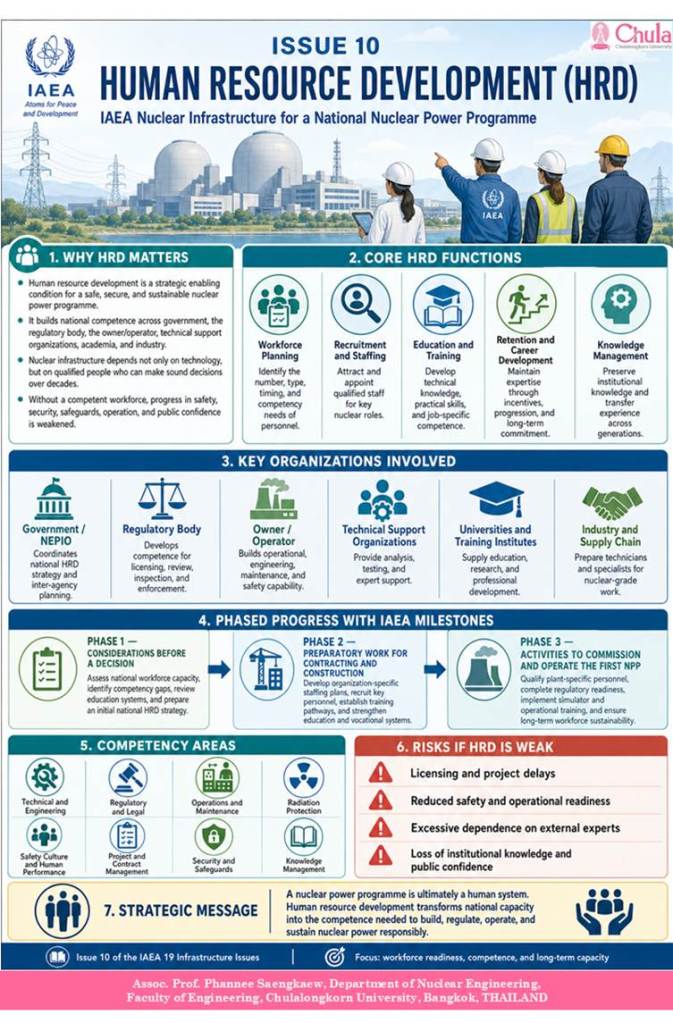
Human Resource Development (HRD), identified as Issue 10 in the IAEA’s 19 nuclear infrastructure issues, is one of the most critical enabling conditions for a safe, secure, and sustainable nuclear power programme. While nuclear power is often discussed in terms of reactor technology, grid capacity, financing, regulation, and safety systems, the long-term success of a nuclear programme ultimately depends on whether a country can develop, retain, and continuously strengthen a competent workforce across all responsible organizations.
In the IAEA Milestones approach, HRD is not limited to training reactor operators. It covers the systematic development of human capacity across the entire national nuclear infrastructure, including government ministries, the Nuclear Energy Programme Implementing Organization (NEPIO), the regulatory body, the future owner/operator, technical support organizations, universities, research institutions, emergency response organizations, industrial suppliers, and vocational training systems. The IAEA identifies Human Resources Development as one of the key documents-supported infrastructure issues and links it with workforce planning, recruitment, education and training, retention, regulatory competence, knowledge management, and systematic training approaches.
A nuclear power programme requires personnel who can make technically sound decisions under conditions of high safety significance, long project duration, strict regulatory oversight, and strong public accountability. Therefore, HRD should be understood not merely as a personnel-management function, but as a strategic national infrastructure system that transforms general education capacity into nuclear-specific competence.
2. Conceptual Meaning of Human Resource Development in a Nuclear Power Programme
In the nuclear context, Human Resource Development refers to the coordinated process by which a country identifies, develops, qualifies, deploys, and retains the people required to support a nuclear power programme throughout its lifecycle. This includes planning the required number and type of personnel, defining competency requirements, establishing education and training pathways, creating mechanisms for qualification and authorization, and ensuring that knowledge is preserved across generations.
The IAEA emphasizes that countries embarking on nuclear power must identify, acquire, and develop the necessary workforce for the first nuclear power plant as a top priority. At the same time, they must build the broader HR infrastructure needed to sustain this workforce across all key organizations involved in the programme.
This distinction is important. A country may be able to import a reactor design, receive vendor support, or contract foreign experts, but it cannot outsource national responsibility for safety, security, safeguards, radiation protection, emergency preparedness, and regulatory control. These responsibilities require domestic competence. Therefore, HRD must be embedded in national planning from the earliest phase of the nuclear power programme.
3. Strategic Importance of Issue 10
Human Resource Development is important because nuclear power programmes operate under conditions that are technically complex, institutionally demanding, and time-dependent. A nuclear power plant is not simply a construction project; it is a long-term socio-technical system that must be safely operated, maintained, regulated, inspected, secured, and eventually decommissioned over many decades.
The IAEA notes that nuclear HR development faces several industry-specific challenges, including the specialized nature of nuclear personnel, the unique demands of the nuclear sector, and programme risks associated with financing and delays. For this reason, an integrated human resource management strategy is considered essential for building a competent and sustainable nuclear power programme.
From an infrastructure perspective, HRD supports several fundamental functions:
First, it enables nuclear safety by ensuring that personnel understand reactor physics, safety analysis, operating limits, maintenance requirements, quality assurance, and safety culture.
Second, it supports regulatory independence and effectiveness by ensuring that the regulatory body has sufficient competent staff to review safety submissions, conduct inspections, enforce requirements, and make licensing decisions.
Third, it strengthens nuclear security and safeguards by developing personnel who can manage physical protection, nuclear material accountancy, cybersecurity, and interface arrangements with international obligations.
Fourth, it supports industrial readiness by preparing engineers, technicians, welders, electricians, mechanical workers, quality-assurance specialists, and supply-chain personnel to meet nuclear-grade requirements.
Fifth, it contributes to programme continuity by reducing dependence on external consultants and by building national ownership of nuclear knowledge.
4. Scope of Human Resource Development
Human Resource Development under Issue 10 should be viewed as a national system involving several layers.
4.1 National-Level Workforce Planning
At the national level, HRD begins with a realistic assessment of the workforce required for the nuclear power programme. This includes the number of personnel, the types of expertise, the timing of recruitment, and the required education and training pathways. Workforce planning must consider the planned number of reactor units, the preferred technology, the contractual model, the level of technology transfer, and the intended degree of national self-reliance.
The IAEA defines workforce planning as a systematic analysis of what an organization will need over time in terms of workforce size, type, quality, experience, and competencies. It aims to ensure that the programme has the right number of people, with the right skills, in the right place, at the right time.
For a newcomer country, workforce planning must also examine whether existing universities, technical colleges, research institutes, and industrial sectors can provide the necessary human resources. If gaps exist, the country must decide whether to develop domestic capacity, use international experts, establish vendor-supported training, or create hybrid arrangements.
4.2 Recruitment and Staffing
Recruitment refers to the process of identifying, attracting, selecting, and appointing personnel for specific roles. In the nuclear sector, recruitment must be more rigorous than in many conventional industries because personnel may need to satisfy technical, medical, security, and behavioral requirements. The IAEA describes recruitment as including job specifications, education and experience requirements, candidate sourcing, shortlisting, interviewing, selection, and subsequent induction and onboarding.
Recruitment should not be delayed until plant construction is nearly complete. Many nuclear roles require long preparation times. Reactor operators, maintenance supervisors, radiation protection staff, safety analysts, regulatory reviewers, and emergency preparedness personnel may require years of education, training, supervised experience, and qualification. Therefore, recruitment must be aligned with the project schedule.
4.3 Education, Training, and Development
Education, training, and development form the technical core of HRD. Education provides foundational knowledge, usually through universities and technical institutes. Training develops job-specific capability through structured courses, simulators, workshops, laboratories, field experience, and vendor-supported programmes. Development refers to the progressive growth of professional judgment, leadership, safety culture, and institutional competence.
The IAEA includes both professional/graduate education and vocational/technical training within education, training, and development. This distinction is essential because a nuclear power programme requires not only nuclear engineers and scientists, but also skilled technicians, craft workers, inspectors, emergency responders, quality-control personnel, and industrial workers trained to nuclear standards.
4.4 Remuneration and Retention
Retention is a critical issue for countries developing nuclear power for the first time. Nuclear personnel are costly and time-consuming to train. If trained personnel leave for better opportunities abroad or in other industries, the programme may lose both competence and institutional memory. The IAEA identifies remuneration and retention as including financial rewards, such as pay and bonuses, and non-financial rewards, such as housing, transport, education, medical support, and broader staff benefits.
Retention strategies should also include career pathways, professional recognition, leadership development, stable employment conditions, and clear institutional roles. In a newcomer country, retention must be addressed early because the international nuclear workforce is mobile and experienced personnel are in global demand.
5. Key Organizations Involved in Human Resource Development
Human Resource Development is not the responsibility of a single ministry or organization. It requires coordination among several national institutions.
5.1 Government and NEPIO
During the early phases, the NEPIO or equivalent coordinating body plays a central role in identifying national HR needs, assessing existing capacity, and preparing the initial HRD strategy. The NEPIO must coordinate among ministries, educational institutions, regulators, utilities, industry, and international partners.
The IAEA notes that in Phase 1, the initial HRM strategy is normally developed at the national level and is usually the responsibility of the NEPIO. It may draw on expertise from national organizations related to education, training, and labour.
5.2 Regulatory Body
The regulatory body must have competent staff before major licensing activities begin. Regulatory competence includes nuclear safety review, inspection, enforcement, radiation protection, emergency preparedness, nuclear security interfaces, safeguards-related oversight, and legal-regulatory understanding. A regulatory body that lacks sufficient competence may become overly dependent on the operator, vendor, or foreign consultants, weakening regulatory independence.
5.3 Owner/Operator
The owner/operator requires the largest and most technically specialized workforce. It must develop capabilities in project management, engineering, procurement, construction oversight, commissioning, operation, maintenance, radiation protection, chemistry, emergency preparedness, quality assurance, configuration management, and safety culture.
5.4 Technical Support Organizations
Technical support organizations may include universities, research institutes, engineering firms, laboratories, and specialist agencies. They provide analytical support, safety assessment, materials testing, environmental monitoring, metrology, dosimetry, reactor physics calculations, and independent technical advice.
5.5 Educational and Training Institutions
Universities and vocational institutions provide the foundation for national HRD. They must adapt curricula, establish nuclear-relevant laboratories, train instructors, create practical modules, and support continuing professional development. For nuclear power, the education system must produce both high-level professionals and plant-ready technical personnel.
5.6 Industry and Supply Chain
Industrial organizations must develop personnel capable of working under nuclear-grade quality requirements. This includes welding, fabrication, electrical installation, civil construction, non-destructive testing, instrumentation and control, quality assurance, and documentation control.
6. Phase-by-Phase Development According to the IAEA Milestones Approach
The IAEA Milestones approach divides nuclear infrastructure development into three phases. The evaluation methodology for national nuclear infrastructure development covers all 19 infrastructure issues and is used for self-evaluation and Integrated Nuclear Infrastructure Review missions. Human Resource Development must progress across all three phases.
Phase 1: Considerations Before a Decision to Launch a Nuclear Power Programme
6.1 Main Objective of Phase 1
In Phase 1, the country is still considering whether nuclear power should become part of its national energy strategy. HRD activities at this stage are therefore exploratory, strategic, and diagnostic. The main objective is to understand whether the country has, or can realistically develop, the human capacity needed to support a nuclear power programme.
The country should not yet focus only on training plant operators. Instead, it must assess national readiness across the entire institutional system. This includes government, regulation, safety, security, safeguards, radiation protection, emergency preparedness, technical education, vocational training, and industrial capability.
6.2 Key HRD Activities in Phase 1
During Phase 1, the country should conduct a national workforce survey. This survey should identify existing expertise in nuclear engineering, mechanical engineering, electrical engineering, civil engineering, radiation protection, health physics, reactor physics, materials science, quality assurance, legal studies, finance, project management, and emergency planning.
The country should also review existing university and vocational programmes to determine whether they can support future nuclear manpower needs. If the education system lacks nuclear-specific content, the government may need to support curriculum development, faculty training, laboratory strengthening, and international cooperation.
The IAEA identifies several Phase 1 workforce-planning steps, including surveying the domestic workforce, reviewing educational programmes, identifying training facilities, identifying competency gaps, evaluating potential owner/operator organizations, and considering how experienced supervisory and management staff will be recruited and developed.
6.3 Expected Phase 1 Outputs
By the end of Phase 1, the country should have an initial national HRD strategy. This strategy should identify approximate staffing needs, national competency gaps, education and training requirements, potential sources of personnel, international cooperation needs, and early retention risks.
The HRD strategy should also become part of the comprehensive report that supports the national decision on whether to proceed with nuclear power. The IAEA states that at the end of Phase 1, the HRM strategy should form an input to the comprehensive report that defines and justifies the national strategy if a positive decision is recommended.
6.4 Phase 1 Challenges
A common challenge in Phase 1 is underestimating the time required to develop nuclear competence. Another challenge is assuming that existing engineering graduates can easily transition into nuclear roles without specialized training. While general STEM capacity is important, nuclear work requires additional knowledge in safety culture, radiation protection, nuclear quality assurance, regulatory compliance, and plant-specific procedures.
For newcomer countries, Phase 1 should therefore focus on the question: Can the country realistically create a competent nuclear workforce before key decisions, contracts, licensing activities, construction, commissioning, and operation occur?
Phase 2: Preparatory Work for Contracting and Construction
7.1 Main Objective of Phase 2
Phase 2 begins after a country has made a knowledgeable decision to proceed with nuclear power. At this stage, HRD becomes more concrete and organization-specific. The country must develop the human resources required to prepare for bidding, contracting, licensing, site evaluation, regulatory review, and establishment of the owner/operator.
The focus shifts from broad national assessment to institutional capacity building. Each key organization must begin to define its structure, staffing plan, job descriptions, competency requirements, and training pathways.
The IAEA notes that as the programme moves into Phases 2 and 3, each organization develops its own HRM strategy, although national-level coordination remains necessary, especially for education and training capability.
7.2 Key HRD Activities in Phase 2
In Phase 2, the regulatory body must recruit and train personnel capable of reviewing site and safety documentation, developing regulations, preparing inspection programmes, and managing licensing processes. The future owner/operator must begin recruiting engineers, managers, technical specialists, and project personnel who can interact effectively with vendors and contractors.
The country should also establish training partnerships with experienced nuclear countries, vendors, international organizations, universities, and technical support organizations. Secondments abroad, participation in operating plants, simulator training, and structured knowledge transfer become increasingly important.
Contracting strategy becomes highly relevant to HRD. If the country adopts a turnkey model, domestic technical requirements may be lower in some areas but higher in contract oversight, regulatory review, and long-term operational competence. If the country seeks technology transfer or localization, stronger domestic technical and industrial capabilities are required.
The IAEA highlights that contracting strategy directly affects workforce planning and that formal training and knowledge-transfer requirements should be considered as part of contracts.
7.3 Education and Training Infrastructure in Phase 2
During Phase 2, the education and training system should move from general preparation to targeted capability development. Universities may introduce nuclear power engineering courses, reactor safety modules, radiation protection training, nuclear regulation content, and project-based learning related to nuclear infrastructure.
Vocational institutions should begin developing programmes for nuclear-grade technical work. These may include welding, electrical maintenance, mechanical maintenance, instrumentation and control, non-destructive testing, radiation monitoring, contamination control, and quality documentation.
Training should increasingly follow a systematic approach. This means that training is based on job analysis, competency requirements, learning objectives, practical assessment, and periodic retraining rather than informal knowledge transfer.
7.4 Expected Phase 2 Outputs
By the end of Phase 2, the country should have organization-specific workforce plans for the regulatory body, owner/operator, NEPIO, technical support organizations, and relevant government agencies. Training agreements should be established. Recruitment should be underway for critical positions. Education and vocational pathways should be aligned with expected project timelines.
The country should also have a clearer understanding of which competencies will be developed domestically, which will be obtained through international recruitment, and which will be supported by vendors or foreign technical organizations.
7.5 Phase 2 Challenges
The most serious Phase 2 risk is misalignment between workforce development and project schedule. If recruitment and training are delayed, the country may reach the licensing, construction, or commissioning stage without sufficient qualified personnel.
Another risk is excessive dependence on foreign consultants. International support is often necessary, but domestic organizations must remain intelligent customers. They must be able to understand, question, evaluate, and take responsibility for technical work performed by vendors or consultants.
Phase 3: Activities to Commission and Operate the First Nuclear Power Plant
8.1 Main Objective of Phase 3
Phase 3 begins after contracts are signed and construction, commissioning, and operational preparations are underway. HRD at this stage becomes highly operational. The objective is to ensure that all organizations have qualified personnel in place before fuel loading, commissioning tests, and routine operation.
At this stage, training must be plant-specific, role-specific, and performance-based. Personnel must not only understand general nuclear principles but must also demonstrate competence in the actual plant design, procedures, safety systems, emergency arrangements, and regulatory requirements.
8.2 Owner/Operator Workforce Development
The owner/operator must complete the recruitment, training, qualification, and authorization of operating personnel. This includes reactor operators, shift supervisors, maintenance staff, radiation protection personnel, chemistry staff, emergency response teams, security personnel, engineering support groups, and management personnel.
A full-scope simulator or equivalent plant-specific training system becomes essential for operator training. Maintenance personnel require practical training on plant systems, components, work control, configuration management, and quality requirements.
8.3 Regulatory Body Workforce Development
The regulatory body must be capable of reviewing commissioning programmes, inspecting construction and installation work, evaluating safety submissions, approving operational limits and conditions, and making decisions related to fuel loading and operating authorization.
The regulatory body should also have sufficient independence and technical depth to challenge the operator’s assumptions. Competence in regulatory decision-making is particularly important because the transition from construction to operation introduces new safety-significant activities.
8.4 Transition from Construction to Operation
The transition from construction to operation is a critical HRD challenge. During construction, the project requires strong engineering, procurement, construction, and quality-control capability. During operation, the emphasis shifts toward operational discipline, maintenance, surveillance, radiation protection, emergency preparedness, and continuous safety improvement.
If this transition is not well managed, the owner/operator may have a workforce suitable for project execution but insufficiently prepared for long-term plant operation. HRD planning must therefore include succession planning, knowledge transfer from vendor teams, operating experience feedback, and long-term professional development.
8.5 Expected Phase 3 Outputs
By the end of Phase 3, the country should have a qualified and authorized operating workforce, a competent regulatory body, functioning training systems, plant-specific procedures, simulator-based training programmes, emergency preparedness training, and a sustainable HRD system for long-term operation.
The outcome should not be merely “enough people hired,” but rather demonstrated competence across all safety-relevant functions.
9. Relationship Between HRD and Other Infrastructure Issues
Issue 10 is strongly connected to almost all other IAEA infrastructure issues.
It supports Issue 2 Nuclear Safety because safety analysis, safety culture, operation, maintenance, and emergency preparedness depend on competent personnel.
It supports Issue 5 Legislative Framework and Issue 7 Regulatory Framework because laws and regulations require qualified staff to implement them.
It supports Issue 8 Radiation Protection because occupational exposure monitoring, dose control, ALARA implementation, and contamination control depend on trained radiation protection personnel.
It supports Issue 9 Electrical Grid because nuclear plant operation requires grid engineers who understand nuclear-grid interface, reliability requirements, load-following constraints, and grid stability.
It supports Issue 15 Nuclear Security because physical protection and cybersecurity require specialized personnel and continuous training.
It supports Issue 18 Industrial Involvement because local participation in nuclear projects is impossible without nuclear-qualified industrial workers.
It supports Issue 19 Procurement because the country must have knowledgeable personnel who can prepare specifications, evaluate bids, manage contracts, and oversee vendor performance.
Thus, HRD should be considered a cross-cutting infrastructure issue. Without it, other infrastructure elements may exist formally but remain weak in implementation.
10. Core Competency Areas Required for a Nuclear Power Programme
A comprehensive HRD strategy should cover multiple competency domains.
10.1 Technical and Engineering Competence
This includes reactor physics, thermal hydraulics, nuclear safety analysis, materials science, mechanical systems, electrical systems, instrumentation and control, radiation detection, radiation dosimetry, chemistry, waste management, and emergency response.
10.2 Regulatory and Legal Competence
This includes licensing, inspection, enforcement, safety review, legal drafting, regulatory independence, compliance assessment, and interface with international obligations.
10.3 Operational Competence
This includes control room operation, maintenance planning, work control, surveillance testing, operational limits and conditions, operating procedures, abnormal event response, and outage management.
10.4 Radiation Protection and Dosimetry Competence
This includes radiation monitoring, individual monitoring, workplace monitoring, contamination control, dose assessment, ALARA planning, calibration, and recordkeeping.
10.5 Safety Culture and Human Performance
This includes conservative decision-making, questioning attitude, procedural adherence, communication, leadership, teamwork, human factors, and organizational learning.
10.6 Project and Contract Management
This includes project scheduling, procurement, contract oversight, vendor management, quality assurance, cost control, and interface management.
10.7 Knowledge Management
This includes preservation of institutional knowledge, succession planning, document control, lessons learned, operating experience feedback, and intergenerational transfer of expertise.
11. Specific Considerations for Newcomer Countries
For countries starting a nuclear power programme for the first time, HRD is particularly challenging because the country may have limited nuclear experience. Existing expertise may be concentrated in research reactors, radiation applications, universities, medical uses, or regulatory activities for radioactive sources. While these are valuable foundations, they are not sufficient by themselves for nuclear power plant construction and operation.
A newcomer country must therefore convert a small technical base into a broader nuclear workforce. This requires time, funding, institutional coordination, and long-term policy continuity.
Important considerations include:
The country must identify existing “seed” capabilities in universities, research institutes, regulatory agencies, and radiation-related industries.
The country must determine whether existing STEM and vocational systems can be adapted to nuclear requirements.
The country must develop instructors and trainers, not only trainees.
The country must secure practical experience through international cooperation, secondments, vendor programmes, research reactors, simulators, and industrial training.
The country must create attractive career pathways to prevent trained personnel from leaving.
The country must integrate HRD into national energy planning, not treat it as a late-stage project activity.
12. Human Resource Development and SMR Deployment
Small Modular Reactors (SMRs) may change some aspects of workforce planning but do not eliminate the need for HRD. SMRs may involve factory fabrication, modular construction, passive safety features, smaller unit capacity, and different staffing models. However, countries still need competent regulators, operators, emergency planners, radiation protection personnel, security specialists, safeguards staff, and technical support organizations.
In some cases, SMRs may create additional HRD challenges because deployment schedules may be shorter than those of conventional large nuclear power plants. A shorter construction period may reduce the time available for on-the-job training. Therefore, countries considering SMRs should begin workforce preparation early, ideally during Phase 2, and ensure that simulator access, vendor training, regulatory competence, and emergency preparedness are ready before commissioning.
13. Risks Associated with Weak HRD
Weak Human Resource Development can create several systemic risks.
First, it may delay the project because licensing, construction oversight, or commissioning cannot proceed without qualified personnel.
Second, it may weaken nuclear safety because staff may not fully understand plant behavior, safety margins, procedures, or abnormal event response.
Third, it may compromise regulatory independence if the regulator becomes dependent on the operator, vendor, or foreign consultants.
Fourth, it may increase cost because international consultants must be used for longer periods.
Fifth, it may reduce public confidence because the public may question whether the country has sufficient competence to manage nuclear technology.
Sixth, it may create long-term sustainability problems if knowledge is not transferred to the next generation.
14. Indicators of Progress for Issue 10
Progress in HRD can be evaluated using several indicators.
A country has made meaningful progress when it has a national HRD strategy aligned with the nuclear power programme schedule.
It has identified workforce needs across the NEPIO, regulatory body, owner/operator, technical support organizations, and education sector.
It has assessed national education and vocational training capacity.
It has identified competency gaps and prepared plans to close them.
It has established cooperation with international partners, vendors, universities, and training organizations.
It has developed recruitment, training, remuneration, and retention strategies.
It has begun preparing qualified regulatory and owner/operator personnel before major licensing and commissioning activities.
It has created mechanisms for knowledge management and succession planning.
It has integrated HRD into broader nuclear infrastructure planning, including safety, security, safeguards, industrial involvement, and procurement.
15. Suggested Structure for a National HRD Strategy
A national HRD strategy for nuclear power should include the following elements:
- National policy objective for nuclear workforce development.
- Assessment of existing human resources and education capacity.
- Forecast of workforce needs by organization and project phase.
- Competency framework for key organizations.
- Education and training development plan.
- Recruitment and staffing plan.
- International cooperation and secondment plan.
- Vendor training and knowledge-transfer requirements.
- Remuneration and retention strategy.
- Regulatory body competence development plan.
- Owner/operator qualification and authorization plan.
- Vocational and industrial workforce development plan.
- Knowledge management and succession plan.
- Monitoring indicators and periodic review mechanism.
16. Summary
Human Resource Development is a foundational infrastructure issue for a national nuclear power programme. It transforms a country’s general educational and industrial capacity into the specialized competence required to manage nuclear technology safely, securely, and sustainably. Within the IAEA Milestones approach, HRD begins in Phase 1 with national workforce assessment and strategic planning, becomes organization-specific in Phase 2 through recruitment, training, and institutional development, and reaches operational maturity in Phase 3 through qualification, authorization, simulator training, regulatory readiness, and long-term knowledge management.
The central message of Issue 10 is that nuclear infrastructure is ultimately a human system. Reactor technology, legislation, regulation, financing, grid readiness, and safety systems cannot function effectively without competent people. For a newcomer country, the development of nuclear human resources must therefore begin early, proceed systematically, and remain aligned with national policy, project schedule, regulatory development, vendor arrangements, and long-term operational needs.
References
- International Atomic Energy Agency. (2015). Milestones in the Development of a National Infrastructure for Nuclear Power (IAEA Nuclear Energy Series No. NG-G-3.1 Rev. 1). IAEA.
- International Atomic Energy Agency. (2022). Evaluation of the Status of National Nuclear Infrastructure Development (IAEA Nuclear Energy Series No. NG-T-3.2 Rev. 2). IAEA.
- International Atomic Energy Agency. (2022). Human Resource Management for New Nuclear Power Programmes (IAEA Nuclear Energy Series No. NG-T-3.10 Rev. 1). IAEA.
- International Atomic Energy Agency. (2014). Managing Regulatory Body Competence (IAEA Safety Reports Series No. 79). IAEA.
- International Atomic Energy Agency. (2022). Guide to Knowledge Management Strategies and Approaches in Nuclear Energy Organizations and Facilities (IAEA Nuclear Energy Series No. NG-G-6.1). IAEA.
- International Atomic Energy Agency. (2023). Managing Human Resources in the Field of Nuclear Energy (IAEA Nuclear Energy Series No. NG-G-2.1 Rev. 1). IAEA.
- International Atomic Energy Agency. (2018). Organization, Management and Staffing of the Regulatory Body for Safety (IAEA Safety Standards Series No. GSG-12). IAEA.
- International Atomic Energy Agency. (2022). Recruitment, Qualification and Training of Personnel for Nuclear Power Plants (IAEA Safety Standards Series No. SSG-75). IAEA.
ประเด็นด้านที่ 10: การพัฒนาทรัพยากรมนุษย์
ภายใต้การพัฒนาโครงสร้างพื้นฐาน 19 ด้านของทบวงการพลังงานปรมาณูระหว่างประเทศสำหรับโครงการพลังงานนิวเคลียร์
1. บทนำ
การพัฒนาทรัพยากรมนุษย์ (Human Resource Development: HRD) เป็นหนึ่งในการพัฒนาโครงสร้างพื้นฐาน 19 ด้าน ของทบวงการพลังงานปรมาณูระหว่างประเทศ และเป็นหนึ่งในเงื่อนไขพื้นฐานที่สำคัญที่สุดต่อการพัฒนาโครงการพลังงานนิวเคลียร์ให้มี ความปลอดภัย ความมั่นคงปลอดภัย และความยั่งยืน แม้ว่าโครงการพลังงานนิวเคลียร์มักถูกกล่าวถึงในมิติของเทคโนโลยีเครื่องปฏิกรณ์นิวเคลียร์ ความพร้อมของระบบโครงข่ายไฟฟ้า กลไกการเงิน กฎหมาย การกำกับดูแล และระบบความปลอดภัย แต่ความสำเร็จระยะยาวของโครงการพลังงานนิวเคลียร์ขึ้นอยู่กับความสามารถของประเทศในการพัฒนา รักษา และเสริมสร้างกำลังคนที่มีสมรรถนะอย่างต่อเนื่องในทุกองค์กรที่เกี่ยวข้อง
ภายใต้แนวทางลำดับขั้นการพัฒนาโครงการพลังงานนิวเคลียร์ของทบวงการพลังงานปรมาณูระหว่างประเทศ หรือแนวทางตามหมุดหมาย (Milestones Approach) การพัฒนาทรัพยากรมนุษย์มิได้จำกัดอยู่เพียงการฝึกอบรมผู้ควบคุมเครื่องปฏิกรณ์นิวเคลียร์เท่านั้น หากแต่ครอบคลุมการพัฒนาขีดความสามารถของบุคลากรอย่างเป็นระบบในระดับโครงสร้างพื้นฐานของประเทศทั้งหมด ซึ่งประกอบด้วยกระทรวงและหน่วยงานของรัฐ คณะดำเนินงานเพื่อเตรียมโครงการพลังงานนิวเคลียร์ หรือ คณะทำงาน NEPIO (Nuclear Energy Programme Implementing Organization: NEPIO) หน่วยงานกำกับดูแล เจ้าของหรือผู้ดำเนินการโรงไฟฟ้าในอนาคต องค์กรสนับสนุนทางเทคนิค มหาวิทยาลัย สถาบันวิจัย หน่วยงานตอบสนองเหตุฉุกเฉิน องค์กรอุตสาหกรรม ผู้จัดหาและห่วงโซ่อุปทาน รวมทั้งระบบการศึกษาระดับอาชีวศึกษาและการฝึกอบรมทางเทคนิค
โครงการพลังงานนิวเคลียร์ต้องการบุคลากรที่สามารถตัดสินใจบนพื้นฐานทางเทคนิคได้อย่างถูกต้อง ภายใต้บริบทที่มีนัยสำคัญสูงต่อความปลอดภัย มีระยะเวลาดำเนินงานยาวนาน ต้องอยู่ภายใต้การกำกับดูแลอย่างเข้มงวด และต้องมีความรับผิดชอบต่อสาธารณะในระดับสูง ดังนั้น การพัฒนาทรัพยากรมนุษย์จึงไม่ควรถูกมองว่าเป็นเพียงหน้าที่ด้านการบริหารบุคลากร แต่ควรถูกเข้าใจว่าเป็นระบบโครงสร้างพื้นฐานเชิงยุทธศาสตร์ระดับชาติ ที่ทำหน้าที่แปลงขีดความสามารถทางการศึกษาทั่วไปให้กลายเป็นสมรรถนะเฉพาะด้านนิวเคลียร์
2. ความหมายเชิงแนวคิดของการพัฒนาทรัพยากรมนุษย์ในโครงการพลังงานนิวเคลียร์
ในบริบทของงานทางนิวเคลียร์ การพัฒนาทรัพยากรมนุษย์หมายถึงกระบวนการที่มีการประสานงานอย่างเป็นระบบ เพื่อให้ประเทศสามารถระบุ พัฒนา รับรองคุณสมบัติ จัดสรร และรักษาบุคลากรที่จำเป็นต่อการสนับสนุนโครงการพลังงานนิวเคลียร์ตลอดวัฏจักรชีวิตของโครงการ กระบวนการนี้รวมถึงการวางแผนจำนวนและประเภทของบุคลากรที่ต้องการ การกำหนดสมรรถนะที่จำเป็น การสร้างเส้นทางการศึกษาและการฝึกอบรม การจัดทำกลไกการรับรองคุณสมบัติและการอนุญาตให้ปฏิบัติงาน รวมทั้งการธำรงรักษาองค์ความรู้ให้คงอยู่ข้ามช่วงเวลาและข้ามรุ่นบุคลากร
ทบวงการพลังงานปรมาณูระหว่างประเทศให้ความสำคัญว่า ประเทศที่เพิ่งเริ่มพัฒนาโครงการพลังงานนิวเคลียร์จำเป็นต้องระบุ จัดหา และพัฒนากำลังคนที่จำเป็นสำหรับโรงไฟฟ้านิวเคลียร์แห่งแรกเป็นลำดับความสำคัญสูง ขณะเดียวกันประเทศนั้นต้องสร้างโครงสร้างพื้นฐานด้านทรัพยากรมนุษย์ในวงกว้างเพื่อรองรับและธำรงรักษากำลังคนเหล่านี้ในทุกองค์กรหลักที่เกี่ยวข้องกับโครงการ
ความแตกต่างนี้มีความสำคัญอย่างยิ่ง ประเทศหนึ่งอาจสามารถนำเข้าแบบเครื่องปฏิกรณ์นิวเคลียร์ รับการสนับสนุนจากผู้ขายเทคโนโลยี หรือจ้างผู้เชี่ยวชาญจากต่างประเทศได้ แต่ประเทศไม่สามารถถ่ายโอนความรับผิดชอบระดับชาติในด้านความปลอดภัย ความมั่นคงปลอดภัย การพิทักษ์ความปลอดภัยทางนิวเคลียร์ การป้องกันอันตรายจากรังสี การเตรียมพร้อมรับเหตุฉุกเฉิน และการกำกับดูแลทางกฎหมายให้ผู้อื่นทั้งหมดได้ ความรับผิดชอบเหล่านี้จำเป็นต้องอาศัยสมรรถนะภายในประเทศ ดังนั้นการพัฒนาทรัพยากรมนุษย์จึงต้องถูกบูรณาการเข้าไปในการวางแผนระดับชาติตั้งแต่ระยะเริ่มต้นที่สุดของโครงการพลังงานนิวเคลียร์
3. ความสำคัญเชิงยุทธศาสตร์ของโครงสร้างด้านที่ 10
การพัฒนาทรัพยากรมนุษย์มีความสำคัญเนื่องจากโครงการพลังงานนิวเคลียร์ดำเนินอยู่ภายใต้เงื่อนไขที่มีความซับซ้อนทางเทคนิค มีความต้องการเชิงสถาบันสูง และมีข้อจำกัดเชิงเวลาที่ต้องบริหารจัดการอย่างรอบคอบ โรงไฟฟ้านิวเคลียร์มิใช่เพียงโครงการก่อสร้าง แต่เป็นทางด้านสังคม-เทคนิคระยะยาวที่ต้องได้รับการดำเนินการ บำรุงรักษา กำกับดูแล ตรวจสอบ คุ้มครองทางกายภาพ และในที่สุดต้องมีการปลดระวางอย่างปลอดภัยตลอดช่วงเวลาหลายทศวรรษ
ทบวงการพลังงานปรมาณูระหว่างประเทศชี้ให้เห็นว่า การพัฒนาทรัพยากรมนุษย์ด้านนิวเคลียร์มีความท้าทายเฉพาะอุตสาหกรรมหลายประการ ได้แก่ ลักษณะเฉพาะของบุคลากรด้านนิวเคลียร์ ความต้องการเฉพาะของภาคนิวเคลียร์ และความเสี่ยงของโครงการที่เกี่ยวข้องกับการเงินและความล่าช้า ด้วยเหตุนี้ ยุทธศาสตร์การบริหารทรัพยากรมนุษย์แบบบูรณาการจึงเป็นสิ่งจำเป็นต่อการสร้างโครงการพลังงานนิวเคลียร์ที่มีสมรรถนะและความยั่งยืน
ในมุมมองเชิงโครงสร้างพื้นฐาน การพัฒนาทรัพยากรมนุษย์สนับสนุนหน้าที่พื้นฐานหลายด้าน
ประการแรก การพัฒนาทรัพยากรมนุษย์ทำให้เกิดความปลอดภัยทางนิวเคลียร์ โดยทำให้บุคลากรเข้าใจฟิสิกส์เครื่องปฏิกรณ์นิวเคลียร์ การวิเคราะห์ความปลอดภัย ขีดจำกัดการเดินเครื่อง ข้อกำหนดการบำรุงรักษา การประกันคุณภาพ และวัฒนธรรมความปลอดภัย
ประการที่สอง การพัฒนาทรัพยากรมนุษย์สนับสนุนความเป็นอิสระและประสิทธิผลของหน่วยงานกำกับดูแล โดยทำให้หน่วยงานกำกับดูแลมีบุคลากรที่มีสมรรถนะเพียงพอในการทบทวนเอกสารด้านความปลอดภัย ดำเนินการตรวจสอบ บังคับใช้ข้อกำหนด และตัดสินใจด้านการอนุญาต
ประการที่สาม การพัฒนาทรัพยากรมนุษย์เสริมสร้างความมั่นคงปลอดภัยทางนิวเคลียร์และการพิทักษ์ความปลอดภัยทางนิวเคลียร์ โดยพัฒนาบุคลากรที่สามารถบริหารจัดการการคุ้มครองทางกายภาพ การบัญชีและควบคุมวัสดุนิวเคลียร์ ความมั่นคงปลอดภัยทางไซเบอร์ และการประสานงานกับพันธกรณีระหว่างประเทศ
ประการที่สี่ การพัฒนาทรัพยากรมนุษย์สนับสนุนความพร้อมของภาคอุตสาหกรรม โดยเตรียมวิศวกร ช่างเทคนิค ช่างเชื่อม ช่างไฟฟ้า ช่างเครื่องกล ผู้เชี่ยวชาญด้านการประกันคุณภาพ และบุคลากรในห่วงโซ่อุปทานให้สามารถทำงานตามมาตรฐานระดับนิวเคลียร์
ประการที่ห้า การพัฒนาทรัพยากรมนุษย์ช่วยสร้างความต่อเนื่องของโครงการ โดยลดการพึ่งพาที่ปรึกษาจากภายนอก และสร้างความเป็นเจ้าขององค์ความรู้ด้านนิวเคลียร์ภายในประเทศ
4. ขอบเขตของการพัฒนาทรัพยากรมนุษย์
การพัฒนาทรัพยากรมนุษย์ภายใต้การพัฒนาโครงสร้างด้านที่ 10 ควรถูกมองว่าเป็นระบบระดับชาติที่ประกอบด้วยหลายชั้นของการดำเนินงาน
4.1 การวางแผนกำลังคนระดับชาติ
ในระดับชาติ การพัฒนาทรัพยากรมนุษย์เริ่มจากการประเมินอย่างสมจริงว่าประเทศต้องการกำลังคนประเภทใดและจำนวนเท่าใดสำหรับโครงการพลังงานนิวเคลียร์ การวางแผนนี้ต้องครอบคลุมจำนวนบุคลากร ประเภทของความเชี่ยวชาญ ช่วงเวลาการรับบุคลากร และเส้นทางการศึกษาและการฝึกอบรมที่จำเป็น การวางแผนกำลังคนต้องคำนึงถึงจำนวนหน่วยโรงไฟฟ้าที่วางแผนไว้ เทคโนโลยีที่ประเทศต้องการใช้ รูปแบบสัญญา ระดับการถ่ายทอดเทคโนโลยี และระดับการพึ่งพาตนเองภายในประเทศที่ต้องการบรรลุ
การวางแผนกำลังคนเป็นการวิเคราะห์อย่างเป็นระบบว่า องค์กรจะต้องการกำลังคนในอนาคตอย่างไร ทั้งในด้านจำนวน ประเภท คุณภาพ ประสบการณ์ และสมรรถนะ เป้าหมายของการวางแผนดังกล่าวคือเพื่อให้มั่นใจว่าโครงการมีบุคลากรที่ถูกต้อง มีทักษะที่เหมาะสม อยู่ในตำแหน่งที่เหมาะสม และพร้อมในเวลาที่เหมาะสม
สำหรับประเทศที่เพิ่งเริ่มโครงการใหม่ การวางแผนกำลังคนต้องตรวจสอบด้วยว่า มหาวิทยาลัย วิทยาลัยเทคนิค สถาบันวิจัย และภาคอุตสาหกรรมที่มีอยู่สามารถสนับสนุนความต้องการกำลังคนด้านนิวเคลียร์ในอนาคตได้เพียงใด หากพบช่องว่าง ประเทศต้องตัดสินใจว่าจะพัฒนาขีดความสามารถภายในประเทศ ใช้ผู้เชี่ยวชาญจากต่างประเทศ จัดตั้งโครงการฝึกอบรมร่วมกับผู้ขายเทคโนโลยี หรือใช้รูปแบบผสมผสานระหว่างการพัฒนาภายในและการสนับสนุนจากภายนอก
4.2 การสรรหาและการจัดอัตรากำลัง
การสรรหาหมายถึงกระบวนการระบุ ดึงดูด คัดเลือก และแต่งตั้งบุคลากรเข้าสู่บทบาทเฉพาะ ในภาคนิวเคลียร์ การสรรหาต้องมีความเข้มงวดมากกว่าหลายอุตสาหกรรมทั่วไป เนื่องจากบุคลากรบางตำแหน่งอาจต้องเป็นไปตามข้อกำหนดด้านเทคนิค สุขภาพ ความมั่นคงปลอดภัย และพฤติกรรมการทำงาน การสรรหาที่มีประสิทธิภาพต้องครอบคลุมการกำหนดรายละเอียดตำแหน่งงาน คุณสมบัติทางการศึกษาและประสบการณ์ แหล่งที่มาของผู้สมัคร การคัดกรอง การสัมภาษณ์ การคัดเลือก และการปฐมนิเทศหรือการเตรียมความพร้อมหลังการรับเข้าทำงาน
การสรรหาไม่ควรถูกเลื่อนออกไปจนกระทั่งการก่อสร้างโรงไฟฟ้าใกล้เสร็จสมบูรณ์ บทบาทด้านนิวเคลียร์จำนวนมากต้องใช้เวลายาวนานในการเตรียมความพร้อม ผู้ควบคุมเครื่องปฏิกรณ์นิวเคลียร์ หัวหน้ากะเดินเครื่อง ผู้ควบคุมงานบำรุงรักษา บุคลากรด้านการป้องกันอันตรายจากรังสี นักวิเคราะห์ความปลอดภัย เจ้าหน้าที่ทบทวนด้านกฎระเบียบ และบุคลากรเตรียมพร้อมรับเหตุฉุกเฉิน อาจต้องใช้เวลาหลายปีในการศึกษา ฝึกอบรม สะสมประสบการณ์ภายใต้การกำกับดูแล และผ่านการรับรองคุณสมบัติ ดังนั้น การสรรหาจึงต้องสอดคล้องกับกำหนดการของโครงการ
4.3 การศึกษา การฝึกอบรม และการพัฒนา
การศึกษา การฝึกอบรม และการพัฒนาเป็นแกนหลักทางเทคนิคของการพัฒนาทรัพยากรมนุษย์ การศึกษาให้ความรู้พื้นฐาน ซึ่งโดยทั่วไปเกิดขึ้นผ่านมหาวิทยาลัยและสถาบันเทคนิค การฝึกอบรมพัฒนาความสามารถเฉพาะงานผ่านหลักสูตรที่มีโครงสร้าง เครื่องจำลอง ห้องปฏิบัติการ การฝึกภาคสนาม การประชุมเชิงปฏิบัติการ และโครงการฝึกอบรมที่ได้รับการสนับสนุนจากผู้ขายเทคโนโลยี ส่วนการพัฒนาหมายถึงการเติบโตอย่างต่อเนื่องของวิจารณญาณทางวิชาชีพ ภาวะผู้นำ วัฒนธรรมความปลอดภัย และสมรรถนะขององค์กร
การศึกษา การฝึกอบรม และการพัฒนาภายใต้บริบทนิวเคลียร์ต้องครอบคลุมทั้งการศึกษาระดับวิชาชีพและบัณฑิตศึกษา รวมถึงการฝึกอบรมระดับอาชีวศึกษาและเทคนิค ความแตกต่างนี้มีความสำคัญ เพราะโครงการพลังงานนิวเคลียร์ไม่ได้ต้องการเพียงวิศวกรนิวเคลียร์และนักวิทยาศาสตร์เท่านั้น แต่ยังต้องการช่างเทคนิคที่มีทักษะ ผู้ปฏิบัติงานฝีมือ เจ้าหน้าที่ตรวจสอบ ผู้ตอบสนองเหตุฉุกเฉิน บุคลากรควบคุมคุณภาพ และแรงงานอุตสาหกรรมที่ได้รับการฝึกให้ปฏิบัติงานตามมาตรฐานด้านนิวเคลียร์
4.4 ค่าตอบแทนและการรักษาบุคลากร
การรักษาบุคลากรเป็นประเด็นสำคัญสำหรับประเทศที่พัฒนาโครงการพลังงานนิวเคลียร์เป็นครั้งแรก บุคลากรด้านนิวเคลียร์ต้องใช้เวลาและทรัพยากรจำนวนมากในการฝึกอบรม หากบุคลากรที่ได้รับการพัฒนาแล้วออกจากระบบไปยังโอกาสที่ดีกว่าในต่างประเทศหรือในอุตสาหกรรมอื่น โครงการอาจสูญเสียทั้งสมรรถนะและองค์ความรู้สะสมของสถาบัน กลยุทธ์การรักษาบุคลากรจึงต้องครอบคลุมทั้งผลตอบแทนทางการเงิน เช่น เงินเดือน โบนัส และสวัสดิการ รวมถึงผลตอบแทนที่ไม่ใช่การเงิน เช่น ที่อยู่อาศัย การเดินทาง การศึกษา การแพทย์ สวัสดิการครอบครัว และโอกาสการเติบโตในวิชาชีพ
กลยุทธ์การรักษาบุคลากรควรรวมถึงเส้นทางความก้าวหน้าในอาชีพ การยอมรับทางวิชาชีพ การพัฒนาภาวะผู้นำ สภาพการจ้างงานที่มั่นคง และบทบาทของสถาบันที่ชัดเจน สำหรับประเทศที่เพิ่งเริ่มโครงการใหม่ การรักษาบุคลากรต้องถูกพิจารณาตั้งแต่ระยะแรก เพราะกำลังคนด้านนิวเคลียร์ในระดับสากลมีการเคลื่อนย้ายได้สูง และบุคลากรที่มีประสบการณ์เป็นที่ต้องการในตลาดแรงงานโลก
5. องค์กรหลักที่เกี่ยวข้องกับการพัฒนาทรัพยากรมนุษย์
การพัฒนาทรัพยากรมนุษย์มิใช่หน้าที่ของกระทรวงหรือองค์กรใดองค์กรหนึ่งเพียงลำพัง แต่ต้องอาศัยการประสานงานระหว่างสถาบันระดับชาติหลายภาคส่วน
5.1 รัฐบาลและคณะทำงาน NEPIO
ในระยะเริ่มต้น คณะดำเนินงานเพื่อเตรียมโครงการพลังงานนิวเคลียร์ หรือคณะทำงาน NEPIO มีบทบาทสำคัญในการระบุความต้องการด้านทรัพยากรมนุษย์ระดับชาติ ประเมินขีดความสามารถที่มีอยู่ และจัดทำยุทธศาสตร์เบื้องต้นด้านการพัฒนาทรัพยากรมนุษย์ คณะทำงาน NEPIO ต้องประสานงานระหว่างกระทรวง สถาบันการศึกษา หน่วยงานกำกับดูแล การไฟฟ้าหรือหน่วยงานเจ้าของโครงการ ภาคอุตสาหกรรม และพันธมิตรระหว่างประเทศ
ในระยะที่ 1 ยุทธศาสตร์เบื้องต้นด้านการบริหารทรัพยากรมนุษย์มักถูกพัฒนาในระดับชาติ และโดยทั่วไปเป็นความรับผิดชอบของคณะทำงาน NEPIO โดยอาจอาศัยความเชี่ยวชาญจากองค์กรระดับชาติที่เกี่ยวข้องกับการศึกษา การฝึกอบรม และแรงงาน
5.2 หน่วยงานกำกับดูแล
หน่วยงานกำกับดูแลต้องมีบุคลากรที่มีสมรรถนะก่อนที่กิจกรรมการอนุญาตที่สำคัญจะเริ่มขึ้น สมรรถนะของหน่วยงานกำกับดูแลประกอบด้วยการทบทวนความปลอดภัยทางนิวเคลียร์ การตรวจสอบ การบังคับใช้ข้อกำหนด การป้องกันอันตรายจากรังสี การเตรียมพร้อมรับเหตุฉุกเฉิน การประสานงานด้านความมั่นคงปลอดภัยทางนิวเคลียร์ การกำกับดูแลด้านการพิทักษ์ความปลอดภัยทางนิวเคลียร์ และความเข้าใจด้านกฎหมายและกฎระเบียบ หากหน่วยงานกำกับดูแลขาดสมรรถนะอย่างเพียงพอ อาจเกิดการพึ่งพาเจ้าของหรือผู้ดำเนินการ ผู้ขายเทคโนโลยี หรือที่ปรึกษาจากต่างประเทศมากเกินไป ซึ่งจะบั่นทอนความเป็นอิสระของการกำกับดูแล
5.3 เจ้าของหรือผู้ดำเนินการ
เจ้าของหรือผู้ดำเนินการเป็นองค์กรที่ต้องการกำลังคนจำนวนมากที่สุดและมีความเชี่ยวชาญเฉพาะทางสูงที่สุด ต้องพัฒนาขีดความสามารถด้านการบริหารโครงการ วิศวกรรม การจัดซื้อจัดจ้าง การกำกับดูแลการก่อสร้าง การทดสอบเดินเครื่อง การเดินเครื่อง การบำรุงรักษา การป้องกันอันตรายจากรังสี เคมีที่เกี่ยวข้อง การเตรียมพร้อมรับเหตุฉุกเฉิน การประกันคุณภาพ การบริหารจัดการการกำหนดค่าระบบ และวัฒนธรรมความปลอดภัย
5.4 องค์กรสนับสนุนทางเทคนิค
องค์กรสนับสนุนทางเทคนิคอาจประกอบด้วยมหาวิทยาลัย สถาบันวิจัย บริษัทวิศวกรรม ห้องปฏิบัติการ และหน่วยงานเฉพาะทาง องค์กรเหล่านี้ให้การสนับสนุนด้านการวิเคราะห์ การประเมินความปลอดภัย การทดสอบวัสดุ การตรวจวัดสิ่งแวดล้อม มาตรวิทยา การวัดปริมาณรังสี ฟิสิกส์เครื่องปฏิกรณ์นิวเคลียร์ และคำแนะนำทางเทคนิคที่เป็นอิสระ
5.5 สถาบันการศึกษาและสถาบันฝึกอบรม
มหาวิทยาลัยและสถาบันอาชีวศึกษาเป็นฐานรากของการพัฒนาทรัพยากรมนุษย์ระดับชาติ สถาบันเหล่านี้ต้องปรับปรุงหลักสูตร จัดตั้งห้องปฏิบัติการที่เกี่ยวข้องกับงานนิวเคลียร์ พัฒนาผู้สอน สร้างหน่วยการเรียนรู้เชิงปฏิบัติ และสนับสนุนการพัฒนาวิชาชีพอย่างต่อเนื่อง สำหรับโครงการพลังงานนิวเคลียร์ ระบบการศึกษาต้องสามารถผลิตทั้งผู้เชี่ยวชาญระดับสูงและบุคลากรเทคนิคที่พร้อมต่อการทำงานในโรงไฟฟ้า
5.6 ภาคอุตสาหกรรมและห่วงโซ่อุปทาน
องค์กรอุตสาหกรรมต้องพัฒนาบุคลากรที่สามารถปฏิบัติงานภายใต้ข้อกำหนดคุณภาพระดับนิวเคลียร์ ซึ่งรวมถึงงานเชื่อม งานประกอบชิ้นส่วน งานติดตั้งระบบไฟฟ้า งานก่อสร้างโยธา การทดสอบโดยไม่ทำลาย การวัดคุมและการควบคุม การประกันคุณภาพ และการควบคุมเอกสาร
6. การพัฒนาเป็นระยะตามแนวทางจุดหมุดหมายของทบวงการพลังงานปรมาณูระหว่างประเทศ
แนวทางตามหมุดหมายของทบวงการพลังงานปรมาณูระหว่างประเทศแบ่งการพัฒนาโครงสร้างพื้นฐานด้านนิวเคลียร์ออกเป็น 3 ระยะ วิธีการประเมินสถานะการพัฒนาโครงสร้างพื้นฐานระดับชาติครอบคลุมโครงสร้างพื้นฐานทั้ง 19 ด้าน และถูกใช้ทั้งสำหรับการประเมินตนเองของประเทศและภารกิจทบทวนโครงสร้างพื้นฐานด้านนิวเคลียร์แบบบูรณาการ การพัฒนาทรัพยากรมนุษย์ต้องก้าวหน้าอย่างเป็นระบบตลอดทั้งสามระยะ
ระยะที่ 1: การพิจารณาก่อนตัดสินใจเริ่มโครงการพลังงานนิวเคลียร์
6.1 วัตถุประสงค์หลักของระยะที่ 1
ในระยะที่ 1 ประเทศยังอยู่ในขั้นพิจารณาว่าพลังงานนิวเคลียร์ควรเป็นส่วนหนึ่งของยุทธศาสตร์พลังงานแห่งชาติหรือไม่ กิจกรรมด้านการพัฒนาทรัพยากรมนุษย์ในระยะนี้จึงมีลักษณะเป็นการสำรวจ การวางแผนเชิงยุทธศาสตร์ และการวินิจฉัยสถานะของประเทศ วัตถุประสงค์หลักคือการทำความเข้าใจว่าประเทศมี หรือสามารถพัฒนา ขีดความสามารถด้านบุคลากรที่จำเป็นต่อการสนับสนุนโครงการพลังงานนิวเคลียร์ได้จริงหรือไม่
ในระยะนี้ ประเทศไม่ควรมุ่งเน้นเฉพาะการฝึกอบรมผู้ควบคุมโรงไฟฟ้าเท่านั้น แต่ต้องประเมินความพร้อมระดับชาติของระบบสถาบันทั้งหมด ซึ่งรวมถึงรัฐบาล การกำกับดูแล ความปลอดภัย ความมั่นคงปลอดภัย การพิทักษ์ความปลอดภัยทางนิวเคลียร์ การป้องกันอันตรายจากรังสี การเตรียมพร้อมรับเหตุฉุกเฉิน การสนับสนุนทางเทคนิค ระบบการศึกษา ระบบอาชีวศึกษา และขีดความสามารถของภาคอุตสาหกรรม
6.2 กิจกรรมสำคัญด้านการพัฒนาทรัพยากรมนุษย์ในระยะที่ 1
ในระยะที่ 1 ประเทศควรดำเนินการสำรวจกำลังคนระดับชาติ การสำรวจนี้ควรระบุความเชี่ยวชาญที่มีอยู่ในด้านวิศวกรรมนิวเคลียร์ วิศวกรรมเครื่องกล วิศวกรรมไฟฟ้า วิศวกรรมโยธา การป้องกันอันตรายจากรังสี ฟิสิกส์สุขภาพ ฟิสิกส์เครื่องปฏิกรณ์นิวเคลียร์ วัสดุศาสตร์ การประกันคุณภาพ กฎหมาย การเงิน การบริหารโครงการ และการวางแผนเหตุฉุกเฉิน
ประเทศควรทบทวนหลักสูตรของมหาวิทยาลัยและสถาบันอาชีวศึกษาที่มีอยู่ เพื่อประเมินว่าสามารถสนับสนุนความต้องการกำลังคนด้านนิวเคลียร์ในอนาคตได้หรือไม่ หากระบบการศึกษายังขาดเนื้อหาเฉพาะด้านนิวเคลียร์ รัฐบาลอาจจำเป็นต้องสนับสนุนการพัฒนาหลักสูตร การพัฒนาอาจารย์ การเสริมสร้างห้องปฏิบัติการ และความร่วมมือระหว่างประเทศ
ขั้นตอนสำคัญของการวางแผนกำลังคนในระยะที่ 1 ได้แก่ การสำรวจกำลังคนภายในประเทศ การทบทวนหลักสูตรการศึกษา การระบุสถานที่ฝึกอบรม การระบุช่องว่างด้านสมรรถนะ การประเมินองค์กรที่อาจเป็นเจ้าของหรือผู้ดำเนินการ และการพิจารณาวิธีการสรรหาและพัฒนาบุคลากรระดับผู้กำกับดูแล ผู้จัดการ และผู้เชี่ยวชาญที่มีประสบการณ์
6.3 ผลลัพธ์ที่คาดหวังในระยะที่ 1
เมื่อสิ้นสุดระยะที่ 1 ประเทศควรมียุทธศาสตร์เบื้องต้นด้านการพัฒนาทรัพยากรมนุษย์ระดับชาติ ยุทธศาสตร์นี้ควรระบุความต้องการกำลังคนโดยประมาณ ช่องว่างด้านสมรรถนะของประเทศ ความต้องการด้านการศึกษาและการฝึกอบรม แหล่งที่มาของบุคลากรที่เป็นไปได้ ความต้องการความร่วมมือระหว่างประเทศ และความเสี่ยงเบื้องต้นด้านการรักษาบุคลากร
ยุทธศาสตร์ด้านการพัฒนาทรัพยากรมนุษย์ควรถูกบรรจุเป็นส่วนหนึ่งของรายงานฉบับสมบูรณ์ที่ใช้สนับสนุนการตัดสินใจระดับชาติว่าจะเดินหน้าโครงการพลังงานนิวเคลียร์หรือไม่ ในกรณีที่มีข้อเสนอแนะเชิงบวกต่อการเริ่มโครงการ ยุทธศาสตร์ด้านทรัพยากรมนุษย์ควรเป็นข้อมูลสำคัญในการกำหนดและให้เหตุผลต่อยุทธศาสตร์ระดับชาติ
6.4 ความท้าทายในระยะที่ 1
ความท้าทายที่พบได้บ่อยในระยะที่ 1 คือการประเมินต่ำเกินไปต่อเวลาที่จำเป็นสำหรับการพัฒนาสมรรถนะด้านนิวเคลียร์ อีกความท้าทายหนึ่งคือการสมมติว่าวิศวกรทั่วไปสามารถเปลี่ยนเข้าสู่บทบาทด้านนิวเคลียร์ได้อย่างง่ายดายโดยไม่ต้องมีการฝึกอบรมเฉพาะทาง แม้ว่าขีดความสามารถด้านวิทยาศาสตร์ เทคโนโลยี วิศวกรรมศาสตร์ และคณิตศาสตร์โดยทั่วไปจะมีความสำคัญ แต่การทำงานด้านนิวเคลียร์ต้องการความรู้เพิ่มเติมด้านวัฒนธรรมความปลอดภัย การป้องกันอันตรายจากรังสี การประกันคุณภาพทางนิวเคลียร์ การปฏิบัติตามกฎระเบียบ และขั้นตอนการปฏิบัติงานเฉพาะของโรงไฟฟ้า
ดังนั้น สำหรับประเทศที่เพิ่งเริ่มโครงการใหม่ ระยะที่ 1 ควรมุ่งตอบคำถามว่า ประเทศสามารถสร้างกำลังคนด้านนิวเคลียร์ที่มีสมรรถนะได้จริงหรือไม่ ก่อนที่จะเข้าสู่การตัดสินใจสำคัญ การทำสัญญา กิจกรรมการอนุญาต การก่อสร้าง การทดสอบเดินเครื่อง และการเดินเครื่องจริง
ระยะที่ 2: การเตรียมงานก่อนการทำสัญญาและการก่อสร้าง
7.1 วัตถุประสงค์หลักของระยะที่ 2
ระยะที่ 2 เริ่มขึ้นหลังจากประเทศได้ตัดสินใจอย่างมีข้อมูลเพียงพอว่าจะเดินหน้าโครงการพลังงานนิวเคลียร์ ในระยะนี้ การพัฒนาทรัพยากรมนุษย์จะมีลักษณะเป็นรูปธรรมมากขึ้นและมีความจำเพาะต่อองค์กร วัตถุประสงค์คือการพัฒนาทรัพยากรมนุษย์ที่จำเป็นต่อการเตรียมการประกวดราคา การทำสัญญา การอนุญาต การประเมินสถานที่ตั้ง การทบทวนด้านกฎระเบียบ และการจัดตั้งเจ้าของหรือผู้ดำเนินการโรงไฟฟ้า
จุดเน้นจึงเปลี่ยนจากการประเมินระดับชาติในภาพกว้างไปสู่การสร้างขีดความสามารถระดับสถาบัน องค์กรหลักแต่ละแห่งต้องเริ่มกำหนดโครงสร้างองค์กร แผนอัตรากำลัง รายละเอียดตำแหน่งงาน ข้อกำหนดด้านสมรรถนะ และเส้นทางการฝึกอบรมของตนเอง
เมื่อโครงการเคลื่อนจากระยะที่ 1 ไปสู่ระยะที่ 2 และระยะที่ 3 องค์กรแต่ละแห่งจะพัฒนายุทธศาสตร์ด้านการบริหารทรัพยากรมนุษย์ของตนเอง อย่างไรก็ตาม การประสานงานระดับชาติยังคงมีความจำเป็น โดยเฉพาะในด้านการศึกษาและขีดความสามารถของระบบฝึกอบรม
7.2 กิจกรรมสำคัญด้านการพัฒนาทรัพยากรมนุษย์ในระยะที่ 2
ในระยะที่ 2 หน่วยงานกำกับดูแลต้องสรรหาและฝึกอบรมบุคลากรที่สามารถทบทวนเอกสารด้านสถานที่ตั้งและความปลอดภัย พัฒนากฎระเบียบ เตรียมโครงการตรวจสอบ และบริหารกระบวนการอนุญาตได้ เจ้าของหรือผู้ดำเนินการในอนาคตต้องเริ่มสรรหาวิศวกร ผู้จัดการ ผู้เชี่ยวชาญทางเทคนิค และบุคลากรโครงการที่สามารถประสานงานกับผู้ขายเทคโนโลยีและผู้รับเหมาได้อย่างมีประสิทธิภาพ
ประเทศควรจัดตั้งความร่วมมือด้านการฝึกอบรมกับประเทศที่มีประสบการณ์ด้านนิวเคลียร์ ผู้ขายเทคโนโลยี องค์การระหว่างประเทศ มหาวิทยาลัย และองค์กรสนับสนุนทางเทคนิค การส่งบุคลากรไปฝึกงานหรือปฏิบัติงานในต่างประเทศ การมีส่วนร่วมในโรงไฟฟ้านิวเคลียร์ที่เดินเครื่องอยู่ การฝึกด้วยเครื่องจำลอง และการถ่ายทอดความรู้อย่างมีโครงสร้างจะมีความสำคัญมากขึ้น
ยุทธศาสตร์การทำสัญญามีความเกี่ยวข้องอย่างยิ่งกับการพัฒนาทรัพยากรมนุษย์ หากประเทศใช้รูปแบบสัญญาแบบเบ็ดเสร็จ ความต้องการด้านเทคนิคภายในประเทศในบางด้านอาจลดลง แต่ความต้องการด้านการกำกับดูแลสัญญา การทบทวนด้านกฎระเบียบ และสมรรถนะการเดินเครื่องระยะยาวจะยังคงสูง หากประเทศต้องการการถ่ายทอดเทคโนโลยีหรือการมีส่วนร่วมของอุตสาหกรรมภายในประเทศในระดับสูง ก็จำเป็นต้องมีขีดความสามารถทางเทคนิคและอุตสาหกรรมภายในประเทศที่เข้มแข็งยิ่งขึ้น
ข้อกำหนดด้านการฝึกอบรมอย่างเป็นทางการและการถ่ายทอดความรู้ควรถูกพิจารณาเป็นส่วนหนึ่งของสัญญา ไม่ควรถูกมองว่าเป็นกิจกรรมเสริมภายหลัง เนื่องจากรูปแบบสัญญามีผลโดยตรงต่อการวางแผนกำลังคนและความสามารถในการสร้างสมรรถนะภายในประเทศ
7.3 โครงสร้างพื้นฐานด้านการศึกษาและการฝึกอบรมในระยะที่ 2
ในระยะที่ 2 ระบบการศึกษาและการฝึกอบรมควรเคลื่อนจากการเตรียมความพร้อมทั่วไปไปสู่การพัฒนาขีดความสามารถเป้าหมาย มหาวิทยาลัยอาจเริ่มเปิดรายวิชาด้านวิศวกรรมไฟฟ้านิวเคลียร์ ความปลอดภัยเครื่องปฏิกรณ์นิวเคลียร์ การป้องกันอันตรายจากรังสี กฎระเบียบด้านนิวเคลียร์ และการเรียนรู้เชิงโครงการที่เกี่ยวข้องกับโครงสร้างพื้นฐานด้านนิวเคลียร์
สถาบันอาชีวศึกษาควรเริ่มพัฒนาโครงการฝึกอบรมสำหรับงานเทคนิคตามมาตรฐานระดับนิวเคลียร์ เช่น งานเชื่อม งานบำรุงรักษาไฟฟ้า งานบำรุงรักษาเครื่องกล ระบบวัดคุมและการควบคุม การทดสอบโดยไม่ทำลาย การตรวจวัดรังสี การควบคุมการปนเปื้อน และการจัดทำเอกสารคุณภาพ
การฝึกอบรมควรพัฒนาไปสู่แนวทางที่เป็นระบบมากขึ้น กล่าวคือ การฝึกอบรมต้องตั้งอยู่บนพื้นฐานของการวิเคราะห์งาน ข้อกำหนดสมรรถนะ วัตถุประสงค์การเรียนรู้ การประเมินภาคปฏิบัติ และการฝึกอบรมทบทวนเป็นระยะ แทนที่จะอาศัยการถ่ายทอดความรู้อย่างไม่เป็นทางการเท่านั้น
7.4 ผลลัพธ์ที่คาดหวังในระยะที่ 2
เมื่อสิ้นสุดระยะที่ 2 ประเทศควรมีแผนกำลังคนเฉพาะองค์กร สำหรับหน่วยงานกำกับดูแล เจ้าของหรือผู้ดำเนินการ คณะทำงาน NEPIO หน่วยงานสนับสนุนทางเทคนิค และหน่วยงานรัฐที่เกี่ยวข้อง ควรมีข้อตกลงด้านการฝึกอบรมที่ชัดเจน การสรรหาบุคลากรในตำแหน่งสำคัญควรเริ่มดำเนินการแล้ว และเส้นทางการศึกษาและอาชีวศึกษาควรถูกปรับให้สอดคล้องกับกำหนดเวลาของโครงการ
ประเทศควรมีความเข้าใจชัดเจนมากขึ้นว่าสมรรถนะใดจะพัฒนาภายในประเทศ สมรรถนะใดจะต้องได้จากการสรรหาผู้เชี่ยวชาญระหว่างประเทศ และสมรรถนะใดจะได้รับการสนับสนุนจากผู้ขายเทคโนโลยีหรือองค์กรเทคนิคจากต่างประเทศ
7.5 ความท้าทายในระยะที่ 2
ความเสี่ยงสำคัญที่สุดในระยะที่ 2 คือความไม่สอดคล้องระหว่างการพัฒนากำลังคนกับกำหนดการของโครงการ หากการสรรหาและการฝึกอบรมล่าช้า ประเทศอาจเข้าสู่ขั้นตอนการอนุญาต การก่อสร้าง หรือการทดสอบเดินเครื่องโดยยังไม่มีบุคลากรที่ผ่านการรับรองเพียงพอ
อีกความเสี่ยงหนึ่งคือการพึ่งพาที่ปรึกษาจากต่างประเทศมากเกินไป การสนับสนุนระหว่างประเทศมักมีความจำเป็น แต่หน่วยงานภายในประเทศต้องยังคงมีความสามารถในฐานะผู้ใช้หรือผู้กำกับดูแลที่มีความรู้เพียงพอ กล่าวคือ ต้องสามารถเข้าใจ ตั้งคำถาม ประเมิน และรับผิดชอบต่องานทางเทคนิคที่ดำเนินการโดยผู้ขายเทคโนโลยีหรือที่ปรึกษาได้
ระยะที่ 3: กิจกรรมเพื่อทดสอบเดินเครื่องและเดินเครื่องโรงไฟฟ้านิวเคลียร์แห่งแรก
8.1 วัตถุประสงค์หลักของระยะที่ 3
ระยะที่ 3 เริ่มขึ้นหลังจากมีการลงนามสัญญา และกิจกรรมการก่อสร้าง การทดสอบเดินเครื่อง และการเตรียมความพร้อมสำหรับการเดินเครื่องกำลังดำเนินอยู่ ในระยะนี้ การพัฒนาทรัพยากรมนุษย์จะมีลักษณะเชิงปฏิบัติการอย่างชัดเจน วัตถุประสงค์คือเพื่อให้มั่นใจว่าองค์กรทั้งหมดมีบุคลากรที่ผ่านการรับรองและพร้อมปฏิบัติงานก่อนการบรรจุเชื้อเพลิง การทดสอบเดินเครื่อง และการเดินเครื่องตามปกติ
ในระยะนี้ การฝึกอบรมต้องจำเพาะต่อโรงไฟฟ้า จำเพาะต่อบทบาท และอิงผลการปฏิบัติงาน บุคลากรต้องไม่เพียงเข้าใจหลักการทั่วไปด้านนิวเคลียร์เท่านั้น แต่ต้องแสดงให้เห็นถึงสมรรถนะในแบบโรงไฟฟ้าจริง ขั้นตอนปฏิบัติงานจริง ระบบความปลอดภัยจริง การจัดการเหตุฉุกเฉินจริง และข้อกำหนดของหน่วยงานกำกับดูแลที่เกี่ยวข้อง
8.2 การพัฒนากำลังคนของเจ้าของหรือผู้ดำเนินการ
เจ้าของหรือผู้ดำเนินการต้องดำเนินการสรรหา ฝึกอบรม รับรองคุณสมบัติ และอนุญาตให้บุคลากรเดินเครื่องปฏิบัติงานให้สมบูรณ์ บุคลากรเหล่านี้รวมถึงผู้ควบคุมเครื่องปฏิกรณ์นิวเคลียร์ หัวหน้ากะเดินเครื่อง บุคลากรบำรุงรักษา บุคลากรป้องกันรังสี บุคลากรด้านเคมี ทีมตอบสนองเหตุฉุกเฉิน บุคลากรรักษาความมั่นคงปลอดภัย กลุ่มสนับสนุนทางวิศวกรรม และผู้บริหาร
เครื่องจำลองเต็มขอบเขตหรือระบบฝึกอบรมเฉพาะโรงไฟฟ้าที่มีคุณภาพเทียบเท่ามีความจำเป็นอย่างยิ่งต่อการฝึกอบรมผู้ควบคุมเครื่องปฏิกรณ์นิวเคลียร์ บุคลากรบำรุงรักษาต้องได้รับการฝึกภาคปฏิบัติกับระบบและส่วนประกอบของโรงไฟฟ้า การควบคุมงาน การบริหารจัดการการกำหนดค่าระบบ และข้อกำหนดด้านคุณภาพ
8.3 การพัฒนากำลังคนของหน่วยงานกำกับดูแล
หน่วยงานกำกับดูแลต้องมีความสามารถในการทบทวนโครงการทดสอบเดินเครื่อง ตรวจสอบงานก่อสร้างและติดตั้ง ประเมินเอกสารความปลอดภัย อนุมัติขีดจำกัดและเงื่อนไขการเดินเครื่อง และตัดสินใจเกี่ยวกับการบรรจุเชื้อเพลิงและการอนุญาตให้เดินเครื่อง
หน่วยงานกำกับดูแลควรมีความเป็นอิสระและความลึกทางเทคนิคเพียงพอที่จะท้าทายสมมติฐานของเจ้าของหรือผู้ดำเนินการได้ สมรรถนะด้านการตัดสินใจเชิงกำกับดูแลมีความสำคัญเป็นพิเศษ เพราะการเปลี่ยนผ่านจากการก่อสร้างไปสู่การเดินเครื่องทำให้เกิดกิจกรรมใหม่ที่มีนัยสำคัญต่อความปลอดภัย
8.4 การเปลี่ยนผ่านจากการก่อสร้างไปสู่การเดินเครื่อง
การเปลี่ยนผ่านจากการก่อสร้างไปสู่การเดินเครื่องเป็นความท้าทายสำคัญด้านการพัฒนาทรัพยากรมนุษย์ ในช่วงการก่อสร้าง โครงการต้องการขีดความสามารถสูงด้านวิศวกรรม การจัดซื้อจัดจ้าง การก่อสร้าง และการควบคุมคุณภาพ แต่ในช่วงการเดินเครื่อง จุดเน้นจะเปลี่ยนไปสู่ความมีวินัยในการเดินเครื่อง การบำรุงรักษา การทดสอบเฝ้าระวัง การป้องกันอันตรายจากรังสี การเตรียมพร้อมรับเหตุฉุกเฉิน และการปรับปรุงความปลอดภัยอย่างต่อเนื่อง
หากการเปลี่ยนผ่านนี้ไม่ได้รับการบริหารจัดการอย่างเหมาะสม เจ้าของหรือผู้ดำเนินการอาจมีกำลังคนที่เหมาะสมต่อการดำเนินโครงการก่อสร้าง แต่ยังไม่พร้อมเพียงพอสำหรับการเดินเครื่องโรงไฟฟ้าในระยะยาว ดังนั้น การวางแผนพัฒนาทรัพยากรมนุษย์ต้องรวมถึงการวางแผนสืบทอดตำแหน่ง การถ่ายทอดความรู้จากทีมผู้ขายเทคโนโลยี การนำประสบการณ์การเดินเครื่องกลับมาใช้ปรับปรุง และการพัฒนาวิชาชีพระยะยาว
8.5 ผลลัพธ์ที่คาดหวังในระยะที่ 3
เมื่อสิ้นสุดระยะที่ 3 ประเทศควรมีกำลังคนด้านการเดินเครื่องที่ผ่านการรับรองและได้รับอนุญาต หน่วยงานกำกับดูแลที่มีสมรรถนะ ระบบฝึกอบรมที่ทำงานได้จริง ขั้นตอนปฏิบัติงานเฉพาะโรงไฟฟ้า โครงการฝึกอบรมด้วยเครื่องจำลอง การฝึกเตรียมพร้อมรับเหตุฉุกเฉิน และระบบพัฒนาทรัพยากรมนุษย์ที่ยั่งยืนสำหรับการเดินเครื่องระยะยาว
ผลลัพธ์ที่ต้องการไม่ควรเป็นเพียง “มีคนจ้างครบจำนวน” แต่ต้องเป็น การแสดงให้เห็นถึงสมรรถนะที่แท้จริง ในทุกหน้าที่ที่มีความสำคัญต่อความปลอดภัย
9. ความสัมพันธ์ระหว่างการพัฒนาทรัพยากรมนุษย์กับโครงสร้างพื้นฐานด้านอื่น
โครงสร้างด้านที่ 10 มีความเชื่อมโยงอย่างยิ่งกับโครงสร้างพื้นฐานอื่นเกือบทั้งหมด คือ
- สนับสนุนโครงสร้างด้านที่ 2 ความปลอดภัยทางนิวเคลียร์ เนื่องจากการวิเคราะห์ความปลอดภัย วัฒนธรรมความปลอดภัย การเดินเครื่อง การบำรุงรักษา และการเตรียมพร้อมรับเหตุฉุกเฉินล้วนขึ้นอยู่กับบุคลากรที่มีสมรรถนะ
- สนับสนุนโครงสร้างด้านที่ 5 กรอบกฎหมาย และ ประเด็นที่ 7 กรอบการกำกับดูแล เนื่องจากกฎหมายและกฎระเบียบต้องอาศัยบุคลากรที่มีคุณสมบัติเหมาะสมในการนำไปปฏิบัติจริง
- สนับสนุนโครงสร้างด้านที่ 8 การป้องกันอันตรายจากรังสี เนื่องจากการเฝ้าระวังการได้รับรังสีจากการทำงาน การควบคุมปริมาณรังสี การดำเนินการตามหลักการให้ได้รับรังสีต่ำที่สุดเท่าที่สามารถทำได้อย่างสมเหตุสมผล การควบคุมการปนเปื้อนทางรังสี และการเก็บบันทึกปริมาณรังสี ล้วนต้องอาศัยบุคลากรป้องกันรังสีที่ได้รับการฝึกอบรมอย่างเหมาะสม
- สนับสนุนโครงสร้างด้านที่ 9 ระบบโครงข่ายไฟฟ้า เนื่องจากการเดินเครื่องโรงไฟฟ้านิวเคลียร์ต้องอาศัยวิศวกรโครงข่ายไฟฟ้าที่เข้าใจปฏิสัมพันธ์ระหว่างโรงไฟฟ้านิวเคลียร์กับระบบไฟฟ้า ความน่าเชื่อถือของระบบ ข้อจำกัดของการปรับกำลังผลิตตามภาระไฟฟ้า และเสถียรภาพของโครงข่ายไฟฟ้า
- สนับสนุนโครงสร้างด้านที่ 15 ความมั่นคงปลอดภัยทางนิวเคลียร์ เนื่องจากการคุ้มครองทางกายภาพและความมั่นคงปลอดภัยทางไซเบอร์ต้องอาศัยบุคลากรเฉพาะทางและการฝึกอบรมอย่างต่อเนื่อง
- สนับสนุนโครงสร้างด้านที่ 18 การมีส่วนร่วมของภาคอุตสาหกรรม เนื่องจากการมีส่วนร่วมของอุตสาหกรรมภายในประเทศในโครงการนิวเคลียร์จะไม่สามารถเกิดขึ้นได้หากขาดแรงงานอุตสาหกรรมที่มีคุณสมบัติตามมาตรฐานนิวเคลียร์
- สนับสนุนโครงสร้างด้านที่ 19 การจัดซื้อจัดจ้าง เนื่องจากประเทศต้องมีบุคลากรที่มีความรู้เพียงพอในการจัดทำข้อกำหนด ประเมินข้อเสนอ บริหารสัญญา และกำกับดูแลผลการดำเนินงานของผู้ขายเทคโนโลยี
ดังนั้น การพัฒนาทรัพยากรมนุษย์ควรถูกพิจารณาเป็นประเด็นโครงสร้างพื้นฐานแบบขวางที่เชื่อมต่อกับทุกระบบ หากปราศจากการพัฒนาทรัพยากรมนุษย์ องค์ประกอบโครงสร้างพื้นฐานอื่นอาจมีอยู่แค่เชิงแบบแผนแต่เมื่อนำไปปฏิบัติจริงจะอ่อนแอ
10. กลุ่มสมรรถนะหลักที่จำเป็นสำหรับโครงการพลังงานนิวเคลียร์
ยุทธศาสตร์การพัฒนาทรัพยากรมนุษย์ที่ครบถ้วน ควรครอบคลุมกลุ่มสมรรถนะหลายด้าน
10.1 สมรรถนะด้านเทคนิคและวิศวกรรม
สมรรถนะกลุ่มนี้รวมถึงฟิสิกส์เครื่องปฏิกรณ์นิวเคลียร์ อุณหพลศาสตร์และชลศาสตร์ความร้อน การวิเคราะห์ความปลอดภัยทางนิวเคลียร์ วัสดุศาสตร์ ระบบเครื่องกล ระบบไฟฟ้า ระบบวัดคุมและการควบคุม การตรวจวัดรังสี การวัดปริมาณรังสี เคมี การจัดการกากกัมมันตรังสี และการตอบสนองเหตุฉุกเฉิน
10.2 สมรรถนะด้านกฎระเบียบและกฎหมาย
สมรรถนะกลุ่มนี้รวมถึงการอนุญาต การตรวจสอบ การบังคับใช้ข้อกำหนด การทบทวนความปลอดภัย การร่างกฎหมายและกฎระเบียบ ความเป็นอิสระของหน่วยงานกำกับดูแล การประเมินความสอดคล้อง และการประสานงานกับพันธกรณีระหว่างประเทศ
10.3 สมรรถนะด้านการเดินเครื่อง
สมรรถนะกลุ่มนี้รวมถึงการควบคุมห้องควบคุม การวางแผนบำรุงรักษา การควบคุมงาน การทดสอบเฝ้าระวัง ขีดจำกัดและเงื่อนไขการเดินเครื่อง ขั้นตอนการเดินเครื่อง การตอบสนองต่อเหตุการณ์ผิดปกติ และการจัดการช่วงหยุดเครื่องเพื่อบำรุงรักษา
10.4 สมรรถนะด้านการป้องกันอันตรายจากรังสีและการวัดปริมาณรังสี
สมรรถนะกลุ่มนี้รวมถึงการเฝ้าระวังรังสี การเฝ้าระวังรายบุคคล การเฝ้าระวังพื้นที่ทำงาน การควบคุมการปนเปื้อน การประเมินปริมาณรังสี การวางแผนตามหลักการให้ได้รับรังสีต่ำที่สุดเท่าที่สามารถทำได้อย่างสมเหตุสมผล การสอบเทียบ และการเก็บบันทึก
10.5 วัฒนธรรมความปลอดภัยและสมรรถนะด้านมนุษย์
สมรรถนะกลุ่มนี้รวมถึงการตัดสินใจอย่างระมัดระวัง การมีทัศนคติที่ตั้งคำถาม การปฏิบัติตามขั้นตอน การสื่อสาร ภาวะผู้นำ การทำงานเป็นทีม ปัจจัยมนุษย์ และการเรียนรู้ขององค์กร
10.6 การบริหารโครงการและการบริหารสัญญา
สมรรถนะกลุ่มนี้รวมถึงการจัดทำกำหนดการโครงการ การจัดซื้อจัดจ้าง การกำกับดูแลสัญญา การบริหารผู้ขายเทคโนโลยี การประกันคุณภาพ การควบคุมต้นทุน และการบริหารจุดเชื่อมต่อระหว่างองค์กร
10.7 การจัดการความรู้
สมรรถนะกลุ่มนี้รวมถึงการรักษาองค์ความรู้ของสถาบัน การวางแผนสืบทอดตำแหน่ง การควบคุมเอกสาร บทเรียนที่ได้รับ การนำประสบการณ์การเดินเครื่องกลับมาใช้ และการถ่ายทอดความรู้ระหว่างรุ่นบุคลากร
11. ข้อพิจารณาเฉพาะสำหรับประเทศที่เพิ่งเริ่มโครงการใหม่
สำหรับประเทศที่เริ่มพัฒนาโครงการพลังงานนิวเคลียร์เป็นครั้งแรก การพัฒนาทรัพยากรมนุษย์มีความท้าทายเป็นพิเศษ เพราะประเทศอาจมีประสบการณ์ด้านนิวเคลียร์จำกัด ความเชี่ยวชาญที่มีอยู่อาจกระจุกตัวอยู่ในเครื่องปฏิกรณ์นิวเคลียร์วิจัย การใช้รังสีและไอโซโทปทางการแพทย์และอุตสาหกรรม มหาวิทยาลัย หรือกิจกรรมกำกับดูแลแหล่งกำเนิดรังสี แม้ขีดความสามารถเหล่านี้จะเป็นฐานรากที่มีคุณค่า แต่ยังไม่เพียงพอโดยลำพังสำหรับการก่อสร้างและการเดินเครื่องโรงไฟฟ้านิวเคลียร์
ประเทศที่เพิ่งเริ่มโครงการใหม่จึงต้องแปลงฐานเทคนิคขนาดเล็กให้กลายเป็นกำลังคนด้านนิวเคลียร์ในวงกว้าง การดำเนินการนี้ต้องใช้เวลา งบประมาณ การประสานงานเชิงสถาบัน และความต่อเนื่องของนโยบายระยะยาว
ข้อพิจารณาสำคัญประกอบด้วยเรื่องต่อไปนี้
- ประเทศต้องระบุขีดความสามารถตั้งต้น หรือ “เมล็ดพันธุ์” ที่มีอยู่ในมหาวิทยาลัย สถาบันวิจัย หน่วยงานกำกับดูแล และอุตสาหกรรมที่เกี่ยวข้องกับรังสี
- ประเทศต้องประเมินว่าระบบวิทยาศาสตร์ เทคโนโลยี วิศวกรรมศาสตร์ คณิตศาสตร์ และระบบอาชีวศึกษาที่มีอยู่สามารถปรับให้ตอบสนองข้อกำหนดด้านนิวเคลียร์ได้หรือไม่
- ประเทศต้องพัฒนาผู้สอนและผู้ฝึกอบรม ไม่ใช่เพียงพัฒนาผู้เข้ารับการฝึกอบรมเท่านั้น
- ประเทศต้องจัดให้เกิดประสบการณ์ภาคปฏิบัติผ่านความร่วมมือระหว่างประเทศ การส่งบุคลากรไปปฏิบัติงานชั่วคราวในองค์กรต่างประเทศ การสนับสนุนจากผู้ขายเทคโนโลยี เครื่องปฏิกรณ์นิวเคลียร์วิจัย เครื่องจำลอง และการฝึกอบรมในภาคอุตสาหกรรม
- ประเทศต้องสร้างเส้นทางอาชีพที่น่าสนใจเพื่อป้องกันไม่ให้บุคลากรที่ได้รับการฝึกอบรมแล้วออกจากระบบ
- ประเทศต้องบูรณาการการพัฒนาทรัพยากรมนุษย์เข้าไปในแผนพลังงานแห่งชาติ มิใช่ปฏิบัติในฐานะกิจกรรมช่วงท้ายของโครงการ
12. การพัฒนาทรัพยากรมนุษย์กับการนำเครื่องปฏิกรณ์นิวเคลียร์แบบโมดูลขนาดเล็กมาใช้
เครื่องปฏิกรณ์นิวเคลียร์แบบโมดูลขนาดเล็ก (Small Modular Reactor: SMR) อาจเปลี่ยนลักษณะบางประการของการวางแผนกำลังคน แต่ไม่ได้ทำให้ความจำเป็นในการพัฒนาทรัพยากรมนุษย์หมดไป เครื่องปฏิกรณ์นิวเคลียร์ประเภทนี้อาจเกี่ยวข้องกับการผลิตชิ้นส่วนจากโรงงาน การก่อสร้างแบบโมดูล คุณลักษณะความปลอดภัยแบบพาสซีฟ ขนาดกำลังผลิตต่อหน่วยที่เล็กลง และรูปแบบการจัดกำลังคนที่แตกต่างจากโรงไฟฟ้านิวเคลียร์ขนาดใหญ่ แต่อย่างไรก็ตามประเทศยังคงต้องมีหน่วยงานกำกับดูแลที่มีสมรรถนะ ผู้ควบคุมโรงไฟฟ้า ผู้วางแผนเหตุฉุกเฉิน บุคลากรป้องกันอันตรายจากรังสี บุคลากรด้านความมั่นคงปลอดภัย เจ้าหน้าที่ด้านการพิทักษ์ความปลอดภัยทางนิวเคลียร์ และองค์กรสนับสนุนทางเทคนิค
ในบางกรณี เครื่องปฏิกรณ์นิวเคลียร์แบบโมดูลขนาดเล็กอาจสร้างความท้าทายเพิ่มเติมด้านการพัฒนาทรัพยากรมนุษย์ เพราะระยะเวลาการนำไปใช้จริงอาจสั้นกว่าโรงไฟฟ้านิวเคลียร์ขนาดใหญ่แบบดั้งเดิม ระยะเวลาก่อสร้างที่สั้นลงอาจทำให้เวลาสำหรับการเรียนรู้จากการปฏิบัติงานจริงลดลง ดังนั้น ประเทศที่พิจารณาเครื่องปฏิกรณ์นิวเคลียร์ประเภทนี้ควรเริ่มเตรียมกำลังคนตั้งแต่เนิ่น ๆ โดยเฉพาะในระยะที่ 2 และต้องทำให้มั่นใจว่าการเข้าถึงเครื่องจำลอง การฝึกอบรมจากผู้ขายเทคโนโลยี สมรรถนะของหน่วยงานกำกับดูแล และการเตรียมพร้อมรับเหตุฉุกเฉิน มีความพร้อมก่อนเข้าสู่ขั้นการทดสอบเดินเครื่อง
13. ความเสี่ยงที่เกิดจากการพัฒนาทรัพยากรมนุษย์ที่อ่อนแอ
การพัฒนาทรัพยากรมนุษย์ที่อ่อนแอสามารถก่อให้เกิดความเสี่ยงเชิงระบบหลายประการ
- ประการแรก อาจทำให้โครงการล่าช้า เพราะการอนุญาต การกำกับดูแลการก่อสร้าง หรือการทดสอบเดินเครื่องไม่สามารถดำเนินได้หากไม่มีบุคลากรที่ผ่านการรับรองอย่างเพียงพอ
- ประการที่สอง อาจทำให้ความปลอดภัยทางนิวเคลียร์อ่อนแอลง เพราะบุคลากรอาจไม่เข้าใจพฤติกรรมของโรงไฟฟ้า ขอบเขตความปลอดภัย ขั้นตอนปฏิบัติงาน หรือการตอบสนองต่อเหตุการณ์ผิดปกติอย่างเพียงพอ
- ประการที่สาม อาจกระทบต่อความเป็นอิสระของหน่วยงานกำกับดูแล หากหน่วยงานกำกับดูแลต้องพึ่งพาเจ้าของหรือผู้ดำเนินการ ผู้ขายเทคโนโลยี หรือที่ปรึกษาจากต่างประเทศมากเกินไป
- ประการที่สี่ อาจเพิ่มต้นทุนของโครงการ เพราะต้องใช้ที่ปรึกษาจากต่างประเทศเป็นเวลานานกว่าที่จำเป็น
- ประการที่ห้า อาจลดความเชื่อมั่นของสาธารณะ เพราะประชาชนอาจตั้งคำถามว่าประเทศมีสมรรถนะเพียงพอในการบริหารจัดการเทคโนโลยีนิวเคลียร์หรือไม่
- ประการที่หก อาจสร้างปัญหาด้านความยั่งยืนระยะยาว หากองค์ความรู้ไม่ได้รับการถ่ายทอดไปยังบุคลากรรุ่นต่อไป
14. ตัวชี้วัดความก้าวหน้าสำหรับโครงสร้างด้านที่ 10
ความก้าวหน้าด้านการพัฒนาทรัพยากรมนุษย์สามารถประเมินได้จากตัวชี้วัดหลายประการ
- ประเทศถือว่ามีความก้าวหน้าอย่างมีนัยสำคัญเมื่อมียุทธศาสตร์การพัฒนาทรัพยากรมนุษย์ระดับชาติที่สอดคล้องกับกำหนดการของโครงการพลังงานนิวเคลียร์
- ประเทศได้ระบุความต้องการกำลังคนในคณะทำงาน NEPIO หน่วยงานกำกับดูแล เจ้าของหรือผู้ดำเนินการ องค์กรสนับสนุนทางเทคนิค และภาคการศึกษา
- ประเทศได้ประเมินขีดความสามารถของระบบการศึกษาและการฝึกอบรมอาชีวศึกษาในประเทศ
- ประเทศได้ระบุช่องว่างด้านสมรรถนะและจัดทำแผนเพื่อปิดช่องว่างเหล่านั้น
- ประเทศได้สร้างความร่วมมือกับพันธมิตรระหว่างประเทศ ผู้ขายเทคโนโลยี มหาวิทยาลัย และองค์กรฝึกอบรม
- ประเทศได้พัฒนากลยุทธ์ด้านการสรรหา การฝึกอบรม ค่าตอบแทน และการรักษาบุคลากร
- ประเทศได้เริ่มเตรียมบุคลากรของหน่วยงานกำกับดูแลและเจ้าของหรือผู้ดำเนินการก่อนกิจกรรมการอนุญาตและการทดสอบเดินเครื่องที่สำคัญ
- ประเทศได้จัดทำกลไกสำหรับการจัดการความรู้และการวางแผนสืบทอดตำแหน่ง
- ประเทศได้บูรณาการการพัฒนาทรัพยากรมนุษย์เข้ากับการวางแผนโครงสร้างพื้นฐานด้านนิวเคลียร์ในภาพรวม ซึ่งรวมถึงความปลอดภัย ความมั่นคงปลอดภัย การพิทักษ์ความปลอดภัยทางนิวเคลียร์ การมีส่วนร่วมของภาคอุตสาหกรรม และการจัดซื้อจัดจ้าง
15. โครงสร้างที่เสนอสำหรับยุทธศาสตร์การพัฒนาทรัพยากรมนุษย์ระดับชาติ
ยุทธศาสตร์การพัฒนาทรัพยากรมนุษย์ระดับชาติสำหรับโครงการพลังงานนิวเคลียร์ควรประกอบด้วยองค์ประกอบต่อไปนี้
- วัตถุประสงค์เชิงนโยบายระดับชาติสำหรับการพัฒนากำลังคนด้านนิวเคลียร์
- การประเมินทรัพยากรมนุษย์และขีดความสามารถทางการศึกษาที่มีอยู่
- การคาดการณ์ความต้องการกำลังคนจำแนกตามองค์กรและระยะของโครงการ
- กรอบสมรรถนะสำหรับองค์กรหลัก
- แผนพัฒนาการศึกษาและการฝึกอบรม
- แผนการสรรหาและการจัดอัตรากำลัง
- แผนความร่วมมือระหว่างประเทศและการส่งบุคลากรไปฝึกประสบการณ์
- ข้อกำหนดด้านการฝึกอบรมจากผู้ขายเทคโนโลยีและการถ่ายทอดความรู้
- กลยุทธ์ค่าตอบแทนและการรักษาบุคลากร
- แผนพัฒนาสมรรถนะของหน่วยงานกำกับดูแล
- แผนการรับรองคุณสมบัติและการอนุญาตบุคลากรของเจ้าของหรือผู้ดำเนินการ
- แผนพัฒนากำลังคนด้านอาชีวศึกษาและภาคอุตสาหกรรม
- แผนการจัดการความรู้และการสืบทอดตำแหน่ง
- ตัวชี้วัดการติดตามผลและกลไกการทบทวนเป็นระยะ
16. สรุป
การพัฒนาทรัพยากรมนุษย์เป็นโครงสร้างพื้นฐานที่เป็นพื้นฐานสำคัญสำหรับโครงการพลังงานนิวเคลียร์ระดับชาติ ประเด็นนี้ทำหน้าที่แปลงขีดความสามารถด้านการศึกษาและอุตสาหกรรมทั่วไปของประเทศให้กลายเป็นสมรรถนะเฉพาะทางที่จำเป็นต่อการบริหารจัดการเทคโนโลยีนิวเคลียร์อย่างปลอดภัย มั่นคงปลอดภัย และยั่งยืน ภายใต้แนวทางตามหมุดหมายของทบวงการพลังงานปรมาณูระหว่างประเทศ การพัฒนาทรัพยากรมนุษย์เริ่มต้นในระยะที่ 1 ด้วยการประเมินกำลังคนระดับชาติและการวางแผนเชิงยุทธศาสตร์ ต่อมาในระยะที่ 2 จะพัฒนาเป็นแผนเฉพาะองค์กรผ่านการสรรหา การฝึกอบรม และการพัฒนาสถาบัน และในระยะที่ 3 จะเข้าสู่ความพร้อมเชิงปฏิบัติการผ่านการรับรองคุณสมบัติ การอนุญาตให้ปฏิบัติงาน การฝึกด้วยเครื่องจำลอง ความพร้อมของหน่วยงานกำกับดูแล และการจัดการความรู้ระยะยาว
สาระสำคัญของโครงสร้างด้านที่ 10 คือ โครงสร้างพื้นฐานด้านนิวเคลียร์เป็นระบบที่มีมนุษย์เป็นแกนกลาง เทคโนโลยีเครื่องปฏิกรณ์นิวเคลียร์ กฎหมาย กฎระเบียบ กลไกการเงิน ความพร้อมของโครงข่ายไฟฟ้า และระบบความปลอดภัย ไม่สามารถทำงานได้อย่างมีประสิทธิผลหากปราศจากบุคลากรที่มีสมรรถนะ สำหรับประเทศที่เพิ่งเริ่มโครงการใหม่ การพัฒนาทรัพยากรมนุษย์จึงต้องเริ่มตั้งแต่ระยะแรก ดำเนินไปอย่างเป็นระบบ และสอดคล้องกับนโยบายระดับชาติ กำหนดการของโครงการ การพัฒนาหน่วยงานกำกับดูแล การจัดทำสัญญากับผู้ขายเทคโนโลยี และความต้องการในการเดินเครื่องระยะยาว
เอกสารอ้างอิง
- International Atomic Energy Agency. (2015). Milestones in the Development of a National Infrastructure for Nuclear Power (IAEA Nuclear Energy Series No. NG-G-3.1 Rev. 1). IAEA.
- International Atomic Energy Agency. (2022). Evaluation of the Status of National Nuclear Infrastructure Development (IAEA Nuclear Energy Series No. NG-T-3.2 Rev. 2). IAEA.
- International Atomic Energy Agency. (2022). Human Resource Management for New Nuclear Power Programmes (IAEA Nuclear Energy Series No. NG-T-3.10 Rev. 1). IAEA.
- International Atomic Energy Agency. (2014). Managing Regulatory Body Competence (IAEA Safety Reports Series No. 79). IAEA.
- International Atomic Energy Agency. (2022). Guide to Knowledge Management Strategies and Approaches in Nuclear Energy Organizations and Facilities (IAEA Nuclear Energy Series No. NG-G-6.1). IAEA.
- International Atomic Energy Agency. (2023). Managing Human Resources in the Field of Nuclear Energy (IAEA Nuclear Energy Series No. NG-G-2.1 Rev. 1). IAEA.
- International Atomic Energy Agency. (2018). Organization, Management and Staffing of the Regulatory Body for Safety (IAEA Safety Standards Series No. GSG-12). IAEA.
- International Atomic Energy Agency. (2022). Recruitment, Qualification and Training of Personnel for Nuclear Power Plants (IAEA Safety Standards Series No. SSG-75).


ใส่ความเห็น