Issue 12: Siting
1. Introduction
Siting, identified as Issue 12 in the IAEA framework of 19 infrastructure issues, is one of the most technically demanding and socially sensitive elements in the development of a nuclear power programme. It concerns the systematic identification, screening, evaluation, selection, and approval of a suitable site for a nuclear power plant or other nuclear installation. In the context of a newcomer nuclear power programme, siting is not merely a question of land availability. It is a multidisciplinary process that integrates nuclear safety, environmental protection, emergency preparedness, grid connection, water availability, transport access, population distribution, geological stability, natural hazards, human-induced hazards, regulatory review, stakeholder engagement, and long-term national development planning.
The IAEA Milestones Approach organizes nuclear infrastructure development into three phases: Phase 1 considers the requirements before a knowledgeable decision is made; Phase 2 prepares for contracting and construction after a policy decision; and Phase 3 covers activities to commission and operate the first nuclear power plant. The IAEA describes milestones as the conditions expected to be achieved by the end of each phase, and the 19 infrastructure issues are intended to be developed progressively across these phases.
Within this framework, siting becomes an enabling condition for later project decisions. A poor siting process can create technical, regulatory, financial, environmental, and public-confidence risks that may persist throughout the lifetime of the plant. Conversely, a robust siting process provides the technical basis for reactor design adaptation, safety analysis, environmental impact assessment, emergency planning, infrastructure investment, and licensing.
The IAEA Safety Requirements publication SSR-1, Site Evaluation for Nuclear Installations, establishes requirements intended to protect workers, the public, and the environment from harmful effects of ionizing radiation. It emphasizes that site-specific hazards and safety-related site characteristics must be adequately taken into account in order to derive appropriate site-specific design parameters. The IAEA Safety Guide SSG-35, Site Survey and Site Selection for Nuclear Installations, further provides recommendations on the systematic process of site survey and site selection, including safety considerations associated with external hazards, population distribution, environmental dispersion pathways, and emergency planning feasibility.
2. Meaning and Scope of Siting in a Nuclear Power Programme
In conventional infrastructure projects, site selection is often governed by economic, logistical, and environmental considerations. In a nuclear power programme, however, siting has a deeper safety significance because the site interacts directly with the design basis, the safety case, emergency planning arrangements, and long-term environmental protection. The site is therefore not a passive location; it becomes part of the overall safety system of the nuclear installation.
A nuclear site must be evaluated in relation to two broad directions of influence. The first direction concerns the effects of the site on the plant, including earthquakes, flooding, extreme meteorological events, geotechnical instability, volcanic hazards, external fires, industrial accidents, aircraft crash potential, and other natural or human-induced external events. The second direction concerns the effects of the plant on the surrounding region, including potential radiological releases, atmospheric and aquatic dispersion, population exposure pathways, emergency response feasibility, land-use restrictions, and environmental monitoring requirements. SSR-1 explicitly frames site evaluation around regional and site characteristics that may affect safety and around the potential effects of the nuclear installation on the region.
The siting issue therefore includes several major components:
- National site survey, which identifies broad regions that may be technically and socially feasible for nuclear development.
- Candidate site screening, which eliminates unsuitable areas based on exclusionary criteria such as active faulting, severe flooding risk, excessive population density, environmental constraints, or inadequate infrastructure.
- Detailed site evaluation, which characterizes the physical, environmental, demographic, and infrastructural properties of shortlisted sites.
- Site selection, which compares candidate sites using transparent technical, safety, environmental, economic, and societal criteria.
- Regulatory review and approval, which determines whether the selected site satisfies applicable safety requirements and can support the proposed nuclear installation.
- Long-term site monitoring and confirmation, which continues through design, construction, commissioning, operation, and decommissioning.
3. Siting as a Safety-Related Infrastructure Issue
Siting is directly linked to the fundamental safety objective of protecting people and the environment from harmful effects of ionizing radiation. The safety of a nuclear power plant depends not only on the reactor design, operator competence, and regulatory oversight, but also on the suitability of the site and the ability of the plant design to withstand site-specific hazards.
For example, a site exposed to high seismic hazard requires more demanding seismic design parameters, foundation studies, and safety margins. A coastal site may provide cooling-water advantages but may also require detailed analysis of storm surge, tsunami, sea-level rise, coastal erosion, and flooding. A riverine site may require assessment of seasonal flow variation, drought, flood recurrence, sedimentation, and thermal discharge impacts. A site near major industrial facilities requires assessment of external human-induced events such as explosions, toxic gas releases, fire, transport accidents, or hazardous material storage. SSG-35 identifies many safety-related factors relevant to site survey and selection, including external hazards, population density, atmospheric and water dispersion, and feasibility of emergency planning.
In this sense, siting is closely connected to the defence-in-depth philosophy. A well-selected site reduces the likelihood that external events will challenge plant safety systems. It also supports the feasibility of protective actions, such as evacuation, sheltering, iodine thyroid blocking, food restrictions, and long-term environmental monitoring in the unlikely event of a radiological emergency.
4. Key Technical Criteria in Nuclear Site Selection
4.1 Geological and Seismological Conditions
Geological and seismological evaluation is one of the most important technical components of siting. The site must be examined for regional tectonic setting, active faults, seismic source zones, historical earthquakes, ground motion parameters, liquefaction potential, slope stability, subsidence, karst features, soil-bearing capacity, and foundation conditions.
A nuclear power plant requires a stable foundation because safety-related structures, systems, and components must maintain their integrity under normal operation, anticipated operational occurrences, and design-basis external events. Detailed geotechnical investigations are therefore required to determine whether the site can safely support reactor buildings, cooling-water structures, emergency power systems, spent fuel facilities, and other safety-related infrastructure.
For newcomer countries, this area often requires significant capacity building because seismic hazard assessment involves specialized data, long-term geological records, probabilistic methods, deterministic evaluations, and regulatory acceptance criteria. Weaknesses in geological characterization can create licensing delays or require costly design changes at later stages.
4.2 Hydrology, Flooding, and Cooling-Water Availability
Water availability is a central siting factor for many nuclear power plant designs. Large light-water reactors require substantial cooling capacity, and even designs with reduced water requirements need reliable heat-sink arrangements. Candidate sites must therefore be evaluated for access to seawater, river water, reservoirs, cooling towers, or alternative heat-sink systems.
Hydrological assessment includes flood hazard, probable maximum flood, dam-break effects, storm surge, tsunami, groundwater conditions, drainage capacity, drought risk, water-use competition, and climate-related changes. For coastal sites, sea-level rise and extreme coastal events must be considered. For inland sites, water scarcity and competing uses among agriculture, industry, municipalities, and ecosystems may become limiting factors.
Cooling-water considerations are not only technical but also environmental. Thermal discharge can affect aquatic ecosystems, while intake structures may influence fish populations and local water use. Therefore, siting must be coordinated with environmental protection, water-resource management, and public consultation.
4.3 Meteorology and Atmospheric Dispersion
Meteorological conditions influence both routine environmental impact assessment and accident consequence analysis. Site evaluation must consider wind direction, wind speed, atmospheric stability, precipitation, temperature extremes, humidity, severe storms, lightning, tornadoes or cyclones where applicable, and long-term climate trends.
Atmospheric dispersion analysis is essential for estimating how radionuclides might be transported in the unlikely event of a release. This analysis supports emergency planning zones, environmental monitoring design, population dose assessment, and regulatory safety evaluation. SSG-35 explicitly includes dispersion in air and water among the safety-related factors considered in site survey and selection.
4.4 Population Distribution and Land Use
Population distribution around a nuclear site is a major determinant of emergency planning feasibility and potential radiological consequences. A candidate site must be evaluated in relation to nearby towns, population density, vulnerable groups, hospitals, schools, transport routes, tourism areas, industrial zones, agricultural land, and future land-use plans.
A technically attractive site may become unsuitable if the surrounding population density is too high, if evacuation routes are inadequate, or if future urban expansion would compromise emergency planning. SSG-35 explicitly links population density, distance from centres, dispersion pathways, and emergency planning feasibility to site selection considerations.
Land-use planning must therefore be integrated with national and local development plans. The siting process should avoid creating conflicts between nuclear safety requirements and future settlement patterns, industrial development, protected areas, or tourism zones.
4.5 External Human-Induced Hazards
External human-induced hazards include risks arising from nearby industrial, transportation, military, or infrastructure activities. Examples include chemical explosions, oil and gas facilities, hazardous material storage, aircraft routes, shipping lanes, rail transport, pipelines, fires, toxic gas releases, and potential impacts from neighbouring high-risk industries.
These hazards are important because nuclear safety analysis must consider external events that could affect safety-related structures and systems. A site located near a major petrochemical complex, military airfield, hazardous material corridor, or dense industrial zone may require additional protective design features or may be screened out during site selection.
4.6 Grid Connection and Off-Site Power
Although electric grid infrastructure is formally addressed under a separate IAEA infrastructure issue, it is closely linked to siting. A nuclear power plant requires reliable connection to the transmission system both to deliver generated electricity and to receive off-site power for safety-related functions when the reactor is shut down. Recent nuclear safety discussions have emphasized that attacks or disruptions affecting electricity infrastructure connected to nuclear power plants can represent direct threats to nuclear safety and security, because off-site power is essential for cooling and other safety functions.
For siting, this means that candidate sites must be evaluated in relation to transmission corridors, grid strength, system stability, access to substations, redundancy of off-site power, load centres, and the cost and schedule of grid reinforcement. A remote site may reduce population exposure concerns but create major grid-connection challenges. Conversely, a site close to load centres may raise population and land-use concerns.
4.7 Transport, Access, and Construction Logistics
Nuclear power plant construction requires the transport of large, heavy, and sensitive components, including reactor vessels, steam generators, turbine components, transformers, cranes, modular structures, and heavy shielding materials. Site selection must therefore consider access roads, ports, rail links, bridges, terrain, construction laydown areas, emergency access routes, and logistics resilience.
Poor transport access can increase project cost, delay construction, and complicate emergency response. For small modular reactors, modular construction may reduce some logistical burdens, but heavy-module transport, site preparation, and specialized installation still require careful evaluation.
5. Institutional Responsibilities for Siting
Siting requires coordination among many national institutions. These commonly include the government ministry responsible for energy policy, the nuclear energy programme implementing organization, the future owner/operator, the nuclear regulatory body, environmental agencies, geological and meteorological agencies, water-resource authorities, emergency management organizations, grid operators, local governments, land-use planning authorities, and stakeholder engagement bodies.
The government is responsible for establishing the overall policy and legal framework that enables siting activities. The owner/operator is normally responsible for conducting site survey, site characterization, environmental studies, and safety-related site evaluation. The regulatory body reviews the safety basis for the site and determines whether the site can be accepted for the proposed installation. Environmental authorities review environmental impact assessments and public consultation requirements. Local authorities and communities participate through land-use planning, social acceptance processes, and emergency preparedness arrangements.
For a newcomer country, it is important that institutional roles be defined early. If responsibilities are unclear, siting may become fragmented among agencies, resulting in duplicated studies, inconsistent data, public mistrust, or delays in regulatory approval.
6. Relationship Between Siting and Other Infrastructure Issues
Siting is strongly interconnected with the other IAEA infrastructure issues.
It is linked to Issue 1: National Position, because the choice of potential nuclear sites reflects national energy strategy, regional development policy, and long-term political commitment.
It is linked to Issue 2: Nuclear Safety, because site characteristics influence design-basis hazards, accident analysis, emergency planning, and defence-in-depth.
It is linked to Issue 3: Management, because siting requires project governance, data management, quality assurance, contractor control, and interface management.
It is linked to Issue 4: Funding and Financing, because site acquisition, surveys, environmental studies, grid connection, water infrastructure, and transport upgrades can involve major upfront costs.
It is linked to Issue 5: Legislative Framework and Issue 7: Regulatory Framework, because site approval must be supported by enforceable laws, licensing processes, safety requirements, environmental rules, and land-use controls.
It is linked to Issue 8: Radiation Protection, because site evaluation includes potential exposure pathways, population distribution, environmental monitoring, and public dose assessment.
It is linked to Issue 9: Electrical Grid, because the site must support reliable power evacuation and off-site power supply.
It is linked to Issue 10: Human Resource Development, because siting requires specialists in geology, seismology, hydrology, meteorology, environmental science, nuclear safety, emergency planning, and regulatory review.
It is linked to Issue 11: Stakeholder Involvement, because siting is often one of the most visible and contested aspects of a nuclear power programme.
It is linked to Issue 13: Environmental Protection, because site selection must consider ecosystems, water resources, protected areas, biodiversity, thermal discharge, and long-term monitoring.
It is linked to Issue 14: Emergency Planning, because the site must allow feasible emergency response arrangements.
It is linked to Issue 15: Nuclear Security, because the site must support physical protection, access control, response arrangements, and security zoning.
Thus, siting should not be treated as an isolated technical exercise. It is a cross-cutting infrastructure issue that integrates safety, environment, society, regulation, and project implementation.
7. Phased Development of Siting Across the IAEA Milestones Approach
7.1 Phase 1: Considerations Before a Knowledgeable Decision
During Phase 1, the country has not yet made a final commitment to launch a nuclear power programme. The purpose of siting activities at this stage is not to approve a final nuclear power plant site, but to determine whether suitable sites are likely to exist and whether national conditions can support a future siting programme.
At this stage, the government and nuclear energy programme implementing organization should identify broad siting requirements and conduct preliminary assessments of possible regions. These assessments may include national mapping of seismic zones, flood-prone areas, coastal regions, cooling-water resources, protected environmental areas, population distribution, grid corridors, transport infrastructure, industrial hazards, and land-use constraints.
Phase 1 siting work should also identify gaps in national data and technical capacity. For example, a country may discover that seismic records are incomplete, geological maps are outdated, meteorological networks are insufficient, flood models are not available, or population-growth projections are not integrated into national planning. These gaps do not necessarily prevent a nuclear programme, but they must be recognized early so that Phase 2 studies can be planned realistically.
A key Phase 1 output is a preliminary understanding of whether the country has potentially acceptable regions for nuclear power development. The result should support the knowledgeable decision on whether to proceed further. It should not be presented as final site approval.
Expected Phase 1 outcomes include:
The country should have established a preliminary understanding of national siting constraints and opportunities. It should have identified candidate regions at a broad level and recognized major exclusionary factors such as severe natural hazards, high population density, water scarcity, protected areas, or grid limitations. It should also have identified the institutions that will later be responsible for detailed siting studies, regulatory review, environmental assessment, and stakeholder engagement.
7.2 Phase 2: Preparatory Work for Contracting and Construction
Phase 2 begins after the government has made a policy decision to proceed with a nuclear power programme. In this phase, siting becomes much more detailed and formalized. The objective is to move from broad regional screening to candidate site selection and preparation of the technical basis for site approval.
The owner/operator or implementing organization should conduct systematic site survey and site selection studies. According to IAEA guidance, site survey and site selection involve a structured process that considers safety-related factors and complements requirements for site evaluation. This process normally includes exclusionary screening, comparative assessment, ranking of candidate sites, and detailed investigation of preferred sites.
Phase 2 studies should include field investigations, geological drilling, seismic hazard assessment, hydrological modelling, meteorological monitoring, environmental baseline studies, population and land-use analysis, transport evaluation, water-resource assessment, grid-connection studies, emergency planning feasibility studies, and preliminary security assessment. The studies must be documented under a quality assurance programme because they will later support licensing and safety analysis.
Stakeholder engagement becomes especially important in Phase 2. Communities near candidate sites should receive clear information about the siting process, safety criteria, environmental studies, emergency preparedness, land use, compensation where applicable, and decision-making procedures. Public trust can be seriously damaged if site selection appears secretive, politically imposed, or technically weak.
The regulatory body should also develop or finalize its expectations for site evaluation and site approval. Although the operator normally performs the detailed studies, the regulatory body must be capable of reviewing the safety basis independently. This requires trained reviewers, access to technical support organizations, and clear regulatory guidance.
Expected Phase 2 outcomes include:
By the end of Phase 2, the country should have selected or be ready to select a preferred site based on systematic technical, safety, environmental, and socioeconomic evaluation. The site should have sufficient characterization to support bidding, technology selection, environmental impact assessment, and preliminary safety analysis. The regulatory body should have developed the capability and procedures to review the site evaluation. The siting decision should be supported by documented evidence, transparent criteria, and credible stakeholder engagement.
7.3 Phase 3: Activities to Commission and Operate the First Nuclear Power Plant
Phase 3 covers the period during which the first nuclear power plant is constructed, commissioned, and prepared for operation. In this phase, the selected site is no longer only a candidate location; it becomes the physical basis for the plant design, safety case, licensing process, emergency plan, environmental monitoring programme, security system, and operational arrangements.
The site evaluation must be finalized and integrated into the plant’s safety analysis report. Site-specific design parameters must be confirmed, including seismic design basis, flood protection levels, meteorological assumptions, external hazard parameters, cooling-water conditions, soil and foundation characteristics, and dispersion models. SSR-1 emphasizes that site-specific hazards and safety-related characteristics must be adequately taken into account to derive site-specific design parameters.
During construction, new information may emerge from excavation, foundation work, groundwater monitoring, or updated hazard studies. The project organization must maintain a process for confirming whether new site data affect the design basis or safety case. If discrepancies arise between earlier assumptions and actual conditions, they must be evaluated and resolved under regulatory oversight.
Emergency planning arrangements must also be finalized in relation to the actual site. This includes emergency planning zones, evacuation routes, sheltering arrangements, communication systems, coordination with local authorities, medical preparedness, environmental sampling networks, and public information systems. The feasibility of emergency planning is a recognized siting consideration, especially in relation to population distribution and access routes.
Environmental monitoring must begin before operation in order to establish baseline conditions. This includes monitoring of air, water, soil, sediment, food chains, aquatic ecosystems, and background radiation levels. Baseline data are essential for detecting any future changes associated with plant operation and for maintaining public confidence.
Expected Phase 3 outcomes include:
By the end of Phase 3, the selected site should have been fully characterized, approved, and integrated into the plant design and licensing basis. Site-related assumptions should be confirmed through construction and commissioning. Emergency planning, environmental monitoring, security arrangements, grid connection, and infrastructure access should be operationally ready before fuel loading and plant operation.
8. Regulatory Review of Siting
The regulatory review of siting is a central element of nuclear safety governance. The regulatory body must determine whether the site is suitable for the proposed nuclear installation and whether the design adequately accounts for site-specific hazards. This review should be independent, technically competent, transparent, and based on established safety requirements.
Regulatory review normally examines whether the applicant has adequately addressed the following areas:
The review considers whether external natural hazards have been identified and characterized with sufficient conservatism. It examines whether seismic, flooding, meteorological, hydrological, geotechnical, and external human-induced hazards are properly reflected in design parameters. It evaluates whether population distribution and emergency planning feasibility have been assessed. It also considers whether environmental dispersion pathways have been analysed and whether the site supports protection of the public and environment.
The regulator should also evaluate the quality of data used in the site evaluation. This includes the credibility of field investigations, monitoring data, models, assumptions, uncertainty treatment, peer review, and quality assurance. Site evaluation is not only about the final conclusion; it is also about whether the methodology is scientifically defensible.
For newcomer countries, regulatory capacity is often one of the most important challenges. The regulatory body may need access to technical support organizations, international peer review, training, and independent expert advice. Without sufficient regulatory competence, the country may become overly dependent on vendor studies or foreign consultants, weakening national ownership of the safety decision.
9. Environmental and Social Dimensions of Siting
Siting is not only a technical safety process. It is also a major environmental and social decision. A nuclear power plant site may affect land use, fisheries, agriculture, local infrastructure, water resources, community identity, employment, property values, tourism, and perceptions of risk. These issues must be addressed through environmental impact assessment, strategic environmental assessment where applicable, and meaningful stakeholder engagement.
Environmental studies should establish baseline conditions before construction. They should examine terrestrial and aquatic ecosystems, protected species, water quality, sediment, air quality, background radiation, land use, cultural heritage, and cumulative impacts from other industrial activities. For coastal sites, marine ecology and thermal discharge are especially important. For inland sites, water withdrawal and drought resilience may become key concerns.
Social studies should evaluate population distribution, livelihoods, community concerns, local governance capacity, emergency preparedness, and long-term regional development. The siting process should not reduce stakeholder engagement to one-way public information. It should provide opportunities for questions, concerns, local knowledge, and independent review.
A technically sound site can still face serious delays if the process lacks transparency or legitimacy. Therefore, the siting process must be designed as both a technical evaluation and a public decision-making process.
10. Siting for Small Modular Reactors
Small modular reactors may change some siting considerations, but they do not eliminate the need for rigorous site evaluation. SMRs may offer design features such as smaller source terms, modular construction, enhanced passive safety systems, underground or partially buried structures, reduced emergency planning requirements in some regulatory contexts, and potential deployment in remote or industrial locations. However, site-specific hazards, environmental conditions, security arrangements, emergency preparedness, grid integration, transport logistics, and regulatory review remain essential.
For newcomer countries, SMR siting may introduce new strategic options. Sites may include former fossil-fuel plant locations, industrial zones, remote grids, mining regions, desalination facilities, or hybrid energy systems. However, reuse of industrial or brownfield sites requires careful assessment of legacy contamination, foundation conditions, external hazards, access control, and compatibility with nuclear safety requirements.
The graded approach described in SSR-1 is relevant here because the scope and depth of site evaluation should be commensurate with the radiation risk posed to people and the environment. Nevertheless, a graded approach does not mean a weak approach. It means that the level of analysis should be proportionate, justified, and accepted by the regulatory body.
11. Common Challenges for Newcomer Countries
Newcomer countries frequently encounter several challenges in siting. The first challenge is insufficient national data. Geological, seismic, hydrological, meteorological, environmental, and demographic datasets may not have been collected with nuclear-grade requirements in mind. Data may be scattered across agencies, inconsistent in format, or unavailable for long-term trend analysis.
The second challenge is limited technical expertise. Siting requires specialized knowledge in many disciplines. A country may have strong civil engineering or environmental expertise but limited experience in nuclear-specific site evaluation, probabilistic seismic hazard assessment, radiological dispersion modelling, or regulatory safety review.
The third challenge is institutional fragmentation. If responsibilities among energy agencies, environmental authorities, regulators, local governments, grid operators, and emergency agencies are not clearly defined, the siting process may become slow and inconsistent.
The fourth challenge is public acceptance. Site selection is often the moment when a nuclear programme becomes visible to local communities. If public engagement begins only after a preferred site has already been chosen, communities may perceive the process as predetermined.
The fifth challenge is premature vendor influence. If site selection becomes too closely tied to vendor proposals before national criteria are established, the country may lose control over the siting basis. The site should be selected through national safety, environmental, and infrastructure criteria, not solely through commercial convenience.
12. Recommended Good Practices
A robust siting programme should be based on a transparent, staged, and evidence-based process. The country should begin with national-level screening, proceed to regional assessment, identify candidate sites, perform comparative evaluation, and then conduct detailed site characterization. Each stage should have clear criteria, documented assumptions, and review mechanisms.
The siting process should be integrated with national energy planning, grid planning, water-resource planning, environmental protection, emergency preparedness, and land-use policy. It should be supported by a formal data-management system and quality assurance programme.
The regulatory body should be involved early enough to clarify expectations but should maintain independence from the applicant’s site selection process. Technical support organizations and international peer review may be useful, especially for newcomer countries.
Stakeholder engagement should begin before a final site is selected. Local communities should understand why certain regions are being considered, what criteria are used, what studies will be conducted, what rights and responsibilities exist, and how concerns will be addressed.
The country should also avoid treating siting as a one-time study. Site monitoring and confirmation continue throughout the plant lifecycle. Climate change, population growth, industrial development, land-use change, and updated hazard information may require periodic reassessment.
13. Academic Summary
Issue 12, Siting, is a foundational infrastructure issue because it determines whether a nuclear power plant can be safely, environmentally, technically, and socially integrated into a national territory. It connects physical geography with nuclear safety, environmental protection, emergency planning, grid reliability, security, regulation, and public confidence.
The core principle of nuclear siting is that the site must be suitable for the proposed nuclear installation, and the design must be suitable for the site. This reciprocal relationship distinguishes nuclear siting from ordinary land selection. The selected site must support defence in depth, withstand external hazards, allow feasible emergency response, protect the environment, provide necessary infrastructure, and remain compatible with long-term national development.
Across the IAEA Milestones Approach, siting develops progressively. In Phase 1, the country establishes whether suitable regions are likely to exist and whether national capabilities are sufficient to proceed. In Phase 2, candidate sites are systematically screened, compared, and characterized. In Phase 3, the selected site is integrated into the plant design, safety case, licensing process, emergency plan, environmental monitoring programme, and operational readiness arrangements.
For newcomer countries, siting should be understood as both a technical safety process and a national governance process. It requires scientific evidence, regulatory independence, institutional coordination, public transparency, and long-term stewardship.
Table: Phased Progress of Issue 12 Siting Across the IAEA Milestones Approach
| Phase | Main Objective | Key Activities | Expected Outcome |
| Phase 1: Before a knowledgeable decision | Determine whether potentially suitable regions exist and identify national siting constraints. | Conduct national-level screening of geology, seismicity, hydrology, population, grid, water, environment, transport, and land use. Identify data gaps and institutional responsibilities. | The country understands broad siting feasibility and recognizes major constraints before making a nuclear programme decision. |
| Phase 2: Preparatory work for contracting and construction | Select and characterize candidate sites capable of supporting a nuclear power plant. | Conduct systematic site survey, exclusionary screening, comparative evaluation, environmental baseline studies, hazard assessment, grid and water studies, and stakeholder engagement. | Preferred site or candidate sites are selected based on transparent technical, safety, environmental, and socioeconomic criteria. |
| Phase 3: Activities to commission and operate | Confirm that the selected site supports design, licensing, construction, emergency planning, and operation. | Finalize site evaluation, confirm design parameters, integrate site data into safety analysis, establish environmental monitoring, complete emergency planning and infrastructure readiness. | The approved site is fully integrated into the safety case, plant design, licensing basis, and operational readiness programme. |
References
- International Atomic Energy Agency. (2024). Milestones in the Development of a National Infrastructure for Nuclear Power (IAEA Nuclear Energy Series No. NG-G-3.1, Rev. 2). IAEA.
- International Atomic Energy Agency. (2019). Site Evaluation for Nuclear Installations (IAEA Safety Standards Series No. SSR-1). IAEA.
- International Atomic Energy Agency. (2015). Site Survey and Site Selection for Nuclear Installations (IAEA Safety Standards Series No. SSG-35). IAEA.
- International Atomic Energy Agency. (2006). Fundamental Safety Principles (IAEA Safety Standards Series No. SF-1). IAEA.
- International Atomic Energy Agency. (2011). Meteorological and Hydrological Hazards in Site Evaluation for Nuclear Installations (IAEA Safety Standards Series No. SSG-18). IAEA.
- International Atomic Energy Agency. (2010). Seismic Hazards in Site Evaluation for Nuclear Installations (IAEA Safety Standards Series No. SSG-9). IAEA.
- International Atomic Energy Agency. (2012). Volcanic Hazards in Site Evaluation for Nuclear Installations (IAEA Safety Standards Series No. SSG-21). IAEA.
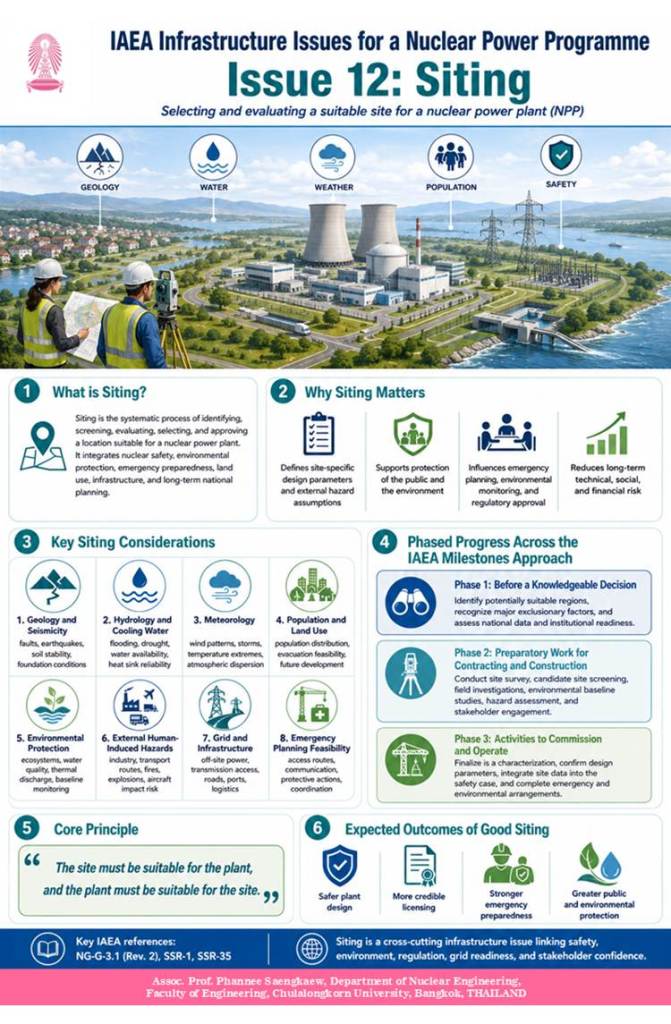
ประเด็นด้านที่ 12: การคัดเลือกสถานที่ตั้ง
1. บทนำ
การคัดเลือกสถานที่ตั้ง (Siting) ซึ่งเป็นด้านที่ 12 ในกรอบโครงสร้างพื้นฐาน 19 ด้านของทบวงการพลังงานปรมาณูระหว่างประเทศ หรือ IAEA เป็นหนึ่งในองค์ประกอบที่มีความซับซ้อนทางเทคนิคสูงและมีความอ่อนไหวทางสังคมอย่างมากในการพัฒนาโครงการโรงไฟฟ้านิวเคลียร์ ประเด็นนี้เกี่ยวข้องกับกระบวนการอย่างเป็นระบบในการระบุพื้นที่เบื้องต้น การคัดกรอง การประเมิน การคัดเลือก และการอนุมัติสถานที่ตั้งที่เหมาะสมสำหรับโรงไฟฟ้านิวเคลียร์หรือสถานประกอบการทางนิวเคลียร์ประเภทอื่น ในบริบทของประเทศเพิ่งเริ่มโครงการพลังงานนิวเคลียร์ การคัดเลือกสถานที่ตั้งมิได้เป็นเพียงคำถามว่า “มีพื้นที่ว่างเพียงพอหรือไม่” เท่านั้น หากแต่เป็นกระบวนการสหสาขาวิชาที่ต้องบูรณาการความปลอดภัยทางนิวเคลียร์ การคุ้มครองสิ่งแวดล้อม การเตรียมพร้อมและการตอบสนองต่อเหตุฉุกเฉิน การเชื่อมต่อกับระบบโครงข่ายไฟฟ้า ความพร้อมของแหล่งน้ำ การเข้าถึงระบบขนส่ง การกระจายตัวของประชากร ความมั่นคงทางธรณีวิทยา ภัยธรรมชาติ ภัยจากกิจกรรมของมนุษย์ การพิจารณาทบทวนโดยหน่วยงานกำกับดูแล การมีส่วนร่วมของผู้มีส่วนได้ส่วนเสีย และการวางแผนพัฒนาประเทศในระยะยาวเข้าด้วยกัน
แนวทาง Milestones Approach ของ IAEA จัดลำดับการพัฒนาโครงสร้างพื้นฐานด้านพลังงานนิวเคลียร์ออกเป็นสามระยะ ได้แก่ ระยะที่ 1 ซึ่งเป็นช่วงพิจารณาข้อกำหนดและความพร้อมก่อนการตัดสินใจอย่างมีความรู้ ระยะที่ 2 ซึ่งเป็นช่วงเตรียมความพร้อมสำหรับการจัดทำสัญญาและการก่อสร้างภายหลังการตัดสินใจเชิงนโยบาย และระยะที่ 3 ซึ่งครอบคลุมกิจกรรมที่จำเป็นต่อการทดสอบเดินเครื่องและการดำเนินงานโรงไฟฟ้านิวเคลียร์แห่งแรก IAEA อธิบายว่า “หมุดหมาย” หรือ milestones คือสภาพความพร้อมที่คาดว่าจะบรรลุเมื่อสิ้นสุดแต่ละระยะ และโครงสร้างพื้นฐาน 19 ด้าน ควรได้รับการพัฒนาอย่างก้าวหน้าตามลำดับระยะดังกล่าว
ภายใต้กรอบนี้ การคัดเลือกสถานที่ตั้งจึงเป็นเงื่อนไขสนับสนุนสำคัญสำหรับการตัดสินใจในขั้นตอนต่อ ๆ ไปของโครงการ หากกระบวนการคัดเลือกสถานที่ตั้งดำเนินการอย่างไม่เหมาะสม อาจก่อให้เกิดความเสี่ยงทางเทคนิค ความเสี่ยงด้านการกำกับดูแล ความเสี่ยงทางการเงิน ความเสี่ยงด้านสิ่งแวดล้อม และความเสี่ยงด้านความเชื่อมั่นของประชาชน ซึ่งอาจคงอยู่ตลอดอายุการดำเนินงานของโรงไฟฟ้า ในทางกลับกัน กระบวนการคัดเลือกสถานที่ตั้งที่มีความเข้มแข็งจะเป็นพื้นฐานทางเทคนิคสำหรับการปรับการออกแบบเครื่องปฏิกรณ์ให้เหมาะสมกับพื้นที่ การวิเคราะห์ความปลอดภัย การประเมินผลกระทบสิ่งแวดล้อม การวางแผนฉุกเฉิน การลงทุนด้านโครงสร้างพื้นฐาน และกระบวนการอนุญาต
เอกสารข้อกำหนดด้านความปลอดภัยของ IAEA เรื่อง Site Evaluation for Nuclear Installations, SSR-1 กำหนดข้อกำหนดที่มุ่งคุ้มครองผู้ปฏิบัติงาน ประชาชน และสิ่งแวดล้อมจากผลกระทบที่เป็นอันตรายของรังสีก่อให้เกิดไอออน โดยเน้นว่าภัยเฉพาะพื้นที่และลักษณะเฉพาะของสถานที่ตั้งที่เกี่ยวข้องกับความปลอดภัยต้องได้รับการพิจารณาอย่างเพียงพอ เพื่อให้สามารถกำหนดพารามิเตอร์การออกแบบเฉพาะสถานที่ตั้งได้อย่างเหมาะสม นอกจากนี้ เอกสารแนวทางด้านความปลอดภัยของ IAEA เรื่อง Site Survey and Site Selection for Nuclear Installations, SSG-35 ยังให้ข้อแนะนำเกี่ยวกับกระบวนการสำรวจและคัดเลือกสถานที่ตั้งอย่างเป็นระบบ โดยรวมถึงการพิจารณาด้านความปลอดภัยที่เกี่ยวข้องกับภัยภายนอก การกระจายตัวของประชากร เส้นทางการแพร่กระจายในสิ่งแวดล้อม และความเป็นไปได้ของการวางแผนฉุกเฉิน
2. ความหมายและขอบเขตของการคัดเลือกสถานที่ตั้งในโครงการโรงไฟฟ้านิวเคลียร์
ในโครงการโครงสร้างพื้นฐานทั่วไป การเลือกสถานที่ตั้งมักพิจารณาจากปัจจัยทางเศรษฐกิจ โลจิสติกส์ และสิ่งแวดล้อมเป็นหลัก อย่างไรก็ตาม ในโครงการโรงไฟฟ้านิวเคลียร์ การคัดเลือกสถานที่ตั้งมีความหมายเชิงความปลอดภัยที่ลึกกว่า เนื่องจากสถานที่ตั้งมีปฏิสัมพันธ์โดยตรงกับพื้นฐานการออกแบบ กรณีความปลอดภัย แผนฉุกเฉิน และการคุ้มครองสิ่งแวดล้อมในระยะยาว ดังนั้น สถานที่ตั้งจึงมิใช่เพียงพื้นที่รองรับโครงการ หากแต่เป็นส่วนหนึ่งของระบบความปลอดภัยโดยรวมของสถานประกอบการทางนิวเคลียร์
สถานที่ตั้งของโรงไฟฟ้านิวเคลียร์ต้องได้รับการประเมินในความสัมพันธ์ของอิทธิพลสองทิศทาง ทิศทางแรกคือ ผลของสถานที่ตั้งต่อโรงไฟฟ้า ซึ่งรวมถึงแผ่นดินไหว น้ำท่วม เหตุการณ์อุตุนิยมวิทยารุนแรง ความไม่มั่นคงทางธรณีเทคนิค ภูเขาไฟ ไฟไหม้ภายนอก อุบัติเหตุจากอุตสาหกรรม ความเป็นไปได้ของอากาศยานตก และเหตุการณ์ภายนอกอื่น ๆ ทั้งที่เกิดจากธรรมชาติและกิจกรรมของมนุษย์ ทิศทางที่สองคือ ผลของโรงไฟฟ้าต่อพื้นที่โดยรอบ ซึ่งรวมถึงความเป็นไปได้ของการปล่อยสารกัมมันตรังสี การแพร่กระจายในอากาศและแหล่งน้ำ วิถีทางการได้รับรังสีของประชาชน ความเป็นไปได้ของการตอบสนองต่อเหตุฉุกเฉิน ข้อจำกัดด้านการใช้ที่ดิน และข้อกำหนดด้านการเฝ้าระวังสิ่งแวดล้อม เอกสาร SSR-1 ได้วางกรอบการประเมินสถานที่ตั้งโดยพิจารณาทั้งลักษณะของภูมิภาคและสถานที่ตั้งที่อาจมีผลต่อความปลอดภัย และผลกระทบที่สถานประกอบการทางนิวเคลียร์อาจมีต่อภูมิภาคโดยรอบ
ดังนั้น ประเด็นการคัดเลือกสถานที่ตั้งจึงครอบคลุมองค์ประกอบสำคัญหลายประการ ได้แก่
- การสำรวจสถานที่ตั้งในระดับประเทศ ซึ่งมีเป้าหมายเพื่อระบุภูมิภาคกว้าง ๆ ที่อาจมีความเป็นไปได้ทางเทคนิคและสังคมสำหรับการพัฒนาโครงการนิวเคลียร์
- การคัดกรองสถานที่ตั้งที่เป็นไปได้ ซึ่งเป็นกระบวนการตัดพื้นที่ที่ไม่เหมาะสมออกตามเกณฑ์คัดออก เช่น รอยเลื่อนมีพลัง ความเสี่ยงน้ำท่วมรุนแรง ความหนาแน่นประชากรสูงเกินไป ข้อจำกัดด้านสิ่งแวดล้อม หรือโครงสร้างพื้นฐานไม่เพียงพอ
- การประเมินสถานที่ตั้งโดยละเอียด ซึ่งเป็นการกำหนดคุณลักษณะทางกายภาพ สิ่งแวดล้อม ประชากรศาสตร์ และโครงสร้างพื้นฐานของพื้นที่ที่ผ่านการคัดเลือกเบื้องต้น
- การคัดเลือกสถานที่ตั้ง ซึ่งเป็นการเปรียบเทียบสถานที่ตั้งที่เป็นไปได้โดยใช้เกณฑ์ด้านเทคนิค ความปลอดภัย สิ่งแวดล้อม เศรษฐกิจ และสังคมอย่างโปร่งใส
- การพิจารณาทบทวนและการอนุมัติโดยหน่วยงานกำกับดูแล ซึ่งเป็นกระบวนการพิจารณาว่าสถานที่ตั้งที่เสนอเป็นไปตามข้อกำหนดด้านความปลอดภัยที่เกี่ยวข้อง และสามารถรองรับสถานประกอบการทางนิวเคลียร์ที่เสนอได้หรือไม่
- การติดตามและยืนยันความเหมาะสมของสถานที่ตั้งในระยะยาว ซึ่งดำเนินต่อเนื่องตั้งแต่ช่วงการออกแบบ การก่อสร้าง การทดสอบเดินเครื่อง การดำเนินงาน ไปจนถึงการรื้อถอน
3. การคัดเลือกสถานที่ตั้งในฐานะโครงสร้างพื้นฐานที่เกี่ยวข้องกับความปลอดภัย
การคัดเลือกสถานที่ตั้งมีความเชื่อมโยงโดยตรงกับวัตถุประสงค์พื้นฐานด้านความปลอดภัย ซึ่งคือการคุ้มครองประชาชนและสิ่งแวดล้อมจากผลกระทบที่เป็นอันตรายของรังสีไอออไนซ์ ความปลอดภัยของโรงไฟฟ้านิวเคลียร์มิได้ขึ้นอยู่กับการออกแบบเครื่องปฏิกรณ์ ความสามารถของผู้เดินเครื่อง และการกำกับดูแลโดยหน่วยงานกำกับดูแลเท่านั้น แต่ยังขึ้นอยู่กับความเหมาะสมของสถานที่ตั้ง และความสามารถของการออกแบบโรงไฟฟ้าในการรองรับภัยเฉพาะพื้นที่ด้วย
ตัวอย่างเช่น สถานที่ตั้งที่เผชิญภัยแผ่นดินไหวสูงย่อมต้องการค่าพารามิเตอร์การออกแบบด้านแผ่นดินไหวที่เข้มงวดมากขึ้น รวมถึงการศึกษาฐานรากและเผื่อค่าความปลอดภัยที่สูงขึ้น สถานที่ตั้งชายฝั่งอาจมีข้อได้เปรียบด้านแหล่งน้ำหล่อเย็น แต่ในขณะเดียวกันก็ต้องมีการวิเคราะห์รายละเอียดเกี่ยวกับคลื่นพายุซัดฝั่ง สึนามิ การเพิ่มขึ้นของระดับน้ำทะเล การกัดเซาะชายฝั่ง และน้ำท่วม สถานที่ตั้งริมแม่น้ำอาจต้องประเมินความผันแปรตามฤดูกาลของอัตราการไหล ความเสี่ยงภัยแล้ง สถิติน้ำท่วม การตกตะกอน และผลกระทบจากการระบายน้ำอุณหภูมิสูงกลับสู่สิ่งแวดล้อม สถานที่ตั้งใกล้สถานประกอบการอุตสาหกรรมขนาดใหญ่จำเป็นต้องประเมินเหตุการณ์ภายนอกที่เกิดจากมนุษย์ เช่น การระเบิด การรั่วไหลของก๊าซพิษ ไฟไหม้ อุบัติเหตุขนส่ง หรือการจัดเก็บวัตถุอันตราย เอกสาร SSG-35 ระบุปัจจัยด้านความปลอดภัยหลายประการที่เกี่ยวข้องกับการสำรวจและคัดเลือกสถานที่ตั้ง ได้แก่ ภัยภายนอก ความหนาแน่นประชากร การแพร่กระจายในอากาศและน้ำ และความเป็นไปได้ของการวางแผนฉุกเฉิน
ในความหมายนี้ การคัดเลือกสถานที่ตั้งจึงเชื่อมโยงอย่างใกล้ชิดกับปรัชญา การป้องกันเชิงลึก (defence in depth) สถานที่ตั้งที่คัดเลือกอย่างเหมาะสมช่วยลดโอกาสที่เหตุการณ์ภายนอกจะท้าทายระบบความปลอดภัยของโรงไฟฟ้า นอกจากนี้ ยังสนับสนุนความเป็นไปได้ของมาตรการป้องกันประชาชน เช่น การอพยพ การหลบภัยในอาคาร การให้ไอโอดีนเพื่อป้องกันต่อมไทรอยด์ การจำกัดอาหาร และการเฝ้าระวังสิ่งแวดล้อมระยะยาวในกรณีที่เกิดเหตุฉุกเฉินทางรังสีซึ่งมีโอกาสเกิดขึ้นน้อยมาก
4. เกณฑ์ทางเทคนิคสำคัญในการคัดเลือกสถานที่ตั้งโรงไฟฟ้านิวเคลียร์
4.1 เงื่อนไขทางธรณีวิทยาและแผ่นดินไหว
การประเมินธรณีวิทยาและแผ่นดินไหวเป็นหนึ่งในองค์ประกอบทางเทคนิคที่สำคัญที่สุดของการคัดเลือกสถานที่ตั้ง พื้นที่ตั้งต้องได้รับการตรวจสอบในด้านสภาพเทคโทนิกระดับภูมิภาค รอยเลื่อนมีพลัง แหล่งกำเนิดแผ่นดินไหว ประวัติแผ่นดินไหว ค่าการเคลื่อนที่ของพื้นดิน ศักยภาพการเกิดดินเหลว ความมั่นคงของลาดเขา การทรุดตัว ลักษณะคาสต์ ความสามารถในการรับน้ำหนักของดิน และสภาพฐานราก
โรงไฟฟ้านิวเคลียร์ต้องการฐานรากที่มีเสถียรภาพ เนื่องจากโครงสร้าง ระบบ และส่วนประกอบที่เกี่ยวข้องกับความปลอดภัยต้องสามารถคงความสมบูรณ์ได้ทั้งในสภาวะเดินเครื่องปกติ เหตุการณ์ขณะเดินเครื่องที่คาดหมายได้ และเหตุการณ์ภายนอกตามพื้นฐานการออกแบบ ดังนั้น จึงจำเป็นต้องมีการสำรวจทางธรณีเทคนิคอย่างละเอียด เพื่อประเมินว่าสถานที่ตั้งสามารถรองรับอาคารเครื่องปฏิกรณ์ โครงสร้างระบบหล่อเย็น ระบบไฟฟ้าฉุกเฉิน สิ่งอำนวยความสะดวกสำหรับเชื้อเพลิงใช้แล้ว และโครงสร้างพื้นฐานอื่นที่เกี่ยวข้องกับความปลอดภัยได้อย่างปลอดภัยหรือไม่
สำหรับประเทศเพิ่งเริ่มโครงการนิวเคลียร์ ประเด็นนี้มักต้องการการเสริมสร้างขีดความสามารถอย่างมาก เนื่องจากการประเมินภัยแผ่นดินไหวต้องอาศัยข้อมูลเฉพาะทาง บันทึกทางธรณีวิทยาระยะยาว วิธีการเชิงความน่าจะเป็น การประเมินเชิงกำหนด และเกณฑ์การยอมรับของหน่วยงานกำกับดูแล หากการกำหนดคุณลักษณะทางธรณีวิทยาไม่เข้มแข็งเพียงพอ อาจทำให้เกิดความล่าช้าในการออกใบอนุญาต หรือจำเป็นต้องปรับเปลี่ยนการออกแบบด้วยต้นทุนสูงในระยะต่อมา
4.2 อุทกวิทยา น้ำท่วม และความพร้อมของน้ำหล่อเย็น
ความพร้อมของน้ำเป็นปัจจัยสำคัญของการคัดเลือกสถานที่ตั้งสำหรับการออกแบบโรงไฟฟ้านิวเคลียร์หลายประเภท เครื่องปฏิกรณ์น้ำเบาขนาดใหญ่ต้องการขีดความสามารถด้านการระบายความร้อนจำนวนมาก และแม้แต่แบบโรงไฟฟ้าที่ต้องการน้ำลดลงก็ยังต้องมีแหล่งระบายความร้อนที่เชื่อถือได้ ดังนั้น สถานที่ตั้งที่เป็นไปได้ต้องได้รับการประเมินในด้านการเข้าถึงน้ำทะเล น้ำจากแม่น้ำ อ่างเก็บน้ำ หอหล่อเย็น หรือระบบระบายความร้อนทางเลือก
การประเมินด้านอุทกวิทยาครอบคลุมภัยน้ำท่วม น้ำท่วมสูงสุดที่เป็นไปได้ ผลกระทบจากเขื่อนแตก คลื่นพายุซัดฝั่ง สึนามิ สภาพน้ำใต้ดิน ความสามารถในการระบายน้ำ ความเสี่ยงภัยแล้ง การแข่งขันด้านการใช้น้ำ และการเปลี่ยนแปลงที่เกี่ยวข้องกับภูมิอากาศ สำหรับพื้นที่ชายฝั่ง ต้องพิจารณาการเพิ่มขึ้นของระดับน้ำทะเลและเหตุการณ์ชายฝั่งรุนแรง สำหรับพื้นที่ภายในประเทศ ความขาดแคลนน้ำและการใช้ประโยชน์น้ำร่วมกันระหว่างภาคเกษตรกรรม อุตสาหกรรม ชุมชนเมือง และระบบนิเวศอาจกลายเป็นข้อจำกัดสำคัญ
การพิจารณาน้ำหล่อเย็นมิใช่ประเด็นทางเทคนิคเท่านั้น แต่ยังเป็นประเด็นด้านสิ่งแวดล้อมด้วย การระบายน้ำอุณหภูมิสูงอาจส่งผลต่อระบบนิเวศน้ำ ขณะที่โครงสร้างรับน้ำเข้าอาจมีผลต่อประชากรปลาและการใช้น้ำของชุมชนท้องถิ่น ดังนั้น การคัดเลือกสถานที่ตั้งต้องประสานกับการคุ้มครองสิ่งแวดล้อม การบริหารจัดการทรัพยากรน้ำ และการปรึกษาหารือกับประชาชน
4.3 อุตุนิยมวิทยาและการแพร่กระจายในบรรยากาศ
เงื่อนไขทางอุตุนิยมวิทยามีผลต่อทั้งการประเมินผลกระทบสิ่งแวดล้อมจากการดำเนินงานตามปกติ และการวิเคราะห์ผลกระทบจากอุบัติเหตุ การประเมินสถานที่ตั้งต้องพิจารณาทิศทางลม ความเร็วลม เสถียรภาพของบรรยากาศ ปริมาณฝน อุณหภูมิสุดขั้ว ความชื้น พายุรุนแรง ฟ้าผ่า พายุทอร์นาโดหรือพายุหมุนเขตร้อนในพื้นที่ที่เกี่ยวข้อง และแนวโน้มภูมิอากาศระยะยาว
การวิเคราะห์การแพร่กระจายในบรรยากาศมีความจำเป็นต่อการประเมินว่านิวไคลด์กัมมันตรังสีอาจถูกพัดพาอย่างไรในกรณีที่เกิดการปล่อยออกสู่สิ่งแวดล้อมซึ่งมีโอกาสเกิดขึ้นน้อยมาก การวิเคราะห์นี้สนับสนุนการกำหนดเขตวางแผนฉุกเฉิน การออกแบบระบบเฝ้าระวังสิ่งแวดล้อม การประเมินปริมาณรังสีต่อประชาชน และการประเมินความปลอดภัยโดยหน่วยงานกำกับดูแล เอกสาร SSG-35 ระบุอย่างชัดเจนว่าการแพร่กระจายในอากาศและน้ำเป็นหนึ่งในปัจจัยด้านความปลอดภัยที่ต้องพิจารณาในการสำรวจและคัดเลือกสถานที่ตั้ง
4.4 การกระจายตัวของประชากรและการใช้ที่ดิน
การกระจายตัวของประชากรรอบสถานที่ตั้งโรงไฟฟ้านิวเคลียร์เป็นปัจจัยสำคัญที่กำหนดความเป็นไปได้ของการวางแผนฉุกเฉินและผลกระทบทางรังสีที่อาจเกิดขึ้น สถานที่ตั้งที่เป็นไปได้ต้องได้รับการประเมินในความสัมพันธ์กับเมืองใกล้เคียง ความหนาแน่นประชากร กลุ่มเปราะบาง โรงพยาบาล โรงเรียน เส้นทางคมนาคม พื้นที่ท่องเที่ยว เขตอุตสาหกรรม พื้นที่เกษตรกรรม และแผนการใช้ที่ดินในอนาคต
สถานที่ตั้งที่น่าสนใจทางเทคนิคอาจไม่เหมาะสม หากพื้นที่โดยรอบมีความหนาแน่นประชากรสูงเกินไป หากเส้นทางอพยพไม่เพียงพอ หรือหากการขยายตัวของเมืองในอนาคตจะกระทบต่อการวางแผนฉุกเฉิน เอกสาร SSG-35 เชื่อมโยงโดยตรงระหว่างความหนาแน่นประชากร ระยะห่างจากศูนย์กลางชุมชน เส้นทางการแพร่กระจาย และความเป็นไปได้ของการวางแผนฉุกเฉินกับการคัดเลือกสถานที่ตั้ง
ดังนั้น การวางแผนการใช้ที่ดินต้องบูรณาการกับแผนพัฒนาระดับชาติและระดับท้องถิ่น กระบวนการคัดเลือกสถานที่ตั้งควรหลีกเลี่ยงการสร้างความขัดแย้งระหว่างข้อกำหนดด้านความปลอดภัยนิวเคลียร์กับรูปแบบการตั้งถิ่นฐานในอนาคต การพัฒนาอุตสาหกรรม เขตอนุรักษ์ หรือพื้นที่ท่องเที่ยว
4.5 ภัยภายนอกที่เกิดจากกิจกรรมของมนุษย์
ภัยภายนอกที่เกิดจากกิจกรรมของมนุษย์ ได้แก่ ความเสี่ยงที่เกิดจากกิจกรรมอุตสาหกรรม การคมนาคม การทหาร หรือโครงสร้างพื้นฐานใกล้เคียง ตัวอย่างเช่น การระเบิดของสารเคมี สิ่งอำนวยความสะดวกด้านน้ำมันและก๊าซ การจัดเก็บวัตถุอันตราย เส้นทางบิน เส้นทางเดินเรือ ทางรถไฟ ท่อส่ง ไฟไหม้ การรั่วไหลของก๊าซพิษ และผลกระทบที่อาจเกิดจากอุตสาหกรรมเสี่ยงสูงบริเวณใกล้เคียง
ภัยเหล่านี้มีความสำคัญเนื่องจากการวิเคราะห์ความปลอดภัยทางนิวเคลียร์ต้องพิจารณาเหตุการณ์ภายนอกที่อาจส่งผลต่อโครงสร้างและระบบที่เกี่ยวข้องกับความปลอดภัย สถานที่ตั้งที่อยู่ใกล้นิคมปิโตรเคมีขนาดใหญ่ สนามบินทหาร เส้นทางขนส่งวัตถุอันตราย หรือเขตอุตสาหกรรมหนาแน่น อาจต้องการคุณลักษณะการออกแบบเพื่อการป้องกันเพิ่มเติม หรืออาจถูกคัดออกในกระบวนการคัดเลือกสถานที่ตั้ง
4.6 การเชื่อมต่อโครงข่ายไฟฟ้าและไฟฟ้าภายนอกสถานี
แม้ว่าโครงสร้างพื้นฐานด้านโครงข่ายไฟฟ้าจะเป็นอีกประเด็นหนึ่งภายใต้กรอบโครงสร้างพื้นฐานของ IAEA แต่ประเด็นดังกล่าวมีความเชื่อมโยงอย่างใกล้ชิดกับการคัดเลือกสถานที่ตั้ง โรงไฟฟ้านิวเคลียร์ต้องการการเชื่อมต่อที่เชื่อถือได้กับระบบส่งไฟฟ้า ทั้งเพื่อส่งพลังงานไฟฟ้าที่ผลิตได้เข้าสู่ระบบ และเพื่อรับไฟฟ้าภายนอกสถานีสำหรับการทำงานของระบบที่เกี่ยวข้องกับความปลอดภัยเมื่อเครื่องปฏิกรณ์หยุดเดินเครื่อง การอภิปรายด้านความปลอดภัยนิวเคลียร์ในช่วงหลังเน้นว่า การโจมตีหรือการหยุดชะงักของโครงสร้างพื้นฐานไฟฟ้าที่เชื่อมต่อกับโรงไฟฟ้านิวเคลียร์อาจเป็นภัยคุกคามโดยตรงต่อความปลอดภัยและความมั่นคงทางนิวเคลียร์ เนื่องจากไฟฟ้าภายนอกสถานีมีความจำเป็นต่อการหล่อเย็นและหน้าที่ด้านความปลอดภัยอื่น ๆ
สำหรับการคัดเลือกสถานที่ตั้ง หมายความว่าสถานที่ตั้งที่เป็นไปได้ต้องได้รับการประเมินในด้านแนวระบบส่งไฟฟ้า ความแข็งแรงของโครงข่าย เสถียรภาพของระบบ การเข้าถึงสถานีไฟฟ้าย่อย ความซ้ำซ้อนของไฟฟ้าภายนอกสถานี ศูนย์กลางโหลด และต้นทุนกับกำหนดเวลาของการเสริมความแข็งแรงของโครงข่ายไฟฟ้า สถานที่ตั้งห่างไกลอาจช่วยลดความกังวลด้านการได้รับรังสีของประชากร แต่ในขณะเดียวกันอาจสร้างความท้าทายอย่างมากด้านการเชื่อมต่อกับโครงข่ายไฟฟ้า ในทางกลับกัน สถานที่ตั้งใกล้ศูนย์กลางโหลดอาจทำให้เกิดข้อกังวลด้านประชากรและการใช้ที่ดิน
4.7 การขนส่ง การเข้าถึง และโลจิสติกส์การก่อสร้าง
การก่อสร้างโรงไฟฟ้านิวเคลียร์ต้องอาศัยการขนส่งชิ้นส่วนขนาดใหญ่ หนัก และไวต่อความเสียหาย เช่น ถังปฏิกรณ์ เครื่องกำเนิดไอน้ำ ชิ้นส่วนกังหัน หม้อแปลงไฟฟ้า เครน โครงสร้างโมดูลาร์ และวัสดุกำบังรังสีที่มีน้ำหนักมาก ดังนั้น การคัดเลือกสถานที่ตั้งต้องพิจารณาถนนเข้าถึง ท่าเรือ ทางรถไฟ สะพาน ลักษณะภูมิประเทศ พื้นที่พักวัสดุและอุปกรณ์ก่อสร้าง เส้นทางเข้าถึงฉุกเฉิน และความยืดหยุ่นของระบบโลจิสติกส์
การเข้าถึงด้านขนส่งที่ไม่เพียงพออาจเพิ่มต้นทุนโครงการ ทำให้การก่อสร้างล่าช้า และทำให้การตอบสนองต่อเหตุฉุกเฉินซับซ้อนขึ้น สำหรับเครื่องปฏิกรณ์แบบโมดูลาร์ขนาดเล็ก การก่อสร้างแบบโมดูลาร์อาจลดภาระด้านโลจิสติกส์บางส่วน แต่การขนส่งโมดูลขนาดหนัก การเตรียมพื้นที่ และการติดตั้งเฉพาะทางยังคงต้องได้รับการประเมินอย่างรอบคอบ
5. ความรับผิดชอบเชิงสถาบันในการคัดเลือกสถานที่ตั้ง
การคัดเลือกสถานที่ตั้งต้องอาศัยการประสานงานระหว่างหลายสถาบันระดับชาติ โดยทั่วไปประกอบด้วยกระทรวงหรือหน่วยงานของรัฐที่รับผิดชอบนโยบายพลังงาน องค์กรดำเนินงานโครงการพลังงานนิวเคลียร์ เจ้าของหรือผู้ดำเนินงานในอนาคต หน่วยงานกำกับดูแลทางนิวเคลียร์ หน่วยงานด้านสิ่งแวดล้อม หน่วยงานธรณีวิทยาและอุตุนิยมวิทยา หน่วยงานทรัพยากรน้ำ องค์กรบริหารจัดการเหตุฉุกเฉิน ผู้ดำเนินงานโครงข่ายไฟฟ้า องค์กรปกครองส่วนท้องถิ่น หน่วยงานวางแผนการใช้ที่ดิน และหน่วยงานที่เกี่ยวข้องกับการมีส่วนร่วมของผู้มีส่วนได้ส่วนเสีย
รัฐบาลมีหน้าที่กำหนดนโยบายและกรอบกฎหมายโดยรวมที่เอื้อให้เกิดกิจกรรมการคัดเลือกสถานที่ตั้ง เจ้าของหรือผู้ดำเนินงานโดยทั่วไปมีหน้าที่ดำเนินการสำรวจสถานที่ตั้ง การกำหนดคุณลักษณะของสถานที่ตั้ง การศึกษาด้านสิ่งแวดล้อม และการประเมินสถานที่ตั้งที่เกี่ยวข้องกับความปลอดภัย หน่วยงานกำกับดูแลมีหน้าที่พิจารณาทบทวนพื้นฐานความปลอดภัยของสถานที่ตั้ง และตัดสินว่าสถานที่ตั้งนั้นสามารถยอมรับได้สำหรับสถานประกอบการทางนิวเคลียร์ที่เสนอหรือไม่ หน่วยงานสิ่งแวดล้อมมีหน้าที่พิจารณาการประเมินผลกระทบสิ่งแวดล้อมและข้อกำหนดด้านการปรึกษาหารือกับประชาชน ส่วนองค์กรปกครองส่วนท้องถิ่นและชุมชนมีบทบาทผ่านการวางแผนการใช้ที่ดิน กระบวนการยอมรับทางสังคม และการจัดเตรียมความพร้อมฉุกเฉิน
สำหรับประเทศเพิ่งเริ่มโครงการนิวเคลียร์ การกำหนดบทบาทของแต่ละสถาบันตั้งแต่ระยะแรกมีความสำคัญอย่างยิ่ง หากความรับผิดชอบไม่ชัดเจน การคัดเลือกสถานที่ตั้งอาจกระจัดกระจายไปตามหน่วยงานต่าง ๆ ทำให้เกิดการศึกษาซ้ำซ้อน ข้อมูลไม่สอดคล้องกัน ความไม่ไว้วางใจของประชาชน หรือความล่าช้าในการอนุมัติของหน่วยงานกำกับดูแล
6. ความสัมพันธ์ระหว่างการคัดเลือกสถานที่ตั้งกับโครงสร้างพื้นฐานด้านอื่น
การคัดเลือกสถานที่ตั้งมีความเชื่อมโยงอย่างเข้มแข็งกับโครงสร้างพื้นฐานด้านอื่น ๆ
เชื่อมโยงกับ ด้านที่ 1: จุดยืนแห่งชาติ (National Position) เนื่องจากการเลือกพื้นที่ที่เป็นไปได้สำหรับโรงไฟฟ้านิวเคลียร์สะท้อนยุทธศาสตร์พลังงานแห่งชาติ นโยบายพัฒนาภูมิภาค และพันธกรณีทางการเมืองระยะยาว
เชื่อมโยงกับ ด้านที่ 2: ความปลอดภัยทางนิวเคลียร์ (Nuclear Safety) เนื่องจากลักษณะเฉพาะของสถานที่ตั้งมีผลต่อภัยตามพื้นฐานการออกแบบ การวิเคราะห์อุบัติเหตุ การวางแผนฉุกเฉิน และการป้องกันเชิงลึก
เชื่อมโยงกับ ด้านที่ 3: การบริหารจัดการ (Management) เนื่องจากการคัดเลือกสถานที่ตั้งต้องอาศัยธรรมาภิบาลโครงการ การบริหารจัดการข้อมูล การประกันคุณภาพ การควบคุมผู้รับจ้าง และการจัดการรอยต่อระหว่างงานหลายด้าน
เชื่อมโยงกับ ด้านที่ 4: เงินทุนและการจัดหาเงินทุน (Funding and Financing) เนื่องจากการจัดหาที่ดิน การสำรวจ การศึกษาสิ่งแวดล้อม การเชื่อมต่อโครงข่ายไฟฟ้า โครงสร้างพื้นฐานด้านน้ำ และการปรับปรุงระบบขนส่ง อาจต้องใช้เงินลงทุนล่วงหน้าจำนวนมาก
เชื่อมโยงกับ ด้านที่ 5: กรอบกฎหมาย (Legislative Framework) และ ด้านที่ 7: กรอบการกำกับดูแล (Regulatory Framework) เนื่องจากการอนุมัติสถานที่ตั้งต้องได้รับการสนับสนุนจากกฎหมายที่บังคับใช้ได้ กระบวนการออกใบอนุญาต ข้อกำหนดด้านความปลอดภัย กฎระเบียบด้านสิ่งแวดล้อม และการควบคุมการใช้ที่ดิน
เชื่อมโยงกับ ด้านที่ 8: การป้องกันอันตรายรังสี (Radiation Protection) เนื่องจากการประเมินสถานที่ตั้งรวมถึงเส้นทางการได้รับรังสีที่อาจเกิดขึ้น การกระจายตัวของประชากร การเฝ้าระวังสิ่งแวดล้อม และการประเมินปริมาณรังสีต่อประชาชน
เชื่อมโยงกับ ด้านที่ 9: โครงข่ายไฟฟ้า (Electrical Grid) เนื่องจากสถานที่ตั้งต้องรองรับการส่งพลังงานไฟฟ้าเข้าสู่ระบบอย่างเชื่อถือได้ และต้องมีแหล่งไฟฟ้าภายนอกสถานีสำหรับหน้าที่ด้านความปลอดภัย
เชื่อมโยงกับ ด้านที่ 10: การพัฒนาทรัพยากรมนุษย์ (Human Resource Development) เนื่องจากการคัดเลือกสถานที่ตั้งต้องอาศัยผู้เชี่ยวชาญด้านธรณีวิทยา แผ่นดินไหว อุทกวิทยา อุตุนิยมวิทยา วิทยาศาสตร์สิ่งแวดล้อม ความปลอดภัยนิวเคลียร์ การวางแผนฉุกเฉิน และการพิจารณาทบทวนด้านกำกับดูแล
เชื่อมโยงกับ ด้านที่ 11: การมีส่วนร่วมของผู้มีส่วนได้ส่วนเสีย (Stakeholder Involvement) เนื่องจากการคัดเลือกสถานที่ตั้งมักเป็นหนึ่งในแง่มุมของโครงการนิวเคลียร์ที่ประชาชนมองเห็นได้ชัดเจนที่สุดและอาจมีข้อถกเถียงสูงที่สุด
เชื่อมโยงกับ ด้านที่ 13: การคุ้มครองสิ่งแวดล้อม (Environmental Protection) เนื่องจากการเลือกสถานที่ตั้งต้องพิจารณาระบบนิเวศ ทรัพยากรน้ำ พื้นที่คุ้มครอง ความหลากหลายทางชีวภาพ การระบายน้ำอุณหภูมิสูง และการเฝ้าระวังระยะยาว
เชื่อมโยงกับ ด้านที่ 14: การวางแผนฉุกเฉิน (Emergency Planning) เนื่องจากสถานที่ตั้งต้องเอื้อให้สามารถจัดการตอบสนองต่อเหตุฉุกเฉินได้จริง
เชื่อมโยงกับ ด้านที่ 15: ความมั่นคงทางนิวเคลียร์ (Nuclear Security) เนื่องจากสถานที่ตั้งต้องรองรับการป้องกันทางกายภาพ การควบคุมการเข้าถึง การจัดกำลังตอบสนอง และการกำหนดเขตความมั่นคง
ดังนั้น การคัดเลือกสถานที่ตั้งไม่ควรถูกมองว่าเป็นการศึกษาเชิงเทคนิคที่แยกขาดจากระบบอื่น หากแต่เป็นประเด็นโครงสร้างพื้นฐานแบบตัดขวางที่บูรณาการความปลอดภัย สิ่งแวดล้อม สังคม การกำกับดูแล และการดำเนินโครงการเข้าด้วยกัน
7. การพัฒนาการคัดเลือกสถานที่ตั้งตามระยะของแนวทาง Milestones ของ IAEA
7.1 ระยะที่ 1: การพิจารณาก่อนการตัดสินใจอย่างมีความรู้
ในระยะที่ 1 ประเทศยังมิได้มีพันธกรณีขั้นสุดท้ายในการเริ่มโครงการโรงไฟฟ้านิวเคลียร์ วัตถุประสงค์ของกิจกรรมด้านการคัดเลือกสถานที่ตั้งในระยะนี้มิใช่เพื่ออนุมัติสถานที่ตั้งสุดท้ายของโรงไฟฟ้านิวเคลียร์ แต่เพื่อประเมินว่ามีความเป็นไปได้ที่จะมีสถานที่ตั้งที่เหมาะสมหรือไม่ และเงื่อนไขระดับชาติสามารถรองรับโครงการคัดเลือกสถานที่ตั้งในอนาคตได้เพียงใด
ในระยะนี้ รัฐบาลและคณะทำงานดำเนินงานโครงการพลังงานนิวเคลียร์ควรกำหนดข้อกำหนดเบื้องต้นของการคัดเลือกสถานที่ตั้ง และดำเนินการประเมินเบื้องต้นของภูมิภาคที่อาจเป็นไปได้ การประเมินดังกล่าวอาจรวมถึงการจัดทำแผนที่ระดับประเทศเกี่ยวกับเขตแผ่นดินไหว พื้นที่เสี่ยงน้ำท่วม พื้นที่ชายฝั่ง ทรัพยากรน้ำหล่อเย็น พื้นที่คุ้มครองด้านสิ่งแวดล้อม การกระจายตัวของประชากร แนวระบบโครงข่ายไฟฟ้า โครงสร้างพื้นฐานด้านขนส่ง ภัยจากอุตสาหกรรม และข้อจำกัดด้านการใช้ที่ดิน
งานด้านการคัดเลือกสถานที่ตั้งในระยะที่ 1 ควรช่วยระบุช่องว่างด้านข้อมูลและขีดความสามารถทางเทคนิคของประเทศด้วย ตัวอย่างเช่น ประเทศอาจพบว่าข้อมูลแผ่นดินไหวยังไม่ครบถ้วน แผนที่ธรณีวิทยาล้าสมัย เครือข่ายตรวจวัดอุตุนิยมวิทยายังไม่เพียงพอ แบบจำลองน้ำท่วมยังไม่มี หรือการคาดการณ์การเติบโตของประชากรยังไม่ได้บูรณาการกับการวางแผนระดับชาติ ช่องว่างเหล่านี้ไม่จำเป็นต้องทำให้โครงการนิวเคลียร์ไม่สามารถดำเนินต่อได้ แต่ต้องได้รับการรับรู้ตั้งแต่ระยะแรก เพื่อให้สามารถวางแผนการศึกษาในระยะที่ 2 ได้อย่างสมจริง
ผลลัพธ์สำคัญของระยะที่ 1 คือความเข้าใจเบื้องต้นว่าประเทศมีภูมิภาคที่อาจยอมรับได้สำหรับการพัฒนาโรงไฟฟ้านิวเคลียร์หรือไม่ ผลลัพธ์นี้ควรสนับสนุนการตัดสินใจอย่างมีความรู้ว่าจะเดินหน้าต่อหรือไม่ และไม่ควรถูกนำเสนอว่าเป็นการอนุมัติสถานที่ตั้งขั้นสุดท้าย
ผลลัพธ์ที่คาดหวังในระยะที่ 1 ได้แก่
ประเทศควรมีความเข้าใจเบื้องต้นเกี่ยวกับข้อจำกัดและโอกาสด้านการคัดเลือกสถานที่ตั้งในระดับชาติ ควรสามารถระบุภูมิภาคที่เป็นไปได้ในระดับกว้าง และรับรู้ปัจจัยคัดออกสำคัญ เช่น ภัยธรรมชาติรุนแรง ความหนาแน่นประชากรสูง ความขาดแคลนน้ำ พื้นที่คุ้มครอง หรือข้อจำกัดด้านโครงข่ายไฟฟ้า นอกจากนี้ ประเทศควรระบุสถาบันที่จะรับผิดชอบในภายหลังต่อการศึกษาสถานที่ตั้งโดยละเอียด การพิจารณาทบทวนด้านกำกับดูแล การประเมินสิ่งแวดล้อม และการมีส่วนร่วมของผู้มีส่วนได้ส่วนเสีย
7.2 ระยะที่ 2: การเตรียมความพร้อมสำหรับการจัดทำสัญญาและการก่อสร้าง
ระยะที่ 2 เริ่มต้นหลังจากรัฐบาลมีการตัดสินใจเชิงนโยบายที่จะดำเนินโครงการโรงไฟฟ้านิวเคลียร์ต่อไป ในระยะนี้ การคัดเลือกสถานที่ตั้งจะมีรายละเอียดและความเป็นทางการมากขึ้นอย่างมีนัยสำคัญ วัตถุประสงค์คือการเคลื่อนจากการคัดกรองระดับภูมิภาคกว้าง ๆ ไปสู่การคัดเลือกสถานที่ตั้งที่เป็นไปได้ และการเตรียมพื้นฐานทางเทคนิคสำหรับการอนุมัติสถานที่ตั้ง
เจ้าของหรือผู้ดำเนินงาน หรือองค์กรดำเนินงานโครงการ ควรดำเนินการศึกษาเพื่อสำรวจและคัดเลือกสถานที่ตั้งอย่างเป็นระบบ ตามแนวทางของ IAEA การสำรวจและการคัดเลือกสถานที่ตั้งเป็นกระบวนการที่มีโครงสร้างชัดเจน ซึ่งพิจารณาปัจจัยที่เกี่ยวข้องกับความปลอดภัยและเสริมข้อกำหนดสำหรับการประเมินสถานที่ตั้ง กระบวนการนี้โดยทั่วไปประกอบด้วยการคัดออกตามเกณฑ์ การประเมินเปรียบเทียบ การจัดลำดับสถานที่ตั้งที่เป็นไปได้ และการสำรวจโดยละเอียดของพื้นที่ที่ได้รับการพิจารณาว่าเหมาะสมที่สุด
การศึกษาในระยะที่ 2 ควรรวมถึงการสำรวจภาคสนาม การเจาะสำรวจทางธรณีวิทยา การประเมินภัยแผ่นดินไหว การจำลองทางอุทกวิทยา การตรวจวัดอุตุนิยมวิทยา การศึกษาสภาพแวดล้อมพื้นฐาน การวิเคราะห์ประชากรและการใช้ที่ดิน การประเมินการขนส่ง การประเมินทรัพยากรน้ำ การศึกษาเชื่อมต่อโครงข่ายไฟฟ้า การศึกษาความเป็นไปได้ของการวางแผนฉุกเฉิน และการประเมินความมั่นคงเบื้องต้น การศึกษาทั้งหมดต้องจัดทำเอกสารภายใต้โครงการประกันคุณภาพ เนื่องจากข้อมูลเหล่านี้จะสนับสนุนกระบวนการอนุญาตและการวิเคราะห์ความปลอดภัยในภายหลัง
การมีส่วนร่วมของผู้มีส่วนได้ส่วนเสียมีความสำคัญอย่างยิ่งในระยะที่ 2 ชุมชนใกล้พื้นที่ที่เป็นไปได้ควรได้รับข้อมูลที่ชัดเจนเกี่ยวกับกระบวนการคัดเลือกสถานที่ตั้ง เกณฑ์ด้านความปลอดภัย การศึกษาสิ่งแวดล้อม การเตรียมพร้อมฉุกเฉิน การใช้ที่ดิน การชดเชยในกรณีที่เกี่ยวข้อง และขั้นตอนการตัดสินใจ ความไว้วางใจของประชาชนอาจเสียหายอย่างรุนแรง หากการคัดเลือกสถานที่ตั้งถูกมองว่าเป็นกระบวนการลับ ถูกกำหนดจากฝ่ายการเมือง หรือมีความอ่อนแอทางเทคนิค
หน่วยงานกำกับดูแลควรพัฒนาหรือจัดทำความคาดหวังด้านการประเมินสถานที่ตั้งและการอนุมัติสถานที่ตั้งให้ชัดเจน แม้ว่าเจ้าของหรือผู้ดำเนินงานจะเป็นผู้ทำการศึกษารายละเอียดเป็นหลัก แต่หน่วยงานกำกับดูแลต้องมีความสามารถในการพิจารณาทบทวนพื้นฐานความปลอดภัยอย่างเป็นอิสระ ซึ่งต้องอาศัยผู้ตรวจประเมินที่ได้รับการฝึกอบรม การเข้าถึงองค์กรสนับสนุนทางเทคนิค และแนวทางการกำกับดูแลที่ชัดเจน
ผลลัพธ์ที่คาดหวังในระยะที่ 2 ได้แก่
เมื่อสิ้นสุดระยะที่ 2 ประเทศควรได้คัดเลือกสถานที่ตั้งที่เหมาะสมที่สุด หรืออยู่ในสถานะพร้อมที่จะคัดเลือกสถานที่ตั้งที่เหมาะสมที่สุด โดยอาศัยการประเมินทางเทคนิค ความปลอดภัย สิ่งแวดล้อม และเศรษฐกิจสังคมอย่างเป็นระบบ สถานที่ตั้งควรได้รับการกำหนดคุณลักษณะอย่างเพียงพอเพื่อรองรับการประมูล การเลือกเทคโนโลยี การประเมินผลกระทบสิ่งแวดล้อม และการวิเคราะห์ความปลอดภัยเบื้องต้น หน่วยงานกำกับดูแลควรมีขีดความสามารถและขั้นตอนในการพิจารณาทบทวนการประเมินสถานที่ตั้ง การตัดสินใจด้านสถานที่ตั้งควรได้รับการสนับสนุนด้วยหลักฐานเอกสาร เกณฑ์ที่โปร่งใส และการมีส่วนร่วมของผู้มีส่วนได้ส่วนเสียที่น่าเชื่อถือ
7.3 ระยะที่ 3: กิจกรรมเพื่อการทดสอบเดินเครื่องและการดำเนินงานโรงไฟฟ้านิวเคลียร์แห่งแรก
ระยะที่ 3 ครอบคลุมช่วงเวลาที่โรงไฟฟ้านิวเคลียร์แห่งแรกอยู่ระหว่างการก่อสร้าง การทดสอบเดินเครื่อง และการเตรียมความพร้อมสำหรับการดำเนินงาน ในระยะนี้ สถานที่ตั้งที่ได้รับการคัดเลือกมิได้เป็นเพียงพื้นที่ที่เป็นไปได้อีกต่อไป แต่กลายเป็นฐานทางกายภาพของการออกแบบโรงไฟฟ้า กรณีความปลอดภัย กระบวนการอนุญาต แผนฉุกเฉิน โครงการเฝ้าระวังสิ่งแวดล้อม ระบบความมั่นคง และการจัดเตรียมด้านการปฏิบัติงาน
การประเมินสถานที่ตั้งต้องดำเนินการให้สมบูรณ์ และบูรณาการเข้าสู่รายงานวิเคราะห์ความปลอดภัยของโรงไฟฟ้า พารามิเตอร์การออกแบบเฉพาะสถานที่ตั้งต้องได้รับการยืนยัน ได้แก่ พื้นฐานการออกแบบด้านแผ่นดินไหว ระดับการป้องกันน้ำท่วม สมมติฐานทางอุตุนิยมวิทยา ค่าพารามิเตอร์ของภัยภายนอก เงื่อนไขน้ำหล่อเย็น ลักษณะดินและฐานราก และแบบจำลองการแพร่กระจาย เอกสาร SSR-1 เน้นว่าภัยเฉพาะสถานที่ตั้งและลักษณะที่เกี่ยวข้องกับความปลอดภัยต้องได้รับการพิจารณาอย่างเพียงพอ เพื่อให้ได้พารามิเตอร์การออกแบบเฉพาะสถานที่ตั้งที่เหมาะสม
ระหว่างการก่อสร้าง ข้อมูลใหม่อาจปรากฏจากการขุด การทำฐานราก การติดตามน้ำใต้ดิน หรือการศึกษาภัยที่ปรับปรุงใหม่ องค์กรโครงการต้องมีกระบวนการยืนยันว่าสารสนเทศใหม่เกี่ยวกับสถานที่ตั้งส่งผลต่อพื้นฐานการออกแบบหรือกรณีความปลอดภัยหรือไม่ หากพบความไม่สอดคล้องระหว่างสมมติฐานเดิมกับสภาพจริง ต้องมีการประเมินและแก้ไขภายใต้การกำกับดูแลของหน่วยงานกำกับดูแล
การจัดเตรียมแผนฉุกเฉินต้องดำเนินการให้สมบูรณ์โดยเชื่อมโยงกับสถานที่ตั้งจริง ซึ่งรวมถึงการกำหนดเขตวางแผนฉุกเฉิน เส้นทางอพยพ การจัดพื้นที่หลบภัย ระบบสื่อสาร การประสานงานกับหน่วยงานท้องถิ่น การเตรียมพร้อมด้านการแพทย์ เครือข่ายเก็บตัวอย่างสิ่งแวดล้อม และระบบให้ข้อมูลแก่ประชาชน ความเป็นไปได้ของการวางแผนฉุกเฉินเป็นหนึ่งในข้อพิจารณาด้านสถานที่ตั้งที่ได้รับการยอมรับ โดยเฉพาะในความสัมพันธ์กับการกระจายตัวของประชากรและเส้นทางเข้าถึง
การเฝ้าระวังสิ่งแวดล้อมต้องเริ่มก่อนการดำเนินงาน เพื่อจัดทำข้อมูลสภาพพื้นฐานก่อนโรงไฟฟ้าเดินเครื่อง ซึ่งรวมถึงการเฝ้าระวังอากาศ น้ำ ดิน ตะกอน ห่วงโซ่อาหาร ระบบนิเวศน้ำ และระดับรังสีพื้นหลัง ข้อมูลพื้นฐานมีความสำคัญต่อการตรวจจับการเปลี่ยนแปลงในอนาคตที่อาจเกี่ยวข้องกับการดำเนินงานของโรงไฟฟ้า และต่อการรักษาความเชื่อมั่นของประชาชน
ผลลัพธ์ที่คาดหวังในระยะที่ 3 ได้แก่
เมื่อสิ้นสุดระยะที่ 3 สถานที่ตั้งที่ได้รับการคัดเลือกควรได้รับการกำหนดคุณลักษณะอย่างสมบูรณ์ ได้รับการอนุมัติ และบูรณาการเข้าสู่การออกแบบโรงไฟฟ้าและพื้นฐานการอนุญาต สมมติฐานที่เกี่ยวข้องกับสถานที่ตั้งควรได้รับการยืนยันผ่านการก่อสร้างและการทดสอบเดินเครื่อง การวางแผนฉุกเฉิน การเฝ้าระวังสิ่งแวดล้อม การจัดเตรียมความมั่นคง การเชื่อมต่อโครงข่ายไฟฟ้า และการเข้าถึงโครงสร้างพื้นฐานควรมีความพร้อมเชิงปฏิบัติการก่อนการบรรจุเชื้อเพลิงและการเดินเครื่องโรงไฟฟ้า
8. การพิจารณาทบทวนด้านกำกับดูแลของการคัดเลือกสถานที่ตั้ง
การพิจารณาทบทวนด้านกำกับดูแลของการคัดเลือกสถานที่ตั้งเป็นองค์ประกอบสำคัญของธรรมาภิบาลด้านความปลอดภัยนิวเคลียร์ หน่วยงานกำกับดูแลต้องพิจารณาว่าสถานที่ตั้งมีความเหมาะสมสำหรับสถานประกอบการทางนิวเคลียร์ที่เสนอหรือไม่ และการออกแบบได้คำนึงถึงภัยเฉพาะสถานที่ตั้งอย่างเพียงพอหรือไม่ การพิจารณาทบทวนนี้ควรมีความเป็นอิสระ มีความสามารถทางเทคนิค มีความโปร่งใส และอาศัยข้อกำหนดด้านความปลอดภัยที่กำหนดไว้
โดยทั่วไป การพิจารณาทบทวนด้านกำกับดูแลจะตรวจสอบว่าผู้ยื่นคำขอได้จัดการประเด็นต่อไปนี้อย่างเพียงพอหรือไม่
การพิจารณาทบทวนจะตรวจสอบว่าภัยธรรมชาติภายนอกได้รับการระบุและกำหนดคุณลักษณะด้วยความเผื่อความปลอดภัยเพียงพอหรือไม่ โดยพิจารณาว่าภัยแผ่นดินไหว น้ำท่วม อุตุนิยมวิทยา อุทกวิทยา ธรณีเทคนิค และภัยภายนอกที่เกิดจากมนุษย์ ถูกสะท้อนอย่างเหมาะสมในพารามิเตอร์การออกแบบหรือไม่ การพิจารณาทบทวนยังประเมินว่าการกระจายตัวของประชากรและความเป็นไปได้ของการวางแผนฉุกเฉินได้รับการประเมินหรือไม่ รวมถึงพิจารณาว่าเส้นทางการแพร่กระจายในสิ่งแวดล้อมได้รับการวิเคราะห์ และสถานที่ตั้งสนับสนุนการคุ้มครองประชาชนและสิ่งแวดล้อมหรือไม่
หน่วยงานกำกับดูแลควรประเมินคุณภาพของข้อมูลที่ใช้ในการประเมินสถานที่ตั้งด้วย ซึ่งรวมถึงความน่าเชื่อถือของการสำรวจภาคสนาม ข้อมูลตรวจวัด แบบจำลอง สมมติฐาน การจัดการความไม่แน่นอน การทบทวนโดยผู้เชี่ยวชาญ และการประกันคุณภาพ การประเมินสถานที่ตั้งมิใช่เพียงเรื่องของข้อสรุปสุดท้ายเท่านั้น แต่ยังเป็นเรื่องของวิธีวิทยาว่ามีความสมเหตุสมผลทางวิทยาศาสตร์เพียงใด
สำหรับประเทศเพิ่งเริ่มโครงการนิวเคลียร์ ขีดความสามารถของหน่วยงานกำกับดูแลมักเป็นหนึ่งในความท้าทายสำคัญที่สุด หน่วยงานกำกับดูแลอาจต้องเข้าถึงองค์กรสนับสนุนทางเทคนิค การทบทวนจากผู้เชี่ยวชาญระหว่างประเทศ การฝึกอบรม และคำแนะนำจากผู้เชี่ยวชาญอิสระ หากปราศจากสมรรถนะด้านกำกับดูแลที่เพียงพอ ประเทศอาจต้องพึ่งพาการศึกษาของผู้ขายเทคโนโลยีหรือที่ปรึกษาต่างชาติมากเกินไป ซึ่งอาจทำให้ความเป็นเจ้าของระดับชาติของการตัดสินใจด้านความปลอดภัยอ่อนแอลง
9. มิติด้านสิ่งแวดล้อมและสังคมของการคัดเลือกสถานที่ตั้ง
การคัดเลือกสถานที่ตั้งมิได้เป็นเพียงกระบวนการทางเทคนิคด้านความปลอดภัยเท่านั้น แต่ยังเป็นการตัดสินใจสำคัญด้านสิ่งแวดล้อมและสังคมด้วย สถานที่ตั้งของโรงไฟฟ้านิวเคลียร์อาจมีผลต่อการใช้ที่ดิน การประมง เกษตรกรรม โครงสร้างพื้นฐานท้องถิ่น ทรัพยากรน้ำ อัตลักษณ์ของชุมชน การจ้างงาน มูลค่าทรัพย์สิน การท่องเที่ยว และการรับรู้ความเสี่ยง ประเด็นเหล่านี้ต้องได้รับการจัดการผ่านการประเมินผลกระทบสิ่งแวดล้อม การประเมินสิ่งแวดล้อมเชิงยุทธศาสตร์ในกรณีที่เกี่ยวข้อง และการมีส่วนร่วมของผู้มีส่วนได้ส่วนเสียอย่างมีความหมาย
การศึกษาสิ่งแวดล้อมควรกำหนดสภาพพื้นฐานก่อนการก่อสร้าง โดยควรตรวจสอบระบบนิเวศบนบกและในน้ำ ชนิดพันธุ์คุ้มครอง คุณภาพน้ำ ตะกอน คุณภาพอากาศ รังสีพื้นหลัง การใช้ที่ดิน มรดกทางวัฒนธรรม และผลกระทบสะสมจากกิจกรรมอุตสาหกรรมอื่น สำหรับสถานที่ตั้งชายฝั่ง นิเวศวิทยาทางทะเลและการระบายน้ำอุณหภูมิสูงมีความสำคัญเป็นพิเศษ สำหรับสถานที่ตั้งภายในประเทศ การสูบน้ำใช้และความยืดหยุ่นต่อภัยแล้งอาจกลายเป็นประเด็นหลัก
การศึกษาสังคมควรประเมินการกระจายตัวของประชากร วิถีชีวิตและการประกอบอาชีพ ความกังวลของชุมชน ขีดความสามารถของการปกครองท้องถิ่น การเตรียมพร้อมฉุกเฉิน และการพัฒนาภูมิภาคระยะยาว กระบวนการคัดเลือกสถานที่ตั้งไม่ควรลดการมีส่วนร่วมของผู้มีส่วนได้ส่วนเสียให้เหลือเพียงการให้ข้อมูลทางเดียวแก่ประชาชน แต่ควรเปิดโอกาสให้มีการตั้งคำถาม การสะท้อนข้อกังวล การใช้ความรู้ท้องถิ่น และการทบทวนโดยอิสระ
สถานที่ตั้งที่เหมาะสมทางเทคนิคอาจยังเผชิญความล่าช้าอย่างรุนแรง หากกระบวนการขาดความโปร่งใสหรือความชอบธรรม ดังนั้น กระบวนการคัดเลือกสถานที่ตั้งต้องได้รับการออกแบบให้เป็นทั้งการประเมินทางเทคนิคและกระบวนการตัดสินใจสาธารณะ
10. การคัดเลือกสถานที่ตั้งสำหรับเครื่องปฏิกรณ์แบบโมดูลขนาดเล็ก
เครื่องปฏิกรณ์แบบโมดูลขนาดเล็ก หรือ SMR อาจเปลี่ยนแปลงข้อพิจารณาด้านการคัดเลือกสถานที่ตั้งบางประการ แต่ไม่ได้ทำให้ความจำเป็นในการประเมินสถานที่ตั้งอย่างเข้มงวดหมดไป SMR อาจมีคุณลักษณะการออกแบบ เช่น ปริมาณสารกัมมันตรังสีที่อาจปล่อยออกต่ำกว่า การก่อสร้างแบบโมดูล ระบบความปลอดภัยแบบพาสซีฟที่ได้รับการเสริมสมรรถนะ โครงสร้างที่อยู่ใต้ดินหรือฝังบางส่วน ข้อกำหนดเขตวางแผนฉุกเฉินที่ลดลงในบางบริบทการกำกับดูแล และความเป็นไปได้ในการติดตั้งในพื้นที่ห่างไกลหรือพื้นที่อุตสาหกรรม อย่างไรก็ตาม ภัยเฉพาะสถานที่ตั้ง เงื่อนไขด้านสิ่งแวดล้อม การจัดเตรียมความมั่นคง การเตรียมพร้อมฉุกเฉิน การบูรณาการกับโครงข่ายไฟฟ้า โลจิสติกส์การขนส่ง และการพิจารณาทบทวนโดยหน่วยงานกำกับดูแลยังคงมีความจำเป็น
สำหรับประเทศเพิ่งเริ่มโครงการ การคัดเลือกสถานที่ตั้งสำหรับ SMR อาจนำเสนอทางเลือกเชิงยุทธศาสตร์ใหม่ ๆ สถานที่ตั้งอาจรวมถึงพื้นที่โรงไฟฟ้าเชื้อเพลิงฟอสซิลเดิม เขตอุตสาหกรรม ระบบไฟฟ้าพื้นที่ห่างไกล เขตเหมืองแร่ โรงงานผลิตน้ำจืดจากน้ำทะเล หรือระบบพลังงานผสม อย่างไรก็ตาม การใช้พื้นที่อุตสาหกรรมเดิมหรือพื้นที่สีน้ำตาลต้องประเมินการปนเปื้อนตกค้าง สภาพฐานราก ภัยภายนอก การควบคุมการเข้าถึง และความสอดคล้องกับข้อกำหนดด้านความปลอดภัยนิวเคลียร์อย่างระมัดระวัง
แนวทางแบบไล่ระดับตามความเสี่ยงที่กล่าวถึงใน SSR-1 มีความเกี่ยวข้องในบริบทนี้ เนื่องจากขอบเขตและความลึกของการประเมินสถานที่ตั้งควรสอดคล้องกับความเสี่ยงทางรังสีต่อประชาชนและสิ่งแวดล้อม อย่างไรก็ตาม แนวทางแบบไล่ระดับมิได้หมายถึงแนวทางที่อ่อนแอ หากแต่หมายถึงระดับการวิเคราะห์ต้องมีความได้สัดส่วน มีเหตุผลรองรับ และได้รับการยอมรับจากหน่วยงานกำกับดูแล
11. ความท้าทายทั่วไปสำหรับประเทศเพิ่งเริ่มโครงการนิวเคลียร์
ประเทศเพิ่งเริ่มโครงการนิวเคลียร์มักเผชิญความท้าทายหลายประการในการคัดเลือกสถานที่ตั้ง
ความท้าทายแรกคือ ข้อมูลระดับชาติไม่เพียงพอ ชุดข้อมูลด้านธรณีวิทยา แผ่นดินไหว อุทกวิทยา อุตุนิยมวิทยา สิ่งแวดล้อม และประชากรศาสตร์ อาจไม่ได้ถูกเก็บรวบรวมโดยคำนึงถึงข้อกำหนดระดับนิวเคลียร์ ข้อมูลอาจกระจายอยู่ในหลายหน่วยงาน มีรูปแบบไม่สอดคล้องกัน หรือไม่เพียงพอสำหรับการวิเคราะห์แนวโน้มระยะยาว
ความท้าทายที่สองคือ ความเชี่ยวชาญทางเทคนิคที่จำกัด การคัดเลือกสถานที่ตั้งต้องอาศัยความรู้เฉพาะทางจากหลายสาขา ประเทศหนึ่งอาจมีความเชี่ยวชาญด้านวิศวกรรมโยธาหรือสิ่งแวดล้อมที่เข้มแข็ง แต่มีประสบการณ์จำกัดในการประเมินสถานที่ตั้งเฉพาะด้านนิวเคลียร์ การประเมินภัยแผ่นดินไหวเชิงความน่าจะเป็น การจำลองการแพร่กระจายทางรังสี หรือการพิจารณาทบทวนความปลอดภัยโดยหน่วยงานกำกับดูแล
ความท้าทายที่สามคือ ความกระจัดกระจายเชิงสถาบัน หากความรับผิดชอบระหว่างหน่วยงานพลังงาน หน่วยงานสิ่งแวดล้อม หน่วยงานกำกับดูแล องค์กรปกครองส่วนท้องถิ่น ผู้ดำเนินงานโครงข่ายไฟฟ้า และหน่วยงานฉุกเฉินไม่ชัดเจน กระบวนการคัดเลือกสถานที่ตั้งอาจล่าช้าและไม่สอดคล้องกัน
ความท้าทายที่สี่คือ การยอมรับของประชาชน การคัดเลือกสถานที่ตั้งมักเป็นช่วงเวลาที่โครงการนิวเคลียร์เริ่มปรากฏชัดต่อชุมชนท้องถิ่น หากการมีส่วนร่วมของประชาชนเริ่มต้นเฉพาะหลังจากที่มีการเลือกสถานที่ตั้งที่ต้องการแล้ว ชุมชนอาจมองว่ากระบวนการดังกล่าวถูกกำหนดไว้ล่วงหน้า
ความท้าทายที่ห้าคือ อิทธิพลของผู้ขายเทคโนโลยีที่เกิดขึ้นก่อนเวลาอันควร หากการคัดเลือกสถานที่ตั้งผูกพันกับข้อเสนอของผู้ขายเทคโนโลยีมากเกินไปก่อนที่ประเทศจะกำหนดเกณฑ์ของตนเอง ประเทศอาจสูญเสียการควบคุมพื้นฐานด้านการคัดเลือกสถานที่ตั้ง สถานที่ตั้งควรถูกคัดเลือกด้วยเกณฑ์ด้านความปลอดภัย สิ่งแวดล้อม และโครงสร้างพื้นฐานระดับชาติ ไม่ใช่ด้วยความสะดวกทางการค้าเพียงอย่างเดียว
12. แนวปฏิบัติที่ดีที่แนะนำ
โครงการคัดเลือกสถานที่ตั้งที่เข้มแข็งควรอาศัยกระบวนการที่โปร่งใส เป็นลำดับขั้น และตั้งอยู่บนหลักฐาน ประเทศควรเริ่มจากการคัดกรองระดับชาติ ดำเนินต่อไปสู่การประเมินระดับภูมิภาค ระบุสถานที่ตั้งที่เป็นไปได้ ดำเนินการประเมินเปรียบเทียบ และจึงทำการกำหนดคุณลักษณะของสถานที่ตั้งโดยละเอียด แต่ละขั้นตอนควรมีเกณฑ์ที่ชัดเจน สมมติฐานที่จัดทำเป็นเอกสาร และกลไกการทบทวน
กระบวนการคัดเลือกสถานที่ตั้งควรบูรณาการกับการวางแผนพลังงานแห่งชาติ การวางแผนโครงข่ายไฟฟ้า การวางแผนทรัพยากรน้ำ การคุ้มครองสิ่งแวดล้อม การเตรียมพร้อมฉุกเฉิน และนโยบายการใช้ที่ดิน กระบวนการดังกล่าวควรได้รับการสนับสนุนจากระบบบริหารจัดการข้อมูลอย่างเป็นทางการ และโครงการประกันคุณภาพ
หน่วยงานกำกับดูแลควรมีส่วนร่วมตั้งแต่ระยะแรกอย่างเพียงพอเพื่อชี้แจงความคาดหวัง แต่ต้องรักษาความเป็นอิสระจากกระบวนการคัดเลือกสถานที่ตั้งของผู้ยื่นคำขอ องค์กรสนับสนุนทางเทคนิคและการทบทวนจากผู้เชี่ยวชาญระหว่างประเทศอาจมีประโยชน์ โดยเฉพาะสำหรับประเทศเพิ่งเริ่มโครงการนิวเคลียร์
การมีส่วนร่วมของผู้มีส่วนได้ส่วนเสียควรเริ่มก่อนการคัดเลือกสถานที่ตั้งขั้นสุดท้าย ชุมชนท้องถิ่นควรเข้าใจว่าเหตุใดบางภูมิภาคจึงถูกพิจารณา เกณฑ์ใดถูกใช้ การศึกษาใดจะดำเนินการ สิทธิและความรับผิดชอบใดมีอยู่ และข้อกังวลจะได้รับการจัดการอย่างไร
ประเทศควรหลีกเลี่ยงการมองว่าการคัดเลือกสถานที่ตั้งเป็นการศึกษาเพียงครั้งเดียว การติดตามและการยืนยันสถานที่ตั้งต้องดำเนินต่อเนื่องตลอดวัฏจักรชีวิตของโรงไฟฟ้า การเปลี่ยนแปลงภูมิอากาศ การเติบโตของประชากร การพัฒนาอุตสาหกรรม การเปลี่ยนแปลงการใช้ที่ดิน และข้อมูลภัยที่ปรับปรุงใหม่ อาจทำให้ต้องมีการประเมินซ้ำเป็นระยะ
13. สรุป
โครงสร้างด้านที่ 12 การคัดเลือกสถานที่ตั้ง เป็นโครงสร้างพื้นฐานที่มีลักษณะพื้นฐานเป็นอย่างยิ่ง เนื่องจากเป็นตัวกำหนดว่าโรงไฟฟ้านิวเคลียร์จะสามารถบูรณาการเข้ากับพื้นที่ของประเทศได้อย่างปลอดภัย เหมาะสมทางสิ่งแวดล้อม เหมาะสมทางเทคนิค และเป็นที่ยอมรับทางสังคมหรือไม่ ประเด็นนี้เชื่อมโยงภูมิศาสตร์ทางกายภาพเข้ากับความปลอดภัยนิวเคลียร์ การคุ้มครองสิ่งแวดล้อม การวางแผนฉุกเฉิน ความเชื่อถือได้ของโครงข่ายไฟฟ้า ความมั่นคง การกำกับดูแล และความเชื่อมั่นของประชาชน
หลักการสำคัญของการคัดเลือกสถานที่ตั้งทางนิวเคลียร์คือ สถานที่ตั้งต้องเหมาะสมกับโรงไฟฟ้า และโรงไฟฟ้าต้องเหมาะสมกับสถานที่ตั้ง ความสัมพันธ์แบบสองทิศทางนี้ทำให้การคัดเลือกสถานที่ตั้งทางนิวเคลียร์แตกต่างจากการเลือกที่ดินทั่วไป สถานที่ตั้งที่ได้รับการคัดเลือกต้องสนับสนุนการป้องกันเชิงลึก สามารถรองรับภัยภายนอก เอื้อให้เกิดการตอบสนองฉุกเฉินที่เป็นไปได้ คุ้มครองสิ่งแวดล้อม มีโครงสร้างพื้นฐานจำเป็น และยังคงสอดคล้องกับการพัฒนาประเทศในระยะยาว
ตามแนวทางกรอบหมุดหมายของ IAEA การคัดเลือกสถานที่ตั้งพัฒนาอย่างก้าวหน้าตามระยะ ในระยะที่ 1 ประเทศต้องประเมินว่ามีภูมิภาคที่เหมาะสมหรือไม่ และขีดความสามารถระดับชาติเพียงพอสำหรับการเดินหน้าหรือไม่ ในระยะที่ 2 สถานที่ตั้งที่เป็นไปได้ต้องได้รับการคัดกรอง เปรียบเทียบ และกำหนดคุณลักษณะอย่างเป็นระบบ ในระยะที่ 3 สถานที่ตั้งที่ได้รับการคัดเลือกต้องถูกบูรณาการเข้าสู่การออกแบบโรงไฟฟ้า กรณีความปลอดภัย กระบวนการอนุญาต แผนฉุกเฉิน โครงการเฝ้าระวังสิ่งแวดล้อม และการเตรียมความพร้อมในการดำเนินงาน
สำหรับประเทศเพิ่งเริ่มโครงการ การคัดเลือกสถานที่ตั้งควรถูกเข้าใจว่าเป็นทั้งกระบวนการทางเทคนิคด้านความปลอดภัยและกระบวนการธรรมาภิบาลระดับชาติ กระบวนการนี้ต้องอาศัยหลักฐานทางวิทยาศาสตร์ ความเป็นอิสระของหน่วยงานกำกับดูแล การประสานงานเชิงสถาบัน ความโปร่งใสต่อสาธารณะ และการดูแลรับผิดชอบในระยะยาว
ตาราง: ความก้าวหน้าตามระยะของด้านที่ 12 การคัดเลือกสถานที่ตั้ง ภายใต้แนวทางกรอบหมุดหมายของ IAEA
| ระยะ | วัตถุประสงค์หลัก | กิจกรรมสำคัญ | ผลลัพธ์ที่คาดหวัง |
| ระยะที่ 1: ก่อนการตัดสินใจอย่างมีความรู้ | ประเมินว่ามีภูมิภาคที่อาจเหมาะสมหรือไม่ และระบุข้อจำกัดด้านการคัดเลือกสถานที่ตั้งในระดับชาติ | ดำเนินการคัดกรองระดับชาติด้านธรณีวิทยา แผ่นดินไหว อุทกวิทยา ประชากร โครงข่ายไฟฟ้า น้ำ สิ่งแวดล้อม การขนส่ง และการใช้ที่ดิน ระบุช่องว่างด้านข้อมูลและความรับผิดชอบเชิงสถาบัน | ประเทศมีความเข้าใจเกี่ยวกับความเป็นไปได้ของสถานที่ตั้งในภาพรวม และตระหนักถึงข้อจำกัดสำคัญก่อนการตัดสินใจดำเนินโครงการนิวเคลียร์ |
| ระยะที่ 2: การเตรียมความพร้อมสำหรับการจัดทำสัญญาและการก่อสร้าง | คัดเลือกและกำหนดคุณลักษณะของสถานที่ตั้งที่สามารถรองรับโรงไฟฟ้านิวเคลียร์ได้ | ดำเนินการสำรวจสถานที่ตั้งอย่างเป็นระบบ การคัดกรองตามเกณฑ์คัดออก การประเมินเปรียบเทียบ การศึกษาสภาพแวดล้อมพื้นฐาน การประเมินภัย การศึกษาโครงข่ายไฟฟ้าและน้ำ และการมีส่วนร่วมของผู้มีส่วนได้ส่วนเสีย | สถานที่ตั้งที่ต้องการหรือสถานที่ตั้งที่เป็นไปได้ได้รับการคัดเลือกตามเกณฑ์ด้านเทคนิค ความปลอดภัย สิ่งแวดล้อม และเศรษฐกิจสังคมอย่างโปร่งใส |
| ระยะที่ 3: กิจกรรมเพื่อการทดสอบเดินเครื่องและการดำเนินงาน | ยืนยันว่าสถานที่ตั้งที่ได้รับการคัดเลือกสนับสนุนการออกแบบ การอนุญาต การก่อสร้าง การวางแผนรับมือเหตุฉุกเฉิน และการดำเนินงาน | จัดทำการประเมินสถานที่ตั้งให้สมบูรณ์ ยืนยันพารามิเตอร์การออกแบบ บูรณาการข้อมูลสถานที่ตั้งเข้าสู่การวิเคราะห์ความปลอดภัย จัดตั้งการเฝ้าระวังสิ่งแวดล้อม และทำให้การวางแผนรับมือฉุกเฉินกับโครงสร้างพื้นฐานมีความพร้อม | สถานที่ตั้งที่ได้รับอนุมัติถูกบูรณาการอย่างสมบูรณ์เข้าสู่กรณีความปลอดภัย การออกแบบโรงไฟฟ้า พื้นฐานการอนุญาต และโครงการเตรียมความพร้อมในการดำเนินงาน |
เอกสารอ้างอิง
- International Atomic Energy Agency. (2024). Milestones in the Development of a National Infrastructure for Nuclear Power (IAEA Nuclear Energy Series No. NG-G-3.1, Rev. 2). IAEA.
- International Atomic Energy Agency. (2019). Site Evaluation for Nuclear Installations (IAEA Safety Standards Series No. SSR-1). IAEA.
- International Atomic Energy Agency. (2015). Site Survey and Site Selection for Nuclear Installations (IAEA Safety Standards Series No. SSG-35). IAEA.
- International Atomic Energy Agency. (2006). Fundamental Safety Principles (IAEA Safety Standards Series No. SF-1). IAEA.
- International Atomic Energy Agency. (2011). Meteorological and Hydrological Hazards in Site Evaluation for Nuclear Installations (IAEA Safety Standards Series No. SSG-18). IAEA.
- International Atomic Energy Agency. (2010). Seismic Hazards in Site Evaluation for Nuclear Installations (IAEA Safety Standards Series No. SSG-9). IAEA.
- International Atomic Energy Agency. (2012). Volcanic Hazards in Site Evaluation for Nuclear Installations (IAEA Safety Standards Series No. SSG-21). IAEA.


ใส่ความเห็น