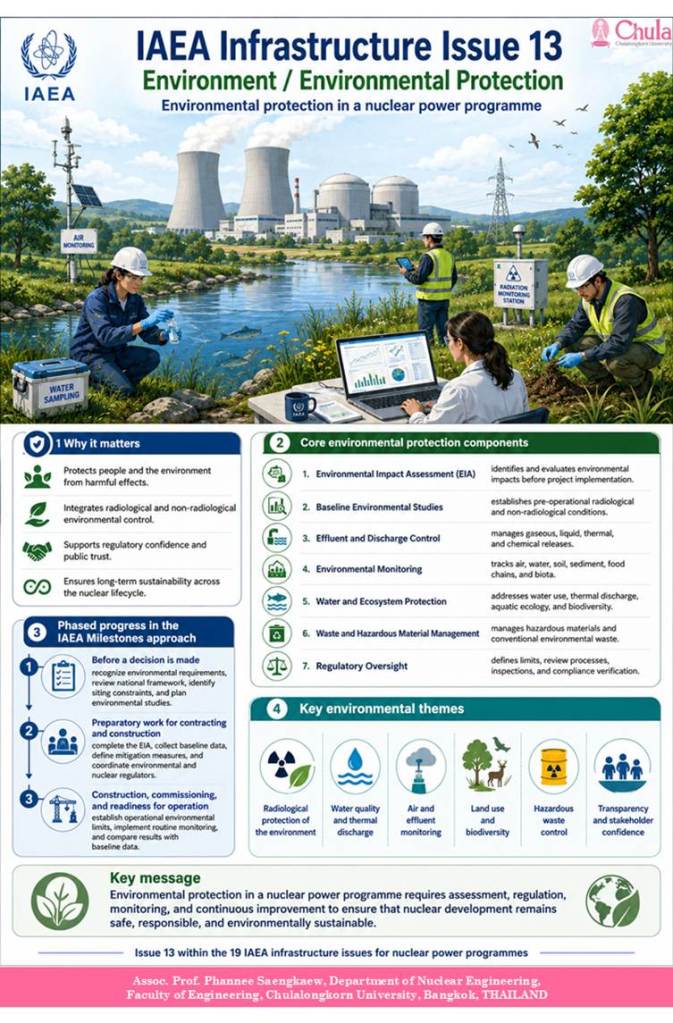
Issue 13: Environment / Environmental Protection
within the 19 IAEA Infrastructure Issues for a Nuclear Power Programme
1. Introduction
Issue 13, Environment or more precisely Environmental Protection, is one of the 19 infrastructure issues identified in the IAEA Milestones approach for countries considering or embarking on a nuclear power programme. Its central purpose is to ensure that the development, construction, commissioning, operation, and eventual decommissioning of a nuclear power plant are planned and implemented in a manner that protects the environment, complies with national environmental requirements, and addresses nuclear-specific environmental considerations from the earliest stages of national decision making.
In the IAEA infrastructure framework, environmental protection is not treated as a secondary or late-stage activity. It is a cross-cutting infrastructure issue that must be integrated into national energy planning, site selection, environmental impact assessment, project licensing, construction management, operational monitoring, radioactive effluent control, waste management, and stakeholder engagement. The IAEA emphasizes that environmental protection in a new nuclear power programme includes the national infrastructure required to protect the environment and the studies needed to assess, mitigate, and manage environmental impacts associated with nuclear power development.
The environmental issue is particularly important for newcomer countries because many countries already have general environmental laws and environmental impact assessment systems, but may have limited experience with the environmental aspects specific to nuclear power. These nuclear-specific aspects include the assessment of radioactive effluents, long-term environmental monitoring, radioecological pathways, thermal discharges, water use, baseline radiological conditions, spent fuel and radioactive waste interfaces, and the coordination between environmental and nuclear regulatory bodies.
From an academic perspective, Issue 13 should be understood as the infrastructure mechanism that connects environmental governance, scientific assessment, regulatory control, and public confidence. It ensures that environmental impacts are not merely described after a technology or site has been chosen, but are systematically considered as part of national decision making, site evaluation, project preparation, construction oversight, and operational control.
2. Conceptual Meaning of Environmental Protection in a Nuclear Power Programme
Environmental protection in a nuclear power programme refers to the set of legal, institutional, technical, scientific, and operational arrangements established to prevent, minimize, monitor, and manage the environmental impacts associated with nuclear power development. It includes both radiological and non-radiological environmental aspects.
The radiological dimension concerns the protection of people and the environment from radioactive releases during normal operation, including gaseous and liquid effluents, environmental transfer pathways, and long-term accumulation in environmental media. The non-radiological dimension concerns issues such as land use, water use, cooling water discharge, thermal effects, chemical discharges, construction disturbance, biodiversity, transport of materials, disposal of hazardous waste, and socioeconomic-environmental interactions.
This distinction is important because a nuclear power plant is not only a radiological facility. It is also a large industrial infrastructure project that interacts with land, water, ecosystems, local communities, transport networks, and energy systems. Therefore, Issue 13 requires an integrated environmental perspective that covers the full lifecycle of the facility, from pre-project planning to operation and eventual decommissioning.
The fundamental safety objective of the IAEA safety framework is to protect people and the environment from harmful effects of ionizing radiation. This objective applies throughout the lifetime of facilities and activities, including planning, siting, design, construction, commissioning, operation, decommissioning, and closure. In the context of Issue 13, this principle is translated into practical infrastructure conditions such as environmental assessment, environmental regulation, baseline monitoring, environmental limits, and operational monitoring programmes.
3. Scope of Issue 13 and Its Boundary with Other Infrastructure Issues
Issue 13 covers offsite releases from planned operation and broader environmental issues associated with the nuclear power programme. The IAEA evaluation guidance clarifies that the protection of workers and members of the public onsite during planned operation is addressed mainly under Issue 8: Radiation Protection, while accidental releases and emergency radiation protection are mainly addressed under Issue 14: Emergency Planning.
This boundary is essential for avoiding overlap among infrastructure issues. Issue 13 does not replace radiation protection or emergency preparedness. Instead, it focuses on the environmental consequences of normal planned activities and the environmental management system needed to ensure that the nuclear power programme remains compatible with national environmental protection objectives.
The scope of Issue 13 therefore includes:
- consideration of environmental requirements during early national planning;
- review of the national environmental protection framework;
- preparation of environmental studies and environmental impact assessment;
- establishment of environmental baseline data;
- identification of environmental pathways and sensitive receptors;
- definition of environmental responsibilities between organizations;
- coordination between the environmental regulator and nuclear regulator;
- development of environmental monitoring systems;
- establishment of radiological and non-radiological environmental limits;
- continuous review of environmental monitoring results during operation.
4. Importance of Issue 13 for a New Nuclear Power Programme
Environmental protection is important because nuclear power development involves long-term commitments and complex interactions between technology, society, regulation, and the natural environment. The IAEA notes that developing a nuclear power programme requires attention to many interrelated infrastructure issues over a long duration, and that the introduction of nuclear power involves commitments extending through operation, decommissioning, and waste disposal.
For a newcomer country, environmental protection serves several strategic functions.
First, it supports informed national decision making. Before a country decides to proceed with nuclear power, environmental considerations must be examined alongside energy security, economic, technological, safety, security, and social factors. This includes considering whether the country has appropriate sites, adequate water resources, suitable environmental regulation, and the institutional ability to assess nuclear-specific environmental impacts.
Second, it supports credible site selection and site justification. Environmental criteria are part of the exclusion and avoidance criteria used in regional analysis and candidate site identification. Site selection must take into account safety, security, cost, socioeconomic issues, engineering conditions, and environmental factors.
Third, it supports regulatory confidence. A nuclear power plant cannot be viewed as environmentally acceptable unless the relevant regulatory authorities have the competence, authority, resources, and coordination mechanisms needed to review environmental assessment documents, set environmental conditions, inspect activities, and evaluate monitoring results.
Fourth, it supports stakeholder confidence. Environmental concerns are often among the most visible public concerns associated with nuclear power. These concerns may include radioactive releases, water consumption, waste management, impacts on agriculture and fisheries, thermal pollution, biodiversity, land-use change, and long-term environmental responsibility. A transparent environmental assessment and monitoring system helps build public trust by making environmental information measurable, reviewable, and accountable.
5. Main Environmental Components in Nuclear Power Infrastructure
5.1 Environmental Impact Assessment
The environmental impact assessment, or EIA, is a central instrument of Issue 13. It provides the structured process through which the environmental consequences of a proposed nuclear power plant are identified, assessed, mitigated, documented, reviewed, and communicated.
For a nuclear power plant, the EIA should not be limited to generic industrial impacts. It should include nuclear-specific issues such as radioactive effluent pathways, baseline radiation levels, environmental transfer of radionuclides, potential exposure routes to humans and biota, monitoring requirements, and environmental management measures. It should also include conventional environmental issues such as construction impacts, water use, thermal discharge, chemical releases, land disturbance, transportation, biodiversity, and waste streams.
In Phase 2 of the Milestones approach, the IAEA expects a complete assessment of the environmental impact of the proposed nuclear power plant to be carried out in accordance with national requirements, with an environmental impact assessment report submitted to the appropriate authority. The IAEA also expects plans for monitoring to be developed in order to provide a baseline for the site and its surroundings.
5.2 Environmental Baseline Study
An environmental baseline study provides the reference condition against which future environmental changes can be evaluated. For a nuclear power plant, the baseline should include both radiological and non-radiological parameters.
Radiological baseline data may include background gamma dose rates, radionuclide concentrations in air, water, soil, sediment, vegetation, foodstuffs, and aquatic organisms. Non-radiological baseline data may include hydrology, meteorology, water quality, ecological conditions, land use, population distribution, agricultural activities, fisheries, and protected areas.
The baseline is critical because once the plant begins construction and operation, environmental monitoring results must be interpreted in relation to pre-existing conditions. Without a reliable baseline, it becomes difficult to distinguish plant-related impacts from natural variation, historical contamination, industrial activities, seasonal effects, or regional environmental changes.
5.3 Radioecological Pathways
A nuclear-specific environmental assessment must identify the pathways through which radioactive materials could move through the environment. These pathways may include atmospheric dispersion, deposition on soil and vegetation, transfer to crops and animal products, discharge into rivers or marine systems, uptake by aquatic organisms, sediment accumulation, groundwater movement, and human consumption pathways.
The IAEA evaluation guidance specifically identifies pathways for effluent transport and concentration in the surrounding environment as one of the environmental factors to be included in the bid invitation specification and site information. This requirement demonstrates that environmental information is not merely a regulatory appendix, but an input into technology procurement, vendor design assumptions, and plant-specific environmental commitments.
5.4 Water Use and Thermal Discharge
Water use is one of the most important non-radiological environmental issues for nuclear power plants. Nuclear power plants require reliable heat removal, and many designs use large quantities of water for cooling. The environmental implications depend on the cooling technology, site location, water availability, seasonal variation, aquatic ecology, and competing water users.
Environmental assessment must therefore examine water intake, discharge temperature, thermal plume behaviour, aquatic ecosystem impacts, drought resilience, flooding risks, long-term climate trends, and the relationship between heat removal capability and plant safety. The IAEA evaluation guidance includes water use, water quality, and data relevant to justifying heat removal capability among the environmental requirements and site characteristics to be considered.
5.5 Hazardous Waste and Conventional Environmental Management
Although radioactive waste is addressed under other infrastructure issues, Issue 13 also concerns hazardous and conventional waste generated during site preparation, construction, operation, maintenance, and decommissioning. These may include oils, chemicals, resins, contaminated materials, construction waste, laboratory waste, wastewater treatment residues, and other industrial wastes.
The environmental infrastructure should define how hazardous waste will be identified, segregated, stored, transported, treated, and disposed of in accordance with national regulations and environmental commitments. The IAEA evaluation guidance explicitly identifies disposal of hazardous waste, transport of materials, and construction impact as non-radiological environmental issues that should be considered by the Nuclear Energy Programme Implementing Organization, or NEPIO.
6. Institutional and Regulatory Requirements
A credible environmental protection framework requires clearly defined institutional responsibilities. In most countries, environmental protection is not regulated by a single organization. Responsibilities may be distributed among the ministry of environment, environmental protection agency, nuclear regulatory body, water authority, public health authority, local government, marine or fisheries agency, land-use planning authority, and emergency management organizations.
For nuclear power, the interface between the environmental regulator and the nuclear regulator is especially important. The environmental regulator may be responsible for environmental impact assessment approval, environmental permits, non-radiological emissions, water discharge, biodiversity protection, and environmental monitoring requirements. The nuclear regulator may be responsible for nuclear safety, radiological protection, radioactive effluent authorization, operational limits, safety assessment, and radioactive waste safety.
The IAEA Phase 2 evaluation condition states that clear and effective regulation of environmental issues should be established. The environmental regulator should have the skills and resources required to fulfil its roles, and the interface between the environmental regulator and nuclear regulator should be defined. Evidence may include defined roles and responsibilities, memoranda of understanding between environmental and nuclear regulatory bodies, and evidence of adequate competence to evaluate the EIA, assess design information, inspect construction activities, and evaluate monitoring results.
This institutional coordination is one of the most important practical challenges for newcomer countries. If responsibilities are unclear, environmental decisions may become fragmented. If environmental and nuclear regulators do not coordinate effectively, there may be gaps or duplication in licensing, monitoring, data interpretation, public communication, and enforcement.
7. Environmental Protection Across the Three IAEA Milestones Phases
7.1 Phase 1: Considerations Before a Decision to Launch a Nuclear Power Programme
In Phase 1, the country is considering whether nuclear power should be included as part of the national energy strategy. At this stage, environmental protection is mainly concerned with early understanding, framework review, and strategic readiness.
The NEPIO should consider the main environmental requirements related to siting a nuclear power plant, including land use, water use, water quality, and the impacts of low-level radioactive effluents. It should also consider non-radiological issues such as transport of materials, hazardous waste disposal, additional environmental monitoring requirements, and construction impact.
At the same time, the country should review whether its existing environmental protection framework is suitable for a nuclear power programme and whether it can meet relevant international obligations. This includes reviewing procedures for preparing, reporting, and assessing environmental studies for nuclear and related facilities.
The expected output of Phase 1 is not a complete plant-specific environmental impact assessment, because the plant design and final site may not yet be selected. Rather, Phase 1 should produce evidence that environmental requirements have been recognized, relevant institutions have been identified, major environmental gaps are understood, and Phase 2 activities have been planned.
Key Phase 1 outputs may include:
- preliminary identification of environmental requirements for nuclear power;
- initial review of environmental legislation and regulatory capacity;
- identification of competent environmental organizations and technical support needs;
- preliminary consideration of candidate siting constraints;
- recognition of water, land-use, ecological, and radiological baseline needs;
- plan for environmental studies and EIA activities in Phase 2;
- initial arrangements for coordination between nuclear and environmental institutions.
7.2 Phase 2: Preparatory Work for Contracting and Construction
In Phase 2, the country prepares the infrastructure needed to invite bids, select a site and technology, establish regulatory processes, and prepare for construction. Environmental protection becomes more detailed, site-specific, and regulatory.
The IAEA expects a complete environmental impact assessment of the proposed nuclear power plant to be performed in accordance with national requirements. The environmental impact assessment report should be submitted to the appropriate authority, and plans should be developed for environmental monitoring to establish the baseline for the site and surroundings.
Phase 2 also requires comprehensive specification of environmental site conditions, factors, characteristics, and data in the bid invitation specification. This includes effluent transport pathways, population demographics, plant and animal life, radioecological sensitivities, land use, heat removal data, hazardous waste disposal sites, and construction-related environmental issues.
This is a particularly important point. Environmental data are not only used by regulators; they also influence vendor design, cooling system selection, effluent management systems, site layout, construction planning, environmental commitments, and operational monitoring obligations. If the environmental information provided to bidders is incomplete or ambiguous, the resulting bids may not properly reflect site-specific environmental constraints.
Key Phase 2 outputs may include:
- completed environmental impact assessment report;
- environmental baseline monitoring plan;
- mitigation measures for radiological and non-radiological impacts;
- environmental conditions included in project documentation;
- environmental data incorporated into bid invitation specifications;
- defined responsibilities for the operating organization and environmental regulator;
- formal interface between environmental and nuclear regulators;
- plans for environmental monitoring systems and facilities;
- stakeholder consultation records related to environmental concerns;
- regulatory review process for environmental approval and conditions.
7.3 Phase 3: Construction, Commissioning Preparation, and Readiness for Operation
In Phase 3, the nuclear power plant is under construction and the country prepares for commissioning and operation. Environmental protection must move from planning and assessment to implementation, control, monitoring, and regulatory oversight.
The IAEA expects environmental limits, both radiological and non-radiological, to be defined and regulatory oversight or monitoring processes to be in place. Evidence should include established environmental limits for operation and evidence of how regulatory oversight is performed.
The IAEA also expects an operational environmental monitoring programme to be in place so that the impact of operation can be assessed by comparison with the baseline study. Evidence may include an operational environmental monitoring programme agreed in the environmental impact assessment and reports of continuous and periodic review of monitoring results against baseline data.
At this stage, environmental protection should become part of the plant’s management system. Environmental commitments made during the EIA process must be translated into procedures, monitoring schedules, reporting obligations, effluent controls, training programmes, audit mechanisms, and corrective action processes.
Key Phase 3 outputs may include:
- approved environmental limits for operation;
- operational environmental monitoring programme;
- environmental management plan for construction and operation;
- environmental reporting procedures;
- regulatory inspection and audit arrangements;
- trained environmental monitoring personnel;
- calibrated monitoring equipment and laboratories;
- baseline comparison methodology;
- procedures for public communication of monitoring results;
- corrective action process for environmental non-compliance.
8. Environmental Monitoring Programme
An environmental monitoring programme is one of the most visible and technically important components of Issue 13. It provides evidence that the plant is operating within authorized environmental limits and that environmental impacts remain consistent with the assumptions made in the environmental assessment.
A comprehensive environmental monitoring programme should include:
- pre-operational baseline monitoring;
- operational monitoring of air, water, soil, sediment, vegetation, foodstuffs, and biota;
- measurement of external radiation levels;
- monitoring of liquid and gaseous effluents;
- monitoring of non-radiological parameters such as temperature, chemical quality, and ecological indicators;
- quality assurance and quality control procedures;
- data review, trend analysis, and reporting;
- comparison with regulatory limits, environmental baseline values, and investigation levels;
- public reporting and stakeholder communication mechanisms.
For nuclear power plants, environmental monitoring must be designed scientifically. Sampling locations should reflect meteorology, hydrology, population distribution, land use, food chains, aquatic pathways, and potential critical groups. Monitoring frequency should be adequate to detect trends and demonstrate compliance. Analytical methods should be validated, laboratories should be competent, and data should be traceable.
The monitoring programme should also be integrated with national radiation monitoring networks, environmental databases, emergency preparedness systems, and public information systems where appropriate.
9. Environmental Limits and Regulatory Oversight
Environmental limits are formal control values that define the authorized boundaries for environmental releases and impacts. They may include limits on radioactive discharges, dose constraints for members of the public, chemical discharge limits, thermal discharge limits, water abstraction conditions, waste management conditions, and ecological protection requirements.
In a nuclear power programme, environmental limits should be established before operation begins. They should be based on national regulations, safety standards, environmental assessment results, site-specific conditions, and plant design information. They should be enforceable, measurable, and linked to monitoring and reporting requirements.
Regulatory oversight should include:
- review and approval of environmental assessment documents;
- authorization of environmental limits and discharge conditions;
- inspection of construction and operational environmental controls;
- review of environmental monitoring data;
- independent or confirmatory measurements where appropriate;
- enforcement actions for non-compliance;
- periodic review of environmental performance;
- coordination with nuclear safety, radiation protection, and emergency preparedness authorities.
The credibility of environmental protection depends not only on the existence of limits, but also on the institutional ability to verify compliance and respond to deviations.
10. Relationship with Stakeholder Engagement
Environmental protection is closely related to Issue 11: Stakeholder Involvement. Environmental matters are often central to public acceptance because they affect local communities, water users, farmers, fishers, local governments, environmental organizations, and neighbouring countries.
Stakeholder engagement in environmental protection should not be treated as one-way information dissemination. It should include meaningful consultation, transparent presentation of environmental data, explanation of monitoring programmes, response to public concerns, and clear communication of uncertainties. Environmental impact assessment processes normally include public participation, and the IAEA environmental protection guidance recognizes the relevance of stakeholder participation in strategic and project-level environmental assessment processes.
For a nuclear power programme, environmental communication should address both technical and social concerns. It should explain how environmental impacts are assessed, what monitoring will be performed, who will regulate the plant, how results will be reported, and what actions will be taken if environmental limits are approached or exceeded.
11. Interfaces with Other IAEA Infrastructure Issues
Issue 13 is strongly interconnected with several other infrastructure issues.
It links with Issue 1: National Position because environmental considerations must be included in the national justification for nuclear power and in the comparison of energy options.
It links with Issue 2: Nuclear Safety because environmental protection is part of the broader objective of protecting people and the environment, and because site evaluation, design safety, effluent control, and operational limits all have safety-related dimensions.
It links with Issue 5: Legislative Framework because environmental protection requires legal authority, environmental permitting, public participation requirements, liability arrangements, enforcement powers, and international obligations.
It links with Issue 7: Regulatory Framework because environmental oversight requires clear regulatory responsibilities, technical competence, inspection powers, and coordination between environmental and nuclear regulatory bodies.
It links with Issue 8: Radiation Protection because radioactive releases to the environment may contribute to public exposure, although onsite occupational and public radiation protection during planned operation are mainly addressed under Issue 8.
It links with Issue 11: Stakeholder Involvement because environmental concerns are central to public trust and environmental impact assessment processes.
It links with Issue 12: Site and Supporting Facilities because environmental criteria are part of site screening, site characterization, water-resource evaluation, land-use assessment, and infrastructure planning.
It links with Issue 14: Emergency Planning because accidental releases and emergency environmental monitoring are addressed mainly under emergency preparedness and response, even though the environmental baseline and monitoring infrastructure developed under Issue 13 can support emergency assessment.
It links with Issue 16: Nuclear Fuel Cycle and Issue 17: Radioactive Waste because spent fuel storage, radioactive waste processing, and waste disposal have environmental interfaces that must be assessed and managed over long time frames.
12. Common Challenges for Newcomer Countries
Newcomer countries may face several challenges in implementing Issue 13.
One challenge is the limited nuclear-specific experience of environmental institutions. Environmental agencies may have experience with industrial projects, hydropower, fossil-fuel plants, mining, or infrastructure development, but may not yet have expertise in radioactive effluent assessment, radioecology, dose assessment, environmental radiological monitoring, or nuclear-related public communication.
A second challenge is institutional fragmentation. Environmental responsibilities may be divided across many agencies, while nuclear regulation may be assigned to a separate authority. Without formal coordination mechanisms, regulatory overlap or gaps can occur.
A third challenge is insufficient baseline data. Reliable baseline data require time, planning, laboratory capability, sampling protocols, and quality assurance. If baseline monitoring begins too late, it may not provide enough seasonal and spatial information to support licensing and future operational comparisons.
A fourth challenge is the integration of environmental commitments into procurement and design. Environmental conditions must be communicated to vendors early enough to influence cooling design, effluent treatment systems, site layout, construction methods, and monitoring systems.
A fifth challenge is public confidence. Environmental issues are often emotionally and politically sensitive. Even technically acceptable environmental assessments may fail to build confidence if they are not transparent, independently reviewed, and communicated in accessible language.
13. Academic Summary
Issue 13, Environmental Protection, should be understood as a core infrastructure issue that transforms environmental responsibility into a structured national system of assessment, regulation, monitoring, and accountability. It ensures that nuclear power development is not evaluated only in terms of electricity generation, economics, or engineering feasibility, but also in terms of its interaction with land, water, ecosystems, public health, communities, and long-term environmental governance.
Across the IAEA Milestones phases, Issue 13 progresses from early recognition of environmental requirements in Phase 1, to site-specific environmental impact assessment and regulatory preparation in Phase 2, and finally to defined environmental limits, operational monitoring, and regulatory oversight in Phase 3. This phased development reflects the broader logic of the IAEA infrastructure approach: the country should not wait until construction or operation to address environmental issues. Instead, environmental protection should be embedded progressively into national planning, project preparation, regulatory capacity, procurement, construction, and operation.
In this sense, Issue 13 is not simply an environmental approval process. It is an enabling infrastructure for the safe, responsible, transparent, and sustainable implementation of a nuclear power programme.
References
- International Atomic Energy Agency. (2006). Fundamental Safety Principles. IAEA Safety Standards Series No. SF-1. Vienna: IAEA. DOI: 10.61092/iaea.hmxn-vw0a.
- International Atomic Energy Agency. (2022). Evaluation of the Status of National Nuclear Infrastructure Development. IAEA Nuclear Energy Series No. NG-T-3.2 (Rev. 2). Vienna: IAEA.
- International Atomic Energy Agency. (2024). Environmental Protection in New Nuclear Power Programmes. IAEA Nuclear Energy Series No. NG-T-3.11 (Rev. 1). Vienna: IAEA.
- International Atomic Energy Agency. (2011). Establishing the Safety Infrastructure for a Nuclear Power Programme. IAEA Safety Standards Series No. SSG-16. Vienna: IAEA.
ประเด็นด้านที่ 13: สิ่งแวดล้อม / การคุ้มครองสิ่งแวดล้อม
ภายใต้การพัฒนาโครงสร้างพื้นฐาน 19 ด้านของ IAEA สำหรับโครงการพลังงานนิวเคลียร์
1. บทนำ
โครงสร้างด้านที่ 13 เรื่อง สิ่งแวดล้อม หรือกล่าวให้เฉพาะเจาะจงมากขึ้นคือ การคุ้มครองสิ่งแวดล้อม เป็นหนึ่งในโครงสร้างพื้นฐาน 19 ด้านที่ทบวงการพลังงานปรมาณูระหว่างประเทศ หรือ IAEA กำหนดไว้ในแนวทางการพัฒนาโครงสร้างพื้นฐานตามกรอบหมุดหมายสำหรับประเทศที่กำลังพิจารณาหรือเริ่มดำเนินโครงการพลังงานนิวเคลียร์ วัตถุประสงค์สำคัญของประเด็นนี้คือเพื่อให้มั่นใจว่า การพัฒนา การก่อสร้าง การทดสอบระบบ การเดินเครื่อง การดำเนินงาน และการรื้อถอนโรงไฟฟ้านิวเคลียร์ในอนาคต ได้รับการวางแผนและดำเนินการในลักษณะที่คุ้มครองสิ่งแวดล้อม สอดคล้องกับข้อกำหนดด้านสิ่งแวดล้อมของประเทศ และครอบคลุมประเด็นเฉพาะด้านสิ่งแวดล้อมที่เกี่ยวข้องกับพลังงานนิวเคลียร์ตั้งแต่ระยะเริ่มต้นของการตัดสินใจระดับชาติ
ในกรอบโครงสร้างพื้นฐานของ IAEA การคุ้มครองสิ่งแวดล้อมมิได้ถูกมองว่าเป็นกิจกรรมรองหรือเป็นขั้นตอนที่ดำเนินการภายหลังเมื่อโครงการมีความก้าวหน้าไปมากแล้ว หากแต่เป็นประเด็นโครงสร้างพื้นฐานที่มีลักษณะเชื่อมโยงข้ามหลายมิติ และต้องบูรณาการเข้ากับการวางแผนพลังงานระดับชาติ การคัดเลือกพื้นที่ตั้ง การประเมินผลกระทบสิ่งแวดล้อม การอนุญาตโครงการ การบริหารจัดการงานก่อสร้าง การติดตามตรวจวัดระหว่างการเดินเครื่อง การควบคุมการปล่อยสารกัมมันตรังสีสู่สิ่งแวดล้อม การจัดการกากกัมมันตรังสี และการมีส่วนร่วมของผู้มีส่วนได้ส่วนเสีย
ประเด็นด้านสิ่งแวดล้อมมีความสำคัญเป็นพิเศษสำหรับประเทศเพิ่งเริ่มโครงการใหม่ เนื่องจากหลายประเทศอาจมีระบบกฎหมายสิ่งแวดล้อมทั่วไปและกระบวนการประเมินผลกระทบสิ่งแวดล้อมอยู่แล้ว แต่ยังอาจมีประสบการณ์จำกัดเกี่ยวกับประเด็นสิ่งแวดล้อมที่มีลักษณะเฉพาะของโรงไฟฟ้านิวเคลียร์ ประเด็นเฉพาะเหล่านี้รวมถึงการประเมินการปล่อยสารกัมมันตรังสีในรูปของของเหลวและก๊าซ การติดตามตรวจวัดสิ่งแวดล้อมระยะยาว เส้นทางการเคลื่อนย้ายของสารกัมมันตรังสีในระบบนิเวศ ผลกระทบจากการระบายความร้อน การใช้น้ำ สภาวะพื้นฐานด้านรังสีของพื้นที่ การเชื่อมโยงกับการจัดการเชื้อเพลิงใช้แล้วและกากกัมมันตรังสี รวมถึงการประสานงานระหว่างหน่วยงานกำกับดูแลด้านสิ่งแวดล้อมและหน่วยงานกำกับดูแลด้านนิวเคลียร์
ในเชิงวิชาการ โครงสร้างด้านที่ 13 ควรถูกทำความเข้าใจในฐานะกลไกโครงสร้างพื้นฐานที่เชื่อมโยงระหว่าง ธรรมาภิบาลด้านสิ่งแวดล้อม การประเมินเชิงวิทยาศาสตร์ การกำกับดูแลตามกฎหมายและระเบียบข้อบังคับ และ ความเชื่อมั่นของสาธารณะ ประเด็นนี้ทำให้มั่นใจได้ว่า ผลกระทบด้านสิ่งแวดล้อมมิได้เป็นเพียงสิ่งที่ถูกอธิบายภายหลังจากที่มีการเลือกเทคโนโลยีหรือพื้นที่ตั้งแล้วเท่านั้น แต่ได้รับการพิจารณาอย่างเป็นระบบในฐานะองค์ประกอบหนึ่งของการตัดสินใจระดับชาติ การประเมินพื้นที่ตั้ง การเตรียมความพร้อมของโครงการ การกำกับดูแลงานก่อสร้าง และการควบคุมระหว่างการดำเนินงาน
2. ความหมายเชิงแนวคิดของการคุ้มครองสิ่งแวดล้อมในโครงการพลังงานนิวเคลียร์
การคุ้มครองสิ่งแวดล้อมในโครงการพลังงานนิวเคลียร์ หมายถึง ชุดของการจัดการด้านกฎหมาย สถาบัน เทคนิค วิทยาศาสตร์ และการปฏิบัติงาน ที่จัดตั้งขึ้นเพื่อป้องกัน ลดให้น้อยที่สุด ติดตามตรวจวัด และบริหารจัดการผลกระทบต่อสิ่งแวดล้อมที่เกี่ยวข้องกับการพัฒนาพลังงานนิวเคลียร์ การคุ้มครองสิ่งแวดล้อมในบริบทนี้ครอบคลุมทั้งมิติที่เกี่ยวข้องกับรังสี และมิติที่ไม่เกี่ยวข้องกับรังสี
มิติด้านรังสีเกี่ยวข้องกับการคุ้มครองประชาชนและสิ่งแวดล้อมจากการปล่อยสารกัมมันตรังสีในระหว่างการดำเนินงานตามปกติของโรงไฟฟ้านิวเคลียร์ ซึ่งรวมถึงการปล่อยสารกัมมันตรังสีในรูปก๊าซและของเหลว เส้นทางการเคลื่อนย้ายของสารเหล่านี้ในสิ่งแวดล้อม และการสะสมในตัวกลางสิ่งแวดล้อมในระยะยาว ส่วนมิติที่ไม่เกี่ยวข้องกับรังสีเกี่ยวข้องกับประเด็นต่าง ๆ เช่น การใช้ที่ดิน การใช้น้ำ การระบายความร้อนลงสู่แหล่งน้ำ ผลกระทบจากความร้อน การปล่อยสารเคมี การรบกวนพื้นที่ในระหว่างก่อสร้าง ความหลากหลายทางชีวภาพ การขนส่งวัสดุ การกำจัดของเสียอันตราย และปฏิสัมพันธ์ระหว่างสิ่งแวดล้อม เศรษฐกิจ และสังคม
ความแตกต่างระหว่างมิติทั้งสองนี้มีความสำคัญ เนื่องจากโรงไฟฟ้านิวเคลียร์มิได้เป็นเพียงสถานประกอบการที่เกี่ยวข้องกับรังสีเท่านั้น แต่ยังเป็นโครงการโครงสร้างพื้นฐานอุตสาหกรรมขนาดใหญ่ที่มีปฏิสัมพันธ์กับที่ดิน น้ำ ระบบนิเวศ ชุมชนท้องถิ่น เครือข่ายคมนาคม และระบบพลังงาน ดังนั้น โครงสร้างด้านที่ 13 จึงต้องอาศัยมุมมองด้านสิ่งแวดล้อมแบบบูรณาการที่ครอบคลุมตลอดวัฏจักรชีวิตของสถานประกอบการ ตั้งแต่การวางแผนก่อนเริ่มโครงการไปจนถึงการดำเนินงานและการรื้อถอนในอนาคต
วัตถุประสงค์พื้นฐานด้านความปลอดภัยของกรอบมาตรฐานความปลอดภัยของ IAEA คือการคุ้มครองประชาชนและสิ่งแวดล้อมจากผลกระทบที่เป็นอันตรายของรังสีไอออไนซ์ วัตถุประสงค์นี้ใช้ตลอดอายุของสถานประกอบการและกิจกรรมต่าง ๆ รวมถึงการวางแผน การเลือกพื้นที่ตั้ง การออกแบบ การก่อสร้าง การทดสอบระบบ การดำเนินงาน การรื้อถอน และการปิดโครงการ ในบริบทของโครงสร้างด้านที่ 13 หลักการนี้ถูกแปลงไปสู่เงื่อนไขเชิงโครงสร้างพื้นฐานในทางปฏิบัติ เช่น การประเมินสิ่งแวดล้อม การกำกับดูแลด้านสิ่งแวดล้อม การติดตามตรวจวัดสภาวะพื้นฐาน การกำหนดขีดจำกัดด้านสิ่งแวดล้อม และแผนงานติดตามตรวจวัดระหว่างการดำเนินงาน
3. ขอบเขตของโครงสร้างด้านที่ 13 และความเชื่อมโยงกับโครงสร้างพื้นฐานด้านอื่น
โครงสร้างด้านที่ 13 ครอบคลุมการปล่อยสารออกนอกพื้นที่ตั้งในระหว่างการดำเนินงานตามแผน และประเด็นด้านสิ่งแวดล้อมในภาพรวมที่เกี่ยวข้องกับโครงการพลังงานนิวเคลียร์ แนวทางการประเมินของ IAEA ชี้ให้เห็นว่า การคุ้มครองผู้ปฏิบัติงานและประชาชนภายในพื้นที่ตั้งในระหว่างการดำเนินงานตามแผนถูกกล่าวถึงเป็นหลักภายใต้ ประเด็นด้านที่ 8: การป้องกันอันตรายจากรังสี ขณะที่การปล่อยสารในกรณีอุบัติเหตุและการป้องกันอันตรายจากรังสีในสถานการณ์ฉุกเฉินถูกกล่าวถึงเป็นหลักภายใต้ ด้านที่ 14: การวางแผนฉุกเฉิน
ขอบเขตดังกล่าวมีความสำคัญต่อการหลีกเลี่ยงความซ้ำซ้อนระหว่างโครงสร้างพื้นฐานด้านต่าง ๆ ด้านที่ 13 มิได้เข้ามาแทนที่การป้องกันอันตรายจากรังสีหรือการเตรียมพร้อมและตอบโต้เหตุฉุกเฉิน หากแต่เน้นผลกระทบต่อสิ่งแวดล้อมจากกิจกรรมตามปกติที่มีการวางแผนไว้ และระบบการบริหารจัดการสิ่งแวดล้อมที่จำเป็นต่อการทำให้โครงการพลังงานนิวเคลียร์สอดคล้องกับวัตถุประสงค์ด้านการคุ้มครองสิ่งแวดล้อมของประเทศ
ดังนั้น ขอบเขตของโครงสร้างด้านที่ 13 จึงรวมถึงเรื่องต่อไปนี้
- การพิจารณาข้อกำหนดด้านสิ่งแวดล้อมตั้งแต่ระยะเริ่มต้นของการวางแผนระดับชาติ
- การทบทวนกรอบการคุ้มครองสิ่งแวดล้อมของประเทศ
- การจัดทำการศึกษาด้านสิ่งแวดล้อมและการประเมินผลกระทบสิ่งแวดล้อม
- การจัดทำข้อมูลสภาวะพื้นฐานด้านสิ่งแวดล้อม
- การระบุเส้นทางการเคลื่อนย้ายในสิ่งแวดล้อมและผู้รับผลกระทบที่มีความอ่อนไหว
- การกำหนดความรับผิดชอบด้านสิ่งแวดล้อมระหว่างองค์กรต่าง ๆ
- การประสานงานระหว่างหน่วยงานกำกับดูแลด้านสิ่งแวดล้อมและหน่วยงานกำกับดูแลด้านนิวเคลียร์
- การพัฒนาระบบติดตามตรวจวัดสิ่งแวดล้อม
- การกำหนดขีดจำกัดด้านสิ่งแวดล้อมทั้งด้านรังสีและไม่ใช่รังสี
- การทบทวนผลการติดตามตรวจวัดสิ่งแวดล้อมอย่างต่อเนื่องระหว่างการดำเนินงาน
4. ความสำคัญของโครงสร้างด้านที่ 13 ต่อโครงการพลังงานนิวเคลียร์ของประเทศเพิ่งเริ่มโครงการใหม่
การคุ้มครองสิ่งแวดล้อมมีความสำคัญเนื่องจากการพัฒนาโครงการพลังงานนิวเคลียร์เกี่ยวข้องกับพันธะผูกพันระยะยาวและปฏิสัมพันธ์ที่ซับซ้อนระหว่างเทคโนโลยี สังคม การกำกับดูแล และธรรมชาติแวดล้อม การพัฒนาโครงการพลังงานนิวเคลียร์ต้องให้ความสำคัญกับประเด็นโครงสร้างพื้นฐานจำนวนมากที่สัมพันธ์กันเป็นเวลานาน และการนำพลังงานนิวเคลียร์มาใช้เกี่ยวข้องกับพันธะผูกพันที่ยืดออกไปตลอดระยะเวลาการเดินเครื่อง การรื้อถอน และการจัดการกากในระยะยาว
สำหรับประเทศเพิ่งเริ่มโครงการใหม่ การคุ้มครองสิ่งแวดล้อมทำหน้าที่เชิงยุทธศาสตร์หลายประการ
- ประการแรก การคุ้มครองสิ่งแวดล้อมสนับสนุน การตัดสินใจระดับชาติที่มีข้อมูลรองรับ ก่อนที่ประเทศจะตัดสินใจเดินหน้าโครงการพลังงานนิวเคลียร์ ประเด็นด้านสิ่งแวดล้อมต้องได้รับการพิจารณาควบคู่กับความมั่นคงด้านพลังงาน เศรษฐศาสตร์ เทคโนโลยี ความปลอดภัย ความมั่นคงปลอดภัย และประเด็นทางสังคม การพิจารณานี้รวมถึงคำถามว่าประเทศมีพื้นที่ตั้งที่เหมาะสมหรือไม่ มีทรัพยากรน้ำเพียงพอหรือไม่ มีระบบกำกับดูแลด้านสิ่งแวดล้อมที่เหมาะสมหรือไม่ และมีความสามารถเชิงสถาบันในการประเมินผลกระทบสิ่งแวดล้อมเฉพาะของพลังงานนิวเคลียร์หรือไม่
- ประการที่สอง การคุ้มครองสิ่งแวดล้อมสนับสนุน การคัดเลือกพื้นที่ตั้งและการให้เหตุผลรองรับพื้นที่ตั้งอย่างน่าเชื่อถือ เกณฑ์ด้านสิ่งแวดล้อมเป็นส่วนหนึ่งของเกณฑ์คัดออกและเกณฑ์หลีกเลี่ยงที่ใช้ในการวิเคราะห์ระดับภูมิภาคและการระบุพื้นที่ตั้งที่เป็นไปได้ การคัดเลือกพื้นที่ตั้งต้องพิจารณาความปลอดภัย ความมั่นคงปลอดภัย ต้นทุน ประเด็นสังคมเศรษฐกิจ เงื่อนไขทางวิศวกรรม และปัจจัยด้านสิ่งแวดล้อมร่วมกัน
- ประการที่สาม การคุ้มครองสิ่งแวดล้อมสนับสนุน ความเชื่อมั่นด้านการกำกับดูแล โรงไฟฟ้านิวเคลียร์ไม่อาจถูกมองว่าเป็นโครงการที่ยอมรับได้ด้านสิ่งแวดล้อม หากหน่วยงานกำกับดูแลที่เกี่ยวข้องไม่มีความรู้ความสามารถ อำนาจหน้าที่ ทรัพยากร และกลไกการประสานงานที่เพียงพอในการทบทวนเอกสารการประเมินสิ่งแวดล้อม กำหนดเงื่อนไขด้านสิ่งแวดล้อม ตรวจสอบกิจกรรม และประเมินผลการติดตามตรวจวัด
- ประการที่สี่ การคุ้มครองสิ่งแวดล้อมสนับสนุน ความเชื่อมั่นของผู้มีส่วนได้ส่วนเสีย ประเด็นด้านสิ่งแวดล้อมมักเป็นหนึ่งในความกังวลสาธารณะที่มองเห็นได้ชัดที่สุดเกี่ยวกับพลังงานนิวเคลียร์ ความกังวลเหล่านี้อาจรวมถึงการปล่อยสารกัมมันตรังสี การใช้น้ำ การจัดการกาก ผลกระทบต่อเกษตรกรรมและประมง มลพิษความร้อน ความหลากหลายทางชีวภาพ การเปลี่ยนแปลงการใช้ที่ดิน และความรับผิดชอบระยะยาวต่อสิ่งแวดล้อม ระบบการประเมินและติดตามตรวจวัดสิ่งแวดล้อมที่โปร่งใสช่วยสร้างความไว้วางใจของประชาชน โดยทำให้ข้อมูลด้านสิ่งแวดล้อมสามารถวัดได้ ทบทวนได้ และตรวจสอบความรับผิดชอบได้
5. องค์ประกอบหลักด้านสิ่งแวดล้อมในโครงสร้างพื้นฐานพลังงานนิวเคลียร์
5.1 การประเมินผลกระทบสิ่งแวดล้อม
การประเมินผลกระทบสิ่งแวดล้อม หรือ Environmental Impact Assessment (EIA) เป็นเครื่องมือหลักของด้านที่ 13 กระบวนการนี้เป็นกระบวนการที่มีโครงสร้างชัดเจนในการระบุ ประเมิน ลดผลกระทบ จัดทำเอกสาร ทบทวน และสื่อสารผลกระทบต่อสิ่งแวดล้อมที่อาจเกิดขึ้นจากโรงไฟฟ้านิวเคลียร์ที่เสนอให้ก่อสร้าง
สำหรับโรงไฟฟ้านิวเคลียร์ การประเมินผลกระทบสิ่งแวดล้อมไม่ควรจำกัดอยู่เพียงผลกระทบทั่วไปของโครงการอุตสาหกรรม แต่ควรรวมประเด็นเฉพาะด้านนิวเคลียร์ เช่น เส้นทางการปล่อยสารกัมมันตรังสี สภาวะพื้นฐานด้านรังสี เส้นทางการเคลื่อนย้ายของนิวไคลด์กัมมันตรังสีในสิ่งแวดล้อม เส้นทางการได้รับรังสีที่อาจเกิดขึ้นต่อมนุษย์และสิ่งมีชีวิต มาตรการติดตามตรวจวัด และมาตรการจัดการสิ่งแวดล้อม นอกจากนี้ยังควรรวมประเด็นสิ่งแวดล้อมทั่วไป เช่น ผลกระทบจากการก่อสร้าง การใช้น้ำ การระบายความร้อน การปล่อยสารเคมี การรบกวนที่ดิน การขนส่ง ความหลากหลายทางชีวภาพ และกระแสของเสียที่เกิดขึ้น
ในระยะที่ 2 ของกรอบหมุดหมาย IAEA คาดหวังให้มีการประเมินผลกระทบสิ่งแวดล้อมของโรงไฟฟ้านิวเคลียร์ที่เสนออย่างครบถ้วนตามข้อกำหนดของประเทศ และให้มีการส่งรายงานการประเมินผลกระทบสิ่งแวดล้อมต่อหน่วยงานที่มีอำนาจหน้าที่ นอกจากนี้ยังคาดหวังให้มีการพัฒนาแผนการติดตามตรวจวัดเพื่อจัดทำสภาวะพื้นฐานของพื้นที่ตั้งและบริเวณโดยรอบ
5.2 การศึกษาสภาวะพื้นฐานด้านสิ่งแวดล้อม
การศึกษาสภาวะพื้นฐานด้านสิ่งแวดล้อมเป็นการจัดทำข้อมูลอ้างอิงที่ใช้เปรียบเทียบกับการเปลี่ยนแปลงของสิ่งแวดล้อมในอนาคต สำหรับโรงไฟฟ้านิวเคลียร์ สภาวะพื้นฐานควรรวมทั้งพารามิเตอร์ที่เกี่ยวข้องกับรังสีและพารามิเตอร์ที่ไม่เกี่ยวข้องกับรังสี
ข้อมูลพื้นฐานด้านรังสีอาจรวมถึงอัตราปริมาณรังสีแกมมาพื้นหลัง ความเข้มข้นของนิวไคลด์กัมมันตรังสีในอากาศ น้ำ ดิน ตะกอน พืช อาหาร และสิ่งมีชีวิตในน้ำ ส่วนข้อมูลพื้นฐานที่ไม่เกี่ยวข้องกับรังสีอาจรวมถึงอุทกวิทยา อุตุนิยมวิทยา คุณภาพน้ำ สภาพระบบนิเวศ การใช้ที่ดิน การกระจายตัวของประชากร กิจกรรมเกษตรกรรม ประมง และพื้นที่คุ้มครอง
ข้อมูลสภาวะพื้นฐานมีความสำคัญอย่างยิ่ง เพราะเมื่อโรงไฟฟ้าเข้าสู่ระยะก่อสร้างและเดินเครื่อง ผลการติดตามตรวจวัดสิ่งแวดล้อมต้องถูกตีความโดยเปรียบเทียบกับสภาพเดิมที่มีอยู่ก่อน หากไม่มีข้อมูลสภาวะพื้นฐานที่เชื่อถือได้ จะเป็นเรื่องยากที่จะแยกแยะว่าผลกระทบที่ตรวจพบเกิดจากโรงไฟฟ้าหรือเกิดจากความแปรผันตามธรรมชาติ การปนเปื้อนในอดีต กิจกรรมอุตสาหกรรม ผลกระทบตามฤดูกาล หรือการเปลี่ยนแปลงของสิ่งแวดล้อมระดับภูมิภาค
5.3 เส้นทางการเคลื่อนย้ายในระบบนิเวศรังสี
การประเมินสิ่งแวดล้อมที่มีลักษณะเฉพาะของนิวเคลียร์ต้องระบุเส้นทางที่วัสดุกัมมันตรังสีอาจเคลื่อนย้ายผ่านสิ่งแวดล้อม เส้นทางเหล่านี้อาจรวมถึงการแพร่กระจายในบรรยากาศ การตกสะสมบนดินและพืช การถ่ายโอนไปสู่พืชอาหารและผลิตภัณฑ์จากสัตว์ การปล่อยลงสู่แม่น้ำหรือระบบทะเล การดูดซึมโดยสิ่งมีชีวิตในน้ำ การสะสมในตะกอน การเคลื่อนที่ของน้ำใต้ดิน และเส้นทางการบริโภคของมนุษย์
แนวทางการประเมินของ IAEA ระบุอย่างเฉพาะเจาะจงว่า เส้นทางการเคลื่อนย้ายและการเพิ่มความเข้มข้นของสารที่ปล่อยออกสู่สิ่งแวดล้อมรอบพื้นที่ตั้ง เป็นหนึ่งในปัจจัยด้านสิ่งแวดล้อมที่ควรรวมอยู่ในข้อกำหนดการเชิญชวนให้เสนอราคาและข้อมูลพื้นที่ตั้ง ข้อกำหนดนี้แสดงให้เห็นว่า ข้อมูลด้านสิ่งแวดล้อมมิใช่เพียงภาคผนวกของการกำกับดูแลเท่านั้น แต่เป็นข้อมูลนำเข้าสำหรับการจัดซื้อเทคโนโลยี สมมติฐานการออกแบบของผู้ขาย และพันธะด้านสิ่งแวดล้อมเฉพาะของโรงไฟฟ้า
5.4 การใช้น้ำและการระบายความร้อน
การใช้น้ำเป็นหนึ่งในประเด็นสิ่งแวดล้อมที่ไม่เกี่ยวข้องกับรังสีที่สำคัญที่สุดสำหรับโรงไฟฟ้านิวเคลียร์ โรงไฟฟ้านิวเคลียร์ต้องการระบบระบายความร้อนที่เชื่อถือได้ และแบบโรงไฟฟ้าหลายประเภทใช้น้ำจำนวนมากเพื่อการระบายความร้อน ผลกระทบต่อสิ่งแวดล้อมขึ้นอยู่กับเทคโนโลยีระบายความร้อน ตำแหน่งพื้นที่ตั้ง ความพร้อมของน้ำ ความแปรผันตามฤดูกาล ระบบนิเวศทางน้ำ และผู้ใช้น้ำรายอื่นที่อาจแข่งขันกัน
ดังนั้น การประเมินสิ่งแวดล้อมต้องพิจารณาการสูบน้ำเข้า อุณหภูมิของน้ำที่ระบายออก พฤติกรรมของกลุ่มน้ำร้อน ผลกระทบต่อระบบนิเวศทางน้ำ ความทนทานต่อภาวะแห้งแล้ง ความเสี่ยงจากน้ำท่วม แนวโน้มภูมิอากาศระยะยาว และความสัมพันธ์ระหว่างความสามารถในการระบายความร้อนกับความปลอดภัยของโรงไฟฟ้า แนวทางการประเมินของ IAEA รวมถึงประเด็นการใช้น้ำ คุณภาพน้ำ และข้อมูลที่เกี่ยวข้องกับการให้เหตุผลรองรับความสามารถในการระบายความร้อน ในฐานะข้อกำหนดด้านสิ่งแวดล้อมและลักษณะของพื้นที่ตั้งที่ต้องพิจารณา
5.5 ของเสียอันตรายและการจัดการสิ่งแวดล้อมทั่วไป
แม้ว่ากากกัมมันตรังสีจะถูกกล่าวถึงภายใต้ประเด็นโครงสร้างพื้นฐานอื่น แต่ด้านที่ 13 ยังเกี่ยวข้องกับของเสียอันตรายและของเสียทั่วไปที่เกิดขึ้นระหว่างการเตรียมพื้นที่ การก่อสร้าง การดำเนินงาน การบำรุงรักษา และการรื้อถอน ของเสียเหล่านี้อาจรวมถึงน้ำมัน สารเคมี เรซิน วัสดุปนเปื้อน ของเสียจากการก่อสร้าง ของเสียจากห้องปฏิบัติการ กากจากระบบบำบัดน้ำเสีย และของเสียอุตสาหกรรมประเภทอื่น
โครงสร้างพื้นฐานด้านสิ่งแวดล้อมควรกำหนดว่า ของเสียอันตรายจะถูกระบุ จำแนก แยกเก็บ จัดเก็บ ขนส่ง บำบัด และกำจัดอย่างไรให้สอดคล้องกับกฎระเบียบของประเทศและพันธะด้านสิ่งแวดล้อม แนวทางการประเมินของ IAEA ระบุอย่างชัดเจนว่า การกำจัดของเสียอันตราย การขนส่งวัสดุ และผลกระทบจากการก่อสร้างเป็นประเด็นสิ่งแวดล้อมที่ไม่เกี่ยวข้องกับรังสี ซึ่งองค์กรดำเนินการโครงการพลังงานนิวเคลียร์ หรือ NEPIO ควรพิจารณา
6. ข้อกำหนดด้านสถาบันและการกำกับดูแล
กรอบการคุ้มครองสิ่งแวดล้อมที่น่าเชื่อถือต้องอาศัยการกำหนดความรับผิดชอบของสถาบันอย่างชัดเจน ในหลายประเทศ การคุ้มครองสิ่งแวดล้อมมิได้อยู่ภายใต้หน่วยงานเดียว ความรับผิดชอบอาจกระจายอยู่ระหว่างกระทรวงสิ่งแวดล้อม หน่วยงานคุ้มครองสิ่งแวดล้อม หน่วยงานกำกับดูแลด้านนิวเคลียร์ หน่วยงานน้ำ หน่วยงานสาธารณสุข องค์กรปกครองส่วนท้องถิ่น หน่วยงานด้านทะเลหรือประมง หน่วยงานวางแผนการใช้ที่ดิน และหน่วยงานจัดการเหตุฉุกเฉิน
สำหรับพลังงานนิวเคลียร์ รอยต่อระหว่าง หน่วยงานกำกับดูแลด้านสิ่งแวดล้อม และ หน่วยงานกำกับดูแลด้านนิวเคลียร์ มีความสำคัญเป็นพิเศษ หน่วยงานกำกับดูแลด้านสิ่งแวดล้อมอาจรับผิดชอบการอนุมัติการประเมินผลกระทบสิ่งแวดล้อม การออกใบอนุญาตด้านสิ่งแวดล้อม การควบคุมการปล่อยสารที่ไม่เกี่ยวข้องกับรังสี การระบายน้ำ การคุ้มครองความหลากหลายทางชีวภาพ และข้อกำหนดด้านการติดตามตรวจวัดสิ่งแวดล้อม ส่วนหน่วยงานกำกับดูแลด้านนิวเคลียร์อาจรับผิดชอบความปลอดภัยนิวเคลียร์ การป้องกันรังสี การอนุญาตการปล่อยสารกัมมันตรังสี ขีดจำกัดการดำเนินงาน การประเมินความปลอดภัย และความปลอดภัยของกากกัมมันตรังสี
เงื่อนไขการประเมินในระยะที่ 2 ของ IAEA ระบุว่า ควรมีการกำกับดูแลประเด็นสิ่งแวดล้อมอย่างชัดเจนและมีประสิทธิผล หน่วยงานกำกับดูแลด้านสิ่งแวดล้อมควรมีทักษะและทรัพยากรที่จำเป็นต่อการปฏิบัติหน้าที่ และควรกำหนดรอยต่อระหว่างหน่วยงานกำกับดูแลด้านสิ่งแวดล้อมกับหน่วยงานกำกับดูแลด้านนิวเคลียร์ หลักฐานอาจรวมถึงการกำหนดบทบาทและความรับผิดชอบ บันทึกความเข้าใจระหว่างหน่วยงานกำกับดูแลด้านสิ่งแวดล้อมและด้านนิวเคลียร์ และหลักฐานของความสามารถที่เพียงพอในการประเมินรายงาน EIA ประเมินข้อมูลการออกแบบ ตรวจสอบกิจกรรมก่อสร้าง และประเมินผลการติดตามตรวจวัด
การประสานงานเชิงสถาบันนี้เป็นหนึ่งในความท้าทายเชิงปฏิบัติที่สำคัญที่สุดสำหรับประเทศเพิ่งเริ่มโครงการใหม่ หากความรับผิดชอบไม่ชัดเจน การตัดสินใจด้านสิ่งแวดล้อมอาจกระจัดกระจาย หากหน่วยงานกำกับดูแลด้านสิ่งแวดล้อมและหน่วยงานกำกับดูแลด้านนิวเคลียร์ไม่ประสานงานกันอย่างมีประสิทธิภาพ อาจเกิดช่องว่างหรือความซ้ำซ้อนในการอนุญาต การติดตามตรวจวัด การตีความข้อมูล การสื่อสารกับประชาชน และการบังคับใช้กฎหมาย
7. การคุ้มครองสิ่งแวดล้อมตลอดสามระยะของกรอบหมุดหมายของ IAEA
7.1 ระยะที่ 1: การพิจารณาก่อนการตัดสินใจเริ่มโครงการพลังงานนิวเคลียร์
ในระยะที่ 1 ประเทศกำลังพิจารณาว่าควรรวมพลังงานนิวเคลียร์เป็นส่วนหนึ่งของยุทธศาสตร์พลังงานแห่งชาติหรือไม่ ในระยะนี้ การคุ้มครองสิ่งแวดล้อมเกี่ยวข้องเป็นหลักกับการทำความเข้าใจในระยะเริ่มต้น การทบทวนกรอบการดำเนินงาน และการประเมินความพร้อมเชิงยุทธศาสตร์
คณะทำงาน NEPIO ควรพิจารณาข้อกำหนดด้านสิ่งแวดล้อมหลักที่เกี่ยวข้องกับการตั้งโรงไฟฟ้านิวเคลียร์ ซึ่งรวมถึงการใช้ที่ดิน การใช้น้ำ คุณภาพน้ำ และผลกระทบจากการปล่อยสารกัมมันตรังสีระดับต่ำ นอกจากนี้ควรพิจารณาประเด็นที่ไม่เกี่ยวข้องกับรังสี เช่น การขนส่งวัสดุ การกำจัดของเสียอันตราย ความต้องการการติดตามตรวจวัดสิ่งแวดล้อมเพิ่มเติม และผลกระทบจากการก่อสร้าง
ในขณะเดียวกัน ประเทศควรทบทวนว่ากรอบการคุ้มครองสิ่งแวดล้อมที่มีอยู่เหมาะสมกับโครงการพลังงานนิวเคลียร์หรือไม่ และสามารถตอบสนองพันธกรณีระหว่างประเทศที่เกี่ยวข้องได้หรือไม่ การทบทวนนี้รวมถึงขั้นตอนสำหรับการจัดทำ การรายงาน และการประเมินการศึกษาด้านสิ่งแวดล้อมสำหรับสถานประกอบการนิวเคลียร์และสถานประกอบการที่เกี่ยวข้อง
ผลลัพธ์ที่คาดหวังของระยะที่ 1 มิใช่การประเมินผลกระทบสิ่งแวดล้อมเฉพาะโรงไฟฟ้าอย่างครบถ้วน เพราะแบบโรงไฟฟ้าและพื้นที่ตั้งสุดท้ายอาจยังไม่ได้รับการคัดเลือก แต่ระยะที่ 1 ควรให้หลักฐานว่าข้อกำหนดด้านสิ่งแวดล้อมได้รับการยอมรับ หน่วยงานที่เกี่ยวข้องได้รับการระบุ ช่องว่างสำคัญด้านสิ่งแวดล้อมได้รับการทำความเข้าใจ และกิจกรรมในระยะที่ 2 ได้รับการวางแผนไว้แล้ว
ผลลัพธ์สำคัญในระยะที่ 1 อาจรวมถึง
- การระบุข้อกำหนดด้านสิ่งแวดล้อมเบื้องต้นสำหรับพลังงานนิวเคลียร์
- การทบทวนเบื้องต้นของกฎหมายสิ่งแวดล้อมและขีดความสามารถด้านการกำกับดูแล
- การระบุองค์กรด้านสิ่งแวดล้อมที่มีอำนาจหน้าที่และความต้องการการสนับสนุนทางเทคนิค
- การพิจารณาเบื้องต้นเกี่ยวกับข้อจำกัดของพื้นที่ตั้งที่เป็นไปได้
- การยอมรับความจำเป็นของข้อมูลพื้นฐานด้านน้ำ การใช้ที่ดิน ระบบนิเวศ และรังสี
- แผนสำหรับการศึกษาด้านสิ่งแวดล้อมและกิจกรรม EIA ในระยะที่ 2
- การจัดการเบื้องต้นสำหรับการประสานงานระหว่างสถาบันด้านนิวเคลียร์และสิ่งแวดล้อม
7.2 ระยะที่ 2: งานเตรียมความพร้อมสำหรับการทำสัญญาและการก่อสร้าง
ในระยะที่ 2 ประเทศเตรียมโครงสร้างพื้นฐานที่จำเป็นต่อการเชิญชวนให้เสนอราคา การคัดเลือกพื้นที่ตั้งและเทคโนโลยี การจัดตั้งกระบวนการกำกับดูแล และการเตรียมการสำหรับการก่อสร้าง การคุ้มครองสิ่งแวดล้อมในระยะนี้จึงมีความละเอียดมากขึ้น เฉพาะเจาะจงต่อพื้นที่มากขึ้น และเกี่ยวข้องกับการกำกับดูแลโดยตรงมากขึ้น
IAEA คาดหวังให้มีการประเมินผลกระทบสิ่งแวดล้อมของโรงไฟฟ้านิวเคลียร์ที่เสนออย่างครบถ้วนตามข้อกำหนดของประเทศ รายงานการประเมินผลกระทบสิ่งแวดล้อมควรถูกส่งต่อหน่วยงานที่มีอำนาจหน้าที่ และควรพัฒนาแผนการติดตามตรวจวัดสิ่งแวดล้อมเพื่อจัดทำสภาวะพื้นฐานของพื้นที่ตั้งและบริเวณโดยรอบ
ระยะที่ 2 ยังต้องมีการกำหนดเงื่อนไข ปัจจัย ลักษณะ และข้อมูลด้านสิ่งแวดล้อมของพื้นที่ตั้งอย่างครบถ้วนในข้อกำหนดการเชิญชวนให้เสนอราคา ข้อมูลเหล่านี้รวมถึงเส้นทางการเคลื่อนย้ายของสารที่ปล่อยออกมา ลักษณะประชากร พืชและสัตว์ ความอ่อนไหวทางระบบนิเวศรังสี การใช้ที่ดิน ข้อมูลด้านการระบายความร้อน พื้นที่กำจัดของเสียอันตราย และประเด็นสิ่งแวดล้อมที่เกี่ยวข้องกับการก่อสร้าง
ประเด็นนี้มีความสำคัญอย่างยิ่ง เพราะข้อมูลด้านสิ่งแวดล้อมไม่ได้ใช้โดยหน่วยงานกำกับดูแลเท่านั้น แต่ยังมีอิทธิพลต่อการออกแบบของผู้ขาย การเลือกเทคโนโลยีระบบระบายความร้อน ระบบจัดการการปล่อยสาร การจัดวางผังพื้นที่ วิธีการก่อสร้าง พันธะด้านสิ่งแวดล้อม และข้อผูกพันด้านการติดตามตรวจวัดระหว่างการดำเนินงาน หากข้อมูลด้านสิ่งแวดล้อมที่ให้แก่ผู้เสนอราคาไม่ครบถ้วนหรือไม่ชัดเจน ข้อเสนอที่ได้รับอาจไม่สะท้อนข้อจำกัดด้านสิ่งแวดล้อมเฉพาะพื้นที่อย่างเหมาะสม
ผลลัพธ์สำคัญในระยะที่ 2 อาจรวมถึง
- รายงานการประเมินผลกระทบสิ่งแวดล้อมที่จัดทำแล้วเสร็จ
- แผนการติดตามตรวจวัดสภาวะพื้นฐานด้านสิ่งแวดล้อม
- มาตรการลดผลกระทบสำหรับผลกระทบทั้งด้านรังสีและไม่ใช่รังสี
- เงื่อนไขด้านสิ่งแวดล้อมที่รวมอยู่ในเอกสารโครงการ
- ข้อมูลสิ่งแวดล้อมที่รวมอยู่ในข้อกำหนดการเชิญชวนให้เสนอราคา
- ความรับผิดชอบที่กำหนดไว้สำหรับองค์กรผู้ดำเนินงานและหน่วยงานกำกับดูแลด้านสิ่งแวดล้อม
- รอยต่ออย่างเป็นทางการระหว่างหน่วยงานกำกับดูแลด้านสิ่งแวดล้อมและด้านนิวเคลียร์
- แผนสำหรับระบบและสถานีติดตามตรวจวัดสิ่งแวดล้อม
- บันทึกการปรึกษาหารือกับผู้มีส่วนได้ส่วนเสียเกี่ยวกับข้อกังวลด้านสิ่งแวดล้อม
- กระบวนการทบทวนด้านการกำกับดูแลสำหรับการอนุมัติและกำหนดเงื่อนไขด้านสิ่งแวดล้อม
7.3 ระยะที่ 3: การก่อสร้าง การเตรียมการทดสอบระบบ และความพร้อมสำหรับการเดินเครื่อง
ในระยะที่ 3 โรงไฟฟ้านิวเคลียร์อยู่ระหว่างการก่อสร้าง และประเทศเตรียมความพร้อมสำหรับการทดสอบระบบและการดำเนินงาน การคุ้มครองสิ่งแวดล้อมต้องเปลี่ยนจากการวางแผนและการประเมินไปสู่การดำเนินการจริง การควบคุม การติดตามตรวจวัด และการกำกับดูแลตามกฎระเบียบ
IAEA คาดหวังให้มีการกำหนดขีดจำกัดด้านสิ่งแวดล้อมทั้งด้านรังสีและไม่ใช่รังสี และให้มีกระบวนการกำกับดูแลหรือติดตามตรวจวัดอยู่ในที่ตั้ง หลักฐานควรรวมถึงขีดจำกัดด้านสิ่งแวดล้อมที่กำหนดไว้สำหรับการดำเนินงาน และหลักฐานว่าการกำกับดูแลด้านกฎระเบียบดำเนินการอย่างไร และ IAEA ยังคาดหวังให้มีแผนงานติดตามตรวจวัดสิ่งแวดล้อมระหว่างการดำเนินงาน เพื่อให้สามารถประเมินผลกระทบจากการเดินเครื่องโดยเปรียบเทียบกับการศึกษาสภาวะพื้นฐาน หลักฐานอาจรวมถึงแผนงานติดตามตรวจวัดสิ่งแวดล้อมระหว่างการดำเนินงานที่ตกลงไว้ในกระบวนการ EIA และรายงานการทบทวนผลการติดตามตรวจวัดอย่างต่อเนื่องและเป็นระยะเมื่อเทียบกับข้อมูลสภาวะพื้นฐาน
ในระยะนี้ การคุ้มครองสิ่งแวดล้อมควรกลายเป็นส่วนหนึ่งของระบบการจัดการของโรงไฟฟ้า พันธะด้านสิ่งแวดล้อมที่กำหนดไว้ในกระบวนการ EIA ต้องถูกแปลงเป็นขั้นตอนปฏิบัติ ตารางการติดตามตรวจวัด ข้อผูกพันในการรายงาน การควบคุมการปล่อยสาร การฝึกอบรม กลไกการตรวจประเมิน และกระบวนการแก้ไขเมื่อพบความไม่สอดคล้อง
ผลลัพธ์สำคัญในระยะที่ 3 อาจรวมถึง
- ขีดจำกัดด้านสิ่งแวดล้อมสำหรับการดำเนินงานที่ได้รับอนุมัติ
- แผนงานติดตามตรวจวัดสิ่งแวดล้อมระหว่างการดำเนินงาน
- แผนการจัดการสิ่งแวดล้อมสำหรับการก่อสร้างและการดำเนินงาน
- ขั้นตอนการรายงานด้านสิ่งแวดล้อม
- การจัดการด้านการตรวจสอบและตรวจประเมินโดยหน่วยงานกำกับดูแล
- บุคลากรติดตามตรวจวัดสิ่งแวดล้อมที่ผ่านการฝึกอบรม
- เครื่องมือและห้องปฏิบัติการติดตามตรวจวัดที่ได้รับการสอบเทียบ
- วิธีการเปรียบเทียบกับข้อมูลสภาวะพื้นฐาน
- ขั้นตอนการสื่อสารผลการติดตามตรวจวัดต่อสาธารณะ
- กระบวนการดำเนินการแก้ไขเมื่อเกิดการไม่ปฏิบัติตามข้อกำหนดด้านสิ่งแวดล้อม
8. แผนงานติดตามตรวจวัดสิ่งแวดล้อม
แผนงานติดตามตรวจวัดสิ่งแวดล้อมเป็นหนึ่งในองค์ประกอบที่มองเห็นได้ชัดเจนที่สุดและมีความสำคัญเชิงเทคนิคมากที่สุดของโครงสร้างด้านที่ 13 แผนงานนี้ให้หลักฐานว่าโรงไฟฟ้าดำเนินงานภายในขีดจำกัดด้านสิ่งแวดล้อมที่ได้รับอนุญาต และผลกระทบต่อสิ่งแวดล้อมยังคงสอดคล้องกับสมมติฐานที่กำหนดไว้ในการประเมินสิ่งแวดล้อม
แผนงานติดตามตรวจวัดสิ่งแวดล้อมที่ครอบคลุมควรรวมถึง
- การติดตามตรวจวัดสภาวะพื้นฐานก่อนการเดินเครื่อง
- การติดตามตรวจวัดระหว่างการเดินเครื่องในอากาศ น้ำ ดิน ตะกอน พืช อาหาร และสิ่งมีชีวิต
- การวัดระดับรังสีภายนอก
- การติดตามตรวจวัดการปล่อยสารในรูปของเหลวและก๊าซ
- การติดตามตรวจวัดพารามิเตอร์ที่ไม่เกี่ยวข้องกับรังสี เช่น อุณหภูมิ คุณภาพทางเคมี และตัวชี้วัดทางนิเวศวิทยา
- ขั้นตอนการประกันคุณภาพและการควบคุมคุณภาพ
- การทบทวนข้อมูล การวิเคราะห์แนวโน้ม และการรายงาน
- การเปรียบเทียบกับขีดจำกัดตามกฎระเบียบ ค่าสภาวะพื้นฐานด้านสิ่งแวดล้อม และระดับที่ต้องมีการตรวจสอบเพิ่มเติม
- กลไกการรายงานต่อสาธารณะและการสื่อสารกับผู้มีส่วนได้ส่วนเสีย
สำหรับโรงไฟฟ้านิวเคลียร์ การติดตามตรวจวัดสิ่งแวดล้อมต้องได้รับการออกแบบบนพื้นฐานทางวิทยาศาสตร์ ตำแหน่งเก็บตัวอย่างควรสะท้อนสภาพอุตุนิยมวิทยา อุทกวิทยา การกระจายตัวของประชากร การใช้ที่ดิน ห่วงโซ่อาหาร เส้นทางทางน้ำ และกลุ่มประชากรสำคัญที่อาจได้รับผลกระทบ ความถี่ในการติดตามตรวจวัดควรเพียงพอต่อการตรวจจับแนวโน้มและแสดงให้เห็นถึงการปฏิบัติตามข้อกำหนด วิธีการวิเคราะห์ควรได้รับการตรวจสอบความใช้ได้ ห้องปฏิบัติการควรมีความสามารถที่เพียงพอ และข้อมูลควรสามารถสืบย้อนกลับได้
แผนงานติดตามตรวจวัดควรถูกบูรณาการกับเครือข่ายติดตามตรวจวัดรังสีระดับชาติ ฐานข้อมูลสิ่งแวดล้อม ระบบเตรียมพร้อมเหตุฉุกเฉิน และระบบข้อมูลสาธารณะตามความเหมาะสม
9. ขีดจำกัดด้านสิ่งแวดล้อมและการกำกับดูแลตามกฎระเบียบ
ขีดจำกัดด้านสิ่งแวดล้อมคือค่าควบคุมอย่างเป็นทางการที่กำหนดขอบเขตที่ได้รับอนุญาตสำหรับการปล่อยสารและผลกระทบต่อสิ่งแวดล้อม ขีดจำกัดเหล่านี้อาจรวมถึงขีดจำกัดการปล่อยสารกัมมันตรังสี ข้อจำกัดปริมาณรังสีสำหรับประชาชน ขีดจำกัดการปล่อยสารเคมี ขีดจำกัดการระบายความร้อน เงื่อนไขการสูบน้ำ เงื่อนไขการจัดการของเสีย และข้อกำหนดด้านการคุ้มครองระบบนิเวศ
ในโครงการพลังงานนิวเคลียร์ ขีดจำกัดด้านสิ่งแวดล้อมควรถูกกำหนดก่อนเริ่มการเดินเครื่อง ขีดจำกัดเหล่านี้ควรตั้งอยู่บนพื้นฐานของกฎระเบียบของประเทศ มาตรฐานความปลอดภัย ผลการประเมินสิ่งแวดล้อม เงื่อนไขเฉพาะพื้นที่ และข้อมูลการออกแบบของโรงไฟฟ้า ขีดจำกัดควรสามารถบังคับใช้ได้ วัดได้ และเชื่อมโยงกับข้อกำหนดด้านการติดตามตรวจวัดและการรายงาน
การกำกับดูแลตามกฎระเบียบควรรวมถึง
- การทบทวนและอนุมัติเอกสารการประเมินสิ่งแวดล้อม
- การอนุญาตขีดจำกัดด้านสิ่งแวดล้อมและเงื่อนไขการปล่อยสาร
- การตรวจสอบการควบคุมด้านสิ่งแวดล้อมในระหว่างการก่อสร้างและการดำเนินงาน
- การทบทวนข้อมูลการติดตามตรวจวัดสิ่งแวดล้อม
- การวัดอิสระหรือการวัดยืนยันตามความเหมาะสม
- การบังคับใช้มาตรการเมื่อเกิดการไม่ปฏิบัติตามข้อกำหนด
- การทบทวนผลการดำเนินงานด้านสิ่งแวดล้อมเป็นระยะ
- การประสานงานกับหน่วยงานด้านความปลอดภัยนิวเคลียร์ การป้องกันรังสี และการเตรียมพร้อมเหตุฉุกเฉิน
ความน่าเชื่อถือของการคุ้มครองสิ่งแวดล้อมไม่ได้ขึ้นอยู่กับการมีขีดจำกัดเท่านั้น แต่ยังขึ้นอยู่กับความสามารถของสถาบันในการตรวจสอบการปฏิบัติตามข้อกำหนดและตอบสนองต่อการเบี่ยงเบนจากเงื่อนไขที่กำหนด
10. ความสัมพันธ์กับการมีส่วนร่วมของผู้มีส่วนได้ส่วนเสีย
การคุ้มครองสิ่งแวดล้อมมีความสัมพันธ์อย่างใกล้ชิดกับ โครงสร้างด้านที่ 11: การมีส่วนร่วมของผู้มีส่วนได้ส่วนเสีย ประเด็นด้านสิ่งแวดล้อมมักเป็นหัวใจของการยอมรับของสาธารณะ เพราะประเด็นเหล่านี้ส่งผลต่อชุมชนท้องถิ่น ผู้ใช้น้ำ เกษตรกร ชาวประมง องค์กรปกครองส่วนท้องถิ่น องค์กรสิ่งแวดล้อม และประเทศเพื่อนบ้าน
การมีส่วนร่วมของผู้มีส่วนได้ส่วนเสียในด้านสิ่งแวดล้อมไม่ควรถูกมองว่าเป็นการเผยแพร่ข้อมูลทางเดียวเท่านั้น แต่ควรรวมถึงการปรึกษาหารืออย่างมีความหมาย การนำเสนอข้อมูลสิ่งแวดล้อมอย่างโปร่งใส การอธิบายแผนงานติดตามตรวจวัด การตอบสนองต่อข้อกังวลของประชาชน และการสื่อสารความไม่แน่นอนอย่างชัดเจน กระบวนการประเมินผลกระทบสิ่งแวดล้อมโดยทั่วไปมักรวมการมีส่วนร่วมของสาธารณะ และแนวทางด้านการคุ้มครองสิ่งแวดล้อมของ IAEA ก็ให้ความสำคัญกับการมีส่วนร่วมของผู้มีส่วนได้ส่วนเสียในกระบวนการประเมินสิ่งแวดล้อมทั้งระดับยุทธศาสตร์และระดับโครงการ
สำหรับโครงการพลังงานนิวเคลียร์ การสื่อสารด้านสิ่งแวดล้อมควรตอบสนองทั้งข้อกังวลเชิงเทคนิคและข้อกังวลทางสังคม การสื่อสารควรอธิบายว่าสิ่งแวดล้อมได้รับการประเมินอย่างไร จะมีการติดตามตรวจวัดอะไรบ้าง ใครเป็นผู้กำกับดูแลโรงไฟฟ้า ผลการตรวจวัดจะถูกรายงานอย่างไร และจะมีการดำเนินการอย่างไรหากค่าต่าง ๆ เข้าใกล้หรือเกินขีดจำกัดด้านสิ่งแวดล้อม
11. ความเชื่อมโยงกับโครงสร้างพื้นฐานด้านอื่น ๆ
โครงสร้างด้านที่ 13 มีความเชื่อมโยงอย่างเข้มแข็งกับโครงสร้างพื้นฐานด้านอื่นหลายด้าน
- ความเชื่อมโยงกับด้านที่ 1: จุดยืนแห่งชาติ เพราะข้อพิจารณาด้านสิ่งแวดล้อมต้องถูกรวมอยู่ในการให้เหตุผลระดับชาติสำหรับพลังงานนิวเคลียร์ และในการเปรียบเทียบทางเลือกด้านพลังงาน
- ความเชื่อมโยงกับด้านที่ 2: ความปลอดภัยนิวเคลียร์ เพราะการคุ้มครองสิ่งแวดล้อมเป็นส่วนหนึ่งของวัตถุประสงค์ที่กว้างกว่าในการคุ้มครองประชาชนและสิ่งแวดล้อม และเพราะการประเมินพื้นที่ตั้ง ความปลอดภัยเชิงออกแบบ การควบคุมการปล่อยสาร และขีดจำกัดการดำเนินงาน ล้วนมีมิติที่เกี่ยวข้องกับความปลอดภัย
- ความเชื่อมโยงกับด้านที่ 5: กรอบกฎหมาย เพราะการคุ้มครองสิ่งแวดล้อมต้องอาศัยอำนาจทางกฎหมาย การอนุญาตด้านสิ่งแวดล้อม ข้อกำหนดด้านการมีส่วนร่วมของสาธารณะ การจัดการความรับผิด อำนาจในการบังคับใช้กฎหมาย และพันธกรณีระหว่างประเทศ
- ความเชื่อมโยงกับด้านที่ 7: กรอบการกำกับดูแล เพราะการกำกับดูแลสิ่งแวดล้อมต้องอาศัยความรับผิดชอบด้านกฎระเบียบที่ชัดเจน ความสามารถทางเทคนิค อำนาจในการตรวจสอบ และการประสานงานระหว่างหน่วยงานกำกับดูแลด้านสิ่งแวดล้อมและด้านนิวเคลียร์
- ความเชื่อมโยงกับด้านที่ 8: การป้องกันอันตรายรังสี เพราะการปล่อยสารกัมมันตรังสีสู่สิ่งแวดล้อมอาจมีส่วนต่อการได้รับรังสีของประชาชน แม้ว่าการป้องกันรังสีของผู้ปฏิบัติงานและประชาชนในพื้นที่ตั้งระหว่างการดำเนินงานตามแผนจะถูกกล่าวถึงเป็นหลักภายใต้ประเด็นที่ 8
- เชื่อมโยงกับด้านที่ 11: การมีส่วนร่วมของผู้มีส่วนได้ส่วนเสีย เพราะข้อกังวลด้านสิ่งแวดล้อมเป็นหัวใจสำคัญของความไว้วางใจของสาธารณะและกระบวนการประเมินผลกระทบสิ่งแวดล้อม
- ความเชื่อมโยงกับด้านที่ 12: พื้นที่ตั้งและสิ่งอำนวยความสะดวกสนับสนุน เพราะเกณฑ์ด้านสิ่งแวดล้อมเป็นส่วนหนึ่งของการคัดกรองพื้นที่ตั้ง การศึกษาลักษณะพื้นที่ การประเมินทรัพยากรน้ำ การประเมินการใช้ที่ดิน และการวางแผนโครงสร้างพื้นฐาน
- ความเชื่อมโยงกับด้านที่ 14: การวางแผนฉุกเฉิน เพราะการปล่อยสารในกรณีอุบัติเหตุและการติดตามตรวจวัดสิ่งแวดล้อมในภาวะฉุกเฉินถูกกล่าวถึงเป็นหลักภายใต้การเตรียมพร้อมและตอบโต้เหตุฉุกเฉิน แม้ว่าสภาวะพื้นฐานด้านสิ่งแวดล้อมและโครงสร้างพื้นฐานการติดตามตรวจวัดที่พัฒนาภายใต้ด้านที่ 13 จะสามารถสนับสนุนการประเมินเหตุฉุกเฉินได้
- ความเชื่อมโยงกับด้านที่ 16: วัฏจักรเชื้อเพลิงนิวเคลียร์ และ ด้านที่ 17: การจัดการกากกัมมันตรังสี เพราะการเก็บรักษาเชื้อเพลิงใช้แล้ว การแปรสภาพกากกัมมันตรังสี และการกำจัดกากกัมมันตรังสี มีรอยต่อด้านสิ่งแวดล้อมที่ต้องได้รับการประเมินและบริหารจัดการในระยะยาว
12. ความท้าทายทั่วไปสำหรับประเทศเพิ่งเริ่มโครงการใหม่
ประเทศเพิ่งเริ่มโครงการใหม่อาจเผชิญความท้าทายหลายประการในการดำเนินการตามด้านที่ 13
- 1. ประสบการณ์เฉพาะด้านนิวเคลียร์ที่จำกัดของสถาบันด้านสิ่งแวดล้อม หน่วยงานด้านสิ่งแวดล้อมอาจมีประสบการณ์กับโครงการอุตสาหกรรม โรงไฟฟ้าพลังน้ำ โรงไฟฟ้าเชื้อเพลิงฟอสซิล การทำเหมือง หรือโครงการโครงสร้างพื้นฐาน แต่ยังอาจไม่มีความเชี่ยวชาญเพียงพอในด้านการประเมินการปล่อยสารกัมมันตรังสี ระบบนิเวศรังสี การประเมินปริมาณรังสี การติดตามตรวจวัดรังสีในสิ่งแวดล้อม หรือการสื่อสารสาธารณะเกี่ยวกับนิวเคลียร์
- 2. ความกระจัดกระจายของสถาบัน ความรับผิดชอบด้านสิ่งแวดล้อมอาจถูกแบ่งออกระหว่างหลายหน่วยงาน ขณะที่การกำกับดูแลด้านนิวเคลียร์อาจอยู่ภายใต้อีกหน่วยงานหนึ่ง หากไม่มีกลไกการประสานงานอย่างเป็นทางการ อาจเกิดการทับซ้อนหรือช่องว่างในการกำกับดูแล
- 3. ข้อมูลสภาวะพื้นฐานที่ไม่เพียงพอ ข้อมูลสภาวะพื้นฐานที่เชื่อถือได้ต้องอาศัยเวลา การวางแผน ความสามารถของห้องปฏิบัติการ ขั้นตอนการเก็บตัวอย่าง และระบบประกันคุณภาพ หากเริ่มติดตามตรวจวัดสภาวะพื้นฐานช้าเกินไป ข้อมูลที่ได้อาจไม่ครอบคลุมความแปรผันตามฤดูกาลและความแตกต่างเชิงพื้นที่เพียงพอต่อการสนับสนุนการอนุญาตและการเปรียบเทียบระหว่างการดำเนินงานในอนาคต
- 4. การบูรณาการพันธะด้านสิ่งแวดล้อมเข้ากับการจัดซื้อจัดจ้างและการออกแบบ เงื่อนไขด้านสิ่งแวดล้อมต้องถูกสื่อสารไปยังผู้ขายตั้งแต่เนิ่น ๆ เพื่อให้สามารถส่งผลต่อการออกแบบระบบระบายความร้อน ระบบบำบัดการปล่อยสาร การจัดวางผังพื้นที่ วิธีการก่อสร้าง และระบบติดตามตรวจวัด
- 5. ความเชื่อมั่นของสาธารณะ ประเด็นด้านสิ่งแวดล้อมมักมีความละเอียดอ่อนทั้งทางอารมณ์และทางการเมือง แม้ว่าการประเมินสิ่งแวดล้อมจะยอมรับได้ในเชิงเทคนิค แต่ก็อาจไม่สามารถสร้างความเชื่อมั่นได้ หากกระบวนการดังกล่าวไม่โปร่งใส ไม่ได้รับการทบทวนโดยอิสระ และไม่ได้สื่อสารด้วยภาษาที่ประชาชนทั่วไปสามารถเข้าใจได้
13. สรุป
โครงสร้างด้านที่ 13 เรื่องการคุ้มครองสิ่งแวดล้อม ควรถูกทำความเข้าใจในฐานะประเด็นโครงสร้างพื้นฐานหลักที่แปลงความรับผิดชอบด้านสิ่งแวดล้อมให้กลายเป็นระบบระดับชาติที่มีโครงสร้างชัดเจน ประกอบด้วยการประเมิน การกำกับดูแล การติดตามตรวจวัด และความรับผิดชอบที่ตรวจสอบได้ ประเด็นนี้ทำให้มั่นใจได้ว่า การพัฒนาพลังงานนิวเคลียร์มิได้ถูกประเมินเฉพาะในด้านการผลิตไฟฟ้า เศรษฐศาสตร์ หรือความเป็นไปได้ทางวิศวกรรมเท่านั้น แต่ยังถูกประเมินในด้านปฏิสัมพันธ์กับที่ดิน น้ำ ระบบนิเวศ สุขภาพประชาชน ชุมชน และธรรมาภิบาลด้านสิ่งแวดล้อมระยะยาว
ตลอดสามระยะของกรอบหมุดหมายของ IAEA ด้านที่ 13 พัฒนาจากการรับรู้ข้อกำหนดด้านสิ่งแวดล้อมในระยะที่ 1 ไปสู่การประเมินผลกระทบสิ่งแวดล้อมเฉพาะพื้นที่และการเตรียมความพร้อมด้านการกำกับดูแลในระยะที่ 2 และท้ายที่สุดไปสู่การกำหนดขีดจำกัดด้านสิ่งแวดล้อม การติดตามตรวจวัดระหว่างการดำเนินงาน และการกำกับดูแลตามกฎระเบียบในระยะที่ 3 การพัฒนาเป็นลำดับขั้นเช่นนี้สะท้อนตรรกะโดยรวมของแนวทางโครงสร้างพื้นฐานของ IAEA กล่าวคือ ประเทศไม่ควรรอจนถึงช่วงก่อสร้างหรือเดินเครื่องจึงค่อยจัดการประเด็นด้านสิ่งแวดล้อม แต่ควรฝังการคุ้มครองสิ่งแวดล้อมอย่างค่อยเป็นค่อยไปในกระบวนการวางแผนระดับชาติ การเตรียมโครงการ ความสามารถในการกำกับดูแล การจัดซื้อจัดจ้าง การก่อสร้าง และการดำเนินงาน
ในแง่นี้ โครงสร้างด้านที่ 13 จึงมิใช่เพียงกระบวนการอนุมัติด้านสิ่งแวดล้อมเท่านั้น แต่เป็นโครงสร้างพื้นฐานที่เอื้อให้โครงการพลังงานนิวเคลียร์สามารถดำเนินไปได้อย่างปลอดภัย รับผิดชอบ โปร่งใส และยั่งยืน
เอกสารอ้างอิง
- International Atomic Energy Agency. (2006). Fundamental Safety Principles. IAEA Safety Standards Series No. SF-1. Vienna: IAEA. DOI: 10.61092/iaea.hmxn-vw0a.
- International Atomic Energy Agency. (2022). Evaluation of the Status of National Nuclear Infrastructure Development. IAEA Nuclear Energy Series No. NG-T-3.2 (Rev. 2). Vienna: IAEA.
- International Atomic Energy Agency. (2024). Environmental Protection in New Nuclear Power Programmes. IAEA Nuclear Energy Series No. NG-T-3.11 (Rev. 1). Vienna: IAEA.


ใส่ความเห็น