Issue 16: Nuclear Fuel Cycle
1. Introduction
Issue 16, Nuclear Fuel Cycle, is one of the 19 infrastructure issues identified in the IAEA Milestones approach for countries considering or developing a nuclear power programme. The nuclear fuel cycle is a strategic infrastructure issue because it determines how nuclear fuel will be supplied, used, stored, transported, and ultimately managed after irradiation in the reactor. It is not merely a technical matter related to fuel procurement. Rather, it is a long-term national planning issue that connects energy security, reactor technology selection, contractual arrangements, safeguards, nuclear security, radioactive waste management, financing, regulatory control, and public confidence.
For a country introducing nuclear power for the first time, the most important decision is usually not whether to establish a complete domestic fuel cycle, but how to develop a realistic and secure fuel cycle strategy. The IAEA emphasizes that the choice of fuel cycle strategy should be made relatively early because it can influence the selection of nuclear technology. The fuel cycle consists of two broad components: the front end, which includes activities before the fuel is used in the reactor, and the back end, which includes activities after fuel is discharged from the reactor.
In the context of a newcomer nuclear power programme, Issue 16 therefore asks whether the country has understood, selected, contracted, and prepared the necessary arrangements for fuel supply and spent fuel management in a manner consistent with national policy, international obligations, safety requirements, nuclear security expectations, and long-term sustainability.
2. Conceptual Scope of the Nuclear Fuel Cycle
The nuclear fuel cycle covers the sequence of industrial, technical, regulatory, and logistical activities required to provide nuclear fuel to a reactor and to manage fuel after it has been irradiated. In conventional uranium-based nuclear power systems, the front end may include uranium mining, milling, conversion, enrichment, and fuel fabrication. The back end may include fresh fuel handling, irradiation in the reactor, spent fuel cooling, on-site spent fuel storage, transport, interim storage, possible reprocessing, and final disposal of spent fuel or high-level radioactive waste.
The IAEA describes the front end as comprising mining, milling, chemical conversion, enrichment, and fabrication. The back end comprises spent fuel storage, transport, and either disposal of spent fuel or reprocessing followed by disposal of high-level radioactive waste. The IAEA also notes that enrichment and reprocessing are sensitive technologies from a proliferation perspective.
For many newcomer countries, most front-end services can be purchased from the international nuclear market. This reduces the need to establish a complete national fuel cycle infrastructure at the beginning of a first nuclear power programme. However, the back end of the fuel cycle usually creates more direct national responsibilities, particularly for spent fuel storage, transport arrangements, interim storage planning, funding provisions, and eventual disposal strategy. The IAEA notes that on-site and interim storage are generally the responsibility of the owner/operator, while ultimate disposal is generally a national responsibility of the government or owner/operator.
Thus, Issue 16 should be understood as a bridge between reactor deployment and long-term nuclear stewardship. It requires the country to answer several fundamental questions:
- How will the first core and future reload fuel be supplied?
- How many reloads should be contractually secured at the beginning of the programme?
- What level of fuel inventory is needed for energy security?
- Which fuel cycle services will be imported and which, if any, will be developed domestically?
- How will fresh fuel be transported, stored, protected, and accounted for?
- How will spent fuel be cooled, stored, transported, and managed for decades?
- Will spent fuel be treated as waste, returned to the supplier, reprocessed abroad, or stored pending a future national decision?
- How will the strategy remain consistent with safeguards, nuclear security, radiation protection, radioactive waste management, and public communication?
3. Strategic Importance of Issue 16
The nuclear fuel cycle has strategic importance because a nuclear power plant cannot be considered operationally sustainable without assured fuel supply and credible arrangements for spent fuel management. Unlike fossil fuel supply chains, nuclear fuel is characterized by long procurement lead times, high regulatory control, international safeguards obligations, nuclear security requirements, and specialized technical specifications. Fuel is also strongly linked to reactor design. A pressurized water reactor, boiling water reactor, heavy water reactor, high-temperature gas-cooled reactor, fast reactor, or small modular reactor may require different fuel forms, enrichments, fabrication pathways, supply contracts, and back-end assumptions.
From a national infrastructure perspective, the fuel cycle influences at least six policy dimensions.
- First, it affects energy security. A country must decide how much fresh fuel inventory should be maintained, how fuel supply disruptions would be managed, and how contractual diversification can reduce dependence on a single supplier.
- Second, it affects technology selection. Reactor vendors may offer different fuel designs, enrichment levels, reload strategies, core management schemes, or take-back arrangements. The fuel cycle strategy therefore has to be reflected in the bid invitation specification and procurement process.
- Third, it affects non-proliferation and safeguards. Uranium enrichment and spent fuel reprocessing are sensitive technologies because of their relevance to nuclear material that could be used in weapons pathways. Even when a country does not develop these technologies domestically, it must still establish nuclear material accountancy, safeguards reporting, and control systems for fresh and spent fuel.
- Fourth, it affects nuclear security. Fresh and spent nuclear fuel must be protected against unauthorized removal, sabotage, theft, and malicious acts. Physical protection, access control, transport security, and coordination between nuclear material accountancy and nuclear security functions are essential.
- Fifth, it affects radioactive waste management. The decision on whether spent fuel is considered waste, stored for future decision, returned to supplier, or reprocessed will strongly shape the radioactive waste management strategy. The IAEA explicitly links the fuel cycle issue with Issue 17, radioactive waste management, because ultimate disposal is treated under the waste management infrastructure issue.
- Sixth, it affects public confidence and intergenerational responsibility. Spent fuel management is often one of the most sensitive public concerns in a nuclear power programme. A credible fuel cycle strategy must therefore be technically robust, transparent, financially supported, and institutionally durable.
4. Front-End Fuel Cycle
The front-end fuel cycle consists of the activities required to produce usable nuclear fuel before it enters the reactor. In a conventional light water reactor programme, these activities normally include uranium supply, conversion of uranium concentrate into a chemical form suitable for enrichment, enrichment of uranium-235 content, and fabrication of fuel assemblies.
For a newcomer country, the most realistic approach is usually to procure front-end services internationally rather than to develop a complete domestic front-end industry. The IAEA notes that for most countries, developing a completely indigenous nuclear fuel cycle at the same time as the first nuclear power plant would be difficult and unlikely to yield economic benefits. A country with abundant uranium resources may consider mining and milling while still purchasing conversion, enrichment, and fabrication services.
A front-end fuel cycle strategy should therefore address:
| Element | Academic Explanation |
| Uranium sourcing | The country should identify whether uranium will be imported, supplied by the vendor, purchased through long-term contracts, or supported by domestic resources if available. |
| Conversion | The strategy should determine whether conversion services will be purchased from international suppliers and how supply assurance will be maintained. |
| Enrichment | Since enrichment is proliferation-sensitive, most newcomer countries rely on international enrichment services rather than domestic enrichment capability. |
| Fuel fabrication | Fabrication must match the reactor design, fuel qualification requirements, licensing basis, and vendor specifications. |
| First core | The initial reactor core must be secured contractually before commissioning. |
| Reload fuel | The country must decide how many reloads should be included in the initial contract and how future reloads will be procured. |
| Fresh fuel inventory | Inventory policy should balance energy security, cost, storage capacity, and security requirements. |
The front-end strategy must be realistic, technically compatible with the selected reactor, commercially credible, and consistent with national non-proliferation commitments.
5. Back-End Fuel Cycle
The back-end fuel cycle begins when nuclear fuel is discharged from the reactor. At that point, spent fuel remains highly radioactive and thermally hot. It must be cooled, shielded, stored, accounted for, and protected. In most nuclear power programmes, spent fuel is initially stored in the spent fuel pool at the reactor site. After sufficient cooling, it may be transferred to dry storage, transported to an interim storage facility, returned to a supplier under a take-back arrangement, reprocessed, or eventually disposed of as waste.
The IAEA emphasizes that on-site spent fuel storage will be necessary for at least ten years of cooling time, regardless of future plans for the fuel. It is also likely that interim spent fuel storage, either on-site or off-site, will be needed for several decades.
A back-end fuel cycle strategy should address:
| Element | Academic Explanation |
| On-site spent fuel storage | The nuclear power plant must include sufficient spent fuel pool and/or dry storage capacity consistent with operational needs. |
| Interim storage | The country should plan whether interim storage will be located on-site, at a centralized facility, or supported by international arrangements. |
| Spent fuel transport | Transport requirements must be considered early, including cask availability, route planning, security, emergency preparedness, and regulatory approval. |
| Fuel take-back | If vendor or supplier take-back is considered, the terms must be contractually clear and consistent with international law and national policy. |
| Reprocessing | If reprocessing is considered, the country must evaluate proliferation, waste, transport, economic, and contractual implications. |
| Final disposal | Ultimate disposal is treated mainly under Issue 17, but Issue 16 must ensure that spent fuel choices do not create unresolved long-term burdens. |
| Funding | Financial provisions must support storage, transport, interim management, and eventual disposal or return arrangements. |
The back-end strategy is one of the most important indicators of whether a nuclear power programme is being planned as a long-term national responsibility rather than simply as a power plant construction project.
6. Relationship with Other IAEA Infrastructure Issues
Issue 16 is strongly interconnected with the other infrastructure issues. It cannot be treated in isolation.
- Issue 1: National Position provides the policy basis for the preferred fuel cycle approach. A country’s national position should clarify whether it intends to rely on imported fuel services, develop limited domestic capabilities, pursue fuel take-back arrangements, or consider longer-term back-end options.
- Issue 4: Funding and Financing is essential because fuel procurement, spent fuel storage, transport, and long-term waste management all require financial commitments across decades.
- Issue 5: Legislative Framework must provide legal authority for nuclear material control, fuel transport, radioactive waste management, safeguards implementation, liability, import/export control, and regulatory oversight.
- Issue 6: Safeguards is directly relevant because fresh and spent nuclear fuel contain nuclear material subject to accountancy, reporting, verification, and international safeguards obligations.
- Issue 7: Regulatory Framework is necessary for licensing fuel handling, storage, transport, spent fuel management, and any fuel cycle facilities.
- Issue 8: Radiation Protection applies to occupational exposure, public exposure, contamination control, and dose monitoring during fuel handling and spent fuel operations.
- Issue 15: Nuclear Security is linked to physical protection of fresh fuel, spent fuel, fuel storage areas, transport operations, and sensitive information.
- Issue 17: Radioactive Waste Management is closely linked to the back end of the fuel cycle, especially if spent fuel is considered waste or if reprocessing generates high-level waste.
- Issue 19: Procurement is directly involved because fuel supply, reload contracts, spent fuel storage systems, transport casks, and possible take-back arrangements must be specified in procurement documents.
7. Phased Progress According to the IAEA Milestones Approach
Phase 1: Before a Knowledgeable Commitment
In Phase 1, the country should develop a broad understanding of the nuclear fuel cycle and identify feasible strategic options. The NEPIO should not yet need to finalize detailed commercial contracts, but it should understand the full implications of front-end and back-end choices. According to the IAEA evaluation methodology, Phase 1 should demonstrate that options for both the front end and back end have been considered, including uranium sourcing, fuel manufacture and supply, spent fuel storage needs, storage capacities, and possible reprocessing.
At this stage, the country should prepare a strategic analysis covering national resources, international supply options, fuel cycle service availability, proliferation implications, human resource needs, security implications, and long-term spent fuel responsibilities. The NEPIO Phase 1 report should provide information on individual fuel cycle steps, potential sources of supply and services, national capabilities, feasible national strategy options, non-proliferation implications, and human resource requirements.
The most important Phase 1 output is not a final fuel contract. It is a credible understanding of the choices ahead. The country should be able to demonstrate that nuclear fuel is not being treated as a simple commodity, but as a strategic material embedded in international, regulatory, security, and long-term waste responsibilities.
Expected Phase 1 outputs
| Area | Expected Output |
| Fuel cycle knowledge | National understanding of front-end and back-end steps. |
| Strategic options | Comparative assessment of imported fuel services, domestic capabilities, supplier arrangements, and back-end pathways. |
| Resource assessment | Identification of any national uranium resources or industrial capabilities relevant to the fuel cycle. |
| Non-proliferation | Preliminary assessment of safeguards and proliferation-sensitive technologies. |
| Spent fuel | Early assessment of on-site storage, interim storage, take-back, reprocessing, and disposal implications. |
| Responsibilities | Allocation of responsibility for developing the fuel cycle policy and strategy in Phase 2. |
Phase 2: Before Inviting Bids or Negotiating a Contract
In Phase 2, the fuel cycle strategy must become more concrete because it will directly influence the bid invitation specification and contract negotiations for the first nuclear power plant. The IAEA states that decisions on fuel cycle strategy should be made in Phase 2 because the chosen strategy affects bid invitation specifications. These specifications need to cover the first reactor core, additional fuel inventory, purchased or domestically developed fuel cycle services, long-term fuel cycle capability, possible reprocessing, on-site spent fuel storage capacity, interim spent fuel storage, transport, and ultimate disposal strategy.
The Phase 2 front-end strategy should define how fresh fuel will be available in both the short and long term. This includes the number of reloads to be requested with the first core and the purchasing strategy for natural uranium, conversion, enrichment, and fuel manufacturing.
The Phase 2 back-end strategy should define plans or options for on-site and off-site storage, possible reprocessing, and fuel take-back arrangements. The IAEA evaluation methodology notes that actions and timescales should be consistent with the planned nuclear power plant construction programme.
At this stage, the country should also decide how the fuel cycle strategy will be reflected in procurement. Bid documents should specify fresh fuel supply requirements, reload commitments, spent fuel pool capacity, dry storage provisions, fuel handling systems, transport interfaces, safeguards design features, and any vendor responsibilities related to spent fuel.
Expected Phase 2 outputs
| Area | Expected Output |
| Front-end strategy | Defined strategy for new fuel supply, including first core and reloads. |
| Procurement integration | Fuel supply and storage requirements included in bid invitation specifications. |
| Back-end strategy | Documented spent fuel management strategy with facilities, actions, resources, and timescales. |
| Storage capacity | Decision on on-site and off-site spent fuel storage capacity. |
| Take-back or reprocessing | Clear assessment of whether these options will be pursued. |
| Non-proliferation consistency | Fuel cycle plans aligned with national safeguards and non-proliferation commitments. |
| Implementation planning | Integrated plan for any national fuel cycle infrastructure, if intended. |
Phase 3: Before Commissioning and Operation
In Phase 3, the fuel cycle arrangements must be operationally ready. Fuel for the initial core should be delivered to the site, additional fuel inventory should be contractually committed, and on-site spent fuel storage should be constructed as part of the nuclear power plant. The IAEA also states that plans for interim storage should be developed, including suitable location, transport capabilities, and funding arrangements. These plans must be consistent with on-site storage capabilities.
The IAEA evaluation methodology for Phase 3 specifies two main conditions. First, arrangements for fuel supply must be in place. This means that provisions to secure the first few reloads have been contractually committed and responsibility for implementing the long-term fuel supply strategy has been defined. Second, spent fuel management arrangements must be in place. This means that adequate on-site storage is available, interim storage plans are consistent with on-site storage capacity, and any fuel take-back arrangements are clear and agreed.
At this stage, the country and owner/operator must demonstrate practical readiness. Fuel handling procedures, fresh fuel storage, spent fuel pool operation, nuclear material accountancy, radiation protection measures, nuclear security arrangements, emergency procedures, transport planning, and staffing should all be operationally integrated.
Expected Phase 3 outputs
| Area | Expected Output |
| First core | Fuel for the initial core delivered or contractually secured. |
| Reload fuel | First reloads contractually committed. |
| Fresh fuel handling | On-site arrangements for receiving, storing, protecting, and handling fresh fuel. |
| Spent fuel storage | Adequate on-site storage constructed and ready. |
| Interim storage | Strategy, timing, funding, responsibilities, and location planning developed. |
| Transport provisions | Transport requirements included in arrangements for spent fuel movement, take-back, or reprocessing. |
| Safeguards and security | Nuclear material accountancy, control, physical protection, and information security implemented. |
| Operational readiness | Procedures, trained personnel, regulatory approvals, and emergency arrangements in place. |
8. Key Technical and Institutional Considerations
8.1 Fuel Supply Assurance
Fuel supply assurance is essential for reliable nuclear power generation. A country should consider whether to rely on a single vendor, diversify supply contracts, maintain strategic fuel inventory, participate in international fuel assurance mechanisms, or negotiate long-term reload contracts. The strategy should balance cost, reliability, geopolitical risk, storage capacity, and compatibility with reactor licensing.
8.2 First Core and Reload Strategy
The first core is technically and commercially important because it is closely tied to reactor commissioning, core design, safety analysis, and vendor guarantees. Reload fuel must also be planned early because nuclear fuel fabrication and licensing have long lead times. A country should decide whether the first contract will include one reload, several reloads, or longer-term supply commitments.
8.3 Spent Fuel Storage Capacity
Spent fuel storage capacity must be designed with sufficient margin. The plant must be able to store discharged fuel safely under normal, abnormal, and emergency conditions. Storage planning should consider full-core offload capability, refuelling outage strategy, cooling requirements, regulatory margins, and the timeline for dry storage or interim storage development.
8.4 Transport and Logistics
Transport of fresh and spent fuel requires specialized packages, licensed transport routes, emergency preparedness, physical protection, international approvals if cross-border movement is involved, and trained personnel. Transport planning should begin well before fuel movement is required because it involves multiple organizations and regulatory approvals.
8.5 Safeguards and Nuclear Material Accountancy
Nuclear fuel contains nuclear material subject to accountancy and safeguards. A country must establish systems to track nuclear material from receipt to storage, loading, irradiation, discharge, storage, and transport. This links Issue 16 directly with Issue 6 on safeguards and with national commitments under international non-proliferation instruments.
8.6 Nuclear Security
Fresh and spent fuel require protection against unauthorized access, theft, sabotage, and malicious acts. Security arrangements should include physical barriers, access control, surveillance, material categorization, transport security, contingency plans, and coordination between the operator, regulator, police, military, customs, and emergency organizations.
8.7 Human Resource Development
Fuel cycle competence is specialized. The country needs personnel capable of understanding fuel procurement, reactor core fuel management, fuel handling, spent fuel storage, nuclear material accountancy, fuel transport, safeguards reporting, nuclear security, radiation protection, and long-term spent fuel policy. Training should begin early because these capabilities cannot be developed at the last moment before fuel delivery.
9. Fuel Cycle Strategy Options for a New Nuclear Power Programme
A newcomer country may consider several broad fuel cycle strategies.
9.1 Once-Through Fuel Cycle
In a once-through fuel cycle, fresh fuel is used in the reactor, discharged as spent fuel, stored, and eventually disposed of without reprocessing. This is often the simplest strategic option for a newcomer country because it avoids proliferation-sensitive reprocessing activities. However, it requires credible long-term storage and disposal planning.
9.2 Supplier-Based Fuel Supply with National Spent Fuel Storage
Under this approach, the country imports fuel services but manages spent fuel domestically after discharge. This may be realistic for many countries, but it requires robust on-site storage, interim storage planning, funding mechanisms, transport capability, and eventual disposal policy.
9.3 Fuel Take-Back Arrangement
Some reactor or fuel suppliers may offer take-back arrangements under specific contractual, legal, and political conditions. This can reduce domestic spent fuel management burdens, but it must be carefully assessed because such arrangements may be limited, conditional, time-bound, or dependent on international agreements.
9.4 Reprocessing Abroad
A country may consider sending spent fuel abroad for reprocessing. This option requires careful evaluation of separated materials, high-level waste return, transport, safeguards, security, cost, and public acceptance. It should not be assumed to eliminate waste management responsibilities.
9.5 Domestic Fuel Cycle Development
A country with uranium resources, industrial capability, and long-term strategic reasons may consider limited domestic fuel cycle development, such as uranium mining and milling. However, establishing conversion, enrichment, fabrication, reprocessing, or advanced fuel cycle facilities would require major industrial, regulatory, safeguards, safety, security, and financial infrastructure. For most newcomer countries, this would not be the initial approach.
10. Common Risks and Challenges
The nuclear fuel cycle creates several risks if not planned early and systematically.
One major risk is fuel supply dependency, especially if the country relies exclusively on one supplier without contingency planning. Another risk is underestimating spent fuel obligations, particularly when decision-makers assume that spent fuel management can be resolved after plant operation begins. A third risk is insufficient integration between procurement and back-end policy, where the plant contract provides fuel supply but does not clearly define spent fuel storage capacity, take-back provisions, or long-term responsibilities.
Additional risks include weak safeguards infrastructure, inadequate nuclear security for fuel storage and transport, lack of trained personnel, insufficient funding for interim storage, public opposition due to unclear spent fuel policy, and inconsistency between national policy and contractual commitments.
For a sustainable nuclear power programme, these risks should be managed through early policy decisions, transparent institutional responsibilities, credible regulatory oversight, robust procurement documents, and long-term financial planning.
11. Indicators of Readiness for Issue 16
A country can be considered progressively ready in Issue 16 when it can demonstrate the following conditions:
| Readiness Area | Indicators |
| Strategic understanding | The country understands all major front-end and back-end fuel cycle steps. |
| Policy alignment | Fuel cycle strategy is consistent with national nuclear policy and energy security goals. |
| Procurement readiness | First core, reloads, fuel services, and spent fuel storage requirements are reflected in bid specifications. |
| Contractual readiness | Fuel supply and reload arrangements are contractually committed before operation. |
| Storage readiness | On-site spent fuel storage is available and interim storage planning is credible. |
| Institutional readiness | Responsibilities are allocated among government, NEPIO, owner/operator, regulator, and waste management organization. |
| Safeguards readiness | Nuclear material accountancy and safeguards reporting systems are established. |
| Security readiness | Fresh and spent fuel protection measures are implemented. |
| Financial readiness | Funding mechanisms exist for storage, transport, and long-term management. |
| Public communication | The public can be informed clearly about fuel supply and spent fuel management responsibilities. |
12. Academic Summary
Issue 16, Nuclear Fuel Cycle, is a central infrastructure issue because it determines whether a nuclear power programme has a credible path for obtaining nuclear fuel and managing spent fuel over the full lifecycle of the facility. It is directly connected to technology selection, procurement, safeguards, nuclear security, radioactive waste management, transport, financing, and long-term national responsibility.
In Phase 1, the country should understand the available front-end and back-end options and assess their implications. In Phase 2, the country should define its fuel cycle strategy and incorporate it into bid invitation specifications and contractual planning. In Phase 3, fuel supply arrangements, fresh fuel handling systems, spent fuel storage capacity, transport provisions, safeguards systems, and security measures must be in place before commissioning and operation.
The central message of Issue 16 is that nuclear fuel is not only a consumable material for electricity generation. It is a strategic, regulated, safeguarded, and security-sensitive material that creates responsibilities before, during, and long after reactor operation. Therefore, a newcomer country must approach the nuclear fuel cycle as a long-term infrastructure commitment rather than a short-term procurement item.
References
- International Atomic Energy Agency. (2015). Milestones in the Development of a National Infrastructure for Nuclear Power (IAEA Nuclear Energy Series No. NG-G-3.1 Rev. 1). IAEA.
- International Atomic Energy Agency. (2022). Evaluation of the Status of National Nuclear Infrastructure Development (IAEA Nuclear Energy Series No. NG-T-3.2 Rev. 2). IAEA.
- International Atomic Energy Agency. (2024). Milestones in the Development of a National Infrastructure for Nuclear Power (IAEA Nuclear Energy Series No. NG-G-3.1 Rev. 2). IAEA.
- International Atomic Energy Agency. (2013). Nuclear Fuel Cycle Objectives (IAEA Nuclear Energy Series No. NF-O). IAEA.
- International Atomic Energy Agency. (2014). Safety of Nuclear Fuel Cycle Facilities (IAEA Safety Standards Series No. NS-R-5 Rev. 1). IAEA.
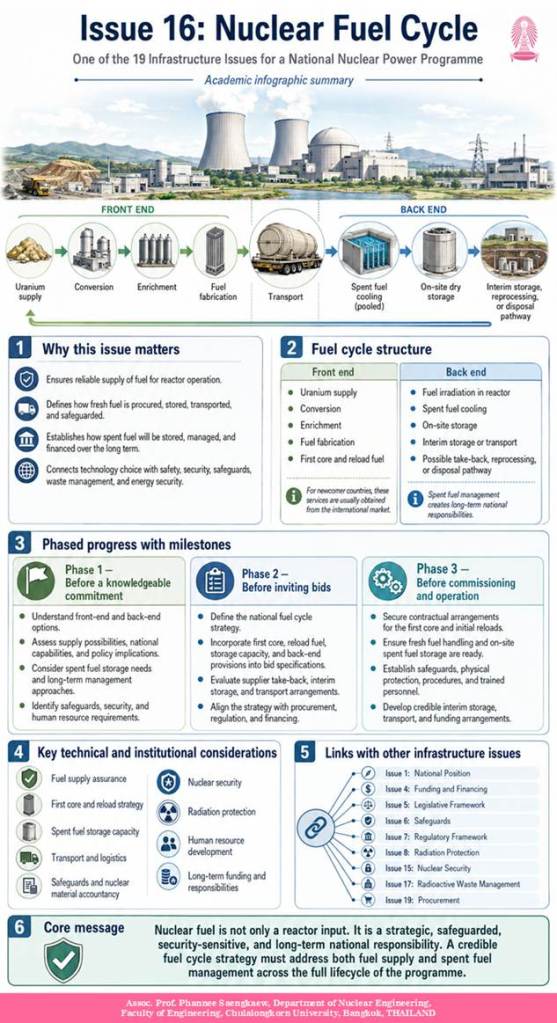
ประเด็นด้านที่ 16: วัฏจักรเชื้อเพลิงนิวเคลียร์
1. บทนำ
โครงสร้างด้านที่ 16 เรื่อง วัฏจักรเชื้อเพลิงนิวเคลียร์ เป็นหนึ่งในโครงสร้างพื้นฐาน 19 ด้าน ที่ระบุไว้ในแนวทางตามกรอบหมุหมายของทบวงการพลังงานปรมาณูระหว่างประเทศ หรือ IAEA สำหรับประเทศที่กำลังพิจารณา พัฒนา หรือเตรียมดำเนินโครงการพลังงานนิวเคลียร์
วัฏจักรเชื้อเพลิงนิวเคลียร์เป็นประเด็นโครงสร้างพื้นฐานเชิงยุทธศาสตร์ เนื่องจากเป็นตัวกำหนดว่าเชื้อเพลิงนิวเคลียร์จะถูกจัดหา ใช้งาน จัดเก็บ ขนส่ง และบริหารจัดการภายหลังการใช้งานในเครื่องปฏิกรณ์อย่างไร ประเด็นนี้มิใช่เพียงเรื่องทางเทคนิคที่เกี่ยวข้องกับการจัดซื้อเชื้อเพลิงเท่านั้น แต่เป็นประเด็นการวางแผนระดับชาติในระยะยาว ซึ่งเชื่อมโยงกับความมั่นคงทางพลังงาน การเลือกเทคโนโลยีเครื่องปฏิกรณ์ การจัดทำสัญญา พันธกรณีด้านพิทักษ์ความปลอดภัยทางนิวเคลียร์ ความมั่นคงปลอดภัยทางนิวเคลียร์ การจัดการกากกัมมันตรังสี การเงินและการลงทุน การกำกับดูแลโดยหน่วยงานกำกับดูแล และความเชื่อมั่นของสาธารณชน
สำหรับประเทศที่เริ่มนำพลังงานนิวเคลียร์มาใช้เป็นครั้งแรก ประเด็นสำคัญที่สุดโดยทั่วไปมิใช่การตัดสินใจว่าจะจัดตั้งวัฏจักรเชื้อเพลิงนิวเคลียร์ครบวงจรภายในประเทศหรือไม่ แต่คือการพัฒนายุทธศาสตร์วัฏจักรเชื้อเพลิงที่มีความสมจริง มีความมั่นคง และสอดคล้องกับขีดความสามารถของประเทศ IAEA เน้นว่าการเลือกยุทธศาสตร์วัฏจักรเชื้อเพลิงควรดำเนินการตั้งแต่ระยะต้นของโครงการ เพราะยุทธศาสตร์ดังกล่าวสามารถส่งผลต่อการเลือกเทคโนโลยีโรงไฟฟ้านิวเคลียร์โดยตรง โดยทั่วไป วัฏจักรเชื้อเพลิงนิวเคลียร์ประกอบด้วยสองส่วนใหญ่ ได้แก่ ภาคต้นของวัฏจักรเชื้อเพลิง หรือ front end ซึ่งครอบคลุมกิจกรรมก่อนที่เชื้อเพลิงจะถูกนำเข้าใช้งานในเครื่องปฏิกรณ์ และ ภาคปลายของวัฏจักรเชื้อเพลิง หรือ back end ซึ่งครอบคลุมกิจกรรมหลังจากเชื้อเพลิงถูกนำออกจากเครื่องปฏิกรณ์แล้ว
ดังนั้น ในบริบทของประเทศที่เพิ่งเริ่มโครงการพลังงานนิวเคลียร์ โครงสร้างด้านที่ 16 จึงเป็นการพิจารณาว่าประเทศมีความเข้าใจ ได้เลือก ได้จัดทำสัญญา และได้เตรียมความพร้อมเกี่ยวกับการจัดหาเชื้อเพลิงและการจัดการเชื้อเพลิงใช้แล้วอย่างเหมาะสมหรือไม่ ทั้งนี้ต้องสอดคล้องกับนโยบายแห่งชาติ พันธกรณีระหว่างประเทศ ข้อกำหนดด้านความปลอดภัย ความคาดหวังด้านความมั่นคงปลอดภัยทางนิวเคลียร์ และความยั่งยืนของโครงการในระยะยาว
2. ขอบเขตเชิงแนวคิดของวัฏจักรเชื้อเพลิงนิวเคลียร์
วัฏจักรเชื้อเพลิงนิวเคลียร์ครอบคลุมลำดับของกิจกรรมด้านอุตสาหกรรม เทคนิค การกำกับดูแล และระบบการจัดส่งและการบริหารการเคลื่อนย้ายที่จำเป็นต่อการจัดหาเชื้อเพลิงนิวเคลียร์ให้แก่เครื่องปฏิกรณ์ และการจัดการเชื้อเพลิงภายหลังจากผ่านการฉายรังสีหรือการใช้งานในเครื่องปฏิกรณ์แล้ว สำหรับระบบพลังงานนิวเคลียร์แบบใช้ยูเรเนียมทั่วไป ภาคต้นของวัฏจักรอาจประกอบด้วยการทำเหมืองยูเรเนียม การแต่งแร่ การแปรสภาพทางเคมี การเสริมสมรรถนะ และการผลิตเชื้อเพลิง ภาคปลายของวัฏจักรอาจประกอบด้วยการจัดการเชื้อเพลิงใหม่ การแผ่รังสีในเครื่องปฏิกรณ์ การระบายความร้อนของเชื้อเพลิงใช้แล้ว การจัดเก็บเชื้อเพลิงใช้แล้วภายในพื้นที่โรงไฟฟ้า การขนส่ง การจัดเก็บชั่วคราว การนำไปแปรสภาพซ้ำ และการกำจัดขั้นสุดท้ายของเชื้อเพลิงใช้แล้วหรือกากกัมมันตรังสีระดับสูง นอกจากนี้ IAEA ยังระบุด้วยว่าการเสริมสมรรถนะและการแปรสภาพซ้ำเป็นเทคโนโลยีที่มีความอ่อนไหวในมุมมองด้านการไม่แพร่ขยายอาวุธนิวเคลียร์
สำหรับประเทศที่เพิ่งเริ่มโครงการพลังงานนิวเคลียร์จำนวนมาก บริการส่วนใหญ่ในภาคต้นของวัฏจักรสามารถจัดซื้อได้จากตลาดนิวเคลียร์ระหว่างประเทศ แนวทางดังกล่าวช่วยลดความจำเป็นในการจัดตั้งโครงสร้างพื้นฐานวัฏจักรเชื้อเพลิงครบวงจรภายในประเทศตั้งแต่ระยะแรกของโครงการ อย่างไรก็ตาม ภาคปลายของวัฏจักรมักก่อให้เกิดความรับผิดชอบระดับชาติโดยตรงมากกว่า โดยเฉพาะในเรื่องการจัดเก็บเชื้อเพลิงใช้แล้วภายในพื้นที่โรงไฟฟ้า การวางแผนการขนส่ง การจัดเก็บชั่วคราว การเตรียมเงินทุน และยุทธศาสตร์การกำจัดขั้นสุดท้าย ซึ่ง IAEA ระบุว่า การจัดเก็บภายในพื้นที่โรงไฟฟ้าและการจัดเก็บชั่วคราวโดยทั่วไปเป็นความรับผิดชอบของเจ้าของหรือผู้ดำเนินการโรงไฟฟ้า ในขณะที่การกำจัดขั้นสุดท้ายมักเป็นความรับผิดชอบระดับชาติของรัฐบาลหรือเจ้าของ/ผู้ดำเนินการตามกรอบของประเทศนั้น ๆ
ดังนั้น โครงสร้างด้านที่ 16 จึงควรเข้าใจว่าเป็นสะพานเชื่อมระหว่าง การนำเครื่องปฏิกรณ์ไปใช้งานจริง กับ ความรับผิดชอบระยะยาวของประเทศต่อวัสดุนิวเคลียร์และกากกัมมันตรังสี ประเด็นนี้ต้องการให้ประเทศสามารถตอบคำถามพื้นฐานหลายประการได้อย่างชัดเจน เช่น
- เชื้อเพลิงชุดแรกของแกนปฏิกรณ์และเชื้อเพลิงสำหรับเปลี่ยนถ่ายในรอบต่อ ๆ ไปจะถูกจัดหาอย่างไร
- ควรจัดทำสัญญาจัดหาเชื้อเพลิงสำหรับกี่รอบการเปลี่ยนถ่ายตั้งแต่เริ่มต้นโครงการ
- ประเทศควรมีปริมาณสำรองเชื้อเพลิงในระดับใดเพื่อรองรับความมั่นคงทางพลังงาน
- บริการในวัฏจักรเชื้อเพลิงส่วนใดควรนำเข้าจากต่างประเทศ และส่วนใด (หากมี) ควรพัฒนาภายในประเทศ
- เชื้อเพลิงใหม่จะถูกขนส่ง จัดเก็บ ป้องกัน และควบคุมบัญชีวัสดุนิวเคลียร์อย่างไร
- เชื้อเพลิงใช้แล้วจะถูกระบายความร้อน จัดเก็บ ขนส่ง และจัดการในช่วงเวลาหลายทศวรรษอย่างไร
- เชื้อเพลิงใช้แล้วจะถูกถือว่าเป็นกากกัมมันตรังสี จะถูกส่งคืนผู้จัดหา จะถูกนำไปแปรสภาพซ้ำในต่างประเทศ หรือจะถูกจัดเก็บไว้เพื่อรอการตัดสินใจในอนาคต
- ยุทธศาสตร์วัฏจักรเชื้อเพลิงจะสอดคล้องกับระบบพิทักษ์ความปลอดภัยทางนิวเคลียร์ ความมั่นคงปลอดภัยทางนิวเคลียร์ การป้องกันอันตรายจากรังสี การจัดการกากกัมมันตรังสี และการสื่อสารกับสาธารณชนได้อย่างไร
3. ความสำคัญเชิงยุทธศาสตร์ของโครงสร้างด้านที่ 16
วัฏจักรเชื้อเพลิงนิวเคลียร์มีความสำคัญเชิงยุทธศาสตร์ เนื่องจากโรงไฟฟ้านิวเคลียร์ไม่สามารถถือได้ว่ามีความยั่งยืนในการเดินเครื่อง หากว่าไม่มีการจัดหาเชื้อเพลิงที่มั่นคงและไม่มีแนวทางที่น่าเชื่อถือสำหรับการจัดการเชื้อเพลิงใช้แล้ว ต่างจากห่วงโซ่อุปทานของเชื้อเพลิงฟอสซิล เชื้อเพลิงนิวเคลียร์มีลักษณะเฉพาะคือมีระยะเวลาการจัดซื้อจัดจ้างล่วงหน้าที่ยาวนาน มีการควบคุมโดยกฎระเบียบอย่างเข้มงวด อยู่ภายใต้พันธกรณีด้านพิทักษ์ความปลอดภัยทางนิวเคลียร์ระหว่างประเทศ ต้องคำนึงถึงความมั่นคงปลอดภัยทางนิวเคลียร์ และมีข้อกำหนดทางเทคนิคที่จำเพาะกับแบบของเครื่องปฏิกรณ์ เชื้อเพลิงนิวเคลียร์ยังมีความเชื่อมโยงอย่างใกล้ชิดกับการออกแบบเครื่องปฏิกรณ์ เครื่องปฏิกรณ์น้ำอัดความดัน เครื่องปฏิกรณ์น้ำเดือด เครื่องปฏิกรณ์น้ำมวลหนัก เครื่องปฏิกรณ์อุณหภูมิสูงแบบใช้ก๊าซ เครื่องปฏิกรณ์เร็ว หรือเครื่องปฏิกรณ์นิวเคลียร์แบบโมดูลขนาดเล็ก อาจต้องใช้รูปแบบเชื้อเพลิง ระดับการเสริมสมรรถนะ กระบวนการผลิตเชื้อเพลิง เงื่อนไขสัญญา และสมมติฐานเกี่ยวกับส่วนปลายของวัฏจักรที่แตกต่างกัน
จากมุมมองโครงสร้างพื้นฐานระดับชาติ วัฏจักรเชื้อเพลิงส่งผลต่อมิติทางนโยบายอย่างน้อยหกด้าน
ประการแรก วัฏจักรเชื้อเพลิงมีผลต่อความมั่นคงทางพลังงาน ประเทศต้องตัดสินใจว่าควรรักษาปริมาณสำรองเชื้อเพลิงใหม่ไว้ในระดับใด จะรับมือกับการหยุดชะงักของการจัดหาเชื้อเพลิงอย่างไร และการกระจายความเสี่ยงของสัญญาจัดหาจะช่วยลดการพึ่งพาผู้จัดหารายเดียวได้อย่างไร
ประการที่สอง วัฏจักรเชื้อเพลิงมีผลต่อการเลือกเทคโนโลยี ผู้ขายหรือผู้จัดหาเทคโนโลยีเครื่องปฏิกรณ์อาจเสนอแบบเชื้อเพลิง ระดับการเสริมสมรรถนะ กลยุทธ์การเปลี่ยนถ่ายเชื้อเพลิง การบริหารแกนปฏิกรณ์ หรือการรับคืนเชื้อเพลิงใช้แล้วที่แตกต่างกัน ดังนั้น ยุทธศาสตร์วัฏจักรเชื้อเพลิงจึงต้องสะท้อนอยู่ในข้อกำหนดการเชิญประมูลและกระบวนการจัดซื้อจัดจ้าง
ประการที่สาม วัฏจักรเชื้อเพลิงมีผลต่อการไม่แพร่ขยายอาวุธนิวเคลียร์และพิทักษ์ความปลอดภัยทางนิวเคลียร์ การเสริมสมรรถนะยูเรเนียมและการแปรสภาพซ้ำของเชื้อเพลิงใช้แล้วเป็นเทคโนโลยีที่มีความอ่อนไหว เนื่องจากเกี่ยวข้องกับวัสดุนิวเคลียร์ที่อาจนำไปสู่เส้นทางการผลิตอาวุธนิวเคลียร์ได้ แม้ประเทศจะไม่พัฒนาเทคโนโลยีเหล่านี้ภายในประเทศ แต่ก็ยังต้องจัดตั้งระบบบัญชีวัสดุนิวเคลียร์ การรายงานตามพันธกรณีด้านพิทักษ์ความปลอดภัย และระบบควบคุมวัสดุนิวเคลียร์สำหรับเชื้อเพลิงใหม่และเชื้อเพลิงใช้แล้ว
ประการที่สี่ วัฏจักรเชื้อเพลิงมีผลต่อความมั่นคงปลอดภัยทางนิวเคลียร์ เชื้อเพลิงใหม่และเชื้อเพลิงใช้แล้วต้องได้รับการป้องกันจากการเคลื่อนย้ายโดยไม่ได้รับอนุญาต การก่อวินาศกรรม การโจรกรรม และการกระทำโดยเจตนาร้าย มาตรการป้องกันทางกายภาพ การควบคุมการเข้าถึง ความมั่นคงปลอดภัยในการขนส่ง และการประสานงานระหว่างงานบัญชีวัสดุนิวเคลียร์กับงานความมั่นคงปลอดภัยทางนิวเคลียร์จึงมีความจำเป็นอย่างยิ่ง
ประการที่ห้า วัฏจักรเชื้อเพลิงมีผลต่อการจัดการกากกัมมันตรังสี การตัดสินใจว่าเชื้อเพลิงใช้แล้วจะถูกถือว่าเป็นกากกัมมันตรังสี จะถูกจัดเก็บเพื่อรอการตัดสินใจในอนาคต จะถูกส่งคืนผู้จัดหา หรือจะถูกนำไปแปรสภาพซ้ำ จะกำหนดทิศทางของยุทธศาสตร์การจัดการกากกัมมันตรังสีโดยตรง IAEA เชื่อมโยงประเด็นวัฏจักรเชื้อเพลิงกับโครงสร้างด้านที่ 17 เรื่องการจัดการกากกัมมันตรังสีอย่างชัดเจน เพราะการกำจัดขั้นสุดท้ายอยู่ภายใต้ประเด็นโครงสร้างพื้นฐานด้านการจัดการกากกัมมันตรังสี
ประการที่หก วัฏจักรเชื้อเพลิงมีผลต่อความเชื่อมั่นของสาธารณชนและความรับผิดชอบต่อคนรุ่นต่อไป การจัดการเชื้อเพลิงใช้แล้วมักเป็นหนึ่งในประเด็นที่สาธารณชนให้ความสนใจและมีความอ่อนไหวมากที่สุดในโครงการพลังงานนิวเคลียร์ ดังนั้น ยุทธศาสตร์วัฏจักรเชื้อเพลิงที่น่าเชื่อถือจะต้องมีความมั่นคงทางเทคนิค มีความโปร่งใส มีการสนับสนุนทางการเงิน และมีความต่อเนื่องเชิงสถาบันในระยะยาว
4. ภาคต้นของวัฏจักรเชื้อเพลิง
ภาคต้นของวัฏจักรเชื้อเพลิงประกอบด้วยกิจกรรมที่จำเป็นต่อการผลิตเชื้อเพลิงนิวเคลียร์ให้พร้อมใช้งานก่อนนำเข้าสู่เครื่องปฏิกรณ์ สำหรับโครงการเครื่องปฏิกรณ์น้ำเบาทั่วไป กิจกรรมเหล่านี้มักประกอบด้วยการจัดหายูเรเนียม การแปรสภาพยูเรเนียมเข้มข้นให้อยู่ในรูปทางเคมีที่เหมาะสมต่อการเสริมสมรรถนะ การเพิ่มสัดส่วนยูเรเนียม-235 และการผลิตมัดเชื้อเพลิงหรือชุดเชื้อเพลิง
สำหรับประเทศที่เพิ่งเริ่มโครงการ แนวทางที่สมจริงที่สุดโดยทั่วไปคือการจัดซื้อบริการส่วนต้นของวัฏจักรจากต่างประเทศ มากกว่าการพัฒนาอุตสาหกรรมส่วนต้นของวัฏจักรเชื้อเพลิงทั้งหมดภายในประเทศ IAEA ระบุว่าสำหรับประเทศส่วนใหญ่ การพัฒนาวัฏจักรเชื้อเพลิงนิวเคลียร์ครบวงจรภายในประเทศพร้อมกับการก่อสร้างโรงไฟฟ้านิวเคลียร์เครื่องแรกจะเป็นเรื่องยาก และไม่น่าจะให้ประโยชน์ทางเศรษฐศาสตร์ในระยะแรก ประเทศที่มีทรัพยากรยูเรเนียมจำนวนมากอาจพิจารณาการทำเหมืองและการแต่งแร่ภายในประเทศ แต่ยังคงจัดซื้อบริการแปรสภาพ เสริมสมรรถนะ และผลิตเชื้อเพลิงจากต่างประเทศ
ดังนั้น ยุทธศาสตร์ภาคต้นของวัฏจักรเชื้อเพลิงควรครอบคลุมประเด็นต่อไปนี้
| องค์ประกอบ | คำอธิบายเชิงวิชาการ |
| การจัดหายูเรเนียม | ประเทศควรระบุให้ชัดเจนว่ายูเรเนียมจะถูกนำเข้า จัดหาโดยผู้ขายเทคโนโลยี จัดซื้อผ่านสัญญาระยะยาว หรือสนับสนุนด้วยทรัพยากรภายในประเทศหากมี |
| การแปรสภาพ | ยุทธศาสตร์ควรกำหนดว่าจะจัดซื้อบริการแปรสภาพจากผู้ให้บริการระหว่างประเทศอย่างไร และจะรักษาความมั่นคงของการจัดหาได้อย่างไร |
| การเสริมสมรรถนะ | เนื่องจากการเสริมสมรรถนะเป็นเทคโนโลยีที่มีความอ่อนไหวต่อการแพร่ขยายอาวุธนิวเคลียร์ ประเทศที่เพิ่งเริ่มโครงการส่วนใหญ่จึงพึ่งพาบริการเสริมสมรรถนะจากต่างประเทศมากกว่าการพัฒนาขีดความสามารถภายในประเทศ |
| การผลิตเชื้อเพลิง | การผลิตเชื้อเพลิงต้องสอดคล้องกับแบบเครื่องปฏิกรณ์ ข้อกำหนดการรับรองคุณสมบัติของเชื้อเพลิง กรณีความปลอดภัยที่ใช้ในการออกใบอนุญาต และข้อกำหนดของผู้ขายเทคโนโลยี |
| เชื้อเพลิงแกนแรก | เชื้อเพลิงสำหรับแกนปฏิกรณ์แรกต้องได้รับการจัดหาอย่างมั่นคงผ่านสัญญาก่อนการเดินเครื่อง |
| เชื้อเพลิงเปลี่ยนถ่าย | ประเทศต้องตัดสินใจว่าจะรวมเชื้อเพลิงสำหรับการเปลี่ยนถ่ายกี่รอบไว้ในสัญญาเริ่มต้น และจะจัดหาเชื้อเพลิงสำหรับรอบต่อ ๆ ไปอย่างไร |
| ปริมาณสำรองเชื้อเพลิงใหม่ | นโยบายปริมาณสำรองเชื้อเพลิงควรสร้างสมดุลระหว่างความมั่นคงทางพลังงาน ต้นทุน ความจุในการจัดเก็บ และข้อกำหนดด้านความมั่นคงปลอดภัย |
ยุทธศาสตร์ภาคต้นของวัฏจักรเชื้อเพลิงต้องมีความสมจริง สอดคล้องทางเทคนิคกับเครื่องปฏิกรณ์ที่เลือก มีความน่าเชื่อถือทางพาณิชย์ และสอดคล้องกับพันธกรณีด้านการไม่แพร่ขยายอาวุธนิวเคลียร์ของประเทศ
5. ภาคปลายของวัฏจักรเชื้อเพลิง
ภาคปลายของวัฏจักรเชื้อเพลิงเริ่มต้นเมื่อเชื้อเพลิงนิวเคลียร์ถูกนำออกจากเครื่องปฏิกรณ์ ณ จุดนั้น เชื้อเพลิงใช้แล้วยังคงมีกัมมันตรังสีสูงและยังคงเกิดความร้อนจากการสลายตัว จึงต้องมีการระบายความร้อน การกำบังรังสี การจัดเก็บ การทำบัญชีวัสดุนิวเคลียร์ และการป้องกันทางกายภาพอย่างเหมาะสม ในโครงการโรงไฟฟ้านิวเคลียร์ส่วนใหญ่ เชื้อเพลิงใช้แล้วจะถูกจัดเก็บในสระเก็บเชื้อเพลิงใช้แล้วภายในพื้นที่โรงไฟฟ้าก่อน หลังจากผ่านการระบายความร้อนอย่างเพียงพอแล้ว อาจถูกย้ายไปยังระบบจัดเก็บแบบแห้ง ถูกขนส่งไปยังสถานที่จัดเก็บชั่วคราว ถูกส่งคืนผู้จัดหาเชื้อเพลิงภายใต้ข้อตกลงการรับคืน ถูกนำไปแปรสภาพซ้ำ หรือถูกกำจัดเป็นกากกัมมันตรังสีในท้ายที่สุด
IAEA เน้นว่า การจัดเก็บเชื้อเพลิงใช้แล้วภายในพื้นที่โรงไฟฟ้าจะมีความจำเป็นอย่างน้อยประมาณสิบปีเพื่อให้มีระยะเวลาระบายความร้อนเพียงพอ ไม่ว่าแผนในอนาคตสำหรับเชื้อเพลิงใช้แล้วจะเป็นอย่างไรก็ตาม นอกจากนี้ ยังมีความเป็นไปได้สูงว่าจะต้องมีการจัดเก็บเชื้อเพลิงใช้แล้วแบบชั่วคราว ไม่ว่าจะเป็นภายในพื้นที่โรงไฟฟ้าหรือภายนอกพื้นที่โรงไฟฟ้า เป็นเวลาหลายทศวรรษ
ยุทธศาสตร์ภาคปลายของวัฏจักรเชื้อเพลิงควรครอบคลุมประเด็นต่อไปนี้
| องค์ประกอบ | คำอธิบายเชิงวิชาการ |
| การจัดเก็บเชื้อเพลิงใช้แล้วภายในพื้นที่โรงไฟฟ้า | โรงไฟฟ้านิวเคลียร์ต้องมีความจุของสระเก็บเชื้อเพลิงใช้แล้ว และ/หรือระบบจัดเก็บแบบแห้งที่เพียงพอต่อความต้องการในการเดินเครื่อง |
| การจัดเก็บชั่วคราว | ประเทศควรวางแผนว่าการจัดเก็บชั่วคราวจะอยู่ภายในพื้นที่โรงไฟฟ้า อยู่ในสถานที่จัดเก็บส่วนกลาง หรืออาศัยข้อตกลงระหว่างประเทศ |
| การขนส่งเชื้อเพลิงใช้แล้ว | ต้องพิจารณาข้อกำหนดด้านการขนส่งตั้งแต่ระยะต้น รวมถึงภาชนะขนส่งเฉพาะทาง เส้นทางขนส่ง ความมั่นคงปลอดภัย การเตรียมพร้อมรับเหตุฉุกเฉิน และการอนุมัติของหน่วยงานกำกับดูแล |
| การรับคืนเชื้อเพลิงใช้แล้ว | หากพิจารณาการรับคืนโดยผู้ขายหรือผู้จัดหา เงื่อนไขต้องระบุไว้อย่างชัดเจนในสัญญา และต้องสอดคล้องกับกฎหมายระหว่างประเทศและนโยบายแห่งชาติ |
| การแปรสภาพซ้ำ | หากพิจารณาการแปรสภาพซ้ำ ประเทศต้องประเมินผลกระทบด้านการแพร่ขยายอาวุธนิวเคลียร์ กากกัมมันตรังสี การขนส่ง เศรษฐศาสตร์ และเงื่อนไขสัญญาอย่างรอบคอบ |
| การกำจัดขั้นสุดท้าย | การกำจัดขั้นสุดท้ายจะอยู่ภายใต้ประเด็นที่ 17 เป็นหลัก แต่โครงสร้างด้านที่ 16 ต้องทำให้มั่นใจว่าทางเลือกเกี่ยวกับเชื้อเพลิงใช้แล้วจะไม่สร้างภาระระยะยาวที่ไม่ได้รับการแก้ไข |
| การจัดสรรเงินทุน | ต้องมีการเตรียมเงินทุนสำหรับการจัดเก็บ การขนส่ง การจัดการชั่วคราว และการกำจัดขั้นสุดท้ายหรือการส่งคืนเชื้อเพลิงใช้แล้ว |
ยุทธศาสตร์ภาคปลายของวัฏจักรเชื้อเพลิงเป็นหนึ่งในตัวชี้วัดสำคัญที่สุดว่าโครงการพลังงานนิวเคลียร์กำลังถูกวางแผนในฐานะความรับผิดชอบระดับชาติระยะยาว มิใช่เพียงโครงการก่อสร้างโรงไฟฟ้าเท่านั้น
6. ความสัมพันธ์กับโครงสร้างพื้นฐาน IAEA ประเด็นอื่น ๆ
โครงสร้างด้านที่ 16 มีความเชื่อมโยงอย่างแน่นแฟ้นกับโครงสร้างพื้นฐานประเด็นอื่น ๆ และไม่สามารถพิจารณาแยกออกจากกันได้
ด้านที่ 1: จุดยืนแห่งชาติ ให้ฐานนโยบายสำหรับแนวทางวัฏจักรเชื้อเพลิงที่ประเทศเลือก ประเทศควรทำให้จุดยืนแห่งชาติระบุได้ชัดเจนว่าจะพึ่งพาบริการเชื้อเพลิงจากต่างประเทศ จะพัฒนาขีดความสามารถภายในประเทศบางส่วน จะใช้ข้อตกลงการรับคืนเชื้อเพลิงใช้แล้ว หรือจะพิจารณาทางเลือกส่วนปลายของวัฏจักรในระยะยาวอย่างไร
ด้านที่ 4: การจัดหาเงินทุนและการเงิน มีความจำเป็นอย่างยิ่ง เพราะการจัดซื้อเชื้อเพลิง การจัดเก็บเชื้อเพลิงใช้แล้ว การขนส่ง และการจัดการกากกัมมันตรังสีระยะยาว ล้วนต้องการภาระผูกพันทางการเงินต่อเนื่องยาวนานหลายทศวรรษ
ด้านที่ 5: กรอบกฎหมาย ต้องให้อำนาจทางกฎหมายสำหรับการควบคุมวัสดุนิวเคลียร์ การขนส่งเชื้อเพลิง การจัดการกากกัมมันตรังสี การดำเนินการตามระบบพิทักษ์ความปลอดภัย ความรับผิดทางกฎหมาย การควบคุมการนำเข้าและส่งออก และการกำกับดูแลโดยหน่วยงานกำกับดูแล
ด้านที่ 6: พิทักษ์ความปลอดภัยทางนิวเคลียร์ มีความเกี่ยวข้องโดยตรง เพราะเชื้อเพลิงใหม่และเชื้อเพลิงใช้แล้วมีวัสดุนิวเคลียร์ที่อยู่ภายใต้การทำบัญชี การรายงาน การตรวจสอบยืนยัน และพันธกรณีด้านพิทักษ์ความปลอดภัยระหว่างประเทศ
ด้านที่ 7: กรอบการกำกับดูแล มีความจำเป็นต่อการออกใบอนุญาตสำหรับการจัดการเชื้อเพลิง การจัดเก็บ การขนส่ง การจัดการเชื้อเพลิงใช้แล้ว และสถานประกอบการใด ๆ ที่เกี่ยวข้องกับวัฏจักรเชื้อเพลิง
ด้านที่ 8: การป้องกันรังสี ใช้กับการรับรังสีจากการทำงาน การรับรังสีของประชาชน การควบคุมการปนเปื้อน และการติดตามปริมาณรังสีระหว่างการจัดการเชื้อเพลิงและการดำเนินงานกับเชื้อเพลิงใช้แล้ว
ด้านที่ 15: ความมั่นคงปลอดภัยทางนิวเคลียร์ เชื่อมโยงกับการป้องกันทางกายภาพของเชื้อเพลิงใหม่ เชื้อเพลิงใช้แล้ว พื้นที่จัดเก็บเชื้อเพลิง การขนส่ง และข้อมูลอ่อนไหว
ด้านที่ 17: การจัดการกากกัมมันตรังสี เชื่อมโยงอย่างใกล้ชิดกับส่วนปลายของวัฏจักรเชื้อเพลิง โดยเฉพาะอย่างยิ่งหากเชื้อเพลิงใช้แล้วถูกถือว่าเป็นกากกัมมันตรังสี หรือหากการแปรสภาพซ้ำก่อให้เกิดกากกัมมันตรังสีระดับสูง
ด้านที่ 19: การจัดซื้อจัดจ้าง มีความเกี่ยวข้องโดยตรง เพราะการจัดหาเชื้อเพลิง สัญญาเชื้อเพลิงเปลี่ยนถ่าย ระบบจัดเก็บเชื้อเพลิงใช้แล้ว ภาชนะขนส่ง และข้อตกลงการรับคืนเชื้อเพลิงใช้แล้ว ต้องถูกระบุไว้ในเอกสารจัดซื้อจัดจ้างอย่างชัดเจน
7. ความก้าวหน้าตามระยะของแนวทาง IAEA Milestones
ระยะที่ 1: ก่อนการให้คำมั่นอย่างมีความรู้และความเข้าใจ
ในระยะที่ 1 ประเทศควรพัฒนาความเข้าใจโดยรวมเกี่ยวกับวัฏจักรเชื้อเพลิงนิวเคลียร์ และระบุทางเลือกเชิงยุทธศาสตร์ที่เป็นไปได้ คณะทำงานเตรียมความพร้อมโครงการนิวเคลียร์ หรือ NEPIO ยังไม่จำเป็นต้องสรุปสัญญาทางพาณิชย์ในรายละเอียด แต่ควรเข้าใจผลกระทบทั้งหมดของทางเลือกทั้งในส่วนต้นและส่วนปลายของวัฏจักรเชื้อเพลิง ตามแนวทางการประเมินของ IAEA ระยะที่ 1 ควรแสดงให้เห็นว่าประเทศได้พิจารณาทางเลือกทั้งส่วนต้นและส่วนปลายแล้ว รวมถึงแหล่งจัดหายูเรเนียม การผลิตและจัดหาเชื้อเพลิง ความต้องการจัดเก็บเชื้อเพลิงใช้แล้ว ความจุในการจัดเก็บ และความเป็นไปได้ของการแปรสภาพซ้ำ
ในระยะนี้ ประเทศควรจัดทำการวิเคราะห์เชิงยุทธศาสตร์ที่ครอบคลุมทรัพยากรภายในประเทศ ทางเลือกการจัดหาจากต่างประเทศ ความพร้อมของบริการวัฏจักรเชื้อเพลิง ผลกระทบด้านการแพร่ขยายอาวุธนิวเคลียร์ ความต้องการด้านทรัพยากรมนุษย์ ผลกระทบด้านความมั่นคงปลอดภัย และความรับผิดชอบระยะยาวเกี่ยวกับเชื้อเพลิงใช้แล้ว รายงานของ NEPIO ในระยะที่ 1 ควรให้ข้อมูลเกี่ยวกับขั้นตอนต่าง ๆ ของวัฏจักรเชื้อเพลิง แหล่งบริการและแหล่งจัดหาที่เป็นไปได้ ขีดความสามารถภายในประเทศ ทางเลือกยุทธศาสตร์ระดับชาติที่เป็นไปได้ ผลกระทบด้านการไม่แพร่ขยายอาวุธนิวเคลียร์ และความต้องการด้านทรัพยากรมนุษย์
ผลลัพธ์ที่สำคัญที่สุดในระยะที่ 1 มิใช่สัญญาเชื้อเพลิงฉบับสุดท้าย แต่คือความเข้าใจที่น่าเชื่อถือเกี่ยวกับทางเลือกและภาระผูกพันที่จะเกิดขึ้น ประเทศควรสามารถแสดงให้เห็นได้ว่าเชื้อเพลิงนิวเคลียร์ไม่ได้ถูกมองเป็นเพียงสินค้าธรรมดา แต่เป็นวัสดุยุทธศาสตร์ที่ฝังอยู่ในกรอบระหว่างประเทศ กฎระเบียบ ความมั่นคงปลอดภัย และความรับผิดชอบด้านกากกัมมันตรังสีระยะยาว
ผลลัพธ์ที่คาดหวังในระยะที่ 1
| ด้าน | ผลลัพธ์ที่คาดหวัง |
| ความรู้เกี่ยวกับวัฏจักรเชื้อเพลิง | ประเทศมีความเข้าใจเกี่ยวกับขั้นตอนสำคัญของภาคต้นและภาคปลายของวัฏจักรเชื้อเพลิง |
| ทางเลือกเชิงยุทธศาสตร์ | มีการประเมินเปรียบเทียบทางเลือกด้านบริการเชื้อเพลิงจากต่างประเทศ ขีดความสามารถภายในประเทศ ข้อตกลงกับผู้จัดหา และทางเลือกส่วนปลายของวัฏจักร |
| การประเมินทรัพยากร | มีการระบุทรัพยากรยูเรเนียมหรือขีดความสามารถทางอุตสาหกรรมภายในประเทศที่เกี่ยวข้องกับวัฏจักรเชื้อเพลิง หากมี |
| การไม่แพร่ขยายอาวุธนิวเคลียร์ | มีการประเมินเบื้องต้นเกี่ยวกับระบบพิทักษ์ความปลอดภัยและเทคโนโลยีที่มีความอ่อนไหวต่อการแพร่ขยาย |
| เชื้อเพลิงใช้แล้ว | มีการประเมินเบื้องต้นเกี่ยวกับการจัดเก็บภายในพื้นที่โรงไฟฟ้า การจัดเก็บชั่วคราว การรับคืนเชื้อเพลิง การแปรสภาพซ้ำ และผลกระทบด้านการกำจัด |
| ความรับผิดชอบ | มีการจัดสรรความรับผิดชอบสำหรับการพัฒนานโยบายและยุทธศาสตร์วัฏจักรเชื้อเพลิงในระยะที่ 2 |
ระยะที่ 2: ก่อนการเชิญประมูลหรือการเจรจาสัญญา
ในระยะที่ 2 ยุทธศาสตร์วัฏจักรเชื้อเพลิงต้องมีความเป็นรูปธรรมมากขึ้น เพราะจะส่งผลโดยตรงต่อข้อกำหนดการเชิญประมูลและการเจรจาสัญญาสำหรับโรงไฟฟ้านิวเคลียร์เครื่องแรก IAEA ระบุว่าการตัดสินใจเกี่ยวกับยุทธศาสตร์วัฏจักรเชื้อเพลิงควรดำเนินการในระยะที่ 2 เนื่องจากยุทธศาสตร์ที่เลือกจะมีผลต่อข้อกำหนดในเอกสารเชิญประมูล ข้อกำหนดดังกล่าวจำเป็นต้องครอบคลุมเชื้อเพลิงสำหรับแกนปฏิกรณ์แรก ปริมาณสำรองเชื้อเพลิงเพิ่มเติม บริการวัฏจักรเชื้อเพลิงที่จะจัดซื้อหรือพัฒนาภายในประเทศ ขีดความสามารถวัฏจักรเชื้อเพลิงระยะยาว ความเป็นไปได้ของการแปรสภาพซ้ำ ความจุของการจัดเก็บเชื้อเพลิงใช้แล้วภายในพื้นที่โรงไฟฟ้า การจัดเก็บเชื้อเพลิงใช้แล้วชั่วคราว การขนส่ง และยุทธศาสตร์การกำจัดขั้นสุดท้าย
ยุทธศาสตร์ภาคต้นของวัฏจักรในระยะที่ 2 ควรกำหนดว่าเชื้อเพลิงใหม่จะมีความพร้อมใช้งานทั้งในระยะสั้นและระยะยาวอย่างไร ประเด็นนี้รวมถึงจำนวนรอบของเชื้อเพลิงเปลี่ยนถ่ายที่จะขอรวมไว้กับเชื้อเพลิงแกนแรก และยุทธศาสตร์การจัดซื้อยูเรเนียมธรรมชาติ การแปรสภาพ การเสริมสมรรถนะ และการผลิตเชื้อเพลิง ยุทธศาสตร์ภาคปลายของวัฏจักรในระยะที่ 2 ควรกำหนดแผนหรือทางเลือกสำหรับการจัดเก็บภายในพื้นที่โรงไฟฟ้าและภายนอกพื้นที่โรงไฟฟ้า ความเป็นไปได้ของการแปรสภาพซ้ำ และข้อตกลงการรับคืนเชื้อเพลิงใช้แล้ว แนวทางการประเมินของ IAEA ระบุว่าการดำเนินการและกรอบเวลาควรสอดคล้องกับแผนการก่อสร้างโรงไฟฟ้านิวเคลียร์
ในระยะนี้ ประเทศควรตัดสินใจด้วยว่ายุทธศาสตร์วัฏจักรเชื้อเพลิงจะสะท้อนอยู่ในกระบวนการจัดซื้อจัดจ้างอย่างไร เอกสารเชิญประมูลควรระบุข้อกำหนดเกี่ยวกับการจัดหาเชื้อเพลิงใหม่ ภาระผูกพันในการจัดหาเชื้อเพลิงเปลี่ยนถ่าย ความจุของสระเก็บเชื้อเพลิงใช้แล้ว ข้อกำหนดสำหรับระบบจัดเก็บแบบแห้ง ระบบจัดการเชื้อเพลิง จุดประสานงานด้านการขนส่ง คุณลักษณะที่สนับสนุนการพิทักษ์ความปลอดภัยในการออกแบบ และความรับผิดชอบของผู้ขายที่เกี่ยวข้องกับเชื้อเพลิงใช้แล้ว หากมี
ผลลัพธ์ที่คาดหวังในระยะที่ 2
| ด้าน | ผลลัพธ์ที่คาดหวัง |
| ยุทธศาสตร์ส่วนต้นของวัฏจักร | มีการกำหนดยุทธศาสตร์การจัดหาเชื้อเพลิงใหม่ รวมถึงเชื้อเพลิงแกนแรกและเชื้อเพลิงเปลี่ยนถ่าย |
| การบูรณาการกับการจัดซื้อจัดจ้าง | ข้อกำหนดด้านการจัดหาเชื้อเพลิงและการจัดเก็บเชื้อเพลิงใช้แล้วถูกบรรจุไว้ในเอกสารเชิญประมูล |
| ยุทธศาสตร์ส่วนปลายของวัฏจักร | มีเอกสารยุทธศาสตร์การจัดการเชื้อเพลิงใช้แล้วที่ระบุสถานที่ กิจกรรม ทรัพยากร และกรอบเวลา |
| ความจุในการจัดเก็บ | มีการตัดสินใจเกี่ยวกับความจุในการจัดเก็บเชื้อเพลิงใช้แล้วทั้งภายในพื้นที่โรงไฟฟ้าและภายนอกพื้นที่โรงไฟฟ้า |
| การรับคืนหรือการแปรสภาพซ้ำ | มีการประเมินอย่างชัดเจนว่าจะดำเนินทางเลือกเหล่านี้หรือไม่ |
| ความสอดคล้องด้านการไม่แพร่ขยาย | แผนวัฏจักรเชื้อเพลิงสอดคล้องกับพันธกรณีด้านพิทักษ์ความปลอดภัยและการไม่แพร่ขยายอาวุธนิวเคลียร์ของประเทศ |
| การวางแผนดำเนินการ | มีแผนบูรณาการสำหรับโครงสร้างพื้นฐานวัฏจักรเชื้อเพลิงภายในประเทศ หากประเทศตั้งใจจะพัฒนา |
ระยะที่ 3: ก่อนการเดินเครื่องและการปฏิบัติการ
ในระยะที่ 3 การจัดการวัฏจักรเชื้อเพลิงต้องมีความพร้อมในระดับปฏิบัติการ เชื้อเพลิงสำหรับแกนปฏิกรณ์แรกควรถูกส่งมายังพื้นที่โรงไฟฟ้าหรือได้รับการจัดหาอย่างมั่นคง เชื้อเพลิงสำรองหรือเชื้อเพลิงเปลี่ยนถ่ายเพิ่มเติมควรได้รับการผูกพันตามสัญญา และระบบจัดเก็บเชื้อเพลิงใช้แล้วภายในพื้นที่โรงไฟฟ้าควรก่อสร้างแล้วเสร็จเป็นส่วนหนึ่งของโรงไฟฟ้านิวเคลียร์ IAEA ยังระบุว่าแผนสำหรับการจัดเก็บชั่วคราวควรได้รับการพัฒนา รวมถึงสถานที่ที่เหมาะสม ขีดความสามารถด้านการขนส่ง และการจัดเตรียมเงินทุน แผนเหล่านี้ต้องสอดคล้องกับขีดความสามารถของการจัดเก็บภายในพื้นที่โรงไฟฟ้า
แนวทางการประเมินของ IAEA สำหรับระยะที่ 3 ระบุเงื่อนไขหลักสองประการ ประการแรก ต้องมีการจัดเตรียมด้านการจัดหาเชื้อเพลิงไว้แล้ว ซึ่งหมายความว่าการจัดหาเชื้อเพลิงเปลี่ยนถ่ายในช่วงแรกได้รับการผูกพันตามสัญญา และมีการกำหนดความรับผิดชอบสำหรับการดำเนินยุทธศาสตร์การจัดหาเชื้อเพลิงระยะยาว ประการที่สอง ต้องมีการจัดเตรียมด้านการจัดการเชื้อเพลิงใช้แล้วไว้แล้ว ซึ่งหมายความว่ามีการจัดเก็บภายในพื้นที่โรงไฟฟ้าที่เพียงพอ แผนการจัดเก็บชั่วคราวสอดคล้องกับความจุในการจัดเก็บภายในพื้นที่โรงไฟฟ้า และข้อตกลงการรับคืนเชื้อเพลิงใช้แล้ว หากมี ต้องมีความชัดเจนและได้รับความเห็นชอบ
ในระยะนี้ ประเทศและเจ้าของ/ผู้ดำเนินการโรงไฟฟ้าต้องแสดงความพร้อมเชิงปฏิบัติอย่างเป็นรูปธรรม ขั้นตอนการจัดการเชื้อเพลิง การจัดเก็บเชื้อเพลิงใหม่ การเดินระบบสระเก็บเชื้อเพลิงใช้แล้ว ระบบบัญชีวัสดุนิวเคลียร์ มาตรการป้องกันรังสี มาตรการความมั่นคงปลอดภัยทางนิวเคลียร์ ขั้นตอนฉุกเฉิน การวางแผนขนส่ง และบุคลากร ต้องได้รับการบูรณาการเข้ากับระบบปฏิบัติการของโรงไฟฟ้าแล้ว
ผลลัพธ์ที่คาดหวังในระยะที่ 3
| ด้าน | ผลลัพธ์ที่คาดหวัง |
| เชื้อเพลิงแกนแรก | เชื้อเพลิงสำหรับแกนปฏิกรณ์แรกได้รับการส่งมอบหรือได้รับการจัดหาอย่างมั่นคงตามสัญญา |
| เชื้อเพลิงเปลี่ยนถ่าย | เชื้อเพลิงเปลี่ยนถ่ายในช่วงแรกได้รับการผูกพันตามสัญญา |
| การจัดการเชื้อเพลิงใหม่ | มีระบบภายในพื้นที่โรงไฟฟ้าสำหรับการรับ การจัดเก็บ การป้องกัน และการจัดการเชื้อเพลิงใหม่ |
| การจัดเก็บเชื้อเพลิงใช้แล้ว | มีระบบจัดเก็บภายในพื้นที่โรงไฟฟ้าที่เพียงพอและพร้อมใช้งาน |
| การจัดเก็บชั่วคราว | มีการพัฒนายุทธศาสตร์ กรอบเวลา เงินทุน ความรับผิดชอบ และการวางแผนสถานที่ |
| การขนส่ง | ข้อกำหนดด้านการขนส่งถูกรวมไว้ในการจัดเตรียมสำหรับการเคลื่อนย้าย การรับคืน หรือการแปรสภาพซ้ำของเชื้อเพลิงใช้แล้ว |
| พิทักษ์ความปลอดภัยและความมั่นคงปลอดภัย | ระบบบัญชีและควบคุมวัสดุนิวเคลียร์ มาตรการป้องกันทางกายภาพ และความมั่นคงปลอดภัยของข้อมูลได้รับการดำเนินการ |
| ความพร้อมในการปฏิบัติการ | มีขั้นตอนปฏิบัติ บุคลากรที่ผ่านการฝึกอบรม การอนุมัติจากหน่วยงานกำกับดูแล และการเตรียมพร้อมรับเหตุฉุกเฉิน |
8. ข้อพิจารณาทางเทคนิคและเชิงสถาบันที่สำคัญ
8.1 ความมั่นคงของการจัดหาเชื้อเพลิง
ความมั่นคงของการจัดหาเชื้อเพลิงเป็นเงื่อนไขสำคัญของการผลิตไฟฟ้านิวเคลียร์ที่เชื่อถือได้ ประเทศควรพิจารณาว่าจะพึ่งพาผู้ขายรายเดียว จะกระจายสัญญาจัดหา จะรักษาปริมาณสำรองเชื้อเพลิงเชิงยุทธศาสตร์ จะเข้าร่วมกลไกระหว่างประเทศเพื่อรับประกันการจัดหาเชื้อเพลิง หรือจะเจรจาสัญญาระยะยาวสำหรับเชื้อเพลิงเปลี่ยนถ่ายอย่างไร ยุทธศาสตร์ดังกล่าวควรสร้างสมดุลระหว่างต้นทุน ความน่าเชื่อถือ ความเสี่ยงทางภูมิรัฐศาสตร์ ความจุในการจัดเก็บ และความสอดคล้องกับใบอนุญาตของเครื่องปฏิกรณ์
8.2 ยุทธศาสตร์เชื้อเพลิงแกนแรกและเชื้อเพลิงเปลี่ยนถ่าย
เชื้อเพลิงสำหรับแกนปฏิกรณ์แรกมีความสำคัญทั้งทางเทคนิคและทางพาณิชย์ เพราะมีความเชื่อมโยงอย่างใกล้ชิดกับการทดสอบเดินเครื่อง การออกแบบแกนปฏิกรณ์ การวิเคราะห์ความปลอดภัย และการรับประกันจากผู้ขายเทคโนโลยี เชื้อเพลิงเปลี่ยนถ่ายต้องได้รับการวางแผนตั้งแต่ระยะต้นเช่นกัน เนื่องจากการผลิตเชื้อเพลิงนิวเคลียร์และการอนุญาตตามกฎหมายมีระยะเวลาดำเนินการยาวนาน ประเทศจึงควรตัดสินใจว่าสัญญาเริ่มต้นจะครอบคลุมเชื้อเพลิงเปลี่ยนถ่ายหนึ่งรอบ หลายรอบ หรือภาระผูกพันการจัดหาเชื้อเพลิงในระยะยาว
8.3 ความจุในการจัดเก็บเชื้อเพลิงใช้แล้ว
ความจุในการจัดเก็บเชื้อเพลิงใช้แล้วต้องออกแบบให้มีส่วนเผื่ออย่างเพียงพอ โรงไฟฟ้าต้องสามารถจัดเก็บเชื้อเพลิงที่ถูกนำออกจากเครื่องปฏิกรณ์ได้อย่างปลอดภัยทั้งในสภาวะปกติ สภาวะผิดปกติ และสภาวะฉุกเฉิน การวางแผนความจุควรพิจารณาความสามารถในการนำเชื้อเพลิงทั้งแกนออกจากเครื่องปฏิกรณ์ กลยุทธ์ช่วงหยุดเดินเครื่องเพื่อเปลี่ยนถ่ายเชื้อเพลิง ความต้องการด้านการระบายความร้อน ขอบเขตความปลอดภัยตามกฎระเบียบ และช่วงเวลาที่ต้องพัฒนาระบบจัดเก็บแบบแห้งหรือสถานที่จัดเก็บชั่วคราว
8.4 การขนส่งและระบบการจัดส่งและการบริหารการเคลื่อนย้าย
การขนส่งเชื้อเพลิงใหม่และเชื้อเพลิงใช้แล้วต้องใช้ภาชนะบรรจุเฉพาะทาง เส้นทางขนส่งที่ได้รับอนุญาต การเตรียมพร้อมรับเหตุฉุกเฉิน การป้องกันทางกายภาพ การอนุมัติระหว่างประเทศหากเกี่ยวข้องกับการเคลื่อนย้ายข้ามพรมแดน และบุคลากรที่ผ่านการฝึกอบรม การวางแผนด้านการขนส่งควรเริ่มต้นก่อนถึงเวลาที่ต้องเคลื่อนย้ายเชื้อเพลิงจริงเป็นเวลานาน เพราะเกี่ยวข้องกับหลายหน่วยงานและต้องได้รับอนุมัติจากหน่วยงานกำกับดูแล
8.5 พิทักษ์ความปลอดภัยและบัญชีวัสดุนิวเคลียร์
เชื้อเพลิงนิวเคลียร์มีวัสดุนิวเคลียร์ที่อยู่ภายใต้การทำบัญชีและระบบพิทักษ์ความปลอดภัย ประเทศต้องจัดตั้งระบบติดตามวัสดุนิวเคลียร์ตั้งแต่การรับเชื้อเพลิง การจัดเก็บ การบรรจุเข้าแกนปฏิกรณ์ การใช้งานในเครื่องปฏิกรณ์ การนำออกจากเครื่องปฏิกรณ์ การจัดเก็บเชื้อเพลิงใช้แล้ว และการขนส่ง ประเด็นนี้เชื่อมโยงโดยตรงกับประเด็นที่ 6 เรื่องพิทักษ์ความปลอดภัยทางนิวเคลียร์ และพันธกรณีระหว่างประเทศด้านการไม่แพร่ขยายอาวุธนิวเคลียร์
8.6 ความมั่นคงปลอดภัยทางนิวเคลียร์
เชื้อเพลิงใหม่และเชื้อเพลิงใช้แล้วต้องได้รับการป้องกันจากการเข้าถึงโดยไม่ได้รับอนุญาต การโจรกรรม การก่อวินาศกรรม และการกระทำโดยเจตนาร้าย มาตรการความมั่นคงปลอดภัยควรประกอบด้วยแนวกั้นทางกายภาพ การควบคุมการเข้าถึง การเฝ้าระวัง การจัดประเภทวัสดุ แผนความมั่นคงปลอดภัยในการขนส่ง แผนเผชิญเหตุ และการประสานงานระหว่างผู้ดำเนินการ หน่วยงานกำกับดูแล ตำรวจ ทหาร ศุลกากร และหน่วยงานจัดการเหตุฉุกเฉิน
8.7 การพัฒนาทรัพยากรมนุษย์
ความสามารถด้านวัฏจักรเชื้อเพลิงเป็นความสามารถเฉพาะทาง ประเทศต้องมีบุคลากรที่เข้าใจการจัดซื้อเชื้อเพลิง การบริหารเชื้อเพลิงในแกนปฏิกรณ์ การจัดการเชื้อเพลิง การจัดเก็บเชื้อเพลิงใช้แล้ว บัญชีวัสดุนิวเคลียร์ การขนส่งเชื้อเพลิง การรายงานตามระบบพิทักษ์ความปลอดภัย ความมั่นคงปลอดภัยทางนิวเคลียร์ การป้องกันรังสี และนโยบายระยะยาวเกี่ยวกับเชื้อเพลิงใช้แล้ว การฝึกอบรมควรเริ่มตั้งแต่ระยะต้น เพราะขีดความสามารถเหล่านี้ไม่สามารถสร้างขึ้นได้ในช่วงเวลาสั้น ๆ ก่อนการส่งมอบเชื้อเพลิง
9. ทางเลือกยุทธศาสตร์วัฏจักรเชื้อเพลิงสำหรับโครงการพลังงานนิวเคลียร์ใหม่
ประเทศที่เพิ่งเริ่มโครงการพลังงานนิวเคลียร์อาจพิจารณายุทธศาสตร์วัฏจักรเชื้อเพลิงในหลายแนวทางกว้าง ๆ ดังต่อไปนี้
9.1 วัฏจักรเชื้อเพลิงแบบใช้ครั้งเดียว
ในวัฏจักรเชื้อเพลิงแบบใช้ครั้งเดียว เชื้อเพลิงใหม่จะถูกนำไปใช้ในเครื่องปฏิกรณ์ จากนั้นถูกนำออกมาเป็นเชื้อเพลิงใช้แล้ว จัดเก็บ และกำจัดในท้ายที่สุดโดยไม่มีการแปรสภาพซ้ำ แนวทางนี้มักเป็นทางเลือกเชิงยุทธศาสตร์ที่เรียบง่ายที่สุดสำหรับประเทศที่เพิ่งเริ่มโครงการ เพราะหลีกเลี่ยงกิจกรรมแปรสภาพซ้ำซึ่งเป็นกิจกรรมที่มีความอ่อนไหวต่อการแพร่ขยายอาวุธนิวเคลียร์ อย่างไรก็ตาม แนวทางนี้จำเป็นต้องมีการวางแผนการจัดเก็บและการกำจัดในระยะยาวที่น่าเชื่อถือ
9.2 การจัดหาเชื้อเพลิงโดยผู้จัดหาต่างประเทศร่วมกับการจัดเก็บเชื้อเพลิงใช้แล้วภายในประเทศ
ภายใต้แนวทางนี้ ประเทศนำเข้าบริการเชื้อเพลิงจากต่างประเทศ แต่จัดการเชื้อเพลิงใช้แล้วภายในประเทศหลังจากถูกนำออกจากเครื่องปฏิกรณ์ แนวทางนี้อาจเป็นทางเลือกที่สมจริงสำหรับหลายประเทศ แต่ต้องมีระบบจัดเก็บภายในพื้นที่โรงไฟฟ้าที่มั่นคง การวางแผนการจัดเก็บชั่วคราว การจัดสรรเงินทุน ขีดความสามารถด้านการขนส่ง และนโยบายการกำจัดขั้นสุดท้าย
9.3 ข้อตกลงการรับคืนเชื้อเพลิงใช้แล้ว
ผู้ขายเครื่องปฏิกรณ์หรือผู้จัดหาเชื้อเพลิงบางรายอาจเสนอข้อตกลงการรับคืนเชื้อเพลิงใช้แล้วภายใต้เงื่อนไขทางสัญญา กฎหมาย และการเมืองระหว่างประเทศที่เฉพาะเจาะจง ข้อตกลงลักษณะนี้สามารถลดภาระการจัดการเชื้อเพลิงใช้แล้วภายในประเทศได้ แต่ต้องได้รับการประเมินอย่างรอบคอบ เพราะอาจมีข้อจำกัด มีเงื่อนไข มีระยะเวลาจำกัด หรือขึ้นอยู่กับข้อตกลงระหว่างรัฐบาล
9.4 การแปรสภาพซ้ำในต่างประเทศ
ประเทศอาจพิจารณาส่งเชื้อเพลิงใช้แล้วไปแปรสภาพซ้ำในต่างประเทศ ทางเลือกนี้ต้องประเมินอย่างรอบคอบเกี่ยวกับวัสดุที่ถูกแยกออกมา กากกัมมันตรังสีระดับสูงที่อาจต้องส่งคืน การขนส่ง พิทักษ์ความปลอดภัย ความมั่นคงปลอดภัย ต้นทุน และการยอมรับของสาธารณชน ไม่ควรสันนิษฐานว่าการแปรสภาพซ้ำจะทำให้ประเทศพ้นจากความรับผิดชอบด้านกากกัมมันตรังสีโดยอัตโนมัติ
9.5 การพัฒนาวัฏจักรเชื้อเพลิงภายในประเทศ
ประเทศที่มีทรัพยากรยูเรเนียม ขีดความสามารถทางอุตสาหกรรม และเหตุผลเชิงยุทธศาสตร์ระยะยาว อาจพิจารณาการพัฒนาวัฏจักรเชื้อเพลิงบางส่วนภายในประเทศ เช่น การทำเหมืองยูเรเนียมและการแต่งแร่ อย่างไรก็ตาม การจัดตั้งกิจการแปรสภาพ การเสริมสมรรถนะ การผลิตเชื้อเพลิง การแปรสภาพซ้ำ หรือสถานประกอบการวัฏจักรเชื้อเพลิงขั้นสูง ต้องอาศัยโครงสร้างพื้นฐานด้านอุตสาหกรรม การกำกับดูแล พิทักษ์ความปลอดภัย ความปลอดภัย ความมั่นคงปลอดภัย และการเงินในระดับสูง สำหรับประเทศที่เพิ่งเริ่มโครงการส่วนใหญ่ แนวทางดังกล่าวจึงไม่น่าจะเป็นทางเลือกเริ่มต้น
10. ความเสี่ยงและความท้าทายที่พบบ่อย
วัฏจักรเชื้อเพลิงนิวเคลียร์ก่อให้เกิดความเสี่ยงหลายประการหากไม่ได้รับการวางแผนตั้งแต่ระยะต้นและอย่างเป็นระบบ
ความเสี่ยงสำคัญประการหนึ่งคือ การพึ่งพาการจัดหาเชื้อเพลิงจากแหล่งเดียว โดยเฉพาะหากประเทศพึ่งพาผู้จัดหารายเดียวโดยไม่มีแผนสำรอง ความเสี่ยงอีกประการหนึ่งคือ การประเมินภาระผูกพันด้านเชื้อเพลิงใช้แล้วต่ำเกินไป โดยเฉพาะเมื่อผู้ตัดสินใจสันนิษฐานว่าการจัดการเชื้อเพลิงใช้แล้วสามารถรอแก้ไขได้หลังจากโรงไฟฟ้าเริ่มเดินเครื่องแล้ว ความเสี่ยงประการที่สามคือ การบูรณาการที่ไม่เพียงพอระหว่างการจัดซื้อจัดจ้างกับนโยบายภาคปลายของวัฏจักรเชื้อเพลิง เช่น สัญญาโรงไฟฟ้าระบุการจัดหาเชื้อเพลิง แต่ไม่กำหนดความจุในการจัดเก็บเชื้อเพลิงใช้แล้ว ข้อกำหนดการรับคืน หรือความรับผิดชอบระยะยาวอย่างชัดเจน
ความเสี่ยงเพิ่มเติม ได้แก่ โครงสร้างพื้นฐานด้านพิทักษ์ความปลอดภัยที่อ่อนแอ ความมั่นคงปลอดภัยที่ไม่เพียงพอสำหรับการจัดเก็บและขนส่งเชื้อเพลิง การขาดบุคลากรที่ผ่านการฝึกอบรม เงินทุนไม่เพียงพอสำหรับการจัดเก็บชั่วคราว การคัดค้านของสาธารณชนเนื่องจากนโยบายเชื้อเพลิงใช้แล้วไม่ชัดเจน และความไม่สอดคล้องระหว่างนโยบายแห่งชาติกับภาระผูกพันตามสัญญา
เพื่อให้โครงการพลังงานนิวเคลียร์มีความยั่งยืน ความเสี่ยงเหล่านี้ควรได้รับการจัดการผ่านการตัดสินใจเชิงนโยบายตั้งแต่ระยะต้น การกำหนดความรับผิดชอบเชิงสถาบันอย่างโปร่งใส การกำกับดูแลที่น่าเชื่อถือ เอกสารจัดซื้อจัดจ้างที่รัดกุม และการวางแผนการเงินระยะยาว
11. ตัวชี้วัดความพร้อมสำหรับโครงสร้างด้านที่ 16
ประเทศสามารถถือได้ว่ามีความพร้อมมากขึ้นตามลำดับในโครงสร้างด้านที่ 16 เมื่อสามารถแสดงเงื่อนไขต่อไปนี้ได้
| ด้านความพร้อม | ตัวชี้วัด |
| ความเข้าใจเชิงยุทธศาสตร์ | ประเทศเข้าใจขั้นตอนสำคัญทั้งหมดของส่วนต้นและส่วนปลายของวัฏจักรเชื้อเพลิง |
| ความสอดคล้องเชิงนโยบาย | ยุทธศาสตร์วัฏจักรเชื้อเพลิงสอดคล้องกับนโยบายนิวเคลียร์แห่งชาติและเป้าหมายความมั่นคงทางพลังงาน |
| ความพร้อมด้านการจัดซื้อจัดจ้าง | เชื้อเพลิงแกนแรก เชื้อเพลิงเปลี่ยนถ่าย บริการเชื้อเพลิง และข้อกำหนดด้านการจัดเก็บเชื้อเพลิงใช้แล้วถูกสะท้อนในเอกสารเชิญประมูล |
| ความพร้อมด้านสัญญา | การจัดหาเชื้อเพลิงและเชื้อเพลิงเปลี่ยนถ่ายได้รับการผูกพันตามสัญญาก่อนการเดินเครื่อง |
| ความพร้อมด้านการจัดเก็บ | มีการจัดเก็บเชื้อเพลิงใช้แล้วภายในพื้นที่โรงไฟฟ้า และมีแผนการจัดเก็บชั่วคราวที่น่าเชื่อถือ |
| ความพร้อมเชิงสถาบัน | มีการจัดสรรความรับผิดชอบระหว่างรัฐบาล NEPIO เจ้าของ/ผู้ดำเนินการ หน่วยงานกำกับดูแล และองค์กรจัดการกากกัมมันตรังสี |
| ความพร้อมด้านพิทักษ์ความปลอดภัย | มีการจัดตั้งระบบบัญชีวัสดุนิวเคลียร์และการรายงานตามพันธกรณีด้านพิทักษ์ความปลอดภัย |
| ความพร้อมด้านความมั่นคงปลอดภัย | มีมาตรการป้องกันเชื้อเพลิงใหม่และเชื้อเพลิงใช้แล้ว |
| ความพร้อมด้านการเงิน | มีกลไกการจัดสรรเงินทุนสำหรับการจัดเก็บ การขนส่ง และการจัดการระยะยาว |
| การสื่อสารกับสาธารณชน | สามารถให้ข้อมูลแก่สาธารณชนอย่างชัดเจนเกี่ยวกับการจัดหาเชื้อเพลิงและความรับผิดชอบต่อเชื้อเพลิงใช้แล้ว |
12. บทสรุป
โครงสร้างด้านที่ 16 เรื่องวัฏจักรเชื้อเพลิงนิวเคลียร์ เป็นประเด็นโครงสร้างพื้นฐานสำคัญ เนื่องจากเป็นตัวกำหนดว่าโครงการพลังงานนิวเคลียร์มีเส้นทางที่น่าเชื่อถือสำหรับการจัดหาเชื้อเพลิงนิวเคลียร์และการจัดการเชื้อเพลิงใช้แล้วตลอดวัฏจักรชีวิตของโรงไฟฟ้าหรือไม่ ประเด็นนี้เชื่อมโยงโดยตรงกับการเลือกเทคโนโลยี การจัดซื้อจัดจ้าง พิทักษ์ความปลอดภัยทางนิวเคลียร์ ความมั่นคงปลอดภัยทางนิวเคลียร์ การจัดการกากกัมมันตรังสี การขนส่ง การเงิน และความรับผิดชอบระดับชาติระยะยาว
ในระยะที่ 1 ประเทศควรเข้าใจทางเลือกทั้งส่วนต้นและส่วนปลายของวัฏจักรเชื้อเพลิง และประเมินผลกระทบของทางเลือกเหล่านั้น ในระยะที่ 2 ประเทศควรกำหนดยุทธศาสตร์วัฏจักรเชื้อเพลิงและบรรจุยุทธศาสตร์ดังกล่าวไว้ในข้อกำหนดการเชิญประมูลและการวางแผนสัญญา ในระยะที่ 3 การจัดหาเชื้อเพลิง ระบบจัดการเชื้อเพลิงใหม่ ความจุในการจัดเก็บเชื้อเพลิงใช้แล้ว การขนส่ง ระบบพิทักษ์ความปลอดภัย และมาตรการความมั่นคงปลอดภัยต้องพร้อมก่อนการเดินเครื่องและการปฏิบัติการ
สาระสำคัญของโครงสร้างด้านที่ 16 คือ เชื้อเพลิงนิวเคลียร์มิใช่เพียงวัสดุสิ้นเปลืองสำหรับการผลิตไฟฟ้า แต่เป็นวัสดุยุทธศาสตร์ที่ถูกกำกับดูแล อยู่ภายใต้ระบบพิทักษ์ความปลอดภัย มีความอ่อนไหวด้านความมั่นคงปลอดภัย และต้องการความรับผิดชอบทั้ง ก่อน ระหว่าง และหลังการเดินเครื่องของโรงไฟฟ้า ดังนั้น ประเทศที่เพิ่งเริ่มโครงการพลังงานนิวเคลียร์ต้องพิจารณาวัฏจักรเชื้อเพลิงนิวเคลียร์ในฐานะพันธะโครงสร้างพื้นฐานระยะยาว ไม่ใช่เพียงรายการจัดซื้อจัดจ้างระยะสั้น
เอกสารอ้างอิง
- International Atomic Energy Agency. (2015). Milestones in the Development of a National Infrastructure for Nuclear Power (IAEA Nuclear Energy Series No. NG-G-3.1 Rev. 1). IAEA.
- International Atomic Energy Agency. (2022). Evaluation of the Status of National Nuclear Infrastructure Development (IAEA Nuclear Energy Series No. NG-T-3.2 Rev. 2). IAEA.
- International Atomic Energy Agency. (2024). Milestones in the Development of a National Infrastructure for Nuclear Power (IAEA Nuclear Energy Series No. NG-G-3.1 Rev. 2). IAEA.
- International Atomic Energy Agency. (2013). Nuclear Fuel Cycle Objectives (IAEA Nuclear Energy Series No. NF-O). IAEA.
- International Atomic Energy Agency. (2014). Safety of Nuclear Fuel Cycle Facilities (IAEA Safety Standards Series No. NS-R-5 Rev. 1). IAEA.


ใส่ความเห็น