Issue 14: Emergency Planning of the 19 IAEA Infrastructure Issues for a Nuclear Power Programme
1. Introduction
Emergency Planning, identified as Issue 14 among the 19 IAEA infrastructure issues, is a fundamental component of national nuclear power infrastructure. It concerns the establishment of the legal, institutional, technical, operational, and communication arrangements required to prepare for and respond effectively to a nuclear or radiological emergency. Within the IAEA Milestones Approach, emergency planning is not treated as an isolated technical activity, but as a national preparedness function that must be developed progressively alongside safety, security, radiation protection, regulatory control, stakeholder engagement, site selection, environmental protection, and operating organization capabilities.
In the context of a nuclear power programme, emergency planning aims to ensure that, in the unlikely event of an accident or abnormal event, the country can protect workers, the public, property, society, and the environment through timely and coordinated actions. These actions include emergency classification, notification, activation of response organizations, protective actions, radiation monitoring, medical response, public communication, environmental assessment, and recovery planning. The IAEA’s Milestones guidance defines the 19 infrastructure issues as the set of conditions to be addressed across the three phases of developing a nuclear power programme, and emergency planning is one of the essential issues that must mature before construction, commissioning, and operation of the first nuclear power plant.
Emergency planning is closely linked to emergency preparedness and response (EPR). Preparedness refers to the arrangements established in advance, whereas response refers to the actions taken once an emergency occurs. IAEA Safety Standards Series No. GSR Part 7, Preparedness and Response for a Nuclear or Radiological Emergency, establishes requirements for achieving an adequate level of preparedness and response, regardless of whether the initiating event is a natural event, human error, mechanical failure, or nuclear security event.
2. Conceptual Role of Emergency Planning in Nuclear Infrastructure
Emergency planning serves as the bridge between accident prevention and consequence mitigation. Nuclear safety is primarily concerned with preventing accidents through defense in depth, robust design, quality assurance, safety analysis, and regulatory control. However, no safety system can be considered complete unless the country also has arrangements to manage the consequences of low-probability but potentially high-impact events. Emergency planning therefore represents the final layer of protection in the broader nuclear safety framework.
From an infrastructure perspective, Emergency Planning has three major functions.
- First, it provides a prepared national response system. A nuclear emergency can involve the operating organization, regulator, national disaster management authority, local government, health authorities, police, military, environmental agencies, meteorological services, media offices, and international contact points. Without predefined roles and communication channels, response actions may be delayed, duplicated, or inconsistent.
- Second, it provides a technical basis for protective actions. Emergency planning must define how decisions will be made regarding evacuation, sheltering, iodine thyroid blocking, food restrictions, water control, access control, decontamination, medical triage, and environmental monitoring. These decisions must be based on emergency classification, projected doses, measured radiation levels, operational intervention levels, and pre-established protection strategies.
- Third, it provides a public confidence mechanism. During a nuclear or radiological emergency, uncertainty and fear may cause social disruption even when actual radiological consequences are limited. Effective emergency planning therefore requires credible communication, transparent information release, trained spokespersons, and consistent coordination among responsible authorities.
3. Scope of Emergency Planning
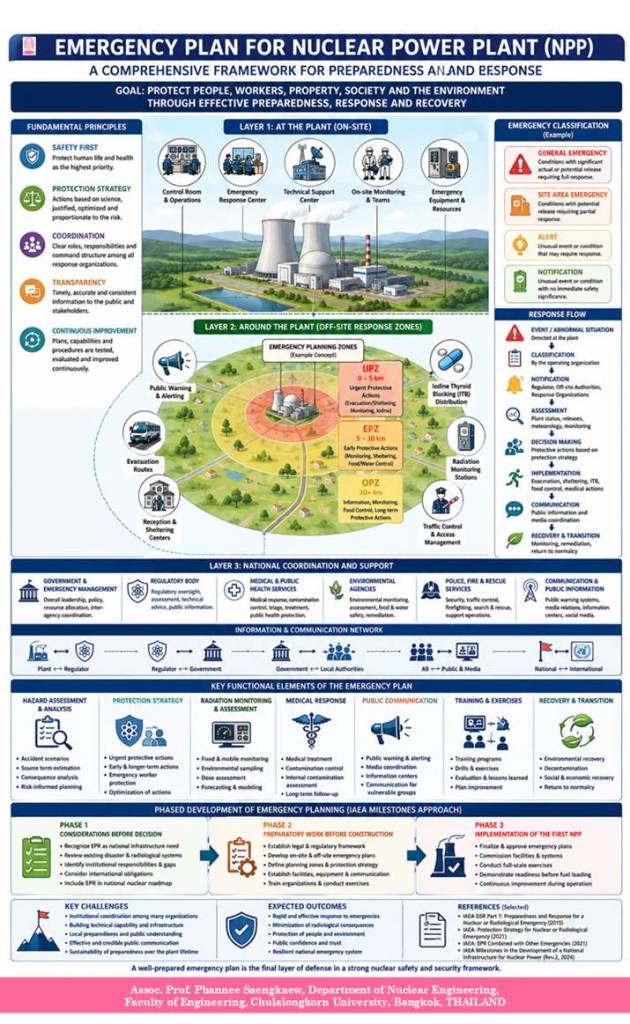
Emergency planning for a nuclear power programme must cover both on-site and off-site arrangements.
On-site emergency planning refers to arrangements within the nuclear power plant site. These include emergency classification, control room actions, emergency operating procedures, severe accident management guidelines, on-site emergency facilities, plant status assessment, worker protection, on-site radiation monitoring, firefighting, rescue operations, and communication with off-site authorities.
Off-site emergency planning refers to arrangements outside the plant boundary. These include local and national emergency response structures, public alerting systems, evacuation routes, sheltering arrangements, iodine thyroid blocking distribution, medical facilities, reception centres, contamination control, food and agriculture restrictions, environmental monitoring, and long-term recovery arrangements.
A mature emergency planning system must also include arrangements for emergencies involving radioactive material transport, spent fuel handling, radioactive waste facilities, sabotage-related events that have radiological consequences, natural disasters affecting the plant, and combined emergencies such as earthquakes, floods, storms, fires, or civil disturbances occurring together with a nuclear event. The IAEA has specific guidance on preparing for nuclear or radiological emergencies combined with other incidents, emphasizing that emergency planning should remain functional even when conventional infrastructure is disrupted.
4. Main Objectives of Emergency Planning
The fundamental objective of emergency planning is to ensure that protective and response actions can be implemented rapidly and effectively when needed. According to the IAEA safety framework, the response to a nuclear or radiological emergency is intended to mitigate consequences, protect people, and support the transition to recovery. GSR Part 7 identifies the need for preparedness and response arrangements applicable to facilities, activities, sources, and off-site jurisdictions that may require protective actions.
The practical objectives of Emergency Planning in a nuclear power programme include the following:
- To regain control of the emergency situation by supporting plant stabilization, accident management, and mitigation of radiological releases.
- To protect workers and emergency workers through dose control, protective equipment, access control, contamination monitoring, and medical support.
- To protect the public through timely warning, sheltering, evacuation, iodine thyroid blocking, food and water restrictions, and public information.
- To reduce deterministic and stochastic health effects by minimizing exposure during the early, intermediate, and recovery phases of an emergency.
- To maintain public trust through accurate, timely, and coordinated communication.
- To support environmental protection and recovery through monitoring, assessment, remediation planning, and management of contaminated areas.
- To ensure national and international coordination through notification, assistance mechanisms, and cooperation with neighbouring countries and international organizations.
5. Key Elements of a National Emergency Planning System
5.1 Legal and Regulatory Basis
Emergency planning must be supported by legislation and regulations that clearly assign responsibilities to the government, regulatory body, operating organization, emergency response organizations, local authorities, medical institutions, environmental agencies, and other competent bodies. The legal framework should define emergency powers, public protection authority, information release mechanisms, emergency worker protection, liability arrangements, compensation mechanisms, and coordination with national disaster management systems.
GSR Part 7 emphasizes that governments must ensure clear allocation of roles and responsibilities in advance among operating organizations, the regulatory body, and response organizations. It also requires arrangements for effectively governing preparedness and response at all relevant levels.
5.2 Hazard Assessment and Graded Approach
Emergency planning must be based on a systematic hazard assessment. The hazard assessment identifies potential accident scenarios, source terms, release pathways, exposure routes, affected areas, and possible consequences. It provides the basis for emergency planning zones, protective action strategies, response resources, radiation monitoring arrangements, and emergency classification.
The IAEA requires that emergency preparedness and response arrangements follow a graded approach, meaning that the level of planning, resources, and response capability should be commensurate with the potential hazards and consequences. For a nuclear power plant, this generally requires comprehensive arrangements because the facility may have the potential for off-site radiological consequences under severe accident conditions.
5.3 Emergency Classification and Notification
A nuclear power plant must have an emergency classification system that allows the operating organization to recognize abnormal conditions and declare the appropriate emergency class. This classification should trigger predefined actions, including internal response activation, notification of the regulatory body, notification of off-site authorities, activation of technical support centres, and communication with the public as needed.
Emergency classification must be linked to observable plant conditions, radiation levels, safety system status, release indicators, and accident progression. It should be designed so that decisions can be made quickly without waiting for complete information.
5.4 Emergency Planning Zones and Distances
Emergency planning requires predefined zones or distances around the nuclear power plant for protective action planning. These zones provide the basis for evacuation planning, sheltering, iodine thyroid blocking, traffic control, reception centres, radiation monitoring, and public information campaigns.
Although detailed zone sizes depend on national regulations, reactor design, site characteristics, and safety analysis, the planning concept normally distinguishes between areas requiring urgent protective actions and broader areas requiring monitoring, food control, or public information. Emergency zones must be coordinated with local administrative boundaries, road networks, population distribution, schools, hospitals, agricultural areas, and vulnerable groups.
5.5 Protection Strategy
A protection strategy defines how protective actions and other response actions will be justified, optimized, and implemented. It should be developed during the preparedness stage rather than during the emergency itself. The IAEA emphasizes that protection strategies should be developed, justified, and optimized in advance for effective protective and response actions during nuclear or radiological emergencies.
A protection strategy should address urgent protective actions, early protective actions, longer-term protective actions, emergency worker protection, medical response, environmental monitoring, public communication, and transition to recovery. It should also consider non-radiological consequences, including social disruption, psychological stress, economic impacts, and public confidence.
5.6 Emergency Facilities and Equipment
The operating organization and national authorities must establish emergency facilities and maintain emergency equipment. At the plant level, these may include an emergency response centre, technical support centre, operational support centre, backup emergency facility, emergency communication systems, portable radiation monitoring instruments, protective clothing, respiratory protection, contamination control equipment, and emergency power and communication supplies.
At the off-site level, required facilities may include national emergency operations centres, local command centres, public information centres, medical reception centres, radiation monitoring laboratories, mobile monitoring teams, decontamination stations, and logistics support facilities.
5.7 Radiation Monitoring and Dose Assessment
Radiation monitoring is central to emergency decision-making. A national emergency planning system must include fixed and mobile monitoring systems, environmental sampling capability, laboratory analysis, plume modelling, meteorological data integration, dose projection, contamination mapping, and data management.
Monitoring results support decisions on evacuation, sheltering, food restrictions, water control, access control, decontamination, and recovery. Emergency monitoring must be integrated with routine environmental monitoring systems but must also be capable of operating under emergency conditions, including loss of power, limited access, severe weather, or infrastructure disruption.
5.8 Medical Preparedness and Public Health Response
Medical preparedness includes first aid, emergency medical treatment, contamination control, internal contamination assessment, decorporation therapy where appropriate, psychological support, triage, biodosimetry, and long-term medical follow-up. Hospitals and medical personnel must be trained to manage contaminated patients without delaying urgent treatment.
Public health authorities must be integrated into emergency planning because nuclear emergencies may involve both radiological and non-radiological health consequences. These include stress, evacuation-related risks, disruption of medical services, misinformation, and long-term health surveillance needs.
5.9 Public Warning and Communication
Public communication is a core element of emergency planning. The public must understand emergency instructions before an event occurs. During an emergency, communication must be timely, credible, consistent, and actionable.
Public communication arrangements should include alert systems, sirens, mobile phone alerts, radio and television messages, social media channels, official websites, public information centres, trained spokespersons, media coordination, and communication for vulnerable populations. Communication should explain what happened, what is being done, what the public should do, what areas are affected, and where reliable information can be obtained.
5.10 Training, Drills, and Exercises
Emergency plans are only effective if they are tested and practiced. Training should cover operators, emergency workers, regulatory staff, local authorities, medical personnel, police, firefighters, environmental monitoring teams, communication officers, and decision-makers.
Exercises should include tabletop exercises, functional exercises, field drills, full-scale national exercises, communication drills, medical drills, evacuation exercises, and international notification exercises. Lessons learned should be documented and used to revise procedures, training programmes, equipment lists, and coordination mechanisms.
6. Institutional Responsibilities
6.1 Government
The government has the highest responsibility for establishing the national emergency preparedness and response framework. It must ensure that legal authority, national policy, funding, coordination mechanisms, public protection powers, and inter-agency responsibilities are clearly defined.
The government also ensures integration between nuclear emergency planning and the national disaster management system. This is essential because a nuclear emergency may require police control, transport management, medical services, shelter facilities, agriculture restrictions, public communication, and international coordination.
6.2 Regulatory Body
The regulatory body establishes regulatory requirements for emergency preparedness, reviews and approves emergency plans, inspects emergency arrangements, evaluates exercises, and ensures that the operating organization maintains adequate emergency capabilities. The regulator must remain independent while coordinating with other national response organizations.
The regulatory body also provides technical advice during an emergency, monitors the licensee’s response, evaluates radiological conditions, and communicates regulatory information to the government and the public.
6.3 Operating Organization
The operating organization is responsible for on-site emergency preparedness and response. It must establish emergency procedures, emergency facilities, trained response teams, emergency classification systems, accident assessment capability, worker protection arrangements, notification procedures, and coordination with off-site authorities.
The operating organization must also conduct drills and exercises, maintain emergency equipment, and demonstrate readiness before fuel loading and operation.
6.4 Local and Regional Authorities
Local and regional authorities are responsible for implementing many off-site protective actions. These may include evacuation, sheltering, traffic control, public alerting, reception centres, local communication, support to vulnerable groups, and coordination with schools, hospitals, and community organizations.
Because local authorities are closest to the affected population, they must be involved early in emergency planning, training, and public information activities.
6.5 Medical and Public Health Authorities
Medical and public health authorities provide emergency medical care, contamination screening, psychological support, dose assessment support, public health advice, and long-term medical follow-up. They also help determine protective actions related to food, water, sanitation, and population health.
6.6 International Interfaces
A nuclear emergency may have transboundary implications. Therefore, emergency planning must include international notification, information exchange, and assistance arrangements. States that are parties to relevant international conventions must be prepared to notify and communicate through established channels. GSR Part 7 recognizes the role of international organizations and the need for harmonized emergency arrangements.
7. Phased Development According to the IAEA Milestones Approach
Phase 1: Considerations Before a Decision to Launch a Nuclear Power Programme
During Phase 1, the country evaluates whether nuclear power is a suitable national option. For Emergency Planning, the focus is not yet on detailed plant-specific emergency arrangements, but on understanding the national implications of emergency preparedness.
At this stage, the country should assess whether its existing national disaster management, radiation protection, medical response, environmental monitoring, and regulatory systems can support a future nuclear power programme. The government should identify responsible institutions and recognize that nuclear emergency planning requires capabilities beyond conventional emergency response.
Important Phase 1 activities include:
- reviewing existing emergency management legislation;
- identifying gaps in radiation emergency preparedness;
- assessing national disaster response structures;
- identifying competent authorities for nuclear or radiological emergencies;
- considering international obligations for notification and assistance;
- estimating future resource needs;
- recognizing emergency planning as a national infrastructure requirement;
- including emergency preparedness in the preliminary nuclear power roadmap.
By the end of Phase 1, the country should understand that emergency planning will require a coordinated national system, not only a plant-level emergency plan.
Phase 2: Preparatory Work for Contracting and Construction
Phase 2 is the critical development period for Emergency Planning. During this phase, the country must establish the legal, regulatory, institutional, and technical arrangements needed before construction and before fuel is brought to the site.
The national emergency preparedness framework should be developed in detail. The regulatory body should issue requirements for emergency preparedness and response. The operating organization should begin developing site-specific emergency plans. Local and national authorities should define responsibilities for off-site response. Emergency planning zones should be studied using site characteristics, safety analysis, population data, meteorological data, and infrastructure information.
Important Phase 2 activities include:
- establishing national EPR policy and regulations;
- defining roles and responsibilities among all response organizations;
- developing hazard assessment methodology;
- defining emergency planning zones and response areas;
- preparing on-site and off-site emergency plans;
- establishing notification and communication arrangements;
- developing public warning systems;
- planning emergency facilities and equipment;
- preparing medical response arrangements;
- training emergency response organizations;
- conducting preliminary drills and exercises;
- integrating nuclear emergency planning with national disaster management;
- establishing international notification and assistance interfaces.
By the end of Phase 2, the country should have a credible and coordinated emergency preparedness framework that can support licensing, construction planning, and future commissioning.
Phase 3: Activities to Implement the First Nuclear Power Plant
During Phase 3, Emergency Planning must move from policy and planning into operational readiness. Before fuel loading and operation, emergency arrangements must be fully implemented, tested, and demonstrated.
The operating organization must finalize plant-specific emergency procedures, emergency classification systems, emergency facilities, staff training, technical support arrangements, severe accident management interfaces, and notification systems. Off-site authorities must demonstrate the ability to implement public protective actions. National emergency centres, local command centres, monitoring teams, medical facilities, and communication systems must be operational.
Important Phase 3 activities include:
- completing and approving on-site and off-site emergency plans;
- commissioning emergency response facilities;
- installing and testing emergency communication systems;
- conducting full-scale emergency exercises;
- demonstrating evacuation, sheltering, and public alert arrangements;
- verifying radiation monitoring and dose assessment capability;
- training emergency workers and decision-makers;
- preparing public information materials;
- testing media communication arrangements;
- evaluating exercise results and correcting weaknesses;
- confirming readiness before fuel loading;
- maintaining continuous improvement after operation begins.
By the end of Phase 3, the country should be able to demonstrate that emergency preparedness and response arrangements are functional, integrated, tested, and capable of protecting the public and workers during a nuclear or radiological emergency.
8. Interfaces with Other Infrastructure Issues
Emergency Planning is strongly connected to many other IAEA infrastructure issues.
It is linked to Issue 2: Nuclear Safety, because emergency planning represents the final protective layer when preventive safety measures are challenged.
It is linked to Issue 5: Legislative Framework, because emergency powers, responsibilities, liability, public protection authority, and compensation arrangements must be legally defined.
It is linked to Issue 7: Regulatory Framework, because emergency preparedness requirements must be regulated, inspected, and enforced.
It is linked to Issue 8: Radiation Protection, because emergency exposure situations require dose criteria, worker protection, public protective actions, monitoring, and health protection.
It is linked to Issue 10: Human Resource Development, because emergency planning depends on trained operators, regulators, emergency workers, medical staff, monitoring teams, communication officers, and decision-makers.
It is linked to Issue 11: Stakeholder Involvement, because public understanding, trust, and participation are essential for protective action implementation.
It is linked to Issue 13: Environmental Protection, because emergency response requires environmental monitoring, contamination assessment, food control, water protection, and recovery planning.
It is linked to Issue 15: Nuclear Security and Physical Protection, because a nuclear security event may lead to radiological consequences requiring coordinated emergency response.
9. Key Challenges for Newcomer Countries
For countries developing nuclear power for the first time, Emergency Planning presents several challenges.
- The first challenge is institutional coordination. Nuclear emergency response involves many organizations that may not normally work together. A newcomer country must therefore build a clear command structure, information flow, and decision-making process before an emergency occurs.
- The second challenge is technical capability. Nuclear emergency planning requires radiation monitoring, dose assessment, plume modelling, emergency classification, contamination control, medical response, and environmental sampling. These capabilities may be limited in countries without previous nuclear power experience.
- The third challenge is local preparedness. Emergency response is often implemented by local authorities, but local organizations may have limited understanding of nuclear hazards. Training, exercises, and public education are therefore essential.
- The fourth challenge is public communication. Nuclear emergencies are highly sensitive. Poor communication may create confusion, fear, distrust, and misinformation. Communication planning must therefore begin well before operation.
- The fifth challenge is sustainability. Emergency preparedness must be maintained throughout the plant lifetime. Equipment must be maintained, staff must be trained, exercises must continue, and emergency plans must be updated as plant conditions, population distribution, infrastructure, and technology change.
10. Academic Interpretation
Emergency Planning should be understood as a national resilience system for nuclear power. It is not merely a set of emergency procedures kept by the operating organization. Rather, it is a coordinated infrastructure that connects law, regulation, plant operation, disaster management, radiation protection, medical preparedness, environmental monitoring, public communication, and international cooperation.
A strong emergency planning system demonstrates that a country is not only capable of building or operating a nuclear power plant, but also capable of managing abnormal and emergency situations responsibly. In this sense, Issue 14 is a maturity indicator of the national nuclear infrastructure. It shows whether the country has moved beyond technical project development toward integrated governance, public protection, and long-term institutional responsibility.
For newcomer countries, emergency planning should begin early because it requires legal authority, institutional trust, public confidence, trained personnel, equipment, facilities, and repeated exercises. Waiting until the plant is near operation would create significant safety and governance risks. Therefore, the development of Emergency Planning must proceed progressively from Phase 1 to Phase 3, with increasing specificity, realism, and operational readiness.
11. Table: Phased Progress of Issue 14 Emergency Planning
| IAEA Phase | Main Objective | Expected Development of Emergency Planning |
| Phase 1 | Understand national implications before deciding to launch nuclear power | The country identifies emergency preparedness as a national infrastructure requirement, reviews existing disaster and radiological emergency systems, identifies institutional gaps, and includes EPR needs in the national nuclear roadmap. |
| Phase 2 | Prepare legal, regulatory, and institutional arrangements before contracting and construction | The country develops EPR regulations, defines roles and responsibilities, prepares on-site and off-site emergency planning concepts, establishes emergency planning zones, develops communication systems, trains response organizations, and begins exercises. |
| Phase 3 | Demonstrate operational readiness before fuel loading and operation | The country finalizes and approves emergency plans, commissions emergency facilities, trains all response organizations, conducts full-scale exercises, tests public warning and radiation monitoring systems, and confirms readiness for operation. |
12. Conclusion
Issue 14, Emergency Planning, is a central infrastructure issue for any country developing a nuclear power programme. It ensures that emergency preparedness and response arrangements are established before nuclear power plant operation and that these arrangements are legally supported, technically sound, institutionally coordinated, and publicly credible.
A well-developed emergency planning system protects workers, the public, and the environment by enabling rapid classification, notification, protective action, radiation monitoring, medical response, communication, and recovery. Within the IAEA Milestones Approach, Emergency Planning must evolve from national awareness in Phase 1, to detailed legal and institutional arrangements in Phase 2, and finally to demonstrated operational readiness in Phase 3.
For a newcomer country, the maturity of Emergency Planning reflects the maturity of the whole nuclear infrastructure. It shows that the country has prepared not only to operate a nuclear power plant under normal conditions, but also to manage abnormal and emergency conditions with competence, transparency, and public responsibility.
References
- International Atomic Energy Agency. (2015). Preparedness and Response for a Nuclear or Radiological Emergency, General Safety Requirements, IAEA Safety Standards Series No. GSR Part 7. IAEA, Vienna.
- International Atomic Energy Agency. (2021). Considerations in the Development of a Protection Strategy for a Nuclear or Radiological Emergency. IAEA, Vienna.
- International Atomic Energy Agency. (2021). Preparedness and Response for a Nuclear or Radiological Emergency Combined with Other Incidents or Emergencies. IAEA, Vienna.
- International Atomic Energy Agency. (2024). Milestones in the Development of a National Infrastructure for Nuclear Power, Revision 2. IAEA Nuclear Energy Series.
- International Atomic Energy Agency. (n.d.). Nuclear Infrastructure Bibliography: 19 Infrastructure Issues. IAEA.
ประเด็นด้านที่ 14: การวางแผนรับมือเหตุฉุกเฉิน
1. บทนำ
การวางแผนรับมือเหตุฉุกเฉิน ซึ่งจัดเป็น ด้านที่ 14 ในกลุ่ม โครงสร้างพื้นฐาน 19 ด้านของทบวงการพลังงานปรมาณูระหว่างประเทศ เป็นองค์ประกอบพื้นฐานที่มีความสำคัญอย่างยิ่งต่อการพัฒนาโครงสร้างพื้นฐานของโครงการพลังงานนิวเคลียร์ระดับชาติ ประเด็นนี้เกี่ยวข้องกับการจัดให้มีกรอบกฎหมาย สถาบัน กลไกทางเทคนิค การปฏิบัติการ และระบบการสื่อสารที่จำเป็นต่อการเตรียมความพร้อมและการตอบสนองอย่างมีประสิทธิภาพต่อเหตุฉุกเฉินทางนิวเคลียร์หรือเหตุฉุกเฉินทางรังสี ภายใต้แนวทางตามกรอบหมุดหมายของ IAEA การวางแผนรับมือเหตุฉุกเฉินไม่ได้ถูกมองว่าเป็นกิจกรรมทางเทคนิคที่แยกออกจากระบบอื่น แต่เป็นหน้าที่ด้านความพร้อมของประเทศที่ต้องพัฒนาอย่างเป็นลำดับควบคู่ไปกับความปลอดภัย ความมั่นคงปลอดภัย การป้องกันรังสี การกำกับดูแล การมีส่วนร่วมของผู้มีส่วนได้ส่วนเสีย การคัดเลือกพื้นที่ตั้ง การคุ้มครองสิ่งแวดล้อม และขีดความสามารถของหน่วยงานผู้ดำเนินการโรงไฟฟ้านิวเคลียร์
ในบริบทของโครงการพลังงานนิวเคลียร์ การวางแผนรับมือเหตุฉุกเฉินมีเป้าหมายเพื่อทำให้มั่นใจว่า หากเกิดอุบัติเหตุหรือเหตุการณ์ผิดปกติที่มีความเป็นไปได้น้อยแต่มีผลกระทบสูง ประเทศจะสามารถปกป้องผู้ปฏิบัติงาน ประชาชน ทรัพย์สิน สังคม และสิ่งแวดล้อมได้ผ่านการดำเนินการที่รวดเร็ว มีการประสานงาน และมีพื้นฐานทางเทคนิคที่เหมาะสม การดำเนินการเหล่านี้รวมถึงการจำแนกระดับเหตุฉุกเฉิน การแจ้งเหตุ การเปิดใช้งานองค์กรตอบสนองฉุกเฉิน การดำเนินมาตรการป้องกัน การตรวจวัดรังสี การตอบสนองทางการแพทย์ การสื่อสารต่อสาธารณะ การประเมินผลกระทบต่อสิ่งแวดล้อม และการวางแผนฟื้นฟูภายหลังเหตุการณ์
การวางแผนรับมือเหตุฉุกเฉินมีความเชื่อมโยงอย่างใกล้ชิดกับแนวคิดเรื่อง การเตรียมความพร้อมและการตอบสนองต่อเหตุฉุกเฉิน หรือ Emergency Preparedness and Response ซึ่งมักย่อว่า EPR คำว่า “การเตรียมความพร้อม” หมายถึง การจัดเตรียมแผน ระบบ ทรัพยากร และกลไกต่าง ๆ ไว้ล่วงหน้าก่อนเกิดเหตุ ส่วน “การตอบสนอง” หมายถึง การดำเนินการจริงเมื่อเกิดเหตุฉุกเฉินขึ้นแล้ว มาตรฐานความปลอดภัยของ IAEA ฉบับ GSR Part 7 เรื่อง Preparedness and Response for a Nuclear or Radiological Emergency ได้กำหนดข้อกำหนดเพื่อให้ประเทศมีระดับความพร้อมและการตอบสนองที่เหมาะสม ไม่ว่าเหตุเริ่มต้นจะเกิดจากภัยธรรมชาติ ความผิดพลาดของมนุษย์ ความขัดข้องของเครื่องจักรกล หรือเหตุการณ์ด้านความมั่นคงปลอดภัยทางนิวเคลียร์
2. บทบาทเชิงแนวคิดของการวางแผนรับมือเหตุฉุกเฉินในโครงสร้างพื้นฐานทางนิวเคลียร์
การวางแผนรับมือเหตุฉุกเฉินทำหน้าที่เป็นสะพานเชื่อมระหว่าง การป้องกันอุบัติเหตุ และ การลดผลกระทบเมื่อเกิดเหตุการณ์ ความปลอดภัยทางนิวเคลียร์มุ่งเน้นการป้องกันอุบัติเหตุเป็นหลัก โดยอาศัยหลักการป้องกันเชิงลึก การออกแบบที่มีความมั่นคงแข็งแรง การประกันคุณภาพ การวิเคราะห์ความปลอดภัย และการกำกับดูแลที่มีประสิทธิภาพ อย่างไรก็ตาม ระบบความปลอดภัยใด ๆ จะยังไม่สมบูรณ์ หากประเทศไม่มีการเตรียมความพร้อมในการจัดการผลกระทบจากเหตุการณ์ที่มีความเป็นไปได้น้อยแต่สามารถก่อให้เกิดผลกระทบสูงได้ การวางแผนรับมือเหตุฉุกเฉินจึงเป็นชั้นสุดท้ายของการปกป้องภายใต้กรอบความปลอดภัยทางนิวเคลียร์โดยรวม
ในมุมมองของโครงสร้างพื้นฐาน การวางแผนรับมือเหตุฉุกเฉินมีหน้าที่สำคัญอย่างน้อยสามประการ
- ประการแรก การวางแผนรับมือเหตุฉุกเฉินทำให้ประเทศมี ระบบตอบสนองแห่งชาติที่เตรียมพร้อมไว้ล่วงหน้า เหตุฉุกเฉินทางนิวเคลียร์อาจเกี่ยวข้องกับหน่วยงานผู้ดำเนินการโรงไฟฟ้านิวเคลียร์ หน่วยงานกำกับดูแล หน่วยงานจัดการภัยพิบัติระดับชาติ องค์กรปกครองส่วนท้องถิ่น หน่วยงานสาธารณสุข ตำรวจ ทหาร หน่วยงานสิ่งแวดล้อม หน่วยงานอุตุนิยมวิทยา หน่วยงานสื่อสารสาธารณะ และจุดประสานงานระหว่างประเทศ หากไม่มีการกำหนดบทบาท ช่องทางการสื่อสาร และลำดับการตัดสินใจไว้ล่วงหน้า การตอบสนองอาจล่าช้า ซ้ำซ้อน หรือขาดความสอดคล้องกัน
- ประการที่สอง การวางแผนรับมือเหตุฉุกเฉินให้ พื้นฐานทางเทคนิคสำหรับการตัดสินใจเกี่ยวกับมาตรการป้องกัน ระบบฉุกเฉินต้องกำหนดไว้ล่วงหน้าว่าจะตัดสินใจเรื่องการอพยพ การหลบอยู่ภายในอาคาร การให้ยาไอโอดีนเสถียรเพื่อป้องกันต่อมไทรอยด์ การควบคุมอาหาร การควบคุมน้ำ การจำกัดการเข้าออกพื้นที่ การขจัดการปนเปื้อน การคัดแยกทางการแพทย์ และการตรวจวัดสิ่งแวดล้อมอย่างไร การตัดสินใจเหล่านี้ต้องตั้งอยู่บนการจำแนกระดับเหตุฉุกเฉิน การคาดการณ์ปริมาณรังสีที่อาจได้รับ ผลการตรวจวัดรังสี ระดับปฏิบัติการสำหรับการแทรกแซง และยุทธศาสตร์การป้องกันที่กำหนดไว้ล่วงหน้า
- ประการที่สาม การวางแผนรับมือเหตุฉุกเฉินทำหน้าที่เป็น กลไกสร้างความเชื่อมั่นของสาธารณะ ในระหว่างเหตุฉุกเฉินทางนิวเคลียร์หรือทางรังสี ความไม่แน่นอนและความหวาดกลัวอาจก่อให้เกิดความปั่นป่วนทางสังคม แม้ผลกระทบทางรังสีที่แท้จริงจะอยู่ในระดับจำกัดก็ตาม ดังนั้น การวางแผนรับมือเหตุฉุกเฉินที่มีประสิทธิภาพจึงต้องรวมถึงการสื่อสารที่น่าเชื่อถือ การเผยแพร่ข้อมูลอย่างโปร่งใส ผู้แถลงข่าวที่ได้รับการฝึกอบรม และการประสานข้อมูลที่สอดคล้องกันระหว่างหน่วยงานที่รับผิดชอบ
3. ขอบเขตของการวางแผนรับมือเหตุฉุกเฉิน
การวางแผนรับมือเหตุฉุกเฉินสำหรับโครงการพลังงานนิวเคลียร์ต้องครอบคลุมทั้ง การจัดการภายในพื้นที่โรงไฟฟ้า และ การจัดการนอกพื้นที่โรงไฟฟ้า
การวางแผนรับมือเหตุฉุกเฉินภายในพื้นที่โรงไฟฟ้าหมายถึง การจัดเตรียมระบบและวิธีปฏิบัติภายในขอบเขตของโรงไฟฟ้านิวเคลียร์ องค์ประกอบเหล่านี้รวมถึงการจำแนกระดับเหตุฉุกเฉิน การดำเนินการของห้องควบคุม ขั้นตอนการปฏิบัติเมื่อเกิดเหตุฉุกเฉิน แนวทางการจัดการอุบัติเหตุรุนแรง ศูนย์ปฏิบัติการฉุกเฉินภายในพื้นที่ การประเมินสถานะของโรงไฟฟ้า การปกป้องผู้ปฏิบัติงาน การตรวจวัดรังสีภายในพื้นที่ การดับเพลิง การกู้ภัย และการสื่อสารกับหน่วยงานภายนอกพื้นที่โรงไฟฟ้า
การวางแผนรับมือเหตุฉุกเฉินนอกพื้นที่โรงไฟฟ้าหมายถึง การจัดเตรียมระบบและกลไกภายนอกขอบเขตของโรงไฟฟ้า องค์ประกอบเหล่านี้รวมถึงโครงสร้างการตอบสนองฉุกเฉินระดับท้องถิ่นและระดับชาติ ระบบแจ้งเตือนสาธารณะ เส้นทางอพยพ สถานที่หลบภัย การแจกจ่ายยาไอโอดีนเสถียร ศูนย์รับรองประชาชน การควบคุมการปนเปื้อน การควบคุมอาหารและน้ำ การตรวจวัดสิ่งแวดล้อม และการวางแผนการฟื้นฟูระยะยาว
ระบบการวางแผนรับมือเหตุฉุกเฉินที่มีความสมบูรณ์ควรครอบคลุมเหตุฉุกเฉินที่เกี่ยวข้องกับการขนส่งวัสดุกัมมันตรังสี การจัดการเชื้อเพลิงใช้แล้ว สิ่งอำนวยความสะดวกด้านกากกัมมันตรังสี เหตุการณ์การก่อวินาศกรรมที่อาจมีผลกระทบทางรังสี ภัยธรรมชาติที่ส่งผลกระทบต่อโรงไฟฟ้า และเหตุฉุกเฉินแบบผสมผสาน เช่น แผ่นดินไหว น้ำท่วม พายุ ไฟไหม้ หรือความไม่สงบทางสังคมที่เกิดร่วมกับเหตุการณ์ทางนิวเคลียร์ และ IAEA มีแนวทางเฉพาะเกี่ยวกับการเตรียมความพร้อมสำหรับเหตุฉุกเฉินทางนิวเคลียร์หรือทางรังสีที่เกิดร่วมกับเหตุการณ์อื่น โดยเน้นว่าการวางแผนรับมือเหตุฉุกเฉินต้องยังคงทำงานได้ แม้โครงสร้างพื้นฐานทั่วไปจะได้รับผลกระทบหรือหยุดชะงัก
4. วัตถุประสงค์หลักของการวางแผนรับมือเหตุฉุกเฉิน
วัตถุประสงค์พื้นฐานของการวางแผนรับมือเหตุฉุกเฉินคือ การทำให้มั่นใจว่ามาตรการป้องกันและการตอบสนองสามารถดำเนินการได้อย่างรวดเร็วและมีประสิทธิภาพเมื่อจำเป็น ภายใต้กรอบมาตรฐานความปลอดภัยของ IAEA การตอบสนองต่อเหตุฉุกเฉินทางนิวเคลียร์หรือทางรังสีมีวัตถุประสงค์เพื่อบรรเทาผลกระทบ ปกป้องประชาชน และสนับสนุนการเปลี่ยนผ่านเข้าสู่ระยะฟื้นฟู
วัตถุประสงค์เชิงปฏิบัติของการวางแผนรับมือเหตุฉุกเฉินในโครงการพลังงานนิวเคลียร์ประกอบด้วยประเด็นต่อไปนี้
- เพื่อให้สามารถควบคุมสถานการณ์ฉุกเฉินกลับคืนมาได้ โดยสนับสนุนการทำให้โรงไฟฟ้าอยู่ในสภาวะเสถียร การจัดการอุบัติเหตุ และการลดผลกระทบจากการปลดปล่อยสารกัมมันตรังสี
- เพื่อปกป้องผู้ปฏิบัติงานและผู้ปฏิบัติงานฉุกเฉิน ผ่านการควบคุมปริมาณรังสี การใช้อุปกรณ์ป้องกัน การควบคุมการเข้าออกพื้นที่ การตรวจวัดการปนเปื้อน และการสนับสนุนทางการแพทย์
- เพื่อปกป้องประชาชน ผ่านการแจ้งเตือนที่ทันท่วงที การหลบอยู่ภายในอาคาร การอพยพ การให้ยาไอโอดีนเสถียร การจำกัดอาหารและน้ำ และการให้ข้อมูลสาธารณะ
- เพื่อลดผลกระทบต่อสุขภาพทั้งแบบกำหนดแน่นอนและแบบสุ่ม โดยลดการได้รับรังสีในระยะต้น ระยะกลาง และระยะฟื้นฟูของเหตุฉุกเฉิน
- เพื่อรักษาความเชื่อมั่นของสาธารณะ ผ่านการสื่อสารที่ถูกต้อง ทันเวลา และมีการประสานงานระหว่างหน่วยงาน
- เพื่อสนับสนุนการคุ้มครองสิ่งแวดล้อมและการฟื้นฟู ผ่านการตรวจวัด การประเมิน การวางแผนฟื้นฟู และการจัดการพื้นที่ปนเปื้อน
- เพื่อให้เกิดการประสานงานระดับชาติและระหว่างประเทศ ผ่านระบบการแจ้งเหตุ การขอรับความช่วยเหลือ และความร่วมมือกับประเทศเพื่อนบ้านและองค์การระหว่างประเทศ
5. องค์ประกอบสำคัญของระบบการวางแผนรับมือเหตุฉุกเฉินแห่งชาติ
5.1 พื้นฐานทางกฎหมายและกฎระเบียบ
การวางแผนรับมือเหตุฉุกเฉินต้องได้รับการรองรับด้วยกฎหมายและกฎระเบียบที่กำหนดความรับผิดชอบของรัฐบาล หน่วยงานกำกับดูแล หน่วยงานผู้ดำเนินการโรงไฟฟ้า องค์กรตอบสนองฉุกเฉิน หน่วยงานท้องถิ่น สถาบันทางการแพทย์ หน่วยงานสิ่งแวดล้อม และหน่วยงานที่มีอำนาจอื่น ๆ อย่างชัดเจน กรอบกฎหมายควรกำหนดอำนาจในภาวะฉุกเฉิน อำนาจในการปกป้องประชาชน กลไกการเผยแพร่ข้อมูล การปกป้องผู้ปฏิบัติงานฉุกเฉิน ระบบความรับผิดทางกฎหมาย กลไกการชดเชย และการประสานงานกับระบบจัดการภัยพิบัติแห่งชาติ
ข้อกำหนดของ IAEA เน้นว่ารัฐบาลต้องทำให้มั่นใจว่ามีการจัดสรรบทบาทและความรับผิดชอบไว้อย่างชัดเจนล่วงหน้า ระหว่างหน่วยงานผู้ดำเนินการโรงไฟฟ้า หน่วยงานกำกับดูแล และองค์กรตอบสนองฉุกเฉิน นอกจากนี้ ยังต้องมีระบบการกำกับและบริหารจัดการความพร้อมและการตอบสนองต่อเหตุฉุกเฉินอย่างมีประสิทธิภาพในทุกระดับที่เกี่ยวข้อง
5.2 การประเมินอันตรายและแนวทางแบบไล่ระดับ
การวางแผนรับมือเหตุฉุกเฉินต้องตั้งอยู่บนการประเมินอันตรายอย่างเป็นระบบ การประเมินอันตรายจะระบุสถานการณ์อุบัติเหตุที่เป็นไปได้ ปริมาณและรูปแบบของสารกัมมันตรังสีที่อาจถูกปลดปล่อย เส้นทางการแพร่กระจาย เส้นทางการได้รับรังสี พื้นที่ที่อาจได้รับผลกระทบ และผลกระทบที่อาจเกิดขึ้น การประเมินนี้เป็นพื้นฐานสำหรับการกำหนดเขตวางแผนฉุกเฉิน ยุทธศาสตร์มาตรการป้องกัน ทรัพยากรตอบสนอง ระบบตรวจวัดรังสี และการจำแนกระดับเหตุฉุกเฉิน
IAEA กำหนดให้การเตรียมความพร้อมและการตอบสนองต่อเหตุฉุกเฉินต้องใช้ แนวทางแบบไล่ระดับ หมายความว่า ระดับของการวางแผน ทรัพยากร และขีดความสามารถในการตอบสนองต้องสอดคล้องกับระดับอันตรายและผลกระทบที่อาจเกิดขึ้น สำหรับโรงไฟฟ้านิวเคลียร์ โดยทั่วไปจำเป็นต้องมีการจัดเตรียมระบบที่ครอบคลุม เนื่องจากโรงไฟฟ้าอาจมีศักยภาพที่จะก่อให้เกิดผลกระทบทางรังสีนอกพื้นที่โรงไฟฟ้าในกรณีอุบัติเหตุรุนแรง
5.3 การจำแนกระดับเหตุฉุกเฉินและการแจ้งเหตุ
โรงไฟฟ้านิวเคลียร์ต้องมีระบบจำแนกระดับเหตุฉุกเฉินที่ทำให้หน่วยงานผู้ดำเนินการสามารถรับรู้สภาวะผิดปกติและประกาศระดับเหตุฉุกเฉินที่เหมาะสมได้ ระบบจำแนกนี้ควรกระตุ้นการดำเนินการที่กำหนดไว้ล่วงหน้า เช่น การเปิดใช้งานการตอบสนองภายในองค์กร การแจ้งหน่วยงานกำกับดูแล การแจ้งหน่วยงานนอกพื้นที่โรงไฟฟ้า การเปิดใช้งานศูนย์สนับสนุนทางเทคนิค และการสื่อสารกับสาธารณะตามความจำเป็น
การจำแนกระดับเหตุฉุกเฉินต้องเชื่อมโยงกับสภาวะของโรงไฟฟ้าที่สามารถสังเกตได้ ระดับรังสี สถานะของระบบความปลอดภัย ตัวชี้วัดการปลดปล่อยสารกัมมันตรังสี และความก้าวหน้าของอุบัติเหตุ ระบบดังกล่าวควรถูกออกแบบให้สามารถตัดสินใจได้รวดเร็ว โดยไม่จำเป็นต้องรอข้อมูลที่สมบูรณ์ทั้งหมดก่อนเริ่มการตอบสนอง
5.4 เขตและระยะสำหรับการวางแผนรับมือเหตุฉุกเฉิน
การวางแผนรับมือเหตุฉุกเฉินต้องกำหนดเขตหรือระยะรอบโรงไฟฟ้านิวเคลียร์ไว้ล่วงหน้าสำหรับการวางแผนมาตรการป้องกัน เขตเหล่านี้เป็นพื้นฐานสำหรับการวางแผนอพยพ การหลบอยู่ภายในอาคาร การให้ยาไอโอดีนเสถียร การควบคุมการจราจร ศูนย์รับรองประชาชน การตรวจวัดรังสี และกิจกรรมสื่อสารสาธารณะ
แม้ขนาดของเขตวางแผนฉุกเฉินจะขึ้นอยู่กับกฎระเบียบของประเทศ แบบของเครื่องปฏิกรณ์ ลักษณะพื้นที่ตั้ง และผลการวิเคราะห์ความปลอดภัย แต่แนวคิดของการวางแผนโดยทั่วไปจะแยกพื้นที่ที่ต้องมีมาตรการป้องกันเร่งด่วนออกจากพื้นที่ที่กว้างกว่า ซึ่งอาจต้องมีการตรวจวัด การควบคุมอาหาร หรือการให้ข้อมูลสาธารณะ เขตฉุกเฉินต้องสอดคล้องกับขอบเขตการปกครองท้องถิ่น โครงข่ายถนน การกระจายตัวของประชากร โรงเรียน โรงพยาบาล พื้นที่เกษตรกรรม และกลุ่มประชากรเปราะบาง
5.5 ยุทธศาสตร์การป้องกัน
ยุทธศาสตร์การป้องกันหมายถึงกรอบการตัดสินใจที่กำหนดว่ามาตรการป้องกันและมาตรการตอบสนองอื่น ๆ จะถูกพิจารณา ดำเนินการ และปรับให้เหมาะสมอย่างไร ยุทธศาสตร์นี้ควรถูกพัฒนาขึ้นในระยะเตรียมความพร้อม ไม่ใช่ในระหว่างเหตุฉุกเฉินเอง IAEA เน้นว่ายุทธศาสตร์การป้องกันควรถูกพัฒนา ให้เหตุผลรองรับ และปรับให้เหมาะสมไว้ล่วงหน้า เพื่อให้มาตรการป้องกันและการตอบสนองสามารถดำเนินการได้อย่างมีประสิทธิภาพในระหว่างเหตุฉุกเฉินทางนิวเคลียร์หรือทางรังสี
ยุทธศาสตร์การป้องกันควรครอบคลุมมาตรการป้องกันเร่งด่วน มาตรการป้องกันระยะแรก มาตรการป้องกันระยะยาว การปกป้องผู้ปฏิบัติงานฉุกเฉิน การตอบสนองทางการแพทย์ การตรวจวัดสิ่งแวดล้อม การสื่อสารสาธารณะ และการเปลี่ยนผ่านเข้าสู่ระยะฟื้นฟู นอกจากนี้ ยังควรพิจารณาผลกระทบที่ไม่ใช่รังสี เช่น ความปั่นป่วนทางสังคม ความเครียดทางจิตใจ ผลกระทบทางเศรษฐกิจ และความเชื่อมั่นของประชาชน
5.6 สิ่งอำนวยความสะดวกและอุปกรณ์ฉุกเฉิน
หน่วยงานผู้ดำเนินการโรงไฟฟ้าและหน่วยงานระดับชาติต้องจัดตั้งสิ่งอำนวยความสะดวกสำหรับเหตุฉุกเฉินและบำรุงรักษาอุปกรณ์ฉุกเฉินให้พร้อมใช้งาน ในระดับโรงไฟฟ้า สิ่งเหล่านี้อาจรวมถึงศูนย์ตอบสนองฉุกเฉิน ศูนย์สนับสนุนทางเทคนิค ศูนย์สนับสนุนการปฏิบัติการ สิ่งอำนวยความสะดวกฉุกเฉินสำรอง ระบบสื่อสารฉุกเฉิน เครื่องมือตรวจวัดรังสีแบบพกพา ชุดป้องกัน อุปกรณ์ป้องกันทางเดินหายใจ อุปกรณ์ควบคุมการปนเปื้อน และแหล่งพลังงานและการสื่อสารสำรอง
ในระดับนอกพื้นที่โรงไฟฟ้า สิ่งอำนวยความสะดวกที่จำเป็นอาจรวมถึงศูนย์ปฏิบัติการฉุกเฉินแห่งชาติ ศูนย์บัญชาการท้องถิ่น ศูนย์ข้อมูลสาธารณะ ศูนย์รับรองทางการแพทย์ ห้องปฏิบัติการตรวจวัดรังสี ทีมตรวจวัดเคลื่อนที่ สถานีขจัดการปนเปื้อน และระบบสนับสนุนด้านโลจิสติกส์
5.7 การตรวจวัดรังสีและการประเมินปริมาณรังสี
การตรวจวัดรังสีเป็นหัวใจสำคัญของการตัดสินใจในภาวะฉุกเฉิน ระบบการวางแผนรับมือเหตุฉุกเฉินแห่งชาติต้องมีระบบตรวจวัดแบบประจำที่และแบบเคลื่อนที่ ขีดความสามารถในการเก็บตัวอย่างสิ่งแวดล้อม การวิเคราะห์ในห้องปฏิบัติการ การจำลองการแพร่กระจายของกลุ่มสารกัมมันตรังสี ข้อมูลอุตุนิยมวิทยา การคาดการณ์ปริมาณรังสี การจัดทำแผนที่การปนเปื้อน และระบบจัดการข้อมูล
ผลการตรวจวัดสนับสนุนการตัดสินใจเรื่องการอพยพ การหลบอยู่ภายในอาคาร การจำกัดอาหาร การควบคุมน้ำ การจำกัดการเข้าออกพื้นที่ การขจัดการปนเปื้อน และการฟื้นฟู การตรวจวัดในภาวะฉุกเฉินต้องบูรณาการกับระบบตรวจวัดสิ่งแวดล้อมตามปกติ แต่ต้องสามารถทำงานได้ภายใต้สภาวะฉุกเฉินด้วย เช่น การสูญเสียไฟฟ้า การเข้าถึงพื้นที่ที่จำกัด สภาพอากาศรุนแรง หรือการหยุดชะงักของโครงสร้างพื้นฐาน
5.8 ความพร้อมทางการแพทย์และการตอบสนองด้านสาธารณสุข
ความพร้อมทางการแพทย์ประกอบด้วยการปฐมพยาบาล การรักษาทางการแพทย์ฉุกเฉิน การควบคุมการปนเปื้อน การประเมินการปนเปื้อนภายในร่างกาย การรักษาเพื่อช่วยขับสารกัมมันตรังสีออกจากร่างกายในกรณีที่เหมาะสม การสนับสนุนด้านจิตใจ การคัดแยกผู้ป่วย การประเมินปริมาณรังสีทางชีวภาพ และการติดตามทางการแพทย์ระยะยาว โรงพยาบาลและบุคลากรทางการแพทย์ต้องได้รับการฝึกอบรมให้สามารถดูแลผู้ป่วยที่มีการปนเปื้อนทางรังสีได้โดยไม่ทำให้การรักษาอาการฉุกเฉินทางการแพทย์ทั่วไปล่าช้า
หน่วยงานสาธารณสุขต้องถูกบูรณาการเข้าสู่การวางแผนรับมือเหตุฉุกเฉิน เนื่องจากเหตุฉุกเฉินทางนิวเคลียร์อาจก่อให้เกิดทั้งผลกระทบทางรังสีและผลกระทบที่ไม่ใช่รังสี ผลกระทบเหล่านี้รวมถึงความเครียด ความเสี่ยงจากการอพยพ การหยุดชะงักของบริการทางการแพทย์ ข้อมูลผิดพลาด และความจำเป็นในการติดตามสุขภาพระยะยาว
5.9 การแจ้งเตือนและการสื่อสารสาธารณะ
การสื่อสารสาธารณะเป็นองค์ประกอบหลักของการวางแผนรับมือเหตุฉุกเฉิน ประชาชนต้องเข้าใจคำแนะนำในภาวะฉุกเฉินก่อนเกิดเหตุจริง ในระหว่างเหตุฉุกเฉิน การสื่อสารต้องรวดเร็ว น่าเชื่อถือ สอดคล้องกัน และสามารถนำไปปฏิบัติได้
ระบบการสื่อสารสาธารณะควรประกอบด้วยระบบแจ้งเตือน เสียงสัญญาณเตือน การแจ้งเตือนผ่านโทรศัพท์เคลื่อนที่ ข้อความผ่านวิทยุและโทรทัศน์ ช่องทางสื่อสังคม เว็บไซต์ทางการ ศูนย์ข้อมูลสาธารณะ ผู้แถลงข่าวที่ได้รับการฝึกอบรม การประสานงานกับสื่อมวลชน และการสื่อสารสำหรับกลุ่มประชากรเปราะบาง การสื่อสารควรอธิบายว่าเกิดอะไรขึ้น หน่วยงานกำลังดำเนินการอะไร ประชาชนควรทำอะไร พื้นที่ใดได้รับผลกระทบ และจะรับข้อมูลที่เชื่อถือได้จากที่ใด
5.10 การฝึกอบรม การฝึกซ้อม และการซ้อมแผน
แผนฉุกเฉินจะมีประสิทธิภาพได้ก็ต่อเมื่อมีการทดสอบและฝึกปฏิบัติจริง การฝึกอบรมควรครอบคลุมผู้เดินเครื่องโรงไฟฟ้า ผู้ปฏิบัติงานฉุกเฉิน เจ้าหน้าที่กำกับดูแล หน่วยงานท้องถิ่น บุคลากรทางการแพทย์ ตำรวจ นักผจญเพลิง ทีมตรวจวัดสิ่งแวดล้อม เจ้าหน้าที่สื่อสาร และผู้มีอำนาจตัดสินใจ
การฝึกซ้อมควรรวมถึง การฝึกซ้อมกับสถานการณ์จำลองบนโต๊ะ การฝึกซ้อมเฉพาะหน้าที่ การฝึกภาคสนาม การฝึกซ้อมเต็มรูปแบบระดับชาติ การฝึกซ้อมด้านการสื่อสาร การฝึกซ้อมด้านการแพทย์ การฝึกซ้อมอพยพ และการฝึกซ้อมการแจ้งเหตุระหว่างประเทศ บทเรียนที่ได้รับจากการฝึกซ้อมควรถูกบันทึกและนำไปใช้ปรับปรุง ขั้นตอนการปฏิบัติ แผนการฝึกอบรม รายการอุปกรณ์ และกลไกการประสานงาน เพื่อให้เมื่อต้องมีการปฏิบัติจริงสามารถปฏิบัติงานได้อย่างมีประสิทธิภาพ
6. ความรับผิดชอบของสถาบันและหน่วยงานที่เกี่ยวข้อง
6.1 รัฐบาล
รัฐบาลมีความรับผิดชอบสูงสุดในการจัดตั้งกรอบการเตรียมความพร้อมและการตอบสนองต่อเหตุฉุกเฉินแห่งชาติ รัฐบาลต้องทำให้มั่นใจว่ามีอำนาจทางกฎหมาย นโยบายระดับชาติ งบประมาณ กลไกการประสานงาน อำนาจในการปกป้องประชาชน และการแบ่งความรับผิดชอบระหว่างหน่วยงานอย่างชัดเจน
รัฐบาลยังต้องทำให้การวางแผนรับมือเหตุฉุกเฉินทางนิวเคลียร์บูรณาการเข้ากับระบบจัดการภัยพิบัติแห่งชาติอย่างเหมาะสม ประเด็นนี้มีความสำคัญมาก เพราะเหตุฉุกเฉินทางนิวเคลียร์อาจต้องอาศัยการควบคุมโดยตำรวจ การจัดการการคมนาคม บริการทางการแพทย์ สถานที่หลบภัย การจำกัดผลผลิตทางเกษตร การสื่อสารสาธารณะ และการประสานงานระหว่างประเทศ
6.2 หน่วยงานกำกับดูแล
หน่วยงานกำกับดูแลมีหน้าที่กำหนดข้อกำหนดด้านการเตรียมความพร้อมต่อเหตุฉุกเฉิน ตรวจทานและอนุมัติแผนฉุกเฉิน ตรวจสอบการจัดเตรียมระบบฉุกเฉิน ประเมินการฝึกซ้อม และทำให้มั่นใจว่าหน่วยงานผู้ดำเนินการโรงไฟฟ้ารักษาขีดความสามารถด้านฉุกเฉินให้อยู่ในระดับที่เพียงพอ หน่วยงานกำกับดูแลต้องคงความเป็นอิสระ ขณะเดียวกันต้องสามารถประสานงานกับองค์กรตอบสนองระดับชาติอื่น ๆ ได้
ในระหว่างเหตุฉุกเฉิน หน่วยงานกำกับดูแลยังทำหน้าที่ให้คำแนะนำทางเทคนิค ติดตามการตอบสนองของผู้รับใบอนุญาต ประเมินสภาวะทางรังสี และสื่อสารข้อมูลด้านการกำกับดูแลต่อรัฐบาลและสาธารณะ
6.3 หน่วยงานผู้ดำเนินการโรงไฟฟ้า
หน่วยงานผู้ดำเนินการโรงไฟฟ้ามีความรับผิดชอบต่อการเตรียมความพร้อมและการตอบสนองฉุกเฉินภายในพื้นที่โรงไฟฟ้า หน่วยงานนี้ต้องจัดทำขั้นตอนปฏิบัติฉุกเฉิน สิ่งอำนวยความสะดวกฉุกเฉิน ทีมตอบสนองที่ผ่านการฝึกอบรม ระบบจำแนกระดับเหตุฉุกเฉิน ขีดความสามารถในการประเมินอุบัติเหตุ ระบบปกป้องผู้ปฏิบัติงาน ขั้นตอนการแจ้งเหตุ และการประสานงานกับหน่วยงานนอกพื้นที่โรงไฟฟ้า
หน่วยงานผู้ดำเนินการโรงไฟฟ้ายังต้องจัดการฝึกซ้อม บำรุงรักษาอุปกรณ์ฉุกเฉิน และแสดงให้เห็นถึงความพร้อมก่อนการบรรจุเชื้อเพลิงและการเดินเครื่องโรงไฟฟ้า
6.4 หน่วยงานท้องถิ่นและภูมิภาค
หน่วยงานท้องถิ่นและภูมิภาคมีหน้าที่ดำเนินการมาตรการป้องกันนอกพื้นที่โรงไฟฟ้าหลายประการ มาตรการเหล่านี้อาจรวมถึงการอพยพ การหลบอยู่ภายในอาคาร การควบคุมการจราจร การแจ้งเตือนประชาชน ศูนย์รับรองประชาชน การสื่อสารระดับท้องถิ่น การสนับสนุนกลุ่มเปราะบาง และการประสานงานกับโรงเรียน โรงพยาบาล และองค์กรชุมชน
เนื่องจากหน่วยงานท้องถิ่นอยู่ใกล้ประชาชนที่อาจได้รับผลกระทบมากที่สุด หน่วยงานเหล่านี้ต้องเข้ามามีส่วนร่วมตั้งแต่ระยะเริ่มต้นของการวางแผนรับมือเหตุฉุกเฉิน การฝึกอบรม และการให้ข้อมูลสาธารณะ
6.5 หน่วยงานการแพทย์และสาธารณสุข
หน่วยงานการแพทย์และสาธารณสุขมีหน้าที่ให้การรักษาทางการแพทย์ฉุกเฉิน การตรวจคัดกรองการปนเปื้อน การสนับสนุนทางจิตใจ การสนับสนุนการประเมินปริมาณรังสี คำแนะนำด้านสาธารณสุข และการติดตามทางการแพทย์ระยะยาว หน่วยงานเหล่านี้ยังช่วยกำหนดมาตรการป้องกันที่เกี่ยวข้องกับอาหาร น้ำ สุขาภิบาล และสุขภาพของประชาชน
6.6 การเชื่อมประสานระหว่างประเทศ
เหตุฉุกเฉินทางนิวเคลียร์อาจมีผลกระทบข้ามพรมแดน ดังนั้น การวางแผนรับมือเหตุฉุกเฉินต้องรวมถึงการแจ้งเหตุระหว่างประเทศ การแลกเปลี่ยนข้อมูล และการจัดเตรียมความช่วยเหลือระหว่างประเทศ รัฐที่เป็นภาคีของอนุสัญญาระหว่างประเทศที่เกี่ยวข้องต้องมีความพร้อมในการแจ้งเหตุและสื่อสารผ่านช่องทางที่กำหนดไว้ การวางแผนรับมือเหตุฉุกเฉินที่ดีจึงต้องพิจารณาทั้งความรับผิดชอบภายในประเทศและพันธกรณีต่อประชาคมระหว่างประเทศ
7. การพัฒนาเป็นระยะตามแนวทางตามกรอบหมุดหมายของ IAEA
ระยะที่ 1: การพิจารณาก่อนตัดสินใจเริ่มโครงการพลังงานนิวเคลียร์
ในระยะที่ 1 ประเทศอยู่ในช่วงประเมินว่าพลังงานนิวเคลียร์เป็นทางเลือกที่เหมาะสมกับประเทศหรือไม่ สำหรับประเด็นการวางแผนรับมือเหตุฉุกเฉิน จุดเน้นในระยะนี้ยังไม่ใช่การจัดทำแผนฉุกเฉินเฉพาะโรงไฟฟ้าอย่างละเอียด แต่เป็นการทำความเข้าใจผลกระทบเชิงระบบของการเตรียมความพร้อมต่อเหตุฉุกเฉินในระดับประเทศ
ในระยะนี้ ประเทศควรประเมินว่าระบบจัดการภัยพิบัติแห่งชาติ ระบบป้องกันอันตรายจากรังสี ระบบตอบสนองทางการแพทย์ ระบบตรวจวัดสิ่งแวดล้อม และระบบกำกับดูแลที่มีอยู่ สามารถสนับสนุนโครงการพลังงานนิวเคลียร์ในอนาคตได้เพียงใด รัฐบาลควรระบุหน่วยงานที่รับผิดชอบและตระหนักว่าการวางแผนรับมือเหตุฉุกเฉินทางนิวเคลียร์ต้องการขีดความสามารถที่มากกว่าการตอบสนองภัยพิบัติทั่วไป
กิจกรรมสำคัญในระยะที่ 1 ได้แก่
- การทบทวนกฎหมายด้านการจัดการเหตุฉุกเฉินที่มีอยู่
- การระบุช่องว่างด้านความพร้อมต่อเหตุฉุกเฉินทางรังสี
- การประเมินโครงสร้างการตอบสนองภัยพิบัติระดับชาติ
- การระบุหน่วยงานที่มีอำนาจหน้าที่สำหรับเหตุฉุกเฉินทางนิวเคลียร์หรือทางรังสี
- การพิจารณาพันธกรณีระหว่างประเทศด้านการแจ้งเหตุและการขอรับความช่วยเหลือ
- การประมาณความต้องการทรัพยากรในอนาคต
- การยอมรับว่าการวางแผนรับมือเหตุฉุกเฉินเป็นข้อกำหนดเชิงโครงสร้างพื้นฐานระดับชาติ
- การบรรจุการเตรียมความพร้อมต่อเหตุฉุกเฉินไว้ในแผนที่นำทางเบื้องต้นของโครงการพลังงานนิวเคลียร์
เมื่อสิ้นสุดระยะที่ 1 ประเทศควรมีความเข้าใจว่าการวางแผนรับมือเหตุฉุกเฉินต้องเป็นระบบระดับชาติที่มีการประสานงาน ไม่ใช่เพียงแผนฉุกเฉินระดับโรงไฟฟ้าเท่านั้น
ระยะที่ 2: การเตรียมงานก่อนการทำสัญญาและการก่อสร้าง
ระยะที่ 2 เป็นช่วงสำคัญของการพัฒนาการวางแผนรับมือเหตุฉุกเฉิน ในระยะนี้ ประเทศต้องจัดตั้งกรอบกฎหมาย กฎระเบียบ สถาบัน และเทคนิคที่จำเป็นก่อนการก่อสร้าง และก่อนที่จะมีเชื้อเพลิงนิวเคลียร์เข้าสู่พื้นที่ตั้งโรงไฟฟ้า
กรอบการเตรียมความพร้อมต่อเหตุฉุกเฉินระดับชาติต้องได้รับการพัฒนาอย่างละเอียด หน่วยงานกำกับดูแลควรออกข้อกำหนดด้านการเตรียมความพร้อมและการตอบสนองต่อเหตุฉุกเฉิน หน่วยงานผู้ดำเนินการโรงไฟฟ้าควรเริ่มจัดทำแผนฉุกเฉินเฉพาะพื้นที่ตั้ง หน่วยงานระดับท้องถิ่นและระดับชาติควรกำหนดความรับผิดชอบสำหรับการตอบสนองนอกพื้นที่โรงไฟฟ้า เขตวางแผนฉุกเฉินควรถูกศึกษาโดยใช้ข้อมูลลักษณะพื้นที่ตั้ง การวิเคราะห์ความปลอดภัย ข้อมูลประชากร ข้อมูลอุตุนิยมวิทยา และข้อมูลโครงสร้างพื้นฐาน
กิจกรรมสำคัญในระยะที่ 2 ได้แก่
- การจัดทำนโยบายและกฎระเบียบด้านการเตรียมความพร้อมและการตอบสนองต่อเหตุฉุกเฉินระดับชาติ
- การกำหนดบทบาทและความรับผิดชอบระหว่างองค์กรตอบสนองทั้งหมด
- การพัฒนาวิธีการประเมินอันตราย
- การกำหนดเขตวางแผนฉุกเฉินและพื้นที่ตอบสนอง
- การจัดทำแผนฉุกเฉินภายในพื้นที่และนอกพื้นที่โรงไฟฟ้า
- การจัดระบบการแจ้งเหตุและการสื่อสาร
- การพัฒนาระบบแจ้งเตือนสาธารณะ
- การวางแผนสิ่งอำนวยความสะดวกและอุปกรณ์ฉุกเฉิน
- การเตรียมระบบตอบสนองทางการแพทย์
- การฝึกอบรมองค์กรตอบสนองฉุกเฉิน
- การจัดการฝึกซ้อมเบื้องต้นและการทดสอบแผน
- การบูรณาการการวางแผนรับมือเหตุฉุกเฉินทางนิวเคลียร์กับระบบจัดการภัยพิบัติแห่งชาติ
- การจัดตั้งการเชื่อมประสานด้านการแจ้งเหตุและการขอรับความช่วยเหลือระหว่างประเทศ
เมื่อสิ้นสุดระยะที่ 2 ประเทศควรมีกรอบความพร้อมฉุกเฉินที่มีความน่าเชื่อถือ มีการประสานงาน และสามารถสนับสนุนการอนุญาต การวางแผนก่อสร้าง และการเตรียมความพร้อมสำหรับการทดสอบเดินเครื่องในอนาคต
ระยะที่ 3: การดำเนินกิจกรรมเพื่อให้โรงไฟฟ้านิวเคลียร์แห่งแรกพร้อมใช้งาน
ในระยะที่ 3 การวางแผนรับมือเหตุฉุกเฉินต้องเปลี่ยนจากระดับนโยบายและการวางแผนไปสู่ความพร้อมเชิงปฏิบัติการ ก่อนการบรรจุเชื้อเพลิงและการเดินเครื่องโรงไฟฟ้า ระบบฉุกเฉินต้องได้รับการดำเนินการครบถ้วน ผ่านการทดสอบ และแสดงให้เห็นว่าสามารถปฏิบัติได้จริง
หน่วยงานผู้ดำเนินการโรงไฟฟ้าต้องจัดทำขั้นตอนปฏิบัติฉุกเฉินเฉพาะโรงไฟฟ้าให้เสร็จสมบูรณ์ ระบบจำแนกระดับเหตุฉุกเฉิน สิ่งอำนวยความสะดวกฉุกเฉิน การฝึกอบรมบุคลากร ระบบสนับสนุนทางเทคนิค การเชื่อมประสานกับการจัดการอุบัติเหตุรุนแรง และระบบการแจ้งเหตุ ต้องได้รับการทดสอบและพร้อมใช้งาน หน่วยงานนอกพื้นที่โรงไฟฟ้าต้องแสดงให้เห็นว่าสามารถดำเนินมาตรการป้องกันประชาชนได้ ศูนย์ฉุกเฉินแห่งชาติ ศูนย์บัญชาการท้องถิ่น ทีมตรวจวัดรังสี สิ่งอำนวยความสะดวกทางการแพทย์ และระบบสื่อสารต้องอยู่ในสภาวะพร้อมปฏิบัติการ
กิจกรรมสำคัญในระยะที่ 3 ได้แก่
- การจัดทำและอนุมัติแผนฉุกเฉินภายในพื้นที่และนอกพื้นที่โรงไฟฟ้าให้เสร็จสมบูรณ์
- การเริ่มใช้งานสิ่งอำนวยความสะดวกสำหรับการตอบสนองฉุกเฉิน
- การติดตั้งและทดสอบระบบสื่อสารฉุกเฉิน
- การจัดการฝึกซ้อมฉุกเฉินเต็มรูปแบบ
- การแสดงให้เห็นถึงความสามารถในการอพยพ การหลบอยู่ภายในอาคาร และการแจ้งเตือนสาธารณะ
- การตรวจสอบขีดความสามารถด้านการตรวจวัดรังสีและการประเมินปริมาณรังสี
- การฝึกอบรมผู้ปฏิบัติงานฉุกเฉินและผู้มีอำนาจตัดสินใจ
- การจัดเตรียมเอกสารข้อมูลสาธารณะ
- การทดสอบระบบการสื่อสารกับสื่อมวลชน
- การประเมินผลการฝึกซ้อมและแก้ไขจุดอ่อน
- การยืนยันความพร้อมก่อนการบรรจุเชื้อเพลิง
- การรักษาการปรับปรุงอย่างต่อเนื่องหลังเริ่มเดินเครื่อง
เมื่อสิ้นสุดระยะที่ 3 ประเทศควรสามารถแสดงให้เห็นว่าการเตรียมความพร้อมและการตอบสนองต่อเหตุฉุกเฉินมีการทำงานจริง มีการบูรณาการ ผ่านการทดสอบ และมีขีดความสามารถในการปกป้องประชาชนและผู้ปฏิบัติงานในระหว่างเหตุฉุกเฉินทางนิวเคลียร์หรือทางรังสี
8. ความเชื่อมโยงกับโครงสร้างพื้นฐานประเด็นอื่น
การวางแผนรับมือเหตุฉุกเฉินมีความเชื่อมโยงอย่างมากกับโครงสร้างพื้นฐานของ IAEA ในหลายประเด็น
เชื่อมโยงกับด้านที่ 2: ความปลอดภัยทางนิวเคลียร์ เพราะการวางแผนรับมือเหตุฉุกเฉินทำหน้าที่เป็นชั้นป้องกันสุดท้ายเมื่อมาตรการป้องกันเชิงความปลอดภัยถูกท้าทายหรือไม่เพียงพอ
เชื่อมโยงกับด้านที่ 5: กรอบกฎหมาย เพราะอำนาจในภาวะฉุกเฉิน ความรับผิดชอบของหน่วยงาน อำนาจในการปกป้องประชาชน ความรับผิดทางกฎหมาย และกลไกการชดเชยต้องถูกกำหนดไว้ในกฎหมายอย่างชัดเจน
เชื่อมโยงกับด้านที่ 7: กรอบการกำกับดูแล เพราะข้อกำหนดด้านการเตรียมความพร้อมต่อเหตุฉุกเฉินต้องได้รับการกำกับ ตรวจสอบ และบังคับใช้
เชื่อมโยงกับด้านที่ 8: การป้องกันรังสี เพราะสถานการณ์การได้รับรังสีในภาวะฉุกเฉินต้องมีเกณฑ์ปริมาณรังสี การปกป้องผู้ปฏิบัติงาน มาตรการป้องกันประชาชน การตรวจวัด และการคุ้มครองสุขภาพ
เชื่อมโยงกับด้านที่ 10: การพัฒนาทรัพยากรมนุษย์ เพราะการวางแผนรับมือเหตุฉุกเฉินขึ้นอยู่กับผู้เดินเครื่องโรงไฟฟ้า เจ้าหน้าที่กำกับดูแล ผู้ปฏิบัติงานฉุกเฉิน บุคลากรทางการแพทย์ ทีมตรวจวัดรังสี เจ้าหน้าที่สื่อสาร และผู้มีอำนาจตัดสินใจที่ผ่านการฝึกอบรม
เชื่อมโยงกับด้านที่ 11: การมีส่วนร่วมของผู้มีส่วนได้ส่วนเสีย เพราะความเข้าใจ ความไว้วางใจ และการมีส่วนร่วมของประชาชนเป็นเงื่อนไขสำคัญต่อการดำเนินมาตรการป้องกันให้ได้ผล
เชื่อมโยงกับด้านที่ 13: การคุ้มครองสิ่งแวดล้อม เพราะการตอบสนองฉุกเฉินต้องอาศัยการตรวจวัดสิ่งแวดล้อม การประเมินการปนเปื้อน การควบคุมอาหาร การคุ้มครองน้ำ และการวางแผนฟื้นฟู
เชื่อมโยงกับด้านที่ 15: ความมั่นคงปลอดภัยทางนิวเคลียร์และการป้องกันทางกายภาพ เพราะเหตุการณ์ด้านความมั่นคงปลอดภัยทางนิวเคลียร์อาจนำไปสู่ผลกระทบทางรังสีที่ต้องการการตอบสนองฉุกเฉินอย่างประสานสอดคล้องกัน
9. ความท้าทายสำคัญสำหรับประเทศเพิ่งเริ่มโครงการใหม่
สำหรับประเทศที่พัฒนาโครงการพลังงานนิวเคลียร์เป็นครั้งแรก การวางแผนรับมือเหตุฉุกเฉินมีความท้าทายหลายประการ
- ความท้าทายที่ 1 คือ การประสานงานเชิงสถาบัน การตอบสนองต่อเหตุฉุกเฉินทางนิวเคลียร์เกี่ยวข้องกับหลายองค์กรที่อาจไม่ได้ทำงานร่วมกันเป็นประจำ ประเทศเพิ่งเริ่มโครงการใหม่จึงต้องสร้างโครงสร้างการบัญชาการ การไหลของข้อมูล และกระบวนการตัดสินใจที่ชัดเจนก่อนเกิดเหตุฉุกเฉิน
- ความท้าทายที่ 2 คือ ขีดความสามารถทางเทคนิค การวางแผนรับมือเหตุฉุกเฉินทางนิวเคลียร์ต้องอาศัยการตรวจวัดรังสี การประเมินปริมาณรังสี การจำลองการแพร่กระจายของกลุ่มสารกัมมันตรังสี การจำแนกระดับเหตุฉุกเฉิน การควบคุมการปนเปื้อน การตอบสนองทางการแพทย์ และการเก็บตัวอย่างสิ่งแวดล้อม ขีดความสามารถเหล่านี้อาจยังมีจำกัดในประเทศที่ไม่มีประสบการณ์ด้านโรงไฟฟ้านิวเคลียร์มาก่อน
- ความท้าทายที่ 3 คือ ความพร้อมของระดับท้องถิ่น การตอบสนองฉุกเฉินจำนวนมากถูกดำเนินการโดยหน่วยงานท้องถิ่น แต่หน่วยงานท้องถิ่นอาจมีความเข้าใจจำกัดเกี่ยวกับอันตรายทางนิวเคลียร์ การฝึกอบรม การฝึกซ้อม และการให้ความรู้แก่สาธารณะจึงมีความจำเป็นอย่างยิ่ง
- ความท้าทายที่ 4 คือ การสื่อสารสาธารณะ เหตุฉุกเฉินทางนิวเคลียร์เป็นเรื่องที่มีความอ่อนไหวสูง การสื่อสารที่ไม่ดีอาจก่อให้เกิดความสับสน ความกลัว ความไม่ไว้วางใจ และข้อมูลผิดพลาด ดังนั้น การวางแผนด้านการสื่อสารต้องเริ่มก่อนการเดินเครื่องโรงไฟฟ้านานพอสมควร
- ความท้าทายที่ 5 คือ ความยั่งยืนของความพร้อมฉุกเฉิน การเตรียมความพร้อมฉุกเฉินต้องได้รับการรักษาตลอดอายุการดำเนินงานของโรงไฟฟ้า อุปกรณ์ต้องได้รับการบำรุงรักษา บุคลากรต้องได้รับการฝึกอบรมอย่างต่อเนื่อง การฝึกซ้อมต้องดำเนินต่อไป และแผนฉุกเฉินต้องได้รับการปรับปรุงตามการเปลี่ยนแปลงของสภาวะโรงไฟฟ้า การกระจายตัวของประชากร โครงสร้างพื้นฐาน และเทคโนโลยี
10. การตีความเชิงวิชาการ
การวางแผนรับมือเหตุฉุกเฉินควรถูกเข้าใจว่าเป็น ระบบความสามารถในการรับมือและฟื้นตัวของประเทศ สำหรับโครงการพลังงานนิวเคลียร์ ไม่ใช่เพียงชุดของขั้นตอนปฏิบัติฉุกเฉินที่เก็บไว้โดยหน่วยงานผู้ดำเนินการโรงไฟฟ้าเท่านั้น แต่เป็นโครงสร้างพื้นฐานที่มีการประสานงาน ซึ่งเชื่อมโยงกฎหมาย การกำกับดูแล การเดินเครื่องโรงไฟฟ้า การจัดการภัยพิบัติ การป้องกันรังสี ความพร้อมทางการแพทย์ การตรวจวัดสิ่งแวดล้อม การสื่อสารสาธารณะ และความร่วมมือระหว่างประเทศเข้าด้วยกัน
ระบบการวางแผนรับมือเหตุฉุกเฉินที่เข้มแข็งแสดงให้เห็นว่า ประเทศไม่ได้มีเพียงความสามารถในการก่อสร้างหรือเดินเครื่องโรงไฟฟ้านิวเคลียร์เท่านั้น แต่ยังมีความสามารถในการจัดการสภาวะผิดปกติและเหตุฉุกเฉินอย่างรับผิดชอบ ในแง่นี้ โครงสร้างด้านที่ 14 จึงเป็นตัวชี้วัดความสมบูรณ์แบบของโครงสร้างพื้นฐานนิวเคลียร์ระดับชาติ แสดงให้เห็นว่าประเทศได้ก้าวพ้นจากการพัฒนาโครงการเชิงเทคนิคไปสู่การกำกับดูแลแบบบูรณาการ การปกป้องประชาชน และความรับผิดชอบเชิงสถาบันระยะยาว
สำหรับประเทศเพิ่งเริ่มโครงการ การวางแผนรับมือเหตุฉุกเฉินควรเริ่มตั้งแต่ระยะแรกเพราะประเด็นด้านนี้ต้องอาศัยอำนาจทางกฎหมาย ความไว้วางใจระหว่างสถาบัน ความเชื่อมั่นของสาธารณะ บุคลากรที่ผ่านการฝึกอบรม อุปกรณ์ สิ่งอำนวยความสะดวก และการฝึกซ้อมซ้ำอย่างต่อเนื่อง หากรอจนโรงไฟฟ้าใกล้เดินเครื่องจึงเริ่มพัฒนาแผนฉุกเฉิน จะทำให้เกิดความเสี่ยงเชิงความปลอดภัยและความเสี่ยงด้านการกำกับดูแลอย่างมีนัยสำคัญ ดังนั้น การพัฒนาการวางแผนรับมือเหตุฉุกเฉินต้องดำเนินไปอย่างเป็นลำดับจากระยะที่ 1 สู่ระยะที่ 3 โดยเพิ่มความจำเพาะ ความสมจริง และความพร้อมเชิงปฏิบัติการมากขึ้นในแต่ละระยะ
11. ตารางเสนอแนะ: ความก้าวหน้าตามระยะของประเด็นที่ 14 การวางแผนรับมือเหตุฉุกเฉิน
| ระยะตามแนวทาง IAEA | วัตถุประสงค์หลัก | พัฒนาการที่คาดหวังของการวางแผนรับมือเหตุฉุกเฉิน |
| ระยะที่ 1 | ทำความเข้าใจผลกระทบระดับชาติก่อนตัดสินใจเริ่มโครงการพลังงานนิวเคลียร์ | ประเทศระบุว่าการเตรียมความพร้อมต่อเหตุฉุกเฉินเป็นข้อกำหนดเชิงโครงสร้างพื้นฐานระดับชาติ ทบทวนระบบจัดการภัยพิบัติและระบบฉุกเฉินทางรังสีที่มีอยู่ ระบุช่องว่างเชิงสถาบัน และบรรจุความต้องการด้านการเตรียมความพร้อมต่อเหตุฉุกเฉินไว้ในแผนที่นำทางด้านพลังงานนิวเคลียร์ของประเทศ |
| ระยะที่ 2 | เตรียมกรอบกฎหมาย กฎระเบียบ และสถาบันก่อนการทำสัญญาและการก่อสร้าง | ประเทศพัฒนากฎระเบียบด้านการเตรียมความพร้อมต่อเหตุฉุกเฉิน กำหนดบทบาทและความรับผิดชอบ จัดทำแนวคิดของแผนฉุกเฉินภายในและนอกพื้นที่โรงไฟฟ้า กำหนดเขตวางแผนฉุกเฉิน พัฒนาระบบสื่อสาร ฝึกอบรมองค์กรตอบสนอง และเริ่มจัดการฝึกซ้อม |
| ระยะที่ 3 | แสดงความพร้อมเชิงปฏิบัติการก่อนการบรรจุเชื้อเพลิงและการเดินเครื่อง | ประเทศจัดทำและอนุมัติแผนฉุกเฉินให้เสร็จสมบูรณ์ เปิดใช้งานสิ่งอำนวยความสะดวกฉุกเฉิน ฝึกอบรมองค์กรตอบสนองทั้งหมด จัดการฝึกซ้อมเต็มรูปแบบ ทดสอบระบบแจ้งเตือนประชาชนและระบบตรวจวัดรังสี และยืนยันความพร้อมสำหรับการเดินเครื่อง |
12. บทสรุป
โครงสร้างด้านที่ 14 เรื่องการวางแผนรับมือเหตุฉุกเฉิน เป็นโครงสร้างพื้นฐานที่มีความสำคัญอย่างยิ่งสำหรับทุกประเทศที่พัฒนาโครงการพลังงานนิวเคลียร์ ทำให้มั่นใจว่าการเตรียมความพร้อมและการตอบสนองต่อเหตุฉุกเฉินได้รับการจัดตั้งก่อนการเดินเครื่องโรงไฟฟ้านิวเคลียร์ และระบบดังกล่าวมีพื้นฐานทางกฎหมาย มีความถูกต้องทางเทคนิค มีการประสานงานเชิงสถาบัน และมีความน่าเชื่อถือต่อสาธารณะ
ระบบการวางแผนรับมือเหตุฉุกเฉินที่พัฒนาอย่างเหมาะสมสามารถปกป้องผู้ปฏิบัติงาน ประชาชน และสิ่งแวดล้อม โดยทำให้เกิดการจำแนกระดับเหตุฉุกเฉิน การแจ้งเหตุ มาตรการป้องกัน การตรวจวัดรังสี การตอบสนองทางการแพทย์ การสื่อสาร และการฟื้นฟูได้อย่างรวดเร็ว ภายใต้แนวทางตามกรอบหมุดหมายของ IAEA การวางแผนรับมือเหตุฉุกเฉินต้องพัฒนาจากความตระหนักระดับชาติในระยะที่ 1 ไปสู่การจัดตั้งกรอบกฎหมายและสถาบันอย่างละเอียดในระยะที่ 2 และไปสู่การแสดงความพร้อมเชิงปฏิบัติการในระยะที่ 3
สำหรับประเทศเพิ่งเริ่มโครงการใหม่ ความสมบูรณ์ของการวางแผนรับมือเหตุฉุกเฉินสะท้อนความสมบูรณ์แบบของโครงสร้างพื้นฐานนิวเคลียร์โดยรวม แสดงให้เห็นว่าประเทศได้เตรียมพร้อมไม่เพียงสำหรับการเดินเครื่องโรงไฟฟ้านิวเคลียร์ภายใต้สภาวะปกติเท่านั้น แต่ยังพร้อมที่จะจัดการสภาวะผิดปกติและเหตุฉุกเฉินด้วยความสามารถ ความโปร่งใส และความรับผิดชอบต่อสาธารณะ
เอกสารอ้างอิง
- International Atomic Energy Agency. (2015). Preparedness and Response for a Nuclear or Radiological Emergency, General Safety Requirements, IAEA Safety Standards Series No. GSR Part 7. IAEA, Vienna.
- International Atomic Energy Agency. (2021). Considerations in the Development of a Protection Strategy for a Nuclear or Radiological Emergency. IAEA, Vienna.
- International Atomic Energy Agency. (2021). Preparedness and Response for a Nuclear or Radiological Emergency Combined with Other Incidents or Emergencies. IAEA, Vienna.
- International Atomic Energy Agency. (2024). Milestones in the Development of a National Infrastructure for Nuclear Power, Revision 2. IAEA Nuclear Energy Series.
- International Atomic Energy Agency. (n.d.). Nuclear Infrastructure Bibliography: 19 Infrastructure Issues. IAEA.


ใส่ความเห็น