Issue 18: Industrial Involvement
1. Introduction
Industrial involvement is Issue 18 of the 19 infrastructure issues identified in the IAEA Milestones Approach for the development of a national nuclear power programme. It refers to the systematic participation of national and local industries in supplying goods, components, construction services, engineering services, maintenance support, calibration services, testing services, and other industrial capabilities required for the construction, commissioning, operation, and long-term support of a nuclear power plant.
Within the IAEA framework, industrial involvement is not treated merely as an economic development activity. It is an infrastructure issue that directly affects the feasibility, schedule, quality, safety, reliability, and sustainability of the nuclear power programme. A nuclear power plant requires a large and highly coordinated industrial base, including civil construction, electrical systems, mechanical systems, instrumentation and control, materials testing, welding, fabrication, logistics, quality assurance, non-destructive testing, environmental monitoring, and long-term maintenance services. Therefore, national industrial participation must be planned realistically, aligned with the procurement strategy, and developed according to nuclear-grade quality requirements.
The IAEA Milestones Approach divides nuclear infrastructure development into three phases: Phase 1, which concerns considerations before a national decision is made; Phase 2, which concerns preparatory work for contracting and construction; and Phase 3, which concerns implementation of the first nuclear power plant. The corresponding milestones are readiness to make a knowledgeable commitment, readiness to invite bids or negotiate a contract, and readiness to operate the first nuclear power plant. Issue 18 follows this phased logic: a country should first assess its industrial capability, then establish realistic participation targets and upgrade plans, and finally apply qualified industrial participation during construction and operational support.
2. Meaning and Scope of Industrial Involvement
Industrial involvement means the participation of national and local industries in the nuclear power programme at levels that are technically justified, economically reasonable, and consistent with nuclear safety, quality, schedule, and regulatory requirements. It can include both nuclear-related and non-nuclear-related parts of the project. For example, local industries may participate in civil works, site preparation, construction materials, logistics, transportation, accommodation, conventional electrical systems, non-safety-related structures, maintenance support, spare parts supply, laboratory services, calibration, and environmental monitoring. More advanced participation may include qualified welding, pressure-boundary components, mechanical fabrication, electrical cabinets, control panels, instrumentation, specialized testing, and nuclear-grade quality assurance services.
The IAEA notes that many commodities, components, and services are required to construct and support the operation of a nuclear power plant, and that these activities may create jobs, stimulate economic growth, and support technology transfer. However, supplying specialized nuclear equipment and services requires capabilities that may be more demanding than those normally applied in other industrial sectors. For this reason, industrial involvement must not be interpreted as a simple target for “local content.” It must be understood as a structured capability-building process governed by quality assurance, supplier qualification, safety culture, regulatory compliance, project schedule discipline, and long-term maintainability.
The term “localization” is often used to describe increasing national and local participation. In the IAEA context, localization should be planned carefully because excessive or unrealistic localization targets can introduce project risks. A country may initially have limited local industrial participation in the first nuclear power plant and gradually increase participation in later units as national capability matures.
3. Strategic Importance of Industrial Involvement
Industrial involvement is strategically important because it connects the nuclear power programme with national economic development, technology transfer, workforce development, supply-chain resilience, and long-term operational sustainability. A nuclear power plant is not only a power generation asset; it is also a complex industrial project that requires thousands of interfaces among engineering, construction, manufacturing, quality control, licensing, procurement, and maintenance organizations.
From an economic perspective, industrial involvement allows a country to capture part of the investment value of a nuclear project through domestic employment, industrial upgrading, technology learning, and participation of local companies. From a technical perspective, domestic capability can improve project support, reduce dependence on foreign suppliers for routine services, and strengthen the national knowledge base. From a safety and operational perspective, qualified local suppliers can support maintenance, calibration, inspection, spare parts management, emergency repair, and long-term ageing management.
However, industrial involvement can also become a source of risk if it is driven mainly by political or economic expectations without sufficient attention to nuclear-grade standards. Nuclear projects require strict control of quality, documentation, traceability, configuration management, supplier qualification, and safety classification. If local suppliers are introduced before they are ready, the project may experience delays, rework, cost escalation, licensing difficulties, or loss of public confidence. The IAEA specifically emphasizes that the actual level of domestic participation should remain within domestic industry’s ability to meet schedule, quality, budget, and safety-related expectations.
4. Relationship with Other Infrastructure Issues
Industrial involvement is closely linked with many other IAEA infrastructure issues. It cannot be developed in isolation.
It is directly connected with Issue 19, Procurement, because decisions on local participation must be reflected in bid invitation specifications, supplier qualification criteria, contract structures, localization requirements, technology transfer clauses, and evaluation criteria. The IAEA states that industrial involvement strategy should align with the procurement strategy and should recognize the role of the engineering, procurement, and construction contractor in selecting suppliers.
It is linked with Issue 10, Human Resource Development, because industrial participation requires qualified engineers, technicians, welders, inspectors, quality assurance personnel, project managers, calibration specialists, and maintenance workers. Industrial capability cannot be created by policy alone; it requires education, training, certification, and experience.
It is linked with Issue 7, Regulatory Framework, because regulatory requirements affect supplier qualification, quality assurance programmes, construction inspection, design changes, documentation, and safety-related classification of components and services.
It is linked with Issue 3, Management, because industrial participation requires management systems, interface control, document control, supply-chain oversight, and accountability among government, owner/operator, vendors, contractors, and domestic industries.
It is linked with Issue 4, Funding and Financing, because upgrading domestic industries may require investment in facilities, equipment, training, testing laboratories, certification systems, and quality management systems.
It is also linked with Issue 11, Stakeholder Involvement, because domestic industrial participation can influence public acceptance. Local economic benefits may strengthen support for the programme, while unrealistic promises about jobs or technology transfer may damage credibility if they are not fulfilled.
5. Main Institutional Responsibilities
5.1 Government
The government has a central role in establishing the national policy direction for industrial involvement. It should define realistic objectives for national participation, ensure that industrial policy is aligned with nuclear safety and procurement strategy, and support capability development where justified. Government agencies may also facilitate industrial surveys, supplier development programmes, technical standards development, national quality infrastructure, vocational training, and coordination with chambers of commerce, industrial estates, universities, research institutes, and standards bodies.
However, the government should avoid imposing unrealistic localization targets that conflict with project safety, cost, schedule, or supplier qualification requirements. Industrial policy must support the nuclear programme, not compromise it.
5.2 NEPIO
During Phase 1, the Nuclear Energy Programme Implementing Organization, or NEPIO, plays the key coordinating role. The IAEA states that the NEPIO Phase 1 study should assess opportunities for national and local industrial involvement, identify the level of involvement that can be achieved with existing capabilities, identify opportunities for increased involvement through planning and investment, and recommend short-term and long-term industrial participation targets.
The NEPIO should also ensure that industrial involvement is evaluated as part of the comprehensive Phase 1 report. This report should not simply list possible industries; it should assess capability, interest, investment needs, training requirements, quality standards, vendor expectations, and realistic pathways for participation.
5.3 Owner/Operator
The owner/operator becomes increasingly important in Phase 2 and Phase 3. It must translate national industrial participation objectives into practical procurement, supplier qualification, and project implementation arrangements. The owner/operator must determine which goods and services can be provided locally, which require foreign suppliers, and which may be developed through joint ventures, subcontracting, technology transfer, or long-term supplier development.
The owner/operator must also ensure that domestic suppliers meet applicable quality assurance, schedule, documentation, safety, and technical requirements. In nuclear projects, supplier oversight is not a simple purchasing activity; it is part of the management system that supports safety and reliability.
5.4 Vendors and EPC Contractors
Vendors and engineering, procurement, and construction contractors play a major role because they often control design requirements, supplier qualification, component selection, technology transfer arrangements, and construction schedule. The IAEA notes that industrial involvement strategy must recognize the role of the EPC contractor in selecting suppliers. Therefore, domestic industrial participation should be discussed early with potential vendors and incorporated into bid specifications and contract negotiations where appropriate.
5.5 Domestic Industry
Domestic industries must evaluate whether they are willing and able to participate in the nuclear programme. Participation may require investment in facilities, personnel training, quality management systems, certifications, documentation systems, traceability procedures, safety culture, and long-term commitment. Companies that normally serve conventional power, petrochemical, oil and gas, shipbuilding, precision manufacturing, construction, electrical systems, or industrial automation sectors may have relevant capabilities, but they may still need significant upgrading to meet nuclear project requirements.
6. Phase 1: Considerations Before a Decision to Launch a Nuclear Power Programme
In Phase 1, the main objective is to understand the current national industrial base and determine what level of industrial involvement is realistic. This stage should not be based on assumptions or political ambition alone. It should be based on a structured industrial survey.
The NEPIO should assess existing national capabilities in civil construction, steel fabrication, concrete technology, electrical installation, mechanical installation, welding, non-destructive testing, instrumentation, control systems, logistics, heavy transport, environmental monitoring, radiation measurement, laboratory services, calibration, engineering consulting, project management, and quality assurance. The assessment should identify which industries can participate immediately, which industries could participate after upgrading, and which areas will likely require foreign suppliers for the first project.
The IAEA identifies several key tasks for the Phase 1 study: researching opportunities for national involvement, discussing opportunities with potential vendors, assessing national and local industrial capabilities, identifying training and development needs, assessing industry’s interest, evaluating investment requirements, and recommending short-term and long-term participation targets.
A strong Phase 1 output should include:
| Area | Expected Phase 1 Output |
| Industrial survey | Mapping of existing companies, facilities, skills, certifications, and industrial sectors |
| Capability gap analysis | Identification of gaps between existing industrial capability and nuclear project requirements |
| Quality standards review | Preliminary understanding of nuclear-grade quality assurance and documentation needs |
| Vendor dialogue | Early discussion with potential vendors and EPC contractors |
| Localization strategy | Realistic short-term and long-term targets for domestic participation |
| Investment needs | Estimate of facility upgrades, training, certification, and quality infrastructure |
| Risk assessment | Identification of risks if localization targets exceed industrial readiness |
At the end of Phase 1, the country should understand whether industrial involvement can provide meaningful benefits without introducing unacceptable project risks. The key principle is realism. A newcomer country may begin with limited participation in safety-related nuclear components but still achieve useful participation in civil works, non-nuclear systems, site infrastructure, logistics, maintenance support, and conventional industrial services.
7. Phase 2: Preparatory Work for Contracting and Construction
In Phase 2, industrial involvement moves from assessment to planning and negotiation. The government, owner/operator, industry, and potential vendors should establish formal dialogue and define an action plan for capability upgrading. The IAEA states that, based on Phase 1 targets, government and industry should communicate with potential vendors, identify industries committed to participation, and agree on action plans for upgrading capability.
This phase is critical because the bid invitation specifications and contract documents are prepared during Phase 2. If industrial involvement is not incorporated into procurement documents at this stage, it may be difficult to achieve later. Bid documents may include requirements or incentives for domestic participation, technology transfer, training, joint ventures, local subcontracting, supplier development, or domestic maintenance capability. However, these requirements must be technically credible and must not weaken safety, quality, or schedule performance.
In Phase 2, the owner/operator should identify which national or local suppliers can reliably supply commodities, components, or services for nuclear-related and non-nuclear portions of the plant. It should also determine which upgrades in skills and capabilities are realistic within the project timeframe.
Important Phase 2 activities include:
| Activity | Purpose |
| Supplier prequalification | Determine which domestic companies can meet project requirements |
| Vendor workshops | Communicate nuclear quality, documentation, and schedule expectations |
| Industrial upgrading plans | Support selected suppliers in training, certification, and process improvement |
| Contract localization clauses | Include realistic domestic participation requirements in bidding and contract documents |
| Joint venture development | Link domestic firms with experienced international suppliers |
| Quality assurance preparation | Develop nuclear-grade management systems, traceability, inspection, and documentation |
| Workforce planning | Coordinate industrial participation with HRD and vocational training |
| Risk control | Prevent localization targets from causing delays or quality failures |
The most important Phase 2 principle is that localization must be compatible with nuclear project execution. Local suppliers must be able to deliver on time, at competitive cost, with appropriate quality control and quality assurance. The IAEA warns that construction delays can significantly increase costs and reduce regulatory and public confidence.
8. Phase 3: Implementation of the First Nuclear Power Plant
In Phase 3, industrial involvement becomes operational through actual construction, commissioning, and preparation for long-term plant support. Domestic industries may participate in site works, civil construction, electrical installation, mechanical installation, non-safety systems, support buildings, infrastructure, logistics, testing, commissioning support, maintenance preparation, calibration services, spare parts supply, and selected technical services.
As construction approaches completion, the country should reassess supply sources for operational support. The IAEA states that if national and local industrial structures have progressed sufficiently, spare parts, consumable supplies, maintenance services, and calibration services may be allocated accordingly. However, supplier qualification requirements remain necessary for operational support, and in some cases operational requirements may be even more stringent than construction requirements.
This point is especially important because the nuclear power programme does not end when construction is completed. Industrial involvement must support decades of operation. Long-term participation may include maintenance contracts, inspection services, calibration laboratories, environmental monitoring, radiation protection services, waste handling support, outage management, ageing management, equipment replacement, and plant modification projects.
At the end of Phase 3, the country should review lessons learned from the first project. If the national strategy aims to increase domestic participation in future nuclear units, lessons from the first plant should be used to improve supplier qualification, training, quality assurance, contract structures, regulatory oversight, and industrial policy.
9. Industrial Capability Categories
A practical way to evaluate industrial involvement is to classify potential domestic participation into several capability levels.
| Capability Level | Examples | Typical Readiness Requirement |
| General industrial support | accommodation, transport, site services, logistics, security support, general construction materials | conventional industrial capability and basic project management |
| Conventional plant systems | non-safety electrical systems, HVAC, water systems, civil structures, roads, warehouses | quality systems, schedule control, engineering documentation |
| Nuclear project support services | calibration, non-destructive testing, laboratory testing, environmental monitoring, radiation measurement | certified personnel, traceability, QA procedures, regulatory awareness |
| Specialized fabrication and installation | welding, piping, pressure components, control panels, precision fabrication | nuclear-grade QA, qualified procedures, inspection records, supplier qualification |
| Safety-related nuclear components | safety-class equipment, pressure boundary items, reactor-related systems | highest level of nuclear qualification, design control, regulatory acceptance, vendor approval |
| Long-term operational support | spare parts, maintenance, outage support, ageing management, calibration, inspection | sustained capability, configuration control, documentation, operational safety culture |
For newcomer countries, the first nuclear power plant may rely heavily on experienced foreign suppliers for nuclear island and safety-related systems. Nevertheless, meaningful domestic involvement can still occur in civil works, conventional systems, site infrastructure, non-nuclear support services, testing laboratories, maintenance training, and future operational support.
10. Quality Assurance and Supplier Qualification
Quality assurance is one of the most important aspects of industrial involvement. Nuclear projects require systematic control of design, procurement, fabrication, installation, inspection, testing, documentation, and configuration. Suppliers must understand not only how to manufacture or deliver a product, but also how to prove that the product meets specified requirements.
Nuclear-grade quality assurance includes traceability of materials, qualification of personnel, approved procedures, inspection and test plans, non-conformance control, corrective actions, document control, records retention, independent verification, and supplier audits. For safety-related items, the requirements are especially strict because component failure may affect nuclear safety.
Domestic industries that are already experienced in petrochemical, oil and gas, aerospace, shipbuilding, or high-reliability power systems may have a useful foundation. However, nuclear projects often require additional documentation discipline, safety classification, regulatory interface, and long-term configuration control. Therefore, the industrial involvement programme should include supplier training, audits, pilot projects, and gradual qualification rather than immediate assignment of critical tasks.
11. Technology Transfer and Knowledge Development
Industrial involvement can support technology transfer, but technology transfer should be understood realistically. It does not occur automatically through procurement. It requires contractual mechanisms, training programmes, joint engineering work, supervised manufacturing, licensing arrangements, intellectual property agreements, quality system development, and long-term cooperation between domestic and international organizations. Technology transfer may take several forms. It may involve training domestic engineers and technicians, establishing joint ventures, qualifying local manufacturers, creating local maintenance capability, transferring documentation and procedures, supporting national laboratories, or developing domestic engineering support organizations. In some cases, technology transfer may focus more on operational and maintenance capability than on manufacturing major nuclear components.
A realistic technology transfer strategy should distinguish between what can be developed before the first plant, what can be developed during construction, and what should be targeted for future units. The first project should not be overloaded with unrealistic industrial ambitions. Instead, the first project should build the foundation for long-term capability.
12. Risks and Challenges
Industrial involvement introduces several risks if not properly managed.
- First, there is the risk of overestimated capability. Domestic companies may appear capable based on conventional industrial experience but may not yet meet nuclear-grade quality assurance, documentation, and schedule requirements.
- Second, there is the risk of unrealistic localization targets. If political expectations force excessive domestic participation, the project may experience delays, quality problems, or contractual disputes.
- Third, there is the risk of supplier fragmentation. Nuclear projects require integrated project management. Too many inexperienced local suppliers can create interface problems.
- Fourth, there is the risk of insufficient investment. Industrial upgrading requires money, time, training, equipment, certification, and management commitment. Without investment, localization remains only a policy statement.
- Fifth, there is the risk of weak long-term continuity. Industrial capability must be sustained beyond construction. If suppliers participate only during construction but are not integrated into long-term operation and maintenance, the national benefit may be limited.
- Sixth, there is the risk of conflict between economic objectives and safety requirements. Industrial involvement must always remain subordinate to nuclear safety, quality assurance, regulatory compliance, and operational reliability.
13. Industrial Involvement for SMRs
For small modular reactors, industrial involvement may have a different structure from large nuclear power plants. SMRs may rely more heavily on factory fabrication, modular construction, standardized designs, and vendor-controlled supply chains. This may reduce some site construction requirements but may also limit domestic manufacturing opportunities for major reactor modules. At the same time, SMRs may create opportunities in civil works, balance-of-plant systems, modular installation, grid connection, operation and maintenance support, security systems, emergency preparedness infrastructure, radiation monitoring, calibration, and local service networks.
The IAEA’s Revision 2 Milestones document notes that industrial involvement policy and strategy should be developed early and that an industry survey should evaluate industry interest and communicate the quality standards required for nuclear power projects; these activities apply to both large nuclear power plants and SMRs. Therefore, even if SMRs reduce some construction complexity, they do not remove the need for national industrial readiness.
14. Indicators of Readiness
A country can evaluate readiness for Issue 18 using several indicators.
| Readiness Area | Key Indicators |
| Policy | National policy on industrial involvement exists and is aligned with procurement and safety requirements |
| Industrial survey | Current capabilities, gaps, and investment needs have been assessed |
| Supplier database | Potential domestic suppliers have been identified and categorized |
| Quality infrastructure | Standards, certification, testing, calibration, and QA systems are available or being developed |
| Vendor engagement | Potential vendors have been consulted about realistic domestic participation |
| Training | Industrial workforce development plans exist for engineers, technicians, welders, inspectors, QA personnel, and maintenance staff |
| Procurement integration | Bid specifications include realistic localization criteria where appropriate |
| Risk management | Schedule, cost, quality, and safety risks from localization are explicitly assessed |
| Operational support | Plans exist for long-term maintenance, spare parts, calibration, inspection, and outage support |
| Lessons learned | Experience from the first project is reviewed to improve future industrial participation |
15. Academic Interpretation
Issue 18 should be understood as a bridge between national industrial policy and nuclear infrastructure readiness. It represents the capacity of a country to convert a nuclear power project from a purely imported technological asset into a nationally supported industrial system. However, the central academic point is that industrial involvement is not measured simply by the percentage of local content. It should be evaluated by the quality, reliability, safety relevance, sustainability, and learning value of domestic participation.
A mature industrial involvement strategy recognizes that different parts of the nuclear power plant have different safety classifications and different qualification requirements. It also recognizes that the first nuclear power plant may serve as a learning platform. For newcomer countries, the objective should not be maximum localization at the beginning, but credible, phased, and sustainable localization. The first project should build experience, supplier discipline, quality culture, and long-term operational capability. Later projects can then increase domestic participation based on demonstrated performance.
16. Conclusion
Industrial involvement is a critical infrastructure issue because it determines how effectively a national economy, industrial base, and technical workforce can participate in and support a nuclear power programme. It provides opportunities for employment, industrial upgrading, technology transfer, and long-term self-reliance. At the same time, it introduces risks if local participation is pursued without adequate quality assurance, supplier qualification, investment, and schedule realism.
Within the IAEA Milestones Approach, Issue 18 progresses from assessment in Phase 1, to planning and contract integration in Phase 2, to implementation and operational support in Phase 3. The central principle is that national industrial involvement must be realistic, phased, quality-based, and aligned with procurement strategy and nuclear safety requirements. A successful industrial involvement strategy does not simply ask how much of the project can be localized. It asks which parts can be localized safely, reliably, economically, and sustainably, while strengthening national capability for the long-term nuclear power programme.
References
- International Atomic Energy Agency. (2016). Industrial Involvement to Support a National Nuclear Power Programme. IAEA Nuclear Energy Series No. NG-T-3.4. IAEA, Vienna.
- International Atomic Energy Agency. (2024). Milestones in the Development of a National Infrastructure for Nuclear Power. IAEA Nuclear Energy Series No. NG-G-3.1, Rev. 2. IAEA, Vienna.
- International Atomic Energy Agency. (n.d.). Milestones Approach. IAEA Infrastructure Development.
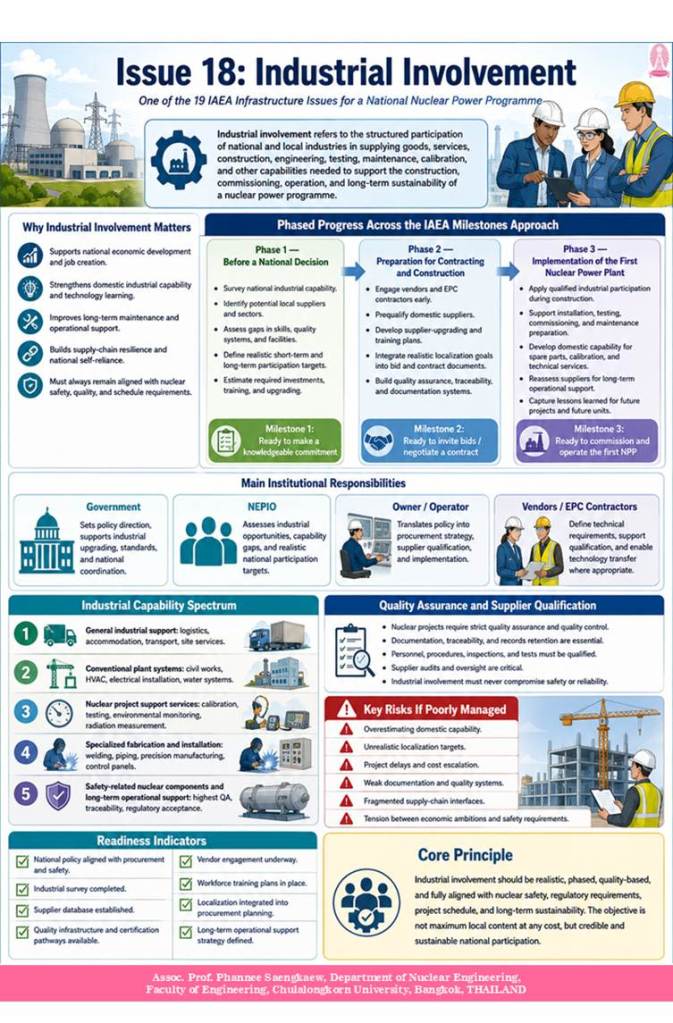
ประเด็นด้านที่ 18: การมีส่วนร่วมของภาคอุตสาหกรรม
1. บทนำ
การมีส่วนร่วมของภาคอุตสาหกรรมเป็นโครงสร้างพื้นฐานด้านที่ 18 จาก โครงสร้างพื้นฐาน 19 ด้าน ที่กำหนดไว้ในแนวทางตามกรอบหมุดหมายของทบวงการพลังงานปรมาณูระหว่างประเทศ หรือ IAEA Milestones Approach สำหรับการพัฒนาโครงการพลังงานนิวเคลียร์แห่งชาติ ประเด็นด้านนี้หมายถึงการมีส่วนร่วมอย่างเป็นระบบของอุตสาหกรรมระดับชาติและระดับท้องถิ่น ในการจัดหาสินค้า ชิ้นส่วน งานก่อสร้าง บริการทางวิศวกรรม งานสนับสนุนการบำรุงรักษา บริการสอบเทียบ บริการทดสอบ และขีดความสามารถทางอุตสาหกรรมอื่น ๆ ที่จำเป็นต่อการก่อสร้าง การทดสอบเดินระบบ การเดินเครื่อง และการสนับสนุนโรงไฟฟ้านิวเคลียร์ในระยะยาว
ภายใต้กรอบของ IAEA นี้ การมีส่วนร่วมของภาคอุตสาหกรรมมิได้ถูกพิจารณาเป็นเพียงกิจกรรมด้านการพัฒนาเศรษฐกิจเท่านั้น แต่เป็นประเด็นโครงสร้างพื้นฐานที่ส่งผลโดยตรงต่อความเป็นไปได้ของโครงการ กำหนดเวลา คุณภาพ ความปลอดภัย ความเชื่อถือได้ และความยั่งยืนของโครงการพลังงานนิวเคลียร์ โรงไฟฟ้านิวเคลียร์ต้องอาศัยฐานอุตสาหกรรมขนาดใหญ่และมีการประสานงานอย่างสูง ครอบคลุมงานก่อสร้างโยธา ระบบไฟฟ้า ระบบเครื่องกล ระบบเครื่องมือวัดและควบคุม การทดสอบวัสดุ งานเชื่อม การผลิตชิ้นส่วน การขนส่งและการจัดการโลจิสติกส์ การประกันคุณภาพ การทดสอบแบบไม่ทำลาย การเฝ้าระวังสิ่งแวดล้อม และบริการบำรุงรักษาระยะยาว ดังนั้นการมีส่วนร่วมของอุตสาหกรรมภายในประเทศต้องได้รับการวางแผนอย่างสมจริง สอดคล้องกับยุทธศาสตร์การจัดซื้อจัดจ้าง และพัฒนาตามข้อกำหนดด้านคุณภาพในระดับนิวเคลียร์
แนวทางตามกรอบหมุดหมายของ IAEA แบ่งการพัฒนาโครงสร้างพื้นฐานทางนิวเคลียร์ออกเป็นสามระยะ ได้แก่ ระยะที่ 1 ซึ่งเกี่ยวข้องกับการพิจารณาก่อนตัดสินใจระดับชาติ ระยะที่ 2 ซึ่งเกี่ยวข้องกับการเตรียมความพร้อมก่อนการทำสัญญาและการก่อสร้าง และระยะที่ 3 ซึ่งเกี่ยวข้องกับการดำเนินโครงการโรงไฟฟ้านิวเคลียร์แห่งแรก หมุดหมายที่สอดคล้องกัน ได้แก่ ความพร้อมในการให้คำมั่นอย่างมีความรู้ ความพร้อมในการเชิญชวนให้เสนอราคา หรือเจรจาสัญญา และความพร้อมในการเดินเครื่องโรงไฟฟ้านิวเคลียร์แห่งแรก โครงสร้างด้านที่ 18 จึงดำเนินตามตรรกะเชิงระยะดังกล่าว กล่าวคือ ประเทศควรเริ่มจากการประเมินขีดความสามารถทางอุตสาหกรรมของตน จากนั้นจึงกำหนดเป้าหมายการมีส่วนร่วมและแผนการยกระดับที่สมจริง และสุดท้ายจึงนำภาคอุตสาหกรรมที่ผ่านการรับรองเข้ามามีส่วนร่วมจริงในช่วงการก่อสร้างและการสนับสนุนการเดินเครื่อง
2. ความหมายและขอบเขตของการมีส่วนร่วมของภาคอุตสาหกรรม
การมีส่วนร่วมของภาคอุตสาหกรรมหมายถึงการเข้าร่วมของอุตสาหกรรมระดับชาติและระดับท้องถิ่นในโครงการพลังงานนิวเคลียร์ ในระดับที่มีเหตุผลทางเทคนิค มีความเหมาะสมทางเศรษฐศาสตร์ และสอดคล้องกับข้อกำหนดด้านความปลอดภัยทางนิวเคลียร์ คุณภาพ กำหนดเวลา และกฎระเบียบ การมีส่วนร่วมดังกล่าวอาจครอบคลุมทั้งส่วนที่เกี่ยวข้องโดยตรงกับงานนิวเคลียร์ และส่วนที่ไม่เกี่ยวข้องโดยตรงกับงานนิวเคลียร์ ตัวอย่างเช่น อุตสาหกรรมภายในประเทศอาจมีส่วนร่วมในงานโยธา การเตรียมพื้นที่ วัสดุก่อสร้าง การจัดการโลจิสติกส์ การขนส่ง ที่พัก ระบบไฟฟ้าทั่วไป โครงสร้างที่ไม่เกี่ยวข้องกับความปลอดภัย งานสนับสนุนการบำรุงรักษา การจัดหาอะไหล่ บริการห้องปฏิบัติการ การสอบเทียบ และการเฝ้าระวังสิ่งแวดล้อม ในระดับที่ก้าวหน้ามากขึ้น การมีส่วนร่วมอาจรวมถึงงานเชื่อมที่ผ่านการรับรอง ชิ้นส่วนขอบเขตความดัน งานผลิตทางเครื่องกล ตู้ไฟฟ้า แผงควบคุม เครื่องมือวัด การทดสอบเฉพาะทาง และบริการประกันคุณภาพระดับคุณภาพนิวเคลียร์
IAEA ระบุว่า การก่อสร้างและการสนับสนุนการดำเนินงานของโรงไฟฟ้านิวเคลียร์ต้องอาศัยสินค้า ชิ้นส่วน และบริการจำนวนมาก และกิจกรรมเหล่านี้สามารถสร้างงาน กระตุ้นการเติบโตทางเศรษฐกิจ และสนับสนุนการถ่ายทอดเทคโนโลยีได้ อย่างไรก็ตาม การจัดหาอุปกรณ์และบริการเฉพาะทางด้านนิวเคลียร์ต้องอาศัยขีดความสามารถที่อาจเข้มงวดกว่ามาตรฐานที่ใช้ในอุตสาหกรรมทั่วไป ด้วยเหตุนี้ การมีส่วนร่วมของภาคอุตสาหกรรมจึงไม่ควรถูกตีความอย่างง่ายว่าเป็นเพียงเป้าหมายของ “สัดส่วนการใช้ทรัพยากรภายในประเทศ” แต่ควรเข้าใจว่าเป็นกระบวนการสร้างขีดความสามารถอย่างเป็นระบบ ซึ่งต้องอยู่ภายใต้การประกันคุณภาพ การรับรองผู้จัดหา วัฒนธรรมความปลอดภัย การปฏิบัติตามกฎระเบียบ วินัยด้านกำหนดเวลาโครงการ และความสามารถในการบำรุงรักษาระยะยาว
คำว่า “การทำให้เป็นท้องถิ่น” หรือ localization มักใช้เพื่ออธิบายการเพิ่มระดับการมีส่วนร่วมของอุตสาหกรรมภายในประเทศและท้องถิ่น ในบริบทของ IAEA การทำให้เป็นท้องถิ่นควรได้รับการวางแผนอย่างรอบคอบ เนื่องจากเป้าหมายการใช้สัดส่วนภายในประเทศที่สูงเกินไปหรือไม่สมจริงอาจทำให้เกิดความเสี่ยงต่อโครงการได้ ประเทศหนึ่งอาจเริ่มต้นด้วยระดับการมีส่วนร่วมของอุตสาหกรรมภายในประเทศที่จำกัดในโรงไฟฟ้านิวเคลียร์แห่งแรก และค่อย ๆ เพิ่มระดับการมีส่วนร่วมในหน่วยถัดไปเมื่อขีดความสามารถของประเทศมีความพร้อมมากขึ้น
3. ความสำคัญเชิงยุทธศาสตร์ของการมีส่วนร่วมของภาคอุตสาหกรรม
การมีส่วนร่วมของภาคอุตสาหกรรมมีความสำคัญเชิงยุทธศาสตร์ เพราะเป็นกลไกที่เชื่อมโยงโครงการพลังงานนิวเคลียร์เข้ากับการพัฒนาเศรษฐกิจของประเทศ การถ่ายทอดเทคโนโลยี การพัฒนากำลังคน ความยืดหยุ่นของห่วงโซ่อุปทาน และความยั่งยืนในการเดินเครื่องระยะยาว โรงไฟฟ้านิวเคลียร์มิใช่เพียงสินทรัพย์สำหรับผลิตไฟฟ้าเท่านั้น แต่เป็นโครงการอุตสาหกรรมที่ซับซ้อนซึ่งต้องอาศัยจุดเชื่อมต่อจำนวนมากระหว่างงานวิศวกรรม การก่อสร้าง การผลิต การควบคุมคุณภาพ การออกใบอนุญาต การจัดซื้อจัดจ้าง และองค์กรด้านการบำรุงรักษา
จากมุมมองทางเศรษฐกิจ การมีส่วนร่วมของภาคอุตสาหกรรมช่วยให้ประเทศสามารถรักษามูลค่าการลงทุนบางส่วนจากโครงการนิวเคลียร์ไว้ภายในประเทศ ผ่านการจ้างงาน การยกระดับอุตสาหกรรม การเรียนรู้เทคโนโลยี และการเข้าร่วมของบริษัทภายในประเทศ จากมุมมองทางเทคนิค ขีดความสามารถภายในประเทศสามารถสนับสนุนโครงการได้ดีขึ้น ลดการพึ่งพาผู้จัดหาจากต่างประเทศสำหรับบริการประจำ และเสริมสร้างฐานความรู้ของประเทศ จากมุมมองด้านความปลอดภัยและการเดินเครื่อง ผู้จัดหาภายในประเทศที่ผ่านการรับรองสามารถสนับสนุนงานบำรุงรักษา การสอบเทียบ การตรวจสอบ การจัดการอะไหล่ การซ่อมแซมฉุกเฉิน และการจัดการความเสื่อมสภาพระยะยาว
อย่างไรก็ตาม การมีส่วนร่วมของภาคอุตสาหกรรมอาจกลายเป็นแหล่งของความเสี่ยงได้เช่นกัน หากขับเคลื่อนด้วยความคาดหวังทางการเมืองหรือเศรษฐกิจเป็นหลัก โดยไม่มีการให้ความสำคัญเพียงพอต่อมาตรฐานระดับคุณภาพนิวเคลียร์ โครงการนิวเคลียร์ต้องอาศัยการควบคุมคุณภาพ การจัดทำเอกสาร การตรวจสอบย้อนกลับ การจัดการโครงรูปของระบบ การรับรองผู้จัดหา และการจำแนกระดับความสำคัญด้านความปลอดภัยอย่างเข้มงวด หากนำผู้จัดหาภายในประเทศเข้ามาก่อนที่มีความพร้อมเพียงพอ โครงการอาจประสบปัญหาความล่าช้า งานแก้ไขซ้ำ ค่าใช้จ่ายเพิ่มขึ้น ปัญหาในการออกใบอนุญาต หรือการสูญเสียความเชื่อมั่นของสาธารณชน ดังนั้น IAEA จึงเน้นว่า ระดับการมีส่วนร่วมของอุตสาหกรรมภายในประเทศจริง ควรอยู่ภายในขีดความสามารถของอุตสาหกรรมภายในประเทศในการตอบสนองต่อความคาดหวังด้านกำหนดเวลา คุณภาพ งบประมาณ และความปลอดภัย
4. ความสัมพันธ์กับประเด็นโครงสร้างพื้นฐานอื่น
การมีส่วนร่วมของภาคอุตสาหกรรมมีความเชื่อมโยงอย่างใกล้ชิดกับหลายด้านในกรอบโครงสร้างพื้นฐานของ IAEA และไม่สามารถพัฒนาโดยแยกออกจากประเด็นด้านอื่นได้
ด้านที่ 19 การจัดซื้อจัดจ้าง เนื่องจากการตัดสินใจเกี่ยวกับการมีส่วนร่วมของอุตสาหกรรมภายในประเทศต้องสะท้อนอยู่ในข้อกำหนดการเชิญชวนให้เสนอราคา เกณฑ์การรับรองผู้จัดหา โครงสร้างสัญญา ข้อกำหนดด้านการทำให้เป็นท้องถิ่น เงื่อนไขการถ่ายทอดเทคโนโลยี และเกณฑ์การประเมิน IAEA ระบุว่ายุทธศาสตร์การมีส่วนร่วมของภาคอุตสาหกรรมควรสอดคล้องกับยุทธศาสตร์การจัดซื้อจัดจ้าง และควรคำนึงถึงบทบาทของผู้รับเหมาด้านวิศวกรรม การจัดซื้อ และการก่อสร้าง หรือ EPC contractor ในการคัดเลือกผู้จัดหา
ด้านที่ 10 การพัฒนาทรัพยากรมนุษย์ เนื่องจากการมีส่วนร่วมของภาคอุตสาหกรรมต้องอาศัยวิศวกร ช่างเทคนิค ช่างเชื่อม ผู้ตรวจสอบ บุคลากรประกันคุณภาพ ผู้จัดการโครงการ ผู้เชี่ยวชาญด้านการสอบเทียบ และบุคลากรด้านบำรุงรักษาที่มีคุณสมบัติเหมาะสม ขีดความสามารถทางอุตสาหกรรมไม่สามารถเกิดขึ้นได้จากนโยบายเพียงอย่างเดียว แต่ต้องอาศัยการศึกษา การฝึกอบรม การรับรอง และประสบการณ์จริง
ด้านที่ 7 กรอบการกำกับดูแล เนื่องจากข้อกำหนดของหน่วยงานกำกับดูแลส่งผลต่อการรับรองผู้จัดหา โครงการประกันคุณภาพ การตรวจสอบระหว่างการก่อสร้าง การเปลี่ยนแปลงแบบ เอกสารประกอบ และการจำแนกระดับความสำคัญด้านความปลอดภัยของชิ้นส่วนและบริการ
ด้านที่ 3 การบริหารจัดการ เนื่องจากการมีส่วนร่วมของภาคอุตสาหกรรมต้องอาศัยระบบบริหารจัดการ การควบคุมการเชื่อมประสานระหว่างองค์กร การควบคุมเอกสาร การกำกับดูแลห่วงโซ่อุปทาน และความรับผิดชอบที่ชัดเจนระหว่างรัฐบาล เจ้าของหรือผู้ดำเนินการ ผู้ขายเทคโนโลยี ผู้รับเหมา และอุตสาหกรรมภายในประเทศ
ด้านที่ 4 การจัดหาเงินทุนและการเงิน เนื่องจากการยกระดับอุตสาหกรรมภายในประเทศอาจต้องใช้งบลงทุนในสถานที่ เครื่องมือ อุปกรณ์ การฝึกอบรม ห้องปฏิบัติการทดสอบ ระบบการรับรอง และระบบบริหารคุณภาพ
ด้านที่ 11 การมีส่วนร่วมของผู้มีส่วนได้ส่วนเสีย เนื่องจากการมีส่วนร่วมของอุตสาหกรรมภายในประเทศสามารถมีอิทธิพลต่อการยอมรับของสาธารณชน ผลประโยชน์ทางเศรษฐกิจในพื้นที่อาจช่วยเสริมแรงสนับสนุนต่อโครงการ ขณะที่การให้คำมั่นที่ไม่สมจริงเกี่ยวกับการจ้างงานหรือการถ่ายทอดเทคโนโลยีอาจทำลายความน่าเชื่อถือ หากไม่สามารถดำเนินการให้เกิดผลจริงได้
5. ความรับผิดชอบหลักของสถาบันที่เกี่ยวข้อง
5.1 รัฐบาล
รัฐบาลมีบทบาทสำคัญในการกำหนดทิศทางนโยบายระดับชาติสำหรับการมีส่วนร่วมของภาคอุตสาหกรรม รัฐบาลควรกำหนดวัตถุประสงค์ที่สมจริงสำหรับการมีส่วนร่วมของอุตสาหกรรมภายในประเทศ รับรองว่านโยบายอุตสาหกรรมสอดคล้องกับความปลอดภัยนิวเคลียร์และยุทธศาสตร์การจัดซื้อจัดจ้าง และสนับสนุนการพัฒนาขีดความสามารถในกรณีที่มีเหตุผลรองรับ หน่วยงานรัฐอาจมีบทบาทในการส่งเสริมการสำรวจอุตสาหกรรม โครงการพัฒนาผู้จัดหา การพัฒนามาตรฐานทางเทคนิค โครงสร้างพื้นฐานคุณภาพแห่งชาติ การฝึกอบรมสายอาชีพ และการประสานงานกับหอการค้า เขตอุตสาหกรรม มหาวิทยาลัย สถาบันวิจัย และหน่วยงานมาตรฐาน
อย่างไรก็ตาม รัฐบาลควรหลีกเลี่ยงการกำหนดเป้าหมายการทำให้เป็นท้องถิ่นที่ไม่สมจริง ซึ่งขัดแย้งกับความปลอดภัยของโครงการ ต้นทุน กำหนดเวลา หรือข้อกำหนดการรับรองผู้จัดหา นโยบายอุตสาหกรรมต้องสนับสนุนโครงการนิวเคลียร์ ไม่ใช่ทำให้โครงการเผชิญความเสี่ยง
5.2 คณะทำงานดำเนินงานเตรียมพร้อมโครงการพลังงานนิวเคลียร์ หรือ คณะทำงาน NEPIO
ในระยะที่ 1 คณะทำงานดำเนินงานเตรียมพร้อมโครงการพลังงานนิวเคลียร์ หรือ Nuclear Energy Programme Implementing Organization ซึ่งมักเรียกว่า คณะทำงาน NEPIO มีบทบาทหลักในการประสานงาน ซึ่ง IAEA ระบุว่าการศึกษาของคณะทำงาน NEPIO ในระยะที่ 1 ควรประเมินโอกาสของการมีส่วนร่วมของอุตสาหกรรมระดับชาติและระดับท้องถิ่น ระบุระดับการมีส่วนร่วมที่สามารถทำได้จากขีดความสามารถที่มีอยู่ ระบุโอกาสในการเพิ่มระดับการมีส่วนร่วมผ่านการวางแผนและการลงทุน และเสนอเป้าหมายระยะสั้นและระยะยาวสำหรับการมีส่วนร่วมของภาคอุตสาหกรรม
คณะทำงาน NEPIO ควรรับรองด้วยว่าการมีส่วนร่วมของภาคอุตสาหกรรมได้รับการประเมินเป็นส่วนหนึ่งของรายงานระยะที่ 1 อย่างครบถ้วน รายงานดังกล่าวไม่ควรเป็นเพียงรายการอุตสาหกรรมที่อาจเกี่ยวข้องเท่านั้น แต่ควรประเมินขีดความสามารถ ความสนใจ ความต้องการด้านการลงทุน ความต้องการด้านการฝึกอบรม มาตรฐานคุณภาพ ความคาดหวังของผู้ขายเทคโนโลยี และเส้นทางที่สมจริงสำหรับการมีส่วนร่วม
5.3 เจ้าของหรือผู้ดำเนินการ
เจ้าของหรือผู้ดำเนินการมีบทบาทเพิ่มขึ้นอย่างมากในระยะที่ 2 และระยะที่ 3 โดยต้องแปลงวัตถุประสงค์ด้านการมีส่วนร่วมของอุตสาหกรรมภายในประเทศให้เป็นการจัดซื้อจัดจ้าง การรับรองผู้จัดหา และการดำเนินโครงการในทางปฏิบัติ เจ้าของหรือผู้ดำเนินการต้องกำหนดว่าสินค้าและบริการใดสามารถจัดหาได้ภายในประเทศ รายการใดต้องใช้ผู้จัดหาจากต่างประเทศ และรายการใดอาจพัฒนาได้ผ่านกิจการร่วมค้า การรับเหมาช่วง การถ่ายทอดเทคโนโลยี หรือการพัฒนาผู้จัดหาในระยะยาว
เจ้าของหรือผู้ดำเนินการต้องรับรองด้วยว่าผู้จัดหาภายในประเทศสามารถปฏิบัติตามข้อกำหนดด้านการประกันคุณภาพ กำหนดเวลา เอกสาร ความปลอดภัย และเทคนิคที่เกี่ยวข้อง ในโครงการนิวเคลียร์ การกำกับดูแลผู้จัดหาไม่ใช่เพียงกิจกรรมการจัดซื้อทั่วไป แต่เป็นส่วนหนึ่งของระบบบริหารจัดการที่สนับสนุนความปลอดภัยและความเชื่อถือได้
5.4 ผู้ขายเทคโนโลยีและผู้รับเหมาหลักที่รับผิดชอบงานวิศวกรรม การจัดหา และการก่อสร้างหรือผู้รับเหมา EPC (Engineering, Procurement and Construction: EPC)
ผู้ขายเทคโนโลยีและผู้รับเหมาด้านวิศวกรรม การจัดซื้อ และการก่อสร้าง หรือ EPC contractor มีบทบาทสำคัญ เนื่องจากมักเป็นฝ่ายควบคุมข้อกำหนดการออกแบบ การรับรองผู้จัดหา การคัดเลือกชิ้นส่วน การจัดการถ่ายทอดเทคโนโลยี และกำหนดเวลาการก่อสร้าง ซึ่ง IAEA ระบุว่ายุทธศาสตร์การมีส่วนร่วมของภาคอุตสาหกรรมต้องคำนึงถึงบทบาทของผู้รับเหมา EPC ในการคัดเลือกผู้จัดหา ดังนั้นการมีส่วนร่วมของอุตสาหกรรมภายในประเทศควรได้รับการหารือกับผู้ขายเทคโนโลยีที่มีศักยภาพตั้งแต่ระยะแรก และควรบรรจุไว้ในข้อกำหนดการเสนอราคาและการเจรจาสัญญาเมื่อเหมาะสม
5.5 อุตสาหกรรมภายในประเทศ
อุตสาหกรรมภายในประเทศต้องประเมินว่าตนมีความเต็มใจและมีความสามารถในการเข้าร่วมโครงการนิวเคลียร์หรือไม่ การเข้าร่วมอาจต้องอาศัยการลงทุนในสถานที่ บุคลากร ระบบบริหารคุณภาพ ใบรับรอง ระบบเอกสาร ขั้นตอนการตรวจสอบย้อนกลับ วัฒนธรรมความปลอดภัย และความมุ่งมั่นระยะยาว บริษัทที่ปกติให้บริการในภาคไฟฟ้าทั่วไป ปิโตรเคมี น้ำมันและก๊าซ การต่อเรือ การผลิตความแม่นยำสูง งานก่อสร้าง ระบบไฟฟ้า หรือระบบอัตโนมัติทางอุตสาหกรรม อาจมีขีดความสามารถพื้นฐานที่เกี่ยวข้อง แต่ยังอาจต้องยกระดับอย่างมีนัยสำคัญเพื่อให้เป็นไปตามข้อกำหนดของโครงการนิวเคลียร์
6. ระยะที่ 1: การพิจารณาก่อนตัดสินใจดำเนินโครงการพลังงานนิวเคลียร์
ในระยะที่ 1 วัตถุประสงค์หลักคือ การทำความเข้าใจฐานอุตสาหกรรมของประเทศในปัจจุบัน และกำหนดระดับการมีส่วนร่วมของภาคอุตสาหกรรมที่สมจริง ขั้นตอนนี้ไม่ควรตั้งอยู่บนสมมติฐานหรือความทะเยอทะยานทางนโยบายเพียงอย่างเดียว แต่ควรตั้งอยู่บนการสำรวจอุตสาหกรรมอย่างเป็นระบบ
คณะทำงาน NEPIO ควรประเมินขีดความสามารถที่มีอยู่ของประเทศในด้านงานก่อสร้างโยธา การผลิตเหล็กและโครงสร้างโลหะ เทคโนโลยีคอนกรีต การติดตั้งระบบไฟฟ้า การติดตั้งระบบเครื่องกล งานเชื่อม การทดสอบแบบไม่ทำลาย ระบบเครื่องมือวัด ระบบควบคุม การจัดการโลจิสติกส์ การขนส่งหนัก การเฝ้าระวังสิ่งแวดล้อม การตรวจวัดรังสี บริการห้องปฏิบัติการ การสอบเทียบ การให้คำปรึกษาทางวิศวกรรม การบริหารโครงการ และการประกันคุณภาพ การประเมินควรระบุว่าอุตสาหกรรมใดสามารถมีส่วนร่วมได้ทันที อุตสาหกรรมใดอาจมีส่วนร่วมได้หลังการยกระดับ และด้านใดมีแนวโน้มต้องพึ่งพาผู้จัดหาจากต่างประเทศสำหรับโครงการแรก
IAEA ระบุภารกิจสำคัญหลายประการสำหรับการศึกษาในระยะที่ 1 ได้แก่ การศึกษาค้นคว้าโอกาสการมีส่วนร่วมของประเทศ การหารือกับผู้ขายเทคโนโลยีที่มีศักยภาพ การประเมินขีดความสามารถของอุตสาหกรรมระดับชาติและระดับท้องถิ่น การระบุความต้องการด้านการฝึกอบรมและการพัฒนา การประเมินความสนใจของภาคอุตสาหกรรม การประเมินความต้องการด้านการลงทุน และการเสนอเป้าหมายการมีส่วนร่วมระยะสั้นและระยะยาว
ผลลัพธ์ที่เข้มแข็งของระยะที่ 1 ควรประกอบด้วยประเด็นต่อไปนี้
| ด้านที่ประเมิน | ผลลัพธ์ที่คาดหวังในระยะที่ 1 |
| การสำรวจอุตสาหกรรม | การจัดทำแผนที่บริษัท สถานที่ผลิต ทักษะ ใบรับรอง และภาคอุตสาหกรรมที่มีอยู่ |
| การวิเคราะห์ช่องว่างของขีดความสามารถ | การระบุช่องว่างระหว่างขีดความสามารถอุตสาหกรรมที่มีอยู่กับข้อกำหนดของโครงการนิวเคลียร์ |
| การทบทวนมาตรฐานคุณภาพ | ความเข้าใจเบื้องต้นเกี่ยวกับการประกันคุณภาพระดับนิวเคลียร์และความต้องการด้านเอกสาร |
| การหารือกับผู้ขายเทคโนโลยี | การหารือเบื้องต้นกับผู้ขายเทคโนโลยีและผู้รับเหมา EPC ที่มีศักยภาพ |
| ยุทธศาสตร์การทำให้เป็นท้องถิ่น | การกำหนดเป้าหมายระยะสั้นและระยะยาวที่สมจริงสำหรับการมีส่วนร่วมภายในประเทศ |
| ความต้องการด้านการลงทุน | การประมาณความต้องการในการยกระดับสถานที่ อุปกรณ์ การฝึกอบรม การรับรอง และโครงสร้างพื้นฐานด้านคุณภาพ |
| การประเมินความเสี่ยง | การระบุความเสี่ยงหากเป้าหมายการทำให้เป็นท้องถิ่นเกินกว่าความพร้อมของอุตสาหกรรม |
เมื่อสิ้นสุดระยะที่ 1 ประเทศควรเข้าใจว่าการมีส่วนร่วมของภาคอุตสาหกรรมสามารถให้ประโยชน์อย่างมีนัยสำคัญได้หรือไม่ โดยไม่ก่อให้เกิดความเสี่ยงที่ยอมรับไม่ได้ต่อโครงการ หลักการสำคัญคือความสมจริง ประเทศที่เพิ่งเริ่มโครงการใหม่อาจเริ่มจากการมีส่วนร่วมจำกัดในชิ้นส่วนระดับนิวเคลียร์ที่เกี่ยวข้องกับความปลอดภัย แต่ยังสามารถสร้างการมีส่วนร่วมที่มีคุณค่าได้ในงานโยธา ระบบที่ไม่เกี่ยวข้องกับนิวเคลียร์ โครงสร้างพื้นฐานของพื้นที่โครงการ การจัดการโลจิสติกส์ บริการสนับสนุนการบำรุงรักษา และบริการอุตสาหกรรมทั่วไป
7. ระยะที่ 2: การเตรียมความพร้อมสำหรับการทำสัญญาและการก่อสร้าง
ในระยะที่ 2 การมีส่วนร่วมของภาคอุตสาหกรรมเปลี่ยนจากการประเมินไปสู่การวางแผนและการเจรจา รัฐบาล เจ้าของหรือผู้ดำเนินการ ภาคอุตสาหกรรม และผู้ขายเทคโนโลยีที่มีศักยภาพควรจัดให้มีการหารืออย่างเป็นทางการ และกำหนดแผนปฏิบัติการสำหรับการยกระดับขีดความสามารถ และทาง IAEA ระบุว่า จากเป้าหมายที่กำหนดไว้ในระยะที่ 1 รัฐบาลและภาคอุตสาหกรรมควรสื่อสารกับผู้ขายเทคโนโลยีที่มีศักยภาพ ระบุอุตสาหกรรมที่มีความมุ่งมั่นจะเข้าร่วม และตกลงแผนปฏิบัติการสำหรับการยกระดับขีดความสามารถ
ระยะนี้มีความสำคัญอย่างยิ่ง เนื่องจากข้อกำหนดการเชิญชวนให้เสนอราคาและเอกสารสัญญาถูกจัดเตรียมในระยะที่ 2 หากการมีส่วนร่วมของภาคอุตสาหกรรมไม่ถูกบรรจุอยู่ในเอกสารการจัดซื้อจัดจ้างในช่วงนี้ อาจเป็นเรื่องยากที่จะดำเนินการให้เกิดผลในภายหลัง เอกสารการเสนอราคาอาจรวมถึงข้อกำหนดหรือแรงจูงใจเกี่ยวกับการมีส่วนร่วมภายในประเทศ การถ่ายทอดเทคโนโลยี การฝึกอบรม กิจการร่วมค้า การรับเหมาช่วงภายในประเทศ การพัฒนาผู้จัดหา หรือการสร้างขีดความสามารถด้านการบำรุงรักษาภายในประเทศ อย่างไรก็ตาม ข้อกำหนดเหล่านี้ต้องมีความน่าเชื่อถือทางเทคนิค และต้องไม่ลดทอนความปลอดภัย คุณภาพ หรือสมรรถนะด้านกำหนดเวลา
ในระยะที่ 2 เจ้าของหรือผู้ดำเนินการควรระบุว่าผู้จัดหาระดับชาติหรือระดับท้องถิ่นรายใดสามารถจัดหาสินค้า ชิ้นส่วน หรือบริการสำหรับส่วนที่เกี่ยวข้องกับนิวเคลียร์และส่วนที่ไม่เกี่ยวข้องกับนิวเคลียร์ของโรงไฟฟ้าได้อย่างเชื่อถือได้ นอกจากนี้ ควรกำหนดว่าการยกระดับทักษะและขีดความสามารถด้านใดมีความสมจริงภายในกรอบเวลาของโครงการ
กิจกรรมสำคัญในระยะที่ 2 ได้แก่
| กิจกรรม | วัตถุประสงค์ |
| การคัดกรองและรับรองผู้จัดหาเบื้องต้น | กำหนดว่าบริษัทภายในประเทศใดสามารถปฏิบัติตามข้อกำหนดของโครงการได้ |
| การประชุมเชิงปฏิบัติการกับผู้ขายเทคโนโลยี | สื่อสารความคาดหวังด้านคุณภาพระดับนิวเคลียร์ เอกสาร และกำหนดเวลา |
| แผนยกระดับอุตสาหกรรม | สนับสนุนผู้จัดหาที่ได้รับคัดเลือกด้านการฝึกอบรม การรับรอง และการปรับปรุงกระบวนการ |
| เงื่อนไขการทำให้เป็นท้องถิ่นในสัญญา | บรรจุข้อกำหนดการมีส่วนร่วมภายในประเทศที่สมจริงไว้ในเอกสารเสนอราคาและสัญญา |
| การพัฒนากิจการร่วมค้า | เชื่อมโยงบริษัทภายในประเทศกับผู้จัดหาระหว่างประเทศที่มีประสบการณ์ |
| การเตรียมความพร้อมด้านการประกันคุณภาพ | พัฒนาระบบบริหารจัดการระดับนิวเคลียร์ การตรวจสอบย้อนกลับ การตรวจสอบ และเอกสาร |
| การวางแผนกำลังคน | ประสานการมีส่วนร่วมของภาคอุตสาหกรรมกับการพัฒนาทรัพยากรมนุษย์และการฝึกอบรมสายอาชีพ |
| การควบคุมความเสี่ยง | ป้องกันไม่ให้เป้าหมายการทำให้เป็นท้องถิ่นก่อให้เกิดความล่าช้าหรือความล้มเหลวด้านคุณภาพ |
หลักการสำคัญที่สุดของระยะที่ 2 คือ การทำให้เป็นท้องถิ่นต้องสอดคล้องกับการดำเนินโครงการนิวเคลียร์ ผู้จัดหาภายในประเทศต้องสามารถส่งมอบงานได้ตรงเวลา มีต้นทุนแข่งขันได้ และมีการควบคุมคุณภาพและการประกันคุณภาพที่เหมาะสม ซึ่ง IAEA เตือนว่าความล่าช้าในการก่อสร้างสามารถเพิ่มต้นทุนอย่างมีนัยสำคัญ และลดความเชื่อมั่นของหน่วยงานกำกับดูแลและสาธารณชนได้
8. ระยะที่ 3: การดำเนินโครงการโรงไฟฟ้านิวเคลียร์แห่งแรก
ในระยะที่ 3 การมีส่วนร่วมของภาคอุตสาหกรรมกลายเป็นการดำเนินการจริงผ่านการก่อสร้าง การทดสอบเดินระบบ และการเตรียมความพร้อมสำหรับการสนับสนุนโรงไฟฟ้าในระยะยาว อุตสาหกรรมภายในประเทศอาจมีส่วนร่วมในงานพื้นที่โครงการ งานก่อสร้างโยธา การติดตั้งระบบไฟฟ้า การติดตั้งระบบเครื่องกล ระบบที่ไม่เกี่ยวข้องกับความปลอดภัย อาคารสนับสนุน โครงสร้างพื้นฐาน การจัดการโลจิสติกส์ การทดสอบ การสนับสนุนการทดสอบเดินระบบ การเตรียมงานบำรุงรักษา บริการสอบเทียบ การจัดหาอะไหล่ และบริการทางเทคนิคบางประเภท
เมื่อการก่อสร้างใกล้เสร็จสมบูรณ์ ประเทศควรประเมินแหล่งจัดหาเพื่อสนับสนุนการเดินเครื่องอีกครั้ง และทาง IAEA ระบุว่า หากโครงสร้างอุตสาหกรรมระดับชาติและระดับท้องถิ่นมีความก้าวหน้าเพียงพอ อะไหล่ วัสดุสิ้นเปลือง บริการบำรุงรักษา และบริการสอบเทียบอาจสามารถจัดสรรให้ผู้จัดหาภายในประเทศได้ตามความเหมาะสม อย่างไรก็ตามข้อกำหนดการรับรองผู้จัดหายังคงมีความจำเป็นสำหรับการสนับสนุนการเดินเครื่อง และในบางกรณีข้อกำหนดด้านการเดินเครื่องอาจเข้มงวดกว่าข้อกำหนดในช่วงการก่อสร้างด้วยซ้ำ
ประเด็นนี้มีความสำคัญอย่างยิ่ง เพราะโครงการพลังงานนิวเคลียร์มิได้สิ้นสุดลงเมื่อการก่อสร้างเสร็จสิ้น การมีส่วนร่วมของภาคอุตสาหกรรมต้องสนับสนุนการเดินเครื่องเป็นเวลาหลายทศวรรษ การมีส่วนร่วมระยะยาวอาจรวมถึงสัญญาบำรุงรักษา บริการตรวจสอบ บริการสอบเทียบ ห้องปฏิบัติการ การเฝ้าระวังสิ่งแวดล้อม บริการป้องกันรังสี งานสนับสนุนการจัดการกาก งานจัดการช่วงหยุดเดินเครื่อง การจัดการความเสื่อมสภาพ การเปลี่ยนอุปกรณ์ และโครงการปรับปรุงโรงไฟฟ้า
เมื่อสิ้นสุดระยะที่ 3 ประเทศควรทบทวนบทเรียนจากโครงการแรก หากยุทธศาสตร์ระดับชาติมีเป้าหมายจะเพิ่มการมีส่วนร่วมภายในประเทศในหน่วยนิวเคลียร์ถัดไป บทเรียนจากโรงไฟฟ้าแห่งแรกควรถูกนำมาใช้เพื่อปรับปรุงการรับรองผู้จัดหา การฝึกอบรม การประกันคุณภาพ โครงสร้างสัญญา การกำกับดูแล และนโยบายอุตสาหกรรม
9. ประเภทของขีดความสามารถทางอุตสาหกรรม
วิธีปฏิบัติที่มีประโยชน์ในการประเมินการมีส่วนร่วมของภาคอุตสาหกรรม คือการจำแนกระดับขีดความสามารถของการมีส่วนร่วมภายในประเทศออกเป็นหลายระดับ
| ระดับขีดความสามารถ | ตัวอย่าง | ความพร้อมที่โดยทั่วไปต้องมี |
| การสนับสนุนอุตสาหกรรมทั่วไป | ที่พัก การขนส่ง บริการในพื้นที่โครงการ การจัดการโลจิสติกส์ การสนับสนุนด้านรักษาความปลอดภัย วัสดุก่อสร้างทั่วไป | ขีดความสามารถอุตสาหกรรมทั่วไปและการบริหารโครงการพื้นฐาน |
| ระบบโรงไฟฟ้าทั่วไป | ระบบไฟฟ้าที่ไม่เกี่ยวข้องกับความปลอดภัย ระบบปรับอากาศและระบายอากาศ ระบบน้ำ โครงสร้างโยธา ถนน คลังสินค้า | ระบบคุณภาพ การควบคุมกำหนดเวลา และเอกสารทางวิศวกรรม |
| บริการสนับสนุนโครงการนิวเคลียร์ | การสอบเทียบ การทดสอบแบบไม่ทำลาย การทดสอบในห้องปฏิบัติการ การเฝ้าระวังสิ่งแวดล้อม การตรวจวัดรังสี | บุคลากรที่ผ่านการรับรอง การตรวจสอบย้อนกลับ ขั้นตอนประกันคุณภาพ และความเข้าใจด้านกฎระเบียบ |
| การผลิตและการติดตั้งเฉพาะทาง | งานเชื่อม ระบบท่อ ชิ้นส่วนขอบเขตความดัน แผงควบคุม การผลิตความแม่นยำสูง | การประกันคุณภาพระดับคุณภาพนิวเคลียร์ ขั้นตอนที่ผ่านการรับรอง บันทึกการตรวจสอบ และการรับรองผู้จัดหา |
| ชิ้นส่วนระดับนิวเคลียร์ที่เกี่ยวข้องกับความปลอดภัย | อุปกรณ์ระดับความปลอดภัย รายการขอบเขตความดัน ระบบที่เกี่ยวข้องกับเครื่องปฏิกรณ์ | ระดับการรับรองทางนิวเคลียร์สูงสุด การควบคุมแบบ การยอมรับของหน่วยงานกำกับดูแล และการอนุมัติจากผู้ขายเทคโนโลยี |
| การสนับสนุนการเดินเครื่องระยะยาว | อะไหล่ การบำรุงรักษา การสนับสนุนช่วงหยุดเดินเครื่อง การจัดการความเสื่อมสภาพ การสอบเทียบ และการตรวจสอบ | ขีดความสามารถที่ยั่งยืน การควบคุมโครงรูป เอกสาร และวัฒนธรรมความปลอดภัยในการเดินเครื่อง |
สำหรับประเทศที่เพิ่งเริ่มโครงการใหม่ โรงไฟฟ้านิวเคลียร์แห่งแรกอาจต้องพึ่งพาผู้จัดหาจากต่างประเทศที่มีประสบการณ์สูงสำหรับเกาะนิวเคลียร์และระบบที่เกี่ยวข้องกับความปลอดภัย อย่างไรก็ตาม การมีส่วนร่วมภายในประเทศที่มีนัยสำคัญยังสามารถเกิดขึ้นได้ในงานโยธา ระบบทั่วไป โครงสร้างพื้นฐานของพื้นที่โครงการ บริการสนับสนุนที่ไม่เกี่ยวข้องกับนิวเคลียร์ ห้องปฏิบัติการทดสอบ การฝึกอบรมด้านบำรุงรักษา และการสนับสนุนการเดินเครื่องในอนาคต
10. การประกันคุณภาพและการรับรองผู้จัดหา
การประกันคุณภาพเป็นหนึ่งในองค์ประกอบที่สำคัญที่สุดของการมีส่วนร่วมของภาคอุตสาหกรรม โครงการนิวเคลียร์ต้องอาศัยการควบคุมอย่างเป็นระบบของการออกแบบ การจัดซื้อ การผลิต การติดตั้ง การตรวจสอบ การทดสอบ เอกสาร และโครงรูปของระบบ ผู้จัดหาต้องเข้าใจไม่เพียงแต่วิธีการผลิตหรือส่งมอบผลิตภัณฑ์เท่านั้น แต่ต้องเข้าใจด้วยว่าจะพิสูจน์อย่างไรว่าผลิตภัณฑ์นั้นเป็นไปตามข้อกำหนดที่กำหนดไว้
การประกันคุณภาพระดับนิวเคลียร์ครอบคลุมการตรวจสอบย้อนกลับของวัสดุ การรับรองคุณสมบัติบุคลากร ขั้นตอนที่ได้รับอนุมัติ แผนการตรวจสอบและทดสอบ การควบคุมความไม่เป็นไปตามข้อกำหนด การดำเนินการแก้ไข การควบคุมเอกสาร การเก็บรักษาบันทึก การตรวจสอบอิสระ และการตรวจประเมินผู้จัดหา สำหรับรายการที่เกี่ยวข้องกับความปลอดภัย ข้อกำหนดจะมีความเข้มงวดเป็นพิเศษ เนื่องจากความล้มเหลวของชิ้นส่วนอาจส่งผลต่อความปลอดภัยนิวเคลียร์
อุตสาหกรรมภายในประเทศที่มีประสบการณ์อยู่แล้วในภาคปิโตรเคมี น้ำมันและก๊าซ อากาศยาน การต่อเรือ หรือระบบพลังงานที่ต้องการความเชื่อถือได้สูง อาจมีพื้นฐานที่เป็นประโยชน์ อย่างไรก็ตาม โครงการนิวเคลียร์มักต้องการวินัยด้านเอกสารที่สูงขึ้น การจำแนกความสำคัญด้านความปลอดภัย การประสานงานกับหน่วยงานกำกับดูแล และการควบคุมโครงรูปในระยะยาว ดังนั้น โครงการการมีส่วนร่วมของภาคอุตสาหกรรมควรรวมถึงการฝึกอบรมผู้จัดหา การตรวจประเมิน โครงการนำร่อง และการรับรองแบบค่อยเป็นค่อยไป มากกว่าการมอบหมายงานสำคัญให้ทันที
11. การถ่ายทอดเทคโนโลยีและการพัฒนาองค์ความรู้
การมีส่วนร่วมของภาคอุตสาหกรรมสามารถสนับสนุนการถ่ายทอดเทคโนโลยีได้ แต่การถ่ายทอดเทคโนโลยีควรถูกเข้าใจอย่างสมจริง การถ่ายทอดเทคโนโลยีไม่ได้เกิดขึ้นโดยอัตโนมัติผ่านการจัดซื้อจัดจ้าง แต่ต้องอาศัยกลไกทางสัญญา โครงการฝึกอบรม งานวิศวกรรมร่วม การผลิตภายใต้การกำกับดูแล ข้อตกลงด้านใบอนุญาต ข้อตกลงด้านทรัพย์สินทางปัญญา การพัฒนาระบบคุณภาพ และความร่วมมือระยะยาวระหว่างองค์กรภายในประเทศและองค์กรระหว่างประเทศ
การถ่ายทอดเทคโนโลยีอาจเกิดขึ้นได้หลายรูปแบบ อาจเกี่ยวข้องกับการฝึกอบรมวิศวกรและช่างเทคนิคภายในประเทศ การจัดตั้งกิจการร่วมค้า การรับรองผู้ผลิตภายในประเทศ การสร้างขีดความสามารถด้านการบำรุงรักษาภายในประเทศ การถ่ายทอดเอกสารและขั้นตอน การสนับสนุนห้องปฏิบัติการระดับชาติ หรือการพัฒนาองค์กรสนับสนุนทางวิศวกรรมภายในประเทศ ในบางกรณี การถ่ายทอดเทคโนโลยีอาจมุ่งเน้นความสามารถด้านการเดินเครื่องและการบำรุงรักษามากกว่าการผลิตชิ้นส่วนหลักทางนิวเคลียร์
ยุทธศาสตร์การถ่ายทอดเทคโนโลยีที่สมจริงควรแยกแยะให้ชัดเจนว่า สิ่งใดสามารถพัฒนาได้ก่อนโรงไฟฟ้าแห่งแรก สิ่งใดสามารถพัฒนาได้ระหว่างการก่อสร้าง และสิ่งใดควรถูกกำหนดเป็นเป้าหมายสำหรับหน่วยถัดไป โครงการแรกไม่ควรถูกบรรทุกด้วยความทะเยอทะยานทางอุตสาหกรรมที่ไม่สมจริงมากเกินไป ในทางกลับกัน โครงการแรกควรทำหน้าที่เป็นรากฐานสำหรับการสร้างขีดความสามารถระยะยาว
12. ความเสี่ยงและความท้าทาย
การมีส่วนร่วมของภาคอุตสาหกรรมก่อให้เกิดความเสี่ยงหลายประการหากไม่ได้รับการจัดการอย่างเหมาะสม
- ประการแรก คือความเสี่ยงจากการประเมินขีดความสามารถสูงเกินจริง บริษัทภายในประเทศอาจดูเหมือนมีความสามารถจากประสบการณ์ในอุตสาหกรรมทั่วไป แต่ยังอาจไม่สามารถปฏิบัติตามข้อกำหนดด้านการประกันคุณภาพ เอกสาร และกำหนดเวลาระดับนิวเคลียร์ได้
- ประการที่สอง คือความเสี่ยงจากเป้าหมายการทำให้เป็นท้องถิ่นที่ไม่สมจริง หากความคาดหวังทางการเมืองผลักดันให้มีการใช้สัดส่วนภายในประเทศมากเกินไป โครงการอาจประสบความล่าช้า ปัญหาคุณภาพ หรือข้อพิพาททางสัญญา
- ประการที่สาม คือความเสี่ยงจากการกระจายตัวของผู้จัดหามากเกินไป โครงการนิวเคลียร์ต้องอาศัยการบริหารโครงการแบบบูรณาการ หากมีผู้จัดหาภายในประเทศจำนวนมากที่ยังไม่มีประสบการณ์ อาจเกิดปัญหารอยต่อระหว่างงานและองค์กรได้
- ประการที่สี่ คือความเสี่ยงจากการลงทุนไม่เพียงพอ การยกระดับอุตสาหกรรมต้องใช้เงิน เวลา การฝึกอบรม อุปกรณ์ การรับรอง และความมุ่งมั่นด้านการบริหาร หากไม่มีการลงทุน การทำให้เป็นท้องถิ่นจะคงอยู่เพียงในระดับถ้อยแถลงเชิงนโยบาย
- ประการที่ห้า คือความเสี่ยงจากความต่อเนื่องระยะยาวที่อ่อนแอ ขีดความสามารถทางอุตสาหกรรมต้องได้รับการรักษาต่อเนื่องหลังจากการก่อสร้าง หากผู้จัดหามีส่วนร่วมเฉพาะช่วงการก่อสร้าง แต่ไม่ได้ถูกบูรณาการเข้าสู่การเดินเครื่องและการบำรุงรักษาระยะยาว ผลประโยชน์ระดับชาติอาจมีจำกัด
- ประการที่หก คือความเสี่ยงจากความขัดแย้งระหว่างวัตถุประสงค์ทางเศรษฐกิจกับข้อกำหนดด้านความปลอดภัย การมีส่วนร่วมของภาคอุตสาหกรรมต้องอยู่ภายใต้ความปลอดภัยนิวเคลียร์ การประกันคุณภาพ การปฏิบัติตามกฎระเบียบ และความเชื่อถือได้ในการเดินเครื่องเสมอ
13. การมีส่วนร่วมของภาคอุตสาหกรรมสำหรับเครื่องปฏิกรณ์แบบโมดูลขนาดเล็ก
สำหรับเครื่องปฏิกรณ์แบบโมดูลขนาดเล็ก หรือ Small Modular Reactors การมีส่วนร่วมของภาคอุตสาหกรรมอาจมีโครงสร้างที่แตกต่างจากโรงไฟฟ้านิวเคลียร์ขนาดใหญ่ ซึ่ง SMR อาจพึ่งพาการผลิตในโรงงาน การก่อสร้างแบบโมดูล แบบมาตรฐาน และห่วงโซ่อุปทานที่ควบคุมโดยผู้ขายเทคโนโลยีมากกว่าเดิม ลักษณะดังกล่าวอาจลดความต้องการด้านการก่อสร้างบางส่วนในพื้นที่โครงการ แต่ก็อาจจำกัดโอกาสการผลิตภายในประเทศสำหรับโมดูลหลักของเครื่องปฏิกรณ์ ในขณะเดียวกัน SMR อาจสร้างโอกาสในงานโยธา ระบบสนับสนุนทั่วไปของโรงไฟฟ้า การติดตั้งโมดูล การเชื่อมต่อระบบไฟฟ้า การสนับสนุนการเดินเครื่องและบำรุงรักษา ระบบรักษาความมั่นคงปลอดภัย โครงสร้างพื้นฐานด้านการเตรียมพร้อมและตอบโต้เหตุฉุกเฉิน การเฝ้าระวังรังสี การสอบเทียบ และเครือข่ายบริการในประเทศ
ซึ่งทาง IAEA ระบุว่า นโยบายและยุทธศาสตร์การมีส่วนร่วมของภาคอุตสาหกรรมควรพัฒนาตั้งแต่ระยะแรก และการสำรวจอุตสาหกรรมควรประเมินความสนใจของภาคอุตสาหกรรม พร้อมทั้งสื่อสารมาตรฐานคุณภาพที่จำเป็นสำหรับโครงการพลังงานนิวเคลียร์ กิจกรรมเหล่านี้ใช้ได้ทั้งกับโรงไฟฟ้านิวเคลียร์ขนาดใหญ่และ SMR ดังนั้น แม้ SMR อาจลดความซับซ้อนบางด้านของการก่อสร้าง แต่ไม่ได้ทำให้ความจำเป็นของความพร้อมทางอุตสาหกรรมของประเทศหมดไป
14. ตัวชี้วัดความพร้อม
ประเทศสามารถประเมินความพร้อมสำหรับโครงสร้างด้านที่ 18 ได้โดยใช้ตัวชี้วัดหลายด้าน
| ด้านความพร้อม | ตัวชี้วัดสำคัญ |
| นโยบาย | มีนโยบายระดับชาติเกี่ยวกับการมีส่วนร่วมของภาคอุตสาหกรรม และสอดคล้องกับข้อกำหนดด้านการจัดซื้อจัดจ้างและความปลอดภัย |
| การสำรวจอุตสาหกรรม | มีการประเมินขีดความสามารถ ช่องว่าง และความต้องการด้านการลงทุนในปัจจุบัน |
| ฐานข้อมูลผู้จัดหา | มีการระบุและจำแนกผู้จัดหาภายในประเทศที่มีศักยภาพ |
| โครงสร้างพื้นฐานด้านคุณภาพ | มีหรือกำลังพัฒนามาตรฐาน ระบบการรับรอง การทดสอบ การสอบเทียบ และระบบประกันคุณภาพ |
| การมีส่วนร่วมกับผู้ขายเทคโนโลยี | มีการหารือกับผู้ขายเทคโนโลยีที่มีศักยภาพเกี่ยวกับระดับการมีส่วนร่วมภายในประเทศที่สมจริง |
| การฝึกอบรม | มีแผนพัฒนากำลังคนภาคอุตสาหกรรมสำหรับวิศวกร ช่างเทคนิค ช่างเชื่อม ผู้ตรวจสอบ บุคลากรประกันคุณภาพ และบุคลากรบำรุงรักษา |
| การบูรณาการกับการจัดซื้อจัดจ้าง | ข้อกำหนดการเสนอราคามีเกณฑ์ด้านการทำให้เป็นท้องถิ่นที่สมจริงเมื่อเหมาะสม |
| การบริหารความเสี่ยง | มีการประเมินความเสี่ยงด้านกำหนดเวลา ต้นทุน คุณภาพ และความปลอดภัยจากการทำให้เป็นท้องถิ่นอย่างชัดเจน |
| การสนับสนุนการเดินเครื่อง | มีแผนสำหรับการบำรุงรักษาระยะยาว อะไหล่ การสอบเทียบ การตรวจสอบ และการสนับสนุนช่วงหยุดเดินเครื่อง |
| บทเรียนที่ได้รับ | มีการทบทวนประสบการณ์จากโครงการแรกเพื่อปรับปรุงการมีส่วนร่วมของภาคอุตสาหกรรมในอนาคต |
15. ความหมายเชิงวิชาการ
โครงสร้างด้านที่ 18 ควรถูกเข้าใจว่าเป็นสะพานเชื่อมระหว่างนโยบายอุตสาหกรรมแห่งชาติกับความพร้อมของโครงสร้างพื้นฐานทางนิวเคลียร์ ประเด็นด้านนี้สะท้อนความสามารถของประเทศในการเปลี่ยนโครงการพลังงานนิวเคลียร์จากสินทรัพย์ทางเทคโนโลยีที่นำเข้าทั้งระบบ ไปสู่ระบบอุตสาหกรรมที่ประเทศสามารถสนับสนุนได้ด้วยตนเอง อย่างไรก็ตาม ประเด็นเชิงวิชาการที่สำคัญคือ การมีส่วนร่วมของภาคอุตสาหกรรมไม่ควรวัดเพียงจากร้อยละของสัดส่วนภายในประเทศเท่านั้น แต่ควรประเมินจากคุณภาพ ความเชื่อถือได้ ความเกี่ยวข้องกับความปลอดภัย ความยั่งยืน และคุณค่าด้านการเรียนรู้ของการมีส่วนร่วมภายในประเทศ
ยุทธศาสตร์การมีส่วนร่วมของภาคอุตสาหกรรมที่สมบูรณ์แบบย่อมตระหนักว่าส่วนต่าง ๆ ของโรงไฟฟ้านิวเคลียร์มีการจำแนกระดับความสำคัญด้านความปลอดภัยและข้อกำหนดการรับรองที่แตกต่างกัน นอกจากนี้ยังตระหนักว่าโรงไฟฟ้านิวเคลียร์แห่งแรกอาจทำหน้าที่เป็นฐานการเรียนรู้ สำหรับประเทศที่เพิ่งเริ่มโครงการใหม่ วัตถุประสงค์ไม่ควรเป็นการทำให้เป็นท้องถิ่นสูงสุดตั้งแต่ต้น แต่ควรเป็นการทำให้เป็นท้องถิ่นที่น่าเชื่อถือ เป็นลำดับขั้น และยั่งยืน โครงการแรกควรสร้างประสบการณ์ วินัยของผู้จัดหา วัฒนธรรมคุณภาพ และขีดความสามารถในการเดินเครื่องระยะยาว จากนั้นโครงการถัดไปจึงสามารถเพิ่มระดับการมีส่วนร่วมภายในประเทศบนพื้นฐานของสมรรถนะที่พิสูจน์แล้ว
16. บทสรุป
การมีส่วนร่วมของภาคอุตสาหกรรมเป็นประเด็นโครงสร้างพื้นฐานที่มีความสำคัญอย่างยิ่ง เพราะเป็นตัวกำหนดว่าระบบเศรษฐกิจ ฐานอุตสาหกรรม และกำลังคนทางเทคนิคของประเทศจะสามารถเข้าร่วมและสนับสนุนโครงการพลังงานนิวเคลียร์ได้อย่างมีประสิทธิภาพเพียงใด ประเด็นนี้เปิดโอกาสให้เกิดการจ้างงาน การยกระดับอุตสาหกรรม การถ่ายทอดเทคโนโลยี และการพึ่งพาตนเองในระยะยาว ในขณะเดียวกัน ประเด็นนี้ก็ก่อให้เกิดความเสี่ยง หากการมีส่วนร่วมของผู้จัดหาภายในประเทศดำเนินไปโดยไม่มีการประกันคุณภาพ การรับรองผู้จัดหา การลงทุน และความสมจริงด้านกำหนดเวลาอย่างเพียงพอ
ภายใต้แนวทางตามกรอบหมุดหมายของ IAEA โครงสร้างด้านที่ 18 มีพัฒนาการจากการประเมินในระยะที่ 1 ไปสู่การวางแผนและการบูรณาการเข้ากับสัญญาในระยะที่ 2 และไปสู่การดำเนินการจริงพร้อมการสนับสนุนการเดินเครื่องในระยะที่ 3 หลักการสำคัญคือ การมีส่วนร่วมของอุตสาหกรรมระดับชาติต้องมีความสมจริง เป็นลำดับขั้น ตั้งอยู่บนฐานคุณภาพ และสอดคล้องกับยุทธศาสตร์การจัดซื้อจัดจ้างและข้อกำหนดด้านความปลอดภัยนิวเคลียร์ ยุทธศาสตร์การมีส่วนร่วมของภาคอุตสาหกรรมที่ประสบความสำเร็จจึงไม่ควรถามเพียงว่าโครงการสามารถทำให้เป็นท้องถิ่นได้มากเพียงใด แต่ควรถามว่าส่วนใดของโครงการสามารถทำให้เป็นท้องถิ่นได้อย่างปลอดภัย เชื่อถือได้ คุ้มค่าทางเศรษฐศาสตร์ และยั่งยืน พร้อมทั้งเสริมสร้างขีดความสามารถของประเทศสำหรับโครงการพลังงานนิวเคลียร์ในระยะยาว
เอกสารอ้างอิง
- International Atomic Energy Agency. (2016). Industrial Involvement to Support a National Nuclear Power Programme. IAEA Nuclear Energy Series No. NG-T-3.4. Vienna: IAEA.
- International Atomic Energy Agency. (2024). Milestones in the Development of a National Infrastructure for Nuclear Power. IAEA Nuclear Energy Series No. NG-G-3.1, Rev. 2. Vienna: IAEA.
- International Atomic Energy Agency. (n.d.). Milestones Approach. IAEA Infrastructure Development.
 Around Radiation Detectors
ใส่ความเห็น