Issue 19: Procurement
1. Introduction
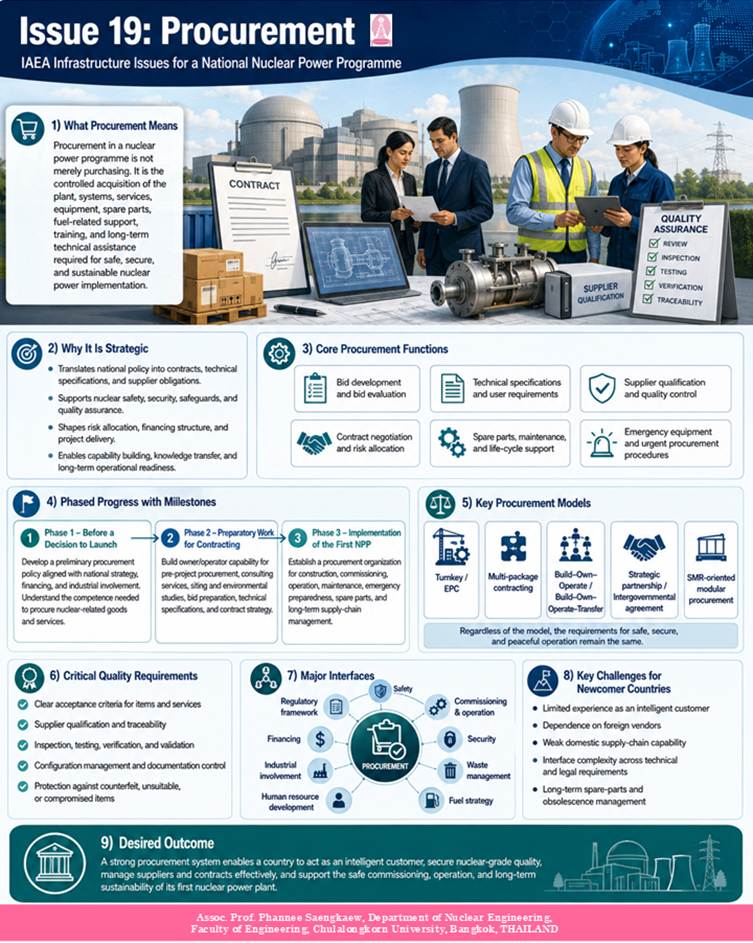
Procurement is the 19th infrastructure issue in the IAEA Milestones approach for developing a national nuclear power programme. Although it appears as the final issue in the list of 19 infrastructure issues, it should not be interpreted as a secondary or late-stage activity. The IAEA emphasizes that the 19 infrastructure issues are not ordered by importance; each requires careful attention across the three phases of nuclear infrastructure development.
In the nuclear context, procurement is not merely the purchase of goods and services. It is a controlled technical, legal, financial, regulatory, and quality-assurance process through which a country, owner/operator, regulatory body, and other responsible organizations obtain the nuclear power plant, supporting services, equipment, spare parts, technical expertise, engineering studies, safety-related components, emergency equipment, and long-term operational supplies required for a safe, secure, and sustainable nuclear power programme.
For a newcomer country, procurement is especially important because the first nuclear power plant is usually acquired through a major international arrangement involving a reactor technology provider, engineering–procurement–construction contractor, strategic partner, or intergovernmental agreement. The 2024 revision of the IAEA Milestones document recognizes that procurement and contracting approaches may include competitive bidding, strategic partnership, sole supplier arrangements, and direct negotiation through intergovernmental agreements. Therefore, procurement must be understood not only as a purchasing function, but also as a mechanism for transferring responsibility, allocating risk, ensuring quality, preserving safety requirements, and building long-term national capability.
2. Meaning and Scope of Procurement in a Nuclear Power Programme
In a conventional industrial project, procurement may focus mainly on cost, delivery time, supplier reliability, and contractual performance. In a nuclear power programme, these factors remain important, but they are not sufficient. Procurement must also ensure that every item, service, and contract package is compatible with nuclear safety, nuclear security, safeguards, radiation protection, environmental protection, quality assurance, configuration management, and long-term plant operation.
The IAEA describes procurement as including the procurement of the nuclear power plant and supporting services, as well as the establishment of procurement capabilities within the owner/operator organization. It further notes that bid development, bid evaluation, technical specifications, and contract negotiations are major tasks in Phases 2 and 3. This means that procurement directly affects whether the country can move from policy intention to a real, licensable, constructible, operable, and maintainable nuclear power plant.
The scope of nuclear procurement includes several categories. First, it includes the main nuclear power plant contract, such as an engineering, procurement and construction contract, a turnkey contract, a build–own–operate arrangement, a build–own–operate–transfer model, or another project-specific ownership and contracting structure. Second, it includes technical advisory services, feasibility studies, siting investigations, environmental impact assessments, safety assessment support, regulatory support, legal services, financial advisory services, and owner’s engineer services. Third, it includes equipment, materials, spare parts, maintenance services, emergency equipment, fuel-related services, radioactive waste management services, radiation monitoring systems, cyber security systems, and training systems.
Thus, Issue 19 is closely connected with nearly all other infrastructure issues. Procurement depends on national policy, funding and financing, legal authority, regulatory requirements, safeguards obligations, industrial involvement, human resource development, site selection, environmental assessment, nuclear security, fuel strategy, waste management, and grid integration. At the same time, weaknesses in procurement can create weaknesses in these other areas.
3. Why Procurement Is a Strategic Infrastructure Issue
Procurement is strategic because it determines how the country’s nuclear programme becomes embodied in actual contracts, technologies, organizations, and supply chains. A national nuclear power policy may declare high-level objectives, but procurement translates these objectives into binding technical specifications, commercial commitments, supplier obligations, acceptance criteria, knowledge-transfer arrangements, localization provisions, warranties, quality requirements, and long-term service responsibilities.
The IAEA’s procurement engineering guidance stresses that ineffective control of procurement can jeopardize plant safety and increase costs for operating organizations. This statement is highly significant because it shows that procurement is not simply an administrative or commercial function. If procurement requirements are incomplete, ambiguous, or poorly controlled, the result may be unsuitable equipment, non-qualified suppliers, inadequate documentation, defective spare parts, weak configuration control, delayed maintenance, and ultimately degraded safety performance.
For newcomer countries, procurement also affects national capability building. If the first nuclear power plant is procured as a simple “black-box” turnkey project without sufficient participation by the future owner/operator, regulator, and domestic technical organizations, the country may receive a physical plant but fail to acquire the knowledge, competence, and institutional memory needed to operate, regulate, maintain, and eventually decommission the facility. Therefore, procurement must be designed as a capability-building pathway, not only as a contract award process.
4. Procurement and the IAEA Milestones Phases
4.1 Phase 1: Considerations Before a Decision to Launch a Nuclear Power Programme
In Phase 1, the country has not yet made a final decision to launch a nuclear power programme. Procurement activities at this stage are therefore preliminary, strategic, and policy-oriented. The Nuclear Energy Programme Implementing Organization, or equivalent coordinating mechanism, should understand the special requirements associated with purchasing equipment and services for nuclear facilities. It should also recognize the level of competence required to procure nuclear-related equipment and services.
At the end of Phase 1, procurement considerations should be reflected in the comprehensive report prepared for national decision makers. This report should recommend a procurement policy that is consistent with the proposed nuclear power strategy and industrial involvement policy. In practical terms, the country should begin asking what type of contracting model is suitable, what level of domestic participation is realistic, how quality requirements will be imposed, what procurement capabilities must be developed, and how national laws and financial arrangements will support future procurement.
During Phase 1, the country should not rush into technology selection or supplier commitment. Instead, it should develop a structured understanding of procurement options. These may include competitive bidding, direct negotiation, strategic partnership, intergovernmental agreement, turnkey delivery, split-package contracting, build–own–operate models, or hybrid arrangements. The appropriate model depends on national policy, financing capacity, owner/operator maturity, regulatory readiness, industrial capability, technology preference, and risk allocation.
A sound Phase 1 procurement policy should therefore address the following matters in full-sentence strategic terms. It should clarify whether the country intends to maximize domestic industrial participation or prioritize rapid delivery from an experienced international supplier. It should identify whether the owner/operator is expected to develop strong internal technical capability or rely heavily on the technology provider. It should consider whether procurement will include provisions for human resource development, simulator access, training, technical documentation, spare parts, fuel supply, waste-related services, and long-term maintenance support. It should also consider how procurement choices could affect national sovereignty, technology dependence, regulatory independence, and long-term operating competence.
4.2 Phase 2: Preparatory Work for Contracting and Construction
Phase 2 begins after the government has made a knowledgeable decision to proceed with nuclear power. This is the phase in which procurement becomes much more concrete. The IAEA describes Phase 2 as the preparatory work for contracting and construction of a nuclear power plant. In this phase, the owner/operator, regulator, and other responsible organizations must be established or expanded, and senior positions should be filled early to provide leadership for safety and organizational development.
For procurement, Phase 2 is especially critical because the country prepares to invite bids, negotiate contracts, or enter into supplier arrangements. According to the IAEA Milestones guidance, the owner/operator should develop the capability to procure required services for pre-project activities, including environmental impact assessment, siting, and consulting. This includes ensuring that suppliers have appropriate expertise and experience, preparing formal specifications for required services, and including quality standards in the service specifications.
In this phase, procurement must be integrated with the development of user requirements and technical specifications. The owner/operator should be capable of defining what it needs, why it needs it, and how each requirement will be verified. This includes plant performance requirements, safety design expectations, site-related requirements, grid interface requirements, fuel supply expectations, waste management interfaces, cyber security requirements, training facilities, simulators, emergency preparedness arrangements, spare parts, and long-term technical support.
Phase 2 procurement should also ensure that the future contract is not limited to construction delivery. It should address the entire early life cycle of the plant, including licensing support, design documentation, safety analysis reports, regulatory interactions, construction quality assurance, commissioning, operational training, spare-parts strategy, maintenance planning, fuel supply, spent fuel management interfaces, radioactive waste handling, and knowledge transfer.
A weak procurement process in Phase 2 can create long-term dependency. For example, if the contract does not clearly require training, documentation, access to design information, simulator delivery, spare-parts support, and local staff participation, the future owner/operator may have difficulty becoming an intelligent customer and competent operator. Likewise, if the regulatory body must rely entirely on vendor-provided information without independent technical support, regulatory effectiveness may be weakened. For this reason, procurement of technical support by the regulatory body remains important even when the plant is based on a strategic supplier or SMR model.
4.3 Phase 3: Activities to Implement the First Nuclear Power Plant
Phase 3 concerns the implementation of the first nuclear power plant project, including construction, commissioning preparation, and readiness for operation. Procurement during this phase becomes operational, detailed, and safety-critical. The owner/operator must establish a procurement organization with the programmes and skills needed for ongoing purchasing of equipment and services. The IAEA notes that this should include procurement for normal operation, emergency equipment to be pre-positioned on-site, and urgent procurement procedures for additional supplies and equipment in emergency situations.
By the end of Phase 3, procurement should no longer depend entirely on the original vendor or project contractor. The owner/operator should have internal procurement procedures, trained staff, supplier qualification processes, technical evaluation capability, quality assurance controls, documentation systems, inventory management systems, and emergency procurement arrangements. The IAEA recommends that procurement staff work alongside the supplier procurement team to gain necessary experience. This is a particularly important capability-transfer mechanism for newcomer countries.
In Phase 3, procurement must support commissioning and transition to operation. This includes ensuring that spare parts, consumables, calibration services, radiation monitoring equipment, maintenance tools, protective equipment, operating procedures, technical manuals, and supplier support arrangements are available before fuel loading and operation. Procurement readiness should also be reviewed as part of operational readiness because inability to obtain qualified parts or services can affect plant availability and safety.
5. Procurement Policy and National Strategy
A procurement policy for a nuclear power programme should be aligned with the national position on nuclear power. It should answer how the country intends to acquire the plant, how responsibilities will be distributed, how risks will be allocated, how quality will be assured, how domestic industry will participate, and how long-term national competence will be developed.
The policy should clarify the relationship between procurement and industrial involvement. Issue 18 focuses on the participation of local industries and companies in the nuclear power programme. The IAEA notes that early development of an industrial involvement policy and strategy is important, including surveys of domestic industry and communication of the quality standards required for nuclear power projects. Procurement is the mechanism through which this policy becomes real. Localization targets, supplier development, domestic manufacturing, local civil works, maintenance services, and technology transfer must be reflected in contract structures and qualification requirements.
However, industrial involvement must not compromise nuclear safety. Domestic participation should be based on realistic assessment of capability, quality assurance maturity, codes and standards, inspection competence, manufacturing capability, documentation control, and regulatory acceptance. Procurement policy should therefore balance national economic objectives with strict nuclear-grade quality requirements.
6. Procurement Models and Contracting Approaches
Modern nuclear procurement can be structured through different ownership and contracting models. The IAEA’s 2024 publication on contracting and ownership approaches explains that Member States have shown interest in different contractual, ownership, and financing approaches, including recent new-build projects and SMR deployment. It also emphasizes that, regardless of the contracting approach, the requirements for safe, secure, and peaceful operation remain the same.
The main procurement and contracting approaches may include the following:
Turnkey or EPC-based model. In this model, a major contractor or consortium is responsible for engineering, procurement, and construction. This can reduce interface complexity for a newcomer country but may also limit the development of owner/operator capability if knowledge transfer is not contractually required.
Multi-package model. In this approach, different packages are procured separately, such as nuclear island, turbine island, civil works, balance of plant, and grid interface. This can increase domestic participation and owner control but requires much stronger project management, interface management, and technical competence.
Build–own–operate or build–own–operate–transfer model. In this model, a vendor or foreign project company may own and operate the plant for a defined period. This can reduce initial national operational burden but raises important questions regarding regulatory control, national responsibility, workforce development, fuel supply, waste management, liability, emergency preparedness, and long-term transfer of competence.
Strategic partnership or intergovernmental agreement. This approach may combine reactor supply, financing, fuel services, training, regulatory cooperation, and long-term support. It can simplify project initiation but requires careful governance to preserve national decision-making, regulatory independence, transparency, and long-term accountability.
SMR-related procurement models. SMRs may introduce new procurement models based on modular manufacturing, factory fabrication, standardization, fleet deployment, and vendor-supported operation. The IAEA notes that SMR procurement remains subject to the same general procurement considerations, although the size of the owner/operator procurement team may be reduced. Nevertheless, SMRs may also require careful attention to module replacement, factory quality assurance, transport logistics, cyber security, fuel form availability, and waste management interfaces.
7. Quality Assurance and Supplier Qualification
Quality assurance is central to nuclear procurement. A nuclear power plant contains systems, structures, and components that perform safety functions. Procurement must therefore ensure that items are designed, manufactured, tested, inspected, documented, delivered, stored, installed, and maintained according to applicable quality requirements.
The owner/operator must specify quality requirements clearly and verify that suppliers meet them. This principle is stated directly in the IAEA Milestones guidance for procurement. Supplier qualification should include technical capability, nuclear experience, quality management system maturity, manufacturing controls, traceability, non-conformance management, inspection arrangements, cyber security controls where applicable, and ability to provide lifetime documentation.
Procurement documents should define acceptance criteria, inspection points, testing requirements, verification and validation responsibilities, documentation deliverables, and independent inspection requirements. The IAEA procurement engineering guidance emphasizes that acceptance criteria are an important part of procurement and that responsibilities for inspection, testing, verification, and validation should be specified.
For safety-related items, procurement must also address classification. Items important to safety require more stringent procurement controls than ordinary commercial equipment. The procurement process should identify whether an item is safety-related, security-related, environmentally qualified, seismically qualified, radiation qualified, or otherwise subject to special requirements.
8. Commercial-Grade Dedication and Replacement Parts
During operation and maintenance, not all replacement parts may be available from original nuclear-qualified suppliers. In some cases, commercial-grade items may be considered for safety-related applications, but only after a formal dedication process. Commercial-grade dedication is the process by which an item not originally produced under a nuclear quality assurance programme is technically evaluated, tested, inspected, and accepted for a safety-related function.
This issue is important because improper use of commercial-grade components can affect safety-related systems. IAEA procurement engineering guidance summarizes extensive operating experience and guidance related to commercial-grade dedication, including the need to identify critical characteristics, verify performance, maintain seismic and equipment qualification, and address documentation and supplier audit issues.
For a newcomer country, commercial-grade dedication should not be treated as a simple purchasing shortcut. It requires engineering judgement, technical expertise, testing capability, regulatory understanding, and documented acceptance criteria. If these capabilities are weak, the owner/operator may become dependent on external suppliers or may unintentionally introduce unsuitable components into safety-related systems.
9. Procurement, Safety, Security, and Safeguards
Procurement directly supports nuclear safety because it controls the quality and suitability of systems, structures, components, spare parts, services, and technical documentation. Poor procurement can lead to defective equipment, counterfeit or fraudulent items, missing documentation, delayed maintenance, or incompatible replacement parts. These weaknesses can degrade defence in depth.
Procurement also supports nuclear security. Security systems, access control equipment, surveillance systems, cyber security tools, physical barriers, communication systems, and emergency response equipment must be procured according to security-sensitive requirements. The IAEA procurement engineering guidance notes that equipment requiring increased computer security measures may need protection against malicious compromise at various procurement stages. This is increasingly relevant as modern nuclear facilities rely on digital instrumentation and control systems.
Procurement also supports safeguards. Nuclear material accountancy systems, measurement equipment, containment and surveillance systems, fuel handling equipment, and documentation systems must support national and international safeguards obligations. Procurement contracts involving nuclear fuel should address supply assurance, transport, storage, accounting, safeguards documentation, and spent fuel arrangements.
10. Procurement and the Regulatory Body
The regulatory body is not usually responsible for procuring the nuclear power plant, but procurement is still relevant to regulatory effectiveness. The regulatory body may need to procure technical support services, independent safety review expertise, inspection tools, software, laboratory services, training, and access to international expertise. The IAEA specifically notes that procurement of technical support by the regulatory body remains relevant, including for SMR-based programmes.
Regulatory procurement must preserve independence. Technical support organizations may provide expertise, but the regulatory body must retain decision-making authority. Procurement arrangements should avoid conflicts of interest, especially where the same consultant, vendor, or organization provides services to both the owner/operator and the regulator. The procurement of regulatory support should therefore include conflict-of-interest provisions, confidentiality requirements, qualification criteria, and clear separation of advisory and decision-making roles.
11. Procurement and Human Resource Development
Procurement cannot be effective without competent people. Nuclear procurement requires staff who understand engineering, safety classification, quality assurance, contracts, supplier evaluation, nuclear codes and standards, project management, logistics, inventory control, and regulatory requirements. For a newcomer country, these competencies must be developed early.
Training should cover nuclear procurement fundamentals, procurement engineering, technical specification writing, bid evaluation, contract management, supplier qualification, quality surveillance, document control, counterfeit item prevention, commercial-grade dedication, spare-parts management, and emergency procurement. Procurement staff should also understand the relationship between procurement decisions and operational safety.
A particularly valuable approach is staff involvement in supplier and vendor procurement processes during Phase 3. The IAEA recommends that procurement staff work alongside supplier procurement teams to gain experience before the end of Phase 3. This approach helps convert procurement from a paper-based function into a real operational competence.
12. Procurement and Industrial Involvement
Procurement is the practical channel through which domestic industry participates in a nuclear power programme. Civil construction, electrical installation, mechanical fabrication, non-safety support systems, logistics, maintenance services, environmental monitoring, training services, and some balance-of-plant activities may offer opportunities for domestic companies. However, the nuclear sector imposes strict requirements for documentation, quality assurance, traceability, inspection, codes, standards, and safety culture.
Therefore, procurement policy should support industrial involvement in a staged and capability-based manner. Early contracts may focus on areas where domestic industry already has competence. More demanding nuclear-grade work should be introduced only after qualification, training, audits, and quality system development. This staged approach helps avoid unrealistic localization targets while still building national industrial capability.
13. Procurement and Financing
Procurement is also a financial risk-management tool. Contract structure affects cost certainty, schedule risk, construction risk, currency risk, financing conditions, owner liability, vendor responsibility, and long-term obligations. The choice between turnkey, multi-package, BOO, BOOT, EPC, or strategic partnership models affects who carries the risk of delays, cost escalation, licensing issues, supply chain disruption, design changes, and performance shortfalls.
A procurement strategy should therefore be developed together with the financing strategy. The contract should clearly define payment milestones, performance guarantees, delay penalties, warranties, insurance, liability arrangements, dispute resolution, force majeure provisions, currency exposure, supply chain responsibilities, and long-term service commitments.
For nuclear projects, procurement should not select the lowest initial price without considering whole-life cost. A cheaper contract may become more expensive if it lacks training, spare parts, documentation, fuel support, maintenance support, or technology transfer. Therefore, procurement evaluation should consider life-cycle value, not only capital cost.
14. Procurement and Long-Term Operation
Procurement does not end when the plant is constructed. During operation, the owner/operator must continuously procure spare parts, maintenance services, testing equipment, calibration services, software updates, security upgrades, radiation protection equipment, waste management services, emergency equipment, and replacement components.
Long-term procurement requires configuration management. Every replacement item must be compatible with the approved design basis and licensing basis. The owner/operator must know what component is installed, why it is qualified, what documentation supports it, whether it has safety significance, and whether substitution is allowed. Without configuration control, procurement can introduce hidden design changes.
Procurement must also address obsolescence. Nuclear power plants operate for decades, while many commercial components, especially digital systems, become obsolete much more rapidly. A long-term procurement programme should therefore include obsolescence monitoring, strategic spare-parts planning, supplier relationship management, reverse engineering controls where appropriate, and qualification of alternative suppliers.
15. Procurement for Emergency Preparedness
The IAEA Milestones guidance explicitly highlights procurement not only for normal operation but also for emergency equipment pre-positioned on-site and urgent procurement of additional supplies and equipment during emergency situations. This shows that procurement is part of emergency preparedness and response.
Emergency procurement should include radiation monitoring instruments, personal protective equipment, communication systems, mobile power supplies, emergency pumps, fire protection equipment, contamination control supplies, medical response materials, dosimeters, sampling equipment, and logistical support arrangements. Procedures should define how urgent purchases are approved, how quality is verified under time pressure, how alternative suppliers are used, and how emergency supplies are stored, tested, and replenished.
16. Key Challenges for Newcomer Countries
Newcomer countries often face several procurement challenges. The first challenge is limited experience as an intelligent customer. Without sufficient technical capability, the owner/operator may not be able to define requirements, evaluate bids, challenge vendors, or verify deliverables.
The second challenge is dependence on foreign vendors. Some dependence is unavoidable for a first nuclear power plant, but excessive dependence can weaken long-term national capability. Procurement should therefore include knowledge transfer, training, documentation, and participation of national staff.
The third challenge is weak domestic supply chains. Local companies may be interested in nuclear work but may not yet meet nuclear quality standards. This requires supplier development rather than immediate high-level localization.
The fourth challenge is interface complexity. Procurement must coordinate nuclear safety requirements, regulatory requirements, environmental requirements, grid requirements, security requirements, safeguards requirements, and financing conditions.
The fifth challenge is long-term spare-parts and obsolescence management. A country may successfully build the plant but later struggle to obtain qualified replacement parts if procurement planning is weak.
The sixth challenge is preserving regulatory independence. Procurement of technical support for the regulator must avoid conflicts of interest and ensure that regulatory decisions remain independent.
17. Desired Conditions by the End of Each Phase
By the end of Phase 1, the country should understand the special nature of nuclear procurement and should have a preliminary procurement policy aligned with the national nuclear strategy, industrial involvement policy, financing considerations, and owner/operator development plan.
By the end of Phase 2, the owner/operator should be capable of procuring pre-project services and preparing for major plant procurement. It should be able to prepare formal specifications, include quality standards, evaluate supplier competence, and support bid invitation or contract negotiation.
By the end of Phase 3, the owner/operator should have an established procurement organization capable of supporting commissioning, operation, maintenance, emergency preparedness, and long-term supply chain management. Procurement staff should have gained practical experience, preferably through working with supplier procurement teams.
18. Summary
Issue 19, Procurement, is the infrastructure issue that converts nuclear policy, planning, and technical requirements into contractual reality. It determines how the nuclear power plant, services, equipment, expertise, spare parts, training, fuel-related support, emergency equipment, and long-term operational supplies are obtained and controlled. In a nuclear power programme, procurement is inseparable from safety, security, safeguards, quality assurance, regulatory effectiveness, financing, industrial involvement, human resource development, and long-term operation.
A well-developed procurement system allows the country to act as an intelligent customer, impose nuclear-grade quality requirements, evaluate suppliers, manage contracts, control risks, develop domestic capability, and ensure that the first nuclear power plant can be safely commissioned and operated. Conversely, weak procurement can create technical dependency, cost escalation, schedule delay, quality problems, safety vulnerabilities, and long-term operational difficulties.
For a newcomer country, procurement should therefore be treated not as a late-stage administrative function, but as a strategic infrastructure capability that must be developed progressively from Phase 1 through Phase 3. It is one of the key mechanisms through which a nuclear power programme becomes not only a purchased facility, but a nationally understood, regulated, operated, and sustained infrastructure system.
References
International Atomic Energy Agency. (2024). Milestones in the Development of a National Infrastructure for Nuclear Power (IAEA Nuclear Energy Series No. NG-G-3.1 Rev. 2). IAEA. DOI: 10.61092/iaea.zjau-e8cs.
International Atomic Energy Agency. (2024). Contracting and Ownership Approaches for New Nuclear Power Plants (IAEA-TECDOC-1750/Rev. 1). IAEA.
International Atomic Energy Agency. (2016). Procurement Engineering and Supply Chain Guidelines in Support of Operation and Maintenance of Nuclear Facilities (IAEA Nuclear Energy Series No. NP-T-3.21). IAEA.
International Atomic Energy Agency. (2026). Milestones Approach. IAEA Nuclear Infrastructure Development.
ประเด็นที่ 19: การจัดซื้อจัดจ้าง
1. บทนำ
การจัดซื้อจัดจ้างเป็นโครงสร้างพื้นฐานลำดับที่ 19 ในแนวทางตามกรอบหมุดหมายของ IAEA สำหรับการพัฒนาโครงการพลังงานนิวเคลียร์ระดับชาติ ถึงแม้ว่าประเด็นด้านนี้จะปรากฏเป็นประเด็นสุดท้ายในรายการโครงสร้างพื้นฐานทั้ง 19 ด้าน แต่ไม่ควรตีความว่าเป็นกิจกรรมที่มีความสำคัญรองลงมาจากด้านอื่นหรือเป็นกิจกรรมที่เกิดขึ้นเฉพาะในช่วงปลายของโครงการ ซึ่งทาง IAEA เน้นย้ำว่าโครงสร้างพื้นฐานทั้ง 19 ด้าน มิได้ถูกจัดลำดับตามความสำคัญ หากแต่ทุกด้านต้องได้รับการพัฒนาอย่างรอบคอบตลอดทั้งสามระยะของการพัฒนาโครงสร้างพื้นฐานด้านนิวเคลียร์ ในบริบทของนิวเคลียร์ การจัดซื้อจัดจ้างมิได้หมายถึงเพียงการซื้อสินค้าและบริการเท่านั้น แต่เป็นกระบวนการทางเทคนิค กฎหมาย การเงิน กฎระเบียบ และการประกันคุณภาพที่ต้องได้รับการควบคุมอย่างเป็นระบบ กระบวนการดังกล่าวเป็นกลไกที่ทำให้ประเทศ เจ้าของโครงการหรือผู้ดำเนินการ หน่วยงานกำกับดูแล และองค์กรที่รับผิดชอบอื่น ๆ สามารถได้มาซึ่งโรงไฟฟ้านิวเคลียร์ บริการสนับสนุน อุปกรณ์ ชิ้นส่วนอะไหล่ ความเชี่ยวชาญทางเทคนิค การศึกษาทางวิศวกรรม องค์ประกอบที่เกี่ยวข้องกับความปลอดภัย อุปกรณ์สำหรับเหตุฉุกเฉิน และวัสดุหรือบริการระยะยาวที่จำเป็นต่อการเดินเครื่องโรงไฟฟ้านิวเคลียร์อย่างปลอดภัย มั่นคง และยั่งยืน
สำหรับประเทศที่เพิ่งเริ่มโครงการใหม่ การจัดซื้อจัดจ้างมีความสำคัญเป็นพิเศษ เนื่องจากโรงไฟฟ้านิวเคลียร์แห่งแรกมักได้มาผ่านข้อตกลงระหว่างประเทศที่มีขนาดใหญ่ โดยอาจเกี่ยวข้องกับผู้จัดหาเทคโนโลยีเครื่องปฏิกรณ์ ผู้รับเหมาด้านวิศวกรรม การจัดซื้อ และการก่อสร้าง (ผู้รับเหมา EPC) พันธมิตรเชิงยุทธศาสตร์ หรือข้อตกลงระหว่างรัฐบาล เอกสาร IAEA Milestones ในปี ค.ศ. 2024 ยอมรับว่าแนวทางการจัดซื้อจัดจ้างและการทำสัญญาอาจครอบคลุม การประมูลแบบแข่งขัน ความร่วมมือเชิงยุทธศาสตร์ การเลือกผู้จัดหาเพียงรายเดียว และการเจรจาโดยตรงผ่านข้อตกลงระหว่างรัฐบาล ดังนั้นการจัดซื้อจัดจ้างจึงต้องถูกเข้าใจว่าไม่ใช่เพียงในฐานะหน้าที่ด้านการซื้อขาย แต่เป็นกลไกสำคัญในการถ่ายโอนความรับผิดชอบ การจัดสรรความเสี่ยง การประกันคุณภาพ การคงไว้ซึ่งข้อกำหนดด้านความปลอดภัย และการสร้างขีดความสามารถของประเทศในระยะยาว
2. ความหมายและขอบเขตของการจัดซื้อจัดจ้างในโครงการพลังงานนิวเคลียร์
ในโครงการอุตสาหกรรมทั่วไป การจัดซื้อจัดจ้างอาจมุ่งเน้นไปที่ ต้นทุน ระยะเวลาการส่งมอบ ความน่าเชื่อถือของผู้จัดหา และผลการปฏิบัติตามสัญญา ปัจจัยเหล่านี้ยังคงมีความสำคัญในโครงการพลังงานนิวเคลียร์ แต่ยังไม่เพียงพอ การจัดซื้อจัดจ้างในโครงการนิวเคลียร์ต้องทำให้มั่นใจว่า สิ่งของ บริการ และชุดสัญญาทุกส่วนมีความสอดคล้องกับความปลอดภัยทางนิวเคลียร์ ความมั่นคงทางนิวเคลียร์ การพิทักษ์ความปลอดภัยทางนิวเคลียร์ การป้องกันอันตรายจากรังสี การคุ้มครองสิ่งแวดล้อม การประกันคุณภาพ การจัดการโครงแบบ และการเดินเครื่องโรงไฟฟ้าในระยะยาว
IAEA อธิบายว่าการจัดซื้อจัดจ้างครอบคลุมทั้งการจัดซื้อโรงไฟฟ้านิวเคลียร์และบริการสนับสนุน ตลอดจนการจัดตั้งขีดความสามารถด้านการจัดซื้อจัดจ้างภายในองค์กรเจ้าของโครงการหรือผู้ดำเนินการ นอกจากนี้ IAEA ยังระบุว่าการพัฒนาเอกสารประกวดราคา การประเมินข้อเสนอ ข้อกำหนดทางเทคนิค และการเจรจาสัญญาเป็นภารกิจสำคัญในระยะที่ 2 และระยะที่ 3 ความหมายเช่นนี้ชี้ให้เห็นว่าการจัดซื้อจัดจ้างมีผลโดยตรงต่อความสามารถของประเทศในการเปลี่ยนความตั้งใจเชิงนโยบายให้กลายเป็นโรงไฟฟ้านิวเคลียร์ที่สามารถได้รับอนุญาต ก่อสร้าง เดินเครื่อง บำรุงรักษา และกำกับดูแลได้จริง
ขอบเขตของการจัดซื้อจัดจ้างด้านนิวเคลียร์ประกอบด้วยหลายประเภท
- ประการแรก ครอบคลุมสัญญาหลักของโรงไฟฟ้านิวเคลียร์ เช่น สัญญาด้านวิศวกรรม การจัดซื้อ และการก่อสร้าง หรือสัญญาแบบส่งมอบเบ็ดเสร็จ รูปแบบสร้าง–เป็นเจ้าของ–ดำเนินการ รูปแบบสร้าง–เป็นเจ้าของ–ดำเนินการ–ถ่ายโอน หรือโครงสร้างความเป็นเจ้าของและการทำสัญญาอื่นที่เหมาะสมกับลักษณะเฉพาะของโครงการ
- ประการที่สอง ครอบคลุมบริการให้คำปรึกษาทางเทคนิค การศึกษาความเป็นไปได้ การสำรวจสถานที่ตั้ง การประเมินผลกระทบสิ่งแวดล้อม การสนับสนุนการประเมินความปลอดภัย บริการสนับสนุนด้านกฎระเบียบ บริการด้านกฎหมาย บริการให้คำปรึกษาทางการเงิน และบริการวิศวกรของเจ้าของโครงการ
- ประการที่สาม ครอบคลุมอุปกรณ์ วัสดุ ชิ้นส่วนอะไหล่ บริการบำรุงรักษา อุปกรณ์ฉุกเฉิน บริการที่เกี่ยวข้องกับเชื้อเพลิง บริการจัดการกากกัมมันตรังสี ระบบตรวจวัดรังสี ระบบความมั่นคงปลอดภัยทางไซเบอร์ และระบบฝึกอบรม
ดังนั้น ประเด็นด้านที่ 19 จึงมีความเชื่อมโยงอย่างใกล้ชิดกับโครงสร้างพื้นฐานด้านอื่นแทบทั้งหมด การจัดซื้อจัดจ้างขึ้นอยู่กับ นโยบายระดับชาติ การจัดหาเงินทุนและการเงิน อำนาจตามกฎหมาย ข้อกำหนดด้านกฎระเบียบ พันธกรณีด้านการพิทักษ์ความปลอดภัยทางนิวเคลียร์ การมีส่วนร่วมของภาคอุตสาหกรรม การพัฒนาทรัพยากรมนุษย์ การเลือกสถานที่ตั้ง การประเมินสิ่งแวดล้อม ความมั่นคงทางนิวเคลียร์ กลยุทธ์เชื้อเพลิง การจัดการกาก และการบูรณาการกับระบบโครงข่ายไฟฟ้า ในขณะเดียวกัน หากการจัดซื้อจัดจ้างมีจุดอ่อน ก็อาจก่อให้เกิดจุดอ่อนในด้านอื่นเหล่านี้ได้เช่นกัน
3. เหตุใดประเด็นด้านการจัดซื้อจัดจ้างจึงเป็นโครงสร้างพื้นฐานเชิงยุทธศาสตร์
การจัดซื้อจัดจ้างมีลักษณะเป็นประเด็นเชิงยุทธศาสตร์ เพราะเป็นกลไกที่ทำให้โครงการนิวเคลียร์ระดับชาติถูกแปลงไปสู่ สัญญา เทคโนโลยี องค์กร และห่วงโซ่อุปทานที่เป็นรูปธรรม นโยบายพลังงานนิวเคลียร์ระดับชาติอาจประกาศวัตถุประสงค์ในระดับสูงได้ แต่การจัดซื้อจัดจ้างคือกระบวนการที่แปลงวัตถุประสงค์เหล่านั้นให้กลายเป็นข้อกำหนดทางเทคนิคที่มีผลผูกพัน ภาระหน้าที่ทางพาณิชย์ของผู้จัดหา ข้อกำหนดการยอมรับ การถ่ายทอดองค์ความรู้ ข้อกำหนดเกี่ยวกับการมีส่วนร่วมของภาคอุตสาหกรรมในประเทศ การรับประกัน ข้อกำหนดด้านคุณภาพ และความรับผิดชอบด้านบริการระยะยาว
เอกสารแนวทางด้านวิศวกรรมการจัดซื้อจัดจ้างของ IAEA เน้นว่า การควบคุมการจัดซื้อจัดจ้างที่ไม่มีประสิทธิภาพอาจเป็นอันตรายต่อความปลอดภัยของโรงไฟฟ้าและเพิ่มต้นทุนให้กับหน่วยงานผู้ดำเนินการ ข้อความนี้มีความสำคัญอย่างยิ่ง เพราะแสดงให้เห็นว่าการจัดซื้อจัดจ้างมิใช่เพียงหน้าที่ด้านธุรการหรือด้านพาณิชย์ หากข้อกำหนดด้านการจัดซื้อจัดจ้างไม่ครบถ้วน คลุมเครือ หรือควบคุมไม่ดี ผลลัพธ์อาจเป็นอุปกรณ์ที่ไม่เหมาะสม ผู้จัดหาที่ไม่ได้รับการรับรอง เอกสารทางเทคนิคไม่เพียงพอ ชิ้นส่วนอะไหล่ที่บกพร่อง การควบคุมโครงแบบที่อ่อนแอ การบำรุงรักษาที่ล่าช้า และในที่สุดอาจนำไปสู่การลดทอนสมรรถนะด้านความปลอดภัย
สำหรับประเทศที่เพิ่งเริ่มโครงการใหม่ การจัดซื้อจัดจ้างยังส่งผลต่อการสร้างขีดความสามารถของประเทศ หากโรงไฟฟ้านิวเคลียร์แห่งแรกถูกจัดซื้อในลักษณะโครงการแบบส่งมอบเบ็ดเสร็จที่เป็น “กล่องดำ” โดยเจ้าของโครงการหรือผู้ดำเนินการในอนาคต หน่วยงานกำกับดูแล และหน่วยงานเทคนิคภายในประเทศมีส่วนร่วมน้อยเกินไป ประเทศอาจได้รับโรงไฟฟ้าที่เป็นวัตถุทางกายภาพ แต่ไม่สามารถได้มาซึ่งองค์ความรู้ สมรรถนะ และองค์ความรู้สะสมของสถาบันที่จำเป็นต่อการเดินเครื่อง การกำกับดูแล การบำรุงรักษา และการรื้อถอนสถานประกอบการในอนาคตได้ ดังนั้นการจัดซื้อจัดจ้างจึงควรถูกออกแบบให้เป็นเส้นทางของการสร้างขีดความสามารถ ไม่ใช่เพียงกระบวนการคัดเลือกและมอบสัญญา
4. การจัดซื้อจัดจ้างกับระยะต่าง ๆ ของแนวทางจุดหมุดหมายของ IAEA
4.1 ระยะที่ 1: การพิจารณาก่อนการตัดสินใจเริ่มโครงการพลังงานนิวเคลียร์
ในระยะที่ 1 ประเทศยังไม่ได้ตัดสินใจอย่างเป็นทางการว่าจะเริ่มโครงการพลังงานนิวเคลียร์หรือไม่ กิจกรรมด้านการจัดซื้อจัดจ้างในระยะนี้จึงมีลักษณะเป็นกิจกรรมเบื้องต้น เชิงยุทธศาสตร์ และเชิงนโยบาย คณะทำงานดำเนินการเตรียมพร้อมโครงการพลังงานนิวเคลียร์ หรือกลไกการประสานงานที่เทียบเท่า ควรเข้าใจข้อกำหนดเฉพาะที่เกี่ยวข้องกับการจัดซื้ออุปกรณ์และบริการสำหรับสถานประกอบการนิวเคลียร์ รวมทั้งต้องตระหนักถึงระดับสมรรถนะที่จำเป็นในการจัดซื้ออุปกรณ์และบริการที่เกี่ยวข้องกับทางนิวเคลียร์
เมื่อสิ้นสุดระยะที่ 1 ประเด็นด้านการจัดซื้อจัดจ้างควรถูกสะท้อนอยู่ในรายงานเชิงบูรณาการที่จัดทำขึ้นสำหรับผู้ตัดสินใจระดับชาติ รายงานดังกล่าวควรเสนอแนะนโยบายการจัดซื้อจัดจ้างที่สอดคล้องกับยุทธศาสตร์โครงการพลังงานนิวเคลียร์และนโยบายการมีส่วนร่วมของภาคอุตสาหกรรม ในเชิงปฏิบัติประเทศควรเริ่มตั้งคำถามว่า รูปแบบการทำสัญญาประเภทใดเหมาะสม ระดับการมีส่วนร่วมของภาคอุตสาหกรรมในประเทศควรเป็นอย่างไร ข้อกำหนดด้านคุณภาพจะถูกบังคับใช้อย่างไร ขีดความสามารถด้านการจัดซื้อจัดจ้างใดจำเป็นต้องพัฒนา และกฎหมายกับการจัดหาเงินทุนของประเทศจะสนับสนุนการจัดซื้อจัดจ้างในอนาคตได้อย่างไร
ในระยะที่ 1 ประเทศไม่ควรเร่งรีบไปสู่การเลือกเทคโนโลยีหรือการผูกพันกับผู้จัดหารายใดรายหนึ่ง แต่ควรพัฒนาความเข้าใจอย่างเป็นระบบต่อทางเลือกด้านการจัดซื้อจัดจ้าง ทางเลือกเหล่านี้อาจรวมถึงการประมูลแบบแข่งขัน การเจรจาโดยตรง ความร่วมมือเชิงยุทธศาสตร์ ข้อตกลงระหว่างรัฐบาล การส่งมอบแบบเบ็ดเสร็จ การทำสัญญาแบบแบ่งชุดงาน รูปแบบสร้าง–เป็นเจ้าของ–ดำเนินการ หรือรูปแบบผสมผสานอื่น ๆ รูปแบบที่เหมาะสมขึ้นอยู่กับนโยบายของประเทศ ความสามารถด้านการเงิน ความพร้อมของเจ้าของโครงการหรือผู้ดำเนินการ ความพร้อมของหน่วยงานกำกับดูแล ความสามารถของภาคอุตสาหกรรม ความต้องการด้านเทคโนโลยี และการจัดสรรความเสี่ยง
ดังนั้น นโยบายการจัดซื้อจัดจ้างที่ดีในระยะที่ 1 ควรตอบประเด็นต่าง ๆ ในลักษณะเชิงยุทธศาสตร์ที่ชัดเจน นโยบายควรระบุว่าประเทศต้องการเพิ่มการมีส่วนร่วมของอุตสาหกรรมในประเทศให้มากที่สุด หรือให้ความสำคัญกับการส่งมอบที่รวดเร็วโดยผู้จัดหาต่างประเทศที่มีประสบการณ์ นโยบายควรระบุว่าเจ้าของโครงการหรือผู้ดำเนินการคาดว่าจะพัฒนาขีดความสามารถทางเทคนิคภายในอย่างเข้มแข็ง หรือพึ่งพาผู้จัดหาเทคโนโลยีเป็นหลัก นโยบายควรพิจารณาว่า การจัดซื้อจัดจ้างจะรวมข้อกำหนดเกี่ยวกับการพัฒนาทรัพยากรมนุษย์ การเข้าถึงเครื่องจำลองการเดินเครื่อง การฝึกอบรม เอกสารทางเทคนิค ชิ้นส่วนอะไหล่ การสนับสนุนด้านเชื้อเพลิง บริการที่เกี่ยวข้องกับการจัดการกาก และการสนับสนุนด้านการบำรุงรักษาระยะยาวหรือไม่ นอกจากนี้ นโยบายควรพิจารณาด้วยว่าการเลือกแนวทางการจัดซื้อจัดจ้างอาจส่งผลต่ออธิปไตยทางเทคโนโลยี การพึ่งพาเทคโนโลยี ความเป็นอิสระของหน่วยงานกำกับดูแล และสมรรถนะระยะยาวในการเดินเครื่องอย่างไร
4.2 ระยะที่ 2: งานเตรียมความพร้อมสำหรับการทำสัญญาและการก่อสร้าง
ระยะที่ 2 เริ่มขึ้นหลังจากรัฐบาลได้ตัดสินใจอย่างมีความรู้เพียงพอที่จะดำเนินโครงการพลังงานนิวเคลียร์ต่อไป ระยะนี้เป็นช่วงที่การจัดซื้อจัดจ้างมีความเป็นรูปธรรมมากขึ้น เอกสาร IAEA อธิบายว่าระยะที่ 2 คือระยะของการเตรียมความพร้อมสำหรับการทำสัญญาและการก่อสร้างโรงไฟฟ้านิวเคลียร์ ในระยะนี้ เจ้าของโครงการหรือผู้ดำเนินการ หน่วยงานกำกับดูแล และหน่วยงานที่รับผิดชอบด้านอื่น ๆ ต้องได้รับการจัดตั้งหรือขยายขีดความสามารถ และตำแหน่งผู้บริหารระดับสูงควรถูกแต่งตั้งตั้งแต่เนิ่น ๆ เพื่อให้มีภาวะผู้นำด้านความปลอดภัยและการพัฒนาองค์กร
สำหรับการจัดซื้อจัดจ้าง ระยะที่ 2 มีความสำคัญเป็นพิเศษ เพราะเป็นช่วงที่ประเทศเตรียมเชิญชวนให้ยื่นข้อเสนอ เจรจาสัญญา หรือเข้าสู่ข้อตกลงกับผู้จัดหา ตามแนวทาง IAEA Milestones เจ้าของโครงการหรือผู้ดำเนินการควรพัฒนาขีดความสามารถในการจัดซื้อบริการที่จำเป็นสำหรับกิจกรรมก่อนโครงการ เช่น การประเมินผลกระทบสิ่งแวดล้อม การศึกษาสถานที่ตั้ง และการให้คำปรึกษา ซึ่งรวมถึงการทำให้มั่นใจว่าผู้จัดหามีความเชี่ยวชาญและประสบการณ์ที่เหมาะสม การจัดทำข้อกำหนดอย่างเป็นทางการสำหรับบริการที่ต้องการ และการบรรจุมาตรฐานคุณภาพไว้ในข้อกำหนดของบริการ
ในระยะนี้ การจัดซื้อจัดจ้างต้องบูรณาการเข้ากับการพัฒนาข้อกำหนดของผู้ใช้และข้อกำหนดทางเทคนิค เจ้าของโครงการหรือผู้ดำเนินการควรมีความสามารถในการระบุว่าต้องการอะไร เหตุใดจึงต้องการสิ่งนั้น และจะตรวจสอบการบรรลุข้อกำหนดแต่ละข้อได้อย่างไร ซึ่งรวมถึงข้อกำหนดด้านสมรรถนะของโรงไฟฟ้า ความคาดหวังด้านการออกแบบเพื่อความปลอดภัย ข้อกำหนดที่เกี่ยวข้องกับสถานที่ตั้ง ข้อกำหนดด้านการเชื่อมต่อกับโครงข่ายไฟฟ้า ความคาดหวังด้านการจัดหาเชื้อเพลิง จุดเชื่อมต่อด้านการจัดการกากกัมมันตรังสี ข้อกำหนดด้านความมั่นคงปลอดภัยทางไซเบอร์ สิ่งอำนวยความสะดวกสำหรับการฝึกอบรม เครื่องจำลองการเดินเครื่อง การเตรียมความพร้อมรับเหตุฉุกเฉิน ชิ้นส่วนอะไหล่ และการสนับสนุนทางเทคนิคระยะยาว
การจัดซื้อจัดจ้างในระยะที่ 2 ควรทำให้มั่นใจว่าสัญญาในอนาคตไม่ได้จำกัดอยู่เพียงการส่งมอบการก่อสร้างเท่านั้น แต่ควรครอบคลุมช่วงต้นของวัฏจักรชีวิตโรงไฟฟ้าทั้งหมด รวมถึงการสนับสนุนด้านการขออนุญาต เอกสารการออกแบบ รายงานวิเคราะห์ความปลอดภัย การปฏิสัมพันธ์กับหน่วยงานกำกับดูแล การประกันคุณภาพการก่อสร้าง การทดสอบและเดินเครื่องเริ่มต้น การฝึกอบรมบุคลากรปฏิบัติการ กลยุทธ์ชิ้นส่วนอะไหล่ การวางแผนบำรุงรักษา การจัดหาเชื้อเพลิง จุดเชื่อมต่อด้านการจัดการเชื้อเพลิงใช้แล้ว การจัดการกากกัมมันตรังสี และการถ่ายทอดองค์ความรู้
กระบวนการจัดซื้อจัดจ้างที่อ่อนแอในระยะที่ 2 อาจสร้างการพึ่งพาในระยะยาว ตัวอย่างเช่น หากสัญญาไม่ได้กำหนดไว้อย่างชัดเจนให้มีการฝึกอบรม เอกสารทางเทคนิค การเข้าถึงข้อมูลการออกแบบ การส่งมอบเครื่องจำลองการเดินเครื่อง การสนับสนุนด้านอะไหล่ และการมีส่วนร่วมของบุคลากรในประเทศ เจ้าของโครงการหรือผู้ดำเนินการในอนาคตอาจประสบความยากลำบากในการเป็นลูกค้าที่มีความรู้ความสามารถและผู้ดำเนินการที่มีสมรรถนะ ในทำนองเดียวกัน หากหน่วยงานกำกับดูแลต้องพึ่งพาข้อมูลจากผู้ขายทั้งหมดโดยไม่มีการสนับสนุนทางเทคนิคที่เป็นอิสระ ประสิทธิผลของการกำกับดูแลอาจลดลง ด้วยเหตุนี้ การจัดซื้อบริการสนับสนุนทางเทคนิคโดยหน่วยงานกำกับดูแลยังคงมีความสำคัญ แม้ว่าโครงการโรงไฟฟ้าจะอาศัยพันธมิตรเชิงยุทธศาสตร์หรือรูปแบบเครื่องปฏิกรณ์โมดูลขนาดเล็กก็ตาม
4.3 ระยะที่ 3: กิจกรรมเพื่อดำเนินโครงการโรงไฟฟ้านิวเคลียร์แห่งแรก
ระยะที่ 3 เป็นระยะของการดำเนินโครงการโรงไฟฟ้านิวเคลียร์แห่งแรก ซึ่งรวมถึงการก่อสร้าง การเตรียมความพร้อมสำหรับการทดสอบและเดินเครื่องเริ่มต้น และความพร้อมสำหรับการเดินเครื่อง การจัดซื้อจัดจ้างในระยะนี้มีลักษณะเป็นกิจกรรมเชิงปฏิบัติการ รายละเอียดสูง และมีความสำคัญต่อความปลอดภัย เจ้าของโครงการหรือผู้ดำเนินการต้องจัดตั้งองค์กรด้านการจัดซื้อจัดจ้างที่มีแผนงานและทักษะที่จำเป็นสำหรับการจัดซื้ออุปกรณ์และบริการอย่างต่อเนื่อง IAEA ระบุว่าสิ่งนี้ควรรวมถึงการจัดซื้อเพื่อการเดินเครื่องปกติ อุปกรณ์ฉุกเฉินที่ต้องจัดเตรียมไว้ล่วงหน้า ณ สถานที่ตั้ง และขั้นตอนการจัดซื้อเร่งด่วนสำหรับวัสดุและอุปกรณ์เพิ่มเติมในสถานการณ์ฉุกเฉิน
เมื่อสิ้นสุดระยะที่ 3 การจัดซื้อจัดจ้างไม่ควรขึ้นอยู่กับผู้ขายหรือผู้รับเหมาหลักของโครงการทั้งหมดอีกต่อไป เจ้าของโครงการหรือผู้ดำเนินการควรมีขั้นตอนการจัดซื้อภายใน บุคลากรที่ผ่านการฝึกอบรม กระบวนการรับรองผู้จัดหา ความสามารถในการประเมินทางเทคนิค การควบคุมการประกันคุณภาพ ระบบเอกสาร ระบบจัดการคลังพัสดุ และการเตรียมการด้านการจัดซื้อในสถานการณ์ฉุกเฉิน และ IAEA แนะนำให้บุคลากรด้านการจัดซื้อจัดจ้างทำงานร่วมกับทีมจัดซื้อของผู้จัดหา เพื่อให้ได้รับประสบการณ์ที่จำเป็น ข้อนี้เป็นกลไกสำคัญในการถ่ายโอนขีดความสามารถสำหรับประเทศที่เพิ่งเริ่มโครงการใหม่
ในระยะที่ 3 การจัดซื้อจัดจ้างต้องสนับสนุนการทดสอบและเดินเครื่องเริ่มต้น รวมถึงการเปลี่ยนผ่านไปสู่การเดินเครื่องจริง ซึ่งรวมถึงการทำให้มั่นใจว่าชิ้นส่วนอะไหล่ วัสดุสิ้นเปลือง บริการสอบเทียบ เครื่องมือตรวจวัดรังสี เครื่องมือบำรุงรักษา อุปกรณ์ป้องกันส่วนบุคคล ขั้นตอนการปฏิบัติงาน คู่มือทางเทคนิค และการสนับสนุนจากผู้จัดหามีความพร้อมก่อนการบรรจุเชื้อเพลิงและการเดินเครื่อง ความพร้อมด้านการจัดซื้อจัดจ้างควรถูกทบทวนในฐานะส่วนหนึ่งของความพร้อมในการเดินเครื่อง เพราะการไม่สามารถจัดหาอะไหล่หรือบริการที่ผ่านการรับรองได้อาจส่งผลต่อความพร้อมใช้งานของโรงไฟฟ้าและความปลอดภัย
5. นโยบายการจัดซื้อจัดจ้างและยุทธศาสตร์ระดับชาติ
นโยบายการจัดซื้อจัดจ้างสำหรับโครงการพลังงานนิวเคลียร์ควรสอดคล้องกับนโยบายระดับชาติด้านพลังงานนิวเคลียร์ นโยบายดังกล่าวควรตอบคำถามว่า ประเทศตั้งใจจะจัดหาโรงไฟฟ้านิวเคลียร์อย่างไร ความรับผิดชอบจะถูกกระจายอย่างไร ความเสี่ยงจะถูกจัดสรรอย่างไร คุณภาพจะได้รับการประกันอย่างไร ภาคอุตสาหกรรมในประเทศจะมีส่วนร่วมอย่างไร และขีดความสามารถระยะยาวของประเทศจะถูกพัฒนาอย่างไร
นโยบายชาตินี้ควรทำให้ความสัมพันธ์ระหว่างการจัดซื้อจัดจ้างกับการมีส่วนร่วมของภาคอุตสาหกรรมมีความชัดเจน ประเด็นด้านที่ 18 มุ่งเน้นการมีส่วนร่วมของอุตสาหกรรมและบริษัทภายในประเทศในโครงการพลังงานนิวเคลียร์ ซึ่งทาง IAEA ระบุว่า การพัฒนานโยบายและยุทธศาสตร์ด้านการมีส่วนร่วมของภาคอุตสาหกรรมตั้งแต่ระยะต้นมีความสำคัญ รวมถึงการสำรวจศักยภาพของอุตสาหกรรมภายในประเทศและการสื่อสารมาตรฐานคุณภาพที่จำเป็นสำหรับโครงการโรงไฟฟ้านิวเคลียร์ การจัดซื้อจัดจ้างคือกลไกที่ทำให้นโยบายดังกล่าวเกิดขึ้นจริง เป้าหมายด้านการใช้ชิ้นส่วนหรือบริการภายในประเทศ การพัฒนาผู้จัดหา การผลิตภายในประเทศ งานโยธาในประเทศ บริการบำรุงรักษา และการถ่ายทอดเทคโนโลยีต้องถูกสะท้อนอยู่ในโครงสร้างสัญญาและข้อกำหนดด้านการรับรองคุณสมบัติ
อย่างไรก็ตาม การมีส่วนร่วมของภาคอุตสาหกรรมต้องไม่ลดทอนความปลอดภัยทางนิวเคลียร์ การมีส่วนร่วมของภาคอุตสาหกรรมในประเทศควรตั้งอยู่บนการประเมินความสามารถอย่างสมจริง ทั้งในด้านความพร้อมของระบบประกันคุณภาพ มาตรฐานและประมวลข้อกำหนดทางวิศวกรรม ความสามารถในการตรวจสอบ ความสามารถด้านการผลิต การควบคุมเอกสาร และการยอมรับโดยหน่วยงานกำกับดูแล ดังนั้น นโยบายการจัดซื้อจัดจ้างจึงควรรักษาสมดุลระหว่างวัตถุประสงค์ทางเศรษฐกิจของประเทศกับข้อกำหนดด้านคุณภาพระดับนิวเคลียร์ที่เข้มงวด
6. รูปแบบการจัดซื้อจัดจ้างและแนวทางการทำสัญญา
การจัดซื้อจัดจ้างด้านนิวเคลียร์สมัยใหม่สามารถจัดโครงสร้างได้ผ่านรูปแบบความเป็นเจ้าของและการทำสัญญาหลายประเภท เอกสารของ IAEA เกี่ยวกับแนวทางการทำสัญญาและความเป็นเจ้าของสำหรับโรงไฟฟ้านิวเคลียร์ใหม่อธิบายว่า ประเทศสมาชิกให้ความสนใจกับแนวทางด้านสัญญา ความเป็นเจ้าของ และการจัดหาเงินทุนที่หลากหลาย รวมถึงโครงการก่อสร้างใหม่และการใช้งานเครื่องปฏิกรณ์โมดูลขนาดเล็ก เอกสารดังกล่าวยังเน้นว่า ไม่ว่าจะใช้แนวทางการทำสัญญาแบบใด ข้อกำหนดสำหรับการเดินเครื่องอย่างปลอดภัย มั่นคง และเพื่อสันติยังคงเหมือนเดิม
แนวทางหลักด้านการจัดซื้อจัดจ้างและการทำสัญญาอาจประกอบด้วยรูปแบบต่อไปนี้
- รูปแบบส่งมอบเบ็ดเสร็จ หรือรูปแบบวิศวกรรม–จัดซื้อ–ก่อสร้าง ในรูปแบบนี้ ผู้รับเหมาหลักหรือกลุ่มผู้รับเหมามีหน้าที่รับผิดชอบด้านวิศวกรรม การจัดซื้อ และการก่อสร้าง รูปแบบนี้สามารถลดความซับซ้อนของการจัดการรอยต่อหรือการเชื่อมประสานงานกันสำหรับประเทศที่เพิ่งเริ่มโครงการใหม่ แต่ก็อาจจำกัดการพัฒนาขีดความสามารถของเจ้าของโครงการหรือผู้ดำเนินการ หากไม่มีข้อกำหนดด้านการถ่ายทอดองค์ความรู้ที่ระบุไว้ในสัญญาอย่างชัดเจน
- รูปแบบแบ่งชุดงานหลายสัญญา ในแนวทางนี้ งานแต่ละส่วนจะถูกจัดซื้อแยกกัน เช่น อาคารนิวเคลียร์ อาคารกังหัน งานโยธา ระบบสนับสนุนโรงไฟฟ้า และการเชื่อมประสานกับโครงข่ายไฟฟ้า รูปแบบนี้อาจเพิ่มการมีส่วนร่วมของภาคอุตสาหกรรมในประเทศและเพิ่มการควบคุมของเจ้าของโครงการ แต่ต้องอาศัยความสามารถด้านการบริหารโครงการ การจัดการการเชื่อมประสานกัน และความสามารถทางเทคนิคที่สูงกว่ามาก
- รูปแบบสร้าง–เป็นเจ้าของ–ดำเนินการ หรือสร้าง–เป็นเจ้าของ–ดำเนินการ–ถ่ายโอน ในรูปแบบนี้ ผู้ขายหรือบริษัทโครงการจากต่างประเทศอาจเป็นเจ้าของและดำเนินการโรงไฟฟ้าในช่วงเวลาที่กำหนด รูปแบบนี้สามารถลดภาระด้านการดำเนินการในช่วงเริ่มต้นของประเทศได้ แต่ก่อให้เกิดคำถามสำคัญเกี่ยวกับการควบคุมโดยหน่วยงานกำกับดูแล ความรับผิดชอบระดับชาติ การพัฒนากำลังคน การจัดหาเชื้อเพลิง การจัดการกาก ความรับผิดตามกฎหมาย การเตรียมความพร้อมรับเหตุฉุกเฉิน และการถ่ายโอนสมรรถนะในระยะยาว
- รูปแบบความร่วมมือเชิงยุทธศาสตร์หรือข้อตกลงระหว่างรัฐบาล แนวทางนี้อาจรวมการจัดหาเครื่องปฏิกรณ์ การจัดหาเงินทุน บริการด้านเชื้อเพลิง การฝึกอบรม ความร่วมมือด้านกฎระเบียบ และการสนับสนุนระยะยาวไว้ด้วยกัน รูปแบบนี้สามารถทำให้การเริ่มโครงการง่ายขึ้น แต่ต้องมีธรรมาภิบาลที่รอบคอบเพื่อรักษาการตัดสินใจของประเทศ ความเป็นอิสระของหน่วยงานกำกับดูแล ความโปร่งใส และความรับผิดชอบระยะยาว
- รูปแบบการจัดซื้อจัดจ้างที่เกี่ยวข้องกับเครื่องปฏิกรณ์โมดูลขนาดเล็ก เครื่องปฏิกรณ์โมดูลขนาดเล็กอาจนำไปสู่รูปแบบการจัดซื้อจัดจ้างใหม่ที่อาศัยการผลิตแบบโมดูล การผลิตในโรงงาน การทำให้เป็นมาตรฐาน การติดตั้งเป็นชุดหรือเป็นกลุ่ม และการสนับสนุนการเดินเครื่องโดยผู้ขาย ซึ่ง IAEA ระบุว่าการจัดซื้อจัดจ้างเครื่องปฏิกรณ์โมดูลขนาดเล็กยังคงอยู่ภายใต้ข้อพิจารณาทั่วไปด้านการจัดซื้อจัดจ้างเช่นเดียวกัน แม้ว่าขนาดของทีมจัดซื้อของเจ้าของโครงการหรือผู้ดำเนินการอาจลดลง อย่างไรก็ดี เครื่องปฏิกรณ์โมดูลขนาดเล็กอาจต้องให้ความสำคัญเป็นพิเศษกับการเปลี่ยนโมดูล การประกันคุณภาพในโรงงานผลิต การจัดการโลจิสติกส์การขนส่ง ความมั่นคงปลอดภัยทางไซเบอร์ ความพร้อมของรูปแบบเชื้อเพลิง และจุดเชื่อมต่อด้านการจัดการกากกัมมันตรังสี
7. การประกันคุณภาพและการรับรองผู้จัดหา
การประกันคุณภาพเป็นหัวใจสำคัญของการจัดซื้อจัดจ้างด้านนิวเคลียร์ โรงไฟฟ้านิวเคลียร์ประกอบด้วยระบบ โครงสร้าง และองค์ประกอบที่ทำหน้าที่ด้านความปลอดภัย ดังนั้น การจัดซื้อจัดจ้างต้องทำให้มั่นใจว่าสิ่งของเหล่านี้ได้รับการออกแบบ ผลิต ทดสอบ ตรวจสอบ จัดทำเอกสาร ส่งมอบ จัดเก็บ ติดตั้ง และบำรุงรักษาตามข้อกำหนดด้านคุณภาพที่เกี่ยวข้อง
เจ้าของโครงการหรือผู้ดำเนินการต้องระบุข้อกำหนดด้านคุณภาพอย่างชัดเจน และต้องตรวจสอบว่าผู้จัดหาสามารถปฏิบัติตามข้อกำหนดเหล่านั้นได้ หลักการนี้ปรากฏอย่างชัดเจนในแนวทาง IAEA Milestones สำหรับการจัดซื้อจัดจ้าง การรับรองผู้จัดหาควรครอบคลุมความสามารถทางเทคนิค ประสบการณ์ด้านนิวเคลียร์ ความพร้อมของระบบบริหารคุณภาพ การควบคุมกระบวนการผลิต การตรวจสอบย้อนกลับ การจัดการความไม่เป็นไปตามข้อกำหนด การจัดเตรียมการตรวจสอบ มาตรการควบคุมด้านความมั่นคงปลอดภัยทางไซเบอร์ในกรณีที่เกี่ยวข้อง และความสามารถในการจัดทำเอกสารตลอดอายุการใช้งาน
เอกสารการจัดซื้อจัดจ้างควรกำหนดเกณฑ์การยอมรับ จุดตรวจสอบ ข้อกำหนดการทดสอบ ความรับผิดชอบในการตรวจพิสูจน์และการยืนยันความใช้ได้ เอกสารส่งมอบ และข้อกำหนดด้านการตรวจสอบโดยอิสระ แนวทางด้านวิศวกรรมการจัดซื้อจัดจ้างของ IAEA เน้นว่าเกณฑ์การยอมรับเป็นส่วนสำคัญของการจัดซื้อจัดจ้าง และความรับผิดชอบด้านการตรวจสอบ การทดสอบ การตรวจพิสูจน์ และการยืนยันความใช้ได้ควรถูกระบุอย่างชัดเจน
สำหรับสิ่งของที่เกี่ยวข้องกับความปลอดภัย การจัดซื้อจัดจ้างต้องพิจารณาการจำแนกระดับความสำคัญด้วย สิ่งของที่มีความสำคัญต่อความปลอดภัยต้องมีการควบคุมด้านการจัดซื้อจัดจ้างที่เข้มงวดกว่าสิ่งของเชิงพาณิชย์ทั่วไป กระบวนการจัดซื้อจัดจ้างควรระบุว่าสิ่งของนั้นเกี่ยวข้องกับความปลอดภัยหรือไม่ เกี่ยวข้องกับความมั่นคงหรือไม่ ต้องผ่านการรับรองด้านสิ่งแวดล้อมหรือไม่ ต้องผ่านการรับรองด้านแผ่นดินไหวหรือไม่ ต้องผ่านการรับรองด้านรังสีหรือไม่ หรืออยู่ภายใต้ข้อกำหนดพิเศษอื่นใด
8. การยอมรับระดับมาตรฐานพาณิชย์เพื่อใช้งานในหน้าที่ด้านความปลอดภัยและชิ้นส่วนทดแทน
ในระหว่างการเดินเครื่องและการบำรุงรักษา อาจไม่สามารถจัดหาชิ้นส่วนทดแทนทั้งหมดจากผู้ผลิตเดิมที่ผ่านการรับรองระดับนิวเคลียร์ได้ ในบางกรณี อาจพิจารณาใช้สิ่งของเชิงพาณิชย์ทั่วไปสำหรับการใช้งานที่เกี่ยวข้องกับความปลอดภัยได้ แต่ต้องดำเนินการผ่านกระบวนการยอมรับอย่างเป็นทางการ กระบวนการยอมรับระดับมาตรฐานพาณิชย์เพื่อใช้ในหน้าที่ด้านความปลอดภัย คือกระบวนการที่สิ่งของซึ่งไม่ได้ผลิตภายใต้ระบบประกันคุณภาพระดับนิวเคลียร์ตั้งแต่แรก ถูกประเมินทางเทคนิค ทดสอบ ตรวจสอบ และยอมรับให้ใช้ในหน้าที่ด้านความปลอดภัย
ประเด็นนี้มีความสำคัญ เพราะการใช้ชิ้นส่วนเชิงพาณิชย์อย่างไม่ถูกต้องอาจส่งผลต่อระบบที่เกี่ยวข้องกับความปลอดภัย แนวทางด้านวิศวกรรมการจัดซื้อจัดจ้างของ IAEA ได้สรุปประสบการณ์การเดินเครื่องและแนวทางจำนวนมากที่เกี่ยวข้องกับการยอมรับระดับมาตรฐานพาณิชย์ รวมถึงความจำเป็นในการระบุคุณลักษณะสำคัญ การตรวจสอบสมรรถนะ การคงไว้ซึ่งการรับรองด้านแผ่นดินไหวและการรับรองอุปกรณ์ และการจัดการเอกสารกับการตรวจประเมินผู้จัดหา
สำหรับประเทศที่เพิ่งเริ่มโครงการใหม่ การยอมรับระดับมาตรฐานพาณิชย์ไม่ควรถูกมองว่าเป็นทางลัดด้านการจัดซื้อจัดจ้าง กระบวนการนี้ต้องอาศัยวิจารณญาณทางวิศวกรรม ความเชี่ยวชาญทางเทคนิค ความสามารถด้านการทดสอบ ความเข้าใจข้อกำหนดด้านกฎระเบียบ และเกณฑ์การยอมรับที่มีเอกสารรองรับ หากขีดความสามารถเหล่านี้ยังอ่อนแอ เจ้าของโครงการหรือผู้ดำเนินการอาจต้องพึ่งพาผู้จัดหาภายนอกอย่างมาก หรืออาจนำองค์ประกอบที่ไม่เหมาะสมเข้าสู่ระบบที่เกี่ยวข้องกับความปลอดภัยโดยไม่ตั้งใจ
9. การจัดซื้อจัดจ้างกับความปลอดภัย ความมั่นคงปลอดภัย และการพิทักษ์ความปลอดภัยทางนิวเคลียร์
การจัดซื้อจัดจ้างสนับสนุนความปลอดภัยทางนิวเคลียร์โดยตรง เพราะเป็นกระบวนการที่ควบคุมคุณภาพและความเหมาะสมของระบบ โครงสร้าง องค์ประกอบ ชิ้นส่วนอะไหล่ บริการ และเอกสารทางเทคนิค การจัดซื้อจัดจ้างที่อ่อนแออาจนำไปสู่อุปกรณ์บกพร่อง สิ่งของปลอมแปลงหรือหลอกลวง เอกสารขาดหาย การบำรุงรักษาล่าช้า หรือชิ้นส่วนทดแทนที่ไม่เข้ากันกับระบบเดิม จุดอ่อนเหล่านี้สามารถลดทอนแนวคิดการป้องกันเป็นลำดับชั้นได้
การจัดซื้อจัดจ้างยังสนับสนุนความมั่นคงปลอดภัยทางนิวเคลียร์ ระบบรักษาความมั่นคงปลอดภัย อุปกรณ์ควบคุมการเข้าออก ระบบเฝ้าระวัง เครื่องมือความมั่นคงปลอดภัยทางไซเบอร์ เครื่องกีดขวางทางกายภาพ ระบบสื่อสาร และอุปกรณ์ตอบโต้เหตุฉุกเฉินต้องถูกจัดซื้อตามข้อกำหนดที่มีความอ่อนไหวด้านความมั่นคง แนวทางด้านวิศวกรรมการจัดซื้อจัดจ้างของ IAEA ระบุว่า อุปกรณ์ที่ต้องมีมาตรการด้านความมั่นคงปลอดภัยของคอมพิวเตอร์เพิ่มขึ้น อาจต้องได้รับการป้องกันจากการถูกแทรกแซงหรือเปลี่ยนแปลงโดยเจตนาร้ายในหลายขั้นตอนของการจัดซื้อจัดจ้าง ประเด็นนี้มีความสำคัญมากขึ้น เนื่องจากสถานประกอบนิวเคลียร์สมัยใหม่พึ่งพาระบบเครื่องมือวัดและระบบควบคุมแบบดิจิทัลมากขึ้น
การจัดซื้อจัดจ้างยังสนับสนุนการพิทักษ์ความปลอดภัยทางนิวเคลียร์ ระบบบัญชีวัสดุนิวเคลียร์ อุปกรณ์วัด ระบบกักกันและเฝ้าระวัง อุปกรณ์จัดการเชื้อเพลิง และระบบเอกสารต้องสนับสนุนพันธกรณีด้านการพิทักษ์ความปลอดภัยทางนิวเคลียร์ทั้งในระดับประเทศและระดับระหว่างประเทศ สัญญาจัดซื้อจัดจ้างที่เกี่ยวข้องกับเชื้อเพลิงนิวเคลียร์ควรระบุประเด็นด้านความมั่นคงในการจัดหา การขนส่ง การจัดเก็บ การบันทึกบัญชีวัสดุ เอกสารด้านการพิทักษ์ความปลอดภัย และการจัดการเชื้อเพลิงใช้แล้ว
10. การจัดซื้อจัดจ้างกับหน่วยงานกำกับดูแล
โดยทั่วไป หน่วยงานกำกับดูแลไม่ได้เป็นผู้รับผิดชอบในการจัดซื้อโรงไฟฟ้านิวเคลียร์ แต่การจัดซื้อจัดจ้างยังคงมีความเกี่ยวข้องกับประสิทธิผลของการกำกับดูแล หน่วยงานกำกับดูแลอาจจำเป็นต้องจัดซื้อบริการสนับสนุนทางเทคนิค ความเชี่ยวชาญอิสระด้านการทบทวนความปลอดภัย เครื่องมือสำหรับการตรวจสอบ ซอฟต์แวร์ บริการห้องปฏิบัติการ การฝึกอบรม และการเข้าถึงความเชี่ยวชาญระหว่างประเทศ IAEA ระบุไว้อย่างชัดเจนว่าการจัดซื้อบริการสนับสนุนทางเทคนิคโดยหน่วยงานกำกับดูแลยังคงมีความสำคัญ รวมถึงในโครงการที่ใช้เครื่องปฏิกรณ์โมดูลขนาดเล็ก
การจัดซื้อจัดจ้างของหน่วยงานกำกับดูแลต้องรักษาความเป็นอิสระ องค์กรสนับสนุนทางเทคนิคอาจให้ความเชี่ยวชาญได้ แต่หน่วยงานกำกับดูแลต้องคงไว้ซึ่งอำนาจในการตัดสินใจ การจัดซื้อจัดจ้างควรหลีกเลี่ยงผลประโยชน์ทับซ้อน โดยเฉพาะในกรณีที่ที่ปรึกษา ผู้ขาย หรือองค์กรเดียวกันให้บริการแก่ทั้งเจ้าของโครงการหรือผู้ดำเนินการและหน่วยงานกำกับดูแล ดังนั้น การจัดซื้อบริการสนับสนุนด้านกฎระเบียบควรรวมข้อกำหนดเกี่ยวกับผลประโยชน์ทับซ้อน ความลับ เกณฑ์คุณสมบัติ และการแยกบทบาทระหว่างการให้คำปรึกษากับการตัดสินใจอย่างชัดเจน
11. การจัดซื้อจัดจ้างกับการพัฒนาทรัพยากรมนุษย์
การจัดซื้อจัดจ้างไม่สามารถมีประสิทธิภาพได้หากขาดบุคลากรที่มีสมรรถนะ การจัดซื้อจัดจ้างด้านนิวเคลียร์ต้องอาศัยบุคลากรที่เข้าใจวิศวกรรม การจำแนกระดับความสำคัญด้านความปลอดภัย การประกันคุณภาพ สัญญา การประเมินผู้จัดหา ประมวลข้อกำหนดและมาตรฐานนิวเคลียร์ การบริหารโครงการ การจัดการโลจิสติกส์ การควบคุมคลังพัสดุ และข้อกำหนดด้านกฎระเบียบ สำหรับประเทศที่เพิ่งเริ่มโครงการใหม่ สมรรถนะเหล่านี้ต้องได้รับการพัฒนาตั้งแต่ระยะต้น
การฝึกอบรมควรครอบคลุมพื้นฐานการจัดซื้อจัดจ้างด้านนิวเคลียร์ วิศวกรรมการจัดซื้อจัดจ้าง การเขียนข้อกำหนดทางเทคนิค การประเมินข้อเสนอ การบริหารสัญญา การรับรองผู้จัดหา การเฝ้าระวังด้านคุณภาพ การควบคุมเอกสาร การป้องกันสิ่งของปลอมแปลง การยอมรับระดับมาตรฐานพาณิชย์เพื่อใช้งานในหน้าที่ด้านความปลอดภัย การจัดการชิ้นส่วนอะไหล่ และการจัดซื้อในช่วงเหตุฉุกเฉิน บุคลากรด้านการจัดซื้อจัดจ้างควรเข้าใจความสัมพันธ์ระหว่างการตัดสินใจด้านการจัดซื้อกับความปลอดภัยในการเดินเครื่องด้วย
แนวทางที่มีคุณค่าอย่างยิ่งคือการให้บุคลากรของประเทศมีส่วนร่วมในกระบวนการจัดซื้อของผู้จัดหาและผู้ขายในระยะที่ 3 ซึ่งทาง IAEA แนะนำให้บุคลากรด้านการจัดซื้อจัดจ้างทำงานร่วมกับทีมจัดซื้อของผู้จัดหา เพื่อให้ได้รับประสบการณ์ก่อนสิ้นสุดระยะที่ 3 แนวทางนี้ช่วยเปลี่ยนการจัดซื้อจัดจ้างจากหน้าที่บนเอกสารให้กลายเป็นสมรรถนะเชิงปฏิบัติการที่แท้จริง
12. การจัดซื้อจัดจ้างกับการมีส่วนร่วมของภาคอุตสาหกรรม
การจัดซื้อจัดจ้างเป็นช่องทางเชิงปฏิบัติที่ทำให้ภาคอุตสาหกรรมในประเทศมีส่วนร่วมในโครงการพลังงานนิวเคลียร์ งานก่อสร้างโยธา งานติดตั้งไฟฟ้า งานผลิตเชิงกล ระบบสนับสนุนที่ไม่เกี่ยวข้องกับความปลอดภัยโดยตรง การจัดการโลจิสติกส์ การบริการบำรุงรักษา การตรวจวัดสิ่งแวดล้อม การบริการฝึกอบรม และกิจกรรมบางส่วนของระบบสนับสนุนโรงไฟฟ้าอาจเปิดโอกาสให้บริษัทภายในประเทศเข้ามามีบทบาท แต่อย่างไรก็ตามทางนิวเคลียร์นี้มีข้อกำหนดที่เข้มงวดเกี่ยวกับเอกสาร การประกันคุณภาพ การตรวจสอบย้อนกลับ การตรวจสอบ มาตรฐาน ประมวลข้อกำหนด และวัฒนธรรมความปลอดภัย
ดังนั้นนโยบายการจัดซื้อจัดจ้างควรสนับสนุนการมีส่วนร่วมของภาคอุตสาหกรรมในลักษณะเป็นขั้นเป็นตอนและอิงกับขีดความสามารถ สัญญาในระยะต้นอาจมุ่งเน้นไปที่พื้นที่ที่อุตสาหกรรมในประเทศมีความสามารถอยู่แล้ว งานระดับคุณภาพนิวเคลียร์ที่มีความซับซ้อนมากขึ้นควรถูกนำเข้ามาเมื่อมีการรับรองคุณสมบัติ การฝึกอบรม การตรวจประเมิน และการพัฒนาระบบคุณภาพอย่างเหมาะสม แนวทางเป็นขั้นตอนเช่นนี้ช่วยหลีกเลี่ยงเป้าหมายการใช้ภาคอุตสาหกรรมภายในประเทศที่ไม่สมจริง แต่ในขณะเดียวกันก็ยังช่วยสร้างขีดความสามารถของอุตสาหกรรมระดับชาติ
13. การจัดซื้อจัดจ้างกับการเงิน
การจัดซื้อจัดจ้างยังเป็นเครื่องมือในการบริหารความเสี่ยงทางการเงิน โครงสร้างของสัญญาส่งผลต่อต้นทุนที่คาดการณ์ได้ ความเสี่ยงด้านกำหนดเวลา ความเสี่ยงด้านการก่อสร้าง ความเสี่ยงจากอัตราแลกเปลี่ยน เงื่อนไขการจัดหาเงินทุน ความรับผิดของเจ้าของโครงการ ความรับผิดชอบของผู้ขาย และภาระผูกพันระยะยาว การเลือกรูปแบบส่งมอบเบ็ดเสร็จ แบบแบ่งชุดงาน แบบสร้าง–เป็นเจ้าของ–ดำเนินการ แบบสร้าง–เป็นเจ้าของ–ดำเนินการ–ถ่ายโอน แบบวิศวกรรม–จัดซื้อ–ก่อสร้าง หรือแบบพันธมิตรเชิงยุทธศาสตร์ ย่อมส่งผลต่อว่าใครเป็นผู้รับความเสี่ยงจากความล่าช้า ต้นทุนที่เพิ่มขึ้น ปัญหาการออกใบอนุญาต การหยุดชะงักของห่วงโซ่อุปทาน การเปลี่ยนแปลงการออกแบบ และผลการปฏิบัติงานที่ไม่เป็นไปตามข้อกำหนด
ดังนั้น กลยุทธ์การจัดซื้อจัดจ้างควรถูกพัฒนาร่วมกับกลยุทธ์การจัดหาเงินทุน สัญญาควรกำหนดอย่างชัดเจนเกี่ยวกับงวดการชำระเงิน หลักประกันด้านสมรรถนะ ค่าปรับกรณีล่าช้า การรับประกัน การประกันภัย ข้อตกลงด้านความรับผิด การระงับข้อพิพาท เหตุสุดวิสัย ความเสี่ยงจากอัตราแลกเปลี่ยน ความรับผิดชอบของห่วงโซ่อุปทาน และพันธะด้านบริการระยะยาว
สำหรับโครงการนิวเคลียร์ การจัดซื้อจัดจ้างไม่ควรเลือกข้อเสนอที่มีราคาต่ำสุดในช่วงเริ่มต้นโดยไม่พิจารณาต้นทุนตลอดอายุการใช้งาน สัญญาที่มีราคาต่ำกว่าอาจกลายเป็นสัญญาที่มีต้นทุนสูงกว่า หากขาดการฝึกอบรม ชิ้นส่วนอะไหล่ เอกสาร การสนับสนุนด้านเชื้อเพลิง การสนับสนุนด้านการบำรุงรักษา หรือการถ่ายทอดเทคโนโลยี ดังนั้น การประเมินข้อเสนอด้านการจัดซื้อจัดจ้างควรพิจารณาคุณค่าตลอดวัฏจักรชีวิต ไม่ใช่พิจารณาเพียงต้นทุนลงทุนเริ่มต้น
14. การจัดซื้อจัดจ้างกับการเดินเครื่องระยะยาว
การจัดซื้อจัดจ้างไม่ได้สิ้นสุดลงเมื่อโรงไฟฟ้าก่อสร้างแล้วเสร็จ ในระหว่างการเดินเครื่อง เจ้าของโครงการหรือผู้ดำเนินการต้องจัดซื้อชิ้นส่วนอะไหล่อย่างต่อเนื่อง บริการบำรุงรักษา อุปกรณ์ทดสอบ บริการสอบเทียบ การปรับปรุงซอฟต์แวร์ การยกระดับระบบความมั่นคง อุปกรณ์ป้องกันอันตรายจากรังสี บริการจัดการกากกัมมันตรังสี อุปกรณ์ฉุกเฉิน และองค์ประกอบทดแทน
การจัดซื้อจัดจ้างระยะยาวต้องอาศัยการจัดการโครงแบบ สิ่งของทดแทนทุกชิ้นต้องสอดคล้องกับพื้นฐานการออกแบบและพื้นฐานการอนุญาตที่ได้รับอนุมัติ เจ้าของโครงการหรือผู้ดำเนินการต้องทราบว่าองค์ประกอบใดถูกติดตั้งอยู่ เหตุใดองค์ประกอบนั้นจึงผ่านการรับรอง เอกสารใดรองรับการรับรองนั้น องค์ประกอบนั้นมีความสำคัญต่อความปลอดภัยหรือไม่ และสามารถใช้สิ่งทดแทนได้หรือไม่ หากไม่มีการควบคุมโครงแบบ การจัดซื้อจัดจ้างอาจนำไปสู่การเปลี่ยนแปลงการออกแบบโดยไม่ปรากฏชัด
การจัดซื้อจัดจ้างยังต้องจัดการกับปัญหาความล้าสมัย โรงไฟฟ้านิวเคลียร์มีอายุการใช้งานหลายสิบปี ในขณะที่องค์ประกอบเชิงพาณิชย์จำนวนมาก โดยเฉพาะระบบดิจิทัล อาจล้าสมัยเร็วกว่านั้นมาก ดังนั้น แผนงานการจัดซื้อจัดจ้างระยะยาวควรรวมถึงการติดตามความล้าสมัย การวางแผนเชิงยุทธศาสตร์ด้านชิ้นส่วนอะไหล่ การบริหารความสัมพันธ์กับผู้จัดหา การควบคุมการวิศวกรรมย้อนกลับในกรณีที่เหมาะสม และการรับรองผู้จัดหาทางเลือก
15. การจัดซื้อจัดจ้างสำหรับการเตรียมความพร้อมรับเหตุฉุกเฉิน
แนวทาง IAEA Milestones เน้นอย่างชัดเจนว่า การจัดซื้อจัดจ้างไม่เพียงเกี่ยวข้องกับการเดินเครื่องปกติเท่านั้น แต่ยังเกี่ยวข้องกับอุปกรณ์ฉุกเฉินที่ต้องจัดเตรียมไว้ล่วงหน้า ณ สถานที่ตั้ง และการจัดซื้อเร่งด่วนสำหรับวัสดุและอุปกรณ์เพิ่มเติมในสถานการณ์ฉุกเฉินด้วย ข้อนี้แสดงให้เห็นว่าการจัดซื้อจัดจ้างเป็นส่วนหนึ่งของการเตรียมความพร้อมและการตอบโต้เหตุฉุกเฉิน
การจัดซื้อจัดจ้างสำหรับเหตุฉุกเฉินควรรวมถึง เครื่องมือตรวจวัดรังสี อุปกรณ์ป้องกันส่วนบุคคล ระบบสื่อสาร แหล่งจ่ายไฟเคลื่อนที่ เครื่องสูบน้ำฉุกเฉิน อุปกรณ์ป้องกันอัคคีภัย วัสดุควบคุมการปนเปื้อน วัสดุสำหรับการตอบโต้ทางการแพทย์ เครื่องวัดปริมาณรังสี อุปกรณ์เก็บตัวอย่าง และการสนับสนุนด้านโลจิสติกส์ ขั้นตอนควรกำหนดว่า การจัดซื้อเร่งด่วนจะได้รับการอนุมัติอย่างไร คุณภาพจะได้รับการตรวจสอบภายใต้ข้อจำกัดด้านเวลาอย่างไร ผู้จัดหาทางเลือกจะถูกใช้เมื่อใด และวัสดุฉุกเฉินจะถูกจัดเก็บ ทดสอบ และเติมเต็มอย่างไร
16. ความท้าทายสำคัญสำหรับประเทศที่เพิ่งเริ่มโครงการใหม่
ประเทศที่เพิ่งเริ่มโครงการใหม่มักเผชิญความท้าทายด้านการจัดซื้อจัดจ้างหลายประการ
- ความท้าทายที่ 1 คือ ประสบการณ์ที่จำกัดในการเป็นลูกค้าที่มีความรู้ความสามารถ หากไม่มีขีดความสามารถทางเทคนิคเพียงพอ เจ้าของโครงการหรือผู้ดำเนินการอาจไม่สามารถกำหนดข้อกำหนด ประเมินข้อเสนอ ตั้งคำถามต่อผู้ขาย หรือทวนสอบสิ่งส่งมอบได้อย่างมีประสิทธิภาพ
- ความท้าทายที่ 2 คือ การพึ่งพาผู้ขายจากต่างประเทศ การพึ่งพาในระดับหนึ่งเป็นสิ่งที่หลีกเลี่ยงได้ยากสำหรับโรงไฟฟ้านิวเคลียร์แห่งแรก แต่การพึ่งพามากเกินไปอาจลดทอนขีดความสามารถระยะยาวของประเทศ ดังนั้น การจัดซื้อจัดจ้างควรรวมการถ่ายทอดองค์ความรู้ การฝึกอบรม เอกสาร และการมีส่วนร่วมของบุคลากรของประเทศ
- ความท้าทายที่ 3 คือ ห่วงโซ่อุปทานภายในประเทศที่ยังอ่อนแอ บริษัทในประเทศอาจสนใจเข้าร่วมงานด้านนิวเคลียร์ แต่ยังไม่สามารถปฏิบัติตามมาตรฐานคุณภาพด้านนิวเคลียร์ได้ จำเป็นต้องมีการพัฒนาผู้จัดหา ไม่ใช่เพียงการกำหนดเป้าหมายให้ใช้ผู้จัดหาในประเทศในระดับสูงทันที
- ความท้าทายที่ 4 คือ ความซับซ้อนของการเชื่อมประสานงาน/เชื่อมต่อ การจัดซื้อจัดจ้างต้องประสานข้อกำหนดด้านความปลอดภัยทางนิวเคลียร์ ข้อกำหนดด้านกฎระเบียบ ข้อกำหนดด้านสิ่งแวดล้อม ข้อกำหนดด้านโครงข่ายไฟฟ้า ข้อกำหนดด้านความมั่นคง ข้อกำหนดด้านการพิทักษ์ความปลอดภัยทางนิวเคลียร์ และเงื่อนไขด้านการจัดหาเงินทุน
- ความท้าทายที่ 5 คือ การจัดการชิ้นส่วนอะไหล่และความล้าสมัยในระยะยาว ประเทศอาจสามารถก่อสร้างโรงไฟฟ้าได้สำเร็จ แต่ในภายหลังอาจประสบปัญหาในการจัดหาชิ้นส่วนทดแทนที่ผ่านการรับรอง หากการวางแผนด้านการจัดซื้อจัดจ้างไม่เข้มแข็ง
- ความท้าทายที่ 6 คือ การรักษาความเป็นอิสระของหน่วยงานกำกับดูแล การจัดซื้อบริการสนับสนุนทางเทคนิคสำหรับหน่วยงานกำกับดูแลต้องหลีกเลี่ยงผลประโยชน์ทับซ้อน และต้องทำให้มั่นใจว่าการตัดสินใจด้านกฎระเบียบยังคงเป็นอิสระ
17. สภาวะที่พึงประสงค์เมื่อสิ้นสุดแต่ละระยะ
- เมื่อสิ้นสุดระยะที่ 1 ประเทศควรเข้าใจลักษณะเฉพาะของการจัดซื้อจัดจ้างด้านนิวเคลียร์ และควรมีนโยบายการจัดซื้อจัดจ้างเบื้องต้นที่สอดคล้องกับยุทธศาสตร์นิวเคลียร์ระดับชาติ นโยบายการมีส่วนร่วมของภาคอุตสาหกรรม ข้อพิจารณาด้านการเงิน และแผนพัฒนาเจ้าของโครงการหรือผู้ดำเนินการ
- เมื่อสิ้นสุดระยะที่ 2 เจ้าของโครงการหรือผู้ดำเนินการควรมีความสามารถในการจัดซื้อบริการก่อนโครงการและเตรียมความพร้อมสำหรับการจัดซื้อโรงไฟฟ้าหลัก ควรสามารถจัดทำข้อกำหนดอย่างเป็นทางการ บรรจุมาตรฐานคุณภาพ ประเมินความสามารถของผู้จัดหา และสนับสนุนการเชิญชวนให้ยื่นข้อเสนอหรือการเจรจาสัญญาได้
- เมื่อสิ้นสุดระยะที่ 3 เจ้าของโครงการหรือผู้ดำเนินการควรมีองค์กรด้านการจัดซื้อจัดจ้างที่จัดตั้งแล้ว และสามารถสนับสนุนการทดสอบและเดินเครื่องเริ่มต้น การเดินเครื่อง การบำรุงรักษา การเตรียมความพร้อมรับเหตุฉุกเฉิน และการจัดการห่วงโซ่อุปทานระยะยาว บุคลากรด้านการจัดซื้อจัดจ้างควรได้รับประสบการณ์เชิงปฏิบัติ โดยเฉพาะผ่านการทำงานร่วมกับทีมจัดซื้อของผู้จัดหา
18. สรุป
โครงสร้างด้านที่ 19 การจัดซื้อจัดจ้าง คือโครงสร้างพื้นฐานด้านที่แปลง นโยบาย การวางแผน และข้อกำหนดทางเทคนิคด้านนิวเคลียร์ ให้กลายเป็นความจริงทางสัญญา การจัดซื้อจัดจ้างกำหนดว่า โรงไฟฟ้านิวเคลียร์ บริการ อุปกรณ์ ความเชี่ยวชาญ ชิ้นส่วนอะไหล่ การฝึกอบรม การสนับสนุนด้านเชื้อเพลิง อุปกรณ์ฉุกเฉิน และวัสดุหรือบริการสำหรับการเดินเครื่องระยะยาวจะถูกจัดหาและควบคุมอย่างไร ในโครงการพลังงานนิวเคลียร์ การจัดซื้อจัดจ้างแยกไม่ออกจากความปลอดภัย ความมั่นคงปลอดภัย การพิทักษ์ความปลอดภัยทางนิวเคลียร์ การประกันคุณภาพ ประสิทธิผลของการกำกับดูแล การเงิน การมีส่วนร่วมของภาคอุตสาหกรรม การพัฒนาทรัพยากรมนุษย์ และการเดินเครื่องระยะยาว
ระบบการจัดซื้อจัดจ้างที่ได้รับการพัฒนาอย่างดีช่วยให้ประเทศสามารถทำหน้าที่เป็นลูกค้าที่มีความรู้ความสามารถ กำหนดข้อกำหนดด้านคุณภาพระดับนิวเคลียร์ ประเมินผู้จัดหา บริหารสัญญา ควบคุมความเสี่ยง พัฒนาขีดความสามารถภายในประเทศ และทำให้โรงไฟฟ้านิวเคลียร์แห่งแรกสามารถทดสอบ เดินเครื่องและดำเนินการได้อย่างปลอดภัย แต่ในทางตรงกันข้ามถ้าหากการจัดซื้อจัดจ้างอ่อนแออาจนำไปสู่การพึ่งพาทางเทคนิค การเพิ่มขึ้นของต้นทุน ความล่าช้าของกำหนดเวลา ปัญหาด้านคุณภาพ ช่องโหว่ด้านความปลอดภัย และความยากลำบากในการเดินเครื่องระยะยาว
สำหรับประเทศที่เพิ่งเริ่มโครงการใหม่ การจัดซื้อจัดจ้างจึงไม่ควรถูกมองเพียงแค่หน้าที่ด้านธุรการในช่วงปลายของโครงการ แต่เป็นขีดความสามารถเชิงยุทธศาสตร์ของโครงสร้างพื้นฐานที่ต้องพัฒนาตั้งแต่ระยะที่ 1 ต่อเนื่องไปถึงระยะที่ 3 การจัดซื้อจัดจ้างเป็นหนึ่งในกลไกสำคัญที่ทำให้โครงการพลังงานนิวเคลียร์กลายเป็นมากกว่าสถานประกอบการที่ถูกซื้อมา แต่เป็นระบบโครงสร้างพื้นฐานที่ประเทศเข้าใจ กำกับดูแล เดินเครื่อง และธำรงรักษาได้อย่างยั่งยืน
เอกสารอ้างอิง
- International Atomic Energy Agency. (2024). Milestones in the Development of a National Infrastructure for Nuclear Power (IAEA Nuclear Energy Series No. NG-G-3.1 Rev. 2). IAEA. DOI: 10.61092/iaea.zjau-e8cs.
- International Atomic Energy Agency. (2024). Contracting and Ownership Approaches for New Nuclear Power Plants (IAEA-TECDOC-1750/Rev. 1). IAEA.
- International Atomic Energy Agency. (2016). Procurement Engineering and Supply Chain Guidelines in Support of Operation and Maintenance of Nuclear Facilities (IAEA Nuclear Energy Series No. NP-T-3.21). IAEA.
- International Atomic Energy Agency. (2026). Milestones Approach. IAEA Nuclear Infrastructure Development.


ใส่ความเห็น