Issue 17: Radioactive Waste Management
1. Introduction
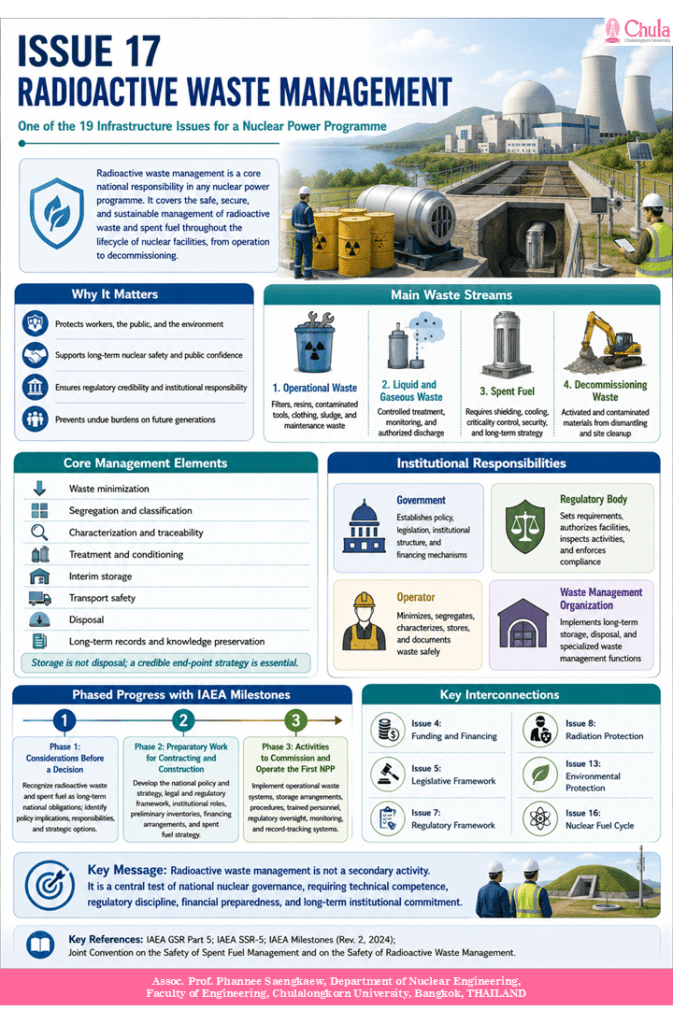
Radioactive waste management is Issue 17 of the IAEA’s 19 infrastructure issues for the development of a national nuclear power programme. It concerns the establishment of a complete national system for the safe, secure, technically sound, and financially sustainable management of radioactive waste generated throughout the nuclear power lifecycle. This includes waste arising from construction, commissioning, operation, maintenance, refurbishment, spent fuel handling, decontamination, and decommissioning. The IAEA Milestones approach emphasizes that each infrastructure issue is interconnected; for example, radioactive waste management is Issue 17, but its financial provisions are also linked to Issue 4 on funding and financing.
In a nuclear power programme, radioactive waste management should not be viewed as a secondary activity after electricity generation. Rather, it is a core component of national nuclear infrastructure because it directly affects nuclear safety, radiation protection, environmental protection, public confidence, regulatory credibility, long-term institutional responsibility, and intergenerational equity. A country that decides to introduce nuclear power must therefore establish a national framework that ensures radioactive waste is minimized, characterized, segregated, treated, conditioned, stored, transported, and ultimately disposed of in a manner that protects workers, the public, and the environment.
The IAEA safety framework distinguishes between predisposal management and disposal. Predisposal management includes all steps before disposal, such as waste generation control, processing, storage, and preparation for disposal. The IAEA GSR Part 5 provides international safety requirements for radioactive waste management before disposal, while SSR-5 establishes safety requirements for disposal facilities for all types of radioactive waste.
2. Conceptual Meaning of Issue 17
Issue 17 requires a country to develop an integrated radioactive waste management system that is consistent with the scale, technology, fuel cycle strategy, regulatory structure, and long-term commitments of its nuclear power programme. This system must cover not only technical facilities but also legislation, regulation, institutional responsibilities, financing mechanisms, human resource development, public communication, safety assessment, environmental monitoring, and long-term record keeping.
Radioactive waste management is a lifecycle obligation. Waste is generated during many stages of a nuclear power programme, including reactor operation, maintenance activities, resin and filter replacement, contaminated tools and protective clothing management, spent fuel pool operations, radioactive liquid treatment, gaseous effluent control, decontamination activities, and decommissioning. Although the volume of high-level radioactive waste or spent fuel is relatively small compared with many industrial waste streams, its radiological hazard and long-lived nature require a structured and legally enforceable management system.
The issue is therefore not simply “where to put the waste.” It is a national infrastructure issue that asks whether the country has a coherent answer to the following questions:
- Who has legal responsibility for radioactive waste management?
- Which organization will operate waste management facilities?
- Which regulatory body will authorize, inspect, and enforce requirements?
- How will waste be classified, recorded, treated, stored, transported, and disposed of?
- How will spent fuel be managed?
- How will long-term liabilities be financed?
- How will public confidence be maintained?
- How will records and institutional knowledge be preserved for decades or centuries?
3. Scope of Radioactive Waste in a Nuclear Power Programme
Radioactive waste from a nuclear power programme may include several categories of material with different radiological, physical, chemical, and operational characteristics. A national waste management system must therefore distinguish among waste types and apply appropriate controls to each category.
3.1 Operational Radioactive Waste
Operational radioactive waste is generated during normal reactor operation and maintenance. It may include contaminated filters, ion-exchange resins, evaporator concentrates, sludge, protective clothing, cleaning materials, tools, laboratory waste, and activated or contaminated components. The radiological content is usually dominated by activation products and fission-product contamination, depending on the reactor type, operating history, coolant chemistry, and waste stream.
The management of operational waste requires clear procedures for waste minimization, segregation at source, characterization, packaging, interim storage, and transfer to treatment or disposal pathways. Poor segregation can increase the volume of waste requiring higher-level management and can create unnecessary financial and radiological burdens.
3.2 Liquid and Gaseous Radioactive Waste
Liquid radioactive waste may arise from reactor coolant systems, laundry systems, decontamination activities, laboratory operations, and floor drainage systems. Gaseous radioactive waste may arise from ventilation systems, off-gas treatment systems, and reactor operations. These streams require treatment, monitoring, and controlled discharge in accordance with regulatory authorization and dose constraints.
Although treated effluents may be released under authorized conditions, such releases must be controlled, monitored, recorded, and assessed to demonstrate compliance with radiation protection and environmental protection requirements. This links Issue 17 with Issue 8 on radiation protection and Issue 13 on environmental protection.
3.3 Spent Nuclear Fuel
Spent nuclear fuel is not always legally classified as radioactive waste because some countries consider it a resource that may be reprocessed, while others consider it a waste form intended for direct disposal. Regardless of national policy, spent fuel requires safe management after discharge from the reactor. It is highly radioactive, thermally hot, and requires shielding, cooling, criticality control, containment, security, safeguards, and long-term strategic planning.
For newcomer countries, spent fuel management is one of the most important policy decisions within Issue 17. The country must determine whether spent fuel will be stored domestically, returned to a supplier under a contractual arrangement, transferred for reprocessing, or eventually disposed of in a national or multinational geological disposal pathway. This decision also interacts with Issue 16 on nuclear fuel cycle strategy and Issue 6 on safeguards.
3.4 Decommissioning Waste
Decommissioning generates large quantities of material, including activated reactor components, contaminated concrete, piping, tanks, insulation, tools, and structural materials. Some material may be cleared from regulatory control if it meets clearance criteria, while other material may require treatment, storage, or disposal as radioactive waste.
Decommissioning waste must be considered early in the nuclear power programme. A credible radioactive waste strategy must therefore include future decommissioning waste inventories, waste acceptance criteria, financial provisions, and disposal options.
4. Key Principles of Radioactive Waste Management
Radioactive waste management is guided by internationally recognized safety principles. The central objective is to protect people and the environment now and in the future without imposing undue burdens on future generations. This requires both technical safety and institutional continuity.
4.1 Waste Minimization
Waste minimization means reducing the generation and volume of radioactive waste as far as reasonably practicable. This can be achieved through good design, careful material selection, contamination control, optimized maintenance practices, effective chemistry control, reuse where appropriate, and segregation of radioactive and non-radioactive materials.
Waste minimization is important because every unnecessary waste item creates additional requirements for characterization, packaging, storage, transport, disposal capacity, dose management, and cost.
4.2 Segregation and Classification
Waste should be segregated according to radiological, physical, chemical, and disposal-relevant characteristics. Segregation may consider activity concentration, half-life, dose rate, contamination level, heat generation, chemical toxicity, combustibility, compactability, and compatibility with treatment or disposal methods.
A national waste classification system is essential because it connects waste properties with management routes. For example, very low-level waste, low-level waste, intermediate-level waste, and high-level waste require different levels of containment, shielding, storage, and disposal.
4.3 Characterization and Traceability
Waste characterization determines the radionuclide content, dose rate, physical form, chemical composition, and other properties of waste packages. This information is necessary for treatment selection, storage design, transport authorization, disposal acceptance, safety assessment, and long-term records.
Traceability is equally important. Each waste package should have a documented history that allows the operator, regulator, and future waste management organization to understand its origin, composition, treatment, package type, storage location, and final disposition.
4.4 Treatment and Conditioning
Treatment refers to operations that reduce volume, remove radionuclides, change the waste form, or prepare waste for further management. Examples include filtration, evaporation, ion exchange, compaction, incineration, decontamination, and chemical treatment. Conditioning refers to converting waste into a stable form suitable for storage, transport, or disposal, such as cementation, bituminization, polymer encapsulation, or vitrification for high-level waste.
Treatment and conditioning should be selected based on safety, compatibility, waste acceptance criteria, cost, technical maturity, and long-term stability.
4.5 Storage
Storage is the temporary placement of radioactive waste in a facility designed to provide containment, shielding, monitoring, retrievability, security, and environmental protection. Storage may be required before treatment, before disposal, or while national disposal solutions are being developed.
However, storage is not the same as disposal. Long-term storage can be part of a strategy, but it does not remove the need for a final management solution. A country should therefore avoid relying on indefinite storage without a credible pathway toward disposal or another approved end state.
4.6 Disposal
Disposal is the emplacement of radioactive waste in an authorized facility without the intention of retrieval. Disposal options depend on waste type and national policy. Very low-level and low-level waste may be disposed of in near-surface facilities where appropriate. Intermediate-level waste may require engineered barriers and deeper disposal. High-level waste and spent fuel intended as waste generally require deep geological disposal.
The IAEA SSR-5 establishes safety requirements for disposal facilities and emphasizes the need for a safety case, safety assessment, governmental responsibilities, regulatory responsibilities, and operator responsibilities throughout the lifecycle of a disposal facility.
5. National Policy and Strategy
A national policy for radioactive waste management expresses the government’s overall commitments, principles, and responsibilities. It should clarify that radioactive waste will be managed safely, securely, and sustainably, with protection of workers, the public, and the environment as the primary objective.
A national strategy translates this policy into practical implementation. It should identify waste streams, responsible organizations, required facilities, financing mechanisms, regulatory steps, timescales, research needs, capacity-building needs, and decision points. GSR Part 5 identifies the need for a legal and regulatory framework and a national policy and strategy for radioactive waste management.
For a newcomer country, the national strategy should be developed early because waste management responsibilities begin before the first nuclear power plant operates. Decisions made during reactor procurement, fuel supply contracting, site selection, and facility design may strongly influence future waste management options.
A credible strategy should address:
- Waste classification and inventory development.
- Operational waste management.
- Spent fuel management.
- Interim storage.
- Disposal pathways.
- Decommissioning waste.
- Transport of radioactive materials.
- Financing and long-term liabilities.
- Institutional responsibilities.
- Public communication and stakeholder engagement.
- Regulatory authorization and inspection.
- Long-term knowledge preservation.
6. Institutional Responsibilities
Radioactive waste management requires a clear allocation of responsibilities among government, the regulatory body, the nuclear power plant owner/operator, waste management organizations, technical support organizations, emergency response bodies, and other relevant agencies.
6.1 Government
The government is responsible for establishing the national policy, legal framework, institutional structure, and financial mechanisms for radioactive waste management. It must ensure that responsibilities are clearly assigned and that no gaps exist between waste generation, storage, transport, disposal, and long-term oversight.
The government also has a role in international commitments, including participation in relevant conventions and peer review processes. The Joint Convention on the Safety of Spent Fuel Management and on the Safety of Radioactive Waste Management is the first global legal instrument addressing spent fuel and radioactive waste management safety, and it establishes fundamental safety principles and a peer review process.
6.2 Regulatory Body
The regulatory body authorizes and inspects waste management activities. It should establish requirements for waste classification, waste acceptance, discharge authorization, storage, transport, disposal, decommissioning waste, environmental monitoring, safety assessment, management systems, and record keeping.
The regulatory body should be independent, competent, adequately resourced, and legally empowered to enforce compliance. It should also review the safety case for waste management facilities and ensure that operators maintain adequate arrangements for radiation protection, environmental protection, security, and emergency preparedness.
6.3 Operator
The nuclear power plant operator is responsible for managing waste generated by its activities in accordance with legal and regulatory requirements. This includes minimizing waste generation, segregating waste at source, maintaining records, operating waste processing systems, ensuring safe storage, preparing waste packages, and transferring waste to authorized facilities.
The operator must also maintain a management system that integrates safety, quality assurance, radiation protection, environmental protection, security, and documentation.
6.4 National Waste Management Organization
Many countries establish a dedicated waste management organization responsible for long-term waste storage, disposal facility development, repository operation, decommissioning waste management, or spent fuel management. For newcomer countries, the establishment of such an organization may occur progressively, but its future role should be considered early.
7. Technical Elements of a Radioactive Waste Management System
A national radioactive waste management system should include both facility infrastructure and procedural infrastructure.
7.1 Waste Inventory System
A waste inventory system is the foundation for planning. It should identify expected waste types, volumes, radionuclide content, physical forms, chemical properties, dose rates, heat generation, and projected generation over time. Inventory estimates are needed for facility sizing, cost estimation, safety assessment, disposal planning, and stakeholder communication.
The inventory should cover operational waste, spent fuel, activated components, contaminated materials, decommissioning waste, secondary waste from treatment processes, and waste from supporting facilities.
7.2 Waste Processing Facilities
Waste processing facilities may include systems for liquid waste treatment, solid waste compaction, resin treatment, filtration, evaporation, cementation, packaging, decontamination, and assay. The facility design must consider worker dose, contamination control, shielding, ventilation, fire protection, criticality safety where relevant, and waste package quality.
7.3 Interim Storage Facilities
Interim storage facilities are necessary when waste cannot be immediately disposed of or when national disposal facilities are not yet available. Such facilities must be designed for safe storage over the expected period, including structural integrity, radiation shielding, environmental controls, monitoring, package retrievability, physical protection, and record keeping.
7.4 Spent Fuel Storage Facilities
Spent fuel storage may occur in spent fuel pools, dry storage casks, or centralized storage facilities. The facility must ensure cooling, shielding, containment, criticality control, safeguards, security, and long-term integrity. Decisions on spent fuel storage are strongly connected with national fuel cycle policy.
7.5 Disposal Facilities
Disposal facility development requires site selection, safety assessment, engineering design, regulatory authorization, construction, operation, closure, and post-closure institutional control. Disposal planning should begin well before waste volumes become difficult to manage.
Disposal options must be matched to waste characteristics. A near-surface disposal facility may be suitable for certain low-level waste, while higher-activity or longer-lived waste may require geological disposal. The safety case must demonstrate that the disposal system will protect people and the environment under normal conditions and credible future scenarios.
8. Safety Case and Safety Assessment
The safety case is a structured collection of arguments, evidence, analyses, and assessments that demonstrate the safety of a waste management facility or activity. It is not only a calculation but a decision-support framework that integrates design, site characteristics, operational controls, engineering barriers, monitoring, quality assurance, and institutional responsibilities.
Safety assessment supports the safety case by evaluating potential radiological impacts during normal operation, anticipated operational occurrences, accidents, and long-term post-closure evolution where relevant. For disposal facilities, the safety case must consider natural processes, engineered barriers, radionuclide migration, exposure pathways, uncertainty, and long-term performance. SSR-5 sets requirements for planning and disposal safety, including governmental, regulatory, and operator responsibilities.
For a newcomer country, developing competence in safety case review is particularly important. The regulator must be able to evaluate technical submissions rather than depend entirely on vendors or foreign consultants.
9. Relationship with Other IAEA Infrastructure Issues
Issue 17 is strongly connected with other infrastructure issues.
- It is linked with Issue 1, National Position, because a national commitment to nuclear power should include acceptance of long-term radioactive waste responsibilities.
- It is linked with Issue 4, Funding and Financing, because waste management and decommissioning require long-term financial provisions. The IAEA Milestones publication explicitly notes that radioactive waste management is Issue 17 while funding for waste management is also addressed under Issue 4.
- It is linked with Issue 5, Legislative Framework, because radioactive waste management must be supported by legally enforceable responsibilities, authorization processes, liability provisions, and institutional arrangements.
- It is linked with Issue 6, Safeguards, because spent fuel and some nuclear materials remain subject to accounting, control, and verification requirements.
- It is linked with Issue 7, Regulatory Framework, because the regulatory body must authorize waste management facilities, inspect activities, and enforce safety requirements.
- It is linked with Issue 8, Radiation Protection, because waste management activities involve occupational exposure, public exposure, contamination control, dose assessment, and monitoring.
- It is linked with Issue 13, Environmental Protection, because waste management facilities and authorized discharges must be assessed for environmental impacts.
- It is linked with Issue 14, Emergency Planning, because waste storage and handling facilities must be included in emergency preparedness arrangements.
- It is linked with Issue 16, Nuclear Fuel Cycle, because spent fuel strategy is a central part of both fuel cycle policy and waste management strategy.
- It is linked with Issue 18, Industrial Involvement, because local industry may be involved in waste packaging, storage systems, civil construction, transport, monitoring, and decommissioning services.
- It is linked with Issue 19, Procurement, because reactor contracts, fuel supply contracts, spent fuel arrangements, waste treatment systems, and decommissioning obligations should be considered in procurement decisions.
10. Phased Development According to the IAEA Milestones Approach
The IAEA Milestones approach structures nuclear infrastructure development into three phases: consideration before a decision, preparatory work after a policy decision, and activities to implement the first nuclear power plant. The Milestones publication describes the conditions expected at the end of each phase to support effective use of resources.
Phase 1: Considerations Before a Decision to Launch a Nuclear Power Programme
During Phase 1, the country should recognize radioactive waste management as a national obligation associated with nuclear power. The government should identify the legal, institutional, technical, financial, and societal implications of managing radioactive waste and spent fuel.
At this phase, the country does not need to have all facilities in place, but it should understand the magnitude and nature of the commitment. It should examine national policy options, international obligations, preliminary waste inventories, potential spent fuel strategies, and the relationship between waste management and public acceptance.
Expected outcomes of Phase 1 include:
- A preliminary understanding of radioactive waste and spent fuel responsibilities.
- Recognition that waste management must be included in the national nuclear policy.
- Initial identification of responsible government bodies.
- Preliminary review of legal and regulatory needs.
- Initial consideration of financing mechanisms.
- Early stakeholder communication on waste responsibilities.
- Initial assessment of possible national or international spent fuel options.
- Recognition of the need for long-term institutional continuity.
Phase 2: Preparatory Work for Contracting and Construction
During Phase 2, radioactive waste management should move from conceptual recognition to structured planning. The government should develop or revise the legal and regulatory framework, define institutional responsibilities, prepare a national radioactive waste management policy and strategy, and establish requirements for operators and waste management organizations.
This phase is especially important because many waste management outcomes are influenced by decisions made during reactor procurement and project planning. Contracts should address waste processing systems, spent fuel storage, fuel return options where applicable, decommissioning data requirements, technical documentation, training, and technology transfer.
Expected outcomes of Phase 2 include:
- A national radioactive waste management policy and strategy.
- A legal and regulatory framework covering predisposal management, storage, transport, disposal, and spent fuel management.
- Defined responsibilities of the government, regulator, operator, and waste management organization.
- Preliminary waste inventory projections.
- Preliminary spent fuel management strategy.
- Initial financial arrangements for waste management and decommissioning.
- Regulatory requirements for waste classification, characterization, packaging, and storage.
- Human resource development plans for waste management specialists.
- Public communication plans addressing radioactive waste and spent fuel.
- Integration of waste requirements into procurement and vendor discussions.
Phase 3: Activities to Commission and Operate the First Nuclear Power Plant
During Phase 3, the country must implement the waste management arrangements necessary for commissioning and operation. Facilities, procedures, regulatory authorizations, trained personnel, records systems, monitoring programmes, and emergency arrangements must be ready before radioactive waste is generated at scale.
The operator must demonstrate that operational waste can be safely managed. The regulatory body must be able to inspect and authorize waste management activities. Interim storage and spent fuel storage arrangements must be available. Waste records must be reliable from the beginning of operation because poor early records can create long-term safety and disposal difficulties.
Expected outcomes of Phase 3 include:
- Operational waste management systems installed and commissioned.
- Procedures for waste minimization, segregation, characterization, treatment, conditioning, packaging, and storage.
- Authorized interim storage facilities.
- Spent fuel storage systems ready for operation.
- Regulatory inspection and enforcement capacity.
- Waste package record and tracking systems.
- Environmental and radiological monitoring programmes.
- Emergency arrangements for waste management facilities.
- Financial mechanisms activated for long-term liabilities.
- Planning for future disposal and decommissioning waste management.
11. Special Considerations for Newcomer Countries
For countries introducing nuclear power for the first time, radioactive waste management can be challenging because the required time horizon extends far beyond the construction and operation of the first plant. A nuclear power plant may operate for 60 years or more, while spent fuel and some radioactive waste require management over much longer periods.
Newcomer countries should therefore avoid treating radioactive waste as a purely technical issue delegated only to the plant operator. It must be embedded in national policy, law, finance, regulation, procurement, education, and public communication.
Several challenges are particularly important:
- Limited domestic experience in radioactive waste classification and treatment.
- Limited regulatory experience in reviewing waste management safety cases.
- Uncertainty over spent fuel policy.
- Limited disposal facility experience.
- Public concern about long-term waste.
- Need for long-term financial assurance.
- Need for trained personnel across several generations.
- Dependence on vendor support during early phases.
- Need to preserve records and institutional memory.
- Need to align waste management with environmental and land-use policy.
12. Public Confidence and Stakeholder Engagement
Radioactive waste is one of the most sensitive topics in nuclear power development. Public concern often focuses not only on technical risk but also on trust, fairness, transparency, long-term responsibility, and perceived institutional competence.
A credible stakeholder engagement strategy should therefore explain what types of waste will be generated, how waste will be managed, who is responsible, how safety will be regulated, how costs will be financed, and how future generations will be protected. Communication should avoid minimizing the issue. Instead, it should demonstrate that the country understands the responsibility and has a structured plan to manage it.
Stakeholder engagement is especially important for waste storage and disposal facilities, which may require site selection, community consultation, environmental assessment, and long-term monitoring.
13. Long-Term Financing
Radioactive waste management requires long-term financial provisions. Costs may include waste processing systems, storage facilities, transport systems, disposal facility development, spent fuel management, decommissioning waste management, environmental monitoring, institutional control, research and development, and regulatory oversight.
A sustainable financing mechanism should ensure that funds are available when needed and that the cost burden is not unfairly transferred to future generations. Possible mechanisms include segregated funds, operator contributions, electricity tariff provisions, government-backed funds, and legally defined decommissioning and waste management funds.
Financial planning must be realistic and updated over time. Underestimating waste management costs can create future regulatory, political, and public confidence problems.
14. Human Resource Development and Knowledge Management
Issue 17 requires specialized competence in radiation protection, waste characterization, radiochemistry, environmental monitoring, waste processing, nuclear engineering, geology, hydrogeology, safety assessment, regulatory review, quality assurance, records management, transport safety, and stakeholder communication.
A newcomer country should develop a human resource strategy that includes operators, regulators, technical support organizations, universities, research institutes, emergency response organizations, and waste management organizations. Training should begin before operation because waste management systems must be functional from the start of commissioning.
Knowledge management is particularly important because radioactive waste responsibilities extend over long time periods. Records must be preserved, updated, and accessible. Institutional knowledge must not depend only on individuals. It should be embedded in procedures, databases, licensing documents, design records, safety cases, and national archives.
15. Conclusion
Issue 17, radioactive waste management, is a central infrastructure requirement for any credible nuclear power programme. It represents the country’s ability to manage the long-term consequences of nuclear energy use in a safe, transparent, regulated, and financially responsible manner.
A mature radioactive waste management system must include national policy, legislation, regulation, institutional responsibilities, technical facilities, safety assessment, waste inventory systems, spent fuel strategy, financing, human resource development, stakeholder engagement, and long-term record preservation. The issue should be addressed from the earliest phase of the nuclear power programme and progressively strengthened through the Milestones approach.
In academic and policy terms, radioactive waste management is not merely an operational support function. It is a test of national nuclear governance. A country that can manage radioactive waste responsibly demonstrates that it has the institutional maturity, technical competence, regulatory discipline, and long-term commitment required for the peaceful and sustainable use of nuclear power.
References
- International Atomic Energy Agency. (2009). Predisposal Management of Radioactive Waste, General Safety Requirements Part 5. IAEA Safety Standards Series No. GSR Part 5. Vienna: IAEA.
- International Atomic Energy Agency. (2011). Disposal of Radioactive Waste, Specific Safety Requirements. IAEA Safety Standards Series No. SSR-5. Vienna: IAEA.
- International Atomic Energy Agency. (2015). Milestones in the Development of a National Infrastructure for Nuclear Power. IAEA Nuclear Energy Series No. NG-G-3.1 Rev. 1. Vienna: IAEA.
- International Atomic Energy Agency. (2024). Milestones in the Development of a National Infrastructure for Nuclear Power. Vienna: IAEA.
- International Atomic Energy Agency. (1997). Joint Convention on the Safety of Spent Fuel Management and on the Safety of Radioactive Waste Management. INFCIRC/546. Vienna: IAEA.
- International Atomic Energy Agency. (n.d.). Joint Convention on the Safety of Spent Fuel Management and on the Safety of Radioactive Waste Management. IAEA Nuclear Safety Conventions.
ประเด็นด้านที่ 17: การจัดการกากกัมมันตรังสี
1. บทนำ
การจัดการกากกัมมันตรังสีเป็นโครงสร้างพื้นฐานด้านที่ 17 ของโครงสร้างพื้นฐาน 19 ด้าน ตามแนวทางของทบวงการพลังงานปรมาณูระหว่างประเทศ สำหรับการพัฒนาโครงการพลังงานนิวเคลียร์ของประเทศ ประเด็นด้านนี้เกี่ยวข้องกับการจัดตั้งระบบระดับชาติที่สมบูรณ์ครอบคลุมสำหรับการจัดการกากกัมมันตรังสีที่เกิดขึ้นตลอดวัฏจักรชีวิตของโครงการนิวเคลียร์อย่างปลอดภัย มั่นคง มีความเหมาะสมทางเทคนิค และมีความยั่งยืนทางการเงิน กากกัมมันตรังสีดังกล่าวครอบคลุมกากกัมมันตรังสีที่เกิดจากการก่อสร้าง การทดสอบและเดินเครื่องเริ่มต้น การเดินเครื่อง การบำรุงรักษา การปรับปรุงหรือยืดอายุการใช้งานโรงไฟฟ้า การจัดการเชื้อเพลิงใช้แล้ว การขจัดการปนเปื้อน และการรื้อถอนสถานประกอบการนิวเคลียร์เมื่อสิ้นสุดอายุการใช้งาน
ในโครงการพลังงานนิวเคลียร์ การจัดการกากกัมมันตรังสีไม่ควรถูกมองว่าเป็นกิจกรรมรองที่เกิดขึ้นภายหลังการผลิตไฟฟ้าเท่านั้น หากแต่เป็นองค์ประกอบหลักของโครงสร้างพื้นฐานนิวเคลียร์ระดับชาติ เนื่องจากมีผลโดยตรงต่อความปลอดภัยทางนิวเคลียร์ การป้องกันอันตรายจากรังสี การคุ้มครองสิ่งแวดล้อม ความเชื่อมั่นของสาธารณชน ความน่าเชื่อถือของระบบกำกับดูแล ความรับผิดชอบของสถาบันในระยะยาว และความเป็นธรรมระหว่างคนรุ่นปัจจุบันกับคนรุ่นอนาคต ดังนั้น ประเทศที่ตัดสินใจจะนำพลังงานนิวเคลียร์มาใช้จำเป็นต้องจัดตั้งกรอบระดับชาติที่ทำให้มั่นใจได้ว่า กากกัมมันตรังสีจะถูกลดปริมาณ จำแนก แยกประเภท ตรวจลักษณะ บำบัด ปรับสภาพ จัดเก็บ ขนส่ง และกำจัดขั้นสุดท้ายอย่างเป็นระบบ เพื่อคุ้มครองผู้ปฏิบัติงาน ประชาชน และสิ่งแวดล้อม
กรอบมาตรฐานความปลอดภัยของ IAEA แยกการจัดการกากกัมมันตรังสีออกเป็นสองช่วงหลัก ได้แก่ การจัดการก่อนการกำจัดขั้นสุดท้าย (predisposal management) และ การกำจัดขั้นสุดท้าย (disposal) การจัดการก่อนการกำจัดขั้นสุดท้ายครอบคลุมทุกขั้นตอนก่อนที่กากจะถูกนำไปกำจัดขั้นสุดท้าย เช่น การควบคุมการเกิดกาก การบำบัด การจัดเก็บ และการเตรียมกากกัมมันตรังสีให้อยู่ในรูปที่เหมาะสมสำหรับการกำจัดขั้นสุดท้าย ส่วนการกำจัดขั้นสุดท้ายหมายถึงการนำกากกัมมันตรังสีไปจัดวางไว้ในสถานที่หรือระบบที่ได้รับอนุญาต โดยไม่มีเจตนาที่จะนำกลับคืนมาใช้งานอีก
2. ความหมายเชิงแนวคิดของโครงสร้างด้านที่ 17
ประเด็นโครงสร้างด้านที่ 17 กำหนดให้ประเทศต้องพัฒนาระบบการจัดการกากกัมมันตรังสีแบบบูรณาการ ซึ่งสอดคล้องกับขนาดของโครงการ เทคโนโลยีโรงไฟฟ้า กลยุทธ์วัฏจักรเชื้อเพลิง โครงสร้างการกำกับดูแล และภาระผูกพันระยะยาวของโครงการพลังงานนิวเคลียร์ ระบบดังกล่าวต้องไม่ครอบคลุมเฉพาะสิ่งอำนวยความสะดวกทางเทคนิคเท่านั้น แต่ต้องรวมถึงกฎหมาย กฎระเบียบ ความรับผิดชอบของหน่วยงาน กลไกการเงิน การพัฒนาทรัพยากรมนุษย์ การสื่อสารสาธารณะ การประเมินความปลอดภัย การเฝ้าระวังสิ่งแวดล้อม และการเก็บรักษาบันทึกระยะยาวด้วย
การจัดการกากกัมมันตรังสีเป็นภาระผูกพันตลอดวัฏจักรชีวิตของโครงการ กากกัมมันตรังสีอาจเกิดขึ้นในหลายช่วงของโครงการพลังงานนิวเคลียร์ เช่น การเดินเครื่องปฏิกรณ์ การบำรุงรักษา การเปลี่ยนเรซินแลกเปลี่ยนไอออนและตัวกรอง การจัดการเครื่องมือและเสื้อผ้าป้องกันที่ปนเปื้อน การดำเนินงานของบ่อเก็บเชื้อเพลิงใช้แล้ว การบำบัดของเหลวกัมมันตรังสี การควบคุมของเสียก๊าซ การขจัดการปนเปื้อน และการรื้อถอนโรงไฟฟ้า แม้ว่าปริมาตรของกากระดับสูงหรือเชื้อเพลิงนิวเคลียร์ใช้แล้วอาจมีขนาดเล็กเมื่อเปรียบเทียบกับของเสียอุตสาหกรรมหลายประเภท แต่ลักษณะอันตรายทางรังสีและอายุยาวของนิวไคลด์กัมมันตรังสีบางชนิดทำให้ต้องมีระบบบริหารจัดการที่เป็นโครงสร้างและมีผลบังคับใช้ตามกฎหมาย
ดังนั้น ประเด็นนี้จึงไม่ใช่เพียงคำถามว่า “จะนำกากกัมมันตรังสีไปไว้ที่ใด” แต่เป็นประเด็นโครงสร้างพื้นฐานระดับชาติที่สะท้อนว่าประเทศมีคำตอบที่เป็นระบบต่อคำถามต่อไปนี้หรือไม่
- ใครเป็นผู้รับผิดชอบตามกฎหมายต่อการจัดการกากกัมมันตรังสี
- องค์กรใดจะเป็นผู้ดำเนินงานสิ่งอำนวยความสะดวกด้านการจัดการกากกัมมันตรังสี
- หน่วยงานกำกับดูแลใดจะเป็นผู้อนุญาต ตรวจสอบ และบังคับใช้ข้อกำหนด ด้านการจัดการกากกัมมันตรังสี
- กากกัมมันตรังสีจะถูกจำแนก บันทึก บำบัด จัดเก็บ ขนส่ง และกำจัดขั้นสุดท้ายอย่างไร
- เชื้อเพลิงนิวเคลียร์ใช้แล้วจะถูกจัดการอย่างไร
- การจัดหาเงินทุนสำหรับภาระผูกพันระยะยาวได้อย่างไร
- ความเชื่อมั่นของสาธารณชนจะได้รับการรักษาอย่างไร
- บันทึกและองค์ความรู้สะสมของสถาบันจะได้รับการรักษาไว้อย่างไรในช่วงเวลาหลายทศวรรษหรือหลายศตวรรษ
3. ขอบเขตของกากกัมมันตรังสีในโครงการพลังงานนิวเคลียร์
กากกัมมันตรังสีจากโครงการพลังงานนิวเคลียร์อาจประกอบด้วยวัสดุหลายประเภทที่มีลักษณะทางรังสี ทางกายภาพ ทางเคมี และทางการดำเนินงานแตกต่างกัน ระบบการจัดการกากระดับชาติจึงต้องแยกแยะประเภทของกากและกำหนดมาตรการควบคุมที่เหมาะสมกับกากแต่ละประเภท
3.1 กากกัมมันตรังสีจากการเดินเครื่อง
กากกัมมันตรังสีจากการเดินเครื่องเกิดขึ้นระหว่างการเดินเครื่องปกติและการบำรุงรักษาโรงไฟฟ้านิวเคลียร์ กากกัมมันตรังสีประเภทนี้อาจรวมถึงตัวกรองที่ปนเปื้อน เรซินแลกเปลี่ยนไอออน สารเข้มข้นจากระบบระเหย ตะกอน เสื้อผ้าป้องกัน วัสดุทำความสะอาด เครื่องมือ กากกัมมันตรังสีจากห้องปฏิบัติการ และชิ้นส่วนที่ถูกกระตุ้นหรือปนเปื้อน องค์ประกอบทางรังสีของกากกัมมันตรังสีเหล่านี้มักถูกครอบงำโดยผลิตภัณฑ์จากการกระตุ้นและการปนเปื้อนจากผลิตภัณฑ์ฟิชชัน ทั้งนี้ขึ้นอยู่กับชนิดของปฏิกรณ์ ประวัติการเดินเครื่อง เคมีของสารหล่อเย็น และเส้นทางของกระแสกากกัมมันตรังสี
การจัดการกากกัมมันตรังสีจากการเดินเครื่องจำเป็นต้องมีขั้นตอนที่ชัดเจนสำหรับการลดการเกิดกากกัมมันตรังสี การแยกกากกัมมันตรังสีตั้งแต่ต้นทาง การตรวจลักษณะกากกัมมันตรังสี การบรรจุหีบห่อ การจัดเก็บชั่วคราว และการส่งต่อไปยังเส้นทางการบำบัดหรือการกำจัดขั้นสุดท้าย หากการแยกกากกัมมันตรังสีไม่มีประสิทธิภาพ อาจทำให้ปริมาณกากกัมมันตรังสีที่ต้องจัดการในระดับสูงขึ้นเพิ่มขึ้นโดยไม่จำเป็น และสร้างภาระทางการเงินและภาระทางรังสีเพิ่มเติม
3.2 กากกัมมันตรังสีชนิดของเหลวและก๊าซ
กากกัมมันตรังสีชนิดของเหลวอาจเกิดจากระบบหล่อเย็นปฏิกรณ์ ระบบซักล้างเสื้อผ้าปนเปื้อน กิจกรรมการขจัดการปนเปื้อน การปฏิบัติงานในห้องปฏิบัติการ และระบบรวบรวมน้ำทิ้งจากพื้นโรงงาน ส่วนกากกัมมันตรังสีชนิดก๊าซอาจเกิดจากระบบระบายอากาศ ระบบบำบัดก๊าซ และการดำเนินงานของปฏิกรณ์ กระแสของเสียเหล่านี้จำเป็นต้องได้รับการบำบัด เฝ้าระวัง และปล่อยออกสู่สิ่งแวดล้อมภายใต้เงื่อนไขที่ได้รับอนุญาตจากหน่วยงานกำกับดูแล
แม้ว่าของเสียบางส่วนหลังการบำบัดอาจได้รับอนุญาตให้ปล่อยออกได้ภายใต้เงื่อนไขที่กำหนด แต่การปล่อยดังกล่าวต้องได้รับการควบคุม ตรวจวัด บันทึก และประเมินผล เพื่อพิสูจน์ความสอดคล้องกับข้อกำหนดด้านการป้องกันอันตรายจากรังสีและการคุ้มครองสิ่งแวดล้อม ประเด็นนี้จึงเชื่อมโยงโดยตรงกับประเด็นด้านที่ 8 เรื่องการป้องกันอันตรายจากรังสี และประเด็นด้านที่ 13 เรื่องการคุ้มครองสิ่งแวดล้อม
3.3 เชื้อเพลิงนิวเคลียร์ใช้แล้ว
เชื้อเพลิงนิวเคลียร์ใช้แล้วไม่ได้ถูกจัดเป็นกากกัมมันตรังสีตามกฎหมายในทุกประเทศ เนื่องจากบางประเทศถือว่าเชื้อเพลิงใช้แล้วเป็นทรัพยากรที่อาจนำไปผ่านกระบวนการแปรสภาพซ้ำได้ ขณะที่บางประเทศถือว่าเป็นของเสียที่ต้องนำไปกำจัดขั้นสุดท้ายโดยตรง อย่างไรก็ตาม ไม่ว่านโยบายระดับชาติจะจัดประเภทเชื้อเพลิงใช้แล้วอย่างไร เชื้อเพลิงใช้แล้วจำเป็นต้องได้รับการจัดการอย่างปลอดภัยหลังจากถูกนำออกจากปฏิกรณ์ เนื่องจากมีระดับกัมมันตรังสีสูงมาก มีความร้อนตกค้าง ต้องอาศัยการกำบังรังสี การระบายความร้อน การควบคุมภาวะวิกฤต การกักกัน การรักษาความมั่นคงปลอดภัยทางนิวเคลียร์ การพิทักษ์ความปลอดภัยทางนิวเคลียร์ และการวางแผนเชิงยุทธศาสตร์ระยะยาว
สำหรับประเทศที่เพิ่งเริ่มโครงการใหม่ การจัดการเชื้อเพลิงใช้แล้วเป็นหนึ่งในการตัดสินใจเชิงนโยบายที่สำคัญที่สุดภายใต้ประเด็นที่ 17 ประเทศต้องกำหนดว่าเชื้อเพลิงใช้แล้วจะถูกจัดเก็บภายในประเทศ ส่งคืนให้ผู้จัดหาภายใต้ข้อตกลงตามสัญญา ส่งไปแปรสภาพซ้ำ หรือถูกนำไปกำจัดขั้นสุดท้ายในระบบกำจัดทางธรณีวิทยาระดับชาติหรือระดับพหุภาคีในอนาคต การตัดสินใจนี้ยังเชื่อมโยงกับประเด็นที่ 16 เรื่องวัฏจักรเชื้อเพลิงนิวเคลียร์ และประเด็นที่ 6 เรื่องการพิทักษ์ความปลอดภัยทางนิวเคลียร์
3.4 กากกัมมันตรังสีจากการรื้อถอน
การรื้อถอนโรงไฟฟ้านิวเคลียร์ก่อให้เกิดวัสดุจำนวนมาก เช่น ชิ้นส่วนปฏิกรณ์ที่ถูกกระตุ้น คอนกรีตที่ปนเปื้อน ท่อ ถัง ฉนวน เครื่องมือ และวัสดุโครงสร้างบางส่วน วัสดุบางประเภทอาจถูกปลดปล่อยออกจากการควบคุมทางกฎหมายได้หากผ่านเกณฑ์การปลดปล่อยหรือเกณฑ์การยกเว้นที่กำหนด ในขณะที่วัสดุบางประเภทอาจต้องผ่านการบำบัด การจัดเก็บ หรือการกำจัดขั้นสุดท้ายในฐานะกากกัมมันตรังสี
กากจากการรื้อถอนต้องถูกพิจารณาตั้งแต่ระยะเริ่มต้นของโครงการพลังงานนิวเคลียร์ กลยุทธ์การจัดการกากกัมมันตรังสีที่น่าเชื่อถือจึงต้องรวมถึงการประมาณคลังกากจากการรื้อถอนในอนาคต เกณฑ์การยอมรับกาก กลไกการเงิน และทางเลือกสำหรับการกำจัดขั้นสุดท้าย
4. หลักการสำคัญของการจัดการกากกัมมันตรังสี
การจัดการกากกัมมันตรังสีอยู่ภายใต้หลักการความปลอดภัยที่ได้รับการยอมรับในระดับนานาชาติ วัตถุประสงค์สำคัญคือการคุ้มครองมนุษย์และสิ่งแวดล้อมทั้งในปัจจุบันและในอนาคต โดยไม่สร้างภาระที่ไม่สมควรให้แก่คนรุ่นหลัง การบรรลุวัตถุประสงค์นี้ต้องอาศัยทั้งความปลอดภัยทางเทคนิคและความต่อเนื่องของสถาบัน
4.1 การลดการเกิดกากกัมมันตรังสี
การลดการเกิดกากกัมมันตรังสีหมายถึงการลดปริมาณและการเกิดกากกัมมันตรังสีให้มากที่สุดเท่าที่สามารถทำได้อย่างสมเหตุสมผล วิธีการนี้สามารถทำได้ผ่านการออกแบบที่ดี การเลือกใช้วัสดุอย่างระมัดระวัง การควบคุมการปนเปื้อน การเพิ่มประสิทธิภาพของการบำรุงรักษา การควบคุมเคมีของระบบอย่างเหมาะสม การนำกลับมาใช้ใหม่ในกรณีที่เหมาะสม และการแยกวัสดุกัมมันตรังสีออกจากวัสดุที่ไม่เป็นกัมมันตรังสีตั้งแต่ต้นทาง
การลดการเกิดกากกัมมันตรังสีมีความสำคัญเพราะกากทุกชิ้นที่เกิดขึ้นโดยไม่จำเป็นจะสร้างภาระเพิ่มเติมต่อการตรวจลักษณะ การบรรจุหีบห่อ การจัดเก็บ การขนส่ง ความจุของระบบกำจัดขั้นสุดท้าย การควบคุมปริมาณรังสี และค่าใช้จ่าย
4.2 การแยกกากกัมมันตรังสีและการจำแนกประเภท
กากกัมมันตรังสีควรถูกแยกตามลักษณะทางรังสี ทางกายภาพ ทางเคมี และลักษณะที่เกี่ยวข้องกับการกำจัดขั้นสุดท้าย การแยกกากกัมมันตรังสีอาจพิจารณาจากความเข้มข้นกัมมันตรังสี ครึ่งชีวิต อัตราปริมาณรังสี ระดับการปนเปื้อน การเกิดความร้อน ความเป็นพิษทางเคมี ความสามารถในการติดไฟ ความสามารถในการอัดลดปริมาตร และความเข้ากันได้กับวิธีการบำบัดหรือการกำจัดขั้นสุดท้าย
ระบบการจำแนกกากกัมมันตรังสีระดับชาติมีความสำคัญอย่างยิ่ง เพราะเป็นกลไกที่เชื่อมโยงคุณสมบัติของกากกัมมันตรังสีเข้ากับเส้นทางการจัดการ ตัวอย่างเช่น กากกัมมันตรังสีระดับต่ำมาก กากกัมมันตรังสีระดับต่ำ กากกัมมันตรังสีระดับกลาง และกากกัมมันตรังสีระดับสูง ต้องการระดับของการกักกัน การกำบังรังสี การจัดเก็บ และการกำจัดขั้นสุดท้ายที่แตกต่างกัน
4.3 การตรวจลักษณะกากและการสอบกลับได้
การตรวจลักษณะกากกัมมันตรังสีเป็นการกำหนดปริมาณและชนิดของนิวไคลด์กัมมันตรังสี อัตราปริมาณรังสี รูปแบบทางกายภาพ องค์ประกอบทางเคมี และคุณสมบัติอื่นของกากกัมมันตรังสีหรือบรรจุภัณฑ์กากกัมมันตรังสี ข้อมูลดังกล่าวจำเป็นต่อการเลือกวิธีบำบัด การออกแบบการจัดเก็บ การอนุญาตการขนส่ง การกำหนดการยอมรับเข้าสู่สถานกำจัดขั้นสุดท้าย การประเมินความปลอดภัย และการเก็บรักษาบันทึกระยะยาว
ความสามารถในการสอบกลับได้มีความสำคัญไม่ยิ่งหย่อนไปกว่ากัน บรรจุภัณฑ์กากกัมมันตรังสีแต่ละชุดควรมีประวัติที่สามารถติดตามได้ ทำให้ผู้ดำเนินงาน หน่วยงานกำกับดูแล และองค์กรจัดการกากกัมมันตรังสีในอนาคตสามารถทราบแหล่งกำเนิด องค์ประกอบ วิธีการบำบัด ชนิดของบรรจุภัณฑ์ สถานที่จัดเก็บ และสถานะสุดท้ายของกากกัมมันตรังสีนั้นได้
4.4 การบำบัดและการปรับสภาพกากกัมมันตรังสี
การบำบัดหมายถึงการดำเนินงานที่ช่วยลดปริมาตร ขจัดนิวไคลด์กัมมันตรังสี เปลี่ยนรูปแบบของกากกัมมันตรังสี หรือเตรียมกากกัมมันตรังสีสำหรับการจัดการขั้นต่อไป ตัวอย่างของการบำบัด ได้แก่ การกรอง การระเหย การแลกเปลี่ยนไอออน การอัดลดปริมาตร การเผา การขจัดการปนเปื้อน และการบำบัดทางเคมี ส่วนการปรับสภาพหมายถึงการเปลี่ยนกากกัมมันตรังสีให้อยู่ในรูปที่เสถียรและเหมาะสมสำหรับการจัดเก็บ การขนส่ง หรือการกำจัดขั้นสุดท้าย เช่น การตรึงในซีเมนต์ การตรึงในบิทูเมน(bitumen) ซึ่งเป็นวัสดุไฮโดรคาร์บอนลักษณะคล้ายยางมะตอย การห่อหุ้มในโพลิเมอร์ หรือการทำให้เป็นแก้วสำหรับกากกัมมันตรังสีระดับสูง
การเลือกวิธีบำบัดและปรับสภาพควรพิจารณาจากความปลอดภัย ความเข้ากันได้กับชนิดกากกัมมันตรังสี เกณฑ์การยอมรับกากกัมมันตรังสี ค่าใช้จ่าย ความพร้อมทางเทคนิค และเสถียรภาพระยะยาวของรูปกากกัมมันตรังสี
4.5 การจัดเก็บ
การจัดเก็บหมายถึงการวางกากกัมมันตรังสีไว้ชั่วคราวในสถานที่ที่ออกแบบให้มีการกักกัน การกำบังรังสี การเฝ้าระวัง การนำกลับคืนได้ ความมั่นคงปลอดภัย และการคุ้มครองสิ่งแวดล้อม การจัดเก็บอาจจำเป็นก่อนการบำบัด ก่อนการกำจัดขั้นสุดท้าย หรือในระหว่างที่ประเทศกำลังพัฒนาทางออกด้านการกำจัดขั้นสุดท้าย
อย่างไรก็ตาม การจัดเก็บไม่ใช่การกำจัดขั้นสุดท้าย การจัดเก็บระยะยาวอาจเป็นส่วนหนึ่งของกลยุทธ์ แต่ไม่ได้ทดแทนความจำเป็นในการมีทางออกสุดท้ายที่น่าเชื่อถือ ประเทศจึงควรหลีกเลี่ยงการพึ่งพาการจัดเก็บแบบไม่มีกำหนดโดยไม่มีเส้นทางที่น่าเชื่อถือไปสู่การกำจัดขั้นสุดท้ายหรือสถานะปลายทางอื่นที่ได้รับอนุมัติ
4.6 การกำจัดขั้นสุดท้าย
การกำจัดขั้นสุดท้ายหมายถึงการนำกากกัมมันตรังสีไปจัดวางไว้ในสถานที่ที่ได้รับอนุญาต โดยไม่มีเจตนาที่จะนำกลับคืนมา ทางเลือกของการกำจัดขั้นสุดท้ายขึ้นอยู่กับชนิดของกากกัมมันตรังสีและนโยบายระดับชาติ กากกัมมันตรังสีระดับต่ำมากและกากกัมมันตรังสีระดับต่ำบางประเภทอาจเหมาะสมกับสถานกำจัดใกล้ผิวดิน ส่วนกากกัมมันตรังสีระดับกลางอาจต้องใช้ระบบกั้นทางวิศวกรรมและการกำจัดในระดับลึกกว่า ขณะที่กากกัมมันตรังสีระดับสูงและเชื้อเพลิงใช้แล้วที่ถูกกำหนดให้เป็นกากกัมมันตรังสีโดยทั่วไปต้องใช้การกำจัดทางธรณีวิทยาระดับลึก
การกำจัดขั้นสุดท้ายต้องอาศัยกรณีความปลอดภัย การประเมินความปลอดภัย ความรับผิดชอบของรัฐบาล ความรับผิดชอบของหน่วยงานกำกับดูแล และความรับผิดชอบของผู้ดำเนินงานตลอดวัฏจักรชีวิตของสถานกำจัด
5. นโยบายและยุทธศาสตร์ระดับชาติ
นโยบายระดับชาติด้านการจัดการกากกัมมันตรังสีแสดงถึงพันธกรณี หลักการ และความรับผิดชอบโดยรวมของรัฐบาล นโยบายควรระบุให้ชัดเจนว่ากากกัมมันตรังสีจะได้รับการจัดการอย่างปลอดภัย มั่นคง และยั่งยืน โดยมีการคุ้มครองผู้ปฏิบัติงาน ประชาชน และสิ่งแวดล้อมเป็นวัตถุประสงค์หลัก
ยุทธศาสตร์ระดับชาติเป็นการแปลงนโยบายดังกล่าวให้เป็นการดำเนินงานในทางปฏิบัติ ยุทธศาสตร์ควรระบุประเภทของกากกัมมันตรังสี หน่วยงานที่รับผิดชอบ สิ่งอำนวยความสะดวกที่จำเป็น กลไกการเงิน ขั้นตอนการกำกับดูแล กำหนดเวลา ความต้องการด้านการวิจัย ความต้องการด้านการพัฒนาขีดความสามารถ และจุดตัดสินใจที่สำคัญ สำหรับประเทศที่เพิ่งเริ่มโครงการใหม่ ยุทธศาสตร์ระดับชาติควรถูกพัฒนาตั้งแต่ระยะเริ่มต้น เนื่องจากความรับผิดชอบด้านการจัดการกากกัมมันตรังสีเริ่มต้นก่อนที่โรงไฟฟ้านิวเคลียร์แห่งแรกจะเดินเครื่อง
การตัดสินใจที่เกิดขึ้นระหว่างการจัดซื้อปฏิกรณ์ การทำสัญญาจัดหาเชื้อเพลิง การเลือกที่ตั้ง และการออกแบบสิ่งอำนวยความสะดวก สามารถมีผลอย่างมากต่อทางเลือกด้านการจัดการกากกัมมันตรังสีในอนาคต ดังนั้น ยุทธศาสตร์ที่น่าเชื่อถือควรครอบคลุมประเด็นต่อไปนี้
- การจำแนกกากกัมมันตรังสีและการพัฒนาคลังกากกัมมันตรังสี
- การจัดการกากกัมมันตรังสีจากการเดินเครื่อง
- การจัดการเชื้อเพลิงใช้แล้ว
- การจัดเก็บชั่วคราว
- เส้นทางการกำจัดขั้นสุดท้าย
- กากกัมมันตรังสีจากการรื้อถอน
- การขนส่งวัสดุกัมมันตรังสี
- การเงินและภาระผูกพันระยะยาว
- ความรับผิดชอบของสถาบัน
- การสื่อสารสาธารณะและการมีส่วนร่วมของผู้มีส่วนได้ส่วนเสีย
- การอนุญาตและการตรวจสอบตามระบบกำกับดูแล
- การรักษาองค์ความรู้ระยะยาว
6. ความรับผิดชอบของสถาบัน
การจัดการกากกัมมันตรังสีต้องอาศัยการจัดสรรความรับผิดชอบอย่างชัดเจนระหว่างรัฐบาล หน่วยงานกำกับดูแล เจ้าของหรือผู้ดำเนินงานโรงไฟฟ้านิวเคลียร์ องค์กรจัดการกากกัมมันตรังสี องค์กรสนับสนุนทางเทคนิค หน่วยงานตอบโต้เหตุฉุกเฉิน และหน่วยงานอื่นที่เกี่ยวข้อง
6.1 รัฐบาล
รัฐบาลมีหน้าที่จัดทำนโยบายระดับชาติ กรอบกฎหมาย โครงสร้างสถาบัน และกลไกทางการเงินสำหรับการจัดการกากกัมมันตรังสี รัฐบาลต้องทำให้มั่นใจว่าความรับผิดชอบถูกกำหนดไว้อย่างชัดเจน และไม่มีช่องว่างระหว่างการเกิดกากกัมมันตรังสี การจัดเก็บ การขนส่ง การกำจัดขั้นสุดท้าย และการกำกับดูแลระยะยาว
รัฐบาลยังมีบทบาทเกี่ยวกับพันธกรณีระหว่างประเทศ รวมถึงการเข้าร่วมอนุสัญญาที่เกี่ยวข้องและกระบวนการทบทวนโดยผู้เชี่ยวชาญระหว่างประเทศ อนุสัญญาร่วมว่าด้วยความปลอดภัยในการจัดการเชื้อเพลิงใช้แล้วและความปลอดภัยในการจัดการกากกัมมันตรังสีเป็นตราสารทางกฎหมายระดับโลกที่สำคัญ ซึ่งกำหนดหลักการพื้นฐานด้านความปลอดภัยและมีกระบวนการทบทวนโดยภาคีสมาชิก
6.2 หน่วยงานกำกับดูแล
หน่วยงานกำกับดูแลมีหน้าที่อนุญาตและตรวจสอบกิจกรรมด้านการจัดการกากกัมมันตรังสี หน่วยงานดังกล่าวควรกำหนดข้อกำหนดเกี่ยวกับการจำแนกกากกัมมันตรังสี การยอมรับกากกัมมันตรังสี การอนุญาตการปล่อยของเสีย การจัดเก็บ การขนส่ง การกำจัดขั้นสุดท้าย กากกัมมันตรังสีจากการรื้อถอน การเฝ้าระวังสิ่งแวดล้อม การประเมินความปลอดภัย ระบบบริหารจัดการ และการเก็บรักษาบันทึก
หน่วยงานกำกับดูแลควรมีความเป็นอิสระ มีความสามารถ มีทรัพยากรเพียงพอ และมีอำนาจตามกฎหมายในการบังคับใช้ข้อกำหนด นอกจากนี้ หน่วยงานกำกับดูแลต้องสามารถทบทวนกรณีความปลอดภัยของสิ่งอำนวยความสะดวกด้านการจัดการกากกัมมันตรังสี และทำให้มั่นใจว่าผู้ดำเนินงานมีการจัดการด้านการป้องกันอันตรายจากรังสี การคุ้มครองสิ่งแวดล้อม ความมั่นคงปลอดภัย และการเตรียมพร้อมรับเหตุฉุกเฉินอย่างเพียงพอ
6.3 ผู้ดำเนินงาน
ผู้ดำเนินงานโรงไฟฟ้านิวเคลียร์มีความรับผิดชอบในการจัดการกากกัมมันตรังสีที่เกิดจากกิจกรรมของตนให้สอดคล้องกับกฎหมายและข้อกำหนดกำกับดูแล ความรับผิดชอบนี้รวมถึงการลดการเกิดกากกัมมันตรังสี การแยกกากกัมมันตรังสีตั้งแต่ต้นทาง การเก็บบันทึก การเดินระบบบำบัดกากกัมมันตรังสี การทำให้มั่นใจว่าการจัดเก็บมีความปลอดภัย การเตรียมบรรจุภัณฑ์กากกัมมันตรังสี และการส่งมอบกากกัมมันตรังสีให้กับสถานที่หรือองค์กรที่ได้รับอนุญาต
ผู้ดำเนินงานต้องมีระบบบริหารจัดการที่บูรณาการความปลอดภัย การประกันคุณภาพ การป้องกันอันตรายจากรังสี การคุ้มครองสิ่งแวดล้อม ความมั่นคงปลอดภัย และการจัดทำเอกสารเข้าด้วยกัน
6.4 องค์กรจัดการกากระดับชาติ
หลายประเทศจัดตั้งองค์กรเฉพาะด้านการจัดการกากกัมมันตรังสี ซึ่งรับผิดชอบการจัดเก็บระยะยาว การพัฒนาสถานกำจัดขั้นสุดท้าย การดำเนินงานสถานกำจัด การจัดการกากกัมมันตรังสีจากการรื้อถอน หรือการจัดการเชื้อเพลิงใช้แล้ว สำหรับประเทศที่เพิ่งเริ่มโครงการใหม่ การจัดตั้งองค์กรดังกล่าวอาจเกิดขึ้นอย่างค่อยเป็นค่อยไป แต่บทบาทในอนาคตขององค์กรนี้ควรถูกพิจารณาตั้งแต่ระยะเริ่มต้น
7. องค์ประกอบทางเทคนิคของระบบการจัดการกากกัมมันตรังสี
ระบบการจัดการกากกัมมันตรังสีระดับชาติควรประกอบด้วยทั้งโครงสร้างพื้นฐานด้านสิ่งอำนวยความสะดวกและโครงสร้างพื้นฐานด้านกระบวนการดำเนินงาน
7.1 ระบบคลังกากกัมมันตรังสี
ระบบคลังกากกัมมันตรังสีเป็นฐานรากของการวางแผน ระบบนี้ควรระบุชนิดกากกัมมันตรังสีที่คาดว่าจะเกิดขึ้น ปริมาตร ปริมาณและชนิดนิวไคลด์กัมมันตรังสี รูปแบบทางกายภาพ คุณสมบัติทางเคมี อัตราปริมาณรังสี การเกิดความร้อน และการคาดการณ์การเกิดกากกัมมันตรังสีตามเวลา การประมาณคลังกากจำเป็นต่อการกำหนดขนาดสิ่งอำนวยความสะดวก การประมาณค่าใช้จ่าย การประเมินความปลอดภัย การวางแผนการกำจัดขั้นสุดท้าย และการสื่อสารกับผู้มีส่วนได้ส่วนเสีย
คลังกากควรครอบคลุมกากกัมมันตรังสีจากการเดินเครื่อง เชื้อเพลิงใช้แล้ว ชิ้นส่วนที่ถูกกระตุ้น วัสดุปนเปื้อน กากกัมมันตรังสีจากการรื้อถอน กากกัมมันตรังสีรองจากกระบวนการบำบัด และกากกัมมันตรังสีจากสิ่งอำนวยความสะดวกสนับสนุน
7.2 สิ่งอำนวยความสะดวกด้านการบำบัดกาก
สิ่งอำนวยความสะดวกด้านการบำบัดกากกัมมันตรังสีอาจประกอบด้วยระบบบำบัดของเหลว ระบบอัดลดปริมาตรกากกัมมันตรังสีของแข็ง ระบบบำบัดเรซิน ระบบกรอง ระบบระเหย ระบบตรึงในซีเมนต์ ระบบบรรจุหีบห่อ ระบบขจัดการปนเปื้อน และระบบตรวจวัดหรือประเมินกากกัมมันตรังสี การออกแบบสิ่งอำนวยความสะดวกต้องพิจารณาปริมาณรังสีของผู้ปฏิบัติงาน การควบคุมการปนเปื้อน การกำบังรังสี ระบบระบายอากาศ การป้องกันอัคคีภัย ความปลอดภัยทางภาวะวิกฤตในกรณีที่เกี่ยวข้อง และคุณภาพของบรรจุภัณฑ์กากกัมมันตรังสี
7.3 สิ่งอำนวยความสะดวกด้านการจัดเก็บชั่วคราว
สิ่งอำนวยความสะดวกด้านการจัดเก็บชั่วคราวมีความจำเป็นเมื่อกากไม่สามารถถูกกำจัดขั้นสุดท้ายได้ทันที หรือเมื่อประเทศยังไม่มีสถานกำจัดขั้นสุดท้าย สิ่งอำนวยความสะดวกดังกล่าวต้องได้รับการออกแบบให้สามารถจัดเก็บกากกัมมันตรังสีได้อย่างปลอดภัยตลอดช่วงเวลาที่คาดการณ์ไว้ โดยรวมถึงความมั่นคงแข็งแรงของโครงสร้าง การกำบังรังสี การควบคุมสภาพแวดล้อม การเฝ้าระวัง ความสามารถในการนำบรรจุภัณฑ์กากกัมมันตรังสีกลับคืน การป้องกันทางกายภาพ และการเก็บรักษาบันทึก
7.4 สิ่งอำนวยความสะดวกด้านการจัดเก็บเชื้อเพลิงใช้แล้ว
การจัดเก็บเชื้อเพลิงใช้แล้วอาจเกิดขึ้นในบ่อเก็บเชื้อเพลิงใช้แล้ว ภาชนะจัดเก็บแห้ง หรือสถานจัดเก็บรวมส่วนกลาง สิ่งอำนวยความสะดวกดังกล่าวต้องทำให้มั่นใจได้ว่ามีการระบายความร้อน การกำบังรังสี การกักกัน การควบคุมภาวะวิกฤต การพิทักษ์ความปลอดภัยทางนิวเคลียร์ ความมั่นคงปลอดภัย และความสมบูรณ์ในระยะยาว การตัดสินใจเกี่ยวกับการจัดเก็บเชื้อเพลิงใช้แล้วเชื่อมโยงอย่างมากกับนโยบายวัฏจักรเชื้อเพลิงระดับชาติ
7.5 สถานกำจัดขั้นสุดท้าย
การพัฒนาสถานกำจัดขั้นสุดท้ายต้องอาศัยการเลือกที่ตั้ง การประเมินความปลอดภัย การออกแบบทางวิศวกรรม การอนุญาตตามระบบกำกับดูแล การก่อสร้าง การดำเนินงาน การปิดสถานที่ และการควบคุมเชิงสถาบันภายหลังการปิด การวางแผนการกำจัดขั้นสุดท้ายควรเริ่มต้นก่อนที่ปริมาณกากกัมมันตรังสีจะสะสมจนยากต่อการจัดการ
ทางเลือกการกำจัดขั้นสุดท้ายต้องสอดคล้องกับลักษณะของกากกัมมันตรังสี สถานกำจัดใกล้ผิวดินอาจเหมาะสมกับกากกัมมันตรังสีระดับต่ำบางประเภท ขณะที่กากที่มีกัมมันตภาพรังสีสูงกว่า หรือมีนิวไคลด์อายุยาวมากกว่า อาจต้องการการกำจัดทางธรณีวิทยา กรณีความปลอดภัยต้องแสดงให้เห็นว่าระบบกำจัดขั้นสุดท้ายจะสามารถคุ้มครองมนุษย์และสิ่งแวดล้อมได้ทั้งในสภาวะปกติและในสถานการณ์อนาคตที่มีความเป็นไปได้อย่างสมเหตุสมผล
8. กรณีความปลอดภัยและการประเมินความปลอดภัย
กรณีความปลอดภัยเป็นการรวบรวมข้อโต้แย้ง หลักฐาน การวิเคราะห์ และการประเมินอย่างเป็นระบบ เพื่อแสดงให้เห็นว่าสิ่งอำนวยความสะดวกหรือกิจกรรมด้านการจัดการกากกัมมันตรังสีมีความปลอดภัย กรณีความปลอดภัยไม่ใช่เพียงการคำนวณ แต่เป็นกรอบสนับสนุนการตัดสินใจที่บูรณาการการออกแบบ ลักษณะของที่ตั้ง มาตรการควบคุมการดำเนินงาน ระบบกั้นทางวิศวกรรม การเฝ้าระวัง การประกันคุณภาพ และความรับผิดชอบของสถาบัน
การประเมินความปลอดภัยสนับสนุนกรณีความปลอดภัยโดยประเมินผลกระทบทางรังสีที่อาจเกิดขึ้นระหว่างการดำเนินงานปกติ เหตุการณ์ที่คาดหมายได้ ความผิดปกติ อุบัติเหตุ และวิวัฒนาการระยะยาวภายหลังการปิดสถานที่ในกรณีที่เกี่ยวข้อง สำหรับสถานกำจัดขั้นสุดท้าย กรณีความปลอดภัยต้องพิจารณากระบวนการทางธรรมชาติ ระบบกั้นทางวิศวกรรม การเคลื่อนย้ายของนิวไคลด์กัมมันตรังสี เส้นทางการได้รับรังสี ความไม่แน่นอน และสมรรถนะระยะยาว
สำหรับประเทศที่เพิ่งเริ่มโครงการใหม่ การพัฒนาความสามารถในการทบทวนกรณีความปลอดภัยมีความสำคัญเป็นพิเศษ หน่วยงานกำกับดูแลต้องสามารถประเมินเอกสารทางเทคนิคได้ด้วยตนเอง ไม่ใช่พึ่งพาผู้ขายเทคโนโลยีหรือที่ปรึกษาต่างประเทศทั้งหมด
9. ความสัมพันธ์กับโครงสร้างพื้นฐานด้านอื่นของ IAEA
โครงสร้างด้านที่ 17 มีความเชื่อมโยงอย่างมากกับโครงสร้างพื้นฐานด้านอื่น ๆ ดังนี้
ด้านที่ 1 จุดยืนระดับชาติ เพราะการยอมรับโครงการพลังงานนิวเคลียร์ระดับชาติต้องรวมถึงการยอมรับความรับผิดชอบระยะยาวต่อกากกัมมันตรังสีด้วย
ด้านที่ 4 การจัดหาเงินทุนและการเงิน เพราะการจัดการกากกัมมันตรังสีและการรื้อถอนต้องอาศัยการจัดเตรียมเงินทุนระยะยาว
ด้านที่ 5 กรอบกฎหมาย เพราะการจัดการกากกัมมันตรังสีต้องมีความรับผิดชอบที่มีผลบังคับตามกฎหมาย กระบวนการอนุญาต บทบัญญัติด้านความรับผิด และการจัดวางสถาบันอย่างชัดเจน
ด้านที่ 6 การพิทักษ์ความปลอดภัยทางนิวเคลียร์ เพราะเชื้อเพลิงใช้แล้วและวัสดุนิวเคลียร์บางประเภทต้องอยู่ภายใต้การทำบัญชี การควบคุม และการตรวจพิสูจน์
ด้านที่ 7 กรอบการกำกับดูแล เพราะหน่วยงานกำกับดูแลต้องอนุญาตสิ่งอำนวยความสะดวกด้านการจัดการกากกัมมันตรังสี ตรวจสอบกิจกรรม และบังคับใช้ข้อกำหนดด้านความปลอดภัย
ด้านที่ 8 การป้องกันอันตรายจากรังสี เพราะกิจกรรมด้านการจัดการกากกัมมันตรังสีเกี่ยวข้องกับการได้รับรังสีของผู้ปฏิบัติงาน การได้รับรังสีของประชาชน การควบคุมการปนเปื้อน การประเมินปริมาณรังสี และการเฝ้าระวัง
ด้านที่ 13 การคุ้มครองสิ่งแวดล้อม เพราะสิ่งอำนวยความสะดวกด้านการจัดการกากกัมมันตรังสีและการปล่อยของเสียที่ได้รับอนุญาตต้องได้รับการประเมินผลกระทบต่อสิ่งแวดล้อม
ด้านที่ 14 การวางแผนเหตุฉุกเฉิน เพราะสถานที่จัดเก็บและจัดการกากกัมมันตรังสีต้องถูกรวมอยู่ในระบบเตรียมพร้อมและตอบโต้เหตุฉุกเฉิน
ด้านที่ 16 วัฏจักรเชื้อเพลิงนิวเคลียร์ เพราะกลยุทธ์เชื้อเพลิงใช้แล้วเป็นส่วนสำคัญของทั้งนโยบายวัฏจักรเชื้อเพลิงและยุทธศาสตร์การจัดการกากกัมมันตรังสี
ด้านที่ 18 การมีส่วนร่วมของอุตสาหกรรม เพราะอุตสาหกรรมภายในประเทศอาจมีบทบาทในการจัดทำบรรจุภัณฑ์กากกัมมันตรังสี ระบบจัดเก็บ งานก่อสร้างโยธา การขนส่ง การเฝ้าระวัง และบริการด้านการรื้อถอน
ด้านที่ 19 การจัดซื้อจัดจ้าง เพราะสัญญาปฏิกรณ์ สัญญาจัดหาเชื้อเพลิง ข้อตกลงเกี่ยวกับเชื้อเพลิงใช้แล้ว ระบบบำบัดกากกัมมันตรังสี และภาระผูกพันด้านการรื้อถอนควรถูกพิจารณาในการจัดซื้อจัดจ้างตั้งแต่ต้น
10. การพัฒนาเป็นระยะตามแนวทางตามกรอบหมุดหมายของ IAEA
แนวทางตามกรอบหมุดหมายของ IAEA แบ่งการพัฒนาโครงสร้างพื้นฐานนิวเคลียร์ออกเป็นสามระยะ ได้แก่ ระยะการพิจารณาก่อนการตัดสินใจ ระยะเตรียมการหลังการตัดสินใจเชิงนโยบาย และระยะกิจกรรมเพื่อดำเนินโครงการโรงไฟฟ้านิวเคลียร์แห่งแรก จุดหมุดหมายเหล่านี้ช่วยกำหนดเงื่อนไขที่คาดหวังเมื่อสิ้นสุดแต่ละระยะ เพื่อสนับสนุนการใช้ทรัพยากรอย่างมีประสิทธิภาพ
ระยะที่ 1: การพิจารณาก่อนการตัดสินใจเริ่มโครงการพลังงานนิวเคลียร์
ในระยะที่ 1 ประเทศควรตระหนักว่าการจัดการกากกัมมันตรังสีเป็นภาระผูกพันระดับชาติที่มาพร้อมกับการใช้พลังงานนิวเคลียร์ รัฐบาลควรระบุผลกระทบทางกฎหมาย สถาบัน เทคนิค การเงิน และสังคมที่เกี่ยวข้องกับการจัดการกากกัมมันตรังสีและเชื้อเพลิงใช้แล้ว
ในระยะนี้ ประเทศยังไม่จำเป็นต้องมีสิ่งอำนวยความสะดวกทั้งหมดพร้อมใช้งาน แต่ต้องเข้าใจขนาดและลักษณะของพันธกรณีที่กำลังจะเกิดขึ้น ประเทศควรพิจารณาทางเลือกเชิงนโยบาย พันธกรณีระหว่างประเทศ คลังข้อมูลกากกัมมันตรังสีเบื้องต้น ทางเลือกเชื้อเพลิงใช้แล้วที่เป็นไปได้ และความสัมพันธ์ระหว่างการจัดการกากกัมมันตรังสีกับการยอมรับของสาธารณชน
ผลลัพธ์ที่คาดหวังในระยะที่ 1 ได้แก่
- ความเข้าใจเบื้องต้นเกี่ยวกับความรับผิดชอบด้านกากกัมมันตรังสีและเชื้อเพลิงใช้แล้ว
- การยอมรับว่าการจัดการกากกัมมันตรังสีต้องรวมอยู่ในนโยบายนิวเคลียร์ระดับชาติ
- การระบุหน่วยงานของรัฐที่เกี่ยวข้องในเบื้องต้น
- การทบทวนเบื้องต้นเกี่ยวกับความจำเป็นด้านกฎหมายและการกำกับดูแล
- การพิจารณาเบื้องต้นเกี่ยวกับกลไกการเงิน
- การสื่อสารกับผู้มีส่วนได้ส่วนเสียในระยะเริ่มต้นเกี่ยวกับความรับผิดชอบด้านกากกัมมันตรังสี
- การประเมินเบื้องต้นเกี่ยวกับทางเลือกด้านเชื้อเพลิงใช้แล้วทั้งในประเทศและระหว่างประเทศ
- การตระหนักถึงความจำเป็นของความต่อเนื่องของสถาบันในระยะยาว
ระยะที่ 2: งานเตรียมการสำหรับการทำสัญญาและการก่อสร้าง
ในระยะที่ 2 การจัดการกากกัมมันตรังสีควรเปลี่ยนจากการตระหนักเชิงแนวคิดไปสู่การวางแผนเชิงโครงสร้าง รัฐบาลควรพัฒนาหรือปรับปรุงกรอบกฎหมายและการกำกับดูแล กำหนดความรับผิดชอบของสถาบัน จัดทำนโยบายและยุทธศาสตร์ระดับชาติด้านการจัดการกากกัมมันตรังสี และกำหนดข้อกำหนดสำหรับผู้ดำเนินงานและองค์กรจัดการกากกัมมันตรังสี
ระยะนี้มีความสำคัญเป็นพิเศษ เพราะผลลัพธ์ด้านการจัดการกากกัมมันตรังสีจำนวนมากถูกกำหนดโดยการตัดสินใจระหว่างการจัดซื้อปฏิกรณ์และการวางแผนโครงการ สัญญาต่าง ๆ ควรครอบคลุมระบบบำบัดกากกัมมันตรังสี ระบบจัดเก็บเชื้อเพลิงใช้แล้ว ทางเลือกการส่งคืนเชื้อเพลิงในกรณีที่เกี่ยวข้อง ข้อกำหนดด้านข้อมูลสำหรับการรื้อถอน เอกสารทางเทคนิค การฝึกอบรม และการถ่ายทอดเทคโนโลยี
ผลลัพธ์ที่คาดหวังในระยะที่ 2 ได้แก่
- นโยบายและยุทธศาสตร์ระดับชาติด้านการจัดการกากกัมมันตรังสี
- กรอบกฎหมายและการกำกับดูแลที่ครอบคลุมการจัดการก่อนการกำจัดขั้นสุดท้าย การจัดเก็บ การขนส่ง การกำจัดขั้นสุดท้าย และการจัดการเชื้อเพลิงใช้แล้ว
- ความรับผิดชอบที่ชัดเจนของรัฐบาล หน่วยงานกำกับดูแล ผู้ดำเนินงาน และองค์กรจัดการกากกัมมันตรังสี
- การคาดการณ์คลังกากเบื้องต้น
- กลยุทธ์เบื้องต้นด้านการจัดการเชื้อเพลิงใช้แล้ว
- การจัดเตรียมทางการเงินเบื้องต้นสำหรับการจัดการกากกัมมันตรังสีและการรื้อถอน
- ข้อกำหนดกำกับดูแลสำหรับการจำแนกกากกัมมันตรังสี การตรวจลักษณะ การบรรจุหีบห่อ และการจัดเก็บ
- แผนการพัฒนาทรัพยากรมนุษย์สำหรับผู้เชี่ยวชาญด้านการจัดการกากกัมมันตรังสี
- แผนการสื่อสารสาธารณะเกี่ยวกับกากกัมมันตรังสีและเชื้อเพลิงใช้แล้ว
- การบูรณาการข้อกำหนดด้านกากกัมมันตรังสีเข้ากับการจัดซื้อจัดจ้างและการหารือกับผู้ขายเทคโนโลยี
ระยะที่ 3: กิจกรรมเพื่อทดสอบ เดินเครื่อง และดำเนินงานโรงไฟฟ้านิวเคลียร์แห่งแรก
ในระยะที่ 3 ประเทศต้องดำเนินการตามระบบการจัดการกากกัมมันตรังสีที่จำเป็นสำหรับการทดสอบ เดินเครื่อง และการดำเนินงานจริง สิ่งอำนวยความสะดวก ขั้นตอนการปฏิบัติงาน การอนุญาตตามระบบกำกับดูแล บุคลากรที่ผ่านการฝึกอบรม ระบบบันทึก โครงการเฝ้าระวัง และการจัดการเหตุฉุกเฉินต้องพร้อมก่อนที่กากกัมมันตรังสีจะเกิดขึ้นในปริมาณมาก
ผู้ดำเนินงานต้องแสดงให้เห็นว่าสามารถจัดการกากกัมมันตรังสีจากการเดินเครื่องได้อย่างปลอดภัย หน่วยงานกำกับดูแลต้องสามารถตรวจสอบและอนุญาตกิจกรรมด้านการจัดการกากกัมมันตรังสีได้ การจัดเก็บชั่วคราวและการจัดเก็บเชื้อเพลิงใช้แล้วต้องพร้อมใช้งาน ระบบบันทึกกากกัมมันตรังสีต้องมีความน่าเชื่อถือตั้งแต่เริ่มต้นการเดินเครื่อง เพราะบันทึกที่ไม่ดีในช่วงแรกอาจสร้างปัญหาด้านความปลอดภัยและการกำจัดขั้นสุดท้ายในระยะยาว
ผลลัพธ์ที่คาดหวังในระยะที่ 3 ได้แก่
- ระบบจัดการกากกัมมันตรังสีจากการเดินเครื่องได้รับการติดตั้งและทดสอบพร้อมใช้งาน
- ขั้นตอนสำหรับการลดการเกิดกากกัมมันตรังสี การแยกกากกัมมันตรังสี การตรวจลักษณะ การบำบัด การปรับสภาพ การบรรจุหีบห่อ และการจัดเก็บ
- สิ่งอำนวยความสะดวกด้านการจัดเก็บชั่วคราวที่ได้รับอนุญาต
- ระบบจัดเก็บเชื้อเพลิงใช้แล้วที่พร้อมสำหรับการใช้งาน
- ความสามารถของหน่วยงานกำกับดูแลในการตรวจสอบและบังคับใช้ข้อกำหนด
- ระบบบันทึกและติดตามบรรจุภัณฑ์กากกัมมันตรังสี
- โครงการเฝ้าระวังสิ่งแวดล้อมและรังสี
- การจัดการเหตุฉุกเฉินสำหรับสิ่งอำนวยความสะดวกด้านการจัดการกากกัมมันตรังสี
- การเริ่มใช้กลไกทางการเงินสำหรับภาระผูกพันระยะยาว
- การวางแผนสำหรับการกำจัดขั้นสุดท้ายและการจัดการกากกัมมันตรังสีจากการรื้อถอนในอนาคต
11. ข้อพิจารณาพิเศษสำหรับประเทศที่เพิ่งเริ่มโครงการใหม่
สำหรับประเทศที่นำพลังงานนิวเคลียร์มาใช้เป็นครั้งแรก การจัดการกากกัมมันตรังสีอาจเป็นความท้าทายสำคัญ เนื่องจากกรอบเวลาของความรับผิดชอบยาวนานกว่าช่วงการก่อสร้างและการเดินเครื่องของโรงไฟฟ้าแห่งแรกอย่างมาก โรงไฟฟ้านิวเคลียร์หนึ่งแห่งอาจเดินเครื่องได้ 60 ปีหรือมากกว่า ขณะที่เชื้อเพลิงใช้แล้วและกากกัมมันตรังสีบางประเภทต้องได้รับการจัดการในช่วงเวลาที่ยาวนานกว่านั้นมาก
ดังนั้น ประเทศที่เพิ่งเริ่มโครงการใหม่ควรหลีกเลี่ยงการมองการจัดการกากกัมมันตรังสีเป็นเพียงประเด็นทางเทคนิคที่มอบหมายให้ผู้ดำเนินงานโรงไฟฟ้าดูแลเท่านั้น ประเด็นนี้ต้องถูกฝังอยู่ในนโยบายระดับชาติ กฎหมาย การเงิน การกำกับดูแล การจัดซื้อจัดจ้าง การศึกษา และการสื่อสารสาธารณะ
ความท้าทายหลายประการมีความสำคัญเป็นพิเศษ ได้แก่
- ประสบการณ์ภายในประเทศที่จำกัดในการจำแนกและบำบัดกากกัมมันตรังสี
- ประสบการณ์ของหน่วยงานกำกับดูแลที่จำกัดในการทบทวนกรณีความปลอดภัยด้านการจัดการกาก
- ความไม่แน่นอนเกี่ยวกับนโยบายเชื้อเพลิงใช้แล้ว
- ประสบการณ์ที่จำกัดเกี่ยวกับสถานกำจัดขั้นสุดท้าย
- ความกังวลของสาธารณชนเกี่ยวกับกากกัมมันตรังสีระยะยาว
- ความจำเป็นของหลักประกันทางการเงินระยะยาว
- ความจำเป็นในการฝึกอบรมบุคลากรต่อเนื่องข้ามรุ่น
- การพึ่งพาการสนับสนุนจากผู้ขายเทคโนโลยีในระยะเริ่มต้น
- ความจำเป็นในการรักษาบันทึกและองค์ความรู้สะสมของสถาบัน
- ความจำเป็นในการจัดให้การจัดการกากกัมมันตรังสีสอดคล้องกับนโยบายสิ่งแวดล้อมและการใช้ที่ดิน
12. ความเชื่อมั่นของสาธารณชนและการมีส่วนร่วมของผู้มีส่วนได้ส่วนเสีย
กากกัมมันตรังสีเป็นหนึ่งในหัวข้อที่อ่อนไหวที่สุดในการพัฒนาโครงการพลังงานนิวเคลียร์ ความกังวลของสาธารณชนมักไม่ได้มุ่งเฉพาะความเสี่ยงทางเทคนิค แต่ยังรวมถึงความไว้วางใจ ความเป็นธรรม ความโปร่งใส ความรับผิดชอบระยะยาว และการรับรู้ต่อความสามารถของสถาบัน
ดังนั้น กลยุทธ์การมีส่วนร่วมของผู้มีส่วนได้ส่วนเสียที่น่าเชื่อถือควรอธิบายว่ากากประเภทใดจะเกิดขึ้น กากจะถูกจัดการอย่างไร ใครเป็นผู้รับผิดชอบ ความปลอดภัยจะได้รับการกำกับดูแลอย่างไร ค่าใช้จ่ายจะได้รับการจัดหาเงินทุนอย่างไร และคนรุ่นอนาคตจะได้รับการคุ้มครองอย่างไร การสื่อสารไม่ควรลดทอนความสำคัญของประเด็นนี้ แต่ควรแสดงให้เห็นว่าประเทศเข้าใจความรับผิดชอบดังกล่าวและมีแผนที่เป็นระบบในการจัดการ
การมีส่วนร่วมของผู้มีส่วนได้ส่วนเสียมีความสำคัญเป็นพิเศษสำหรับสถานที่จัดเก็บและสถานกำจัดขั้นสุดท้าย ซึ่งอาจต้องอาศัยการเลือกที่ตั้ง การปรึกษาหารือกับชุมชน การประเมินผลกระทบสิ่งแวดล้อม และการเฝ้าระวังระยะยาว
13. การเงินระยะยาว
การจัดการกากกัมมันตรังสีต้องอาศัยการจัดเตรียมเงินทุนระยะยาว ค่าใช้จ่ายอาจรวมถึงระบบบำบัดกาก สิ่งอำนวยความสะดวกด้านการจัดเก็บ ระบบขนส่ง การพัฒนาสถานกำจัดขั้นสุดท้าย การจัดการเชื้อเพลิงใช้แล้ว การจัดการกากจากการรื้อถอน การเฝ้าระวังสิ่งแวดล้อม การควบคุมเชิงสถาบัน การวิจัยและพัฒนา และการกำกับดูแลของหน่วยงานกำกับดูแล
กลไกการเงินที่ยั่งยืนควรทำให้มั่นใจว่ามีเงินทุนเพียงพอเมื่อจำเป็น และภาระค่าใช้จ่ายไม่ถูกถ่ายโอนไปยังคนรุ่นอนาคตอย่างไม่เป็นธรรม กลไกที่เป็นไปได้อาจรวมถึงกองทุนแยกเฉพาะ เงินสมทบจากผู้ดำเนินงาน การจัดสรรผ่านค่าไฟฟ้า กองทุนที่รัฐให้การสนับสนุน และกองทุนด้านการรื้อถอนและการจัดการกากกัมมันตรังสีที่กำหนดไว้ตามกฎหมาย
การวางแผนทางการเงินต้องมีความสมจริงและได้รับการปรับปรุงตามเวลา การประเมินค่าใช้จ่ายด้านการจัดการกากกัมมันตรังสีต่ำเกินไปอาจสร้างปัญหาด้านการกำกับดูแล การเมือง และความเชื่อมั่นของสาธารณชนในอนาคต
14. การพัฒนาทรัพยากรมนุษย์และการจัดการความรู้
ประเด็นโครงสร้างด้านที่ 17 ต้องการความสามารถเฉพาะทางในหลายสาขา ได้แก่ การป้องกันอันตรายจากรังสี การตรวจลักษณะกากกัมมันตรังสี เคมีรังสี การเฝ้าระวังสิ่งแวดล้อม การบำบัดกากกัมมันตรังสี วิศวกรรมนิวเคลียร์ ธรณีวิทยา อุทกธรณีวิทยา การประเมินความปลอดภัย การทบทวนตามระบบกำกับดูแล การประกันคุณภาพ การจัดการบันทึก ความปลอดภัยในการขนส่ง และการสื่อสารกับผู้มีส่วนได้ส่วนเสีย
ประเทศที่เพิ่งเริ่มโครงการใหม่ควรพัฒนายุทธศาสตร์ทรัพยากรมนุษย์ที่ครอบคลุมผู้ดำเนินงาน หน่วยงานกำกับดูแล องค์กรสนับสนุนทางเทคนิค มหาวิทยาลัย สถาบันวิจัย หน่วยงานตอบโต้เหตุฉุกเฉิน และองค์กรจัดการกากกัมมันตรังสี การฝึกอบรมควรเริ่มต้นก่อนการเดินเครื่อง เพราะระบบการจัดการกากกัมมันตรังสีต้องพร้อมใช้งานตั้งแต่ระยะทดสอบและเดินเครื่องเริ่มต้น
การจัดการความรู้มีความสำคัญเป็นพิเศษ เนื่องจากความรับผิดชอบด้านกากกัมมันตรังสีขยายตัวอยู่ในช่วงเวลายาวนาน บันทึกต้องได้รับการเก็บรักษา ปรับปรุง และสามารถเข้าถึงได้ องค์ความรู้สะสมของสถาบันไม่ควรขึ้นอยู่กับบุคคลใดบุคคลหนึ่งเท่านั้น แต่ควรถูกฝังอยู่ในขั้นตอนปฏิบัติงาน ฐานข้อมูล เอกสารอนุญาต บันทึกการออกแบบ กรณีความปลอดภัย และคลังเอกสารระดับชาติ
15. บทสรุป
โครงสร้างด้านที่ 17 เรื่องการจัดการกากกัมมันตรังสี เป็นข้อกำหนดด้านโครงสร้างพื้นฐานที่สำคัญสำหรับโครงการพลังงานนิวเคลียร์ที่มีความน่าเชื่อถือ ประเด็นนี้สะท้อนความสามารถของประเทศในการจัดการผลสืบเนื่องระยะยาวจากการใช้พลังงานนิวเคลียร์อย่างปลอดภัย โปร่งใส อยู่ภายใต้การกำกับดูแล และมีความรับผิดชอบทางการเงิน
ระบบการจัดการกากกัมมันตรังสีที่มีความสมบูรณ์แบบต้องประกอบด้วย นโยบายระดับชาติ กฎหมาย การกำกับดูแล ความรับผิดชอบของสถาบัน สิ่งอำนวยความสะดวกทางเทคนิค การประเมินความปลอดภัย ระบบคลังกากกัมมันตรังสี กลยุทธ์เชื้อเพลิงใช้แล้ว การเงิน การพัฒนาทรัพยากรมนุษย์ การมีส่วนร่วมของผู้มีส่วนได้ส่วนเสีย และการเก็บรักษาบันทึกระยะยาว ประเด็นด้านนี้ควรถูกพิจารณาตั้งแต่ระยะแรกสุดของโครงการพลังงานนิวเคลียร์ และได้รับการพัฒนาอย่างต่อเนื่องตามแนวทางกรอบหมุดหมายของ IAEA
ในเชิงวิชาการและเชิงนโยบาย การจัดการกากกัมมันตรังสีไม่ใช่เพียงหน้าที่สนับสนุนการดำเนินงาน แต่เป็นบททดสอบของธรรมาภิบาลนิวเคลียร์ระดับชาติ ประเทศที่สามารถจัดการกากกัมมันตรังสีได้อย่างรับผิดชอบ ย่อมแสดงให้เห็นถึงความสมบูรณ์แบบของสถาบัน ความสามารถทางเทคนิค วินัยของระบบกำกับดูแล และความมุ่งมั่นระยะยาวที่จำเป็นต่อการใช้พลังงานนิวเคลียร์เพื่อสันติอย่างยั่งยืน
เอกสารอ้างอิง
- International Atomic Energy Agency. (2009). Predisposal Management of Radioactive Waste, General Safety Requirements Part 5. IAEA Safety Standards Series No. GSR Part 5. Vienna: IAEA.
- International Atomic Energy Agency. (2011). Disposal of Radioactive Waste, Specific Safety Requirements. IAEA Safety Standards Series No. SSR-5. Vienna: IAEA.
- International Atomic Energy Agency. (2015). Milestones in the Development of a National Infrastructure for Nuclear Power. IAEA Nuclear Energy Series No. NG-G-3.1 Rev. 1. Vienna: IAEA.
- International Atomic Energy Agency. (2024). Milestones in the Development of a National Infrastructure for Nuclear Power. Revision 2. Vienna: IAEA.
- International Atomic Energy Agency. (1997). Joint Convention on the Safety of Spent Fuel Management and on the Safety of Radioactive Waste Management. INFCIRC/546. Vienna: IAEA.
- International Atomic Energy Agency. (n.d.). Joint Convention on the Safety of Spent Fuel Management and on the Safety of Radioactive Waste Management. IAEA Nuclear Safety Conventions.


ใส่ความเห็น