ภารกิจทบทวนโครงสร้างพื้นฐานนิวเคลียร์แบบบูรณาการของทบวงการพลังงานปรมาณูระหว่างประเทศ
(Integrated Nuclear Infrastructure Review: INIR)
1 บทนำ
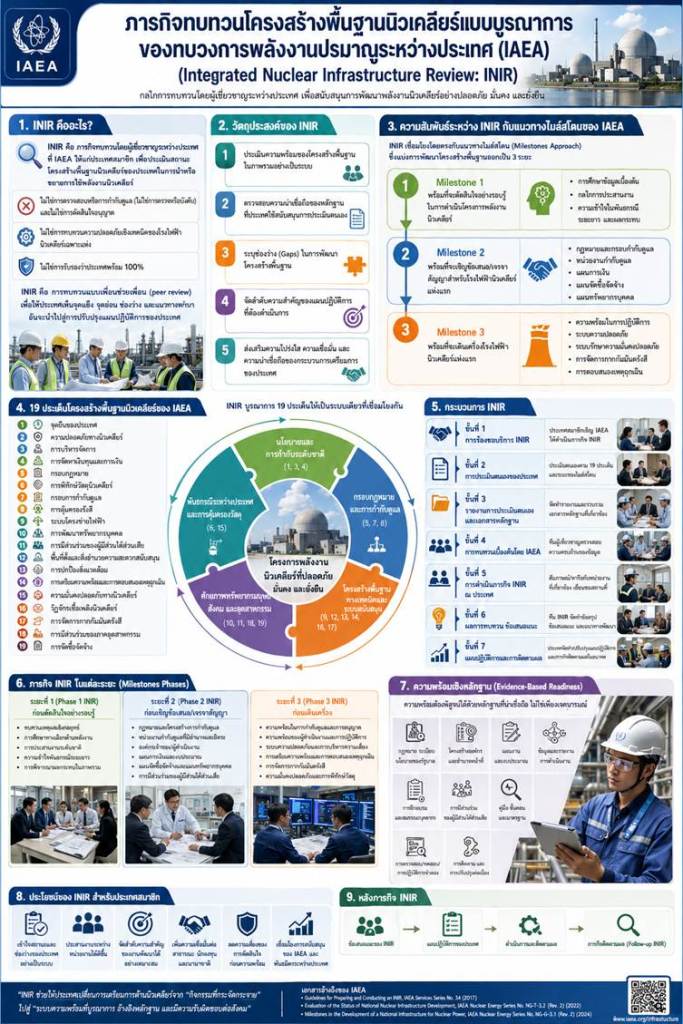
หลังจากการพิจารณาโครงสร้างพื้นฐานนิวเคลียร์ทั้ง 19 ด้านภายใต้แนวทางของทบวงการพลังงานปรมาณูระหว่างประเทศแล้ว คำถามสำคัญที่ตามมาคือ ประเทศหนึ่งจะทราบได้อย่างไรว่าการเตรียมความพร้อมของตนมีความครบถ้วน เพียงพอ และสอดคล้องกับความคาดหวังสากลเพียงใด ภารกิจทบทวนโครงสร้างพื้นฐานนิวเคลียร์แบบบูรณาการ (Integrated Nuclear Infrastructure Review: INIR) จึงมีบทบาทสำคัญในฐานะกลไกการทบทวนโดยผู้เชี่ยวชาญระหว่างประเทศ เพื่อช่วยประเทศสมาชิกประเมินสถานะของโครงสร้างพื้นฐานระดับชาติสำหรับการพัฒนาโครงการโรงไฟฟ้านิวเคลียร์อย่างเป็นระบบ INIR เป็นบริการทบทวนโดยผู้เชี่ยวชาญของทบวงการพลังงานปรมาณูระหว่างประเทศ หรือ IAEA ที่มีลักษณะเป็นการประเมินแบบองค์รวม (holistic peer review) เพื่อช่วยประเทศสมาชิกประเมินสถานะโครงสร้างพื้นฐานระดับชาติสำหรับการเริ่มต้นหรือพัฒนาโครงการโรงไฟฟ้านิวเคลียร์ โดยครอบคลุมโครงสร้างพื้นฐานที่จำเป็นต่อการพัฒนาโครงการนิวเคลียร์ให้มีความปลอดภัย ความมั่นคง และความยั่งยืน ภารกิจนี้ไม่ได้มีเป้าหมายเพื่อ “รับรอง” ว่าประเทศพร้อมโดยสมบูรณ์ และไม่ใช่การตรวจสอบโรงไฟฟ้านิวเคลียร์ในเชิงเทคนิคเฉพาะหน่วยผลิต หากแต่เป็นกระบวนการทบทวนความพร้อมของระบบประเทศ ทั้งด้านนโยบาย กฎหมาย สถาบันกำกับดูแล ความปลอดภัย ความมั่นคงปลอดภัย การพิทักษ์ความปลอดภัยทางนิวเคลียร์ การเงิน บุคลากร อุตสาหกรรม สิ่งแวดล้อม การมีส่วนร่วมของผู้มีส่วนได้ส่วนเสีย และการจัดซื้อจัดจ้าง
ในบริบทนี้ ภารกิจ INIR ถือว่าเป็น “บทเชื่อมต่อ” หลังจากโครงสร้างพื้นฐาน 19 ด้าน เพราะ ภารกิจ INIR คือกลไกที่นำองค์ความรู้จากทั้ง 19 ด้าน มาทบทวนในภาพรวม มิใช่เพียงการตรวจสอบแต่ละประเด็นแยกส่วน การมีอยู่ของ INIR สะท้อนแนวคิดสำคัญว่า ความพร้อมด้านนิวเคลียร์ไม่อาจวัดจากการมีเทคโนโลยีโรงไฟฟ้าเพียงอย่างเดียว แต่ต้องพิจารณาความสามารถของประเทศในการบริหารความรับผิดชอบระยะยาวที่เกิดขึ้นตลอดวัฏจักรชีวิตของโครงการโรงไฟฟ้านิวเคลียร์
2 ความหมายและขอบเขตของภาริจ INIR
คำว่า Integrated Nuclear Infrastructure Review สามารถแปลเป็นภาษาไทยได้ว่า “ภารกิจทบทวนโครงสร้างพื้นฐานนิวเคลียร์แบบบูรณาการ” โดยคำว่า “ภารกิจทบทวน” สื่อถึงลักษณะของการทบทวนโดยคณะผู้เชี่ยวชาญ ไม่ใช่การตรวจสอบเชิงบังคับหรือการตรวจจับข้อบกพร่อง ส่วนคำว่า “แบบบูรณาการ” สะท้อนว่า ภารกิจ INIR พิจารณาโครงสร้างพื้นฐานทั้งระบบตามกรอบ 19 ด้าน ตามแนวทางตามหมุดหมายของทบวงการพลังงานปรมาณูฯ (IAEA Milestones Approach) ซึ่งไม่ใช่การประเมินเฉพาะด้านใดด้านหนึ่ง
ทบวงการพลังงานปรมาณูฯ ระบุว่า ภารกิจ INIR ครอบคลุมโครงสร้างพื้นฐานที่จำเป็นสำหรับการพัฒนาโครงการโรงไฟฟ้านิวเคลียร์ที่ปลอดภัย มั่นคง และยั่งยืน โดยตั้งอยู่บนแนวทางตามหมุดหมาย และโครงสร้างพื้นฐานนิวเคลียร์ 19 ด้าน ด้วยเหตุนี้ ภารกิจ INIR จึงควรถูกเข้าใจว่าเป็นการทบทวน “ระบบความพร้อมของประเทศ” มากกว่าการประเมินความพร้อมของโรงไฟฟ้าใดโรงไฟฟ้าหนึ่ง
ขอบเขตของ ภารกิจ INIR ประกอบด้วย การทบทวนรายงานการประเมินตนเองของประเทศสมาชิก เอกสารหลักฐานที่สนับสนุนรายงานดังกล่าว การสัมภาษณ์หรือหารือกับหน่วยงานที่เกี่ยวข้อง และการจัดทำข้อเสนอแนะหรือข้อสังเกตเพื่อให้ประเทศใช้ปรับปรุงแผนพัฒนาโครงสร้างพื้นฐานของตน กระบวนการนี้ช่วยให้ประเทศเห็นทั้งจุดแข็ง ช่องว่าง และลำดับความสำคัญของการดำเนินการในระยะต่อไป
3 ความสัมพันธ์ระหว่างภารกิจ INIR กับแนวทางตามหมุดหมายของทบวงการปรมาณูระหว่างประเทศ
ภารกิจ INIR มีรากฐานโดยตรงจากแนวทางตามหมุดหมายของทบวงการปรมาณูฯ ซึ่งเป็นกรอบการพัฒนาโครงสร้างพื้นฐานสำหรับประเทศที่กำลังพิจารณาหรือเริ่มต้นโครงการโรงไฟฟ้านิวเคลียร์ แนวทางตามหมุดหมายแบ่งการพัฒนาโครงสร้างพื้นฐานออกเป็น 3 ระยะ โดยแต่ละระยะสิ้นสุดที่หมุดหมายสำคัญ ได้แก่ ความพร้อมในการตัดสินใจ ความพร้อมในการเชิญประมูลหรือทำสัญญา และความพร้อมในการว่าจ้างใช้งานและเดินเครื่องโรงไฟฟ้า
ในแนวทางนี้ ประเทศต้องพิจารณาโครงสร้างพื้นฐาน 19 ด้านในทุกระยะของการพัฒนาโครงการ ไม่ใช่พิจารณาเฉพาะบางประเด็นหรือเฉพาะในระยะท้ายของโครงการทบวงการพลังงานปรมาณูฯ ระบุว่า 19 ด้านดังกล่าวต้องได้รับความเอาใจใส่อย่างเหมาะสมทั้งหมด และลำดับการนำเสนอไม่ได้หมายความว่าประเด็นใดสำคัญกว่าประเด็นอื่น
ดังนั้น ภารกิจ INIR จึงเป็นกลไกที่ช่วยตรวจสอบว่า การดำเนินงานตาม แนวทางตามหมุดหมาย มีความก้าวหน้าเพียงใด ประเทศได้รวบรวมหลักฐานเชิงสถาบันและเชิงปฏิบัติการเพียงพอหรือไม่ และแผนงานที่เสนอสามารถนำไปสู่ความพร้อมในระยะถัดไปได้จริงหรือไม่ ความสัมพันธ์ระหว่าง ภารกิจ INIR กับ แนวทางตามหมุดหมาย จึงเป็นความสัมพันธ์ระหว่าง “กรอบการพัฒนา” กับ “กลไกการทบทวนความก้าวหน้า”
4 วัตถุประสงค์ของภารกิจ INIR
วัตถุประสงค์หลักของภารกิจ INIR คือการช่วยประเทศสมาชิกประเมินสถานะของโครงสร้างพื้นฐานนิวเคลียร์ระดับชาติ และระบุประเด็นที่ควรพัฒนาเพิ่มเติมเพื่อสนับสนุนการดำเนินโครงการโรงไฟฟ้านิวเคลียร์ให้เป็นไปตามมาตรฐานและแนวปฏิบัติสากล กระบวนการนี้มีลักษณะสนับสนุนและให้คำแนะนำ มากกว่าการตัดสินเชิงอนุมัติหรือไม่อนุมัติ
ในเชิงวิชาการ วัตถุประสงค์ของ INIR สามารถสรุปได้เป็น 5 ประการสำคัญ
- ประการที่ 1 ภารกิจ INIR ช่วยประเมินความพร้อมของประเทศในเชิงองค์รวม โดยพิจารณาความเชื่อมโยงระหว่างนโยบายระดับชาติ กฎหมาย หน่วยงานกำกับดูแล ผู้ดำเนินโครงการ ระบบความปลอดภัย ระบบความมั่นคงปลอดภัย การพิทักษ์ความปลอดภัยทางนิวเคลียร์ การป้องกันอันตรายจากรังสี และประเด็นสนับสนุนอื่น ๆ
- ประการที่ 2 ภารกิจ INIR ช่วยตรวจสอบว่าประเทศมีหลักฐานเพียงพอรองรับข้อสรุปในการประเมินตนเองหรือไม่ การกล่าวว่าประเทศมีความพร้อมในประเด็นใดประเด็นหนึ่งย่อมต้องมีเอกสาร นโยบาย กฎหมาย แผนงาน โครงสร้างองค์กร งบประมาณ บุคลากร และกลไกปฏิบัติที่พิสูจน์ได้
- ประการที่ 3 ภารกิจ INIR ช่วยระบุช่องว่างของการพัฒนาโครงสร้างพื้นฐาน ไม่ว่าจะเป็นช่องว่างด้านกฎหมาย ช่องว่างด้านสถาบัน ช่องว่างด้านทรัพยากรบุคคล ช่องว่างด้านงบประมาณ หรือช่องว่างด้านการประสานงานระหว่างหน่วยงาน
- ประการที่ 4 ภารกิจ INIR ช่วยสนับสนุนการจัดลำดับความสำคัญของแผนปฏิบัติการ เนื่องจากไม่ใช่ทุกประเด็นจะสามารถดำเนินการพร้อมกันได้ในระดับความเข้มข้นเท่ากัน ประเทศจึงจำเป็นต้องระบุว่าเรื่องใดต้องดำเนินการก่อน เรื่องใดต้องใช้เวลานาน และเรื่องใดเป็นเงื่อนไขตั้งต้นของประเด็นอื่น
- ประการที่ 5 ภารกิจ INIR ช่วยสร้างความโปร่งใสและความน่าเชื่อถือของกระบวนการเตรียมความพร้อม เพราะเป็นการเปิดพื้นที่ให้ผู้เชี่ยวชาญระหว่างประเทศเข้ามาทบทวนสถานะของประเทศบนพื้นฐานของหลักฐานและกรอบมาตรฐานเดียวกัน
5 ขอบเขตของภารกิจ INIR
การเข้าใจ ภารกิจ INIR อย่างถูกต้องมีความสำคัญอย่างยิ่ง เพราะหากเข้าใจคลาดเคลื่อน อาจทำให้ประเทศหรือสาธารณชนคาดหวังจากภารกิจ INIR มากเกินไปหรือน้อยเกินไป ภารกิจ INIR ไม่ใช่การอนุญาตให้ก่อสร้างโรงไฟฟ้านิวเคลียร์ การออกใบอนุญาตเป็นอำนาจของหน่วยงานกำกับดูแลของประเทศนั้น ๆ ภายใต้กฎหมายภายในประเทศ ภารกิจ INIR ไม่ใช่การตรวจสอบความปลอดภัยเชิงรายละเอียดของแบบโรงไฟฟ้าหรือระบบวิศวกรรมเฉพาะโครงการ และไม่ใช่การรับรองว่าโรงไฟฟ้าจะสามารถดำเนินงานได้โดยปราศจากความเสี่ยง นอกจากนี้ ภารกิจ INIR ไม่ใช่การแทนที่การประเมินด้านความปลอดภัย ความมั่นคงปลอดภัย การพิทักษ์ความปลอดภัยทางนิวเคลียร์ การเตรียมความพร้อมฉุกเฉิน หรือการประเมินผลกระทบด้านสิ่งแวดล้อมที่ต้องดำเนินการโดยหน่วยงานเฉพาะทาง
ภารกิจ INIR เป็นกรอบทบทวนโครงสร้างพื้นฐานระดับชาติในภาพรวม โดยอาจเชื่อมโยงกับบริการทบทวนอื่นของทบวงการพลังงานปรมาณูฯ ในประเด็นเฉพาะ เช่น ด้านความปลอดภัย ความมั่นคงปลอดภัย การเตรียมความพร้อมฉุกเฉิน และการกำกับดูแล ทั้งนี้ทบวงการพลังงานปรมาณูฯ ระบุว่าในระยะที่ 3 วิธีการภารกิจ INIR สามารถอ้างอิงผลจากบริการทบทวนอื่นของทบวงการพลังงานปรมาณูฯ เพื่อลดความซ้ำซ้อนและภาระของประเทศสมาชิก ด้วยเหตุนี้ ภารกิจ INIR จึงควรถูกเข้าใจว่าเป็นเครื่องมือเชิงยุทธศาสตร์สำหรับการประเมินความพร้อม ไม่ใช่ใบรับรองความสำเร็จของโครงการ
6 กระบวนการของภารกิจ INIR
กระบวนการภารกิจ INIR โดยทั่วไปเริ่มจากการที่ประเทศสมาชิกดำเนินการประเมินตนเอง (self-evaluation) ตามแนวทางของทบวงการพลังงานปรมาณูฯ แล้วจัดทำรายงานการประเมินตนเอง (Self-Evaluation Report: SER) พร้อมเอกสารสนับสนุน ทบวงการพลังงานปรมาณูฯ ระบุว่ากระบวนการ INIR เริ่มจากการประเมินตนเองของประเทศเกี่ยวกับสถานะโครงสร้างพื้นฐานนิวเคลียร์ระดับชาติ จากนั้นทบวงการพลังงานปรมาณูฯ จะทบทวนรายงานการประเมินตนเองและเอกสารประกอบว่ามีความเพียงพอ ครบถ้วน และมีหลักฐานสนับสนุนหรือไม่
กระบวนการดังกล่าวสามารถอธิบายเป็นลำดับได้ดังนี้
ขั้นที่ 1 การตัดสินใจขอรับภารกิจ INIR
ประเทศสมาชิกที่กำลังพัฒนาโครงการโรงไฟฟ้านิวเคลียร์อาจเชิญทบวงการพลังงานปรมาณูฯ ให้จัดภารกิจ INIR เพื่อทบทวนสถานะความพร้อมของตน การเชิญนี้สะท้อนความสมัครใจ ความโปร่งใส และความต้องการใช้กลไกสากลในการสนับสนุนการพัฒนาโครงสร้างพื้นฐาน
ขั้นที่ 2 การประเมินตนเอง
ประเทศต้องประเมินสถานะของตนตามโครงสร้างพื้นฐาน 19 ด้าน และตามเงื่อนไขของระยะการพัฒนาตามหมุดหมายที่เกี่ยวข้อง การประเมินตนเองที่ดีต้องไม่ใช่เพียงการบรรยายกิจกรรมที่ดำเนินการแล้ว แต่ต้องวิเคราะห์ว่ากิจกรรมเหล่านั้นเพียงพอต่อการบรรลุผลลัพธ์ของแต่ละประเด็นหรือไม่
ขั้นที่ 3 การจัดทำรายงานการประเมินตนเองและเอกสารหลักฐาน
รายงานการประเมินตนเองควรระบุสถานะปัจจุบัน ช่องว่าง แผนปฏิบัติการ หน่วยงานรับผิดชอบ ระยะเวลา และหลักฐานสนับสนุน เช่น กฎหมาย แผนยุทธศาสตร์ รายงานการศึกษา โครงสร้างองค์กร คำสั่งแต่งตั้งคณะกรรมการ แผนกำลังคน แผนงบประมาณ และเอกสารการสื่อสารกับผู้มีส่วนได้ส่วนเสีย
ขั้นที่ 4 การทบทวนล่วงหน้าโดยทบวงการพลังงานปรมาณูฯ
ทบวงการพลังงานปรมาณูฯ และคณะผู้เชี่ยวชาญจะทบทวนรายงานการประเมินตนเองและเอกสารหลักฐานก่อนภารกิจจริง เพื่อระบุประเด็นที่ต้องขอข้อมูลเพิ่มเติมหรือหารือในรายละเอียด
ขั้นที่ 5 ภารกิจทบทวนในประเทศ
คณะผู้เชี่ยวชาญสำหรับภารกิจ INIR จะหารือกับผู้แทนจากหน่วยงานที่เกี่ยวข้อง ซึ่งโดยทั่วไปครอบคลุมหน่วยงานนโยบาย หน่วยงานกำกับดูแล ผู้ดำเนินโครงการหรือเจ้าของโครงการ หน่วยงานด้านพลังงาน หน่วยงานด้านสิ่งแวดล้อม หน่วยงานด้านความมั่นคง หน่วยงานด้านการศึกษาและฝึกอบรม และหน่วยงานอื่นที่เกี่ยวข้อง
ขั้นที่ 6 การจัดทำข้อค้นพบ ข้อเสนอแนะ และข้อสังเกต
ผลจากภารกิจ INIR มักประกอบด้วยข้อเสนอแนะและข้อสังเกตเพื่อให้ประเทศใช้ปรับปรุงแผนงานทบวงการพลังงานปรมาณูฯ อธิบายว่า ภารกิจ INIR มีเป้าหมายช่วยประเทศสมาชิกระบุพื้นที่ที่ต้องดำเนินการเพิ่มเติมและความช่วยเหลือที่อาจจำเป็น รวมถึงความช่วยเหลือจากทบวงการพลังงานปรมาณูฯ
ขั้นที่ 7 การจัดทำแผนปฏิบัติการและการติดตามผล
หลังภารกิจ INIR ประเทศควรนำข้อเสนอแนะและข้อสังเกตไปจัดทำหรือปรับปรุงแผนปฏิบัติการแห่งชาติ และอาจมีภารกิจติดตามผลในภายหลังเพื่อตรวจสอบความก้าวหน้าของการดำเนินการ
7 ระยะของภารกิจ INIR ตามแนวทางตามหมุดหมาย
ภารกิจ INIR สามารถดำเนินการในระยะต่าง ๆ ของการพัฒนาโครงการโรงไฟฟ้านิวเคลียร์ โดยสอดคล้องกับแนวทางตามหมุดหมาย
7.1 ภารกิจ INIR ระยะที่ 1: ก่อนการตัดสินใจเชิงนโยบาย
ภารกิจ INIR ระยะที่ 1 มุ่งพิจารณาว่า ประเทศได้ศึกษานัยสำคัญของการนำพลังงานนิวเคลียร์เข้าสู่ระบบพลังงานของประเทศอย่างเพียงพอหรือไม่ ระยะนี้เน้นคำถามพื้นฐาน เช่น ประเทศมีเหตุผลเชิงยุทธศาสตร์ในการพิจารณาพลังงานนิวเคลียร์หรือไม่ มีหน่วยงานประสานงานโครงการหรือไม่ มีการศึกษาความเป็นไปได้เบื้องต้นหรือไม่ มีการวิเคราะห์ทางเลือกพลังงานหรือไม่ และมีการพิจารณาภาระผูกพันระยะยาวของโครงการนิวเคลียร์หรือไม่
สำหรับประเทศที่ยังไม่ได้ตัดสินใจสร้างโรงไฟฟ้านิวเคลียร์ ภารกิจ INIR ระยะที่ 1 มีคุณค่าอย่างมาก เพราะช่วยให้การตัดสินใจไม่ได้ตั้งอยู่บนความคาดหวังด้านเทคโนโลยีหรือเศรษฐกิจเพียงด้านเดียว แต่พิจารณาความพร้อมของทั้งระบบประเทศ
7.2 ภารกิจ INIR ระยะที่ 2: ก่อนการเชิญประมูลหรือทำสัญญา
ภารกิจ INIR ระยะที่ 2 มุ่งพิจารณา ความพร้อมของประเทศในการเข้าสู่การจัดหาเทคโนโลยี การเชิญประมูล การเจรจาสัญญา และการเตรียมการก่อสร้าง ระยะนี้ต้องการหลักฐานที่เป็นรูปธรรมมากขึ้น เช่น กฎหมายหลักด้านนิวเคลียร์ หน่วยงานกำกับดูแลที่มีอำนาจและความเป็นอิสระเบื้องต้น เจ้าของหรือผู้ดำเนินโครงการที่มีหน้าที่ชัดเจน แผนการเงิน โครงสร้างการจัดซื้อจัดจ้าง แผนพัฒนาบุคลากร และกรอบการมีส่วนร่วมของผู้มีส่วนได้ส่วนเสีย
ในระยะนี้ ภารกิจ INIR มีบทบาทสำคัญในการลดความเสี่ยงที่ประเทศจะเข้าสู่กระบวนการจัดซื้อจัดจ้างก่อนที่โครงสร้างพื้นฐานด้านกฎหมาย สถาบัน และบุคลากรจะพร้อมเพียงพอ
7.3 ภารกิจ INIR ระยะที่ 3: ก่อนการว่าจ้างใช้งานและเดินเครื่อง
ภารกิจ INIR ระยะที่ 3 มุ่งพิจารณา ความพร้อมของประเทศในช่วงปลายของการก่อสร้างและก่อนเข้าสู่การเดินเครื่องโรงไฟฟ้านิวเคลียร์ ระยะนี้มีความเข้มข้นสูง เพราะเกี่ยวข้องกับความพร้อมในการปฏิบัติจริง ทั้งด้านการกำกับดูแล การอนุญาต การตรวจสอบ การเดินเครื่อง การตอบสนองเหตุฉุกเฉิน การจัดการกากกัมมันตรังสี ความมั่นคงปลอดภัยทางกายภาพ การพิทักษ์ความปลอดภัยทางนิวเคลียร์ และการสื่อสารกับสาธารณชน
ทบวงการพลังงานปรมาณูฯ ระบุว่าวิธีการประเมินสำหรับระยะที่ 3 ครอบคลุมการประเมินโครงสร้างพื้นฐานทั้ง 19 ด้านที่จำเป็นต่อการบรรลุหมุดหมายที่ 3 และอาจใช้ผลจากบริการทบทวนอื่นของทบวงการพลังงานปรมาณูฯ เพื่อหลีกเลี่ยงความซ้ำซ้อน
8 ภารกิจ INIR กับการประเมินตนเองของประเทศ
หัวใจสำคัญของ ภารกิจ INIR คือ การประเมินตนเองของประเทศ การประเมินตนเองมิใช่เพียงขั้นตอนเตรียมเอกสารเพื่อให้ทบวงการพลังงานปรมาณูฯ ทบทวน แต่เป็นกระบวนการเรียนรู้ภายในประเทศที่ช่วยให้หน่วยงานต่าง ๆ เข้าใจบทบาทของตนเองและความเชื่อมโยงกับโครงสร้างพื้นฐาน 19 ด้าน
การประเมินตนเองที่มีคุณภาพควรมีลักษณะ 6 ประการ
- 1 ต้องมีความครอบคลุม โดยไม่ละเลยประเด็นใดใน 19 ด้าน แม้บางประเด็นจะยังอยู่ในระยะเริ่มต้นก็ตาม
- 2 ต้องมีหลักฐานรองรับ ไม่ใช่เพียงการประกาศเชิงนโยบายหรือคำอธิบายทั่วไป
- 3 ต้องสะท้อนสถานะจริงของประเทศ รวมทั้งข้อจำกัดและช่องว่าง ไม่ควรเขียนเพื่อสร้างภาพความพร้อมเกินจริง
- 4 ต้องเชื่อมโยงกับแผนปฏิบัติการที่มีหน่วยงานรับผิดชอบ ระยะเวลา และทรัพยากรที่ชัดเจน
- 5 ต้องแสดงความเชื่อมโยงระหว่างประเด็น เช่น ความพร้อมด้านกฎหมายมีผลต่อความพร้อมด้านกำกับดูแล ความพร้อมด้านบุคลากรมีผลต่อความปลอดภัย และความพร้อมด้านการเงินมีผลต่อการจัดซื้อจัดจ้างและการจัดการกากกัมมันตรังสี
- 6 ต้องได้รับการมีส่วนร่วมจากหน่วยงานที่เกี่ยวข้องจริง ไม่ใช่จัดทำโดยหน่วยงานใดหน่วยงานหนึ่งเพียงลำพัง
ในแง่นี้ การประเมินตนเองก่อนภารกิจ INIR จึงเป็น “เครื่องมือสร้างองค์ความรู้สะสมของสถาบัน” เพราะทำให้ประเทศรวบรวมเอกสาร เหตุผล ประสบการณ์ บทเรียน และช่องว่างของการเตรียมความพร้อมไว้ในระบบเดียวกัน
9 บทบาทของภารกิจ INIR ต่อโครงสร้างพื้นฐาน 19 ด้าน
ภารกิจ INIR มีความสำคัญเพราะเป็นกลไกที่ทำให้การพัฒนาโครงสร้างพื้นฐาน 19 ด้าน ไม่ถูกมองเป็นรายการตรวจสอบแยกส่วน แต่ถูกนำมาพิจารณาในฐานะระบบเดียวกัน ตัวอย่างเช่น นโยบายระดับชาติจะไม่มีความหมายมากนักหากไม่เชื่อมโยงกับกฎหมาย งบประมาณ ผู้ดำเนินโครงการ และการสื่อสารกับสาธารณชน ความปลอดภัยนิวเคลียร์จะไม่เกิดขึ้นจริงหากไม่มีหน่วยงานกำกับดูแลที่เข้มแข็ง บุคลากรที่มีสมรรถนะ และวัฒนธรรมความปลอดภัย การจัดซื้อจัดจ้างจะไม่สามารถลดความเสี่ยงของโครงการได้ หากไม่มีความเข้าใจเรื่องข้อกำหนดทางเทคนิค การถ่ายทอดความรู้ การมีส่วนร่วมของอุตสาหกรรม และภาระผูกพันระยะยาว
ตารางต่อไปนี้แสดงบทบาทของภารกิจ INIR ต่อการบูรณาการโครงสร้างพื้นฐาน 19 ด้าน
| กลุ่มประเด็น | ตัวอย่างประเด็นที่เกี่ยวข้อง | บทบาทของภารกิจ INIR |
| กลุ่มนโยบายและการบริหาร | นโยบายระดับชาติ การบริหารโครงการ การเงิน | ตรวจสอบว่าการตัดสินใจและแผนงานมีเหตุผลเชิงยุทธศาสตร์และมีทรัพยากรรองรับ |
| กลุ่มกฎหมายและกำกับดูแล | กฎหมาย กรอบกำกับดูแล ความปลอดภัย การคุ้มครองรังสี | ทบทวนว่ากลไกกำกับดูแลมีอำนาจ ความเป็นอิสระ และความสามารถเพียงพอหรือไม่ |
| กลุ่มพันธกรณีระหว่างประเทศ | การพิทักษ์ความปลอดภัยทางนิวเคลียร์ ความมั่นคงปลอดภัย การป้องกันทางกายภาพ | พิจารณาว่าประเทศมีระบบรองรับพันธกรณีและมาตรการป้องกันที่สอดคล้องกับมาตรฐานสากลหรือไม่ |
| กลุ่มเทคนิคและระบบสนับสนุน | โครงข่ายไฟฟ้า สถานที่ตั้ง สิ่งแวดล้อม แผนฉุกเฉิน เชื้อเพลิง กากกัมมันตรังสี | ทบทวนว่าประเทศมีแผนและความสามารถทางเทคนิคเพียงพอต่อการนำโรงไฟฟ้าเข้าสู่ระบบจริงหรือไม่ |
| กลุ่มมนุษย์ สังคม และอุตสาหกรรม | บุคลากร ผู้มีส่วนได้ส่วนเสีย อุตสาหกรรมภายในประเทศ การจัดซื้อจัดจ้าง | ประเมินว่าประเทศมีขีดความสามารถเชิงสถาบันและสังคมรองรับโครงการระยะยาวหรือไม่ |
10 ภารกิจ INIR กับการเตรียมความพร้อมเชิงหลักฐาน
หนึ่งในคุณูปการสำคัญของภารกิจ INIR คือการผลักดันให้การเตรียมความพร้อมด้านนิวเคลียร์เป็นกระบวนการที่อิงหลักฐาน ไม่ใช่เพียงการประกาศนโยบายหรือการจัดตั้งคณะกรรมการ การมีหลักฐานรองรับหมายถึงประเทศต้องสามารถแสดงให้เห็นว่า สิ่งที่กล่าวอ้างว่าพร้อมนั้นมีอยู่จริง มีคุณภาพเพียงพอ และสามารถนำไปใช้ในทางปฏิบัติได้
ตัวอย่างของหลักฐานที่เกี่ยวข้อง ได้แก่
| ประเด็น | ตัวอย่างหลักฐานที่ควรมี |
| นโยบายระดับชาติ | แผนพลังงานแห่งชาติ มติคณะรัฐมนตรี รายงานวิเคราะห์ทางเลือกพลังงาน |
| ความปลอดภัย | นโยบายความปลอดภัย กฎหมายกำกับดูแล รายงานกำหนดบทบาทหน่วยงาน |
| การเงินและการจัดหาเงินทุน | แบบจำลองต้นทุน แผนการเงิน กลไกจัดสรรงบประมาณระยะยาว |
| กฎหมาย | ร่างหรือกฎหมายที่มีผลบังคับใช้ ข้อกำหนดรอง กลไกบังคับใช้ |
| การกำกับดูแล | โครงสร้างหน่วยงานกำกับดูแล แผนอัตรากำลัง กระบวนการอนุญาต |
| บุคลากร | แผนพัฒนากำลังคน แผนฝึกอบรม สมรรถนะที่ต้องการ |
| ผู้มีส่วนได้ส่วนเสีย | แผนสื่อสารสาธารณะ บันทึกการรับฟังความคิดเห็น กลไกตอบข้อกังวล |
| โครงข่ายไฟฟ้า | รายงานศึกษาความมั่นคงของระบบไฟฟ้า การวิเคราะห์เสถียรภาพระบบ |
| สถานที่ตั้ง | รายงานคัดเลือกพื้นที่ รายงานข้อมูลธรณีวิทยา อุทกวิทยา และประชากร |
| การจัดการกากกัมมันตรังสี | นโยบายกากกัมมันตรังสี แผนจัดเก็บชั่วคราวและระยะยาว |
การประเมินในลักษณะนี้ทำให้ความพร้อมไม่ใช่เพียง “ความตั้งใจ” แต่เป็น “ความสามารถที่พิสูจน์ได้”
11 ความสำคัญของภารกิจ INIR ต่อประเทศที่เพิ่งเริ่มโครงการใหม่
สำหรับประเทศที่เพิ่งเริ่มโครงการโรงไฟฟ้านิวเคลียร์ ภารกิจ INIR มีความสำคัญเป็นพิเศษ เพราะประเทศกลุ่มนี้มักยังไม่มีประสบการณ์ตรงในการพัฒนาและกำกับดูแลโรงไฟฟ้านิวเคลียร์เชิงพาณิชย์ การพึ่งพาผู้ขายเทคโนโลยีหรือผู้รับเหมาเพียงอย่างเดียวไม่อาจทดแทนความพร้อมของประเทศในด้านกฎหมาย การกำกับดูแล ความปลอดภัย บุคลากร และความรับผิดชอบระยะยาวได้
ภารกิจ INIR ช่วยให้ประเทศที่เพิ่งเริ่มโครงการใหม่มองเห็นความซับซ้อนของภาระผูกพันนิวเคลียร์ก่อนเข้าสู่ขั้นตอนที่มีต้นทุนสูง เช่น การจัดซื้อจัดจ้าง การก่อสร้าง หรือการว่าจ้างใช้งานโรงไฟฟ้า นอกจากนี้ ภารกิจ INIR ยังช่วยลดความเสี่ยงของการตัดสินใจเร็วเกินไปโดยที่โครงสร้างพื้นฐานยังไม่พร้อม
ในเชิงยุทธศาสตร์ ภารกิจ INIR จึงเป็นกลไกที่ช่วยเปลี่ยนคำถามจาก “เราจะเลือกเทคโนโลยีใด” ไปสู่คำถามที่ลึกกว่า คือ “ประเทศมีความพร้อมเพียงใดในการเป็นเจ้าของ กำกับดูแล ดำเนินงาน และรับผิดชอบโครงการนิวเคลียร์ตลอดอายุโครงการ”
12 ภารกิจ INIR กับความโปร่งใสและความน่าเชื่อถือ
การเชิญ ภารกิจ INIR สะท้อนความพร้อมของประเทศที่จะเปิดให้มีการทบทวนโดยผู้เชี่ยวชาญภายนอก ความโปร่งใสในลักษณะนี้มีความสำคัญต่อความเชื่อมั่นของสาธารณชน ผู้กำหนดนโยบาย นักลงทุน ผู้ให้เงินกู้ ผู้ขายเทคโนโลยี และประชาคมระหว่างประเทศ
อย่างไรก็ตาม ความโปร่งใสมิได้หมายถึงการเปิดเผยข้อมูลทุกประเภทโดยไม่มีข้อจำกัด เพราะข้อมูลบางส่วนอาจเกี่ยวข้องกับความมั่นคงปลอดภัย ความลับทางพาณิชย์ หรือข้อมูลที่อยู่ระหว่างการพิจารณาเชิงนโยบาย ความโปร่งใสในบริบทของ ภารกิจ INIR หมายถึงการมีหลักฐานที่ตรวจสอบได้ กระบวนการที่ชัดเจน การยอมรับข้อเสนอแนะ และการใช้ผลการทบทวนเพื่อปรับปรุงแผนงานอย่างจริงจัง
การเผยแพร่รายงานหรือสรุปผล ภารกิจ INIR ในระดับที่เหมาะสมยังช่วยให้สาธารณชนเข้าใจว่าโครงการนิวเคลียร์ไม่ได้พิจารณาเพียงมิติของการผลิตไฟฟ้า แต่ต้องอาศัยระบบกำกับดูแล ความปลอดภัย และความรับผิดชอบระยะยาว
13 ภารกิจ INIR กับแผนปฏิบัติการหลังการทบทวน
ผลลัพธ์ของภารกิจ INIR จะมีคุณค่าก็ต่อเมื่อประเทศนำข้อค้นพบไปสู่การปฏิบัติจริง หลังภารกิจ INIR ประเทศควรจัดทำแผนปฏิบัติการที่ระบุประเด็นที่ต้องดำเนินการ หน่วยงานรับผิดชอบ ทรัพยากรที่ต้องใช้ ระยะเวลา และตัวชี้วัดความก้าวหน้า
แผนปฏิบัติการหลัง ภารกิจ INIR ควรมีลักษณะดังนี้
- 1 ต้องเชื่อมโยงกับข้อเสนอแนะและข้อสังเกตจากคณะ INIR อย่างชัดเจน
- 2 ต้องจัดลำดับความสำคัญ โดยแยกประเด็นที่เป็นเงื่อนไขเร่งด่วนออกจากประเด็นที่สามารถดำเนินการในระยะถัดไป
- 3 ต้องกำหนดเจ้าภาพหลักและหน่วยงานร่วมรับผิดชอบ เพื่อหลีกเลี่ยงช่องว่างระหว่างหน่วยงาน
- 4 ต้องมีกรอบเวลาที่สอดคล้องกับระยะของ แนวทางตามหมุดหมาย
- 5 ต้องมีระบบติดตามผลและรายงานความก้าวหน้าอย่างต่อเนื่อง
- 6 ต้องสามารถปรับปรุงได้ตามบริบทของประเทศและข้อค้นพบใหม่
ในกรณีของภารกิจติดตามผลภารกิจทบทวน INIR ตัวอย่างรายงานของทบวงการพลังงานปรมาณูฯ แสดงให้เห็นว่าประเทศต้องจัดทำรายงานความก้าวหน้าของแผนปฏิบัติการและเอกสารสนับสนุน เพื่อให้คณะผู้เชี่ยวชาญประเมินระดับการดำเนินการตามข้อเสนอแนะและข้อสังเกตจากภารกิจเดิม
14 ประเด็นท้าทายในการเตรียมตัวสำหรับภารกิจ INIR
แม้ว่า ภารกิจ INIR จะเป็นกลไกสนับสนุนที่มีประโยชน์สูง แต่การเตรียมตัวสำหรับภารกิจ INIR มีความท้าทายหลายประการ
- ประการที่ 1 การรวบรวมข้อมูลจากหลายหน่วยงานอาจทำได้ยาก หากประเทศยังไม่มีหน่วยงานประสานงานกลางที่มีอำนาจเพียงพอ ประเด็นนี้เกี่ยวข้องโดยตรงกับบทบาทขององค์กรประสานงานโครงการนิวเคลียร์และการบริหารโครงการระดับชาติ
- ประการที่ 2 เอกสารหลักฐานอาจมีอยู่แต่กระจัดกระจาย ไม่เป็นระบบ หรือไม่เชื่อมโยงกับข้อกำหนดของ แนวทางตามหมุดหมาย ทำให้การประเมินตนเองไม่สามารถสะท้อนความพร้อมได้อย่างชัดเจน
- ประการที่ 3 หน่วยงานบางแห่งอาจมอง INIR เป็นการตรวจสอบจากภายนอกมากกว่ากระบวนการเรียนรู้ร่วมกัน ส่งผลให้รายงานการประเมินตนเองมีแนวโน้มเน้นภาพบวกมากกว่าการวิเคราะห์ช่องว่างอย่างตรงไปตรงมา
- ประการที่ 4 การประเมินตนเองอาจขาดการบูรณาการระหว่างประเด็น เช่น มีแผนพัฒนาบุคลากรแต่ไม่เชื่อมกับกำหนดเวลาการจัดซื้อจัดจ้าง มีแผนโครงข่ายไฟฟ้าแต่ไม่เชื่อมกับลักษณะทางเทคนิคของโรงไฟฟ้า หรือมีกฎหมายหลักแต่ยังไม่มีแผนสร้างสมรรถนะของหน่วยงานกำกับดูแล
- ประการที่ 5 ความพร้อมเชิงสถาบันต้องใช้เวลา การจัดตั้งหน่วยงาน การฝึกอบรมบุคลากร การสร้างวัฒนธรรมความปลอดภัย และการพัฒนาระบบกำกับดูแลไม่สามารถทำได้ทันทีหลังจากตัดสินใจเลือกเทคโนโลยี
15 กรอบการใช้การทบทวน INIR ในบท “การประเมินตนเองเบื้องต้น”
สำหรับบริบทนี้ ภารกิจ INIR สามารถใช้เป็นฐานในการออกแบบบทว่าด้วย การประเมินตนเองเบื้องต้นสำหรับโครงสร้างพื้นฐานนิวเคลียร์ 19 ด้าน ได้อย่างเหมาะสม เพราะภารกิจ INIR แสดงให้เห็นว่าการประเมินความพร้อมต้องมีอย่างน้อย 4 ชั้นของการวิเคราะห์
- ชั้นที่ 1 คือ การมีอยู่ของกรอบนโยบายและกฎหมาย ประเทศต้องมีหลักการทางนโยบายและฐานทางกฎหมายที่ชัดเจนเพียงพอ
- ชั้นที่ 2 คือ การมีอยู่ขององค์กรและหน้าที่รับผิดชอบ ประเทศต้องระบุว่าใครเป็นผู้กำหนดนโยบาย ใครเป็นผู้กำกับดูแล ใครเป็นเจ้าของโครงการ ใครเป็นผู้ดำเนินงาน และใครเป็นผู้รับผิดชอบในภาวะฉุกเฉิน
- ชั้นที่ 3 คือ การมีขีดความสามารถเชิงปฏิบัติการ ไม่ว่าจะเป็นบุคลากร งบประมาณ ระบบข้อมูล เครื่องมือวิเคราะห์ ห้องปฏิบัติการ ระบบตรวจวัด หรือกระบวนการอนุญาต
- ชั้นที่ 4 คือ การมีหลักฐานและระบบติดตามผล ความพร้อมต้องสามารถพิสูจน์ได้ผ่านเอกสาร แผนงาน รายงาน การฝึกซ้อม ผลการประเมิน และระบบปรับปรุงต่อเนื่อง
กรอบนี้สามารถพัฒนาเป็นตารางประเมินตนเองเบื้องต้น ดังตัวอย่างต่อไปนี้
| ระดับความพร้อม | ลักษณะโดยทั่วไป | ความหมายเชิงภารกิจ INIR |
| ระดับ 1: เริ่มตระหนัก | มีการอภิปรายหรือศึกษาเบื้องต้น แต่ยังไม่มีระบบชัดเจน | ยังไม่เพียงพอสำหรับการแสดงความพร้อม ต้องพัฒนาแผนและเจ้าภาพ |
| ระดับ 2: มีกรอบเบื้องต้น | มีนโยบาย แผน หรือคณะทำงานบางส่วน | เริ่มมีฐานสำหรับการประเมินตนเอง แต่หลักฐานอาจยังไม่ครบ |
| ระดับ 3: มีระบบและแผนปฏิบัติการ | มีหน่วยงานรับผิดชอบ เอกสารหลักฐาน และแผนงาน | สามารถเข้าสู่การทบทวนเชิงลึกได้ หากหลักฐานเชื่อมโยงกับ Milestones |
| ระดับ 4: มีการดำเนินการจริง | มีกระบวนการปฏิบัติ บุคลากร และงบประมาณ | แสดงความพร้อมเชิงสถาบันและเชิงปฏิบัติการมากขึ้น |
| ระดับ 5: มีการติดตามและปรับปรุงต่อเนื่อง | มีระบบตรวจสอบ ประเมินผล และปรับปรุง | สะท้อนความพร้อมที่มีความยั่งยืนและตรวจสอบได้ |
ตารางนี้ไม่ใช่เครื่องมือภารกิจ INIR อย่างเป็นทางการ แต่สามารถใช้เป็นกรอบเบื้องต้นสำหรับการเตรียมรายงานประเมินตนเองในเชิงวิชาการหรือเชิงนโยบาย
16 ความเชื่อมโยงกับบริบทประเทศไทย
สำหรับประเทศไทย ภารกิจ INIR มีนัยสำคัญในฐานะกรอบอ้างอิงสำหรับการพิจารณาว่าหากประเทศจะพัฒนาโครงการโรงไฟฟ้านิวเคลียร์ในอนาคต ควรเตรียมความพร้อมเชิงโครงสร้างพื้นฐานอย่างไร การใช้ภารกิจ INIR เป็นกรอบคิดไม่ได้หมายความว่าประเทศต้องตัดสินใจเดินหน้าโครงการนิวเคลียร์ทันที แต่หมายถึงการใช้มาตรฐานสากลในการถามคำถามที่ถูกต้องก่อนตัดสินใจ
ในบริบทไทย ประเด็นที่ควรเชื่อมโยงกับภารกิจ INIR ได้แก่ ความชัดเจนของนโยบายระดับชาติ ความสอดคล้องกับแผนพัฒนาพลังงานระยะยาว ความพร้อมของกฎหมายและหน่วยงานกำกับดูแล ความสามารถด้านบุคลากร การพัฒนาองค์ความรู้สะสมของสถาบัน การมีส่วนร่วมของผู้มีส่วนได้ส่วนเสีย ความพร้อมของโครงข่ายไฟฟ้า และความเข้าใจของสาธารณชนต่อภาระผูกพันระยะยาวของเทคโนโลยีนิวเคลียร์
ภารกิจ INIR จึงอาจถูกใช้เป็นกรอบ “เตรียมความพร้อมก่อนตัดสินใจ” มากกว่าจะเป็นกรอบ “เร่งให้ตัดสินใจ” ประเด็นนี้สำคัญต่อการรักษาความเป็นกลางทางวิชาการ เพราะการประเมินความพร้อมไม่ควรถูกตีความเป็นการสนับสนุนหรือคัดค้านโครงการนิวเคลียร์ แต่เป็นการสร้างฐานความรู้เพื่อให้การตัดสินใจในอนาคตมีความรับผิดชอบและตรวจสอบได้
17 บทสรุป
ภารกิจทบทวนโครงสร้างพื้นฐานนิวเคลียร์แบบบูรณาการ หรือ ภารกิจ INIR เป็นกลไกสำคัญของทบวงการพลังงานปรมาณูฯ ที่ช่วยประเทศสมาชิกประเมินความพร้อมของโครงสร้างพื้นฐานระดับชาติสำหรับการพัฒนาโครงการโรงไฟฟ้านิวเคลียร์อย่างเป็นระบบ ภารกิจนี้ตั้งอยู่บนแนวทางตามหมุดหมาย และครอบคลุมโครงสร้างพื้นฐาน 19 ด้าน จึงทำหน้าที่เป็นสะพานเชื่อมระหว่างการศึกษารายประเด็นกับการประเมินความพร้อมของประเทศในภาพรวม สาระสำคัญของภารกิจ INIR ไม่ได้อยู่ที่การตัดสินว่าประเทศ “พร้อม” หรือ “ไม่พร้อม” อย่างเด็ดขาด แต่อยู่ที่การช่วยให้ประเทศเข้าใจสถานะจริงของตนเอง เห็นช่องว่างที่ต้องพัฒนา จัดลำดับความสำคัญของแผนปฏิบัติการ และสร้างหลักฐานเชิงสถาบันสำหรับการตัดสินใจอย่างมีความรับผิดชอบ
ในบริบทนี้ ภารกิจ INIR ควรถูกมองเป็นกลไกบูรณาการหลังจากการพิจารณาโครงสร้างพื้นฐาน 19 ด้านทั้งหมดแล้ว กล่าวคือ เมื่อแต่ละประเด็นอธิบายว่า “ประเทศต้องเตรียมอะไร” ภารกิจ INIR จะช่วยตอบคำถามว่า “ประเทศรู้ได้อย่างไรว่าสิ่งที่เตรียมนั้นเพียงพอ เชื่อมโยงกัน และพร้อมต่อการก้าวสู่ระยะถัดไปเพียงใด”
เอกสารอ้างอิง
- International Atomic Energy Agency. (2017). Guidelines for Preparing and Conducting an Integrated Nuclear Infrastructure Review (INIR). IAEA Services Series No. 34. Vienna: IAEA.
- International Atomic Energy Agency. (2022). Evaluation of the Status of National Nuclear Infrastructure Development. IAEA Nuclear Energy Series No. NG-T-3.2 (Rev. 2). Vienna: IAEA.
- International Atomic Energy Agency. (2024). Milestones in the Development of a National Infrastructure for Nuclear Power. IAEA Nuclear Energy Series No. NG-G-3.1 (Rev. 2). Vienna: IAEA.
- International Atomic Energy Agency. (n.d.). Integrated Nuclear Infrastructure Review (INIR). IAEA Review Missions.
- International Atomic Energy Agency. (n.d.). Milestones Approach. IAEA Nuclear Infrastructure Development.
- International Atomic Energy Agency. (2020). Integrated Nuclear Infrastructure Review. IAEA Brochure.
********************************************************************************
Integrated Nuclear Infrastructure Review (INIR) of the International Atomic Energy Agency
1 Introduction
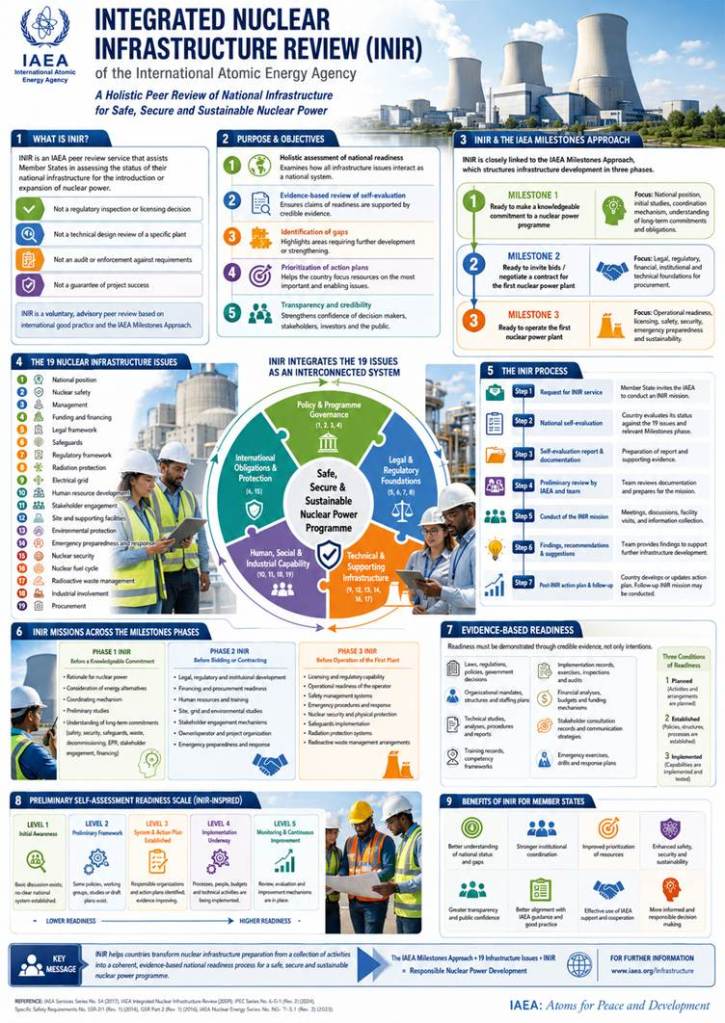
After examining the nineteen nuclear infrastructure issues under the IAEA Milestones Approach, an important question naturally follows: how can a country determine whether its preparation for a nuclear power programme is sufficiently comprehensive, coherent, evidence-based, and aligned with international good practice? The Integrated Nuclear Infrastructure Review (INIR) provides an important mechanism for addressing this question. It is an IAEA peer review service that assists Member States in assessing the status of their national infrastructure for the introduction or expansion of nuclear power. The review covers the comprehensive infrastructure required for developing a nuclear power programme that is safe, secure, and sustainable.
INIR is not a regulatory inspection, a licensing decision, or a technical design review of a specific nuclear power plant. Rather, it is a structured peer review of the national infrastructure needed to support a nuclear power programme. It examines how far a country has developed the policy, legal, regulatory, institutional, technical, financial, human resource, industrial, environmental, security, safeguards, and stakeholder-related arrangements required for responsible nuclear power development. The IAEA describes INIR as a holistic peer review, and its process is based on the IAEA Milestones Approach and the associated nineteen nuclear infrastructure issues.
Here, INIR should be positioned as a bridging chapter after the discussion of the nineteen infrastructure issues. The previous chapters explain the meaning, importance, and development requirements of each issue. This chapter explains how these issues can be reviewed as an integrated national system. INIR is therefore not simply another infrastructure issue; it is a review mechanism that helps a country understand whether the nineteen issues are being developed in a coordinated, phased, and evidence-based manner.
The central value of INIR lies in its ability to transform nuclear infrastructure preparation from a collection of separate activities into a coherent national readiness process. A nuclear power programme cannot be judged only by the selection of reactor technology, the preparation of a construction site, or the availability of financing. It requires a national system capable of making informed decisions, establishing legal and regulatory authority, ensuring nuclear safety, meeting safeguards obligations, providing nuclear security, protecting workers and the public from radiation exposure, developing competent human resources, managing radioactive waste, engaging stakeholders, and sustaining responsibilities over the full life cycle of the programme.
2 Meaning and Scope of INIR
The term Integrated Nuclear Infrastructure Review refers to a peer review mission conducted under the framework of the International Atomic Energy Agency. The word review indicates that the mission is a professional and advisory peer review, not an enforcement audit or regulatory inspection. The word integrated indicates that the mission considers the national nuclear infrastructure as a system, rather than evaluating only one technical, legal, institutional, or project-management component.
The scope of INIR is directly related to the IAEA Milestones Approach. The review considers the development of national nuclear infrastructure across the nineteen infrastructure issues identified by the IAEA. These issues include National position, Nuclear safety, Management, Funding and financing, Legal framework, Safeguards, Regulatory framework, Radiation protection, Electrical grid, Human resource development, Stakeholder engagement, Site and supporting facilities, Environmental protection, Emergency preparedness and response, Nuclear security, Nuclear fuel cycle, Radioactive waste management, Industrial involvement, and Procurement. These issues collectively define the national infrastructure required to support a responsible nuclear power programme. INIR reviews the status of national preparation in relation to the relevant phase of nuclear power programme development. It is therefore more accurate to describe INIR as a review of national infrastructure readiness than as a review of a nuclear power plant project alone. A nuclear power plant is the technical facility, but the nuclear power programme is the broader national undertaking that includes law, regulation, safety, security, safeguards, financing, human resources, emergency preparedness, waste management, stakeholder engagement, and long-term institutional responsibility.
The review normally includes the examination of a national self-evaluation report, supporting documentation, discussions with relevant national organizations, and the preparation of findings that can be used to improve national planning. The IAEA states that an INIR mission enables in-depth discussions between Member State representatives and international experts, and that recommendations and suggestions are provided to support the development of a national action plan to address identified gaps.
3 Relationship between INIR and the IAEA Milestones Approach
INIR is closely connected to the IAEA Milestones Approach, which provides a phased framework for developing the infrastructure required for a nuclear power programme. The Milestones Approach divides the development of national nuclear infrastructure into three phases, each ending with a major milestone. The formal IAEA milestone wording is as follows: Milestone 1: ready to make a knowledgeable commitment to a nuclear power programme; Milestone 2: ready to invite bids/negotiate a contract for the first nuclear power plant; and Milestone 3: ready to operate the first nuclear power plant.
This phased approach is important because nuclear infrastructure cannot be developed effectively in a single step. A country must first understand the implications of introducing nuclear power before making a knowledgeable national commitment. It must then develop the legal, institutional, regulatory, financial, technical, and human resource foundations needed before entering procurement and contracting. Finally, before operation, it must demonstrate that the national system is capable of licensing, regulating, operating, securing, monitoring, and sustaining the first nuclear power plant.
INIR functions as a review mechanism within this phased approach. It helps determine whether the country has made sufficient progress in the relevant phase and whether the evidence presented by the country supports its own self-evaluation. The IAEA publication Evaluation of the Status of National Nuclear Infrastructure Development provides a holistic approach for evaluating progress based on the Milestones guidance, and it can be used both for national self-evaluation and as a basis for an INIR mission.
Thus, the relationship between the Milestones Approach and INIR may be understood as the relationship between a development framework and a peer review mechanism. The Milestones Approach explains what a country should develop and when. INIR helps review how far that development has progressed, what gaps remain, and what actions should be prioritized.
4 Objectives of INIR
The main objective of INIR is to assist a Member State in reviewing the status of its national nuclear infrastructure and identifying areas requiring further development. It is intended to support responsible nuclear power programme development by helping the country compare its progress with IAEA guidance, international experience, and good practices.
From an academic perspective, the objectives of INIR may be organized into five interrelated dimensions.
First, INIR supports a holistic assessment of national readiness. It does not examine infrastructure issues in isolation, but considers the relationship among policy, law, regulation, safety, security, safeguards, financing, human resources, technical studies, procurement, stakeholder engagement, and long-term responsibilities.
Second, INIR supports an evidence-based review of self-evaluation. A country’s statement that it is ready in a particular area must be supported by credible evidence. Such evidence may include national policy decisions, legislation, regulations, institutional mandates, organizational structures, staffing plans, training programmes, financing strategies, technical studies, procedures, and implementation records.
Third, INIR helps identify gaps in nuclear infrastructure development. These gaps may relate to incomplete legislation, insufficient regulatory independence, unclear institutional responsibilities, weak coordination, inadequate human resource planning, immature stakeholder engagement, limited technical capability, or insufficient long-term arrangements for radioactive waste management and decommissioning.
Fourth, INIR supports the prioritization of national action plans. Not all infrastructure issues can be developed at the same pace. Some issues are enabling conditions for others. For example, a legal framework is necessary for establishing regulatory authority; human resource development is necessary for safety and operational capability; and procurement strategy must be connected with financing, technical requirements, industrial involvement, and knowledge transfer.
Fifth, INIR contributes to transparency and credibility. By inviting an international peer review, a country demonstrates that it is willing to examine its preparation through a structured and internationally recognized process. This can strengthen confidence among national decision makers, regulatory bodies, future owner/operators, stakeholders, investors, technology providers, and the wider public.
5 What INIR Is Not: Clarifying Its Proper Boundaries
A clear understanding of what INIR is not is essential. Misunderstanding the mission may lead to unrealistic expectations or incorrect interpretation of its findings.
INIR is not a licence to construct or operate a nuclear power plant. Licensing is the responsibility of the national regulatory body under the country’s legal and regulatory framework. INIR does not replace national regulatory decision-making.
INIR is not a detailed technical safety review of a reactor design. It does not perform the function of a design certification, safety analysis review, site licence review, construction permit review, or operating licence review.
INIR is not an audit or inspection against binding requirements. IAEA materials describe INIR as a peer review process that provides recommendations and suggestions; it is not an external critical audit of the national infrastructure.
INIR is also not a guarantee of project success. A positive review does not mean that all risks have disappeared, nor does it mean that the country can proceed without further work. Nuclear power programmes involve long time frames, large financial commitments, evolving regulatory requirements, social expectations, and long-term responsibilities. INIR helps identify and prioritize necessary improvements, but implementation remains the responsibility of the country.
INIR should therefore be understood as a strategic peer review mechanism. It helps a country understand its status, identify remaining work, and improve its action plan. It does not replace national sovereignty, national regulation, project due diligence, technical assessment, environmental review, or political decision-making.
6 The INIR Process
The INIR process begins with national preparation. A country considering or developing a nuclear power programme conducts a self-evaluation against the relevant infrastructure issues and phase conditions. The IAEA methodology for such evaluation is described in Evaluation of the Status of National Nuclear Infrastructure Development, which can be used by Member States for self-evaluation and as the basis for INIR peer review missions.
In IAEA practice, the INIR service may be described through four main stages: support for self-evaluation, a pre-INIR mission, preparation and conduct of the main INIR mission, and a follow-up INIR mission. For analytical purposes, the process can be explained in greater detail as follows.
Step 1: Request for INIR service
A Member State may invite the IAEA to conduct an INIR mission. This invitation reflects voluntary engagement and the country’s intention to use international peer review to support its infrastructure development.
Step 2: National self-evaluation
The country evaluates its progress against the nineteen nuclear infrastructure issues and the relevant Milestones phase. A serious self-evaluation does not merely list activities that have been completed. It assesses whether the activities are sufficient, coherent, implemented, and supported by evidence.
Step 3: Preparation of the Self-Evaluation Report and supporting documentation
The country prepares a Self-Evaluation Report and collects supporting documents. These may include national policy documents, energy planning studies, laws, draft legislation, regulations, institutional mandates, organizational charts, staffing plans, training records, technical studies, stakeholder engagement records, financial analyses, and emergency preparedness documents.
Step 4: Preliminary review by the IAEA and the review team
Before the mission, the INIR team reviews the Self-Evaluation Report and supporting documentation. This allows the team to identify areas that require clarification, additional information, or deeper discussion during the mission. Examples of INIR mission reports show that the team reviews self-evaluation reports and supporting documents, including national laws, regulations, studies, and reports.
Step 5: Conduct of the INIR mission
During the mission, the INIR team meets with national representatives from relevant organizations. These may include policy-making bodies, nuclear energy programme implementing organizations, regulatory bodies, energy authorities, environmental authorities, emergency preparedness organizations, security organizations, education and training institutions, and future owner/operator organizations.
Step 6: Preparation of findings, recommendations, and suggestions
The INIR team provides findings that may include recommendations and suggestions. These are intended to support further development of the national nuclear infrastructure and to assist the country in improving its action plan.
Step 7: Post-INIR action plan and follow-up
After the mission, the country is expected to develop or revise an action plan addressing the recommendations and suggestions. The IAEA’s ten-year INIR lessons learned document states that after an INIR mission, the Member State is expected to develop an action plan addressing the recommendations and suggestions identified, and that this action plan can become the basis for future integrated IAEA support.
7 INIR Missions across the Milestones Phases
INIR missions may be conducted at different stages of nuclear power programme development. The scope and emphasis of the review depend on the relevant phase of the Milestones Approach.
7.1 Phase 1 INIR: Before a Knowledgeable Commitment
A Phase 1 INIR mission reviews whether a country has adequately considered the implications of introducing nuclear power before making a knowledgeable national commitment. This phase is especially important for countries that are still evaluating whether nuclear power should become part of their long-term energy strategy.
At this stage, key questions include whether the country has established a clear rationale for considering nuclear power, whether it has assessed energy alternatives, whether a coordinating mechanism exists, whether preliminary studies have been carried out, and whether the country understands the long-term commitments associated with nuclear power. These commitments include safety, security, safeguards, radioactive waste management, decommissioning, emergency preparedness and response, stakeholder engagement, and long-term financing.
For a country that has not yet decided to proceed with nuclear power, a Phase 1 INIR mission can help ensure that the national discussion is not limited to electricity generation, cost, or technology selection. It broadens the discussion to include institutional capacity, regulatory independence, human resources, public communication, international obligations, and long-term governance.
7.2 Phase 2 INIR: Before Bidding or Contracting
A Phase 2 INIR mission reviews whether the country is ready to invite bids or negotiate a contract for the first nuclear power plant. This phase requires more developed evidence than Phase 1 because the country is approaching procurement, vendor engagement, technology selection, and project structuring.
At this stage, the country should be able to demonstrate that key legal, regulatory, institutional, financial, and technical arrangements are being developed. Examples include a legal framework for nuclear power, a regulatory body with defined authority and increasing capability, a designated owner/operator or project organization, a financing strategy, procurement arrangements, human resource development plans, stakeholder engagement mechanisms, and technical studies related to site, grid, environmental protection, and emergency preparedness and response.
A Phase 2 INIR mission is particularly important because premature movement into procurement can create long-term project risks. If the country enters contract negotiation before its legal framework, regulatory capability, financial arrangements, human resource plans, and technical requirements are sufficiently mature, the project may become dependent on external vendors in ways that weaken national ownership and oversight.
7.3 Phase 3 INIR: Before Operation of the First Nuclear Power Plant
A Phase 3 INIR mission reviews readiness before operation of the first nuclear power plant. By this stage, the country must demonstrate practical implementation capability, not merely policy intentions or preliminary plans.
The review may consider whether the regulatory body can conduct licensing and inspection, whether the owner/operator has developed the required management systems and operating capability, whether emergency preparedness and response arrangements are functional, whether nuclear security and physical protection measures are in place, whether safeguards obligations can be implemented, whether radiation protection systems are operational, and whether radioactive waste management arrangements are adequate for the initial operating phase.
Phase 3 places strong emphasis on operational readiness. It is at this stage that the country must demonstrate that institutions, procedures, people, technical systems, regulatory processes, and emergency arrangements are no longer merely planned but are capable of functioning in practice. The review may also take account of other IAEA review services in order to reduce duplication and provide a more integrated understanding of readiness.
8 INIR and National Self-Evaluation
The foundation of INIR is national self-evaluation. The starting point for an INIR mission is a self-evaluation performed by the Member State against the infrastructure issues. Following the self-evaluation, the INIR mission reviews the status of national nuclear infrastructure, identifies gaps, and proposes recommendations to address those gaps.
Self-evaluation is not simply an administrative document prepared for international review. It is a national learning process. It requires the country to collect evidence, examine institutional responsibilities, identify gaps, and develop a shared understanding among organizations involved in the nuclear power programme.
A high-quality self-evaluation should have six characteristics.
- First, it should be comprehensive. It should cover all nineteen infrastructure issues and should not omit difficult or immature areas.
- Second, it should be evidence-based. General statements of intention are not sufficient. Claims of readiness should be supported by documents, decisions, resources, institutional arrangements, procedures, staffing plans, and records of implementation.
- Third, it should be realistic. The purpose of self-evaluation is not to present an overly positive image, but to understand the country’s actual status. Honest identification of gaps is essential.
- Fourth, it should be linked to action planning. A self-evaluation that identifies gaps without assigning responsibilities, timelines, and resources will have limited practical value.
- Fifth, it should be integrated. It should show how the nineteen infrastructure issues influence one another. For example, legal framework affects regulatory framework; human resource development affects safety and regulatory capability; financing affects procurement and waste management; and stakeholder engagement affects public confidence and decision-making legitimacy.
- Sixth, it should be institutionally inclusive. A credible self-evaluation cannot be prepared by a single organization alone. It requires participation from policy bodies, regulatory bodies, technical organizations, emergency authorities, security organizations, environmental agencies, educational institutions, and the future owner/operator.
In this sense, self-evaluation becomes a mechanism for building institutional memory. It collects the country’s reasoning, evidence, decisions, responsibilities, and lessons learned into a structured framework that can support future decision-making.
9 INIR and the Integration of the Nineteen Infrastructure Issues
INIR is valuable because it prevents the nineteen infrastructure issues from being treated as isolated checklist items. In practice, the issues are deeply interconnected. Weakness in one issue can affect the credibility and performance of several others.
For example, National position provides the policy foundation for the programme, but it must be supported by Funding and financing, Legal framework, Management, and Stakeholder engagement. Nuclear safety depends not only on technical standards but also on a strong Regulatory framework, competent human resources, safety culture, emergency preparedness and response, and an effective owner/operator. Procurement is not merely a commercial process; it must be connected to technical requirements, financing, industrial involvement, nuclear safety, knowledge transfer, and long-term responsibilities.
The following table summarizes how INIR helps integrate the nineteen infrastructure issues.
| Group of Issues | Examples of Relevant Issues | Role of INIR |
| Policy and programme governance | National position; Management; Funding and financing | Reviews whether decision-making is justified, coordinated, resourced, and linked to a credible national programme |
| Legal and regulatory foundations | Legal framework; Regulatory framework; Nuclear safety; Radiation protection | Reviews whether authority, independence, competence, and regulatory processes are being developed appropriately |
| International obligations and protection | Safeguards; Nuclear security; Physical protection | Reviews whether the country is preparing systems to meet international obligations and protect nuclear material, facilities, and information |
| Technical and supporting infrastructure | Electrical grid; Site and supporting facilities; Environmental protection; Emergency preparedness and response; Nuclear fuel cycle; Radioactive waste management | Reviews whether the technical and institutional support systems are sufficient for introducing and operating nuclear power |
| Human, social, and industrial capability | Human resource development; Stakeholder engagement; Industrial involvement; Procurement | Reviews whether the country has the people, institutions, industries, communication mechanisms, and procurement capability needed for a long-term programme |
This integrated perspective is central to the value of INIR. It encourages the country to ask not only whether each issue exists, but whether the issues function together as a national system.
10 INIR and Evidence-Based Readiness
One of the most important contributions of INIR is that it promotes evidence-based readiness. Nuclear infrastructure readiness cannot be demonstrated merely by statements of intention, general policy support, or the creation of committees. It must be supported by evidence showing that the country has developed the necessary capability, authority, resources, and implementation mechanisms.
Examples of evidence relevant to self-evaluation and INIR preparation include the following.
| Infrastructure Issue | Examples of Evidence |
| National position | National energy policy, power development plan, government decisions, energy option studies |
| Nuclear safety | National safety policy, safety legislation, regulatory requirements, safety culture programmes |
| Management | Programme management structure, responsibilities, coordination mechanisms, national action plan |
| Funding and financing | Cost studies, financing model, funding commitments, long-term budget mechanisms |
| Legal framework | Nuclear law, supporting regulations, international legal instruments, enforcement mechanisms |
| Safeguards | Safeguards agreements, national accounting and control arrangements, institutional responsibilities |
| Regulatory framework | Regulatory body mandate, independence arrangements, staffing plan, licensing procedures |
| Radiation protection | Radiation protection regulations, dose monitoring systems, occupational exposure records |
| Electrical grid | Grid reliability studies, load flow studies, stability analysis, grid upgrade plans |
| Human resource development | Workforce plan, education and training programmes, competency framework |
| Stakeholder engagement | Communication strategy, consultation records, public information mechanisms |
| Site and supporting facilities | Site survey, site selection criteria, geological and hydrological studies |
| Environmental protection | Environmental baseline studies, environmental impact assessment framework |
| Emergency preparedness and response | Emergency plans, exercises, roles and responsibilities, communication arrangements |
| Nuclear security | Nuclear security policy, physical protection requirements, threat assessment arrangements |
| Nuclear fuel cycle | Fuel supply strategy, spent fuel policy, transport arrangements |
| Radioactive waste management | Waste policy, interim storage strategy, disposal planning, funding mechanisms |
| Industrial involvement | Industrial capability assessment, localization strategy, quality assurance requirements |
| Procurement | Procurement strategy, bid invitation specifications, contract management arrangements |
This approach transforms readiness from an aspiration into a demonstrable capability. It also helps the country distinguish between three different conditions: activities that have been planned, arrangements that have been established, and capabilities that have been implemented and tested.
11 Importance of INIR for Newcomer Countries
INIR is particularly important for newcomer countries because they often lack direct experience in developing, operating, and regulating a commercial nuclear power plant. In such countries, the greatest risks may not lie only in reactor technology, but in national capacity, institutional coordination, regulatory independence, human resource development, financing, public confidence, emergency preparedness, and long-term waste responsibilities.
A technology vendor or engineering, procurement, and construction contractor can provide reactor technology, engineering services, construction support, and training. However, external suppliers cannot replace national responsibility. The country must still establish its own legal framework, regulatory authority, safety oversight, safeguards arrangements, nuclear security system, radiation protection framework, emergency preparedness and response capability, radioactive waste policy, stakeholder engagement process, and long-term institutional competence.
For newcomer countries, INIR helps shift the central question from:
Which reactor technology should be selected?
to a deeper question:
Is the country ready to own, regulate, operate, oversee, finance, secure, and sustain a nuclear power programme over its full life cycle?
This shift is essential. Nuclear power is not simply a power generation option. It is a long-term national programme requiring durable governance, institutional memory, technical competence, regulatory credibility, and public trust.
12 INIR, Transparency, and Credibility
Inviting an INIR mission can strengthen transparency and credibility. It demonstrates that the country is willing to subject its preparation to international peer review and to compare its progress with IAEA guidance and international experience. The mission enables in-depth discussions between national representatives and international experts, and it provides recommendations and suggestions to support further development.
Transparency in this context does not mean that all information must be released publicly without restriction. Some information may involve national security, commercial confidentiality, procurement sensitivity, or regulatory deliberation. Rather, transparency means that the country has clear processes, verifiable evidence, accountable responsibilities, and a willingness to acknowledge gaps and improve its national action plan.
INIR can also help support public understanding. It shows that a nuclear power programme is not only about electricity generation or technology selection. It requires a national system for safety, security, safeguards, radiation protection, emergency preparedness and response, radioactive waste management, environmental protection, and long-term governance.
13 INIR and the Post-Review National Action Plan
The value of INIR depends on what the country does after the mission. Recommendations and suggestions have practical significance only if they are translated into an updated national action plan. IAEA materials state that recommendations and suggestions are provided to support the development of a national action plan to address identified gaps, and that after an INIR mission the Member State is expected to develop an action plan addressing the recommendations and suggestions.
A strong post-INIR action plan should have several characteristics.
- First, it should be clearly linked to the findings, recommendations, and suggestions of the INIR mission.
- Second, it should distinguish between urgent prerequisites and longer-term development needs.
- Third, it should assign lead and supporting organizations for each action.
- Fourth, it should define expected outputs, timelines, resources, and indicators of progress.
- Fifth, it should be aligned with the relevant Milestones phase.
- Sixth, it should be reviewed and updated regularly as the programme evolves.
- Seventh, it should be integrated with IAEA support, bilateral cooperation, national capacity-building programmes, and domestic institutional development.
In this way, INIR becomes not only a review event but part of a continuing cycle of self-evaluation, peer review, action planning, implementation, follow-up, and improvement.
14 Challenges in Preparing for an INIR Mission
Although INIR is a useful support mechanism, preparing for an INIR mission can be challenging. These challenges are especially important for countries that are still in the early stages of considering nuclear power.
- The first challenge is coordination among national organizations. Nuclear infrastructure involves many organizations, including energy authorities, regulatory bodies, environmental agencies, emergency management authorities, security organizations, educational institutions, research institutes, finance ministries, industry bodies, and future owner/operator organizations. If roles are unclear, self-evaluation becomes fragmented.
- The second challenge is evidence management. Many countries may have relevant studies, plans, laws, or institutional documents, but these may be scattered across agencies and not organized according to the nineteen infrastructure issues. Without systematic evidence management, the country may be unable to demonstrate its actual progress.
- The third challenge is realistic gap analysis. Some organizations may treat self-evaluation as a public relations document rather than an internal learning tool. This can result in overly positive statements and insufficient attention to weaknesses. A credible INIR preparation process requires honest identification of gaps.
- The fourth challenge is integration across issues. A country may have a human resource development plan that is not connected to the procurement schedule, a grid study that is not connected to the technical characteristics of the proposed plant, or a nuclear law that is not supported by a realistic regulatory staffing plan. INIR preparation requires these connections to be made explicit.
- The fifth challenge is time. Institutional readiness cannot be created immediately. Regulatory competence, safety culture, emergency preparedness, nuclear security capability, safeguards implementation, and radioactive waste management capacity all require sustained development.
- The sixth challenge is maintaining national ownership. Vendor support and international cooperation are valuable, but the country must remain responsible for its own national infrastructure. INIR preparation should therefore strengthen national capability rather than create dependence on external actors.
15 Using INIR as a Framework for Preliminary Self-Assessment
For this book, INIR provides an appropriate foundation for a preliminary self-assessment framework. Such a framework is not intended to replace the official IAEA methodology. Rather, it can help readers understand how a country might begin to organize its thinking before undertaking a formal self-evaluation or requesting an INIR mission.
A preliminary self-assessment inspired by INIR should consider at least four layers of readiness.
- The first layer is policy and legal foundation. The country should ask whether there is a clear national position, whether the role of nuclear power has been considered within long-term energy planning, and whether a legal framework exists or is being developed.
- The second layer is institutional responsibility. The country should ask whether the roles of the policy body, regulatory body, future owner/operator, technical support organizations, emergency authorities, security organizations, and other stakeholders are clearly defined.
- The third layer is practical capability. The country should ask whether it has people, procedures, funding, technical studies, training systems, analytical tools, regulatory processes, and implementation mechanisms.
- The fourth layer is evidence and continuous improvement. The country should ask whether readiness can be demonstrated through documents, records, exercises, studies, action plans, and follow-up mechanisms.
A preliminary readiness scale may be expressed as follows.
| Readiness Level | General Characteristics | Meaning in Relation to INIR-Inspired Self-Assessment |
| Level 1: Initial awareness | Basic discussion or preliminary interest exists, but no clear national system has been established | The country is not yet able to demonstrate readiness; leadership, coordination, and structured studies are needed |
| Level 2: Preliminary framework | Some policies, working groups, studies, or draft plans exist | The country has an initial basis for self-evaluation, but evidence and institutional arrangements remain incomplete |
| Level 3: System and action plan established | Responsible organizations, supporting documents, and action plans are identified | The country can begin a more structured review if the evidence is linked to the Milestones Approach |
| Level 4: Implementation underway | Processes, people, budgets, and technical activities are being implemented | The country demonstrates increasing practical readiness, although further validation may be needed |
| Level 5: Monitoring and continuous improvement | Review, evaluation, corrective actions, and improvement mechanisms are in place | The country shows sustainable and evidence-based readiness consistent with a mature infrastructure development process |
This scale should not be presented as an official IAEA rating system. It is an academic tool for organizing preliminary reflection. The official basis for self-evaluation and INIR preparation remains the IAEA methodology in Evaluation of the Status of National Nuclear Infrastructure Development.
16 Relevance of INIR to the Thai Context
For Thailand, INIR can serve as a useful reference framework for considering how national infrastructure should be prepared if the country decides to develop a nuclear power programme in the future. Using INIR as a framework does not imply that Thailand must proceed with nuclear power immediately. Rather, it means that Thailand can use internationally recognized guidance to ask the right questions before making any major decision.
In the Thai context, several issues are particularly relevant. These include the clarity of the national position, consistency with the long-term power development plan, readiness of the legal framework, independence and capability of the regulatory framework, human resource development, stakeholder engagement, grid readiness, emergency preparedness and response, nuclear security, safeguards, radioactive waste management, and industrial involvement.
INIR is especially valuable because it frames nuclear power readiness as a national system rather than a single project decision. Thailand already has experience in radiation and nuclear applications in medicine, industry, agriculture, research, education, and regulation. However, a nuclear power programme would require a broader and more demanding infrastructure. INIR provides a structured way to examine the transition from existing nuclear and radiation-use capabilities toward the comprehensive infrastructure required for nuclear power.
For Thailand, INIR should therefore be understood as a tool for preparedness before decision-making, not as an instrument for accelerating a decision. This distinction is important for maintaining a neutral, educational, and academic tone. A readiness assessment should not be interpreted as advocacy for or opposition to nuclear power. It is a method for ensuring that any future decision is informed, responsible, transparent, and evidence-based.
17 Conclusion
The Integrated Nuclear Infrastructure Review is an important IAEA peer review service that assists Member States in assessing the status of their national nuclear infrastructure for the introduction or expansion of nuclear power. It is based on the IAEA Milestones Approach and the nineteen nuclear infrastructure issues. INIR helps countries review whether their nuclear infrastructure development is comprehensive, coherent, evidence-based, and appropriate for the relevant phase of programme development.
The significance of INIR does not lie in declaring a country simply “ready” or “not ready.” Its real value lies in helping a country understand its actual status, identify gaps, prioritize actions, strengthen institutional coordination, and improve its national action plan. Within this framework, INIR serves as an integrating chapter after the nineteen infrastructure issues. Each of the nineteen issues explains what a country must prepare. INIR explains how those preparations can be reviewed as a national system. It shifts the focus from isolated readiness claims to evidence-based national capability.
For countries considering nuclear power, including newcomer countries, INIR provides an essential lesson: nuclear power readiness is not created by technology selection alone. It is created through sustained national preparation, institutional competence, regulatory credibility, stakeholder trust, technical capability, and long-term responsibility. A country that understands INIR understands that the central question is not merely whether a nuclear power plant can be built, but whether the country is ready to govern, regulate, operate, secure, and sustain a nuclear power programme responsibly over time.
References
- International Atomic Energy Agency. (2017). Guidelines for Preparing and Conducting an Integrated Nuclear Infrastructure Review (INIR). IAEA Services Series No. 34. Vienna: IAEA.
- International Atomic Energy Agency. (2020). Integrated Nuclear Infrastructure Review. Vienna: IAEA.
- International Atomic Energy Agency. (2020). Integrated Nuclear Infrastructure Review (INIR): Ten Years of Lessons Learned. IAEA-TECDOC-1947. Vienna: IAEA.
- International Atomic Energy Agency. (2022). Evaluation of the Status of National Nuclear Infrastructure Development. IAEA Nuclear Energy Series No. NG-T-3.2 (Rev. 2). Vienna: IAEA.
- International Atomic Energy Agency. (2024). Milestones in the Development of a National Infrastructure for Nuclear Power. IAEA Nuclear Energy Series No. NG-G-3.1 (Rev. 2). Vienna: IAEA.
- International Atomic Energy Agency. (n.d.). Integrated Nuclear Infrastructure Review (INIR). IAEA Review Missions.
- International Atomic Energy Agency. (n.d.). Nuclear Infrastructure Bibliography. IAEA.


ใส่ความเห็น