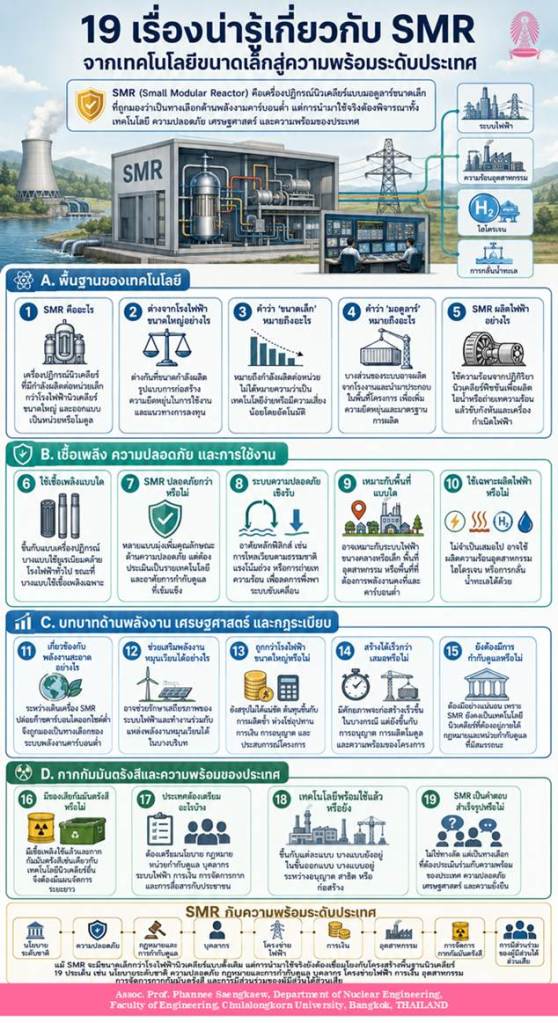
19 เรื่องน่ารู้เกี่ยวกับ SMR: จากเทคโนโลยีขนาดเล็กสู่ความพร้อมระดับประเทศ
เครื่องปฏิกรณ์นิวเคลียร์แบบโมดูลขนาดเล็ก หรือ Small Modular Reactors (SMRs) เป็นเทคโนโลยีนิวเคลียร์ที่ได้รับความสนใจมากขึ้นในบริบทของพลังงานคาร์บอนต่ำ ความมั่นคงทางพลังงาน และการเปลี่ยนผ่านระบบไฟฟ้าในอนาคต จุดเด่นของ SMR คือการมีกำลังผลิตต่อหน่วยเล็กกว่าโรงไฟฟ้านิวเคลียร์ขนาดใหญ่ มีแนวคิดการออกแบบแบบโมดูล และมีเป้าหมายให้บางส่วนของระบบสามารถผลิตหรือประกอบในโรงงานก่อนนำไปติดตั้งในพื้นที่โครงการ ทบวงการพลังงานปรมาณูระหว่างประเทศ (IAEA) อธิบายว่า SMRs และ microreactors (เครื่องปฏิกรณ์ขนาดจิ๋ว) อาจผลิตได้ทั้งไฟฟ้าฐาน ไฟฟ้าที่ปรับจ่ายได้ และผลิตภัณฑ์พลังงานสะอาดอื่น เช่น ความร้อน ไฮโดรเจน และพลังงานสำหรับการกลั่นน้ำทะเล ซึ่งอาจมีบทบาทต่อการลดคาร์บอนในภาคอุตสาหกรรม การขนส่ง อาคาร และระบบพลังงานโดยรวม อย่างไรก็ตาม SMR ไม่ใช่ “นิวเคลียร์แบบง่าย” และไม่ใช่ “ทางลัด” ที่ทำให้ประเทศไม่ต้องเตรียมโครงสร้างพื้นฐานด้านนิวเคลียร์ ความปลอดภัย กฎหมาย หน่วยกำกับดูแล บุคลากร การจัดการเชื้อเพลิงและกากกัมมันตรังสี การเงิน โครงข่ายไฟฟ้า และการสื่อสารกับสังคมยังคงเป็นเรื่องจำเป็น IAEA Milestones Approach ระบุว่า การพัฒนาโครงการไฟฟ้านิวเคลียร์ต้องพิจารณา โครงสร้างพื้นฐานนิวเคลียร์ 19 ประเด็น ในแต่ละช่วงของการพัฒนาโครงการ และทุกประเด็นต้องได้รับความสนใจอย่างเหมาะสม ไม่ใช่เลือกพิจารณาเฉพาะบางเรื่องเท่านั้น
1. SMR คืออะไร
SMR ย่อมาจาก Small Modular Reactor หรือ เครื่องปฏิกรณ์นิวเคลียร์แบบโมดูลขนาดเล็ก โดยทั่วไปหมายถึงเครื่องปฏิกรณ์นิวเคลียร์ที่มีกำลังผลิตต่อหน่วยต่ำกว่าโรงไฟฟ้านิวเคลียร์ขนาดใหญ่ ประมาณไม่เกิน 300 เมกะวัตต์ไฟฟ้า (MW(e)) และออกแบบภายใต้แนวคิดการประกอบเป็นหน่วยหรือโมดูล คำว่า “ขนาดเล็ก” จึงไม่ได้หมายความว่าเป็นเทคโนโลยีง่ายหรือมีความรับผิดชอบน้อยลง แต่หมายถึงขนาดกำลังผลิตและแนวทางการออกแบบที่แตกต่างจากโรงไฟฟ้านิวเคลียร์ขนาดใหญ่แบบดั้งเดิม
SMR อาจถูกใช้เป็นหน่วยผลิตไฟฟ้าเดี่ยว ใช้หลายหน่วยร่วมกัน หรือเชื่อมโยงกับระบบพลังงานอื่น เช่น พลังงานหมุนเวียน ระบบผลิตความร้อน หรือระบบอุตสาหกรรมที่ต้องการพลังงานต่อเนื่อง จุดนี้ทำให้ SMR ถูกมองว่าเป็นเทคโนโลยีที่มีความยืดหยุ่นมากขึ้น แต่ความเหมาะสมยังต้องพิจารณาเป็นรายประเทศ รายพื้นที่ และรายเทคโนโลยี
มุมมองด้านความพร้อมของประเทศ:
ประเด็นนี้เชื่อมโยงกับประเด็นด้านที่ 1 นโยบายหรือจุดยืนระดับชาติ (National Position) และ ประเด็นด้านที่ 3: การบริหารจัดการ (Management) เพราะก่อนที่ประเทศหนึ่งจะสนใจ SMR ต้องตอบให้ชัดว่าเหตุใดจึงต้องการพลังงานนิวเคลียร์ ต้องการใช้เพื่อผลิตไฟฟ้า ลดคาร์บอน เสริมความมั่นคงทางพลังงาน สนับสนุนอุตสาหกรรม หรือใช้เพื่อเป้าหมายอื่น นอกจากนี้ยังต้องมีหน่วยงานหรือกลไกบริหารระดับชาติที่สามารถประสานงานระหว่างภาคพลังงาน หน่วยกำกับดูแล ภาคอุตสาหกรรม ภาควิชาการ และประชาชนได้อย่างเป็นระบบ
2. SMR ต่างจากโรงไฟฟ้านิวเคลียร์ขนาดใหญ่อย่างไร
ความแตกต่างหลักอยู่ที่ ขนาดกำลังผลิต แนวคิดการก่อสร้าง ความยืดหยุ่นในการใช้งาน และรูปแบบการลงทุน โรงไฟฟ้านิวเคลียร์ขนาดใหญ่โดยทั่วไปมีกำลังผลิตสูงต่อหนึ่งหน่วย ต้องใช้เงินลงทุนสูง ใช้เวลาวางแผนและก่อสร้างนาน และต้องมีระบบไฟฟ้าที่สามารถรองรับกำลังผลิตขนาดใหญ่ได้
ในขณะที่ SMR มีขนาดต่อหน่วยเล็กลง จึงอาจเหมาะกับระบบไฟฟ้าที่ไม่ต้องการเพิ่มกำลังผลิตครั้งละมาก ๆ หรือประเทศที่ต้องการเริ่มต้นด้วยกำลังผลิตที่ไม่ใหญ่มาก อย่างไรก็ตาม “เล็กกว่า” ไม่ได้แปลว่า “ง่ายกว่า” เสมอไป เพราะยังต้องมีระบบควบคุมปฏิกิริยานิวเคลียร์ ระบบระบายความร้อน ระบบความปลอดภัย การจัดการเชื้อเพลิงใช้แล้ว และการกำกับดูแลตามมาตรฐานนิวเคลียร์
มุมมองด้านความพร้อมของประเทศ:
ประเด็นนี้เกี่ยวข้องกับ ประเด็นด้านที่ 1: นโยบายระดับชาติ, ประเด็นด้านที่ 9: โครงข่ายไฟฟ้า (Electrical Grid) และ ประเด็นด้านที่ 19: การจัดซื้อจัดจ้าง (Procurement) เพราะขนาดและลักษณะของ SMR มีผลโดยตรงต่อการวางนโยบายพลังงาน การประเมินความเข้ากันได้กับโครงข่ายไฟฟ้า และการเลือกแบบเทคโนโลยี หากประเทศมอง SMR เพียงว่าเป็น “โรงไฟฟ้านิวเคลียร์ขนาดเล็ก” อาจมองข้ามเงื่อนไขเชิงระบบ เช่น ความเสถียรของโครงข่ายไฟฟ้า รูปแบบสัญญา ความรับผิดชอบของผู้ขายเทคโนโลยี และสมรรถนะของผู้ดำเนินโครงการ
3. คำว่า “ขนาดเล็ก” หมายถึงอะไร
คำว่า “ขนาดเล็ก” ใน SMR หมายถึงกำลังผลิตของเครื่องปฏิกรณ์ต่อหน่วย ไม่ใช่ระดับความซับซ้อนของเทคโนโลยี เครื่องปฏิกรณ์ขนาดเล็กยังต้องมีระบบควบคุม ระบบป้องกัน ระบบระบายความร้อน ระบบกักเก็บสารกัมมันตรังสี และมาตรการความปลอดภัยเช่นเดียวกับเทคโนโลยีนิวเคลียร์อื่น
ข้อดีที่มักถูกกล่าวถึงคือ ขนาดที่เล็กลงอาจช่วยให้การวางแผนลงทุนมีความยืดหยุ่นมากขึ้น เช่น เริ่มต้นจากหนึ่งหน่วยก่อน แล้วเพิ่มหน่วยต่อไปเมื่อความต้องการไฟฟ้าเพิ่มขึ้น แต่ในทางเศรษฐศาสตร์ ยังไม่ควรสรุปทันทีว่า SMR จะถูกกว่าเสมอ เพราะต้นทุนต่อหน่วยไฟฟ้าขึ้นกับการผลิตซ้ำ ห่วงโซ่อุปทาน ระยะเวลาก่อสร้าง ต้นทุนทางการเงิน และประสบการณ์จริงของโครงการ OECD-NEA ระบุว่าการนำ SMR ไปใช้ในวงกว้างยังเผชิญความท้าทายด้านเทคนิค เศรษฐศาสตร์ กฎระเบียบ และห่วงโซ่อุปทาน
มุมมองด้านความพร้อมของประเทศ:
ประเด็นนี้เชื่อมโยงกับ ประเด็นด้านที่ 4: การเงินและการจัดหาเงินทุน (Funding and Financing) และ ประเด็นด้านที่ 9: โครงข่ายไฟฟ้า เพราะขนาดเล็กอาจช่วยลดเงินลงทุนเริ่มต้นต่อหน่วย แต่ไม่ได้ยกเลิกความจำเป็นในการวิเคราะห์ต้นทุนรวม ความเสี่ยงทางการเงิน ความเหมาะสมกับระบบไฟฟ้า และภาระผูกพันระยะยาว ประเทศจึงต้องประเมินทั้ง “ขนาดของเครื่องปฏิกรณ์” และ “ขนาดของความพร้อม” ไปพร้อมกัน
4. คำว่า “โมดูล” หมายถึงอะไร
คำว่า “โมดูล” หมายถึงแนวคิดการออกแบบระบบให้เป็นหน่วยหรือส่วนประกอบที่สามารถผลิต ทดสอบ หรือประกอบบางส่วนจากโรงงาน แล้วนำไปติดตั้งหรือประกอบในพื้นที่ตั้งโครงการ แนวคิดนี้มีเป้าหมายเพื่อลดความซับซ้อนของงานก่อสร้างภาคสนาม เพิ่มการควบคุมคุณภาพ และเปิดโอกาสให้เกิดการผลิตซ้ำในระดับอุตสาหกรรม
อย่างไรก็ตาม ความเป็นโมดูลไม่ได้หมายความว่าโครงการจะง่ายโดยอัตโนมัติ เพราะยังต้องมีมาตรฐานการผลิต การขนส่งชิ้นส่วนขนาดใหญ่ การตรวจสอบคุณภาพ การเชื่อมต่อกับระบบในพื้นที่โครงการ และกระบวนการอนุญาตจากหน่วยกำกับดูแล การผลิตแบบโมดูลจะให้ประโยชน์จริงก็ต่อเมื่อมีห่วงโซ่อุปทานและการบริหารโครงการที่พร้อมเพียงพอ
มุมมองด้านความพร้อมของประเทศ:
ประเด็นนี้เกี่ยวข้องกับ ประเด็นด้านที่ 18: การมีส่วนร่วมของภาคอุตสาหกรรม (Industrial Involvement) และ ประเด็นด้านที่ 19: การจัดซื้อจัดจ้าง เพราะแนวคิดโมดูลเชื่อมโยงกับบทบาทของอุตสาหกรรมในประเทศ การผลิตชิ้นส่วน การควบคุมคุณภาพ การถ่ายทอดเทคโนโลยี และเงื่อนไขในสัญญาจัดซื้อจัดจ้าง ประเทศที่สนใจ SMR ควรถามว่าอุตสาหกรรมภายในประเทศจะมีบทบาทเพียงใด จะพัฒนาผู้รับเหมาและผู้ผลิตชิ้นส่วนอย่างไร และจะกำหนดเงื่อนไขสัญญาให้เกิดการถ่ายทอดสมรรถนะอย่างเหมาะสมได้หรือไม่
5. SMR ผลิตไฟฟ้าอย่างไร
หลักการพื้นฐานของ SMR ไม่ต่างจากโรงไฟฟ้านิวเคลียร์ทั่วไปมากนัก คือใช้พลังงานความร้อนจากปฏิกิริยานิวเคลียร์ฟิชชันเพื่อผลิตไอน้ำหรือถ่ายเทความร้อนไปยังระบบผลิตไฟฟ้า จากนั้นพลังงานความร้อนจะถูกเปลี่ยนเป็นพลังงานกลในกังหัน และเปลี่ยนเป็นพลังงานไฟฟ้าด้วยเครื่องกำเนิดไฟฟ้า
สิ่งที่ต่างกันคือรายละเอียดของเทคโนโลยี เช่น ชนิดเครื่องปฏิกรณ์ สารหล่อเย็น เชื้อเพลิง อุณหภูมิการทำงาน ระบบถ่ายเทความร้อน และรูปแบบการจัดวางระบบ บางแบบเป็นเครื่องปฏิกรณ์น้ำเบา บางแบบเป็นเครื่องปฏิกรณ์อุณหภูมิสูง บางแบบใช้โลหะเหลวหรือเกลือหลอมเหลวเป็นตัวกลางถ่ายเทความร้อน IAEA ARIS SMR Catalogue 2024 แสดงให้เห็นว่า SMR ที่อยู่ระหว่างการพัฒนามีหลายสายเทคโนโลยี ไม่ได้มีรูปแบบเดียวทั้งหมด
มุมมองด้านความพร้อมของประเทศ:
ประเด็นนี้เกี่ยวข้องกับ ประเด็นด้านที่ 2: ความปลอดภัยทางนิวเคลียร์ (Nuclear Safety) และ ประเด็นด้านที่ 10: การพัฒนาทรัพยากรมนุษย์ (Human Resource Development) เพราะแม้หลักการพื้นฐานคือการผลิตความร้อนจากฟิชชัน แต่บุคลากรต้องเข้าใจระบบเครื่องปฏิกรณ์ ระบบถ่ายเทความร้อน การเดินเครื่อง การควบคุมกำลัง และระบบป้องกัน ความรู้ด้านเทคนิคจึงเป็นพื้นฐานสำคัญของความปลอดภัย การกำกับดูแล และการตัดสินใจเชิงนโยบายที่มีคุณภาพ
6. SMR ใช้เชื้อเพลิงนิวเคลียร์แบบใด
เชื้อเพลิงของ SMR ขึ้นกับแบบเครื่องปฏิกรณ์ บางแบบใช้เชื้อเพลิงยูเรเนียมที่ใกล้เคียงกับโรงไฟฟ้านิวเคลียร์น้ำเบาทั่วไป ขณะที่บางแบบอาจใช้เชื้อเพลิงเฉพาะ เช่น เชื้อเพลิงสำหรับเครื่องปฏิกรณ์อุณหภูมิสูง เชื้อเพลิงรูปแบบอนุภาค หรือเชื้อเพลิงที่มีลักษณะเหมาะกับเทคโนโลยีเฉพาะของเครื่องปฏิกรณ์นั้น
ประเด็นเชื้อเพลิงมีความสำคัญมาก เพราะเกี่ยวข้องกับการจัดหา การขนส่ง การเก็บรักษา การบัญชีวัสดุนิวเคลียร์ การพิทักษ์ความปลอดภัยทางนิวเคลียร์ ความมั่นคงทางนิวเคลียร์ และการจัดการเชื้อเพลิงใช้แล้ว ประเทศที่สนใจ SMR จึงต้องพิจารณาวงจรเชื้อเพลิงทั้งระบบ ไม่ใช่มองเฉพาะช่วงที่เครื่องปฏิกรณ์ผลิตไฟฟ้า
มุมมองด้านความพร้อมของประเทศ:
ประเด็นนี้เชื่อมโยงกับ ประเด็นด้านที่ 6: การพิทักษ์ความปลอดภัยทางนิวเคลียร์ (Safeguards), ประเด็นด้านที่ 15: ความมั่นคงปลอดภัยทางนิวเคลียร์และการป้องกันทางกายภาพ (Nuclear Security and Physical Protection) และ ประเด็นด้านที่ 16: วัฏจักรเชื้อเพลิงนิวเคลียร์ (Nuclear Fuel Cycle) เพราะเชื้อเพลิงนิวเคลียร์เป็นทั้งทรัพยากรพลังงาน วัสดุที่ต้องควบคุม และองค์ประกอบสำคัญของความรับผิดชอบระหว่างประเทศ ประเทศต้องมีระบบบัญชีและควบคุมวัสดุนิวเคลียร์ มาตรการความมั่นคง และนโยบายด้านวงจรเชื้อเพลิงที่ชัดเจนตั้งแต่ก่อนเริ่มโครงการ
7. SMR ปลอดภัยกว่าหรือไม่
คำถามนี้ควรตอบอย่างระมัดระวังว่า SMR หลายแบบตั้งเป้าให้มีคุณลักษณะความปลอดภัยที่ดีขึ้น แต่ต้องประเมินเป็นรายแบบเทคโนโลยี ไม่ควรสรุปโดยรวมว่า SMR ทุกแบบปลอดภัยกว่าโรงไฟฟ้านิวเคลียร์เดิมเสมอ เพราะความปลอดภัยขึ้นกับการออกแบบ รายละเอียดทางวิศวกรรม การวิเคราะห์อุบัติเหตุ ระบบป้องกัน การก่อสร้าง การเดินเครื่อง วัฒนธรรมความปลอดภัย และการกำกับดูแล
SMR หลายแบบเน้นระบบความปลอดภัยเชิงรับ การลดจำนวนระบบที่ซับซ้อนบางส่วน การออกแบบให้ระบายความร้อนได้ด้วยหลักฟิสิกส์ และการลดความเสี่ยงจากสถานการณ์อุบัติเหตุบางประเภท แต่สิ่งเหล่านี้ต้องได้รับการพิสูจน์ผ่านการวิเคราะห์ การทดสอบ และการประเมินโดยหน่วยกำกับดูแลอย่างเป็นระบบ
มุมมองด้านความพร้อมของประเทศ:
ประเด็นนี้เกี่ยวข้องกับ ประเด็นด้านที่ 2: ความปลอดภัยทางนิวเคลียร์, ประเด็นด้านที่ 7: กรอบการกำกับดูแล (Regulatory Framework), ประเด็นด้านที่ 10: การพัฒนาทรัพยากรมนุษย์ และ ประเด็นด้านที่ 14: การวางแผนรับมือเหตุฉุกเฉิน (Emergency Planning) เพราะประเทศต้องสามารถประเมินความปลอดภัยของแบบเครื่องปฏิกรณ์ มีหน่วยกำกับดูแลที่มีสมรรถนะ พัฒนาบุคลากรที่เข้าใจเทคโนโลยีเฉพาะ และจัดทำแผนฉุกเฉินที่สอดคล้องกับลักษณะของ SMR และพื้นที่ตั้งโครงการ
8. ระบบความปลอดภัยเชิงรับคืออะไร
ระบบความปลอดภัยแบบพาสซีฟ หรือ passive safety system คือระบบที่อาศัยหลักการทางฟิสิกส์ เช่น แรงโน้มถ่วง การพาความร้อนตามธรรมชาติ ความดัน หรือการเดือดและการควบแน่น เพื่อช่วยทำหน้าที่ด้านความปลอดภัยโดยลดการพึ่งพาอุปกรณ์ที่ต้องใช้ไฟฟ้า ปั๊ม หรือการกระทำของผู้ปฏิบัติงานในบางสถานการณ์ ตัวอย่างเช่น การระบายความร้อนจากแกนปฏิกรณ์ด้วยการไหลเวียนตามธรรมชาติ หรือการออกแบบให้ความร้อนถ่ายเทออกสู่แหล่งกักเก็บความร้อนได้โดยไม่ต้องใช้ระบบขับเคลื่อนเชิงกลตลอดเวลา อย่างไรก็ตาม ระบบเชิงรับไม่ใช่เพียงแนวคิดที่กล่าวอ้างได้เอง แต่ต้องได้รับการวิเคราะห์ ทดสอบ และตรวจสอบตามข้อกำหนดของหน่วยกำกับดูแล
มุมมองด้านความพร้อมของประเทศ:
ประเด็นนี้เชื่อมโยงกับ ประเด็นด้านที่ 2: ความปลอดภัยทางนิวเคลียร์ และ ประเด็นด้านที่ 7: กรอบการกำกับดูแล เพราะหน่วยงานกำกับดูแลต้องเข้าใจหลักการทำงานของระบบเชิงรับ สามารถประเมินข้อสมมติทางวิศวกรรม และตรวจสอบได้ว่าระบบทำงานได้จริงตามเงื่อนไขอุบัติเหตุที่กำหนด ความปลอดภัยเชิงรับจึงไม่ได้ลดบทบาทของการกำกับดูแล แต่กลับทำให้ต้องมีความเข้าใจเชิงเทคนิคที่ลึกขึ้น
9. SMR เหมาะกับพื้นที่แบบใด
SMR อาจเหมาะกับหลายบริบท เช่น ระบบไฟฟ้าขนาดกลางหรือขนาดเล็ก พื้นที่ที่ไม่สามารถรองรับโรงไฟฟ้านิวเคลียร์ขนาดใหญ่ พื้นที่อุตสาหกรรมที่ต้องการไฟฟ้าและความร้อนอย่างต่อเนื่อง พื้นที่ห่างไกล หรือประเทศที่ต้องการเริ่มต้นด้วยกำลังผลิตไม่ใหญ่มาก อย่างไรก็ตาม ความเหมาะสมไม่ได้ขึ้นกับขนาดเครื่องปฏิกรณ์เพียงอย่างเดียว ต้องพิจารณาพื้นที่ตั้ง ระบบไฟฟ้า แหล่งน้ำหรือระบบระบายความร้อน การขนส่งชิ้นส่วน ความเสี่ยงทางธรรมชาติ สิ่งแวดล้อม ชุมชนโดยรอบ และความสามารถในการตอบโต้เหตุฉุกเฉิน
มุมมองด้านความพร้อมของประเทศ:
ประเด็นนี้เกี่ยวข้องกับ ประเด็นด้านที่ 12: สถานที่ตั้งและสิ่งสนับสนุน (Site and Supporting Facilities), ประเด็นด้านที่ 13: การคุ้มครองสิ่งแวดล้อม (Environmental Protection), ประเด็นด้านที่ 11: การมีส่วนร่วมของผู้ที่มีส่วนได้ส่วนเสีย (Stakeholder Involvement) และ ประเด็นด้านที่ 14: การวางแผนรับมือเหตุฉุกเฉิน เพราะการเลือกพื้นที่ตั้งต้องพิจารณาทั้งความปลอดภัย สิ่งแวดล้อม โครงสร้างพื้นฐานสนับสนุน ชุมชน และแผนฉุกเฉิน การที่ SMR มีขนาดเล็กกว่าไม่ได้หมายความว่าสามารถตั้งได้ทุกที่โดยไม่ต้องประเมินอย่างรอบคอบ
10. SMR ใช้เฉพาะผลิตไฟฟ้าหรือไม่
SMR ไม่จำเป็นต้องใช้เฉพาะผลิตไฟฟ้าเท่านั้น หลายแบบถูกกล่าวถึงในบริบทของการใช้พลังงานร่วม เช่น การผลิตความร้อนในอุตสาหกรรม การผลิตไฮโดรเจน การกลั่นน้ำทะเล การจ่ายความร้อนให้ชุมชน หรือการสนับสนุนระบบพลังงานผสมผสาน IAEA ระบุว่า SMRs และ microreactors สามารถผลิตไฟฟ้าฐาน ไฟฟ้าที่ปรับจ่ายได้ และผลิตภัณฑ์พลังงานสะอาดอื่น ๆ ที่จำเป็นต่อการลดคาร์บอนในภาคส่วนต่าง ๆ
ประเด็นนี้ทำให้ SMR ไม่ได้เป็นเพียง “โรงไฟฟ้านิวเคลียร์ขนาดเล็ก” แต่เป็นเทคโนโลยีพลังงานที่อาจเชื่อมโยงกับภาคอุตสาหกรรมและระบบพลังงานคาร์บอนต่ำในอนาคต อย่างไรก็ตาม การใช้งานนอกเหนือจากผลิตไฟฟ้าต้องมีการประเมินความต้องการจริง ความคุ้มค่าทางเศรษฐศาสตร์ ความปลอดภัย และรูปแบบการกำกับดูแลที่เหมาะสม
มุมมองด้านความพร้อมของประเทศ:
ประเด็นนี้เชื่อมโยงกับ ประเด็นด้านที่ 1: นโยบายระดับชาติ, ประเด็นด้านที่ 9: โครงข่ายไฟฟ้า และ ประเด็นด้านที่ 18: การมีส่วนร่วมของภาคอุตสาหกรรม เพราะหากประเทศต้องการใช้ SMR เพื่อผลิตไฮโดรเจน ความร้อน หรือสนับสนุนอุตสาหกรรม ต้องกำหนดให้ชัดว่าเป้าหมายพลังงานและอุตสาหกรรมของประเทศคืออะไร และจะบูรณาการ SMR เข้ากับระบบเศรษฐกิจและระบบพลังงานอย่างไร
11. SMR เกี่ยวข้องกับพลังงานสะอาดอย่างไร
ระหว่างการเดินเครื่อง โรงไฟฟ้านิวเคลียร์รวมถึง SMR มีการปล่อยก๊าซคาร์บอนไดออกไซด์ต่ำเมื่อเทียบกับโรงไฟฟ้าเชื้อเพลิงฟอสซิล จึงถูกพูดถึงในฐานะหนึ่งในทางเลือกของระบบพลังงานคาร์บอนต่ำ โดยเฉพาะในประเทศที่ต้องการลดการปล่อยก๊าซเรือนกระจกแต่ยังต้องรักษาเสถียรภาพของระบบไฟฟ้า
อย่างไรก็ตาม คำว่า “พลังงานสะอาด” ในบริบทนิวเคลียร์ควรอธิบายอย่างครบถ้วน คือสะอาดในแง่การปล่อยคาร์บอนต่ำระหว่างเดินเครื่อง แต่ยังต้องจัดการประเด็นด้านกากกัมมันตรังสี เชื้อเพลิงใช้แล้ว ความปลอดภัย และความไว้วางใจของสังคมอย่างรอบคอบ
มุมมองด้านความพร้อมของประเทศ:
ประเด็นนี้เกี่ยวข้องกับ ประเด็นด้านที่ 1: นโยบายระดับชาติ และ ประเด็นด้านที่ 13: การคุ้มครองสิ่งแวดล้อม เพราะการกล่าวถึง SMR ในฐานะพลังงานคาร์บอนต่ำต้องเชื่อมโยงกับนโยบายพลังงานและสิ่งแวดล้อมของประเทศ รวมถึงการประเมินผลกระทบสิ่งแวดล้อมตลอดอายุโครงการ การลดคาร์บอนจึงเป็นเพียงหนึ่งมิติของการประเมิน ไม่ใช่คำตอบทั้งหมด
12. SMR ช่วยเสริมพลังงานหมุนเวียนได้อย่างไร
ระบบไฟฟ้าที่มีพลังงานหมุนเวียนเพิ่มขึ้น เช่น พลังงานแสงอาทิตย์และพลังงานลม อาจต้องการแหล่งพลังงานที่ช่วยรักษาเสถียรภาพเมื่อกำลังผลิตจากแหล่งหมุนเวียนเปลี่ยนแปลงตามสภาพอากาศ SMR บางแนวคิดจึงถูกนำเสนอว่าอาจทำงานร่วมกับพลังงานหมุนเวียนได้ โดยช่วยจ่ายไฟฟ้าต่อเนื่อง หรือในบางแบบอาจปรับกำลังผลิตเพื่อสนับสนุนระบบไฟฟ้า
อย่างไรก็ตาม ความสามารถในการทำงานร่วมกับพลังงานหมุนเวียนขึ้นกับเทคโนโลยีเฉพาะของ SMR รูปแบบการเดินเครื่อง ข้อกำหนดของระบบไฟฟ้า ตลาดไฟฟ้า และความคุ้มค่าทางเศรษฐศาสตร์ ไม่ใช่ SMR ทุกแบบจะเหมาะกับการปรับกำลังผลิตบ่อยครั้งเหมือนกัน
มุมมองด้านความพร้อมของประเทศ:
ประเด็นนี้เชื่อมโยงกับ ประเด็นด้านที่ 9: โครงข่ายไฟฟ้า และ ประเด็นด้านที่ 3: การบริหารจัดการ เพราะการนำ SMR ไปใช้ร่วมกับพลังงานหมุนเวียนต้องอาศัยการวางแผนระบบไฟฟ้า การบริหารโหลด การรักษาเสถียรภาพของโครงข่าย และการประสานงานระหว่างหน่วยงานด้านพลังงาน ไฟฟ้า และนิวเคลียร์
13. SMR ถูกกว่าโรงไฟฟ้านิวเคลียร์ขนาดใหญ่หรือไม่
ยังไม่ควรสรุปง่าย ๆ ว่า SMR “ถูกกว่า” โรงไฟฟ้านิวเคลียร์ขนาดใหญ่เสมอไป แม้เงินลงทุนเริ่มต้นต่อหน่วยอาจต่ำกว่าเนื่องจากขนาดเล็กลง แต่ต้นทุนต่อหน่วยไฟฟ้าขึ้นกับหลายปัจจัย เช่น จำนวนหน่วยที่ผลิตจริง การผลิตซ้ำในโรงงาน ความสามารถในการลดต้นทุนจากประสบการณ์ ห่วงโซ่อุปทาน ระยะเวลาก่อสร้าง ต้นทุนทางการเงิน และค่าใช้จ่ายด้านการอนุญาต
OECD-NEA ชี้ว่าการนำ SMR ไปใช้ในวงกว้างยังมีความท้าทายด้านเทคนิค เศรษฐศาสตร์ กฎระเบียบ และห่วงโซ่อุปทาน ซึ่งหมายความว่าความคุ้มค่าของ SMR ต้องพิสูจน์ผ่านโครงการจริงและการพัฒนาอุตสาหกรรมรองรับอย่างเพียงพอ
มุมมองด้านความพร้อมของประเทศ:
ประเด็นนี้เกี่ยวข้องกับ ประเด็นด้านที่ 4: การเงินและการจัดหาเงินทุน และ ประเด็นด้านที่ 19: การจัดซื้อจัดจ้าง เพราะต้นทุนของ SMR ไม่ได้ขึ้นกับราคาเครื่องปฏิกรณ์เท่านั้น แต่รวมถึงรูปแบบสัญญา ความเสี่ยงของโครงการ ต้นทุนทางการเงิน การรับประกันสมรรถนะ การจัดการความล่าช้า และภาระผูกพันระยะยาว ประเทศต้องมีความสามารถในการประเมินข้อเสนอทางการเงินและเทคโนโลยีอย่างรอบด้าน
14. SMR สร้างได้เร็วกว่าเสมอหรือไม่
SMR หลายแบบตั้งเป้าว่าจะลดระยะเวลาก่อสร้างด้วยแนวคิดโมดูลและการผลิตบางส่วนในโรงงาน แต่ในทางปฏิบัติ ระยะเวลาโครงการไม่ได้ขึ้นกับตัวเครื่องปฏิกรณ์เท่านั้น ยังขึ้นกับกระบวนการอนุญาต การเตรียมพื้นที่ตั้ง การเชื่อมต่อโครงข่ายไฟฟ้า การจัดหาเงินทุน การผลิตชิ้นส่วน การทดสอบระบบ และความพร้อมของบุคลากร
ดังนั้น ควรกล่าวว่า SMR “มีศักยภาพ” ที่จะก่อสร้างได้รวดเร็วขึ้นในบางกรณี แต่ไม่ควรสรุปว่าเร็วกว่าเสมอ โดยเฉพาะโครงการแรกของแบบเทคโนโลยีใหม่ ซึ่งมักเผชิญความไม่แน่นอนด้านการอนุญาต การผลิต และการก่อสร้างมากกว่าโครงการที่มีประสบการณ์สะสมแล้ว
มุมมองด้านความพร้อมของประเทศ:
ประเด็นนี้เชื่อมโยงกับ ประเด็นด้านที่ 3: การบริหารจัดการ, ประเด็นด้านที่ 18: การมีส่วนร่วมของภาคอุตสาหกรรม และ ประเด็นด้านที่ 19: การจัดซื้อจัดจ้าง เพราะระยะเวลาก่อสร้างขึ้นกับการบริหารโครงการ ห่วงโซ่อุปทาน ความพร้อมของผู้รับเหมา การผลิตโมดูล และการประสานงานระหว่างผู้ขายเทคโนโลยี หน่วยงานรัฐ หน่วยกำกับดูแล และผู้ดำเนินโครงการ
15. SMR ยังต้องมีการกำกับดูแลหรือไม่
ต้องมีอย่างแน่นอน เพราะ SMR ยังคงเป็นเทคโนโลยีนิวเคลียร์ ไม่ว่าจะมีขนาดเล็กลงเพียงใด ก็ยังต้องอยู่ภายใต้กฎหมาย การออกใบอนุญาต การประเมินความปลอดภัย การตรวจสอบ การกำกับดูแลการเดินเครื่อง การรักษาความมั่นคงทางนิวเคลียร์ และการพิทักษ์ความปลอดภัยทางนิวเคลียร์
ความท้าทายของ SMR คือหลายแบบยังเป็นเทคโนโลยีใหม่ หรือมีแนวคิดการติดตั้งและการใช้งานต่างจากโรงไฟฟ้านิวเคลียร์แบบเดิม หน่วยกำกับดูแลจึงต้องมีความสามารถในการประเมินแบบเครื่องปฏิกรณ์ใหม่ ระบบความปลอดภัยใหม่ รูปแบบหลายโมดูล หรือรูปแบบการใช้งานร่วมกับภาคอุตสาหกรรม
มุมมองด้านความพร้อมของประเทศ:
ประเด็นนี้เกี่ยวข้องโดยตรงกับ ประเด็นด้านที่ 5: กรอบกฎหมาย (Legislative Framework) และ ประเด็นด้านที่ 7: กรอบการกำกับดูแล เพราะต้องมีกฎหมายที่ชัดเจน หน่วยกำกับดูแลที่มีอำนาจ อิสระ สมรรถนะ และทรัพยากรเพียงพอ การกำกับดูแล SMR ไม่ใช่การลดมาตรฐานให้เบาลง แต่เป็นการปรับกรอบการประเมินให้เหมาะกับเทคโนโลยีใหม่โดยยังคงหลักความปลอดภัยอย่างเข้มงวด
16. SMR มีกากกัมมันตรังสีหรือไม่
SMR เป็นเทคโนโลยีนิวเคลียร์ จึงยังมีเชื้อเพลิงใช้แล้วและกากกัมมันตรังสีในระดับต่าง ๆ เหมือนโครงการนิวเคลียร์อื่น แม้ปริมาณ รูปแบบ และองค์ประกอบของของเสียอาจแตกต่างกันตามชนิดเครื่องปฏิกรณ์ เชื้อเพลิง วัสดุ และรูปแบบการเดินเครื่อง
สิ่งสำคัญคือ ประเทศที่พิจารณา SMR ต้องมีนโยบายและระบบจัดการกากกัมมันตรังสีระยะยาว ตั้งแต่การจำแนกประเภทกาก การเก็บรักษาชั่วคราว การขนส่ง การกำกับดูแลสถานที่จัดเก็บ ไปจนถึงแนวทางปลายทางสำหรับเชื้อเพลิงใช้แล้วหรือกากระดับสูง IAEA ระบุว่าเอกสารด้านพัฒนาการ SMR ครอบคลุมวัฏจักรชีวิตของเทคโนโลยี ตั้งแต่แนวคิด การพัฒนา การใช้งาน ไปจนถึงการปลดระวาง ซึ่งสะท้อนว่าประเด็นปลายทางเป็นส่วนหนึ่งของการพิจารณาเทคโนโลยีนี้
มุมมองด้านความพร้อมของประเทศ:
ประเด็นนี้เกี่ยวข้องกับ ประเด็นด้านที่ 17: การจัดการกากกัมมันตรังสี (Radioactive Waste Management) และ ประเด็นด้านที่ 16: วัฏจักรเชื้อเพลิงนิวเคลียร์ เพราะ SMR ไม่ได้ทำให้ปัญหากากกัมมันตรังสีหายไป ประเทศยังต้องมีนโยบาย แผนงาน สถานที่ ระบบกำกับดูแล และความสามารถทางเทคนิคในการจัดการกากและเชื้อเพลิงใช้แล้วตลอดอายุโครงการ
17. ประเทศที่สนใจ SMR ต้องเตรียมอะไรบ้าง
ประเทศที่สนใจ SMR ต้องเตรียมมากกว่าการเลือกเทคโนโลยีหรือผู้ขาย ต้องเตรียมโครงสร้างพื้นฐานระดับประเทศ เช่น นโยบาย กฎหมาย หน่วยกำกับดูแล บุคลากร ระบบความปลอดภัย ความมั่นคงทางนิวเคลียร์ การพิทักษ์ความปลอดภัยทางนิวเคลียร์ ระบบจัดการกาก โครงข่ายไฟฟ้า การเงิน การจัดซื้อจัดจ้าง การสื่อสารกับสาธารณะ และระบบตอบโต้เหตุฉุกเฉิน
แนวทางการพัฒนาตามหมุดหมาย (IAEA Milestones) ฉบับปรับปรุง ระบุว่า ประเทศที่เริ่มต้นหรือขยายโครงการไฟฟ้านิวเคลียร์มีหน้าที่ต้องจัดตั้งโครงสร้างพื้นฐานที่จำเป็น และเอกสารฉบับนี้ยังรวมข้อพิจารณาเฉพาะสำหรับ SMRs ไว้ด้วย เพื่อช่วยให้ประเทศพิจารณาทั้งกรอบโครงสร้างพื้นฐานทั่วไปและลักษณะเฉพาะของเทคโนโลยี SMR
มุมมองด้านความพร้อมของประเทศ:
ประเด็นนี้ครอบคลุมโครงสร้างพื้นฐานทั้ง 19 ด้าน เพราะ SMR ไม่ลดความจำเป็นของความพร้อมระดับประเทศ เพียงแต่ทำให้ประเทศต้องตีความความพร้อมเหล่านั้นให้เหมาะกับรูปแบบเทคโนโลยี ขนาดโครงการ ลักษณะการติดตั้ง และรูปแบบการใช้งานจริง
18. SMR เป็นเทคโนโลยีที่พร้อมใช้งานแล้วหรือยัง
คำตอบคือ ขึ้นกับแบบเทคโนโลยี เพราะ SMR ไม่ใช่เทคโนโลยีแบบเดียวทั่วโลก บางแบบยังอยู่ในขั้นออกแบบ บางแบบอยู่ระหว่างกระบวนการอนุญาต บางแบบอยู่ในขั้นสาธิตหรือก่อสร้าง และบางแบบมีความก้าวหน้ามากกว่าแบบอื่น IAEA ระบุว่าเอกสาร Advances in SMR Developments 2024 มีเป้าหมายเพื่อให้ประเทศสมาชิกเห็นภาพรวมล่าสุดของพัฒนาการเทคโนโลยี SMR ทั่วโลก ตั้งแต่การพัฒนาแนวคิดไปจนถึงการปลดระวาง
ดังนั้น เวลาอ่านข่าวเกี่ยวกับ SMR ควรถามต่อเสมอว่าเป็นเทคโนโลยีแบบใด อยู่ในประเทศใด ผ่านขั้นตอนอนุญาตแล้วหรือยัง มีโครงการสาธิตหรือโครงการเชิงพาณิชย์แล้วหรือไม่ และมีประสบการณ์เดินเครื่องจริงมากน้อยเพียงใด
มุมมองด้านความพร้อมของประเทศ:
ประเด็นนี้เกี่ยวข้องกับ ประเด็นด้านที่ 7: กรอบการกำกับดูแล, ประเด็นด้านที่ 10: การพัฒนาทรัพยากรมนุษย์ และ ประเด็นด้านที่ 19: การจัดซื้อจัดจ้าง เพราะประเทศต้องสามารถประเมินความพร้อมของเทคโนโลยี ไม่ใช่พิจารณาจากคำโฆษณาเท่านั้น ต้องดูสถานะการอนุญาต ประสบการณ์จริง ความพร้อมของผู้ขายเทคโนโลยี เงื่อนไขสัญญา และความสามารถของบุคลากรในประเทศที่จะเรียนรู้และกำกับดูแลเทคโนโลยีนั้น
19. SMR เป็นคำตอบสำเร็จรูปหรือไม่
SMR ไม่ใช่คำตอบสำเร็จรูป และไม่ใช่เทคโนโลยีที่ทำให้ประเทศ “ข้ามขั้นตอน” การเตรียมความพร้อมด้านนิวเคลียร์ได้ แต่เป็นหนึ่งในทางเลือกที่ควรพิจารณาอย่างรอบด้าน ทั้งในแง่เทคนิค เศรษฐศาสตร์ ความปลอดภัย ความมั่นคงทางนิวเคลียร์ การจัดการกาก โครงข่ายไฟฟ้า บุคลากร กฎหมาย อุตสาหกรรม และการยอมรับของสังคม
จุดแข็งของ SMR คือความยืดหยุ่น ขนาดกำลังผลิตที่เล็กลง แนวคิดโมดูล และศักยภาพในการใช้งานที่หลากหลาย แต่จุดที่ต้องพิจารณาอย่างจริงจังคือความพร้อมของเทคโนโลยี ต้นทุนจริง การอนุญาต ห่วงโซ่อุปทาน และความสามารถของประเทศในการกำกับดูแลโครงการนิวเคลียร์อย่างรับผิดชอบ
มุมมองด้านความพร้อมของประเทศ:
ประเด็นนี้เชื่อมโยงกับ ประเด็นด้านที่ 1: นโยบายระดับชาติ และในทางปฏิบัติครอบคลุม ทั้ง 19 ด้าน เพราะคำถามสุดท้ายไม่ใช่เพียงว่า “SMR ดีหรือไม่” แต่คือ “ประเทศพร้อมจะใช้ SMR อย่างปลอดภัย รับผิดชอบ คุ้มค่า และยั่งยืนหรือไม่” การตัดสินใจเกี่ยวกับ SMR จึงต้องเริ่มจากนโยบายระดับชาติที่ชัดเจน และขยายไปสู่การเตรียมความพร้อมในทุกมิติ
ตารางสรุป: 19 เรื่องน่ารู้เกี่ยวกับ SMR กับโครงสร้างพื้นฐานนิวเคลียร์ 19 ประเด็น
| เรื่องน่ารู้เกี่ยวกับ SMR | ประเด็นโครงสร้างพื้นฐานที่เกี่ยวข้อง | ความหมายเชิงความพร้อม |
| 1. SMR คืออะไร | ประเด็นด้านที่ 1, ประเด็นด้านที่ 3 | ต้องมีเหตุผลเชิงนโยบายและกลไกบริหารระดับชาติ |
| 2. ต่างจากโรงไฟฟ้านิวเคลียร์ขนาดใหญ่อย่างไร | ประเด็นด้านที่ 1, ประเด็นด้านที่ 9, ประเด็นด้านที่ 19 | ขนาดและรูปแบบโครงการมีผลต่อระบบไฟฟ้าและการจัดซื้อจัดจ้าง |
| 3. “ขนาดเล็ก” หมายถึงอะไร | ประเด็นด้านที่ 4, ประเด็นด้านที่ 9 | ต้องประเมินต้นทุน ความเสี่ยง และความเหมาะสมกับโครงข่ายไฟฟ้า |
| 4. “โมดูล” หมายถึงอะไร | ประเด็นด้านที่ 18, ประเด็นด้านที่ 19 | เกี่ยวข้องกับอุตสาหกรรม ห่วงโซ่อุปทาน และสัญญา |
| 5. SMR ผลิตไฟฟ้าอย่างไร | ประเด็นด้านที่ 2, ประเด็นด้านที่ 10 | ต้องมีบุคลากรเข้าใจระบบเครื่องปฏิกรณ์และความปลอดภัย |
| 6. ใช้เชื้อเพลิงแบบใด | ประเด็นด้านที่ 6, ประเด็นด้านที่ 15, ประเด็นด้านที่ 16 | เกี่ยวข้องกับเชื้อเพลิง การควบคุมวัสดุนิวเคลียร์ และความมั่นคง |
| 7. ปลอดภัยกว่าหรือไม่ | ประเด็นด้านที่ 2, ประเด็นด้านที่ 7, ประเด็นด้านที่ 10, ประเด็นด้านที่ 14 | ต้องประเมินความปลอดภัย อนุญาต และเตรียมฉุกเฉิน |
| 8. ระบบความปลอดภัยเชิงรับคืออะไร | ประเด็นด้านที่ 2, ประเด็นด้านที่ 7 | ต้องพิสูจน์และกำกับดูแลระบบเชิงรับได้จริง |
| 9. เหมาะกับพื้นที่แบบใด | ประเด็นด้านที่ 11, ประเด็นด้านที่ 12, ประเด็นด้านที่ 13, ประเด็นด้านที่ 14 | พื้นที่ตั้งต้องผ่านการประเมินด้านเทคนิค สิ่งแวดล้อม และสังคม |
| 10. ใช้เฉพาะผลิตไฟฟ้าหรือไม่ | ประเด็นด้านที่ 1, ประเด็นด้านที่ 9, ประเด็นด้านที่ 18 | ต้องเชื่อมกับยุทธศาสตร์พลังงานและอุตสาหกรรม |
| 11. เกี่ยวข้องกับพลังงานสะอาดอย่างไร | ประเด็นด้านที่ 1, ประเด็นด้านที่ 13 | ต้องพิจารณาทั้งคาร์บอนต่ำและผลกระทบสิ่งแวดล้อม |
| 12. ช่วยเสริมพลังงานหมุนเวียนอย่างไร | ประเด็นด้านที่ 3, ประเด็นด้านที่ 9 | ต้องวางแผนระบบไฟฟ้า โหลด และเสถียรภาพโครงข่าย |
| 13. ถูกกว่าหรือไม่ | ประเด็นด้านที่ 4, ประเด็นด้านที่ 19 | ต้องประเมินต้นทุนจริง การเงิน และความเสี่ยงของสัญญา |
| 14. สร้างได้เร็วกว่าเสมอหรือไม่ | ประเด็นด้านที่ 3, ประเด็นด้านที่ 18, ประเด็นด้านที่ 19 | ต้องบริหารโครงการ ห่วงโซ่อุปทาน และการผลิตโมดูล |
| 15. ยังต้องมีการกำกับดูแลหรือไม่ | ประเด็นด้านที่ 5, ประเด็นด้านที่ 7 | ต้องมีกฎหมายและหน่วยกำกับดูแลที่มีสมรรถนะ |
| 16. มีกากกัมมันตรังสีหรือไม่ | ประเด็นด้านที่ 16, ประเด็นด้านที่ 17 | ต้องมีระบบจัดการเชื้อเพลิงใช้แล้วและกากกัมมันตรังสี |
| 17. ประเทศต้องเตรียมอะไรบ้าง | ทั้ง 19 ประเด็น | SMR ต้องอาศัยความพร้อมระดับประเทศครบทุกมิติ |
| 18. พร้อมใช้งานแล้วหรือยัง | ประเด็นด้านที่ 7, ประเด็นด้านที่ 10, ประเด็นด้านที่ 19 | ต้องประเมินสถานะเทคโนโลยี การอนุญาต และสมรรถนะบุคลากร |
| 19. เป็นคำตอบสำเร็จรูปหรือไม่ | ประเด็นด้านที่ 1 และทั้ง 19 ประเด็น | ต้องตัดสินใจบนฐานนโยบาย ความพร้อม และความรับผิดชอบระยะยาว |
บทสรุป
SMR ควรถูกมองในสองระดับพร้อมกัน ระดับแรกคือ เทคโนโลยีเครื่องปฏิกรณ์ ซึ่งมีจุดเด่นด้านขนาด ความยืดหยุ่น การออกแบบแบบโมดูล และศักยภาพในการใช้งานที่หลากหลาย ระดับที่สองคือ ระบบความพร้อมของประเทศ ซึ่งครอบคลุมกฎหมาย การกำกับดูแล ความปลอดภัย ความมั่นคงทางนิวเคลียร์ การจัดการเชื้อเพลิงและกากกัมมันตรังสี บุคลากร การเงิน อุตสาหกรรม โครงข่ายไฟฟ้า และความไว้วางใจของสังคม
กล่าวอย่างง่ายที่สุด SMR อาจมีขนาดเล็กกว่าโรงไฟฟ้านิวเคลียร์แบบดั้งเดิม แต่ “ความรับผิดชอบ” ของประเทศที่นำเทคโนโลยีนี้มาใช้ไม่ได้เล็กลงตามไปด้วย การเริ่มต้นเข้าใจ SMR จึงควรเริ่มจากทั้งคำถามทางเทคนิคว่า “SMR ทำงานอย่างไร” และคำถามเชิงโครงสร้างพื้นฐานว่า “ประเทศต้องพร้อมด้านใดบ้างจึงจะใช้ SMR ได้อย่างปลอดภัย รับผิดชอบ และยั่งยืน”
แหล่งอ้างอิงเพิ่มเติมที่แนะนำ
- International Atomic Energy Agency. Small Modular Reactors: Advances in SMR Developments 2024.
เหมาะสำหรับใช้เป็นแหล่งอ้างอิงหลักเกี่ยวกับพัฒนาการเทคโนโลยี SMR ทั่วโลก ประเภทของเทคโนโลยี และวงจรชีวิตตั้งแต่แนวคิดจนถึงการปลดระวาง
- International Atomic Energy Agency. Milestones in the Development of a National Infrastructure for Nuclear Power, Rev. 2.
เหมาะสำหรับอ้างอิงกรอบโครงสร้างพื้นฐานนิวเคลียร์ 19 ประเด็น และแนวทางการเตรียมความพร้อมของประเทศที่เริ่มต้นหรือขยายโครงการไฟฟ้านิวเคลียร์
- International Atomic Energy Agency. Milestones Approach.
เหมาะสำหรับอ่านภาพรวมของแนวทาง Milestones Approach ซึ่งแบ่งการพัฒนาโครงการไฟฟ้านิวเคลียร์เป็นระยะ และเน้นว่า 19 ประเด็นต้องได้รับความสนใจอย่างเหมาะสม
- IAEA ARIS. SMR Catalogue 2024.
เหมาะสำหรับดูรายละเอียดแบบเครื่องปฏิกรณ์และสายเทคโนโลยี SMR หลายกลุ่ม เช่น น้ำมวลเบา อุณหภูมิสูง โลหะเหลว และเกลือหลอมเหลว
- OECD Nuclear Energy Agency (2021). Small Modular Reactors: Challenges and Opportunities.
เหมาะสำหรับอ้างอิงความท้าทายด้านเทคนิค เศรษฐศาสตร์ กฎระเบียบ ห่วงโซ่อุปทาน และเงื่อนไขที่จำเป็นต่อการนำ SMR ไปใช้ในวงกว้าง
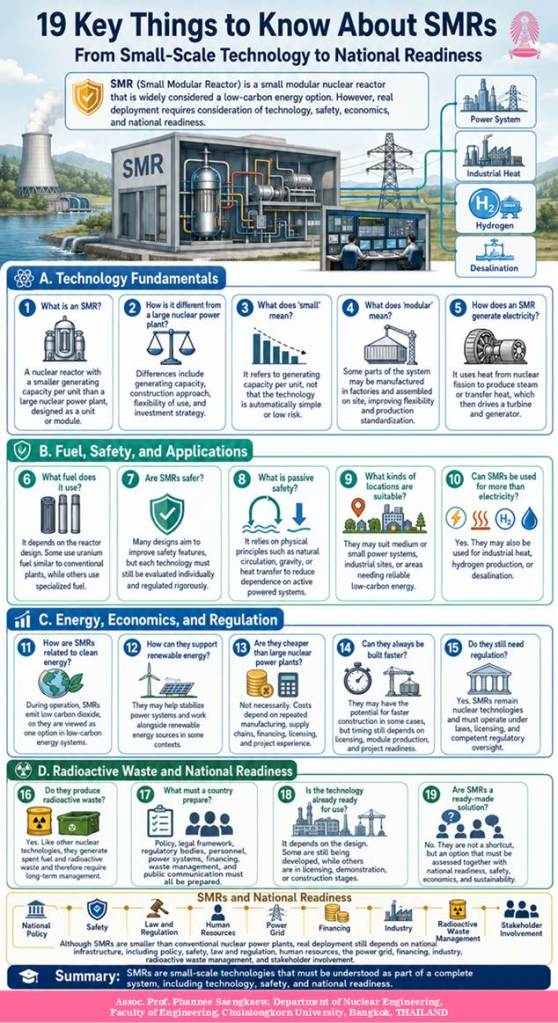
19 Key Things to Know About SMRs:
From Small-Scale Technology to National Readiness
Introduction
Small Modular Reactors, or SMRs, are nuclear reactor technologies that have attracted increasing attention in the context of low-carbon energy, energy security, and the future transformation of electricity systems. A key feature of SMRs is that they have a smaller generating capacity per unit than large nuclear power plants. They are also based on a modular design concept, with the intention that some parts of the system may be manufactured or assembled in factories before being transported and installed at the project site.
The International Atomic Energy Agency (IAEA) describes SMRs and microreactors as technologies that may provide baseload electricity, dispatchable electricity, and other clean energy products such as heat, hydrogen, and energy for desalination. These features may support decarbonization in industry, transport, buildings, and broader energy systems.
However, SMRs are not “simple nuclear technology,” nor are they a shortcut that allows a country to avoid preparing the necessary nuclear infrastructure. Nuclear safety, legal frameworks, regulatory bodies, human resources, nuclear fuel and radioactive waste management, financing, power grid readiness, and communication with society remain essential. Under the IAEA Milestones Approach, the development of a nuclear power programme requires consideration of 19 nuclear infrastructure issues throughout the different phases of programme development. All of these issues must receive appropriate attention; they cannot be selectively addressed.
This article therefore aims to explain SMRs at a level deeper than a general introductory article, while still remaining accessible and readable. It is intended for students, academically interested readers, and those who wish to understand the relationship between reactor technology and national readiness under the framework of the 19 nuclear infrastructure issues.
1. What is an SMR?
SMR stands for Small Modular Reactor. In general, it refers to a nuclear reactor with a smaller generating capacity per unit than a large nuclear power plant and designed according to a modular concept. The word “small” does not mean that the technology is simple or that the responsibility associated with it is reduced. Rather, it refers to the generating capacity and design approach, which differ from conventional large nuclear power plants.
An SMR may be used as a single electricity-generating unit, as multiple units operating together, or as part of a broader energy system. It may also be connected with renewable energy systems, heat production systems, or industrial systems that require continuous energy supply. This flexibility is one reason why SMRs are often discussed as an alternative nuclear technology in certain contexts. Nevertheless, their suitability must still be assessed by country, by site, and by specific reactor technology.
National readiness perspective:
This issue is linked to Issue 1: National Position and Issue 3: Management. Before a country considers SMRs, it must clearly answer why it wants nuclear energy, whether the objective is electricity generation, carbon reduction, energy security, industrial support, or another national goal. It must also establish a national management mechanism capable of coordinating the energy sector, the regulatory body, industry, academia, and the public in a systematic manner.
2. How is an SMR different from a large nuclear power plant?
The main differences lie in generating capacity, construction approach, flexibility of use, and investment model. A large nuclear power plant generally has a high generating capacity per unit. It usually requires large capital investment, a long planning and construction period, and an electricity system capable of accommodating a large generating unit.
By contrast, an SMR has a smaller generating capacity per unit. It may therefore be suitable for electricity systems that do not need to add a very large amount of capacity at once, or for countries that wish to begin with a smaller-scale nuclear power option. However, “smaller” does not necessarily mean “simpler.” SMRs still require nuclear reaction control systems, cooling systems, safety systems, spent fuel management, and regulatory oversight according to nuclear standards.
National readiness perspective:
This issue is related to Issue 1: National Position, Issue 9: Electrical Grid, and Issue 19: Procurement. The size and characteristics of an SMR directly affect national energy policy, grid compatibility assessment, and technology selection. If a country views an SMR merely as a “small nuclear power plant,” it may overlook important system-level conditions such as grid stability, contract structure, vendor responsibility, and the capability of the project owner or operator.
3. What does the word “small” mean?
The word “small” in SMR refers to the generating capacity of the reactor unit. It does not refer to the complexity of the technology. A small reactor still requires control systems, protection systems, cooling systems, radioactive material confinement, and safety measures comparable in principle to other nuclear technologies.
One commonly discussed advantage is that smaller unit size may allow more flexible investment planning. A country or utility may be able to start with one unit and add more units later as electricity demand increases. However, from an economic perspective, it should not be assumed automatically that SMRs will always be cheaper. The cost of electricity depends on repeated manufacturing, supply chains, construction duration, financing costs, and real project experience. The OECD Nuclear Energy Agency has emphasized that large-scale deployment of SMRs still faces challenges related to technology, economics, regulation, and supply chains.
National readiness perspective:
This issue is connected to Issue 4: Funding and Financing and Issue 9: Electrical Grid. Smaller size may reduce the initial capital requirement per unit, but it does not eliminate the need to analyze total cost, financial risk, grid suitability, and long-term obligations. A country must therefore assess both the “size of the reactor” and the “size of national readiness” at the same time.
4. What does “modular” mean?
The word “modular” refers to the design concept in which systems or components are arranged as units or modules. Some parts may be manufactured, tested, or assembled in factories before being transported and installed at the project site. This concept aims to reduce the complexity of on-site construction, improve quality control, and create opportunities for repeated manufacturing at an industrial scale.
However, modularity does not automatically make a project simple. Modular construction still requires manufacturing standards, transportation of large components, quality inspection, integration with site systems, and regulatory approval. The benefits of modular manufacturing can be realized only when supply chains and project management capabilities are sufficiently prepared.
National readiness perspective:
This issue is related to Issue 18: Industrial Involvement and Issue 19: Procurement. The modular concept is closely linked to the role of domestic industry, component manufacturing, quality control, technology transfer, and procurement contract conditions. A country interested in SMRs should ask how domestic industry can participate, how contractors and suppliers can be developed, and how contracts can be structured to support appropriate capability transfer.
5. How does an SMR generate electricity?
The basic principle of an SMR is similar to that of a conventional nuclear power plant. Heat generated from nuclear fission is used to produce steam or transfer heat to a power conversion system. The thermal energy is then converted into mechanical energy in a turbine and finally into electricity by a generator.
What differs among SMR designs is the technological detail. This includes reactor type, coolant, fuel, operating temperature, heat transfer system, and system configuration. Some designs are based on light-water reactor technology, while others are high-temperature reactors, liquid-metal-cooled reactors, or molten-salt-based systems. The IAEA ARIS SMR Catalogue shows that SMR designs under development cover multiple technological families rather than a single reactor type.
National readiness perspective:
This issue is connected to Issue 2: Nuclear Safety and Issue 10: Human Resource Development. Although the basic principle is heat production from fission, personnel must understand reactor systems, heat transfer systems, operation, power control, and protection systems. Technical understanding is therefore a foundation for safety, regulation, and high-quality policy decision-making.
6. What type of nuclear fuel does an SMR use?
The fuel used in an SMR depends on the reactor design. Some SMRs use uranium fuel similar to that used in conventional light-water nuclear power plants. Others may use specialized fuels, such as fuel for high-temperature reactors, particle-based fuel, or fuels designed specifically for a particular reactor technology.
Fuel is an important issue because it involves supply, transportation, storage, nuclear material accounting, safeguards, nuclear security, and spent fuel management. A country interested in SMRs must therefore consider the entire nuclear fuel cycle, not only the period during which the reactor produces electricity.
National readiness perspective:
This issue is linked to Issue 6: Safeguards, Issue 15: Nuclear Security and Physical Protection, and Issue 16: Nuclear Fuel Cycle. Nuclear fuel is an energy resource, a material requiring strict control, and an important element of international responsibility. A country must establish nuclear material accounting and control systems, security measures, and a clear nuclear fuel cycle policy before beginning a nuclear power project.
7. Are SMRs safer?
This question should be answered carefully. Many SMR designs aim to provide enhanced safety features, but safety must be assessed for each specific technology. It should not be assumed that all SMRs are automatically safer than conventional nuclear power plants. Safety depends on design, engineering details, accident analysis, protection systems, construction quality, operation, safety culture, and regulatory oversight.
Many SMR designs emphasize passive safety systems, simplification of certain systems, heat removal based on physical principles, and reduction of some accident risks. However, these features must be demonstrated through analysis, testing, and systematic regulatory evaluation.
National readiness perspective:
This issue is related to Issue 2: Nuclear Safety, Issue 7: Regulatory Framework, Issue 10: Human Resource Development, and Issue 14: Emergency Planning. A country must be able to assess the safety of reactor designs, maintain a competent regulatory body, develop personnel who understand the specific technology, and prepare emergency plans appropriate to the characteristics of the SMR and the project site.
8. What is passive safety?
A passive safety system is a system that relies on physical principles such as gravity, natural circulation, pressure, boiling, condensation, or heat transfer to perform a safety function while reducing dependence on electrically powered equipment, pumps, or operator action in certain situations.
For example, a reactor may be designed so that heat can be removed from the reactor core through natural circulation, or so that heat can be transferred to a heat sink without continuous mechanical pumping. However, passive safety is not merely a concept that can be claimed. It must be analyzed, tested, and verified according to regulatory requirements.
National readiness perspective:
This issue is connected to Issue 2: Nuclear Safety and Issue 7: Regulatory Framework. The regulatory body must understand how passive systems work, evaluate engineering assumptions, and verify that the systems can perform under defined accident conditions. Passive safety therefore does not reduce the importance of regulation; rather, it requires deeper technical understanding from both operators and regulators.
9. What kinds of locations are suitable for SMRs?
SMRs may be suitable in various contexts, such as medium or small electricity systems, areas unable to accommodate a large nuclear power plant, industrial zones requiring continuous electricity and heat, remote areas, or countries that wish to begin with a smaller generating capacity.
However, site suitability does not depend only on reactor size. It must also consider the project site, electricity system, water source or cooling system, transport of large components, natural hazards, environmental conditions, surrounding communities, and emergency response capability.
National readiness perspective:
This issue is related to Issue 12: Site and Supporting Facilities, Issue 13: Environmental Protection, Issue 11: Stakeholder Involvement, and Issue 14: Emergency Planning. Site selection must consider safety, environment, supporting infrastructure, communities, and emergency planning. The fact that an SMR is smaller does not mean it can be placed anywhere without careful assessment.
10. Can SMRs be used for more than electricity generation?
SMRs do not necessarily have to be used only for electricity generation. Many designs are discussed in the context of integrated energy use, such as industrial heat production, hydrogen production, desalination, district heating, or support for hybrid energy systems. The IAEA notes that SMRs and microreactors may provide baseload electricity, dispatchable electricity, and other clean energy products required for decarbonization in different sectors.
This means that SMRs should not be viewed only as “small nuclear power plants.” They may also be energy technologies connected with industry and future low-carbon energy systems. However, non-electric applications require careful assessment of real demand, economic viability, safety, and appropriate regulatory arrangements.
National readiness perspective:
This issue is connected to Issue 1: National Position, Issue 9: Electrical Grid, and Issue 18: Industrial Involvement. If a country intends to use SMRs for hydrogen, industrial heat, or industrial support, it must clearly define its energy and industrial objectives and determine how SMRs would be integrated into the national economy and energy system.
11. How are SMRs related to clean energy?
During operation, nuclear power plants, including SMRs, emit low levels of carbon dioxide compared with fossil-fuel-based power plants. SMRs are therefore discussed as one option within low-carbon energy systems, especially for countries seeking to reduce greenhouse gas emissions while maintaining electricity system stability.
However, the term “clean energy” in the nuclear context should be explained carefully. Nuclear energy has a strong advantage in terms of low carbon dioxide emissions during operation. At the same time, it requires serious attention to radioactive waste, spent fuel, safety, regulatory oversight, and public trust.
National readiness perspective:
This issue is related to Issue 1: National Position and Issue 13: Environmental Protection. Describing SMRs as low-carbon energy must be linked to national energy and environmental policy, as well as environmental impact assessment throughout the project life cycle. Carbon reduction is therefore only one dimension of evaluation, not the whole answer.
12. How can SMRs support renewable energy?
Electricity systems with increasing shares of renewable energy, such as solar and wind, may require energy sources that help maintain stability when renewable generation fluctuates with weather and time. Some SMR concepts are therefore proposed as technologies that may work alongside renewable energy by providing continuous electricity or, in some designs, by adjusting output to support the grid.
However, the ability of SMRs to work with renewable energy depends on the specific reactor technology, operating mode, grid requirements, electricity market design, and economic viability. Not all SMRs are equally suited to frequent load-following operation.
National readiness perspective:
This issue is linked to Issue 9: Electrical Grid and Issue 3: Management. Using SMRs together with renewable energy requires power system planning, load management, grid stability assessment, and coordination among energy, electricity, and nuclear organizations.
13. Are SMRs cheaper than large nuclear power plants?
It should not be concluded too easily that SMRs are always cheaper than large nuclear power plants. Although the initial investment per unit may be lower because of smaller size, the cost of electricity depends on many factors. These include the number of units actually manufactured, repeated factory production, learning effects, supply chains, construction duration, financing costs, and licensing costs.
The OECD Nuclear Energy Agency has noted that large-scale deployment of SMRs still faces challenges related to technology, economics, regulation, and supply chains. This means that the economic competitiveness of SMRs must be demonstrated through real projects and sufficient industrial development.
National readiness perspective:
This issue is related to Issue 4: Funding and Financing and Issue 19: Procurement. The cost of SMRs is not determined only by the price of the reactor. It also includes contract structure, project risk, financing cost, performance guarantees, delay management, and long-term obligations. A country must be able to evaluate financial and technological proposals comprehensively.
14. Can SMRs always be built faster?
Many SMR designs aim to reduce construction time through modular design and factory fabrication. In practice, however, project duration does not depend only on the reactor. It also depends on licensing, site preparation, grid connection, financing, component manufacturing, system testing, and human resource readiness.
Therefore, it is more accurate to say that SMRs may have the potential for faster construction in certain cases, but they should not be assumed to always be faster. First-of-a-kind projects for new technologies often face uncertainties in licensing, manufacturing, and construction, especially before sufficient project experience has been accumulated.
National readiness perspective:
This issue is connected to Issue 3: Management, Issue 18: Industrial Involvement, and Issue 19: Procurement. Construction time depends on project management, supply chains, contractor readiness, module production, and coordination among technology vendors, government agencies, regulatory bodies, and project owners.
15. Do SMRs still need regulation?
Yes, absolutely. SMRs remain nuclear technologies. Regardless of their smaller size, they must still be subject to legislation, licensing, safety assessment, inspection, operational oversight, nuclear security, and safeguards.
The challenge is that many SMR designs are new technologies or involve deployment and operational concepts different from conventional nuclear power plants. Regulatory bodies must therefore be capable of assessing new reactor designs, new safety systems, multi-module configurations, and possible industrial applications.
National readiness perspective:
This issue is directly related to Issue 5: Legislative Framework and Issue 7: Regulatory Framework. A country must have clear laws and a regulatory body with legal authority, independence, competence, and sufficient resources. Regulating SMRs does not mean lowering standards; it means adapting regulatory assessment to new technologies while maintaining strong safety principles.
16. Do SMRs produce radioactive waste?
Yes. SMRs are nuclear technologies and therefore produce spent fuel and radioactive waste, as do other nuclear power technologies. The amount, form, and composition of waste may differ depending on reactor type, fuel, materials, and operating mode.
A country considering SMRs must have a long-term radioactive waste management policy and system. This includes waste classification, interim storage, transportation, regulation of storage facilities, and final management options for spent fuel or high-level waste. The IAEA’s work on SMR development considers the technology life cycle from concept and development to deployment and decommissioning, reflecting the fact that end-of-life issues are part of technology assessment.
National readiness perspective:
This issue is related to Issue 17: Radioactive Waste Management and Issue 16: Nuclear Fuel Cycle. SMRs do not make radioactive waste disappear. A country still needs policy, plans, facilities, regulatory systems, and technical capability to manage radioactive waste and spent fuel throughout the project life cycle.
17. What must a country prepare before considering SMRs?
A country interested in SMRs must prepare more than technology selection or vendor selection. It must prepare national infrastructure, including policy, legislation, regulatory bodies, human resources, safety systems, nuclear security, safeguards, radioactive waste management, the electrical grid, financing, procurement, public communication, and emergency response systems.
The revised IAEA Milestones guidance states that countries starting or expanding nuclear power programmes must establish the necessary infrastructure. It also includes specific considerations for SMRs, helping countries assess both the general nuclear infrastructure framework and the particular characteristics of SMR technologies.
National readiness perspective:
This issue covers all 19 infrastructure issues. SMRs do not reduce the need for national readiness. Rather, they require countries to interpret readiness in ways appropriate to the technology, project size, deployment model, and actual use case.
18. Is SMR technology already ready for use?
The answer depends on the specific design. SMR is not a single technology. Some designs are still in the conceptual or design stage. Some are undergoing licensing. Some are in demonstration or construction stages. Others are more advanced than others. The IAEA’s Advances in SMR Developments 2024 aims to provide Member States with an updated overview of SMR technology development worldwide, from concept development to decommissioning.
Therefore, when reading news about SMRs, it is important to ask: Which technology is being discussed? In which country? Has it passed licensing? Is there a demonstration or commercial project? How much real operating experience exists?
National readiness perspective:
This issue is related to Issue 7: Regulatory Framework, Issue 10: Human Resource Development, and Issue 19: Procurement. A country must be able to assess technology readiness rather than rely only on promotional claims. It must consider licensing status, real project experience, vendor readiness, contract conditions, and domestic capability to learn, operate, and regulate the technology.
19. Are SMRs a ready-made solution?
SMRs are not a ready-made solution, nor are they a technology that allows a country to skip the steps of nuclear infrastructure preparation. They are one technology option that must be assessed comprehensively in terms of technology, economics, safety, nuclear security, radioactive waste management, the electrical grid, human resources, legislation, industry, and public acceptance.
The strengths of SMRs include flexibility, smaller generating capacity, modular design, and potential for diverse applications. However, serious considerations remain, including technology readiness, real costs, licensing, supply chains, and the country’s ability to regulate nuclear projects responsibly.
National readiness perspective:
This issue is connected to Issue 1: National Position and, in practice, covers all 19 infrastructure issues. The final question is not simply “Are SMRs good?” but rather “Is the country ready to use SMRs safely, responsibly, economically, and sustainably?” Decisions about SMRs must therefore begin with a clear national position and extend to readiness preparation in all relevant dimensions.
Summary Table: 19 Key Things About SMRs and the 19 Nuclear Infrastructure Issues
| Key SMR Topic | Related Nuclear Infrastructure Issues | Readiness Meaning |
| 1. What is an SMR? | Issue 1, Issue 3 | A country needs a policy rationale and national management mechanism. |
| 2. Difference from large nuclear power plants | Issue 1, Issue 9, Issue 19 | Project size and configuration affect the electricity grid and procurement. |
| 3. Meaning of “small” | Issue 4, Issue 9 | Costs, risks, and grid suitability must be assessed. |
| 4. Meaning of “modular” | Issue 18, Issue 19 | Related to industry, supply chains, and contract structure. |
| 5. How SMRs generate electricity | Issue 2, Issue 10 | Personnel must understand reactor systems and nuclear safety. |
| 6. Nuclear fuel used by SMRs | Issue 6, Issue 15, Issue 16 | Related to fuel supply, nuclear material control, and nuclear security. |
| 7. Whether SMRs are safer | Issue 2, Issue 7, Issue 10, Issue 14 | Safety assessment, licensing, and emergency preparedness are required. |
| 8. Passive safety | Issue 2, Issue 7 | Passive systems must be demonstrated and regulated. |
| 9. Suitable locations | Issue 11, Issue 12, Issue 13, Issue 14 | Sites require technical, environmental, and social assessment. |
| 10. Uses beyond electricity | Issue 1, Issue 9, Issue 18 | Must align with energy strategy and industrial objectives. |
| 11. Relation to clean energy | Issue 1, Issue 13 | Both low-carbon benefits and environmental impacts must be considered. |
| 12. Support for renewable energy | Issue 3, Issue 9 | Requires grid planning, load management, and system stability. |
| 13. Cost compared with large nuclear plants | Issue 4, Issue 19 | Real costs, financing, and contract risks must be evaluated. |
| 14. Faster construction | Issue 3, Issue 18, Issue 19 | Requires project management, supply chains, and module production readiness. |
| 15. Need for regulation | Issue 5, Issue 7 | Requires legislation and a competent regulatory body. |
| 16. Radioactive waste | Issue 16, Issue 17 | Requires spent fuel and radioactive waste management systems. |
| 17. What a country must prepare | All 19 issues | SMRs require comprehensive national readiness. |
| 18. Technology readiness | Issue 7, Issue 10, Issue 19 | Requires assessment of technology status, licensing, and human capability. |
| 19. Ready-made solution or not | Issue 1 and all 19 issues | Decisions must be based on national policy, readiness, and long-term responsibility. |
Conclusion
SMRs should be viewed at two levels simultaneously. The first level is reactor technology, which offers potential advantages in terms of size, flexibility, modular design, and diverse applications. The second level is national readiness, which includes legislation, regulation, safety, nuclear security, nuclear fuel and radioactive waste management, human resources, financing, industry, grid integration, and public trust.
In simple terms, SMRs may be smaller than conventional nuclear power plants, but the responsibility of a country that chooses to deploy them is not smaller. Understanding SMRs should therefore begin with both a technical question — “How does an SMR work?” — and an infrastructure question — “What must a country prepare in order to use SMRs safely, responsibly, and sustainably?”
Recommended References for Further Reading
- International Atomic Energy Agency. Small Modular Reactors: Advances in SMR Developments 2024.
https://www.iaea.org/publications/15790/small-modular-reactors-advances-in-smr-developments-2024
Useful as a key reference on global SMR technology development, reactor types, and the technology life cycle from concept to decommissioning.
- International Atomic Energy Agency. Milestones in the Development of a National Infrastructure for Nuclear Power, Rev. 2.
Useful as a primary reference on the 19 nuclear infrastructure issues and the readiness framework for countries starting or expanding nuclear power programmes.
- International Atomic Energy Agency. Milestones Approach.
https://www.iaea.org/topics/infrastructure-development/milestones-approach
Useful for understanding the overall framework that divides nuclear power programme development into phases and emphasizes the appropriate treatment of all 19 infrastructure issues.
- IAEA ARIS. SMR Catalogue 2024.
Useful for reviewing SMR designs and technology categories, including light-water, high-temperature, liquid-metal-cooled, and molten-salt reactor concepts.
- OECD Nuclear Energy Agency. Small Modular Reactors: Challenges and Opportunities.
Useful for understanding technical, economic, regulatory, supply-chain, and deployment challenges associated with SMRs.
#SMR #SmallModularReactors #NuclearEnergy #NuclearInfrastructure #NationalReadiness #CleanEnergy #LowCarbonEnergy #NuclearSafety #EnergyTransition #NuclearTechnology #IAEA #EnergyPolicy #RadioactiveWasteManagement #PowerGrid #StakeholderEngagement #เครื่องปฏิกรณ์นิวเคลียร์แบบมอดูลาร์ขนาดเล็ก #พลังงานนิวเคลียร์ #โครงสร้างพื้นฐานนิวเคลียร์ #ความพร้อมระดับประเทศ #พลังงานสะอาด #พลังงานคาร์บอนต่ำ #ความปลอดภัยนิวเคลียร์ #การเปลี่ยนผ่านพลังงาน #เทคโนโลยีนิวเคลียร์ #IAEA #นโยบายพลังงาน #การจัดการกากกัมมันตรังสี #โครงข่ายไฟฟ้า #การมีส่วนร่วมของผู้มีส่วนได้ส่วนเสีย


ใส่ความเห็น