(English version below)
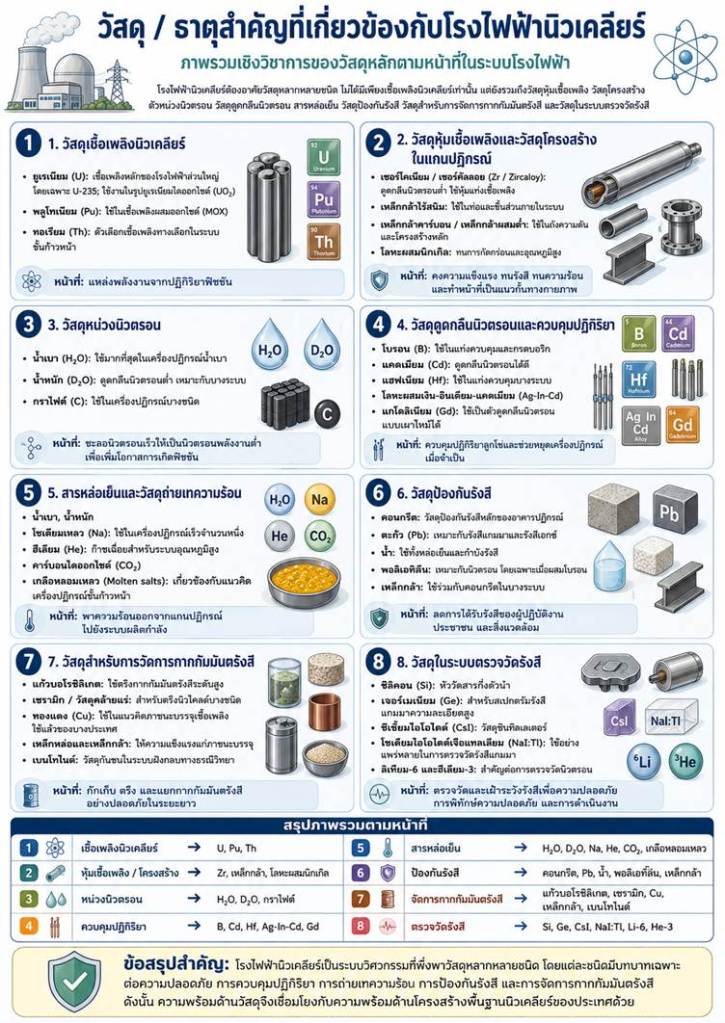
วัสดุและธาตุสำคัญที่เกี่ยวข้องกับ โรงไฟฟ้านิวเคลียร์ สามารถมองได้เป็นหลายกลุ่มตาม “หน้าที่” ในระบบโรงไฟฟ้า ไม่ใช่มีเพียงเชื้อเพลิงนิวเคลียร์เท่านั้น แต่รวมถึงวัสดุโครงสร้าง วัสดุควบคุมนิวตรอน วัสดุป้องกันรังสี วัสดุหล่อเย็น และวัสดุสำหรับการจัดการกากกัมมันตรังสีด้วย
1. วัสดุเชื้อเพลิงนิวเคลียร์
กลุ่มนี้เป็นหัวใจของเครื่องปฏิกรณ์ เพราะเป็นแหล่งกำเนิดพลังงานจากปฏิกิริยาฟิชชัน
- ยูเรเนียม (Uranium, U)
เป็นธาตุเชื้อเพลิงหลักของโรงไฟฟ้านิวเคลียร์ส่วนใหญ่ โดยเฉพาะไอโซโทปยูเรเนียม-235 ซึ่งสามารถเกิดฟิชชันได้ดี ในเชื้อเพลิงจริงมักอยู่ในรูป ยูเรเนียมไดออกไซด์ (UO₂) อัดเป็นเม็ดเชื้อเพลิง แล้วบรรจุในแท่งเชื้อเพลิง
- พลูโทเนียม (Plutonium, Pu)
เกิดขึ้นในเครื่องปฏิกรณ์จากการจับนิวตรอนของยูเรเนียม-238 และสามารถใช้เป็นเชื้อเพลิงในรูปเชื้อเพลิงผสมออกไซด์ หรือ MOX fuel ซึ่งประกอบด้วยยูเรเนียมออกไซด์และพลูโทเนียมออกไซด์
- ทอเรียม (Thorium, Th)
เป็นธาตุที่อาจใช้ในวัฏจักรเชื้อเพลิงทางเลือก โดยทอเรียม-232 สามารถเปลี่ยนเป็นยูเรเนียม-233 ซึ่งเป็นไอโซโทปที่เกิดฟิชชันได้ ทอเรียมมักถูกกล่าวถึงในบริบทของเครื่องปฏิกรณ์รุ่นใหม่หรือระบบเชื้อเพลิงอนาคต
2. วัสดุหุ้มเชื้อเพลิงและวัสดุโครงสร้างในแกนปฏิกรณ์
วัสดุกลุ่มนี้ต้องทนต่ออุณหภูมิสูง การกัดกร่อน รังสีนิวตรอน และความเค้นทางกล
- เซอร์โคเนียม (Zirconium, Zr)
ใช้เป็นวัสดุหุ้มแท่งเชื้อเพลิงในเครื่องปฏิกรณ์น้ำเบา เนื่องจากมีสมบัติสำคัญคือดูดกลืนนิวตรอนต่ำ ทนการกัดกร่อนในน้ำที่อุณหภูมิและความดันสูง และคงความแข็งแรงได้ดี โลหะผสมที่ใช้บ่อยคือ Zircaloy
- เหล็กกล้าไร้สนิม (Stainless steel)
ใช้ในส่วนประกอบหลายชนิด เช่น ท่อ ระบบสนับสนุนภายในถังปฏิกรณ์ เครื่องแลกเปลี่ยนความร้อน และระบบทุติยภูมิ ต้องเลือกเกรดที่ทนการกัดกร่อนและทนต่อสภาวะรังสีได้เหมาะสม
- เหล็กกล้าคาร์บอนและเหล็กกล้าผสมต่ำ
ใช้ในโครงสร้างขนาดใหญ่ เช่น ถังความดันปฏิกรณ์ ท่อ และส่วนรองรับทางวิศวกรรม โดยต้องมีความเหนียว ความแข็งแรง และความสามารถในการรับความดันสูง
- นิกเกิลและโลหะผสมนิกเกิล (Nickel-based alloys)
ใช้ในบริเวณที่ต้องการความทนทานต่อการกัดกร่อน อุณหภูมิสูง และความเค้น เช่น ท่อเครื่องกำเนิดไอน้ำ หรือชิ้นส่วนในระบบหล่อเย็นบางประเภท
3. วัสดุหน่วงนิวตรอน
วัสดุหน่วงนิวตรอนทำหน้าที่ลดพลังงานของนิวตรอนเร็วให้กลายเป็นนิวตรอนพลังงานต่ำ เพื่อเพิ่มโอกาสการเกิดฟิชชันในเชื้อเพลิง
- น้ำธรรมดา หรือน้ำเบา (Light water, H₂O)
ใช้ทั้งเป็นสารหน่วงนิวตรอนและสารหล่อเย็นในเครื่องปฏิกรณ์น้ำเบา ซึ่งเป็นชนิดที่ใช้แพร่หลายที่สุดในโรงไฟฟ้านิวเคลียร์ทั่วโลก
- น้ำหนัก หรือดิวเทอเรียมออกไซด์ (Heavy water, D₂O)
ใช้ในเครื่องปฏิกรณ์บางชนิด เช่น เครื่องปฏิกรณ์แบบน้ำหนัก มีข้อดีคือดูดกลืนนิวตรอนต่ำมาก จึงสามารถใช้เชื้อเพลิงยูเรเนียมธรรมชาติได้ในบางระบบ
- กราไฟต์ (Graphite, C)
ใช้เป็นสารหน่วงนิวตรอนในเครื่องปฏิกรณ์บางชนิด เช่น เครื่องปฏิกรณ์แบบแก๊สหล่อเย็น หรือเครื่องปฏิกรณ์กราไฟต์ ต้องมีความบริสุทธิ์สูง เพราะสิ่งเจือปนบางชนิดอาจดูดกลืนนิวตรอนมากเกินไป
4. วัสดุดูดกลืนนิวตรอนและควบคุมปฏิกิริยา
วัสดุกลุ่มนี้ใช้ในแท่งควบคุม หรือระบบควบคุมปฏิกิริยาลูกโซ่ของเครื่องปฏิกรณ์
- โบรอน (Boron, B)
โดยเฉพาะโบรอน-10 มีความสามารถสูงในการดูดกลืนนิวตรอน ใช้ในรูปกรดบอริกในน้ำหล่อเย็นของเครื่องปฏิกรณ์น้ำอัดความดัน และใช้ในวัสดุควบคุมนิวตรอนบางชนิด
- แคดเมียม (Cadmium, Cd)
มีสมบัติดูดกลืนนิวตรอนดีมาก โดยเฉพาะนิวตรอนพลังงานต่ำ เคยใช้ในแท่งควบคุม แต่มีข้อจำกัดด้านพิษและสมบัติเชิงวัสดุ
- แฮฟเนียม (Hafnium, Hf)
ดูดกลืนนิวตรอนได้ดี ทนการกัดกร่อน และมีความแข็งแรง ใช้ในแท่งควบคุมของเครื่องปฏิกรณ์บางประเภท
- เงิน–อินเดียม–แคดเมียม (Ag-In-Cd alloy)
เป็นโลหะผสมที่ใช้ในแท่งควบคุมของเครื่องปฏิกรณ์น้ำอัดความดันบางแบบ เนื่องจากให้สมบัติการดูดกลืนนิวตรอนที่เหมาะสมในช่วงพลังงานต่าง ๆ
- แกโดลิเนียม (Gadolinium, Gd)
ใช้เป็นสารดูดกลืนนิวตรอนแบบเผาไหม้ได้ หรือ burnable absorber ผสมในเชื้อเพลิง เพื่อช่วยควบคุมความไวต่อการเกิดปฏิกิริยาในช่วงต้นวัฏจักรเชื้อเพลิง
5. วัสดุหล่อเย็นและถ่ายเทความร้อน
วัสดุหล่อเย็นทำหน้าที่พาความร้อนออกจากแกนปฏิกรณ์ไปยังระบบผลิตไอน้ำหรือระบบแปลงพลังงาน
- น้ำเบา (H₂O)
ใช้เป็นสารหล่อเย็นหลักในเครื่องปฏิกรณ์น้ำเบา เช่น PWR และ BWR
- น้ำหนัก (D₂O)
ใช้เป็นสารหล่อเย็นและสารหน่วงนิวตรอนในเครื่องปฏิกรณ์บางระบบ
- โซเดียมเหลว (Liquid sodium, Na)
ใช้ในเครื่องปฏิกรณ์เร็วบางชนิด มีสมบัติถ่ายเทความร้อนดีมาก แต่ทำปฏิกิริยารุนแรงกับน้ำและอากาศ จึงต้องมีมาตรการความปลอดภัยเฉพาะ
- ฮีเลียม (Helium, He)
ใช้เป็นก๊าซหล่อเย็นในเครื่องปฏิกรณ์อุณหภูมิสูงบางชนิด มีข้อดีคือเป็นก๊าซเฉื่อย ไม่เกิดปฏิกิริยาเคมีง่าย และไม่กลายเป็นกัมมันตรังสีอย่างมีนัยสำคัญ
- คาร์บอนไดออกไซด์ (CO₂)
ใช้เป็นก๊าซหล่อเย็นในเครื่องปฏิกรณ์แบบแก๊สหล่อเย็นบางรุ่น
- เกลือหลอมเหลว (Molten salts)
เกี่ยวข้องกับเครื่องปฏิกรณ์เกลือหลอมเหลวและระบบรุ่นใหม่ ใช้ได้ทั้งเป็นสารหล่อเย็น หรือในบางแนวคิดอาจเป็นตัวกลางที่มีเชื้อเพลิงละลายอยู่ด้วย
6. วัสดุป้องกันรังสี
ใช้เพื่อลดระดับรังสีต่อผู้ปฏิบัติงาน ประชาชน และสิ่งแวดล้อม
- คอนกรีต (Concrete)
เป็นวัสดุป้องกันรังสีหลักในอาคารปฏิกรณ์และอาคารกำบังรังสี มีประสิทธิภาพดีต่อรังสีแกมมาและนิวตรอน โดยเฉพาะเมื่อมีความหนาเพียงพอ
- ตะกั่ว (Lead, Pb)
เหมาะสำหรับกำบังรังสีแกมมาและรังสีเอกซ์ เนื่องจากมีเลขอะตอมสูงและความหนาแน่นสูง แต่ไม่เหมาะเป็นหลักสำหรับนิวตรอน
- น้ำ (Water)
ใช้กำบังรังสีและนิวตรอนในหลายบริบท เช่น สระเก็บเชื้อเพลิงใช้แล้ว น้ำช่วยทั้งลดพลังงานนิวตรอนและกำบังรังสีแกมมา
- โพลิเอทิลีน (Polyethylene)
มีไฮโดรเจนสูง จึงเหมาะสำหรับลดพลังงานนิวตรอน มักใช้ร่วมกับโบรอนเพื่อดูดกลืนนิวตรอนหลังจากถูกหน่วงพลังงานแล้ว
- เหล็กกล้า (Steel)
ใช้เป็นวัสดุกำบังและโครงสร้างร่วมกับคอนกรีตในระบบป้องกันรังสีและโครงสร้างนิรภัย
7. วัสดุในระบบกักเก็บและจัดการกากกัมมันตรังสี
กลุ่มนี้สำคัญต่อความปลอดภัยระยะยาวและความพร้อมด้านโครงสร้างพื้นฐานของประเทศ
- แก้วบอโรซิลิเกต (Borosilicate glass)
ใช้ตรึงกากกัมมันตรังสีระดับสูงโดยกระบวนการทำให้เป็นแก้ว หรือ vitrification เพื่อให้กากมีเสถียรภาพทางเคมีและกายภาพ
- เซรามิกและวัสดุคล้ายหินธรรมชาติ
ใช้หรือศึกษาเพื่อกักเก็บนิวไคลด์กัมมันตรังสีบางชนิดในระยะยาว เนื่องจากมีความเสถียรสูง
- ทองแดง (Copper, Cu)
ใช้ในแนวคิดภาชนะบรรจุกากเชื้อเพลิงใช้แล้วของบางประเทศ เนื่องจากทนการกัดกร่อนในสภาพธรณีวิทยาบางแบบได้ดี
- เหล็กหล่อและเหล็กกล้า
ใช้เป็นโครงสร้างภาชนะบรรจุเชื้อเพลิงใช้แล้วหรือกากกัมมันตรังสี เพื่อให้ความแข็งแรงทางกล
- เบนโทไนต์ (Bentonite clay)
ใช้เป็นวัสดุกันชนทางวิศวกรรมในระบบฝังกลบทางธรณีวิทยา มีสมบัติพองตัวได้ ช่วยลดการไหลผ่านของน้ำและชะลอการเคลื่อนที่ของนิวไคลด์กัมมันตรังสี
8. ธาตุและวัสดุสำคัญในระบบตรวจวัดรังสี
ระบบตรวจวัดรังสีเป็นส่วนสำคัญของความปลอดภัย การป้องกันอันตรายจากรังสี การเฝ้าระวังสิ่งแวดล้อม และการตรวจพิสูจน์วัสดุนิวเคลียร์
- ซิลิคอน (Silicon, Si)
ใช้ในหัววัดรังสีแบบสารกึ่งตัวนำ เหมาะกับการตรวจวัดอนุภาคมีประจุและรังสีบางชนิด
- เจอร์เมเนียม (Germanium, Ge)
ใช้ในหัววัดรังสีแกมมาความละเอียดสูง เช่น HPGe detector สำหรับการวิเคราะห์สเปกตรัมพลังงานรังสีแกมมา
- ซีเซียมไอโอไดด์ (Cesium iodide, CsI)
เป็นวัสดุซินทิลเลเตอร์ ใช้ตรวจวัดรังสีแกมมา รังสีเอกซ์ และอนุภาคบางชนิด มักใช้ร่วมกับอุปกรณ์รับแสง
- โซเดียมไอโอไดด์เจือแทลเลียม (NaI:Tl)
เป็นซินทิลเลเตอร์ที่ใช้แพร่หลายสำหรับการตรวจวัดรังสีแกมมา เนื่องจากให้แสงสูงและใช้งานง่าย
- ลิเทียม-6 และฮีเลียม-3
เกี่ยวข้องกับการตรวจวัดนิวตรอน โดยอาศัยปฏิกิริยานิวเคลียร์กับนิวตรอนพลังงานต่ำ
สรุปเชิงระบบ
วัสดุสำคัญในโรงไฟฟ้านิวเคลียร์สรุปได้ดังตารางนี้
| กลุ่มหน้าที่ | วัสดุ / ธาตุสำคัญ |
| เชื้อเพลิงนิวเคลียร์ | U, Pu, Th, UO₂, MOX |
| หุ้มเชื้อเพลิง | Zr, Zircaloy |
| โครงสร้างและถังปฏิกรณ์ | เหล็กกล้า, stainless steel, nickel alloys |
| หน่วงนิวตรอน | H₂O, D₂O, graphite |
| ควบคุมนิวตรอน | B, Cd, Hf, Ag-In-Cd, Gd |
| หล่อเย็น | H₂O, D₂O, Na, He, CO₂, molten salts |
| ป้องกันรังสี | Concrete, Pb, water, polyethylene, steel |
| กากกัมมันตรังสี | Borosilicate glass, ceramic, copper, steel, bentonite |
| ตรวจวัดรังสี | Si, Ge, CsI, NaI:Tl, Li-6, He-3 |
กล่าวโดยสรุป โรงไฟฟ้านิวเคลียร์เป็นระบบวัสดุขั้นสูงที่ต้องอาศัยการเลือกวัสดุอย่างรอบคอบตามหน้าที่เฉพาะ ทั้งด้านนิวตรอน ความร้อน ความดัน การกัดกร่อน รังสี ความปลอดภัย และการจัดการระยะยาว ดังนั้น “ความพร้อมด้านวัสดุ” จึงไม่ใช่เพียงเรื่องทางวิศวกรรมของโรงไฟฟ้าเท่านั้น แต่ยังเชื่อมโยงกับความพร้อมของประเทศด้านเชื้อเพลิง กฎหมาย การกำกับดูแล ความปลอดภัย การจัดการกากกัมมันตรังสี และบุคลากรทางเทคนิคด้วย
Important Materials and Elements Related to Nuclear Power Plants
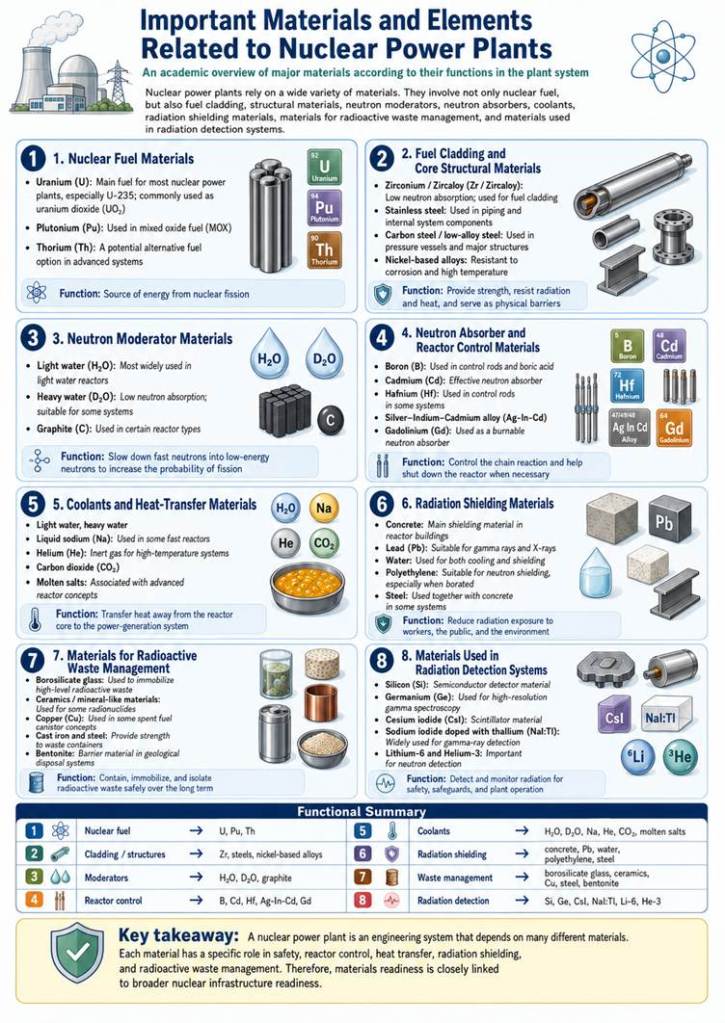
Materials and elements associated with nuclear power plants should be understood as part of an integrated engineering system. They are not limited to nuclear fuel, but also include fuel cladding, reactor structural materials, neutron moderators, neutron absorbers, coolants, radiation shielding materials, waste-form materials, and materials used in radiation detection and monitoring systems.
Each material is selected according to a specific function: sustaining nuclear fission, controlling neutron behavior, transferring heat, maintaining structural integrity, resisting corrosion and irradiation damage, reducing radiation exposure, and ensuring long-term safety in radioactive waste management. Therefore, materials in nuclear power plants are closely linked not only to reactor technology, but also to nuclear safety, radiation protection, nuclear security, safeguards, environmental protection, waste management, and national infrastructure readiness.
1. Nuclear Fuel Materials
Nuclear fuel materials are the primary source of energy in a nuclear reactor. Energy is released through nuclear fission, in which heavy atomic nuclei split into smaller fragments, producing heat and additional neutrons.
Uranium (U)
Uranium is the most widely used nuclear fuel element in commercial nuclear power plants. The most important fissile isotope is uranium-235, which can sustain a nuclear chain reaction. However, natural uranium contains only a small fraction of uranium-235, while most of it is uranium-238. For many commercial light water reactors, uranium fuel is enriched to increase the proportion of uranium-235.
In most commercial reactors, uranium is used in the form of uranium dioxide (UO₂). This ceramic fuel has a high melting point, good chemical stability, and suitable behavior under irradiation. UO₂ is manufactured into small cylindrical fuel pellets, which are stacked inside metal cladding tubes to form fuel rods.
Plutonium (Pu)
Plutonium is produced inside nuclear reactors when uranium-238 captures neutrons and is converted through nuclear reactions into plutonium isotopes. Plutonium-239 is fissile and can contribute to energy production in the reactor.
Plutonium may also be used in mixed oxide fuel, commonly known as MOX fuel, which contains a mixture of uranium oxide and plutonium oxide. The use of plutonium in nuclear fuel is closely related to fuel-cycle strategy, safeguards, nuclear security, and international non-proliferation considerations.
Thorium (Th)
Thorium is a potential alternative nuclear fuel material. The isotope thorium-232 is not itself fissile, but it is fertile, meaning that it can absorb neutrons and eventually be converted into uranium-233, which is fissile.
Thorium-based fuel cycles are often discussed in relation to advanced reactor systems and long-term fuel-cycle options. However, thorium use requires specific reactor designs, fuel fabrication technologies, reprocessing considerations, and regulatory readiness.
2. Fuel Cladding and Core Structural Materials
Fuel cladding and core structural materials form the first physical barrier between radioactive fuel and the reactor coolant. These materials must withstand high temperature, high pressure, corrosion, mechanical stress, and intense neutron irradiation.
Zirconium and Zirconium Alloys
Zirconium is one of the most important materials in nuclear reactors, especially in light water reactors. It is used primarily as fuel cladding because it has a low neutron absorption cross-section, allowing neutrons to remain available for sustaining the chain reaction.
Zirconium alloys, such as Zircaloy, also provide good corrosion resistance in high-temperature water and maintain suitable mechanical strength during reactor operation. Because fuel cladding is a key safety barrier, its material behavior under normal operation, accident conditions, and long-term irradiation is highly important.
Stainless Steel
Stainless steel is used in many reactor and plant components, including piping systems, internal structures, heat exchangers, and auxiliary systems. It is valued for its corrosion resistance, mechanical strength, and manufacturability.
Different grades of stainless steel may be selected depending on the operating environment, temperature, radiation field, and chemical conditions of the coolant system.
Carbon Steel and Low-Alloy Steel
Carbon steel and low-alloy steel are used in large structural components such as the reactor pressure vessel, piping, support structures, and containment-related systems. These materials must provide high strength, toughness, weldability, and resistance to pressure loading.
For reactor pressure vessels, resistance to neutron irradiation embrittlement is particularly important because changes in material toughness can affect long-term safety margins.
Nickel-Based Alloys
Nickel-based alloys are used in components that require high resistance to corrosion, stress corrosion cracking, and elevated-temperature operation. They are commonly found in steam generator tubes and other components exposed to demanding chemical and thermal conditions.
3. Neutron Moderator Materials
Neutron moderators are materials used to slow down fast neutrons produced by fission. Slower, or thermal, neutrons are more effective at causing fission in uranium-235 and some other fissile isotopes.
Light Water (H₂O)
Light water is the most widely used neutron moderator in commercial nuclear power plants. It is used in both pressurized water reactors and boiling water reactors. In these systems, light water often serves two functions: it acts as both the moderator and the coolant.
This dual function makes light water reactors technically mature and widely deployed. However, the use of light water also influences fuel enrichment requirements because ordinary hydrogen absorbs some neutrons.
Heavy Water (D₂O)
Heavy water contains deuterium instead of ordinary hydrogen. It has a much lower neutron absorption probability than light water, making it an excellent moderator. Because of this property, some heavy water reactor designs can use natural uranium or very low-enriched uranium as fuel.
However, heavy water production, handling, and inventory control require specific infrastructure and safeguards considerations.
Graphite (C)
Graphite is used as a moderator in certain reactor designs, including some gas-cooled reactors and graphite-moderated systems. Reactor-grade graphite must be highly pure because impurities can absorb neutrons and reduce reactor performance.
Graphite also introduces specific material issues, including irradiation-induced dimensional changes, oxidation behavior, and long-term waste management considerations.
4. Neutron Absorber and Control Materials
Neutron absorber materials are used to regulate the nuclear chain reaction. They are commonly used in control rods, shutdown systems, burnable absorbers, and chemical shim systems.
Boron (B)
Boron, especially the isotope boron-10, is an effective neutron absorber. In pressurized water reactors, boron is often used as boric acid dissolved in the reactor coolant to help control reactivity.
Boron is also used in solid absorber materials and in borated shielding materials. Its role is important for both reactor control and radiation protection.
Cadmium (Cd)
Cadmium has a high neutron absorption capability, especially for thermal neutrons. It has historically been used in control rods and neutron shielding applications.
However, its toxicity, melting behavior, and material limitations make it less favorable in some modern applications compared with other absorber materials.
Hafnium (Hf)
Hafnium is a strong neutron absorber with good corrosion resistance and mechanical strength. It is used in control rods in certain reactor systems, particularly where long service life and material robustness are required.
Silver–Indium–Cadmium Alloy
Silver–indium–cadmium alloy is used in control rods in some pressurized water reactors. The combination of these elements provides effective neutron absorption over a range of neutron energies.
This alloy is important because reactor control requires materials that can perform reliably under high radiation, high temperature, and corrosive coolant environments.
Gadolinium (Gd)
Gadolinium has very high neutron absorption capability and is often used as a burnable absorber in nuclear fuel. It helps compensate for excess reactivity at the beginning of a fuel cycle and gradually burns out as reactor operation proceeds.
This allows better control of the power distribution and reactivity over the fuel cycle.
5. Coolant and Heat-Transfer Materials
Coolants remove heat generated in the reactor core and transfer it to the power conversion system. The choice of coolant strongly affects reactor design, safety characteristics, operating temperature, pressure, and accident behavior.
Light Water
Light water is the dominant coolant in commercial nuclear power plants. In pressurized water reactors, it transfers heat from the reactor core to the steam generator. In boiling water reactors, it boils directly in the reactor vessel to produce steam.
Light water has good heat-transfer properties, but it requires high-pressure operation in many reactor designs.
Heavy Water
Heavy water may serve as both coolant and moderator in some reactor types. Its low neutron absorption makes it suitable for designs using natural uranium, but its cost and safeguards relevance require careful management.
Liquid Sodium
Liquid sodium is used as a coolant in some fast reactors. It has excellent thermal conductivity and can operate at high temperatures under relatively low pressure.
However, sodium reacts chemically with water and air. Therefore, sodium-cooled reactor systems require specialized design features, leak detection systems, and fire prevention measures.
Helium
Helium is used as a coolant in high-temperature gas-cooled reactors. It is chemically inert, does not easily become radioactive, and can support high-temperature operation.
Its use is attractive for advanced reactor concepts, including systems intended for electricity generation, industrial heat, and hydrogen production.
Carbon Dioxide
Carbon dioxide has been used as a coolant in some gas-cooled reactor designs. It is chemically more active than helium at high temperatures but has been used successfully in several reactor systems.
Molten Salts
Molten salts are associated with advanced reactor concepts, especially molten salt reactors. They may be used as coolants, or in some designs, nuclear fuel may be dissolved directly in the molten salt.
Molten salt systems introduce special requirements for chemistry control, corrosion resistance, materials qualification, and regulatory evaluation.
6. Radiation Shielding Materials
Radiation shielding materials reduce radiation exposure to workers, the public, and the environment. Shielding design depends on the type of radiation, its energy, and the operating conditions.
Concrete
Concrete is one of the most important shielding materials in nuclear power plants. It is used in reactor buildings, containment structures, biological shielding, spent fuel storage areas, and other controlled areas.
Concrete is effective because it can attenuate gamma radiation and, depending on composition, also help reduce neutron radiation. Heavy concrete or specially designed concrete may be used where higher shielding performance is required.
Lead (Pb)
Lead is effective for shielding gamma rays and X-rays because of its high density and high atomic number. It is often used in localized shielding, containers, and laboratory radiation protection.
However, lead is not ideal as a primary neutron shielding material and must be handled carefully due to toxicity concerns.
Water
Water is an important shielding material in spent fuel pools and reactor systems. It can attenuate gamma radiation and slow down neutrons. In spent fuel pools, water also provides cooling, shielding, and visual access for fuel handling operations.
Polyethylene
Polyethylene contains a high concentration of hydrogen, making it effective for slowing down fast neutrons. Borated polyethylene combines neutron moderation with neutron absorption, making it useful in neutron shielding applications.
Steel
Steel is used as both a structural and shielding material. It is often combined with concrete, water, or other shielding materials to provide mechanical strength and radiation attenuation.
7. Materials for Radioactive Waste Management
Materials used in radioactive waste management are essential for long-term safety. Their purpose is to immobilize radionuclides, maintain containment, reduce migration, and provide engineered barriers.
Borosilicate Glass
Borosilicate glass is widely used to immobilize high-level radioactive waste through vitrification. In this process, radioactive waste is incorporated into a stable glass matrix.
This waste form is designed to resist chemical degradation and retain radionuclides over long periods under disposal conditions.
Ceramics and Mineral-Like Materials
Ceramic and mineral-like materials are used or studied for immobilizing specific radionuclides. They are attractive because some naturally occurring minerals have retained radioactive elements over geological timescales.
These materials may be considered for special waste streams or advanced waste-form development.
Copper (Cu)
Copper is used in some geological disposal concepts for spent nuclear fuel canisters. It is selected because of its corrosion resistance under specific underground chemical conditions.
The use of copper depends strongly on national disposal strategy, geological environment, and long-term safety assessment.
Cast Iron and Steel
Cast iron and steel provide mechanical strength for spent fuel containers and radioactive waste packages. In some disposal concepts, steel or cast iron may be used together with corrosion-resistant outer barriers.
Bentonite Clay
Bentonite clay is used as an engineered barrier in geological disposal systems. It can swell when hydrated, reduce water flow, and retard radionuclide migration.
Its function is not only mechanical but also hydrogeological and geochemical, making it important in long-term waste isolation.
8. Materials Used in Radiation Detection Systems
Radiation detection systems are essential for operation, safety, radiation protection, environmental monitoring, safeguards, and emergency preparedness. Materials used in detectors convert radiation interactions into measurable electrical or optical signals.
Silicon (Si)
Silicon is used in semiconductor radiation detectors. It is suitable for detecting charged particles, X-rays, and some gamma-ray applications. Silicon detectors are important in radiation monitoring, instrumentation, and nuclear measurements.
Germanium (Ge)
High-purity germanium detectors are widely used for high-resolution gamma-ray spectroscopy. Germanium provides excellent energy resolution, making it valuable for radionuclide identification and nuclear material analysis.
Cesium Iodide (CsI)
Cesium iodide is a scintillator material used for detecting gamma rays, X-rays, and charged particles. It produces light when radiation deposits energy in the crystal and is often coupled with photodetectors.
Sodium Iodide Doped with Thallium (NaI:Tl)
NaI:Tl is one of the most widely used scintillation materials for gamma-ray detection. It has high light output and is relatively easy to use, although its energy resolution is lower than that of high-purity germanium detectors.
Lithium-6 and Helium-3
Lithium-6 and helium-3 are important materials for neutron detection. They interact with thermal neutrons through nuclear reactions that produce charged particles, which can then be measured by detector systems.
These materials are important in reactor monitoring, safeguards, security screening, and neutron dosimetry.
Summary Table
| Functional Group | Important Materials / Elements | Main Function |
| Nuclear fuel | U, Pu, Th, UO₂, MOX fuel | Source of fission energy |
| Fuel cladding | Zr, Zircaloy | First barrier retaining fuel and fission products |
| Reactor structures | Carbon steel, low-alloy steel, stainless steel, nickel-based alloys | Mechanical integrity, pressure boundary, structural support |
| Neutron moderators | H₂O, D₂O, graphite | Slow down neutrons to sustain fission |
| Neutron absorbers and control materials | B, Cd, Hf, Ag-In-Cd, Gd | Control reactivity and shut down the reactor |
| Coolants | H₂O, D₂O, liquid Na, He, CO₂, molten salts | Remove heat from the reactor core |
| Radiation shielding | Concrete, Pb, water, polyethylene, steel | Reduce radiation exposure |
| Radioactive waste management | Borosilicate glass, ceramics, copper, steel, bentonite | Immobilize, contain, and isolate radioactive waste |
| Radiation detection systems | Si, Ge, CsI, NaI:Tl, Li-6, He-3 | Detect and measure ionizing radiation |
Concluding Perspective
A nuclear power plant is a complex materials-based engineering system. The safe and reliable operation of the plant depends on the correct selection, qualification, fabrication, inspection, and long-term performance of many different materials.
Fuel materials must sustain controlled fission. Cladding and structural materials must maintain integrity under irradiation, corrosion, pressure, and temperature. Moderator and absorber materials must control neutron behavior. Coolants must remove heat efficiently. Shielding materials must protect workers and the public. Waste-management materials must support long-term containment and isolation. Detector materials must provide the measurement capability needed for safety, safeguards, radiation protection, environmental monitoring, and emergency response.
Therefore, the topic of materials in nuclear power plants is not only a matter of reactor engineering. It is also connected to broader national readiness, including fuel-cycle policy, regulatory capability, industrial involvement, quality assurance, radiation protection, radioactive waste management, nuclear security, safeguards, and human resource development. In this sense, materials readiness is one important foundation of overall nuclear infrastructure readiness.


ใส่ความเห็น