การผลิตไอน้ำเพื่อกระบวนการอุตสาหกรรมในโรงงานเคมี และบทบาทของ SMR ในฐานะทางเลือกคาร์บอนต่ำ (Industrial Process Steam Supply in Chemical Plants and the Role of SMRs as a Low-Carbon Alternative)
(English version below)
1. บทนำ
โรงงานเคมีเป็นหนึ่งในกลุ่มอุตสาหกรรมที่ต้องพึ่งพา ไอน้ำเพื่อกระบวนการอุตสาหกรรม (industrial process steam) หรือเรียกสั้น ๆ ว่า ไอน้ำกระบวนการอุตสาหกรรม อย่างต่อเนื่อง เนื่องจากไอน้ำถูกใช้เป็นตัวกลางถ่ายเทความร้อนในหลายขั้นตอนของการผลิต เช่น การให้ความร้อนแก่สารตั้งต้น การกลั่น การระเหย การอบแห้ง การควบคุมอุณหภูมิของเครื่องปฏิกรณ์เคมี และการแลกเปลี่ยนความร้อนในระบบต่าง ๆ ภายในโรงงาน ไอน้ำจึงไม่ได้เป็นเพียง “พลังงานเสริม” แต่เป็นองค์ประกอบพื้นฐานของระบบการผลิตที่มีผลโดยตรงต่อความต่อเนื่อง ความปลอดภัย ประสิทธิภาพ และต้นทุนของโรงงานเคมี
ในปัจจุบัน การผลิตไอน้ำในโรงงานเคมียังอาศัยหลายวิธีร่วมกัน ตั้งแต่หม้อไอน้ำเชื้อเพลิงฟอสซิล ระบบผลิตร่วมไฟฟ้าและความร้อน หม้อไอน้ำไฟฟ้า การใช้ชีวมวล การกู้คืนความร้อนทิ้ง ไปจนถึงแนวคิดใหม่ในการใช้เครื่องปฏิกรณ์นิวเคลียร์ขนาดเล็กแบบโมดูล หรือ SMR เพื่อผลิตความร้อนและไอน้ำที่ปลดปล่อยคาร์บอนต่ำสำหรับอุตสาหกรรม ทั้งนี้ทบวงการพลังงานปรมาณูระหว่างประเทศได้ระบุว่า ภาคอุตสาหกรรมเป็นภาคส่วนที่ใช้พลังงานมากที่สุด โดยมีสัดส่วนเกือบ 40% ของการใช้พลังงานขั้นสุดท้ายทั่วโลก จึงทำให้การลดคาร์บอนจากความร้อนอุตสาหกรรมเป็นโจทย์สำคัญของระบบพลังงานสมัยใหม่
2. ความสำคัญของไอน้ำกระบวนการในโรงงานเคมี
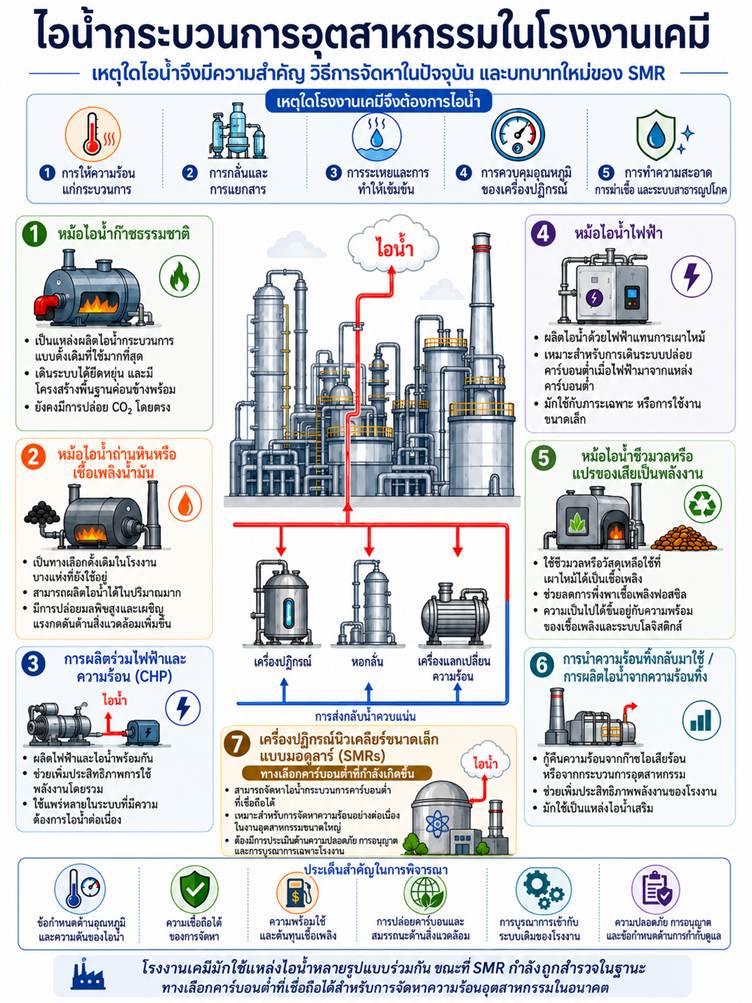
ไอน้ำกระบวนการมีบทบาทสำคัญเพราะสามารถถ่ายเทความร้อนได้อย่างมีประสิทธิภาพ ควบคุมอุณหภูมิได้ค่อนข้างดี และสามารถกระจายผ่านระบบท่อไปยังหลายส่วนของโรงงานได้พร้อมกัน ในโรงงานเคมี ไอน้ำอาจถูกส่งไปยังเครื่องปฏิกรณ์ หอกลั่น เครื่องแลกเปลี่ยนความร้อน เครื่องอบแห้ง หรือระบบทำความสะอาดและฆ่าเชื้อ โดยหลังจากไอน้ำถ่ายเทความร้อนแล้ว ไอน้ำจะควบแน่นเป็นน้ำ และมักถูกส่งกลับเข้าสู่ระบบในรูปของ น้ำควบแน่น เพื่อลดการสูญเสียน้ำและพลังงาน
ความต้องการไอน้ำของโรงงานเคมีมีความหลากหลายมาก ทั้งด้านอุณหภูมิ ความดัน อัตราการไหล ความต่อเนื่องของการใช้งาน และข้อกำหนดด้านความสะอาดของไอน้ำ โรงงานบางประเภทต้องการไอน้ำความดันต่ำหรือปานกลางสำหรับการให้ความร้อนทั่วไป ขณะที่บางกระบวนการอาจต้องการไอน้ำอุณหภูมิสูง ความดันสูง หรือความร้อนอย่างต่อเนื่องตลอด 24 ชั่วโมง ดังนั้น การเลือกแหล่งผลิตไอน้ำจึงต้องพิจารณาทั้งด้านเทคนิค เศรษฐศาสตร์ สิ่งแวดล้อม ความมั่นคงของพลังงาน และการบูรณาการกับระบบเดิมของโรงงาน
3. วิธีการปัจจุบันในการผลิตไอน้ำกระบวนการ
3.1 หม้อไอน้ำก๊าซธรรมชาติ (Natural Gas Boilers)
หม้อไอน้ำก๊าซธรรมชาติเป็นแหล่งผลิตไอน้ำที่ใช้แพร่หลายในโรงงานอุตสาหกรรม เนื่องจากเทคโนโลยีมีความพัฒนาเต็มที่และมีประสบการณ์การใช้งานจริงมานาน โครงสร้างพื้นฐานด้านเชื้อเพลิงมีอยู่ค่อนข้างมาก และสามารถเดินระบบได้ยืดหยุ่นเมื่อเทียบกับเชื้อเพลิงบางประเภท ก๊าซธรรมชาติมีการเผาไหม้สะอาดกว่าถ่านหินหรือน้ำมันในหลายด้าน แต่ยังคงเป็นเชื้อเพลิงฟอสซิลที่ปล่อยคาร์บอนไดออกไซด์โดยตรง
ข้อดีของระบบนี้คือควบคุมกำลังผลิตไอน้ำได้ค่อนข้างรวดเร็ว เหมาะกับโรงงานที่มีความต้องการไอน้ำเปลี่ยนแปลงตามรอบการผลิต อย่างไรก็ตาม ในบริบทของการลดการปล่อยก๊าซเรือนกระจก หม้อไอน้ำก๊าซธรรมชาติยังคงมีข้อจำกัด เพราะการปล่อย CO₂ เกิดขึ้นโดยตรงจากการเผาไหม้เชื้อเพลิง
3.2 หม้อไอน้ำถ่านหินหรือเชื้อเพลิงน้ำมัน (Coal or Oil-Fired Boilers)
หม้อไอน้ำถ่านหินและน้ำมันเคยเป็นระบบหลักในโรงงานอุตสาหกรรมหลายแห่ง โดยเฉพาะโรงงานที่ต้องการไอน้ำในปริมาณมากและมีต้นทุนเชื้อเพลิงที่แข่งขันได้ในบางช่วงเวลา ระบบเหล่านี้สามารถให้กำลังความร้อนสูงและรองรับโหลดขนาดใหญ่ได้ดี
อย่างไรก็ตาม ข้อจำกัดสำคัญคือการปล่อยมลพิษและก๊าซเรือนกระจกสูงกว่าเชื้อเพลิงทางเลือกอื่น รวมถึงมีประเด็นด้านฝุ่นละออง ซัลเฟอร์ออกไซด์ ไนโตรเจนออกไซด์ และของเสียจากการเผาไหม้ จึงทำให้โรงงานที่ใช้ระบบประเภทนี้เผชิญแรงกดดันมากขึ้นจากข้อกำหนดด้านสิ่งแวดล้อม ต้นทุนการควบคุมมลพิษ และนโยบายลดคาร์บอน
3.3 การผลิตร่วมไฟฟ้าและความร้อน (Cogeneration / Combined Heat and Power)
ระบบการผลิตร่วมไฟฟ้าและความร้อน หรือ Combined Heat and Power: CHP เป็นวิธีที่ผลิตไฟฟ้าและไอน้ำพร้อมกันจากแหล่งพลังงานเดียว ระบบนี้ช่วยเพิ่มประสิทธิภาพการใช้พลังงานโดยรวม เพราะความร้อนที่เหลือจากการผลิตไฟฟ้าสามารถนำมาใช้ผลิตไอน้ำสำหรับกระบวนการอุตสาหกรรมได้ แทนที่จะปล่อยทิ้งไปโดยไม่เกิดประโยชน์ ซึ่งระบบ CHP เหมาะกับโรงงานที่มีความต้องการทั้งไฟฟ้าและไอน้ำอย่างต่อเนื่อง เช่น โรงงานเคมี โรงกลั่นน้ำมัน โรงงานปิโตรเคมี และโรงงานกระดาษ จุดแข็งของระบบนี้คือช่วยลดการใช้พลังงานรวมและเพิ่มความมั่นคงของระบบพลังงานภายในโรงงาน แต่ประสิทธิผลของระบบ CHP ยังขึ้นอยู่กับรูปแบบโหลดไฟฟ้าและโหลดความร้อน หากความต้องการไฟฟ้าและไอน้ำไม่สัมพันธ์กัน การออกแบบและการเดินระบบอาจซับซ้อนขึ้น
3.4 หม้อไอน้ำไฟฟ้า (Electric Boilers)
หม้อไอน้ำไฟฟ้าเป็นวิธีผลิตไอน้ำโดยใช้พลังงานไฟฟ้าแทนการเผาไหม้เชื้อเพลิง จุดเด่นคือไม่มีการปล่อยมลพิษโดยตรง ณ จุดใช้งาน และสามารถทำงานร่วมกับไฟฟ้าคาร์บอนต่ำได้ เช่น ไฟฟ้าจากพลังงานหมุนเวียนหรือไฟฟ้าจากนิวเคลียร์ องค์การพลังงานระหว่างประเทศชี้ว่าการใช้ไฟฟ้าเพื่อผลิตความร้อนอุตสาหกรรม โดยเฉพาะความร้อนอุณหภูมิต่ำถึงปานกลาง เป็นหนึ่งในแนวทางสำคัญของการลดคาร์บอนในภาคอุตสาหกรรม แต่อย่างไรก็ตาม หม้อไอน้ำไฟฟ้าจะมีความเหมาะสมมากน้อยเพียงใดขึ้นอยู่กับราคาไฟฟ้า ความพร้อมของโครงข่ายไฟฟ้า กำลังไฟฟ้าที่โรงงานสามารถรับได้ และแหล่งที่มาของไฟฟ้า หากไฟฟ้ายังมาจากเชื้อเพลิงฟอสซิลในสัดส่วนสูง ผลประโยชน์ด้านคาร์บอนโดยรวมอาจลดลง
3.5 หม้อไอน้ำชีวมวลหรือการแปรของเสียเป็นพลังงาน (Biomass or Waste-to-Energy Boilers)
หม้อไอน้ำชีวมวลและระบบแปรของเสียเป็นพลังงานใช้เชื้อเพลิงชีวภาพ เศษวัสดุเกษตร เศษไม้ หรือของเสียอุตสาหกรรมที่เผาไหม้ได้ในการผลิตความร้อนและไอน้ำ แนวทางนี้สามารถช่วยลดการพึ่งพาเชื้อเพลิงฟอสซิล และในบางกรณีอาจช่วยจัดการของเสียที่มีอยู่ในพื้นที่ แต่อย่างไรก็ตาม ความเป็นไปได้ของระบบนี้ขึ้นอยู่กับความมั่นคงของเชื้อเพลิง ปริมาณวัตถุดิบ คุณภาพ ความชื้น โลจิสติกส์ พื้นที่จัดเก็บ และระบบควบคุมมลพิษ หากเชื้อเพลิงมีคุณภาพไม่สม่ำเสมอหรือมีต้นทุนขนส่งสูง ระบบอาจไม่คุ้มค่าหรือมีความซับซ้อนในการเดินระบบ
3.6 การนำความร้อนทิ้งกลับมาใช้ (Waste Heat Recovery / Heat Recovery Steam Generation)
การกู้คืนความร้อนทิ้งเป็นแนวทางที่สำคัญมากในการเพิ่มประสิทธิภาพพลังงานของโรงงานเคมี ความร้อนทิ้งอาจมาจากก๊าซไอเสียร้อน กระบวนการเผาไหม้ เตาอุตสาหกรรม เครื่องอัดก๊าซ หรือกระบวนการผลิตที่ปล่อยความร้อนออกมาโดยไม่ได้ใช้ประโยชน์ การติดตั้งระบบกู้คืนความร้อน เช่น Heat Recovery Steam Generator หรือเครื่องแลกเปลี่ยนความร้อน สามารถนำพลังงานส่วนนี้กลับมาผลิตไอน้ำหรืออุ่นน้ำป้อนหม้อไอน้ำได้ ซึ่งแนวทางนี้มักเป็นมาตรการที่ควรพิจารณาก่อนการเพิ่มแหล่งพลังงานใหม่ เพราะช่วยลดความต้องการเชื้อเพลิงโดยรวม ลดต้นทุน และลดการปล่อยคาร์บอนจากระบบเดิม การศึกษาด้านระบบไอน้ำอุตสาหกรรมยังชี้ให้เห็นว่าการปรับปรุงประสิทธิภาพของระบบไอน้ำสามารถให้ผลประหยัดพลังงานได้อย่างมีนัยสำคัญในหลายบริบท
4. เครื่องปฏิกรณ์นิวเคลียร์ขนาดเล็กแบบโมดูลในฐานะทางเลือกคาร์บอนต่ำสำหรับไอน้ำอุตสาหกรรม
เครื่องปฏิกรณ์นิวเคลียร์ขนาดเล็กแบบโมดูล หรือ Small Modular Reactors: SMRs เป็นแนวคิดเครื่องปฏิกรณ์ที่มีขนาดเล็กกว่าโรงไฟฟ้านิวเคลียร์ขนาดใหญ่แบบดั้งเดิม โดยทั่วไปออกแบบให้มีกำลังผลิตไฟฟ้าไม่เกินประมาณ 300 เมกะวัตต์ไฟฟ้า และเน้นคุณลักษณะด้านการผลิตเป็นแบบโมดูล การออกแบบมาตรฐาน และการใช้งานที่ยืดหยุ่นมากขึ้น ซึ่งได้มีการนำเสนอว่า เครื่องปฏิกรณ์ SMR สามารถพิจารณาได้ไม่เพียงแต่สำหรับการผลิตไฟฟ้า แต่ยังรวมถึงการผลิตความร้อนสำหรับกระบวนการอุตสาหกรรม การผลิตไฮโดรเจน และการผลิตน้ำจืดจากน้ำทะเล
ในบริบทของโรงงานเคมี เครื่องปฏิกรณ์ SMR อาจมีบทบาทเป็นแหล่งความร้อนคาร์บอนต่ำสำหรับผลิตไอน้ำกระบวนการ โดยเฉพาะโรงงานที่ต้องการความร้อนอย่างต่อเนื่อง มีภาระความร้อนขนาดใหญ่ และต้องการลดการพึ่งพาเชื้อเพลิงฟอสซิล จุดเด่นเชิงแนวคิดคือ เครื่องปฏิกรณ์ SMR สามารถผลิตความร้อนและไฟฟ้าได้อย่างต่อเนื่อง มีความหนาแน่นพลังงานสูง และมีศักยภาพในการเชื่อมโยงกับระบบอุตสาหกรรมที่ต้องการความน่าเชื่อถือสูง
แต่อย่างไรก็ตาม การใช้เครื่องปฏิกรณ์ SMR สำหรับผลิตไอน้ำในโรงงานเคมีไม่ควรถูกนำเสนอว่าเป็นคำตอบสำเร็จรูป เพราะต้องพิจารณาประเด็นสำคัญหลายด้าน ได้แก่ ความเหมาะสมของอุณหภูมิและความดันไอน้ำที่ต้องการ ระยะห่างระหว่างแหล่งความร้อนนิวเคลียร์กับพื้นที่กระบวนการเคมี การออกแบบระบบแลกเปลี่ยนความร้อน การแยกขอบเขตระหว่างระบบนิวเคลียร์และระบบเคมี ความปลอดภัย การอนุญาต การกำกับดูแล แผนฉุกเฉิน การยอมรับของผู้มีส่วนได้ส่วนเสีย และความคุ้มค่าทางเศรษฐศาสตร์ ซึ่งได้มีงานวิเคราะห์เชิงเทคนิคและเศรษฐศาสตร์บางส่วนยังชี้ว่า เครื่องปฏิกรณ์ SMR สำหรับความร้อนอุตสาหกรรมมีศักยภาพในแง่มุมคาร์บอนต่ำ แต่ความคุ้มค่าจะขึ้นอยู่กับราคาก๊าซ ต้นทุนเทคโนโลยี รูปแบบการใช้งาน และเงื่อนไขเฉพาะของพื้นที่
5. ประเด็นสำคัญในการเลือกวิธีจัดหาไอน้ำ
การเลือกวิธีจัดหาไอน้ำสำหรับโรงงานเคมีควรพิจารณาอย่างเป็นระบบ ไม่ใช่เลือกจากต้นทุนเชื้อเพลิงเพียงอย่างเดียว ประเด็นสำคัญประกอบด้วย
- ประการที่ 1 คือข้อกำหนดด้านอุณหภูมิและความดันของไอน้ำ กระบวนการเคมีแต่ละประเภทต้องการไอน้ำที่มีคุณสมบัติแตกต่างกัน หากแหล่งผลิตไอน้ำไม่สามารถให้คุณภาพไอน้ำที่เหมาะสมได้ อาจกระทบต่อประสิทธิภาพและความปลอดภัยของกระบวนการ
- ประการที่ 2 คือความเชื่อถือได้ของการจัดหา โรงงานเคมีจำนวนมากไม่สามารถหยุดการจ่ายไอน้ำได้โดยไม่ส่งผลต่อการผลิต ดังนั้น ระบบไอน้ำต้องมีความมั่นคง มีระบบสำรอง และมีแผนบำรุงรักษาที่ไม่กระทบต่อการผลิตหลัก
- ประการที่ 3 คือความพร้อมใช้และต้นทุนเชื้อเพลิง หม้อไอน้ำก๊าซธรรมชาติอาจมีความยืดหยุ่นสูงในพื้นที่ที่มีโครงสร้างพื้นฐานก๊าซพร้อม ขณะที่ชีวมวลอาจเหมาะในพื้นที่ที่มีวัตถุดิบเพียงพอ ส่วนหม้อไอน้ำไฟฟ้าจะขึ้นอยู่กับราคาไฟฟ้าและความสามารถของโครงข่าย
- ประการที่ 4 คือการปล่อยคาร์บอนและสมรรถนะด้านสิ่งแวดล้อม โรงงานเคมีในอนาคตจะเผชิญข้อกำหนดด้านคาร์บอนมากขึ้น การประเมินจึงต้องพิจารณาทั้งการปล่อยโดยตรงจากการเผาไหม้ และการปล่อยทางอ้อมจากแหล่งพลังงานที่นำมาใช้
- ประการที่ 5 คือการบูรณาการกับระบบเดิมของโรงงาน แหล่งไอน้ำใหม่ต้องเข้ากับระบบท่อ เครื่องแลกเปลี่ยนความร้อน ระบบควบคุม ระบบน้ำป้อน ระบบส่งกลับน้ำควบแน่น และข้อกำหนดด้านความปลอดภัยของโรงงานเดิม
- ประการที่ 6 คือข้อกำหนดด้านความปลอดภัย การอนุญาต และการกำกับดูแล ประเด็นนี้มีความสำคัญเป็นพิเศษเมื่อพิจารณาเทคโนโลยีใหม่ เช่น SMR เพราะไม่ได้เกี่ยวข้องเฉพาะสมรรถนะทางเทคนิค แต่เกี่ยวข้องกับระบบกฎหมาย หน่วยงานกำกับดูแล การประเมินความเสี่ยง และการมีส่วนร่วมของผู้มีส่วนได้ส่วนเสียด้วย
6. บทสรุป
การจัดหาไอน้ำกระบวนการในโรงงานเคมีเป็นโจทย์ที่เชื่อมโยงเทคโนโลยีพลังงาน วิศวกรรมกระบวนการ เศรษฐศาสตร์ สิ่งแวดล้อม และความปลอดภัยเข้าด้วยกัน วิธีการที่ใช้อยู่ในปัจจุบันยังคงมีความหลากหลาย ตั้งแต่หม้อไอน้ำก๊าซธรรมชาติ หม้อไอน้ำถ่านหินหรือน้ำมัน ระบบผลิตร่วมไฟฟ้าและความร้อน หม้อไอน้ำไฟฟ้า ชีวมวล ระบบแปรของเสียเป็นพลังงาน และการกู้คืนความร้อนทิ้ง แต่ละวิธีมีจุดแข็งและข้อจำกัดแตกต่างกัน
ในอนาคต เครื่องปฏิกรณ์นิวเคลียร์ขนาดเล็กแบบโมดูลอาจเป็นหนึ่งในทางเลือกคาร์บอนต่ำสำหรับการผลิตไอน้ำอุตสาหกรรม โดยเฉพาะในโรงงานที่ต้องการความร้อนต่อเนื่องและต้องการลดการปล่อยคาร์บอนจากเชื้อเพลิงฟอสซิล อย่างไรก็ตาม การนำเครื่องปฏิกรณ์นิวเคลียร์ SMR มาใช้กับโรงงานเคมีต้องอาศัยการประเมินเฉพาะกรณีอย่างรอบด้าน ทั้งด้านเทคนิค ความปลอดภัย การอนุญาต การกำกับดูแล เศรษฐศาสตร์ และการยอมรับของสังคม ดังนั้นเครื่องปฏิกรณ์นิวเคลียร์ SMR ควรถูกพิจารณาเป็น “ทางเลือกที่มีศักยภาพ” ซึ่งต้องพัฒนาและประเมินภายใต้กรอบความพร้อมเชิงโครงสร้างพื้นฐานอย่างรอบคอบ มากกว่าจะเป็นคำตอบสำเร็จรูปสำหรับทุกโรงงาน
เอกสารอ้างอิง
- International Atomic Energy Agency. (2024). Small Modular Reactors: Catalogue 2024.
- International Atomic Energy Agency. (n.d.). Small Modular Reactors.
- International Energy Agency. (2023). Electrification.
- International Energy Agency. (2025). Energy Efficiency 2025: Industry.
- Vanatta, M., Patel, D., Allen, T. R., & Abdulla, A. (2023). Technoeconomic analysis of small modular reactors decarbonizing industrial process heat. Joule.
Industrial Process Steam Supply in Chemical Plants and the Role of SMRs as a Low-Carbon Alternative
1. Introduction
Chemical plants are among the industrial facilities that rely heavily on industrial process steam. Steam is used as a heat-transfer medium in many stages of chemical production, including heating of feedstocks, distillation, evaporation, drying, temperature control in chemical reactors, and heat exchange across various plant systems. For this reason, steam is not merely an auxiliary utility; it is a fundamental part of the production infrastructure that directly affects operational continuity, safety, efficiency, and production cost.
At present, industrial process steam in chemical plants is supplied through a variety of methods. These include fossil-fuel-fired boilers, combined heat and power systems, electric boilers, biomass or waste-to-energy boilers, waste heat recovery systems, and emerging low-carbon options such as Small Modular Reactors (SMRs). The choice of steam supply method depends on steam temperature and pressure requirements, fuel availability, cost, reliability, environmental performance, and compatibility with existing plant systems.
As the industrial sector faces increasing pressure to reduce greenhouse gas emissions, the question of how to supply reliable, affordable, and low-carbon process heat has become increasingly important. Chemical plants often require continuous heat supply, and in many cases, process steam demand cannot be easily interrupted. Therefore, future steam supply strategies must balance energy security, process reliability, environmental responsibility, and technological feasibility.
2. Importance of Process Steam in Chemical Plants
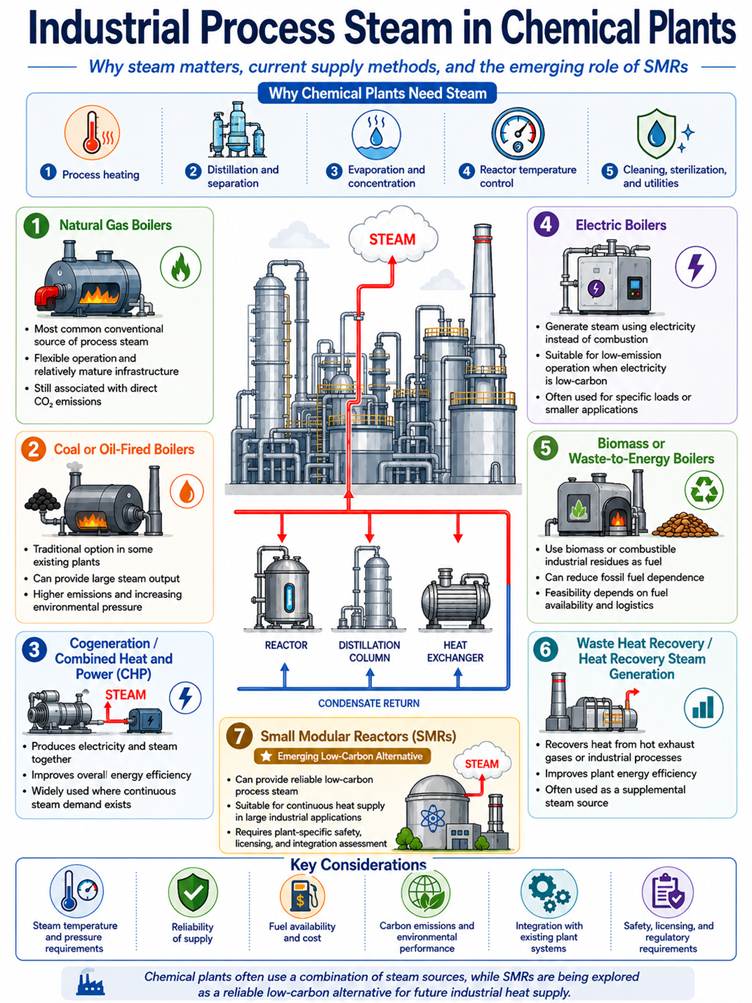
Process steam plays a central role in chemical manufacturing because it can transfer heat efficiently, maintain controlled temperatures, and be distributed through piping networks to multiple units within a plant. In a typical chemical plant, steam may be supplied to reactors, distillation columns, evaporators, dryers, heat exchangers, cleaning systems, and auxiliary services.
After steam transfers heat to the process, it condenses into water. This condensate is commonly returned to the steam generation system to improve energy efficiency, reduce water consumption, and lower operating costs. Therefore, a steam system is not only a heat supply system but also an integrated thermal cycle involving steam generation, steam distribution, heat use, condensate recovery, and water treatment.
The steam demand of chemical plants varies widely. Some processes require low- or medium-pressure steam for general heating, while others require high-temperature or high-pressure steam for more energy-intensive operations. In addition, some chemical plants operate continuously, making steam reliability a critical requirement. As a result, the selection of a steam supply method must consider not only the fuel or energy source, but also system integration, operational flexibility, safety, economics, and long-term environmental performance.
3. Present Methods for Industrial Process Steam Supply
3.1 Natural Gas Boilers
Natural gas boilers are among the most common conventional sources of industrial process steam. They are widely used because the technology is mature, operationally flexible, and supported by relatively well-developed fuel supply infrastructure in many regions. Compared with coal or oil, natural gas generally produces lower emissions of particulate matter and some air pollutants. However, it remains a fossil fuel and still produces direct carbon dioxide emissions during combustion.
The main advantage of natural gas boilers is their ability to respond relatively quickly to changes in steam demand. This makes them suitable for chemical plants with variable production loads. Nevertheless, in the context of decarbonization, natural gas boilers face an important limitation: they continue to emit CO₂ directly at the point of use. Therefore, although natural gas may serve as a transitional fuel in some settings, it does not fully eliminate carbon emissions from industrial heat supply.
3.2 Coal or Oil-Fired Boilers
Coal- and oil-fired boilers have traditionally been used in many industrial facilities, particularly where large steam output is required and fuel costs have historically been competitive. These systems can provide high thermal capacity and are capable of supporting large industrial loads.
However, coal and oil-fired boilers are associated with higher environmental burdens compared with many alternative options. Their operation can result in significant emissions of carbon dioxide, sulfur oxides, nitrogen oxides, particulate matter, and other pollutants. They may also require additional pollution control systems, ash handling, fuel storage, and environmental management measures.
As environmental regulations become stricter and carbon reduction targets become more prominent, coal and oil-fired steam systems are facing increasing pressure. In many contexts, they are being reconsidered, retrofitted, or gradually replaced by lower-emission alternatives.
3.3 Cogeneration / Combined Heat and Power
Cogeneration, also known as Combined Heat and Power (CHP), is a method that produces electricity and useful heat from the same energy source. In chemical plants, CHP can be attractive because waste heat from power generation can be recovered and used to produce process steam. This improves overall energy efficiency compared with separate production of electricity and steam.
CHP systems are particularly suitable for industrial sites with continuous demand for both electricity and steam. Examples include chemical plants, petrochemical facilities, refineries, pulp and paper mills, and other energy-intensive industries. By using fuel more efficiently, CHP can reduce total energy consumption and improve the reliability of on-site energy supply.
However, the effectiveness of CHP depends on the balance between electricity demand and heat demand. If the plant’s electricity and steam requirements do not match well, the system may become more complex to design and operate. Therefore, careful analysis of load profiles, operating schedules, fuel supply, and plant integration is necessary.
3.4 Electric Boilers
Electric boilers generate steam using electricity rather than direct combustion of fuel. Their main advantage is that they produce no direct combustion emissions at the point of use. When supplied by low-carbon electricity, such as renewable or nuclear electricity, electric boilers can become a low-emission option for producing industrial steam.
Electric boilers can also be useful for specific loads, backup applications, or smaller-scale steam requirements. They are generally simpler than combustion-based systems in terms of on-site fuel handling and flue gas management. In some industrial settings, they may support electrification strategies and help reduce direct emissions from fossil-fuel combustion.
However, the suitability of electric boilers depends strongly on electricity price, grid capacity, power availability, and the carbon intensity of the electricity supply. If the electricity is generated mainly from fossil fuels, the overall emissions benefit may be limited. In addition, large-scale electric steam production may require significant electrical infrastructure upgrades.
3.5 Biomass or Waste-to-Energy Boilers
Biomass boilers and waste-to-energy systems use biomass, agricultural residues, wood waste, or combustible industrial residues as fuel for producing heat and steam. These systems can reduce dependence on fossil fuels and may be attractive where biomass or suitable waste streams are locally available.
In some cases, biomass or waste-to-energy systems can also support waste management objectives by converting residues into useful thermal energy. However, their feasibility depends on the availability, quality, moisture content, transportation distance, storage requirements, and long-term supply reliability of the fuel.
Environmental performance also depends on the type of biomass or waste used, combustion conditions, and air pollution control systems. Although biomass is often considered lower-carbon than fossil fuels, its sustainability must be evaluated carefully, especially in relation to land use, supply chains, and lifecycle emissions.
3.6 Waste Heat Recovery / Heat Recovery Steam Generation
Waste heat recovery is one of the most important approaches for improving energy efficiency in chemical plants. Many industrial processes release heat through hot exhaust gases, furnaces, compressors, process streams, or other thermal systems. Instead of discharging this heat to the environment, waste heat recovery systems can capture it and use it to produce steam or preheat boiler feedwater.
Heat Recovery Steam Generators and heat exchangers are commonly used for this purpose. By recovering heat that would otherwise be wasted, chemical plants can reduce fuel consumption, lower operating costs, and reduce carbon emissions from existing systems.
Waste heat recovery is often considered a priority measure before adding new energy sources, because it improves the efficiency of the current plant. However, its potential depends on the temperature, quantity, and continuity of available waste heat, as well as the compatibility of the recovered heat with steam demand.
4. SMRs as a Low-Carbon Alternative for Industrial Process Steam
Small Modular Reactors (SMRs) are nuclear reactors designed to be smaller than conventional large nuclear power plants. Many SMR concepts are designed with modular construction, standardized manufacturing, enhanced safety features, and flexible deployment possibilities. While SMRs are often discussed in relation to electricity generation, they may also have potential applications in industrial heat supply, including process steam production, hydrogen production, desalination, and district heating.
In the context of chemical plants, SMRs could serve as a low-carbon heat source for producing industrial process steam. This may be especially relevant for facilities that require large amounts of continuous heat and seek to reduce dependence on fossil-fuel-fired boilers. Because nuclear energy has high energy density and can operate continuously, SMRs may offer a potential pathway for reliable low-carbon industrial heat supply.
However, SMRs should not be presented as a universal or ready-made solution for all chemical plants. Their application to industrial steam supply requires careful case-by-case assessment. Important issues include steam temperature and pressure compatibility, distance between the nuclear heat source and chemical process units, heat exchanger design, separation between nuclear and chemical systems, safety analysis, licensing, emergency planning, security, safeguards, regulatory oversight, stakeholder involvement, and economic feasibility.
The integration of SMRs into chemical plants would also require strong institutional readiness. This includes a competent regulatory framework, trained personnel, emergency preparedness, public communication, and long-term responsibilities for nuclear safety, security, radioactive waste management, and decommissioning. Therefore, SMRs should be understood as a potential low-carbon alternative that requires systematic evaluation rather than an immediate replacement for existing steam supply systems.
5. Key Considerations in Selecting a Steam Supply Method
The selection of an industrial steam supply method should be based on a comprehensive assessment rather than fuel cost alone. Several key considerations are especially important.
- First, steam temperature and pressure requirements must be matched to the needs of the chemical process. Different processes require different steam qualities. If the steam source cannot provide the required conditions, process efficiency and safety may be affected.
- Second, reliability of supply is critical. Many chemical plants depend on continuous steam availability. A sudden interruption of steam supply can disrupt production, affect product quality, or create safety concerns. Therefore, redundancy, backup systems, maintenance planning, and operational reliability must be considered.
- Third, fuel availability and cost influence long-term feasibility. Natural gas boilers may be attractive where gas infrastructure is available, while biomass systems may be suitable in regions with stable biomass supply chains. Electric boilers depend on electricity cost and grid capacity, while SMRs require nuclear infrastructure and regulatory readiness.
- Fourth, carbon emissions and environmental performance are becoming increasingly important. Steam supply decisions must consider both direct emissions from combustion and indirect emissions from electricity or fuel supply chains. Environmental assessment should also include air pollutants, water use, waste generation, and lifecycle impacts.
- Fifth, integration with existing plant systems is essential. A new steam source must be compatible with existing piping networks, heat exchangers, control systems, feedwater systems, condensate return systems, and safety systems. Poor integration can reduce efficiency and increase operational complexity.
- Sixth, safety, licensing, and regulatory requirements must be considered, particularly for advanced or nuclear-based options such as SMRs. The adoption of SMRs would require a strong legal and regulatory framework, clear safety responsibilities, emergency planning, and public confidence.
6. Conclusion
Industrial process steam is a fundamental energy carrier in chemical plants. It supports essential operations such as heating, distillation, evaporation, drying, reaction control, and heat exchange. At present, chemical plants use a range of steam supply methods, including natural gas boilers, coal or oil-fired boilers, CHP systems, electric boilers, biomass or waste-to-energy boilers, and waste heat recovery systems. Each option has advantages and limitations depending on technical requirements, fuel availability, cost, emissions, reliability, and integration with existing plant infrastructure.
As industries move toward decarbonization, the search for reliable low-carbon process heat becomes increasingly important. SMRs may offer a potential alternative for future industrial steam supply, especially for facilities with large and continuous heat demand. Nevertheless, their application requires careful assessment of technical, regulatory, economic, safety, and societal factors.
Therefore, SMRs should be viewed as an emerging low-carbon option with potential, not as a universal solution. The future of industrial process steam supply in chemical plants will likely involve a combination of methods, including efficiency improvement, waste heat recovery, electrification, low-carbon fuels, and—in selected contexts—advanced nuclear heat sources such as SMRs.
References
- International Atomic Energy Agency. (2024). Small Modular Reactors: Catalogue 2024. IAEA.
- International Atomic Energy Agency. (n.d.). Small Modular Reactors. IAEA.
- International Energy Agency. (2023). Electrification. IEA.
- International Energy Agency. (2025). Energy Efficiency 2025: Industry. IEA.
- Vanatta, M., Patel, D., Allen, T. R., & Abdulla, A. (2023). Technoeconomic analysis of small modular reactors decarbonizing industrial process heat. Joule.


ใส่ความเห็น